Engagement Archive · Battle of Zaoyang–Yichang
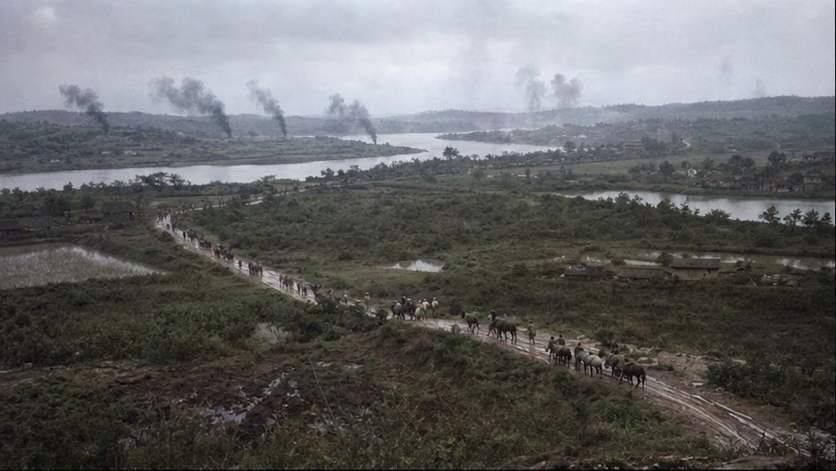
The Japanese Eleventh Army struck northern Hubei again and took Yichang for the first time: an army-group commander-in-chief died on the firing line he had requested, and the gateway by which the Yangtze entered Sichuan was lost. The general's death and the gateway's loss belonged to the same campaign.
Engagement Data
| Item | Content |
|---|---|
| Time | 1940.5.1 – late June, about two months |
| Location | The Zaoyang–Xiangyang–Yichang line in Hubei (both banks of the Xiang River) |
| Part of | Fourteen-Year War of Resistance · stalemate-phase frontal-battlefield campaign (called the "Yichang Operation" by the Japanese side) |
| Chinese side | Forces under the Fifth War Area (commander-in-chief Li Zongren) |
| Japanese side | Eleventh Army (commander Sonobe Waichiro), including the Third, Thirteenth, Thirty-Ninth, and Fortieth Divisions, among other units |
| Result | Japanese forces took Yichang for the first time on 6.12, withdrew once, and then reoccupied it; Zhang Zizhong died for his country on 5.16; the main force of the Fifth War Area was not encircled and annihilated |
Belligerents
| Item | Chinese Side | Japanese Side |
|---|---|---|
| Strength | Several dozen divisions of the Fifth War Area (Chinese war histories commonly put the total around 350,000, though the bases vary) | About 110,000–120,000 (basis in Chinese sources) |
| Firepower | Equipment varied widely among the army groups, and heavy artillery was scarce | Divisional artillery + tank units + aviation |
| Air | Essentially no air superiority | Aviation supported the operation throughout; in the later stage, Yichang was used as a forward airfield |
| Use of terrain | Relied on the Xiang River and the Tongbai Mountains–Dahong Mountains hills for step-by-step resistance | Advanced rapidly along roads and river valleys; mechanized advantages came into play on the plains and hills of northern Hubei |
Terrain and Conditions
(For the larger situation in 1940--the outbreak of war in Europe, Japan's southward advance, and its anxiety over "settling the China Incident"--see *Fourteen-Year War of Resistance · War Overview*; here only northern Hubei is treated.)
Northern Hubei: the forward line where the two sides had faced each other for two years after the Battle of Wuhan. After Wuhan fell in October 1938, the Fifth War Area withdrew to northern Hubei and southern Henan, relying on the Tongbai Mountains, the Dahong Mountains, and the Xiang River to confront the Eleventh Army stationed in Wuhan. The Battle of Suizhou–Zaoyang in 1939 and the Winter Offensive at the end of the same year were both fought on this ground: the Battle of Zaoyang–Yichang was the Japanese forces' retaliatory counterstroke against the Winter Offensive, and neither side was unfamiliar with the other's methods.
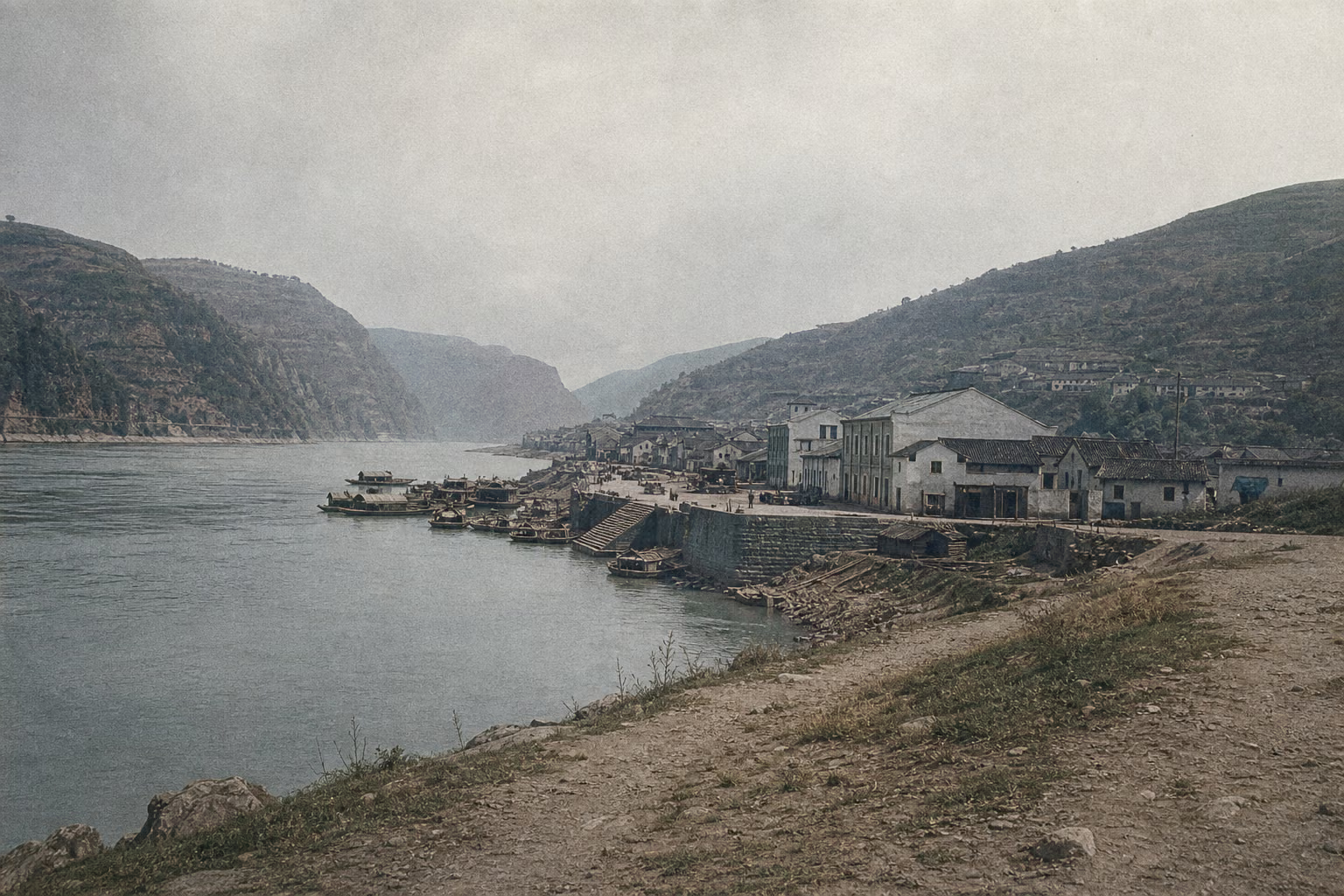
Yichang: the threshold of the Sichuan Yangtze. Yichang stood at the eastern mouth of the Three Gorges on the Yangtze, the throat between Sichuan and Hubei; supplies, personnel, and factory equipment moving upriver into Sichuan all had to transship and change vessels here. After Wuhan fell, Yichang was the most important transit port between the rear area and the front, and the downstream shield of the wartime capital Chongqing. If Yichang was lost, Chongqing would be exposed along an axis of advance up the Yangtze.
Why It Was Fought
Where the Winter Offensive had stabbed deepest, the counterstroke fell. From late 1939 to early 1940, the Fifth War Area in northern Hubei had bitten into the Eleventh Army's line of strongpoints until it bled at every point. Japanese official war history admitted that the offensive "far exceeded our expectations" and concluded from this that the greatest immediate threat in central China was Li Zongren's Fifth War Area. Beginning in April 1940, the Eleventh Army, now under a new commander--Sonobe Waichiro--assembled the Third, Thirteenth, Thirty-Ninth, and Fortieth Divisions and other units, aiming to strike the Fifth War Area's main force again and reproduce the encirclement of the Battle of Suizhou–Zaoyang the previous year.
This time, another layer of dispute appeared inside the Japanese forces: whether to seize Yichang in the west if the opportunity arose. Yichang lay at the eastern mouth of the Three Gorges, the throat between Sichuan and Hubei: after Wuhan fell, the supplies, personnel, and factory equipment entering Sichuan all transshipped and changed vessels there. It was the most important transit port between the rear area and the front, the downstream shield of the wartime capital Chongqing, and, for Japanese aviation, a forward airfield for bombing Chongqing. The logistics system argued for stopping once the gains were sufficient, since the supply line was already long enough; the activist faction ultimately prevailed (the Japanese decision-making process is based on recollections in Japanese war history; details unverified).
The Chinese deployment remained the old pattern. Suizhou–Zaoyang had already been fought, and the Winter Offensive had already been fought; the two sides knew each other's methods well. Rely on the Xiang River, the Tongbai Mountains, and the Dahong Mountains for successive resistance, avoid encirclement, then strike the enemy rear from the flank. Zhang Zizhong's 33rd Army Group was placed on the west bank of the Xiang River. Everyone prepared according to the script of the previous battle; even the Japanese original plan was to return after the fighting and not make a long occupation.
In timing, this campaign happened to straddle a turning point in the world. Ten days after it began, German forces swept across western Europe, and France was on the verge of collapse. Tokyo's anxiety over "settling the China Incident" and its appetite for a southward advance expanded together. Yichang, which in the original plan was to be "returned after occupation," would in June become a long-held position because of one Imperial General Headquarters telegram ordering that Yichang be secured; the connection between the telegram and the stimulus of the European war follows Japanese war-history evidence here.
On May 1, Japanese forces advanced north along three routes, their spearheads pointed directly at Zaoyang. The battle fought on the same ground the previous May began again.
Course of the Engagement
| Stage | Time | Key Points |
|---|---|---|
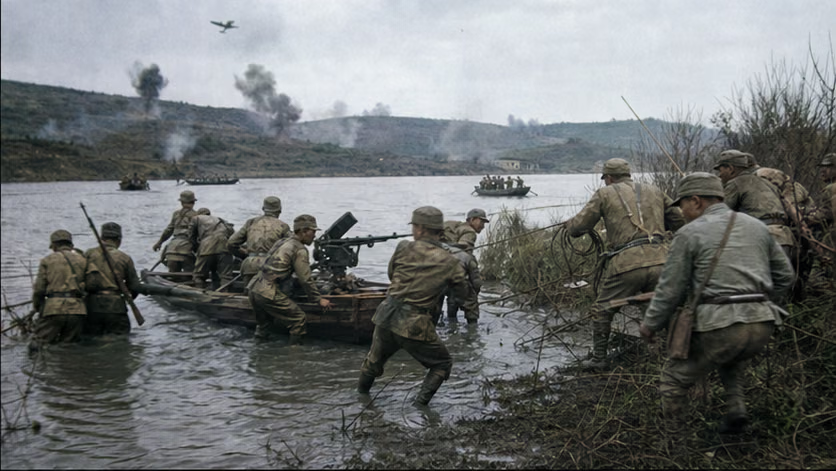
| Japanese northward attack | 5.1–5.10 | Japanese forces advanced north along three routes and took the Biyang–Tanghe line in succession; Zaoyang fell on 5.8; the Japanese encirclement around Zaoyang closed on empty ground, as the main force of the Fifth War Area had shifted out earlier |
| Chinese counterattack | 5.10–5.16 | Chinese units counterattacked, and Japanese forces withdrew south; on 5.7, Zhang Zizhong personally led a special-duty battalion and two regiments of the 74th Division, about 2,000 men in all, east across the Xiang River to intercept the enemy; around 5.14, near the Nanguadian line, he cut off the enemy force, but was then attacked from north and south by the Japanese Thirteenth and Thirty-Ninth Divisions and other units |
| Nanguadian | 5.16 | Zhang Zizhong's force was surrounded at Shilichangshan, Nanguadian, south of Yicheng, and fought hard from morning until noon; his unit suffered almost total casualties, and Zhang Zizhong, hit by several bullets, died for his country (inspection found two artillery wounds, one bayonet wound, and five bullet wounds, eight wounds in all) |
| Japanese westward advance | 5.21–6.1 | Japanese forces turned back and reoccupied Zaoyang (chronological details unverified), forced a crossing of the Xiang River on 5.31, and occupied Xiangyang on 6.1 |
| Loss of Yichang | 6.12–6.24 | Japanese forces advanced west along the Yangtze, and Yichang fell on 6.12. The Japanese side had originally planned to return after occupation, and withdrew once on 6.15–16; the Chinese 18th Army followed in and recovered it on 6.17. Stimulated by the European war, Imperial General Headquarters ordered Yichang secured; Japanese forces turned back, and by 6.24 had completely reoccupied it (the dates of withdrawal and reoccupation vary slightly among sources, unverified) |
Casualties and Losses
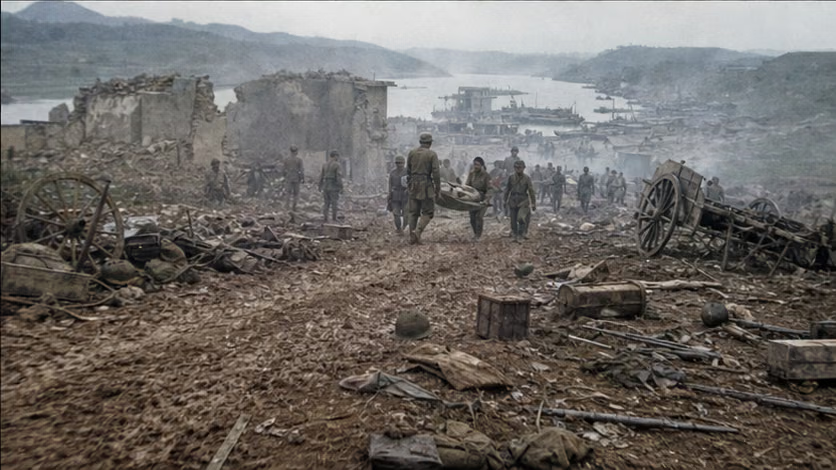
- Chinese side: about 37,000 casualties (a common basis in Chinese war histories, though accounts differ and the statistical boundary is unverified); among generals of lieutenant general rank or above who died in action, Zhang Zizhong was the highest-ranking. The eastward-crossing force of the 33rd Army Group suffered extremely heavy losses.
- Japanese side: Japanese official war history cited Eleventh Army staff statistics, self-reporting about 11,000 casualties (two internal sets of statistics differ, details unrecorded); Chinese sources also give figures of 25,000 Japanese casualties and more than 3,000 killed. The two bases differ by more than a factor of two and come from different sources.
- Whichever basis is used, Japanese forces occupied Yichang but failed to encircle and annihilate the main force of the Fifth War Area: the battle objective was only half achieved. Yichang, meanwhile, remained in Japanese hands until 1945.
Aftermath
- With Yichang lost, the gateway to the Sichuan Yangtze stood open. Japanese forces immediately built an airfield at Yichang, bringing Chongqing and the rear area within the striking radius of a forward Japanese air base. The strategic bombing that followed was directly connected to this battle (see *Bombing of Chongqing ※*).
- Zhang Zizhong's coffin reached Chongqing on 5.28, and the whole country mourned. The National Government formally commended him and posthumously promoted him to army general (the exact wording of the order for posthumous promotion to "second-class general" is unverified). Yan'an also held a memorial meeting, and Mao Zedong wrote the elegiac phrase "serve the country with utmost loyalty" (the wording of Zhu De's and Zhou Enlai's inscriptions is unverified).
- The Eleventh Army used Yichang as a long-term strongpoint, and the western Hubei front shifted west from this point on. The Battle of Western Hubei four years later, in 1943, was still fought along this same axis.
- This campaign left two symbols: the death of a general, and the loss of a gateway. The former became the most honored case among all generals who died for the country in the War of Resistance; the latter became the beginning of the most grueling years in the air-defense history of the rear area.
Accounts of Those Present
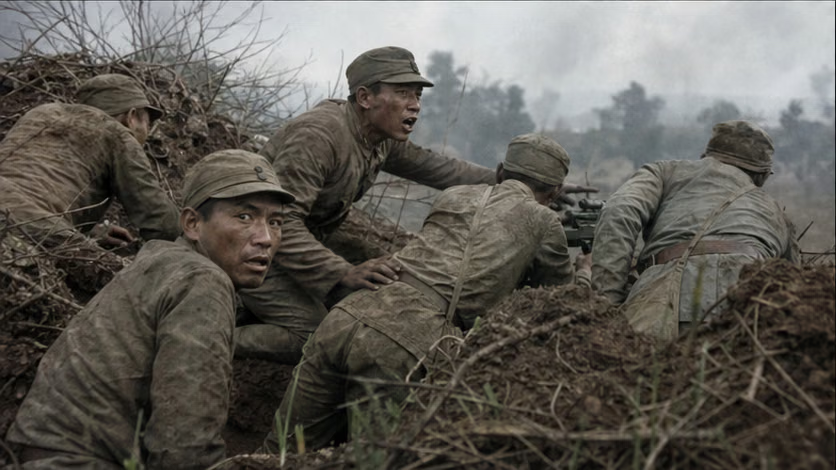
- Two final letters, no family letter: Zhang Zizhong left a farewell letter whenever he went into battle, and burned it if he returned alive. Before crossing the river, he left two letters: one to deputy commander-in-chief Feng Zhi'an, saying, "...toward our final objective (death), advance north. Whether we do well or badly, we must seek comfort for our conscience." Another to the commanders said, "The country has reached such a point that, except for us dying for it, there is no other way... the resolve to die for the country and the nation will not change in the slightest until the sea clears and the stones decay!" He left not a single word for his family (the wording differs slightly among transmitted versions of the two letters, and the original wording is unverified).
- Respected by enemy and comrades alike, in the same frame: On the night of 5.16, after the Japanese 39th Division confirmed the body's identity, it wiped him with alcohol, placed him in a coffin, and gave him a shallow burial on the slope behind the Chen family ancestral hall, erecting before the grave a wooden marker reading "Tomb of the Chinese General Zhang Zizhong"; the troops formed ranks, removed their caps, and gave a marching salute. The Japanese military radio station in Hankou broadcast news of his death that day in a solemn tone. That same night, Huang Weigang, commander of the 38th Division, led a suicide squad in a night attack on Nanguadian and recovered the body after fierce fighting. On 5.18, after Nanguadian and Fangjiaji were recovered, the body was dressed in a general's formal uniform and reburied in a nanmu coffin. The killers buried him with respect; the dead man's subordinates fought through the night to take his body back. The respect shown by both sides to the same general happened in the same night (details of the Japanese burial come mostly from Chinese records and memoirs; corresponding Japanese war-history records are unverified).
- No one on the Yichang riverbank hid: On 5.21, as the coffin was transported through Yichang, 100,000 soldiers and civilians gathered to escort it to the riverbank. Japanese aircraft circled overhead three times, but not one mourner hid or fled (the number of people and aircraft passes come from Chinese accounts and are unverified).
- The man under a burden of guilt: When the Beiping incident occurred in 1937, Zhang Zizhong was ordered to remain in Beiping to negotiate, and public opinion cursed him as a "traitor." After that, he fought to be first in almost every battle and left farewell letters before almost every battle. After he died for his country, the public opinion that had once cursed him repaid him with the highest form of vindication.
- The first burial place at Shilichangshan: The 38th Division later erected a small stone stele at the shallow burial place left by the Japanese forces, inscribed "First burial place of General Zhang, 1940.5.16." It was discovered by farmers in a field in 1952 and still exists today (the present holding location of the stele is unverified).
The Ground
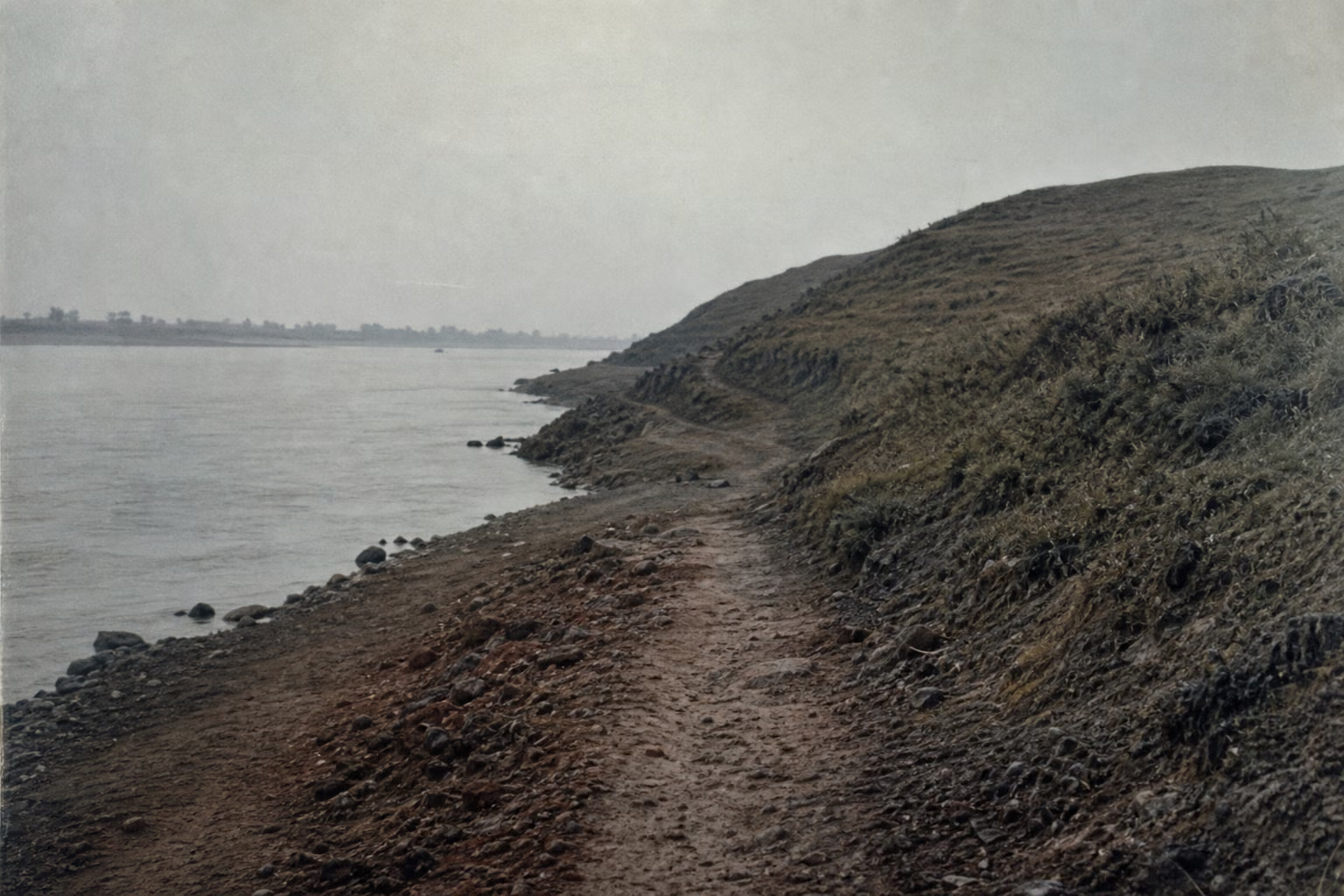
- One river fixed the pattern: the Xiang River (Han River) cut diagonally across the battlefield from northwest to southeast. East of the river lay the hills and plains toward Zaoyang; west of the river lay Xiangyang and Yichang. The whole field's gates of life and death were at the crossings: Zhang Zizhong crossed east to go to his death; Japanese forces crossed west to break the gate.
- Shilichangshan at Nanguadian: low mountains and a long ridge near the riverbank, only a few li across. The final position of an army-group commander-in-chief was reduced to this scale: two regiments and one battalion against the pincer attack of two divisions.
- Yichang: a city at the mouth of Xiling Gorge, with the Jianghan Plain downstream and the Three Gorges upstream. Its loss was not the gain or loss of a single city; it meant that the direction of a river had changed.
- Time gap: from Zhang Zizhong's death for the country (5.16) to the fall of Yichang (6.12) was less than a month; the straight-line distance between the two places was more than one hundred kilometers. The two stages of the campaign were fought continuously in the same northern Hubei landscape.
How Each Side Records It
- Chinese side: the core memory of the Battle of Zaoyang–Yichang is almost Zhang Zizhong himself: the state funeral, posthumous promotion, the Meihuashan cemetery, "Zhang Zizhong Roads" in Beibei and many other places, and the memorial meeting in Yan'an. Militarily, it is recorded as a defeat (Yichang lost, the gateway to the Sichuan Yangtze thrown open); spiritually, it is recorded as a monument. In 1982, the Ministry of Civil Affairs posthumously recognized Zhang Zizhong as a revolutionary martyr (year unverified).
- Japanese side: official war history calls it the "Yichang Operation," with its narrative center on the failed attempt to encircle and annihilate the main force of the Fifth War Area and on the repeated reversals in the decision to occupy Yichang. On Zhang Zizhong's death, Japanese battlefield records and wartime broadcasts both referred to him in honorific terms; phrases such as "peerless brave general" and "died heroically in battle" appear in later quotations (the original broadcast script and war-history text are unverified).
- Remembered on both sides of the Taiwan Strait: Taiwanese and mainland Chinese war histories differ very little in their narration of this battle. Zhang Zizhong is one of the few figures whose commemorative rank is almost the same on both sides.
Disputes and Sensitivities
- Two bases for Japanese casualties: the Japanese side's self-reported figure of about 11,000 (with two internal statistical sets not matching each other) coexists with the Chinese-source figure of 25,000, a gap of more than a factor of two.
- The charge of "traitor" and the narrative of dying for the country: how to judge the period in 1937 when he remained in Beiping is still written in different ways. The two frames of "enduring humiliation" and "harming the country" both remain in use. The charge had genuinely existed in public memory before he died for the country.
- The problem of single-source evidence for the burial honors: details such as Japanese forces washing the body, erecting a marker, saluting, broadcasting by radio, and even "ordering bombing to stop lest his body be damaged" mostly come from Chinese accounts and late-life memoirs, and their rhetorical coloring needs to be sifted. The marker text itself is corroborated by physical evidence and early records, but the exact wording varies by version.
- Yichang "taken, abandoned again, then reoccupied": first fall on 6.12, withdrawal on 6.15–16, Chinese recovery on 6.17, Japanese reoccupation on 6.24. The dates of each node differ by one or two days in different war histories, and the Japanese decision chain for withdrawing and then returning (the connection between the Imperial General Headquarters telegram and the stimulus of the European war) should be checked against Japanese war history.
Sources and Open Questions
Known main sources:
- Li Zongren's memoirs (the perspective of the Fifth War Area commander-in-chief, with first-hand account of the decision to intercept at Nanguadian)
- Relevant volumes of *Senshi Sosho* by the War History Office of Japan's Defense Agency (Japanese official history, including Eleventh Army staff casualty statistics)
- Wang Shuzeng, *War of Resistance Against Japan*, volume 2 (standard narrative; quotations require checking back to original sources)
- Zhang Zizhong General Memorial Hall (Yicheng, Hubei), and the holdings and exhibitions of the Zhang Zizhong Martyrs' Cemetery at Meihuashan, Beibei, Chongqing
Open questions:
1. The original text of the order posthumously promoting Zhang Zizhong: whether it said "posthumously promoted to army second-class general" or "posthumously granted army general," and the date and order number. 2. The original wording of the two final letters (the letter to Feng Zhi'an and the letter to the commanders), given differences among transmitted versions. 3. The Japanese marker text: the two versions, "Tomb of the Chinese General Zhang Zizhong" and "Spirit of Commander-in-Chief Zhang Zizhong," both exist; which should be treated as authoritative? 4. Cross-corroboration in original Chinese and Japanese records for the Japanese burial, salute, Hankou radio broadcast, and "halting bombing to protect the body." 5. The basis for Chinese participating strength (the figure of around 350,000) and the statistical boundary of 37,000 casualties. 6. The specific figures and bases of the two Eleventh Army staff casualty statistics on the Japanese side. 7. The accurate dates of each node in Yichang's June fall--withdrawal--recovery--reoccupation (6.12 / 6.15–16 / 6.17 / 6.24). 8. The original source for the number of people escorting the coffin through Yichang ("100,000") and the number of Japanese aircraft passes; the sequence of the 5.21 and 5.28 movements. 9. Yan'an memorial-meeting inscriptions: beyond Mao Zedong's "serve the country with utmost loyalty," the original wording of inscriptions by Zhu De and Zhou Enlai. 10. The year and document by which the Ministry of Civil Affairs recognized Zhang Zizhong as a revolutionary martyr in 1982. 11. Details of the decision-making dispute inside the Japanese Eleventh Army over whether to attack Yichang (Japanese original records on Sonobe Waichiro and his staff group).
All images on this site are AI-generated depictions. They are not historical photographs, not primary sources, and do not depict any real individual.