Engagement Archive · Siege of Qinyuan
Japanese forces occupied Qinyuan county seat, and all 80,000 people in the county, under Party organization, collectively emptied it out: for two and a half years, the occupying forces held an empty city with no people, no grain, and no secure water supply, until in the end they withdrew on their own. A battle won without fighting a major battle: the most complete demonstration of the four words "people's war."
Engagement Data
| Item | Content |
|---|---|
| Belongs To | Fourteen-Year War of Resistance · Battlefields Behind Enemy Lines (for the broader situation, see "Battlefields Behind Enemy Lines · Theater Overview") |
| Time | 1942.11 – 1945.4.11 (Japanese forces withdrew), about two and a half years |
| Location | Qinyuan, Shanxi (the interior of the Taiyue area) |
| Besieging Side | Taiyue Military District forces, Qinyuan county Party-government organs, and the county's entire population (the "Qinyuan Siege Command") |
| Besieged Side | Elements of the Japanese 69th Division and puppet troops stationed in Qinyuan city and strongpoints along the transport lines (several hundred to more than a thousand troops; rotation bases vary by account) |
| Result | In 1945.4, Japanese forces abandoned the city and withdrew; in all Qinyuan there was not a single "maintenance association" -- the name "the county without a maintenance association" (wording unverified) |
Belligerents
| Item | Besieging Side | Besieged Side |
|---|---|---|
| Strength | Small regular-army detachments + militia + the county's entire population | Strongpoint garrisons, superior in firepower but with nowhere to use it |
| Tactics | Emptying houses and clearing the fields; filling wells and warning of poisoning (the question of harm from pollution to one's own side is unverified); blocking roads with mines; harassment by snipers; seizure of enemy transport | Strongpoints + road lines; raids out of the strongpoints met mines |
Terrain and Conditions
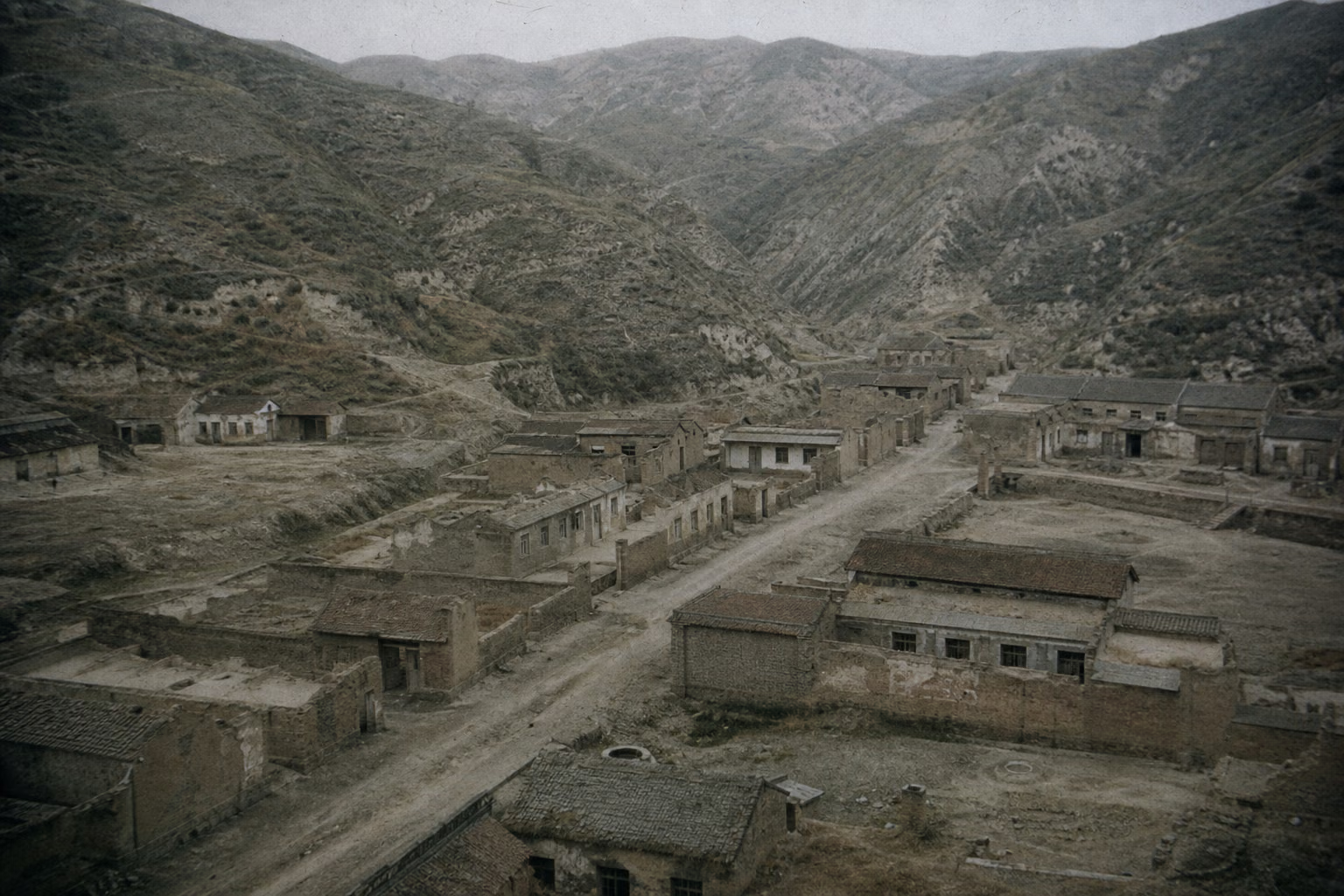
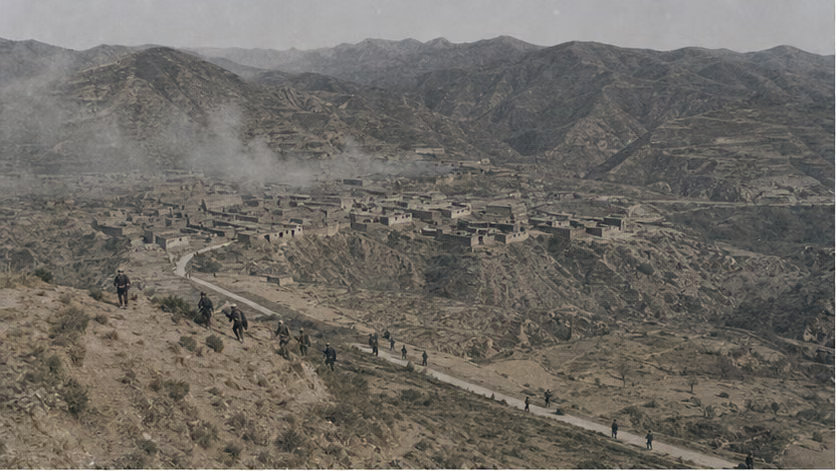
A mountain county in the interior of the Taiyue area. In 1942, the Japanese "mountain anti-Communist suppression" campaign tried to drive a nail into the heart of the base area. Qinyuan's response was not to defend the city but to move house: more than 80,000 people from the county seat and the areas along the roads (figures vary by account) were transferred as a whole into the mountain gullies, turning "occupation" into "occupying emptiness."
Why It Was Fought
The fighting in Zhejiang and Jiangxi ended by late August. Japanese forces had opened the railway, destroyed the airfields, and then, according to plan, pulled back again; the front-line battlefield returned to its old stalemate. In that same year, 1942, behind Japanese lines in North China there was no word called "campaign": mopping-up operations, nibbling advances, blockade. The fighting took place at the scale of villages and mountain gullies, and this was the hardest year for the base areas.
The Taiyue area lay in the interior of Shanxi, and Qinyuan was a mountain county at its heart. In repeated Japanese mopping-up operations, forces came and went, went and came, yet the base area could never be swept away. After the autumn 1942 mopping-up operation, Japanese forces changed their method: elements of the 69th Division remained in Qinyuan county seat and the strongpoints along the transport lines, and did not leave. What they wanted was not the city itself, but a model that could be replicated: drive a nail into the heart of the base area, build strongpoints, set up maintenance associations, connect the roads, and show all North China how to turn mountain country into a public-order zone.
The Taiyue area's countermeasure was to overturn the problem itself. The city could not be held, and a fortified assault could not be afforded; then make the city impossible to "govern," and turn the model into a negative example. More than 80,000 people from the county seat and along the roads (figures vary by account) moved as a whole into the mountain gullies. People, grain, livestock, millstones, and water buckets all went; wells were filled in. Emptying houses and clearing the fields was taken to its limit, turning "occupation" into "occupying emptiness." For the Japanese model to hold, there had to be people in the city to govern, grain to requisition, and associations to maintain it; the people of Qinyuan moved away all three.
In 1942.11, Japanese forces occupied Qinyuan city, and the siege command was immediately established. Both sides treated this small city as a proving ground for principles: one side tested whether occupation could be managed, the other whether occupation could be starved into collapse. That test lasted two and a half years.
Course of the Engagement
| Stage | Key Points |
|---|---|
| The Great Move, 1942.11 | Emptying houses and clearing the fields: people, grain, livestock, millstones, and water buckets all gone; wells filled in -- leaving the occupying forces a "stone city" |
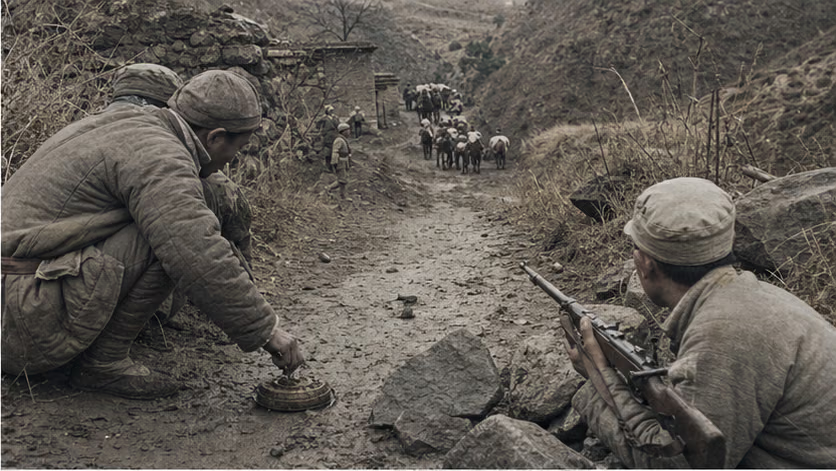
| Siege as Normal Condition, 1943–44 | The siege command divided the area and imposed a blockade: mine networks sealed the roads ("den-ending mines" and "chain mines" as militia tactics); sniper teams harassed day and night; transport lines were seized -- strongpoint supply still had to move under armed escort and was often ambushed |
| "Grain Seizure and Counter-Seizure" | Japanese forces came out of the city to seize the harvest; militia farming-protection teams covered rushed planting and rushed harvesting -- the agricultural calendar became the war calendar |
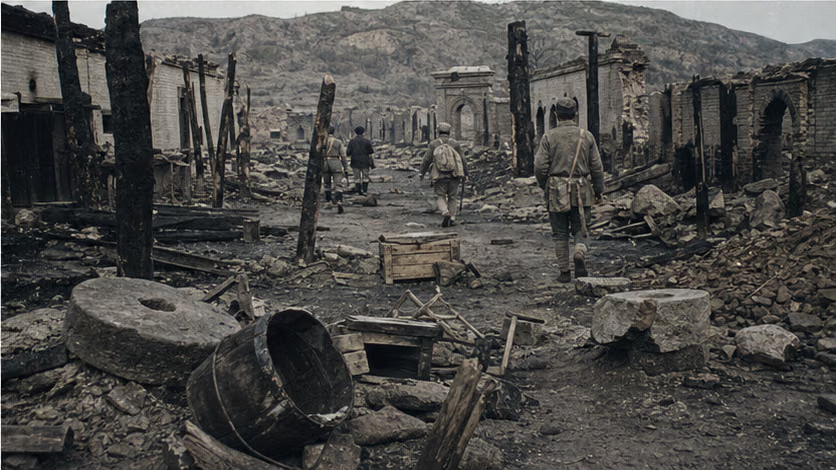
| Withdrawal, 1945.4.11 | Unable to sustain the drain, Japanese forces burned the strongpoints and withdrew; Qinyuan was recovered |
Casualties and Losses
- Civilians: deaths from cold, hunger, disease, and attacks during two and a half years of life in the mountain gullies (no complete statistics -- write explicitly "no statistics" ※); what the whole county paid was life itself.
- Japanese-puppet side: several thousand casualties in total (Chinese-side figures vary by account); the more substantive loss was the collapse of the model for turning mountain country into a public-order zone.
- Casualties among besieging-side forces were relatively light (figures vary by account).
Aftermath
- The Yan'an *Jiefang Daily* editorial "Salute to the Soldiers and People of Qinyuan" (1944.1, "heroic people, heroic city" -- editorial phrase unverified) -- it was already held up as an example during the war.
- "Siege warfare" entered the lexicon of tactics behind enemy lines: without fortified assault and without decisive battle, social organization made occupation unprofitable -- the cost science of occupation is this article's contribution to military studies.
Accounts of Those Present
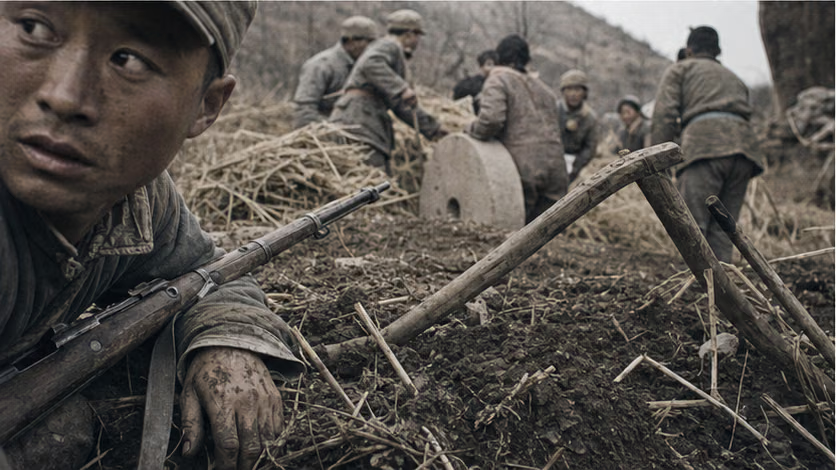
- The millstones that were carried away: during the countywide transfer, even the stone mills were lifted and carried off, so the occupying forces could not even grind flour; the clearing-fields list of "smash what cannot be taken away" (oral-history material; source level unverified).
- The county government in the mountain gullies: for two and a half years, the county government, schools, and cooperatives operated as usual in cave dwellings in the gullies -- the occupied county never stopped administering itself, the organizational base that made "siege" possible.
- The guns of the farming-protection teams: plowing while keeping watch, finishing the wheat harvest before Japanese forces could come out of the city -- farm work and combat on the same timetable.
The Ground
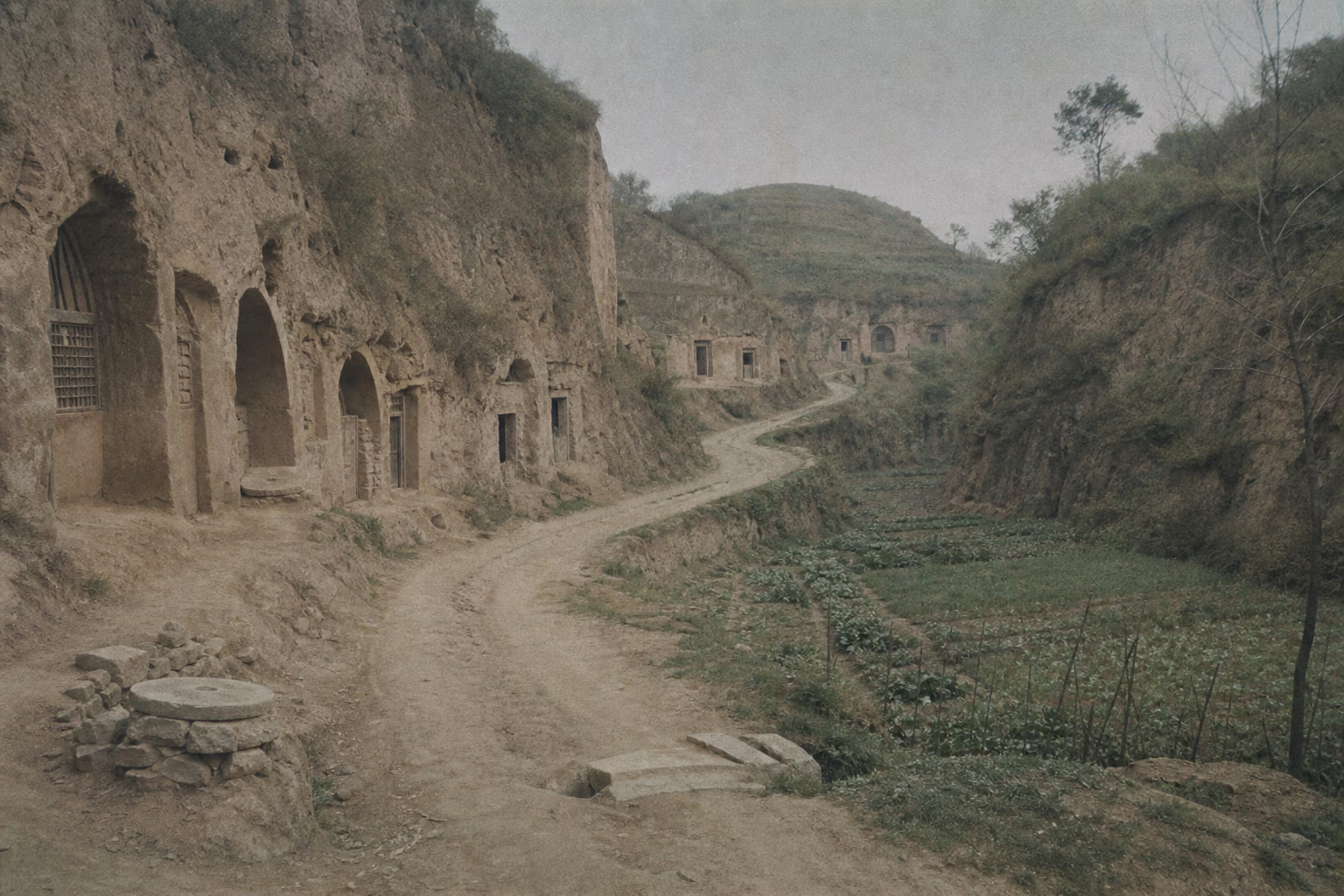
- "Empty city" as weapon: the occupiers trapped inside the space they themselves occupied -- a map where every resource point has vanished, and the occupying side feels suffocated.
- Mine-blockade network: the density of booby traps on roads, wells, and thresholds made "leaving the strongpoint" itself a battle.
- Mountain-gully society: a concealed settlement network of cave-dwelling clusters, fields, and sentry posts; the occupying forces could see the mountains but not the county.
How Each Side Records It
- Chinese side: canonized as a classic of "people's war" (editorial-level honor); contemporary Qinyuan treats the "siege" as a core memory of county history.
- Japanese side: its war histories give Qinyuan little space (technical records of contraction along the strongpoint lines, unverified) -- for a battle lost to organizational capacity, military history often has nowhere to begin writing.
Disputes and Sensitivities
- The scale of the civilian cost (deaths from cold, hunger, and disease) has no statistics -- do not cover it over with a victory narrative.
- The dispute over harm to one's own side from clearing-field measures such as the handling of wells (this claim unverified).
Sources and Open Questions
Sources: *Historical Materials of the Taiyue Revolutionary Base Area*; original 1944 *Jiefang Daily* editorial (literature platforms); Qinyuan county gazetteer.
Open questions: number of people transferred; Japanese-puppet casualty figures; original text of the editorial; composition of the siege command; records of civilian casualties.
All images on this site are AI-generated depictions. They are not historical photographs, not primary sources, and do not depict any real individual.