Engagement Archive · Retreat Through the Savage Mountains (※)
Once Lashio was lost, the road home for the one hundred thousand men of the Expeditionary Force was gone: tens of thousands under Du Yuming's command were ordered to cross the primeval rain forest of the Hukawng Valley and return to China, and in the rainy season, among leeches, miasma, and hunger, more men died in the forest over two or three months than were killed in the whole Burma campaign. This was the quietest and most grievous passage on Whence We Came: the enemy scarcely fired a shot.
Engagement Data
| Item | Content |
|---|---|
| Part of | Fourteen-Year War of Resistance · Yunnan–Burma Theater (for the overall picture, see *Yunnan–Burma Theater · Overview*) |
| Time | 1942.5 – 8 (units emerged from the forest at different times) |
| Location | Hukawng Valley in northern Burma ("Savage Mountains," an uninhabited belt in the Kachin hills) — Shinbwiyang — Daluo — Putao — western Yunnan / India |
| Retreating side | Units of the Expeditionary Force's First Route: Fifth Army headquarters and the New 22nd Division, 96th Division, remnants of the 200th Division, and others (Du Yuming led the main force into the Savage Mountains); New 38th Division (Sun Liren) disobeyed orders and turned toward India |
| Harm-causing side | Environment: rainy season, malaria, relapsing fever, leeches, poisonous insects, hunger; Japanese pursuit reached only the margins (limited military contact) |
| Result | Units entering the mountains lost between one third and two thirds of their strength (see the casualties section for each unit's statistical basis); the New 38th Division reached India intact |
Belligerents
| Item | Retreating Units | Environment |
|---|---|---|
| Condition | Ammunition and transport destroyed first (ordered to burn vehicles and destroy artillery -- a mechanized army entered the forest on foot), with only several days of grain and fodder | Rainy season with no roads, river-valley miasma and disease, and supply airdrops too small to meet the need |
| Decision | Obey orders and return to China (Du Yuming) vs. disobey orders and go to India (Sun Liren) -- two routes, two outcomes, the core contrast of this article | — |
Terrain and Conditions
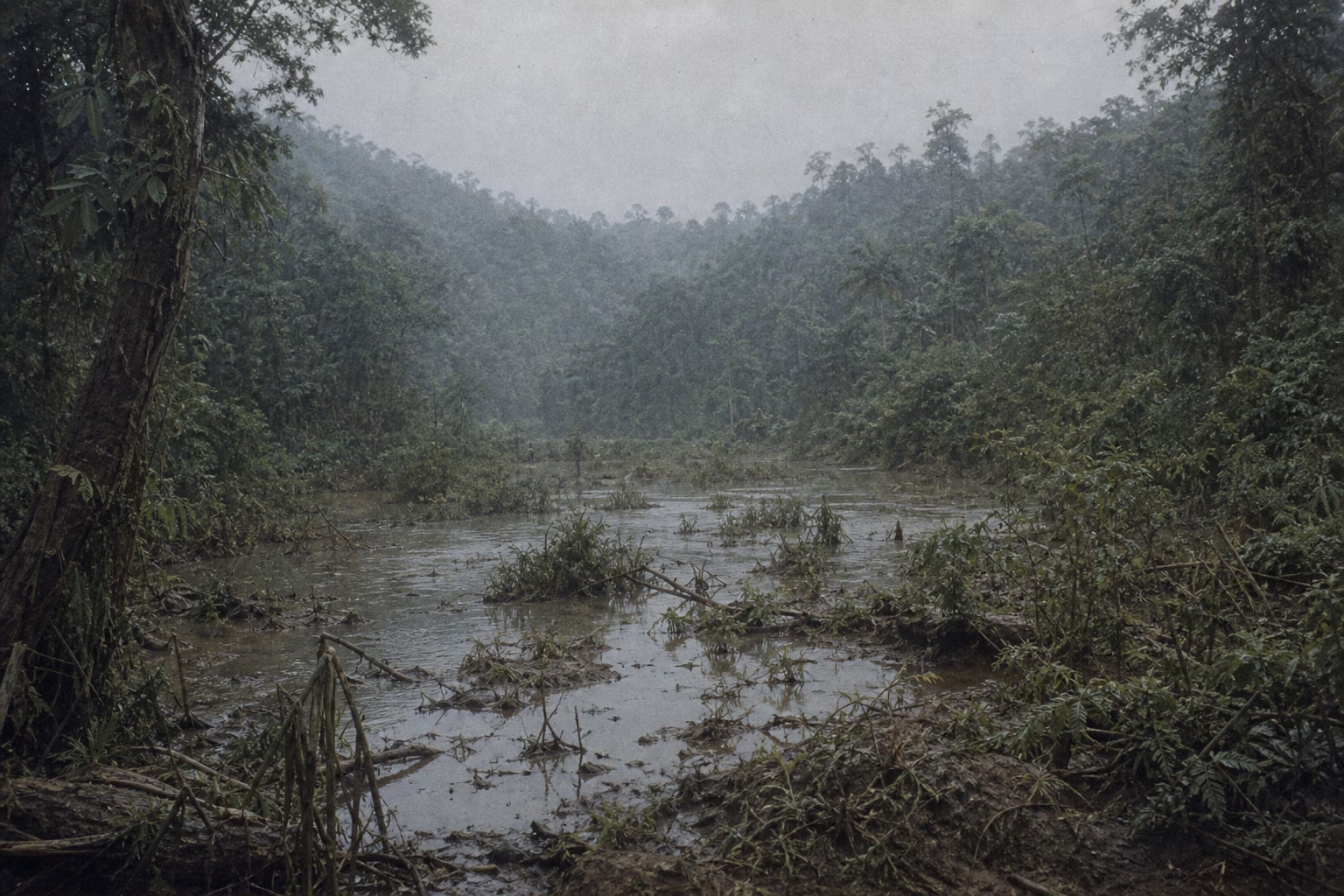
The Hukawng Valley: in Burmese, "the place where devils live" (meaning unverified), primeval rain forest in the Kachin hills, a river valley that turned into a waterlogged country during the rains. In 1942.5, Lashio and Myitkyina fell one after another, and the route home was cut through the waist. On the map, only this uninhabited belt remained blank: because no one could pass through it, there was no enemy there. That was the logic behind choosing it.
Why It Was Fought
The Battle of Mandalay miscarried in April: British forces resolved to abandon Burma and preserve India, withdrawing west on their own, while the Japanese 56th Division's fast column on the eastern route drove straight along the road into Lashio. On April 29, Lashio fell, and the throat of the road home was severed; on May 8, Myitkyina also fell, and the northern gate closed as well. When the Expeditionary Force looked up at the map, only the uninhabited belt of the Hukawng Valley was still blank. Blank meant there was no enemy there; no one weighed the other meaning of blank -- there was also no road, no village, and no food (whether this level entered the decision-making record at the time is unverified).
Two routes lay on the table, and two orders also arrived. Stilwell wanted the troops to withdraw west to India with him; he himself set out first on foot with a party of more than one hundred people and walked all the way to Imphal (details of his movements unverified). Chongqing's order was the opposite: withdraw back into China. Fifth Army commander Du Yuming radioed Chongqing for instructions, and after several rounds of cables, the order to return to China did not change (the exchanged cables are unverified). The resolve finally fell into one specific order: burn the vehicles and artillery, and enter the forest on foot. China's first mechanized army had to burn itself down into infantry before it could enter that mountain.
Material conditions welded both ends of this order shut. Going to India meant handing tens of thousands of men over to the British to feed, which Chongqing did not want; returning by road meant Japanese tanks on the road. Of the account in the forest, only half could be calculated at the time: only several days of food and fodder, no grain to be collected from northern Burmese villages before the rains, pack animals unable to carry heavy equipment, and sick and wounded men impossible to evacuate to the rear. The other half that could not be calculated was the rainy season: the rains would arrive in late May, while the crossing would be counted in months. Those entering the forest did not even know that two months later an American aircraft would find the columns in the forest. Before airdrops began, the word "rescue" appeared in no plan.
The opposing view was on the table, and someone acted on it. Sun Liren, commander of the New 38th Division, had been ordered to cover the whole army's rear; after weighing what entering the forest meant, he disobeyed orders and led his entire division along the route of the British westward withdrawal, reaching India at the end of May with his formation intact (details of the disobedience are unverified). The same rain forest, two routes and two ways of walking: the gulf in cost would not be calculable until the day the troops emerged from the forest. No surviving record has been found of whether there was dissent inside the Fifth Army over entering the forest (unverified).
In mid-May, north of Mandalay, tanks and artillery pieces were set alight one after another, and the infantry columns entered the mountains.
Course of the Retreat
| Phase | Key Points |
|---|---|
| Burn equipment and enter the forest, mid-May | North of Mandalay, vehicles were abandoned and artillery burned (mechanized equipment destroyed by one's own hand -- accounts of soldiers watching tanks burn are at the recollection level); routes divided into the mountains |
| Rainy season seals the valleys, late May–7 | The rainy season arrived; rivers rose and roads broke; after food ran out, men ate banana pith, monkeys, snakes, and belts; the wounded and sick died as soon as they fell behind; bones piled along the route became "road signs" (a common image in survivors' recollections) |
| Airdrop rescue, 6–7 | After U.S. aircraft found the columns, food and medicine were airdropped (the discovery process and airdrop volume are unverified) -- the turning point for survival as organized formations |
| Emerging from the forest, 7–8 | Units successively reached the line of Shinbwiyang and Putao, then turned toward India or back to Yunnan; the New 38th Division had already reached India intact at the end of May (control group) |
| Death of Dai Anlan, 5.26 | During the 200th Division's breakout, division commander Dai Anlan was badly wounded and died at Maobang village; his body was carried in relays by officers and soldiers back toward the national border (see the firsthand details in the overview) |
Casualties and Losses ※
- The Fifth Army suffered about 7,300 combat casualties, while about 14,700 died during the retreat (common statistical bases vary: combined count for army headquarters, the New 22nd Division, and the 96th Division -- deaths from sickness and hunger were twice the battle deaths, with details by unit unrecorded); almost no women soldiers who entered the mountains survived (Liu Guiying is a famous survivor -- oral-history level).
- First expedition of the whole Expeditionary Force: about one hundred thousand went abroad, and about forty thousand returned (the distinction among killed, wounded, died of sickness, and missing is listed side by side and remains unverified).
- The New 38th Division reached India with its formation intact and equipment complete -- the starting point from which the British side moved from suspicion to respect during training (contrast).
- ※ The great majority of the deaths recorded in this article have no grave and no name -- both "no statistics" and "nameless" are written plainly; from 2011 onward, the remains in the Hukawng Valley have been the subject of civilian search and reburial efforts (veterans' remains return-to-China project, unverified).
Aftermath
- The Savage Mountains became a negative legacy and psychological wound in national-defense decision-making. In the 1943 counteroffensive, the Chinese Army in India fought back along the same valley ("fighting back from the place of burial": the first battlefield of the northern Burma counteroffensive was precisely the Savage Mountains, a closed spatial loop of revenge, cross-reference *North Burma Counteroffensive*).
- Du Yuming returned to China because of illness and was forgiven, while Sun Liren became famous through disobedience -- the fork in the two men's later military paths and historical evaluations (cross-article biographical line: Du's next stop was Huaihai, Sun's ending was house arrest in Taiwan -- two strokes cross-reference each other, each marked by level).
- "Savage Mountains" entered the vocabulary of national memory as a synonym for a march through extremity (one note on contemporary retellings such as *My Chief and My Regiment*).
Accounts of Those Present
- The tankers who burned their tanks: soldiers of a mechanized army setting fire by hand to their own vehicles -- China's most expensive army at the time first burned away its own identity before entering the forest.
- Liu Guiying's feet: a woman soldier who walked out of the Savage Mountains; in old age, what she repeatedly recounted was the order in which her companions fell one by one (oral-history level) -- the typical structure of survivor narrative: she remembered every person who did not walk out.
- Dai Anlan's stretcher: the general's body completed on a stretcher the road he had not finished; when it passed a village, villagers burned incense and knelt to receive it (records along the route back to China are unverified) -- the body's road home became a moving state funeral.
- Belts and banana pith: the material list of a hunger diet (common in recollection-level accounts) -- plain realism is enough; no embellishment is needed.
- Nameless bones: later travelers used bones as road signs -- the dead pointed the living toward the road, the heaviest image in this article.
The Ground
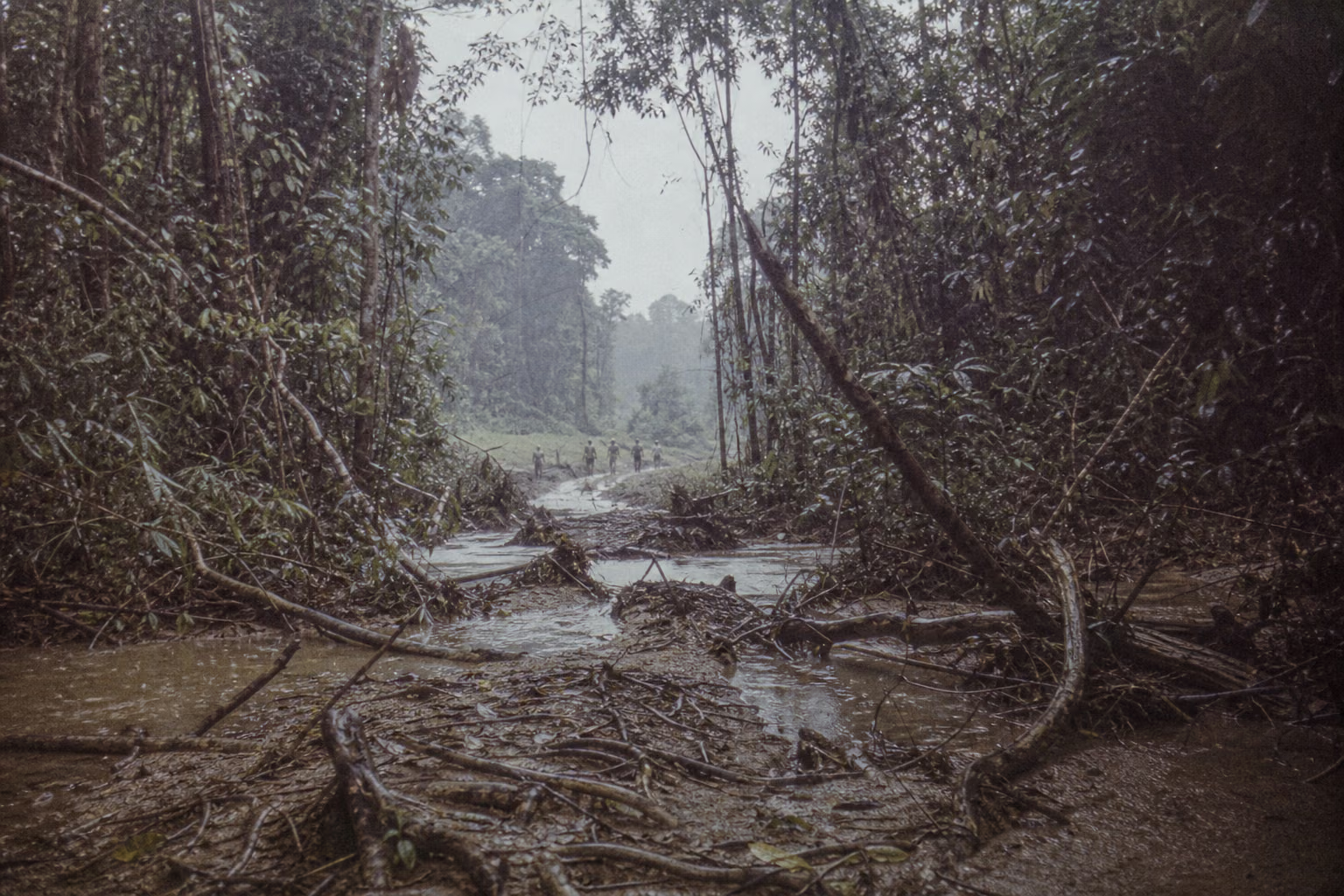
- The space of an enemy without an enemy: rain, rivers, forest, miasma -- the environment as the only "enemy" in a marching survival space, cross-referenced with the grasslands of the Long March.
- The entropy of the column: formations dissolved day by day in the forest -- falling behind, losing contact, and dispersing on one's own constituted the process by which organization collapsed.
- Airdrop points: the only nodes of hope -- open ground, signals, struggle, and order.
- Comparative route map: the Savage Mountains (road of death) and the New 38th Division's road to India (road of survival) placed on the same map -- one map tells the whole matter of "choice."
How Each Side Records It
- Chinese side: long avoided (a defeated retreat and deaths outside combat), then entered public narrative as memory of the Expeditionary Force warmed after the 1980s; survivors' oral accounts are the main historical source.
- Japanese side: there is no chapter for this in its war history -- a disaster in which the opponent was not present; Japanese forces record only pursuit up to a certain line (this claim is unverified).
- American and British sides: Stilwell walked out of Burma in the same period ("we got a hell of a beating" famous remark ✓ source unverified) -- the Allied version of the retreat narrative placed beside the Chinese version.
Disputes and Sensitivities
- Decision-making responsibility for the order to return to China (the distinction between Chongqing and Du Yuming levels) and the evaluation of Sun Liren's disobedience -- the two views are listed side by side, without choosing one.
- There are multiple statistical bases for the composition of deaths (combat / sickness and hunger / missing).
- Large-scale non-combat deaths stand alongside Nanjing and *Counter-"Mopping-Up" Operations*.
Sources and Open Questions
Sources: Du Yuming, *A Brief Account of the Chinese Expeditionary Force's Operations Against Japan in Burma*; Sun Kegang, *Record of Pacifying the Bandits in Burma*; collected oral accounts by Liu Guiying and other survivors; the Stilwell papers; Ge Shuya's field research; the pursuit sections in the Japanese *Operations to Capture Burma*.
Open questions: detailed losses by unit; the course of airdrop rescue; records of Dai Anlan's road home; source of Stilwell's remark; the remains reburial project; the meaning of Hukawng Valley; exchanged cables between Chongqing's order to return to China and Stilwell's order to withdraw to India; text and timing of the equipment-burning order; estimates before entering the forest of the rainy season and the route; the process by which U.S. aircraft found the columns and the airdrop decision was made; the course of Sun Liren's disobedience and subsequent handling; whether there was dissent inside the Fifth Army over entering the forest; period maps and reconnaissance materials for northern Burma.
All images on this site are AI-generated depictions. They are not historical photographs, not primary sources, and do not depict any real individual.