Engagement Archive · January 28 Incident (Battle of Shanghai, 1932)
Less than half a year after the Northeast had been lost, Japanese forces again made trouble in Shanghai; the Nineteenth Route Army met them where they came, the Fifth Army arrived to fight beside it, and thirty-four days turned into a grinding seesaw - ending with a ceasefire agreement that tied the hands of Chinese troops in Shanghai and laid the unfavorable ground for the Battle of Shanghai (1937) five years later.
Engagement Data
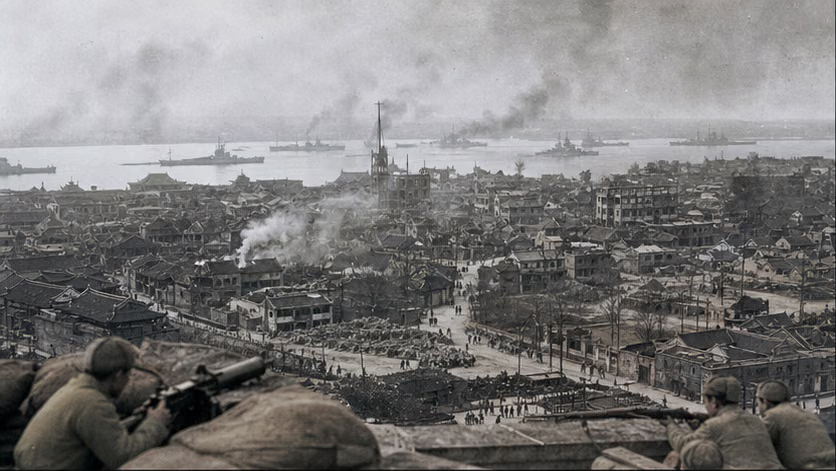
| Item | Details |
|---|---|
| Time | 1932.1.28 night - 3.3 ceasefire; 5.5 signing of the Shanghai Ceasefire Agreement |
| Place | The line through Zhabei, Jiangwan, Miaohang, and Dachang in Shanghai, as well as Wusong and Liuhe |
| Part of | Fourteen-Year War of Resistance · phase of local resistance (called the "First Shanghai Incident" by the Japanese side) |
| Chinese side | Nineteenth Route Army (commander-in-chief Jiang Guangnai, army commander Cai Tingkai), over 30,000 men; Fifth Army (army commander Zhang Zhizhong), about 20,000 reinforcements |
| Japanese side | Shanghai Expeditionary Army and others; command changed hands four times in succession (Koichi Shiozawa -> Kichisaburo Nomura -> Kenkichi Ueda -> Yoshinori Shirakawa), with reinforcements bringing strength to about 70,000 |
| Result | After Japanese forces landed at Liuhe on 3.1 and outflanked the defenders, the defending troops withdrew to a second defensive line; the ceasefire agreement signed on 5.5 restricted Chinese troop deployment in Shanghai |
Belligerents
| Item | Chinese Side | Japanese Side |
|---|---|---|
| Strength | Nineteenth Route Army, over 30,000 + Fifth Army, about 20,000, roughly 50,000 in all (figures vary by account) | Initially several thousand naval landing troops; reinforcements arrived in stages, and later the Ninth, Eleventh, Fourteenth Divisions and others were committed, about 70,000 cumulatively (Japanese organizational basis) |
| Firepower | Infantry-centered, with few guns; the Nineteenth Route Army was noted for grenade fighting at close range | Divisional artillery, naval guns (ships on the Huangpu River and at the Yangtze estuary firing directly), tanks, and aviation |
| Sea and air | No navy took part; the air force made scattered sorties (details unrecorded) | Absolute naval superiority, with carrier aircraft committed |
| Terrain | The streets and lanes of Zhabei, and the waterways and villages of Jiangwan and Miaohang - close combat offset the firepower gap | Mechanized units were constrained in the river network, but landings on the flank and rear could bypass the front |
Terrain and Conditions
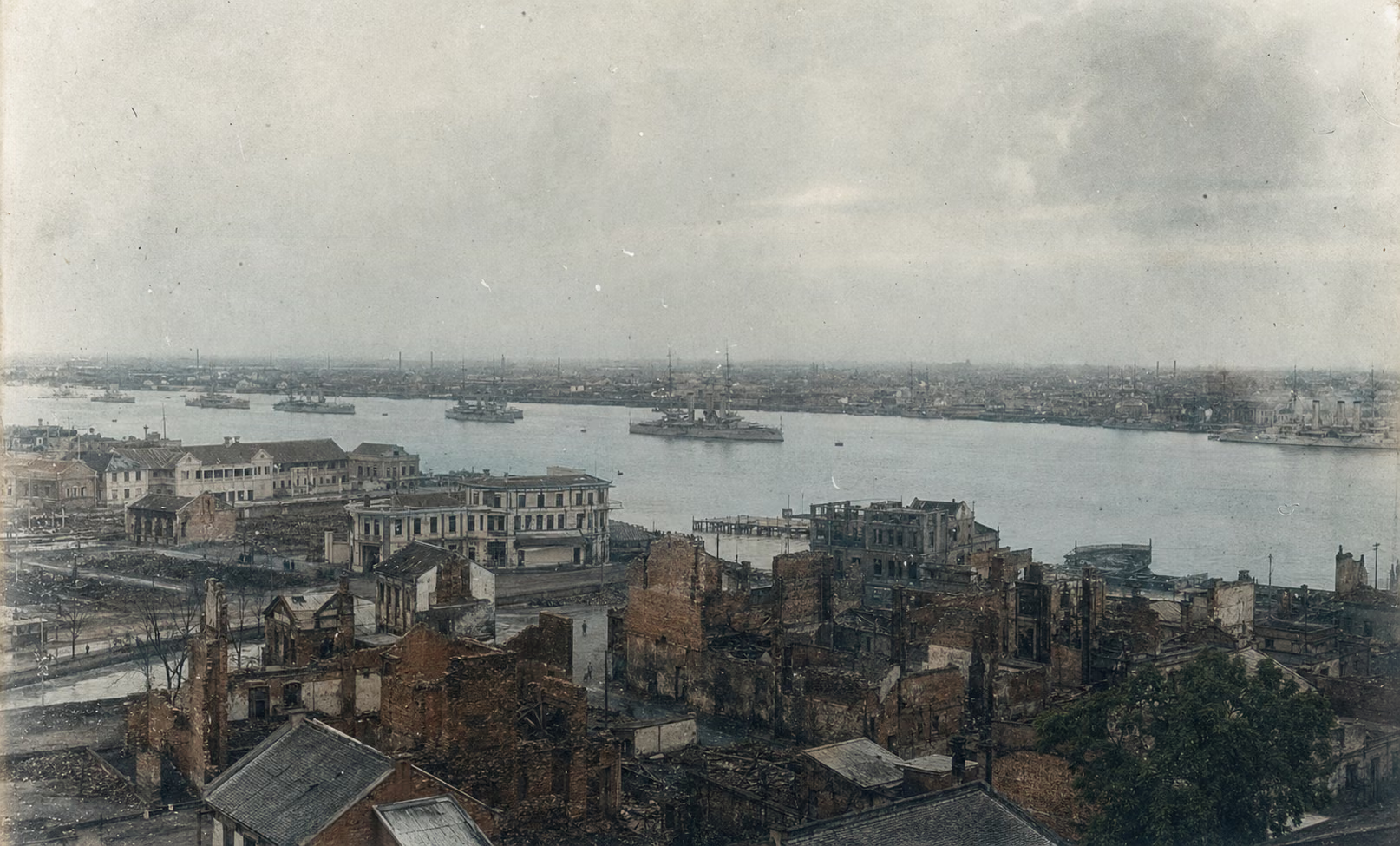
(For the larger situation - Japanese arrogance after the Mukden Incident, League of Nations mediation, and the Nanjing government's policy of "resisting while negotiating" - see Fourteen-Year War of Resistance · War Overview. This entry covers only Shanghai.)
- Shanghai was the largest commercial port in the Far East, the lifeline of China's economy, and the site of the foreign concessions - if fighting broke out here, the whole world would be watching. The Japanese side chose Shanghai in part to divert international attention from the Northeast, where the puppet state of Manchukuo was being prepared, and in part because it could rely on the concessions and naval bases.
- Before January 28, anti-Japanese feeling among Shanghai residents had already boiled up after the Mukden Incident. Boycotts of Japanese goods and the Japanese monk incident came one after another; the city was ready to catch fire at a touch.
Why It Was Fought
The gunfire at Jiangqiao stopped in mid-November 1931: Ma Zhanshan withdrew toward Hailun, and Qiqihar changed hands. On 1932.1.3, Jinzhou was abandoned without a fight as well. With the overall situation in the Northeast nearly settled, the Japanese began preparing the puppet state of "Manchukuo," while the League of Nations commission of inquiry was preparing to come east. It was at this moment that the war first leapt beyond the Northeast and landed in Shanghai, two thousand kilometers away.
Shanghai was not chosen at random. It was the largest commercial port in the Far East, China's economic lifeline, and the place where the foreign concessions sat - if Japan acted there, the whole world would be watching. And "the whole world would be watching" was precisely the point: Manchukuo was about to be unveiled, and the Northeast needed international eyes turned away for a while. Shanghai also offered the International Settlement and warships on the Huangpu River as a base. The naval landing force stationed in Shanghai could attack forward or withdraw back into the concession. Since the Mukden Incident, boycotts of Japanese goods in Shanghai had risen wave after wave, and the city was ready to ignite at a touch - the woodpile was already there; only a spark was missing.
The spark was manufactured. On 1932.1.18, five Japanese monks were attacked outside Sanyou Industrial Society; one was killed and two wounded. The Japanese side called this the "Japanese monk incident." The claim that this affair was instigated and staged by Japanese agents Ryukichi Tanaka and Yoshiko Kawashima comes from postwar materials by Japanese participants and is of relatively high evidentiary rank, but the claim remains unverified. On 1.21, Japan presented four demands to the Shanghai municipal government: apology, punishment of the perpetrators, compensation, and suppression of the anti-Japanese movement, while threatening reinforcement.
Each side had its own arithmetic. The naval landing force declared that it would "occupy Zhabei in four hours" - in Koichi Shiozawa's ledger, this was to be a police action of a few hours. The following thirty-four days, in which Japanese forces changed commanders four times and increased to 70,000 men, measure just how wrong that accounting was. On the Chinese side, Nanjing's policy was "resisting while negotiating," and the Shanghai municipal government yielded where it could; but the Nineteenth Route Army garrisoning the Beijing-Shanghai line had already made up its mind: if Japanese forces crossed the boundary and attacked, it would return fire on the spot.
The Nineteenth Route Army's resolve took concrete form. In late January, Jiang Guangnai and Cai Tingkai convened a meeting of officers at battalion level and above, setting the policy that if Japanese forces attacked, resistance would be made on the spot (the meeting date varies by record and remains unverified). Zhang Zhizhong volunteered in Nanjing, and the Fifth Army soon marched out (the sequence of the request to fight and the departure remains unverified). The Chinese side could see the Japanese warships increasing day by day in the Huangpu River; the Japanese side could not see what this time would become.
The material line was drawn very tight. The Nineteenth Route Army was several months in arrears of pay (the number of months varies by account), and its ammunition depended on allocations from Nanjing. Shanghai's customs, commerce, and industry were the lifeline of Nanjing's finances - if the city was smashed, tax revenue would be cut off. That was the real bottom card behind "negotiating." The Japanese side had limits too: the navy moved first because it wanted sole credit for "punishment," while mobilizing army divisions took time. The four changes of commander were all later payments on the original underestimation.
The opposition on the surface was plain. Nanjing's Ministry of Military Administration favored withdrawal and at one point ordered the Sixth Gendarmerie Regiment to take over the defense of Zhabei, replacing the Nineteenth Route Army (the date and wording of the order to take over the defense remain unverified). The handover had not been completed before the fighting began that night - the opposition failed to take effect not because it had been persuaded, but because there was no time.
On the afternoon of 1.28, the municipal government sent its reply, accepting all four demands. At 23:30 that night, the naval landing force still crossed out of the concession according to its planned schedule and attacked Zhabei. The Nineteenth Route Army returned fire on the spot, and the battle began.
The Chinese side had already reached the end of the visible path of retreat - all conditions had been accepted, and the fighting still came. "Provocation" is not rhetoric; it is the sequence of events.
Course of the Engagement
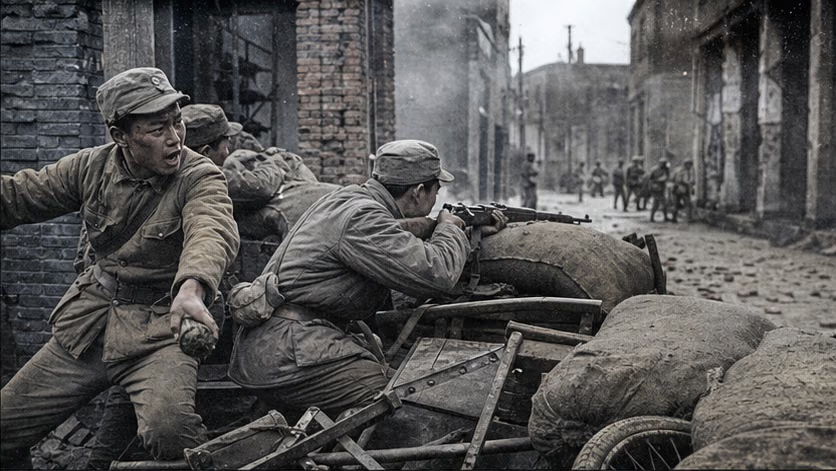
| Phase | Time | Key Points |
|---|---|---|
| Initial fighting in Zhabei | 1.28 night - early February | The naval landing force attacked Zhabei, and the Nineteenth Route Army resisted from the streets and lanes; Koichi Shiozawa's boast of "occupying Zhabei in four hours" failed; Japanese forces made their first change of commander, with Kichisaburo Nomura taking over |
| Seesaw fighting at Wusong and Jiangwan | Early and mid-February | Japanese forces brought in reinforcements to attack Wusong and Jiangwan; the Zhabei fire ※; the Commercial Press main plant and the Oriental Library were bombed and burned from 1.29 onward, with 460,000 volumes of classics destroyed by fire (a marker of cultural atrocity) |
| Fifth Army enters the battle | Around 2.14 | The Fifth Army (Eighty-Seventh and Eighty-Eighth Divisions and the Training Corps) arrived, took over the Jiangwan-Miaohang line, and fought beside the Nineteenth Route Army |
| Victory at Miaohang | Around 2.20 | The defenders' counterattack succeeded, inflicting heavy losses on the Japanese Ninth Division (Kenkichi Ueda) - Chinese battle reports said enemy losses inflicted in this action numbered several thousand; Japanese figures are lower. Both are recorded here; the matter remains unverified. Japanese forces made their third change of commander, with Yoshinori Shirakawa arriving to command the Shanghai Expeditionary Army |
| Liuhe landing | 3.1 | The Japanese Eleventh Division landed at Liuhe and drove straight into the flank and rear of the defenders; with the frontal force already exhausted, the defenders were attacked from front and rear and ordered to withdraw that night |
| Ceasefire | 3.3 | The defenders withdrew to the second defensive line from Huangdu to Taicang; a ceasefire was arranged through League of Nations mediation, and the Shanghai Ceasefire Agreement was signed on 5.5 |
Casualties and Losses
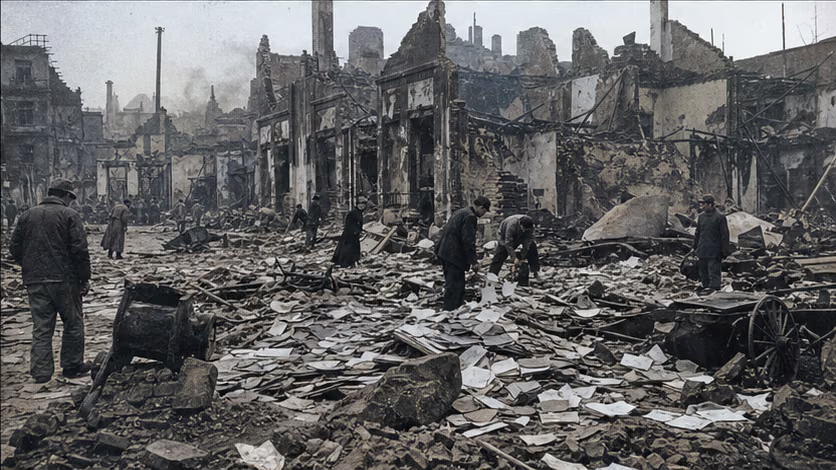
- Chinese side: the Nineteenth Route Army and Fifth Army suffered about 14,000 casualties in all (Chinese battle-report basis; breakdown unrecorded).
- Japanese side: Japanese self-reports put casualties at around 3,000; Chinese battle reports claimed over 10,000 killed and wounded. The two statistical bases differ greatly; both are given here.
- Civilians and the city ※: the Zhabei fire burned for many days, turning the finest part of the Chinese-administered city into scorched earth; the Oriental Library's 460,000-volume collection was destroyed - at the time, it was one of China's foremost private libraries, and the Song- and Yuan-dynasty rare editions held in Hanfenlou were all lost. This was targeted cultural destruction, noted accordingly.
- Cost of the agreement: Chinese troops were not allowed to garrison the area from Shanghai's urban districts to Kunshan and Suzhou, effectively "demilitarizing" Shanghai. Five years later, on August 13, the first step for Chinese forces at the opening of battle was to "smuggle" troops into Shanghai. This was the unfavorable starting point planted in 1932.
Aftermath
- The Shanghai Ceasefire Agreement (1932.5.5): Japanese forces withdrew to the concessions and the extra-concession road-building zones, but obtained clauses restricting Chinese troop deployment; Chinese public opinion regarded it bitterly as a humiliation.
- On 4.29, during the Japanese forces' "Tenchosetsu" victory parade in Hongkou Park, Korean patriot Yun Bong-gil threw a bomb. General Yoshinori Shirakawa died of his wounds, and Mamoru Shigemitsu and other dignitaries were injured. This blow by an anti-Japanese fighter from a third country in Shanghai shared the same source as resistance to Japan in the Northeast: it was planned by the Provisional Government of the Republic of Korea under Kim Gu. Yun Bong-gil was arrested on the spot and executed in Kanazawa, Japan, in December.
- After the battle, the Nineteenth Route Army was transferred to Fujian and launched the Fujian Incident in 1933; the Fifth Army returned to its original defense area.
- For the Japanese side, the army paid a higher-than-expected price at Shanghai. It was the first hard blow after Japan's easy success in the Northeast.
Accounts of Those Present
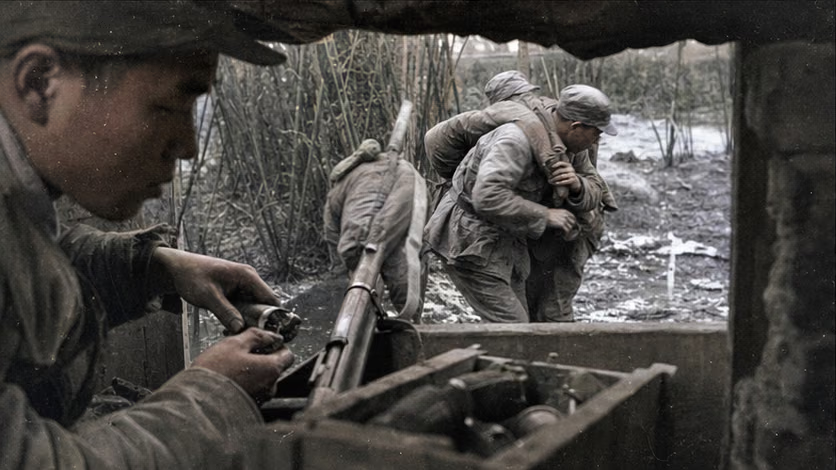
- "Why not rise and come?": Officers and men of the Fifth Army volunteered from Nanjing, and Zhang Zhizhong wrote a will before the battle, vowing to die if necessary (the original text of the will remains unverified).
- The ashes of the Commercial Press: Ashes drifted across the concessions with the wind. British and American diaries wrote that "paper ash fell like snow on Jing'an Temple Road" (source unverified). A city's cultural memory burned away in three days.
- Yun Bong-gil: Twenty-four years old, he had his photograph taken under the Taegeukgi before setting out, with one pocket watch and one white glove - relics preserved in Korea (details remain unverified). He was not Chinese, but the people he bombed were China's enemy: Shanghai in 1932 was an international field of resistance to Japan.
- Local civilian support for the front: Shanghai residents organized rescue teams and transport teams; rickshaw pullers voluntarily moved wounded soldiers and ammunition. At the popular level, civilians stood on the front line with the army in this battle (specific lists of organizations remain unverified).
The Ground
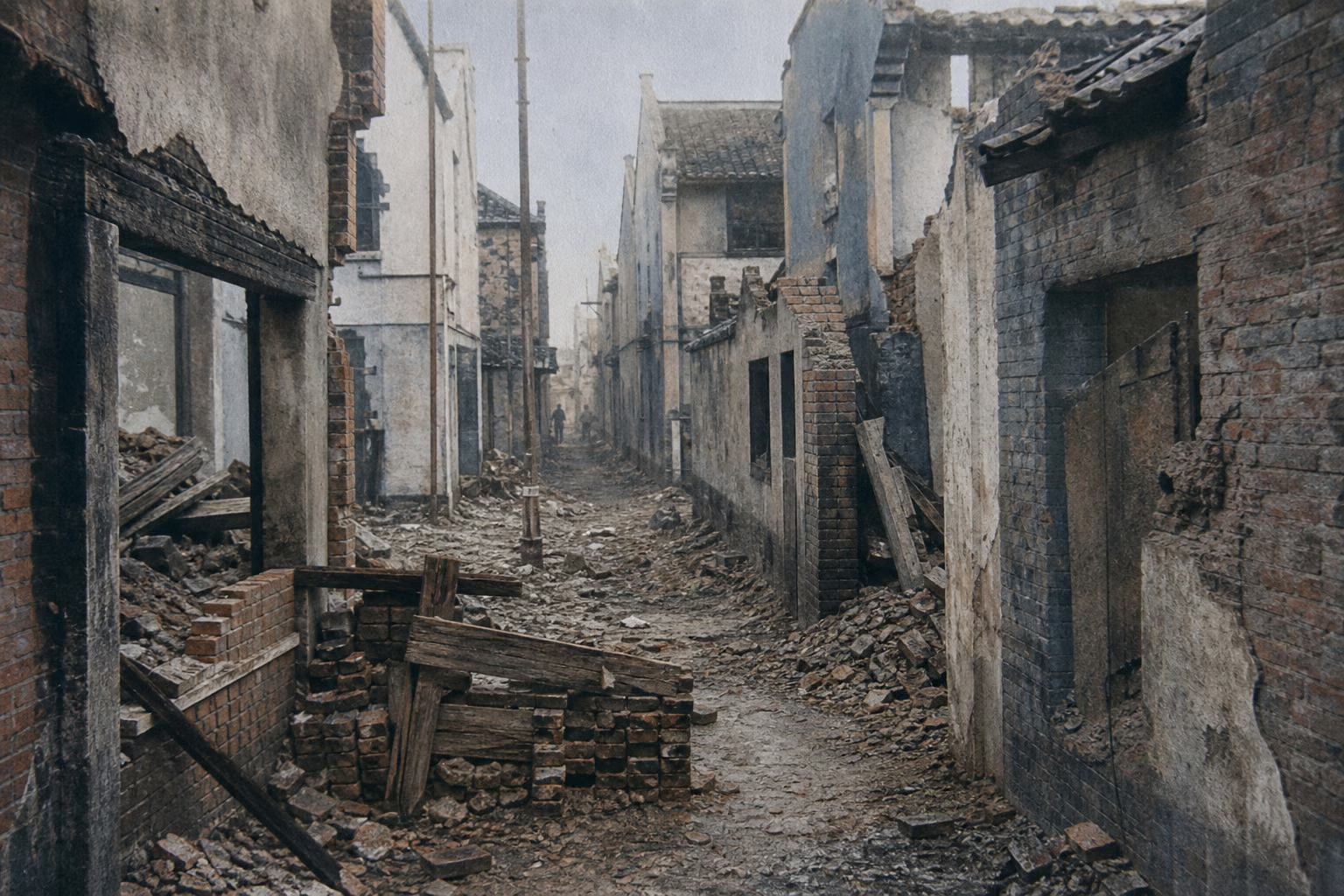
- Zhabei: the Chinese-administered district bordered the International Settlement, with dense streets and many lilong lanes. The defenders made the urban market area their position, while Japanese naval guns did not dare fire indiscriminately, because the concession was so close. That created the space for close combat.
- Jiangwan-Miaohang: waterways, villages, and bamboo groves made mechanized deployment difficult; this was typical defensive terrain of the Jiangnan water country.
- Liuhe: tidal flats on the southern bank of the Yangtze estuary, dozens of kilometers away from the main battlefield - textbook ground for landing and cutting the rear. However well the front was fought, this one point behind it could not be stopped.
- Huangpu River: the moving artillery platform for Japanese naval guns; the riverbank itself was the line of fire.
How Each Side Records It
- Japanese side: called it the "First Shanghai Incident." The narrative frame was "protecting nationals and punishing violent Chinese troops"; regarding the process by which four changes of commander and reinforcement to 70,000 men were needed before the opponent could be forced to withdraw, official war histories use cautious wording (specific wording remains unverified).
- Chinese side: called it the "January 28 Incident (Battle of Shanghai, 1932)." The Fifth Army's participation was long treated quietly in the narrative - because the Fifth Army was a direct-line Central Army unit and Zhang Zhizhong belonged to the Whampoa circle. In mainland narratives for a period, "January 28" was almost entirely told through the Nineteenth Route Army, while the contribution of direct-line Kuomintang troops was played down (Taiwan-side narratives also have their own emphases). This entry: the Nineteenth Route Army fought first and stayed through the whole battle; the Fifth Army arrived later and fought hard beside it. Both are real; without either one, the account is incomplete.
- Popular level: Shanghai residents, nationwide opinion, and donations from overseas Chinese (the claim that overseas Chinese in the Philippines donated to purchase the "Philippines" aircraft remains unverified) - January 28 was the second high tide of popular mobilization after the Mukden Incident.
Disputes and Sensitivities
- Authenticity of the Japanese monk incident: the claim that Japanese agents staged it themselves comes from postwar Japanese materials, including Ryukichi Tanaka's relevant testimony at the International Military Tribunal for the Far East, and is of relatively high evidentiary rank; the specific executors and details of Yoshiko Kawashima's role remain unverified.
- The Fifth Army narrative issue: as noted above. Statements such as "January 28 was only the Nineteenth Route Army" should be read alongside Fifth Army historical materials.
- Casualty basis: Chinese and Japanese battle reports differ by several times over; the numerical gap between the two sides is large, and this entry records both claims side by side.
- After the Liuhe landing, the front had not been defeated, but the strategy was already lost. That is the core turning point of this engagement.
Sources and Open Questions
Known principal sources:
- Telegrams by Jiang Guangnai, Cai Tingkai, and Dai Ji, and Nineteenth Route Army battle reports
- Zhang Zhizhong's memoirs (on the Fifth Army's participation)
- The Japan Defense Agency War History Office's Senshi Sosho volumes related to the Shanghai Incident
- Ryukichi Tanaka's Tokyo Trial testimony (source for the claim that the Japanese monk incident was staged)
- Text of the Shanghai Ceasefire Agreement (1932.5.5)
Open questions: the specific course and executors of the Japanese monk incident; detailed strength figures for the two Chinese armies; statistical boundaries for casualties on both sides; the exact date of the Miaohang fighting and differing accounts of its results; the unit designation of the Liuhe landing force and the scale of the convoy; the original records for the number of volumes lost at the Commercial Press (whether "460,000 volumes" includes the Oriental Library or also the books stored at the main plant); the original text of Zhang Zhizhong's will; the source for the eyewitness note on "paper ash"; details of Yun Bong-gil's relics; specific overseas Chinese donation projects; concrete historical examples of the downplaying of the Fifth Army's participation in narratives (textbooks and museum exhibitions from different periods); the date and records of the Nineteenth Route Army meeting of officers at battalion level and above; the sequence of Zhang Zhizhong's request to fight and the Fifth Army's departure; the number of months of unpaid wages for the Nineteenth Route Army; the date and wording of the Sixth Gendarmerie Regiment order to take over the defense; Japanese materials for the claim that the Japanese navy sought sole credit for "punishment."
All images on this site are AI-generated depictions. They are not historical photographs, not primary sources, and do not depict any real individual.