War Overview · Sino-Vietnamese War (1979–91)
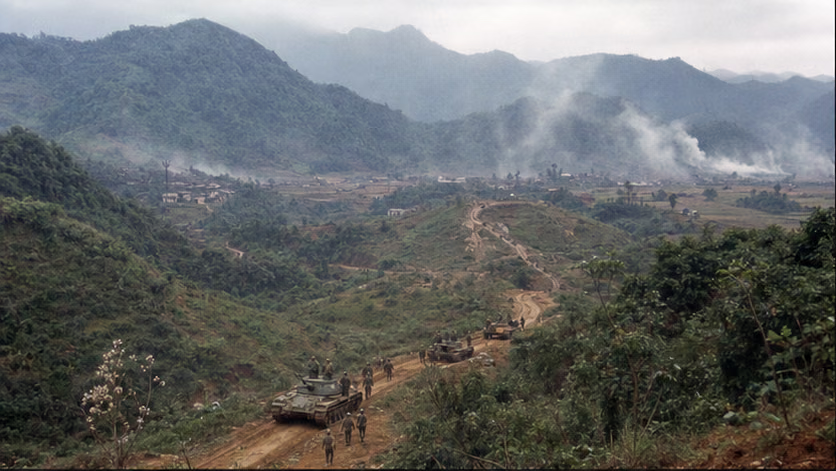
Two countries that had spent 20 years as "comrades plus brothers" went to war along the full length of the China-Vietnam border in February 1979. After the 28-day counterattack, artillery continued to sound intermittently on the frontier for another 10 years; only when Vietnam withdrew from Cambodia in 1989 and the two countries normalized relations in 1991 was this war truly over. It was also this army's last large-scale external operation as of the time this article was written.
Engagement Data
| Item | Content |
|---|---|
| Time | 1979.2.17–3.16 Counterattack in Self-Defense Against Vietnam; afterward, fighting over points straddling the border and artillery duels became normal (1980 Luojiaping Dashan, 1981 Fakashan and Koulinshan, 1984–89 rotating campaigns of the Two Mountains), with the gunfire gradually fading around 1990; China-Vietnam relations normalized in 1991.11, closing the sequence |
| Place | The entire China-Vietnam land border, roughly 1,300 kilometers: the eastern sector opposite Guangxi (Dong Dang–Lang Son, Cao Bang direction) and the western sector opposite Yunnan (Lao Cai, Ha Tuyen direction); the fighting took place in northern Vietnamese border provinces and in mountain areas straddling the border |
| Belligerents | Chinese People's Liberation Army (in 1979, Xu Shiyou of the Guangzhou Military Region on the eastern front and Yang Dezhi of the Kunming Military Region on the western front; during the rotation-war period, units from the major military regions took turns entering the fighting) / Vietnam People's Army, armed public security forces, and militia (the northern Vietnam whole-population defense system) |
| Result | In the 1979 counterattack, the Chinese side took Cao Bang, Lang Son, Lao Cai, and other places, then withdrew on its own initiative; both sides declared victory. There followed ten years of border confrontation; in 1989 Vietnam withdrew from Cambodia and the rotation campaigns wound down, and in 1991 relations normalized -- after ten years of fighting, the boundary line still lay broadly where it had been before the war began (the land boundary was finally delimited by the 1999 treaty; see the disputes section) |
Belligerents (War Level)
| Item | Chinese Side | Vietnamese Side |
|---|---|---|
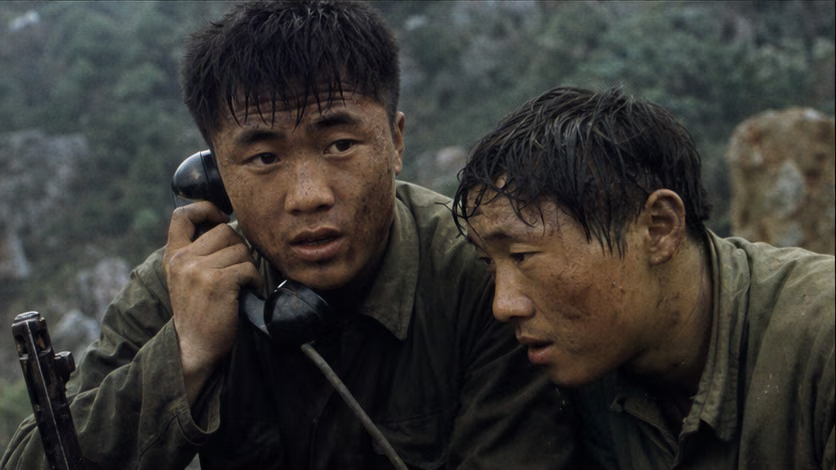
| Troops | In 1979, 9 armies and 200,000–300,000 troops committed (figures vary by statistical basis); during the rotation-war period, units from the Nanjing, Jinan, Lanzhou, Beijing, Chengdu, and other military regions, together with reconnaissance detachments from the military regions, entered the war in succession | In 1979, roughly 6 regular divisions on the northern front line, plus local forces, public-security posts, and militia, for a total of about 100,000 (figures vary by statistical basis); afterward, heavy forces were stationed along the northern border year-round |
| Firepower | Type 59 / Type 62 tanks and various suppression artillery; during the Two Mountains period, the artillery became the main actor | Soviet-aid equipment + captured U.S. weapons + arms previously supplied by China -- aid sent to Vietnam was turned back against China |
| Air | Neither side's air force engaged on a large scale during the entire war period (in 1979 the Chinese side only patrolled and stood alert within its own territory; explanations vary by account) | Same as left; from 1979, Soviet aviation units and ships entered Cam Ranh Bay |
| Evolution | From the exposure in 1979 of problems in infantry-tank coordination, command, equipment, and organization, to the maturing of reconnaissance, artillery, and fortification work in the Two Mountains period -- the Chinese main line is an army making up Cultural Revolution arrears through a ten-year border war | The main forces were bogged down in Cambodia, and the northern front focused on delay and attrition -- the Vietnamese main line is the overextension of national strength under two-front war |
Historical Setting
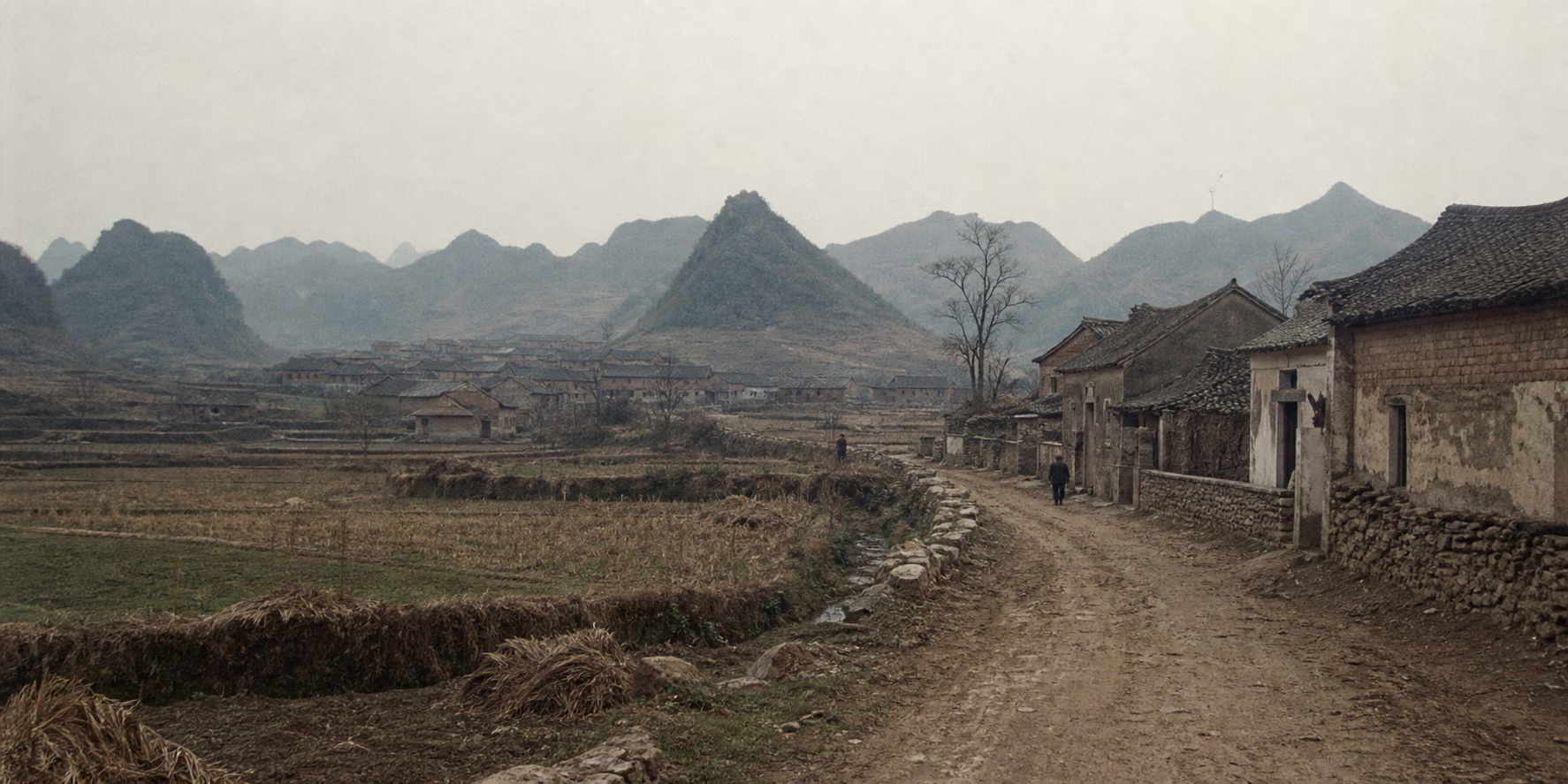
World: the late Cold War triangle -- China and the United States established diplomatic relations on 1979.1.1, while the Sino-Soviet confrontation remained unresolved; through the 1978.11 *Soviet-Vietnamese Treaty of Friendship and Cooperation*, the Soviet Union gained a foothold in Southeast Asia, entered Cam Ranh Bay from 1979 onward, and invaded Afghanistan at year's end. China's judgment that year was that the Soviet Union was the main threat and Vietnam was its "Asian Cuba" (wording source unverified). The United States and ASEAN were focused on the Cambodia question and publicly advocated a "dual withdrawal" over the China-Vietnam war (wording unverified).
China: the Cultural Revolution had ended only 2 years earlier, and the Third Plenary Session of the Eleventh Central Committee in 1978.12 had turned toward reform and opening. The army had not fought a major war for more than 10 years, training had decayed, and organization had grown bloated; the country needed a stable environment and access to U.S. and Japanese markets and technology -- this was both a reason for caution about war and a reason to seek a long-term secure frontier.
Vietnam: Saigon changed hands on 1975.4.30, and north and south were unified in 1976; the victor of 30 years of war took over a country full of wounds. In 1978.6 Vietnam joined Comecon, and on 11.3 it concluded a treaty with the Soviet Union. In the same year it expelled and drove out ethnic Chinese (※ hundreds of thousands of overseas Chinese and ethnic Chinese left the country, and the Chinese side established overseas-Chinese farms to resettle more than 200,000; figure disputed). Regarding Cambodia: beginning in 1975, the Khmer Rouge repeatedly attacked Vietnamese border villages (※ the 1978.4 Ba Chuc massacre in An Giang Province; Vietnamese records put civilian deaths at more than 3,000, figure disputed), and on 1978.12.25 the Vietnamese army entered Cambodia in full force. Vietnam's claims over the Paracels and Spratlys changed around the time of unification -- for the maritime line, see the articles and overview for "Paracel and Spratly Islands."
Why It Was Fought
The previous article, *Johnson South Reef Skirmish*, stopped at the Spratlys in March 1988. By then, this land war had already reached its 10th year -- the gunfire in the South China Sea was only the line it had extended out to sea. Turn the clock back to 1975.
On April 30, Vietnamese tanks crashed through the iron gate of the Independence Palace in Saigon, and 30 years of war in Indochina ended in Hanoi's complete victory. China had been one of the largest external funders of that victory: from the anti-French war to the anti-American war, accumulated aid was counted at 20 billion U.S. dollars (Chinese basis, unverified). But victory did not bind the two parties more tightly together. In the era of the Sino-Soviet split, Hanoi had already chosen Moscow. Over the next 3 years, relations worsened step by step. In June 1978, Vietnam joined Comecon; in the summer, the handling of the "overseas Chinese question" pushed hundreds of thousands of people across Friendship Pass and the Beilun River -- the Chinese basis was "expulsion," while the Vietnamese basis was "voluntary departure" (※ listed side by side; numbers unrecorded). On November 3, the *Soviet-Vietnamese Treaty of Friendship and Cooperation* was signed in Moscow, with a clause requiring mutual consultation in the event of attack (article number and wording unverified). On the border, gunfire had grown denser year by year since the mid-1970s, and each side preserved its own statistical record of the other's "provocations"; the numbers are completely opposed (all unverified).
On December 25, the Vietnamese army entered Cambodia in full force; on January 7, 1979, Phnom Penh changed hands. The overthrown Democratic Kampuchea was a regime later recorded as having produced large-scale domestic deaths (research estimates from all sides run into the millions ※), and it was also the regime China supported at the time. Vietnam said it had ended killing; China said this was regional hegemony swallowing a neighbor. Cambodians themselves keep both accounts.
At the end of January, Deng Xiaoping visited the United States and told Carter that Vietnam had to be given a "necessary lesson" (wording and occasion unverified); Washington neither supported nor stopped him (accounts vary by basis). Beijing's military calculation was drawn narrowly: limited time, limited depth, a quick fight and quick withdrawal, with the judgment that the Soviet Union, constrained by winter in the Far East and by conditions for assembling forces, would not move south in force (assessment bases vary by account) -- even so, all northern military regions shifted into full alert. The door to negotiation had in fact opened: the 1978 border talks and overseas-Chinese talks were both held, and both failed (sequence unverified).
At dawn on February 17, hundreds of artillery positions opposite Guangxi and Yunnan opened fire at the same time. "Comrades plus brothers" was an old phrase from the Ho Chi Minh era -- in the 12 years after this day, the China-Vietnam border would not have a single full year of quiet.
Course of the Engagement (One War, Ten Years)
| Phase | Time | Key Points | Related Article |
|---|---|---|---|
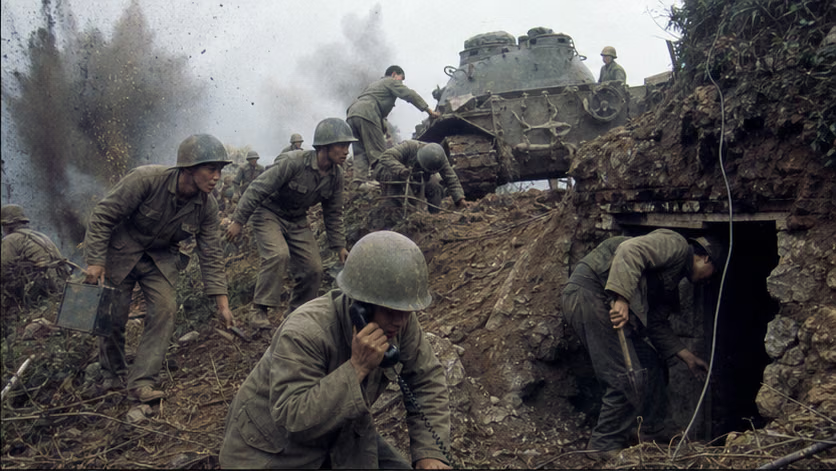
| Counterattack | 1979.2.17–3.16 | 9 armies attacked on the eastern and western fronts, taking Cao Bang, Lang Son, Lao Cai, and Cam Duong; withdrawal was announced on 3.5 and completed on 3.16; the Cao Bang-direction penetration was frustrated, with the loss of the 448th Regiment during withdrawal | Counterattack in Self-Defense Against Vietnam |
| Fighting over border-straddling points | 1980–83 | After the withdrawal, Vietnamese troops occupied several points straddling the border, and artillery exchanges and friction became normal; 1980.10 Luojiaping Dashan (dates vary by account), and in 1981.5 Fakashan and Koulinshan were seized back and held for the long term | Battles of Fakashan and Koulinshan |
| Rotating campaigns of the Two Mountains | 1984.4–1989 | Laoshan and Zheyinshan were recovered; on 7.12 a Vietnamese division-scale counterattack was smashed by artillery fire; afterward, units from the major military regions entered the war by turns, with five years of positional warfare and artillery duels | Battles of Laoshan and Zheyinshan (rotating campaigns of the Two Mountains) |
| Closing phase | 1989–91 | In 1989.9 Vietnam announced its complete withdrawal from Cambodia; rotation-war units left, and the gunfire gradually faded by around 1990; 1990.9 Chengdu meeting (details unverified), and 1991.11 normalization of relations | — |
Casualties and Losses
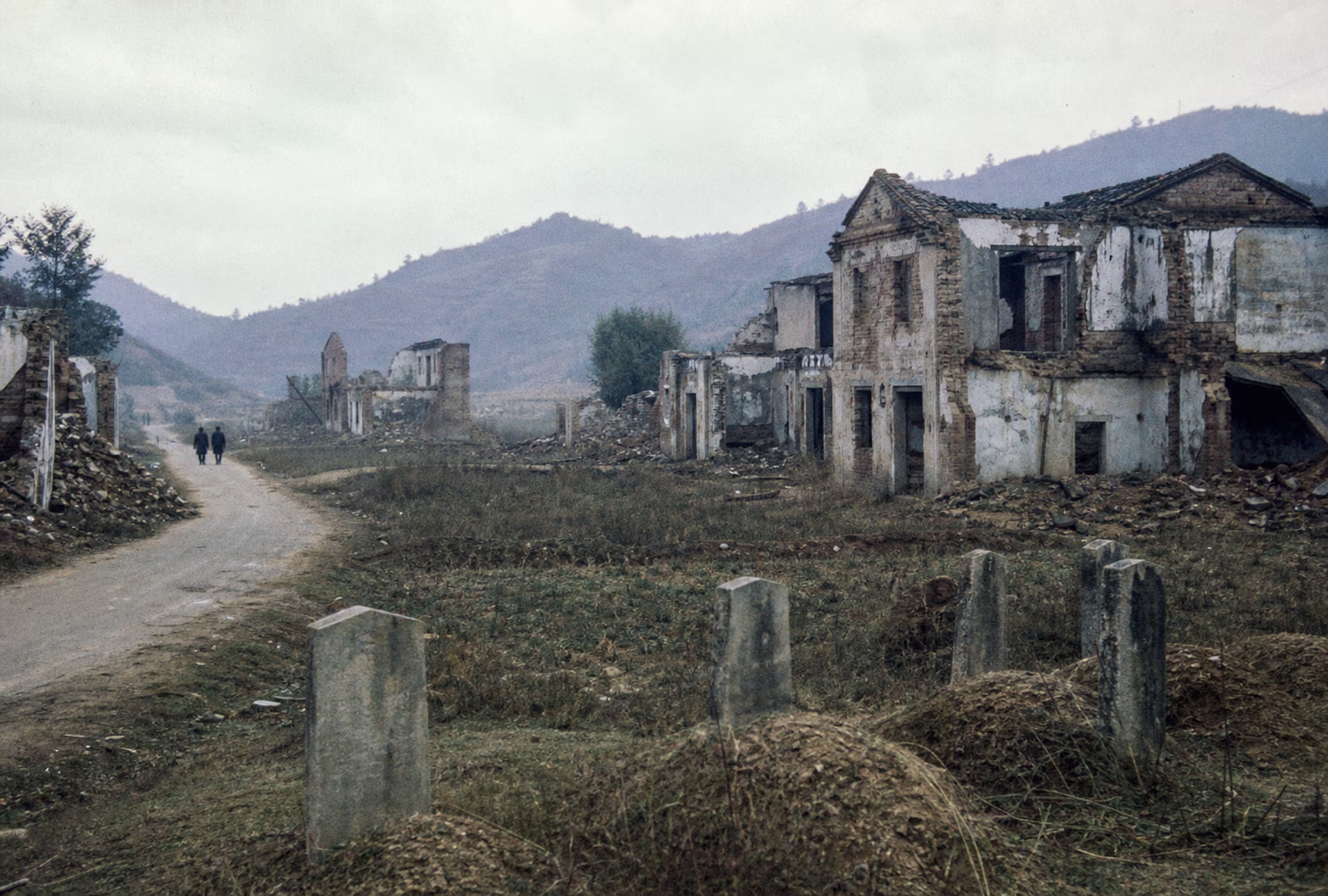
- Counterattack: the circulated Chinese basis gives about 6,900 killed and about 15,000 wounded (statistical source unverified), while another account gives more than 8,500 killed; Chinese battle reports claimed more than 57,000 Vietnamese troops eliminated; Vietnam claimed that it eliminated 62,000 Chinese troops and that northern Vietnamese civilian deaths ran into the tens of thousands (※). The 4 sets of numbers are mutually incompatible, and their statistical boundaries are all unclear.
- Ten-year total: neither side has publicly released an authoritative total. Chinese casualties in the Two Mountains period are covered in the related article; Vietnamese commemorative figures say that more than 4,000 died in the Vi Xuyen direction (Vietnamese media basis after 2014, unverified).
- Civilians and border residents ※: northern Vietnamese border towns were destroyed on a large scale during the 1979 withdrawal (for each side's basis, see the disputes section); villages and towns on the Guangxi and Yunnan border were shelled over ten years, with border residents killed or wounded and fields abandoned (figure disputed); land mines left after the war caused long-term injury and disability among border residents on both sides (figure disputed).
- Overseas Chinese refugees ※: in 1978–79, hundreds of thousands of overseas Chinese and ethnic Chinese left Vietnam and entered China for resettlement; large numbers of boat people also floated southward by sea, becoming part of that year's global refugee crisis (figures disputed across all parties).
- National strength: Vietnam's two-front war and economic hardship lasted until Doi Moi in 1986; China's military spending and border-front support burden (bases vary by account) -- the ten-year border war tied down more than Vietnam alone.
Aftermath
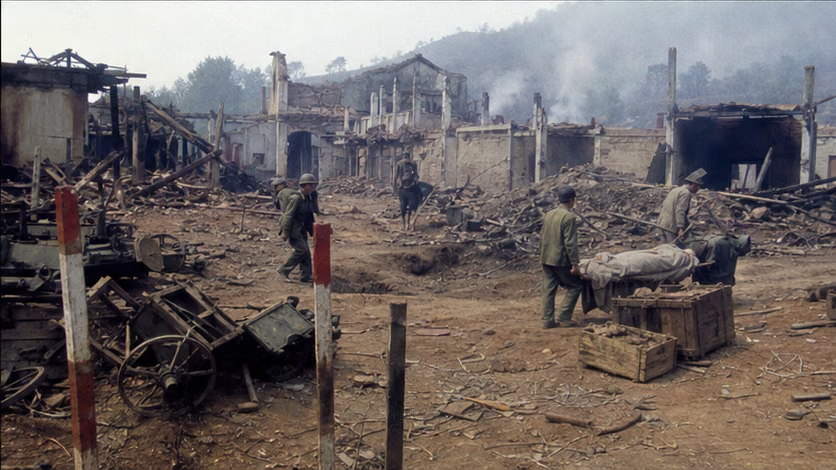
- Military reform: the 1979 list of lessons (infantry-tank coordination, communications and command, wartime expansion, obsolete equipment) directly drove the military reforms of the 1980s -- the 1985 demobilization of one million troops, the formation of combined group armies, and the restoration of military academies and ranks (1988); at the same time, the rotating campaigns of the Two Mountains became a live-fire training ground for each military region, and their training character appears in internal military literature.
- The Cambodia question was internationalized for 12 years: the struggle over the United Nations seat, Sihanouk's tripartite coalition government, and finally the 1991.10 Paris Agreements that closed the issue.
- Sino-Soviet and Sino-Vietnamese thaws followed one another: in 1989.5 Gorbachev visited China, and among the "three major obstacles," the Cambodia item disappeared with the Vietnamese army's withdrawal; 1990.9 Chengdu meeting (unverified), and in 1991.11 Vietnamese Communist Party General Secretary Do Muoi and Chairman of the Council of Ministers Vo Van Kiet visited China, normalizing relations.
- Border settlement: the 1999.12 land-boundary treaty and the 2000.12 Gulf of Tonkin delimitation agreement were signed, followed by boundary demarcation and marker erection (completion time unverified).
- The long tail of land mines: the China-Vietnam border underwent multiple large-scale mine-clearance rounds (2 rounds in the 1990s, and another in 2015–18; start and end dates unverified); injury records from villages in the minefields are among the longest shadows of this war ※.
- Veterans and commemoration: participating veterans' claims for benefits and their memory writing continue to the present; martyrs' cemeteries such as Malipo have become places of popular memorial visits -- for the history of commemoration, see the next section.
How Each Side Records It
- Chinese side: officially named the "Counterattack in Self-Defense Against Vietnam and Defense of the Frontier Operation." It ran hot in the 1980s (hero-model reports, *Wreaths at the Foot of the High Mountains*, *The Glamour of Blood*), then after normalization in 1991 entered a long low-key period -- textbook space shrank, and film and television treatments became rare. Veterans' memories moved into civil society: online commemoration, returns to the battlefield, and Qingming visits to Malipo. No official full history has appeared, and many archives remain classified -- memory survives mainly in memoirs and local gazetteers, the most distinctive feature of the source landscape for this war.
- Vietnamese side: officially named the "1979 War to Defend the Northern Border," with 2.17 as the commemorative node; after normalization it likewise remained low-key for a long time, and commemoration warmed after 2014 (expansion of the Vi Xuyen martyrs' cemetery, concentrated reporting on the fortieth anniversary in 2019); additions and deletions in textbook treatment are a public issue inside Vietnam (unverified).
- Cambodian dimension: 1.7 (the day Phnom Penh changed hands) is officially remembered in Vietnam and Cambodia as the anniversary of the overthrow of the Pol Pot regime, while another part of Cambodians remember it as the beginning of occupation -- the 2 memories coexist to the present, and this article lists them side by side.
- Scholarship: the war is often framed as part of the "Third Indochina War" (1978–91, reading the Cambodian-Vietnamese War and the Sino-Vietnamese War together); Chinese archives are not open and Vietnamese archives are limited, so scholarship has long relied on memoirs and third-party archives -- the asymmetry of sources itself is the present condition of the historiography of this war.
Disputes and Sensitivities
- Khmer Rouge question: the Democratic Kampuchea regime supported by China left records of large-scale domestic deaths (research estimates from all sides vary widely, running into the millions ※); Vietnam's intervention ended it and also brought ten years of occupation. Liberation and occupation, tyranny and intervention -- the narratives of all sides are completely opposed here.
- Aid to Vietnam and rupture: the reversal from more than twenty years of aid to war in 1979 -- Chinese narratives often use the language of "ingratitude," while Vietnamese narratives often use the language of "great-power hegemony"; the two accounts are listed side by side, and this article does not adopt either side's characterization.
- Destruction during withdrawal ※: during the March 1979 withdrawal, northern Vietnamese towns and facilities were destroyed on a large scale -- the Chinese basis says military facilities were destroyed and aid materials previously sent to Vietnam were recovered; the Vietnamese basis says cities such as Lang Son and Cao Bang were systematically destroyed; Western journalists who entered that year left on-site reporting. The 3 bodies of record are listed side by side; for details, see *Counterattack in Self-Defense Against Vietnam*.
- Casualty and victory-claim figures: the two sides' bases differ sharply, and neither provides clear statistical boundaries.
- Characterization of the war: China's "self-defense counterattack" / Vietnam's "war of aggression" -- the 2 official names are listed side by side; that year's United Nations Security Council debate ended without a resolution (sequence unverified).
- The tension between the low-key domestic narrative and participating veterans' claims on memory continues to coexist.
- Present boundary: narratives about the boundary and territory involve the factual 1999 / 2000 treaties, not present-day claims or judgments.
Contents
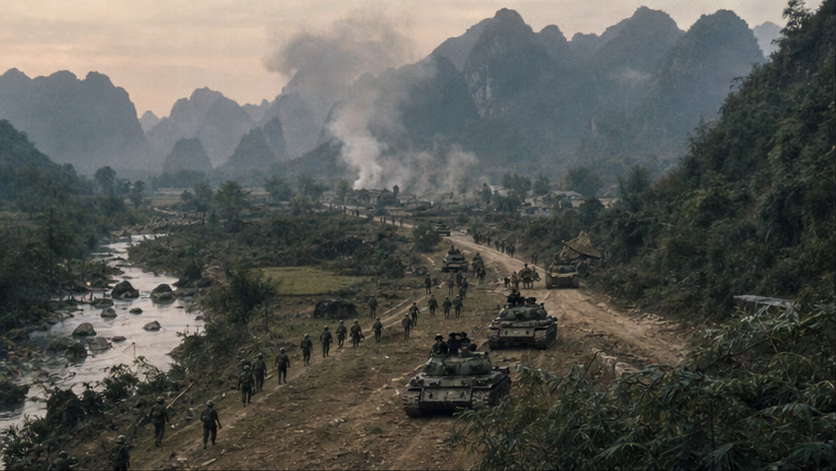 Counterattack in Self-Defense Against Vietnam1979.02At dawn on February 17, 1979, the People's Liberation Army crossed the border simultaneously on the Guangxi and Yunnan fronts with 9 armies; in 28 days it took Cao Bang, Lang Son, and Lao Cai, announced its withdrawal on March 5, and had fully returned across the border by March 16 -- a border war of rapid advance and rapid withdrawal, in which both sides declared victory, and whose exposed problems were written into every page of China's military reforms over the following 10 years.
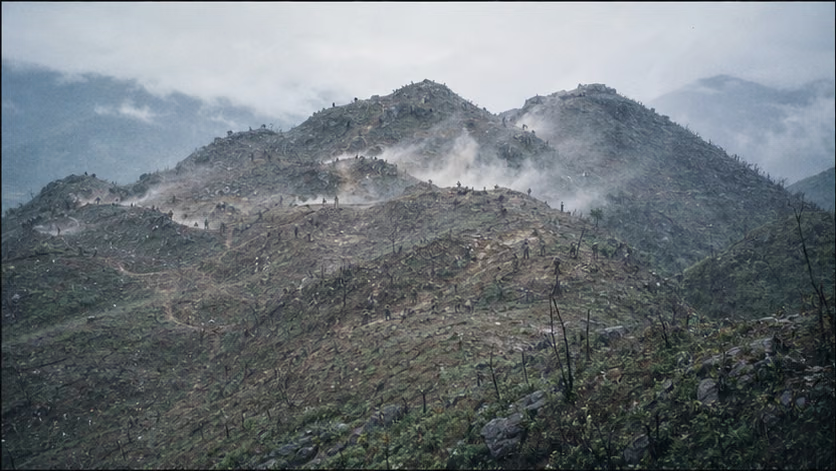 Battles of Fakashan and Koulinshan1981.05Points straddling the boundary line that Vietnamese troops occupied after the 1979 withdrawal were taken back one by one beginning in May 1981: on the 5th, Guangxi border-defense units recovered Fakashan; on the 7th, the Yunnan-based 14th Army recovered Koulinshan. Seizing the points took from several dozen minutes to several hours; holding them lasted for years.
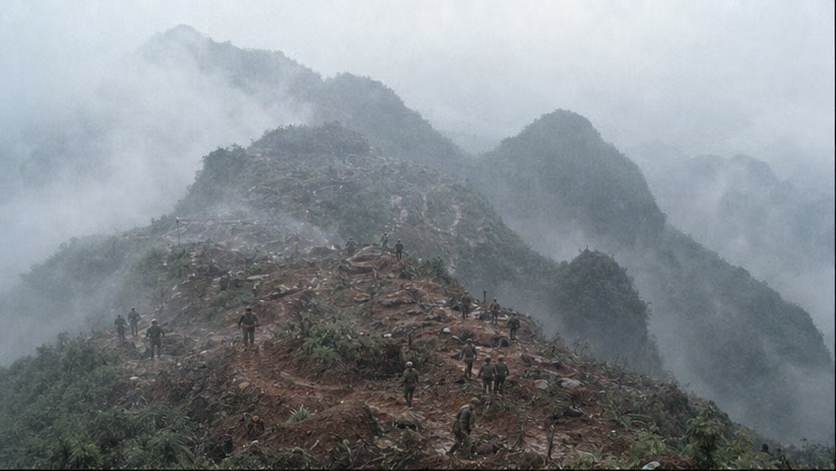 Battles of Laoshan and Zheyinshan (rotating campaigns of the Two Mountains)1984.04On April 28 and 30, 1984, the 14th Army recovered Laoshan and the Eleventh Army recovered Zheyinshan; on July 12, a Vietnamese division-scale counterattack was broken up under interdiction by artillery groups. For the next 5 years, troops from the major military regions took turns going up the mountains -- the "rotating campaigns" were both defense of the soil and the only practical battlefield classroom for an army then undergoing reform; only when the rotating campaigns wound down in 1989 did the sound of artillery gradually fade in the early 1990s.
Sources and Open Questions
Sources: no full volume of the Chinese public war history has appeared; this article relies mainly on postwar summaries by military regions (internal), histories of participating units and memoirs by officers and soldiers, and local gazetteers from Guangxi and Yunnan; Xiaoming Zhang, *Deng Xiaoping's Long War: The Military Conflict between China and Vietnam, 1979–1991* (2015); Edward C. O'Dowd, *Chinese Military Strategy in the Third Indochina War*; King C. Chen, *China's War with Vietnam, 1979*; publications by Vietnamese Defense Ministry military-history institutions and commemorative materials from *People's Army Newspaper* (bibliography unverified); UNHCR archives on Indochinese refugees.
Open questions: the various bases and statistical boundaries for 1979 troop strengths and casualties on both sides; the basis for total aid to Vietnam; the military clauses of the *Soviet-Vietnamese Treaty of Friendship and Cooperation*; Deng Xiaoping's original wording of "lesson" and the occasion; numbers for anti-Chinese expulsions, departures, and resettlement; the sequence of the 1978 border talks and overseas-Chinese talks; the date of Luojiaping Dashan; details of the Soviet wartime response; the U.S. wording of "dual withdrawal"; details of the Chengdu meeting; start and end dates of mine-clearance rounds; the Vietnamese basis for deaths in Vi Xuyen; source of the phrase "Asian Cuba."
All images on this site are AI-generated depictions. They are not historical photographs, not primary sources, and do not depict any real individual.