War Overview · Second Revolution (1913)
In the second year after the Republic was founded, revolutionary party members rose against Yuan Shikai over the assassination of Song Jiaoren and the Reorganization Loan; seven provinces answered in succession, only to be defeated one by one by the Beiyang Army within two months—the showdown between republic and autocracy ended with the republican camp driven wholly from the field.
Engagement Data
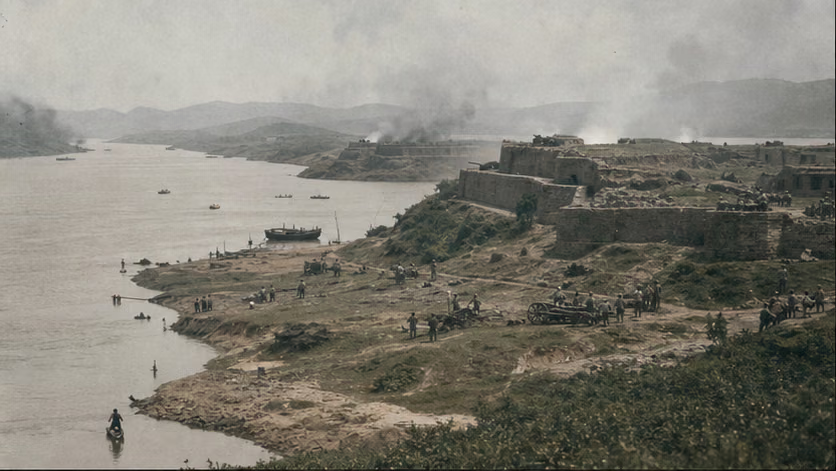
| Item | Content |
|---|---|
| Time | 1913.7.12 – 9.12, lasting about two months |
| Place | Main theaters in Jiangxi (Hukou—Jiujiang—Nanchang), Jiangsu (Nanjing), and Shanghai; Anhui, Guangdong, Fujian, Hunan, and Sichuan (Chongqing) were affected in succession |
| Belligerents | Anti-Yuan forces (southern soldiers and civilians in Jiangxi, Jiangsu, Shanghai, Anhui, Guangdong, Fujian, Hunan, and Sichuan as they declared independence in succession) / Beiyang Army (the Yuan Shikai government's forces sent south) |
| Result | The Anti-Yuan forces were completely defeated, provincial independence was canceled; Sun Yat-sen, Huang Xing, and others went into exile in Japan |
Belligerents (War Level)
| Item | Anti-Yuan Forces | Beiyang Army |
|---|---|---|
| Total strength | The independent armies of the provinces together numbered in the tens of thousands, but each province fought on its own, without mutual subordination or unified command (no authoritative overall total, unverified) | The main southern expeditionary forces were one column attacking Jiangxi (commanded by Duan Zhigui, with Li Chun's Sixth Division as the vanguard) and one column attacking Nanjing (commanded by Feng Guozhang, with Zhang Xun's troops making the main attack on Nanjing), totaling several tens of thousands (details unrecorded) |
| Core forces | Li Liejun's Jiangxi forces were relatively intact; the Nanjing defenders changed repeatedly and mixed factions together; elsewhere, most units were local troops and people's militias hastily assembled | The direct line of the Beiyang Six Divisions formed the main force: long-trained troops, with ample pay, weapons, and equipment |
| Firepower | The New Armies in the provinces were unevenly equipped; Hukou fortress had gun batteries (the defending commander defected during the fighting) | Organized artillery and machine-gun detachments were complete; the Jiangxi offensive was supported by armed river steamers (figure disputed) |
| Supply and system | The affair began in haste, with no military funds and no rear area; before the rising, the party delayed for months, and after it began, each force fought alone and was defeated in turn | The Reorganization Loan was in hand, giving the army funds; the railways and Yangtze shipping were controlled, and troop movements were rapid; Yuan issued orders in the name of the central government, giving the campaign a formal justification |
Situation
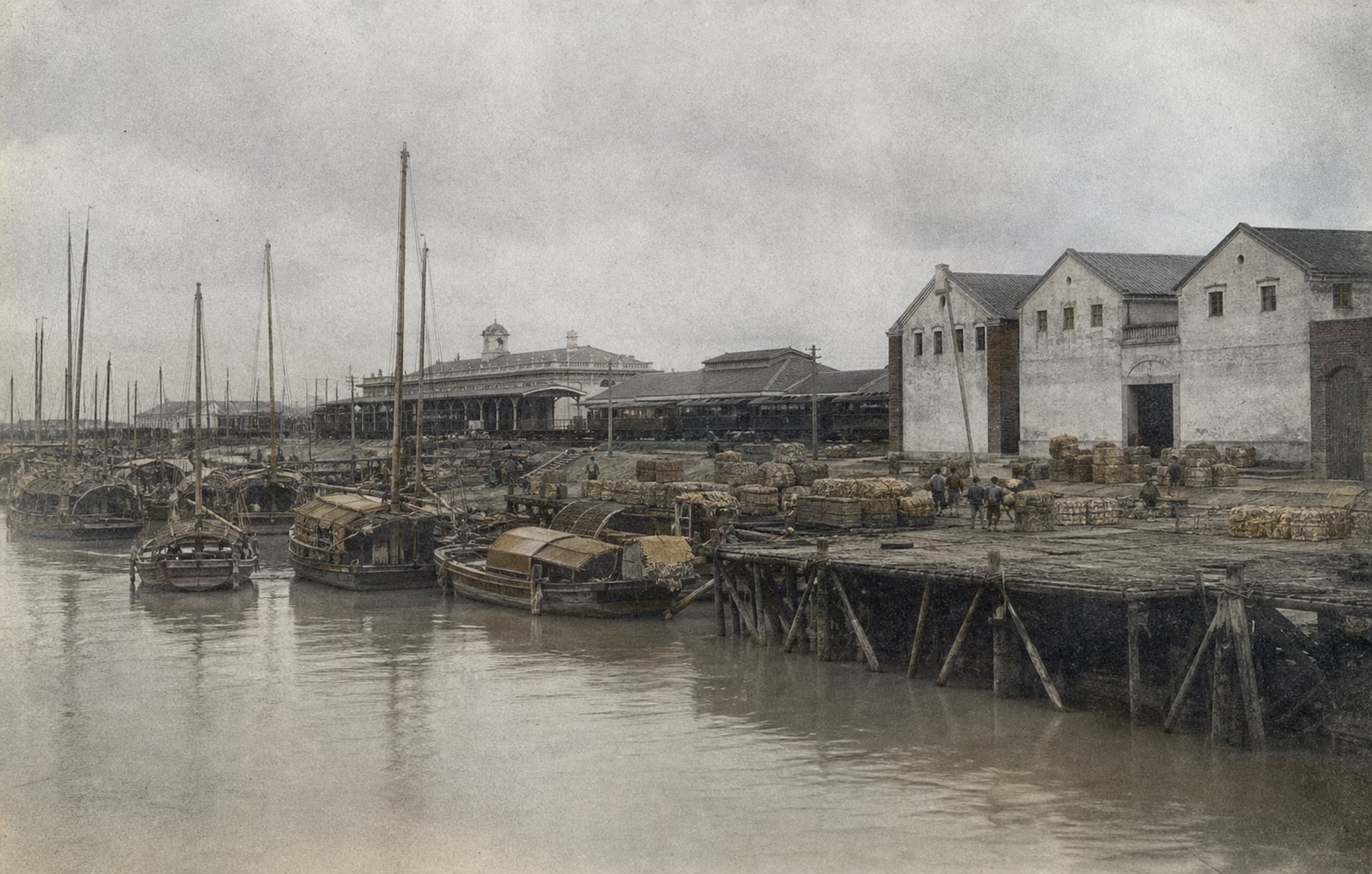
World: on the eve of the First World War, the balance among the powers in China had not yet been broken. Japan's attitude toward the southern revolutionaries was ambiguous, while toward Yuan Shikai it both exerted pressure and made deals; the Reorganization Loan was underwritten by a banking consortium from Britain, France, Germany, Russia, and Japan—the powers' money was, in effect, lent to the Beijing government to pacify the South (specific attitudes of each country unverified).
China: in the second year of the Republic, the republican signboard had been hanging for only one year. In the parliamentary elections from the end of 1912 to the beginning of 1913, the Nationalist Party won a major victory, and Song Jiaoren toured the country speaking for a party cabinet—this was the prospect Yuan Shikai least could tolerate. Military and civil authority in several southern provinces was still in revolutionary hands (Li Liejun in Jiangxi, Hu Hanmin in Guangdong, Bai Wenwei in Anhui), and Beiyang power had not yet crossed the Yangtze. The army, finance, and public opinion were mostly on Yuan's side; Parliament and the Provisional Constitution were the South's remaining institutional grounds.
Yuan Shikai government: three things brought the showdown to the front. First, on 1913.3.20 Song Jiaoren was shot at Shanghai railway station and died of his wounds on 3.22; the assassin Ying Kuicheng (Ying Guixin) was arrested on the spot, and exchanged telegrams led to Hong Shuzu, secretary in the Ministry of the Interior, with clues reaching upward to the Ministry of the Interior and Premier Zhao Bingjun. Whether Yuan Shikai himself ordered it has had no settled answer for a hundred years (see "Disputes and Sensitivities"). Second, in April the government signed the Reorganization Loan of £25 million with the five-power banking consortium, without parliamentary approval, and the Nationalist Party legislators' collective opposition failed. Third, in June Yuan dismissed in succession the three military governors Li Liejun (Jiangxi), Hu Hanmin (Guangdong), and Bai Wenwei (Anhui)—first stripping the revolutionaries' territories away institutionally, then sending the Beiyang Army into the Yangtze region. By the time the rising began, Yuan's side had already set its positions.
Why It Was Fought
The South made its decision for a showdown before Song Jiaoren's funeral bier. On March 22, 1913, after Song died of his wounds, Sun Yat-sen hurried back to Shanghai from Japan and strongly urged an immediate rising before Yuan's arrangements were complete. What he held in hand was the military and civil authority of several southern provinces and the parliamentary majority just won; what he lacked was money, weapons, and an army that could be moved across provincial lines. Huang Xing argued for a legal solution: the Song case had evidence and a court, and one should appeal to law and public opinion, waiting for Yuan to defeat himself. This argument lasted for several months (sequence of party meetings and details of letters and telegrams unverified), while the legal road was then blocked inch by inch: the Shanghai court summoned Zhao Bingjun and Hong Shuzu to appear, but could not reach Beijing; Zhao soon claimed illness and resigned, and the case hung in midair. By the time the rising began, the road inside the system had already been exhausted, and the road outside the system had not yet opened.
The decision on Beijing's side was made earlier, and more quietly. In late April the great loan was signed and military funds came into hand; in June, Jiangxi military governor Li Liejun, Guangdong military governor Hu Hanmin, and Anhui military governor Bai Wenwei were removed from office in succession; the Beiyang Army moved toward the Yangtze along the Tianjin–Pukou and Beijing–Hankou railways. What Yuan Shikai wanted was quite clear: to remove the Nationalist Party as a whole from the army, the territory, and Parliament. What he had in hand was the loan, the direct line of the Beiyang Six Divisions, the railways and Yangtze shipping, and the banner of "central pacification." He also misjudged matters: he estimated the South as local disturbances that could be defeated one by one, and did not calculate that the July rising would draw responses from seven provinces—although in the end he still took those seven provinces one by one.
By July, there was little room left for "choice" in beginning the rising. Once the dismissal orders for the three military governors were issued, handing over seals as ordered meant being reorganized; refusing meant defying orders. After decisions were made in Shanghai (details of the consultations unverified), Li Liejun secretly returned to Jiangxi in early July and on the 12th declared independence at Hukou to oppose Yuan—the first shot was chosen at Hukou because it was the only intact force and fortress in Jiangxi's hands. The boundaries that material conditions drew for this uprising were as cold as a ledger: no military funds—the great loan had cut off the road to borrowing abroad, provincial treasuries were empty, and troops were months in arrears; no rear area—the provinces that rose fought separately, without mutual subordination, so Nanjing could not rescue Jiangxi when the Jiangxi forces failed, and Shanghai could not relieve Nanjing when Nanjing was besieged; no manpower—the Anti-Yuan forces were mostly hastily gathered militias and New Army troops in arrears, while opposite them stood long-trained Beiyang soldiers. Huang Xing arrived in Nanjing on July 15 to take charge and left the city on the 28th. What he saw in those dozen days is described differently in his later account and in contemporary records (Huang Xing's decision process before leaving Nanjing, record unverified).
The recorded dissent was precisely that party struggle. After the Sun–Huang dispute was settled by the situation, on the day of the rising there were still separate proposals, such as Chen Qimei's bid to fight for Shanghai and Bai Wenwei's effort to stabilize Anhui, but in the end no one exercised overall command (details of each proposal unverified). Yuan's side was not a solid block either: Li Yuanhong, as vice president in Wuchang, attached himself to Yuan but refused to leave his territory to attack Jiangxi; in the Nanjing column, Feng Guozhang advanced slowly while Zhang Xun pressed to take the lead, and within Beiyang circles each had his calculation over how to fight and who should fight (details of Beiyang internal deployment disputes unverified). As for whether anyone at the moment of rising proposed a path of "simply not fighting, preserving the South's military and civil authority, and planning for a later move," no surviving record has been seen (no dissent record found).
Course of the Engagement (Two Phases, Four Lines)
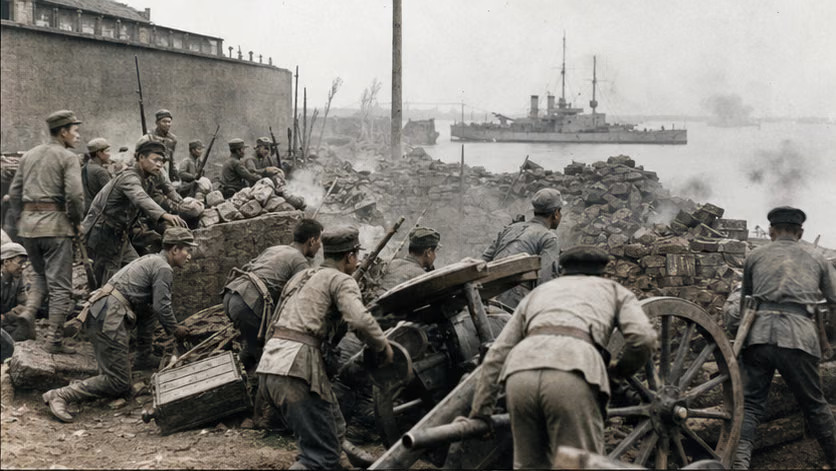
The war had no proper set-piece battle. It was a string of short fights in which provinces raised their flags in succession and were destroyed in succession, ending within two months.
| Phase | Time | Key Points | Separate Articles |
|---|---|---|---|
| Jiangxi begins the rising | 7.12 – 8.18 | On 7.12 Li Liejun declared independence at Hukou to oppose Yuan and won a small initial success; Li Chun's Beiyang troops were reinforced and attacked fiercely, while Hukou fortress commander Chen Jianxun was bought off and defected (figure disputed); on 7.25 Hukou was lost; Li Liejun withdrew to Nanchang and then turned to Fengcheng; on 8.18 Li Chun's troops occupied Nanchang, and the Jiangxi affair failed | Battle of Hukou included in this article |
| Shanghai assault | late July – mid-August | Chen Qimei and others led Shanghai forces in repeated attacks on the Jiangnan Arsenal; the northern troops defending the arsenal held strong works and had naval support, and the attacks failed repeatedly. In August, Shanghai's independence collapsed | Included in this article |
| Nanjing holds alone | 7.15 – 9.1 | On 7.15 Huang Xing entered Nanjing to direct the campaign against Yuan, and Jiangsu declared independence; on 7.28 Huang Xing, seeing the larger situation as hopeless, left Nanjing; in August He Haiming and others raised the independence flag again and held out to the death; on 9.1 Zhang Xun's troops took Nanjing (see next section) | Battle of Nanjing included in this article |
| Provincial responses and endgame | mid-July – 9.12 | Anhui (Bai Wenwei), Guangdong, Fujian, and Hunan declared independence in succession and then canceled it in succession; on 8.4 Xiong Kewu rose in Chongqing, isolated in one corner, and failed on 9.12—the Second Revolution ended here (start and end dates province by province details unrecorded) | Included in this article |
Fall of Nanjing (1913.9.1)
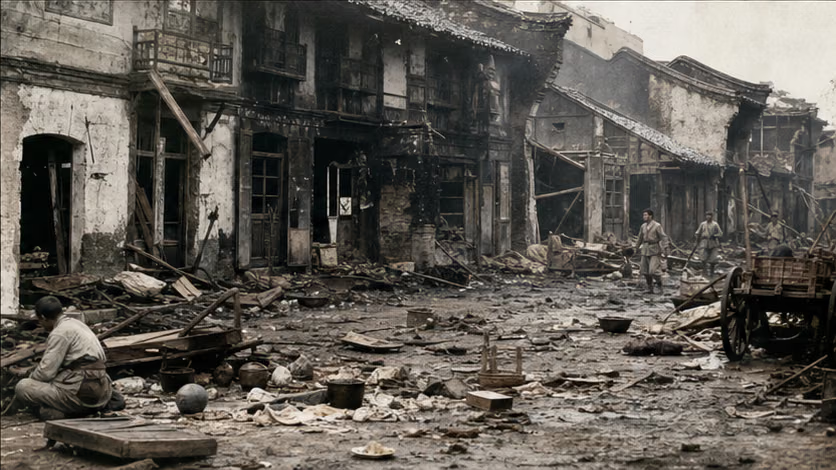
Nanjing was the Anti-Yuan forces' last stronghold. After Huang Xing left Nanjing on 7.28, the city's defense wavered several times; He Haiming and others led remnants and militias to raise the independence flag again and hold the city for more than ten days (day-by-day fighting record unverified). Feng Guozhang commanded northern troops attacking along the river, and on 9.1 Zhang Xun's troops (the Wuwei Vanguard Army, commonly called the Queue Army) were the first to enter the city. ※ After entering the city, Zhang's troops let soldiers burn, loot, and plunder; historians call it the "Guichou Plunder of Nanjing." Merchants and civilians in the city suffered gravely, and Japanese residents were killed and wounded, producing the diplomatic negotiations known as the "Nanjing Incident" (date of the plunder, casualties, and details of the Japanese-resident incident all unverified). In the same war, harassment of civilians was not confined to one side: the Anti-Yuan forces were mostly hastily gathered men, and records from various provinces note that deserters after collapse became bandits (figure disputed)—but organized troops plundering a great city in formation was most notorious in this engagement.
Casualties and Losses
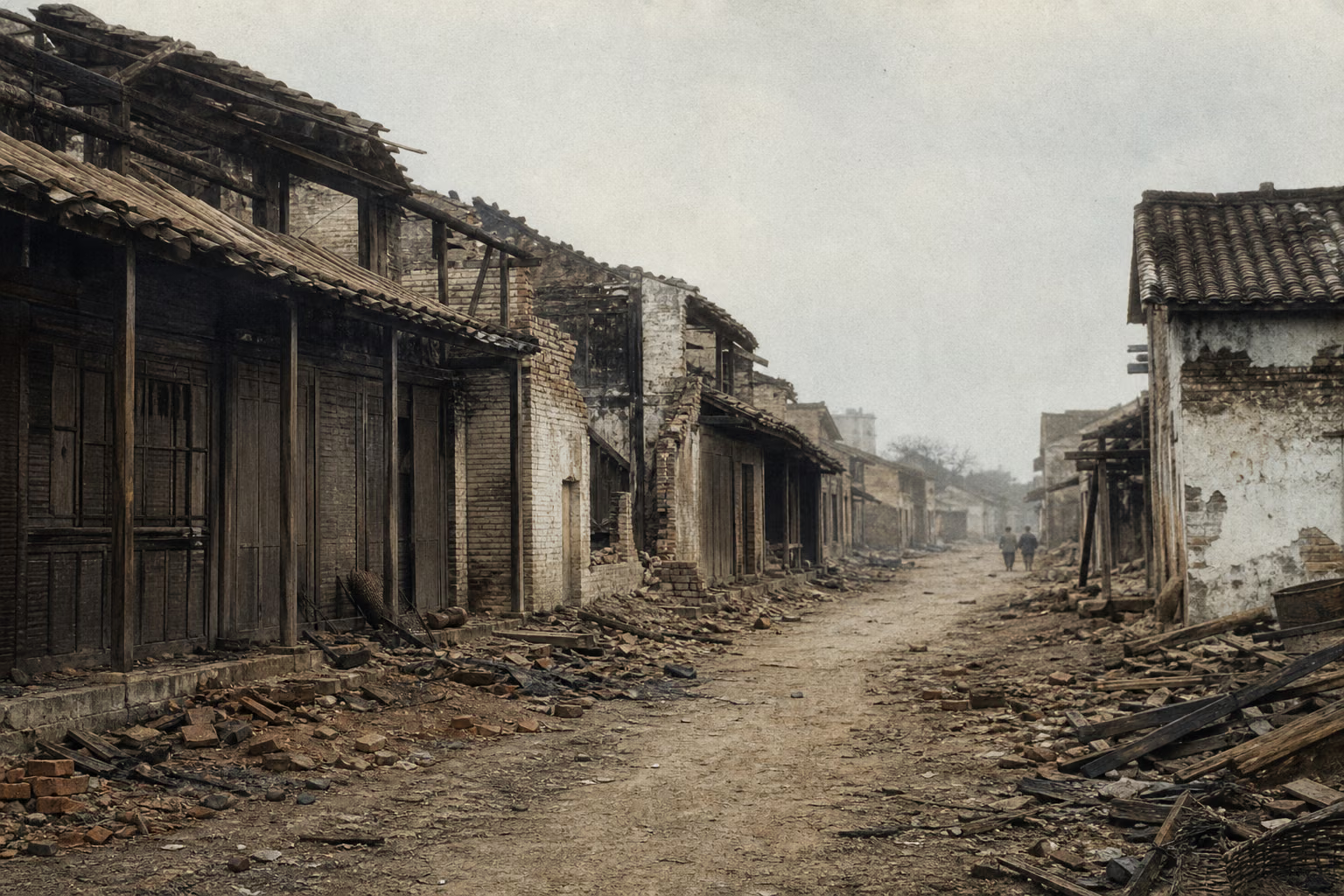
- Anti-Yuan forces: no reliable overall casualty total exists for the engagements (figure disputed); the southern revolutionaries' military strength was essentially swept away through this engagement, and military and civil authority in the provinces all passed to the Beiyang line.
- Beiyang Army: no reliable overall casualty total exists (figure disputed).
- Civilians: beyond the Nanjing plunder, defeated soldiers harassed civilians and commercial ports shut down in battlefields such as Jiangxi and Anhui, with no statistics.
- Political cost (the heaviest account): the Nationalist Party's power in Parliament was destroyed with it, and the slight institutional constraints of the early Republic were brought to zero—see next section.
Aftermath
- Sun Yat-sen, Huang Xing, Li Liejun, Chen Qimei, and others went into exile in Japan in succession. In 1914, Sun founded the Chinese Revolutionary Party in Japan and broke with Huang Xing's faction over the mode of party organization—the split in the revolutionary camp was the interest paid on this defeat.
- In 1913.11 Yuan Shikai ordered the Nationalist Party dissolved, recalled the certificates of Nationalist Party legislators, and left Parliament paralyzed for lack of a quorum; in 1914.1 Parliament was formally dissolved; in May, the Provisional Constitution was abolished and the Constitutional Compact of the Republic of China was promulgated, giving presidential concentration of power a legal basis. The roadblocks on the path to monarchy were thereby cleared.
- After the Hong Shuzu case broke, Hong fled. In 1917 he was seized in Shanghai by Song Jiaoren's son Song Zhenlü and others, and in 1918 was executed by hanging—the only person in the Song case's operational line to face legal execution (execution details unrecorded).
- Two years later, Yuan Shikai proclaimed himself emperor, and Yunnan rose—see also *National Protection War · Overview*.
How Each Side Records It
- Names are positions, so two names are written side by side: southern revolutionary narrative calls it the "Second Revolution" (the second revolution after the Xinhai Revolution), a naming by the revolutionaries; Beiyang official writing calls it the "Ganning Rebellion," a naming of government pacification. Among people of the same year, some also used the cyclical name "Guichou Campaign." Three names, three positions: this article takes "Second Revolution" as the common name, while the other two are listed alongside it in the text.
- Southern revolutionary narrative: a righteous war to oppose Yuan and defend the constitution, defeated by haste and internal divisions; anger over the Song case and defense of the Provisional Constitution were its sources of legitimacy. After exile, this war was retrospectively narrated as one link in the revolutionary lineage of "falling repeatedly and rising repeatedly."
- Beiyang narrative: the central government pacified a southern rebellion, and the four characters "Ganning Rebellion" already contained the verdict; the Yuan Shikai government used the momentum of victory to define the Nationalist Party as a "rebel party" as a whole.
- Later narrative change: when Beiyang-line writers compiled history, this was Yuan's "unification"; after the Nationalist Party came to power, the war entered the orthodoxy of revolutionary history; in recent decades, historical research has increasingly offered sympathetic reassessments—studies of the causes of defeat, the dispute over striking first or later, and reexamination of the evidence in the Song case have restored a "righteous war" to a gamble whose odds were never high (see next section).
Disputes and Sensitivities
- The century-old unresolved question of who ordered the Song case: the trail Ying Kuicheng—Hong Shuzu—Zhao Bingjun stops before the State Council's door. Whether Yuan Shikai knew of it, and whether he ordered it, has always lacked direct evidence. Traditional narratives identify Yuan as the principal plotter; more recent reexaminations, represented by Shang Xiaoming's *Reexamining the Song Case* (Peking University Press, 2018), review the evidentiary chain item by item and reach more cautious conclusions. Multiple views coexist.
- The dispute over "striking first or striking later": after the Song case, Sun Yat-sen advocated an immediate rising, while Huang Xing advocated legal resolution and waiting for Parliament and public opinion; the party delayed for several months. By the time the rising began, Yuan had already borrowed the great loan, dismissed the three military governors, and deployed his troops—later reassessments often regard these months of delay as one cause of defeat. But the opposing side can ask the same question: if they had risen in March, how great would the chance of victory have been? There is no standard answer to this dispute; both views are placed side by side.
- The dispute over characterization: was this a war to defend the republic, or armed defiance of the center by local power-holders? Both layers of narrative coexist.
- Records of the Plunder of Nanjing: Zhang Xun's troops engaging in organized plunder is a basic historical fact, but specific dates and casualty scale mostly come from contemporary newspapers and foreign accounts, and the numbers vary (figure disputed).
Contents
This article has no separate articles—the Battle of Hukou, the attack on the Jiangnan Arsenal in Shanghai, the Battle of Nanjing, and the provincial responses are all included here. If later materials become ample, the section on the Fall of Nanjing can be separated into an article of its own.
Sources and Open Questions
Known main sources:
- Li Liejun, *Autobiography of General Li Liejun*, and *Collected Works of Li Liejun* (the Anti-Yuan commander-in-chief's own account)
- Relevant letters and telegrams in *Complete Works of Sun Yat-sen* and *Collected Works of Huang Xing* (primary records of the rising decision and the dispute over "striking first or striking later")
- Shang Xiaoming, *Reexamining the Song Case* (Peking University Press, 2018; representative work of reexamination of the Song case)
- Lai Xinxia et al., *History of the Beiyang Warlords* (the Beiyang-side context)
- Li Zongyi, *Biography of Yuan Shikai* (Yuan-side decision-making)
- Contemporary newspapers: *Shenbao* and *Minli Bao* reports from the Guichou year (sources for details such as the Plunder of Nanjing; original texts must be checked back)
Open questions: the specific attitudes of the powers toward the northern and southern sides and the details of loan negotiations; overall troop figures for the Anti-Yuan forces and the Beiyang Army; details of the defection of Hukou fortress commander Chen Jianxun; successive fighting in the attacks on the Jiangnan Arsenal in Shanghai; province-by-province dates for declaring and canceling independence; day-by-day fighting in the siege of Nanjing; the dates, casualty scale, and full diplomatic course of the Japanese-resident incident in the "Guichou Plunder of Nanjing"; total casualties on both sides; execution details for Hong Shuzu; the earliest occurrence of the term "Ganning Rebellion" in Beiyang official writings; the sequence of Nationalist Party meetings after the Song case and the letters and telegrams between Sun and Huang; details of the legal-solution path (the Shanghai court's summons of Zhao Bingjun); the Shanghai consultations that decided the rising; Huang Xing's Nanjing decisions and records before leaving the city; details of the Anti-Yuan forces' weapons, pay, and arrears by province; the relation between the great loan and the South's loss of military funding; records of Beiyang internal deployment disputes over the attacks on Jiangxi and Nanjing.
All images on this site are AI-generated depictions. They are not historical photographs, not primary sources, and do not depict any real individual.