War Overview · National Protection War (1915–16)
A remote southwestern province was the first to raise troops, and within half a year turned a war that had reached no military decision into a nationwide abandonment of Yuan Shikai: monarchy died, the republican signboard was hung back up, but from then on the people hanging it were the soldiers of the provinces.
Engagement Data
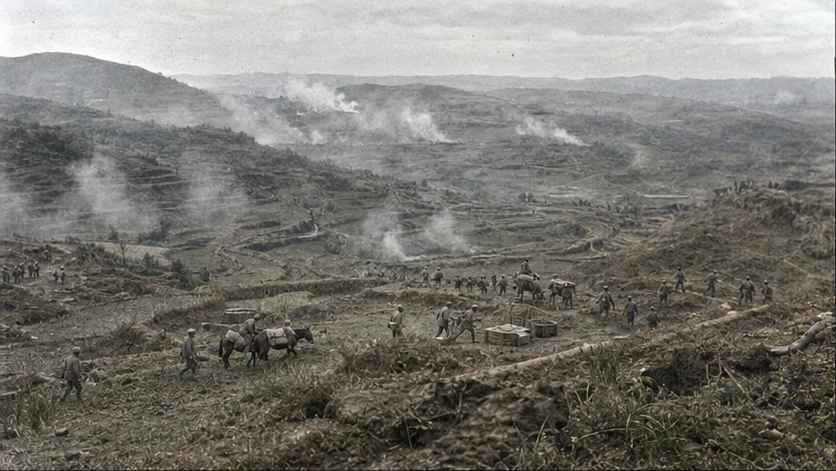
| Item | Content |
|---|---|
| Time | 1915.12 – 1916.7 (from Yunnan's independence on 1915.12.25 to the dissolution of the Military Affairs Council in 1916.7) |
| Place | Main battlefield in southern Sichuan (the Luzhou–Naxi line), with effects reaching western Hunan, Yunnan–Guangxi–Guangdong, and the provinces that declared independence in succession |
| Belligerents | National Protection Army (Yunnan, Guizhou, Guangxi, and other southwestern provinces) / Beiyang Army (Yuan Shikai's Beijing government) |
| Result | On 1916.3.22 Yuan was forced to cancel the monarchy; on 6.6 Yuan died, Li Yuanhong succeeded as president, the Provisional Constitution and Parliament were restored, and the fighting stopped |
Belligerents (War Level)
| Item | National Protection Army | Beiyang Army |
|---|---|---|
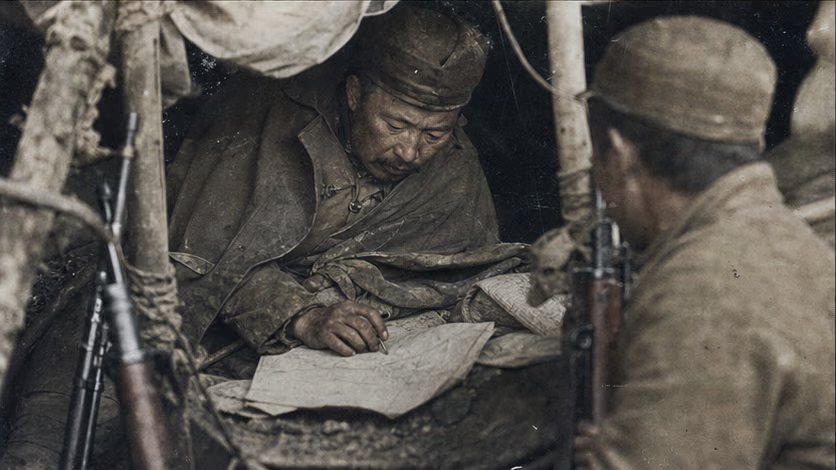
| Total strength | At the outbreak, two divisions and one mixed brigade, about 21,000 men; the First Army's main force entering Sichuan numbered six or seven thousand (another figure gives about eight thousand; bases differ, all unverified) | Nationwide, 13 divisions and 17 mixed brigades, publicly claimed as 380,000; about four divisions and more than 30,000 men were committed to the Sichuan and Hunan fronts (figures vary by account) |
| Equipment | Yunnan's arms and ammunition were not poor among provincial armies, but there was no source of replenishment; every round fired left one round fewer | Complete organization, standardized firearms, and superiority in artillery; Cao Kun's Third Division, Zhang Jingyao's Seventh Division, Li Changtai's Eighth Division, and others entering Sichuan were all main forces |
| Logistics | One province, Yunnan, had to support three armies; both pay and ammunition were short, and supplies to the front were intermittent | Central finances were exhausted by the cost of preparing the monarchy, and foreign-borrowing channels were constrained by the European war and Japan (details unrecorded) |
| Command | Cai E went to the front in person despite illness; the armies shared one goal: only to campaign against Yuan, and not to ask the rest | Frontline commanders were passive: Duan Qirui pleaded illness and refused to take charge of the campaign against Yunnan, Feng Guozhang sat in Nanjing and watched, and the provinces would not send troops |
Situation
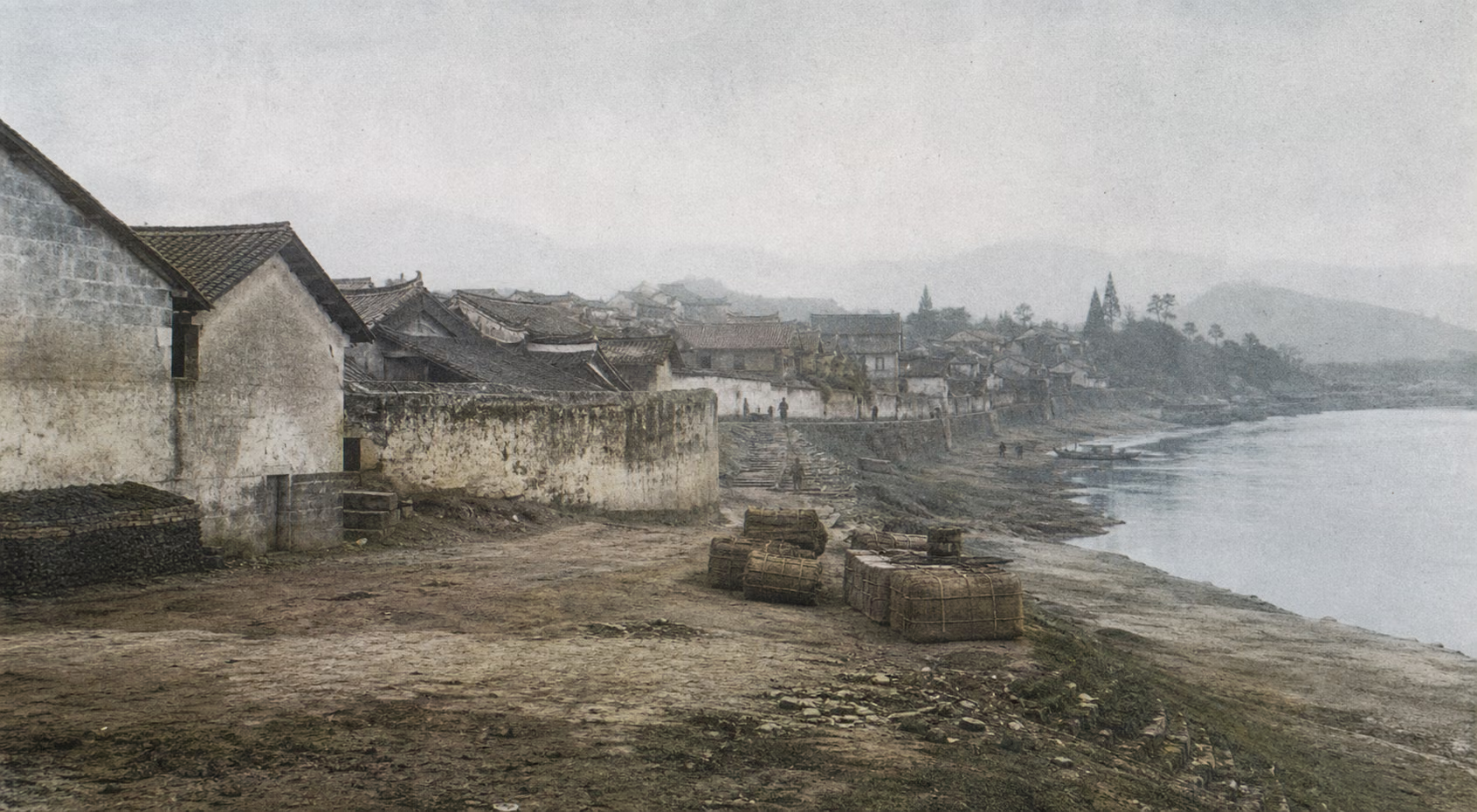
World: The First World War was in full force, and the European powers had no attention to spare for the East. Japan first indulged and then obstructed Yuan's monarchy: at first it showed goodwill in exchange for interests; after Yunnan rose, it turned to support anti-Yuan forces on several sides and refused to receive the special envoy Yuan sent out (details unrecorded). The monarchy had no friends in diplomacy.
China (Beiyang side): After the Second Revolution was suppressed, Yuan Shikai's power reached its peak, and the monarchical process advanced step by step: in 1915.8 the Society for Planning Peace was founded, advocating monarchy in the name of academic discussion; provincial "citizens' groups" and "petitions" urged enthronement; the Political Council, under the name of a "National Convention," unanimously urged enthronement; on 12.12 Yuan accepted the imperial throne and designated 1916 as the first year of "Hongxian." The first nail at the level of public opinion was Liang Qichao's essay "Strange Indeed, This So-Called Question of the State Form," published in 1915.8: the Progressives openly broke with the monarchy.
Southwestern side: After the Xinhai Revolution, the Yunnan army retained a revolutionary-party base, anti-Yuan feeling was fierce among middle- and lower-ranking officers, and Tang Jiyao half-resisted and half-drifted aboard. Cai E, held close under Yuan's restraint in Beijing, pretended to indulge in wine and women and to avoid politics, then found a chance to leave the capital and, by way of Tianjin, Japan, Hong Kong, and Vietnam, made his way into Yunnan (the phrase "to fight for the dignity of four hundred million people" circulated very widely, source unverified). Liang Qichao went south to coordinate, moving between Shanghai and Guangxi. In Guangxi, Lu Rongting held heavy troops and waited to see his price; his alignment later became the weight on the scale.
Why It Was Fought
Yunnan's resolve was first settled in the barracks of its middle- and lower-ranking officers. The Yunnan army retained the foundation of the Xinhai Revolution, and the anti-Yuan atmosphere had long since become impossible to suppress at company- and platoon-commander level, with several attempts brewing toward spontaneous action. Tang Jiyao at first watched and waited. Yunnan had only two divisions and one brigade; for one province to rise alone was to set one province against the whole country. What he hesitated over was not whether to oppose Yuan, but whether he could survive after doing so. Three things landing in succession made up his mind: monarchy moved from public argument into fact, when on December 12 Yuan Shikai accepted the "enthronement" and announced a new era name; Cai E escaped Beijing and, in mid-December, reached Kunming by way of Japan, Hong Kong, and Hanoi (the exact date of arrival in Yunnan is unverified) -- this famous general, whom Yuan Shikai had kept restrained in Beijing, stood there in person, in effect guaranteeing to the world on Yunnan's behalf that this was not a local rebellion; and Liang Qichao's letters and telegrams of instigation kept coming, while the Progressives promised diplomatic and public-opinion support. On December 23, Yunnan telegraphed Beijing, demanding cancellation of the monarchy and punishment of the culprits, with a deadline for reply (original telegram unverified). No reply arrived; on December 25 it sent a circular telegram declaring independence, and the National Protection Army took its oath. From Cai E's arrival in Yunnan to the circular telegram that began the rising, less than ten days passed. The political preparation had long been complete; Yunnan was waiting for someone to sign and seal it.
The material account was clearest to the people who rose. Yunnan's military expenses had long depended on subsidies from other provinces; independence cut them off at once. One province had to support three armies fighting outside the province, relying on withheld salt taxes, public bonds, and province-wide retrenchment (details of military-finance raising unverified). Cai E's First Army entering Sichuan had only six or seven thousand men, with no source of replenishment for weapons or ammunition; every round fired left one round fewer. The National Protection Army's calculation was never to destroy the Beiyang main force, but to create a posture of "the southwest not yet pacified" and wait for changes in the provinces and inside Beiyang itself. That calculation was later proved right; but by the time it was right, Cai E's sick body and Yunnan's finances were already near their limit. When the Naxi front was at its tightest, ammunition supply was counted by the day (details unverified).
On Yuan Shikai's side, the decision for monarchy rested on layer after layer of "urging enthronement." Telegrams urging enthronement from provincial generals and civil governors, and unanimous enthronement by the Political Council's "National Convention": the public will he saw was manufactured by his own system, and he needed to believe it. His misjudgment had three layers. He thought Yunnan not worth serious concern, and that a detached force could sweep it away; deployment on the Sichuan and Hunan fronts began in haste only after the National Protection Army entered Sichuan. He thought the Beiyang commanders would obey every order, and did not see the chill behind Duan Qirui's illness and Feng Guozhang's watching from the side. He thought Japan would ultimately use the monarchy as a bargaining chip, and did not anticipate Japan's turn to support all sides opposing Yuan. Opposition to monarchy inside his own system was in fact not small: Duan Qirui left office on grounds of illness, Zhang Jian resigned as minister and left Beijing, and Liang Qichao openly broke with him in print. It was only that these voices had no army as their footnote, until Yunnan gave them one.
On February 23, 1916, Yuan announced that the monarchy would be postponed and abolished the office preparing the enthronement ceremony; on March 22, he revoked the case recognizing the imperial throne. From the Hongxian era change to the cancellation of monarchy, eighty-three days passed. What crushed it was not the fighting in southern Sichuan, but the total account of Guangxi's independence joining the southwest into one piece, the leaked secret telegram of the five generals, and the double severing of diplomacy and finance.
Course of the Engagement (Five Stages)
| Stage | Time | Key Points | Separate Article |
|---|---|---|---|
| Yunnan rises | 1915.12 | On 12.25 Tang Jiyao, Cai E, and Li Liejun jointly sent a circular telegram announcing Yunnan's independence and forming the National Protection Army's three armies: Cai E's First Army entered Sichuan, Li Liejun's Second Army moved toward Guangxi and Guangdong, and Tang Jiyao concurrently commanded the Third Army remaining behind | — |
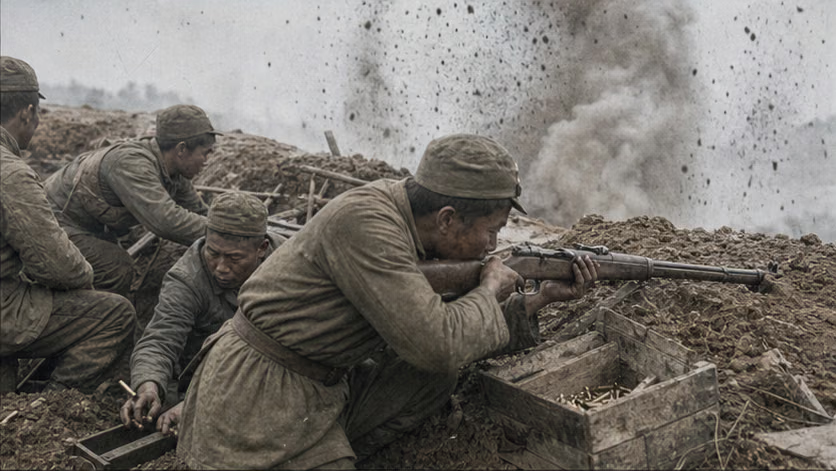
| Fighting for southern Sichuan | 1916.1–3 | The National Protection First Army took Xufu and pressed Luzhou; Beiyang forces including those of Cao Kun and Zhang Jingyao entered Sichuan, and the two sides held and seesawed along the Naxi line (mainly at Mianhuapo), each winning and losing, with neither able to swallow the other | Battle of Luzhou–Naxi |
| Western Hunan and the Yunnan–Guangxi direction | 1916.1–3 | Wang Wenhua's Guizhou troops entered western Hunan, while Beiyang forces under Ma Jizeng and others entered Hunan to block them, and the line became deadlocked (details unrecorded); Long Jinguang's Guangdong troops borrowed a route through Guangxi to attack Yunnan, only to be disarmed by Guangxi troops (details unrecorded) | — |
| Guangxi independence and cancellation of monarchy | 1916.3 | Guizhou had already declared independence in January; on 3.15 Lu Rongting announced Guangxi's independence, joining the southwest into one piece: the turning point; on 3.22 Yuan was forced to abolish the monarchy | — |
| After the cancellation of monarchy | 1916.4–7 | Yuan clung to the presidency; in April-May Guangdong, Zhejiang, Shaanxi, Sichuan, and Hunan declared independence in succession; on 5.8 the National Protection Army's Military Affairs Council was established at Zhaoqing; on 6.6 Yuan died; Li Yuanhong succeeded him, restoring the Provisional Constitution and Parliament; in July the Military Affairs Council was dissolved, and the fighting ended | — |
A War Without a Decisive Battle
The National Protection War had no decisive military engagement: southern Sichuan stood in stalemate for months, the National Protection Army failed to break the Beiyang main force, and the Beiyang Army likewise failed to open the southwest's gate. Monarchy died from the collapse of three other lines: no one recognized it diplomatically, there was no grain for the pot fiscally, and most fatal was the centrifugal force inside Beiyang. Feng Guozhang contacted Li Chun in Jiangxi, Zhu Rui in Zhejiang, Jin Yunpeng in Shandong, and Tang Xiangming in Hunan, planning a "secret telegram of the five generals" to urge Yuan to abdicate; the matter leaked, and Yuan was shaken with fear (original telegram unverified). What defeated Yuan Shikai was not the National Protection Army's guns, but the state of feeling among the people inside his own system. The eighty-three-day monarchy (counting from the Hongxian era change on New Year's Day 1916; if counted from the acceptance of the imperial throne on 1915.12.12, it was more than one hundred days, and both bases coexist) was dismantled by universal abandonment.
Casualties and Losses
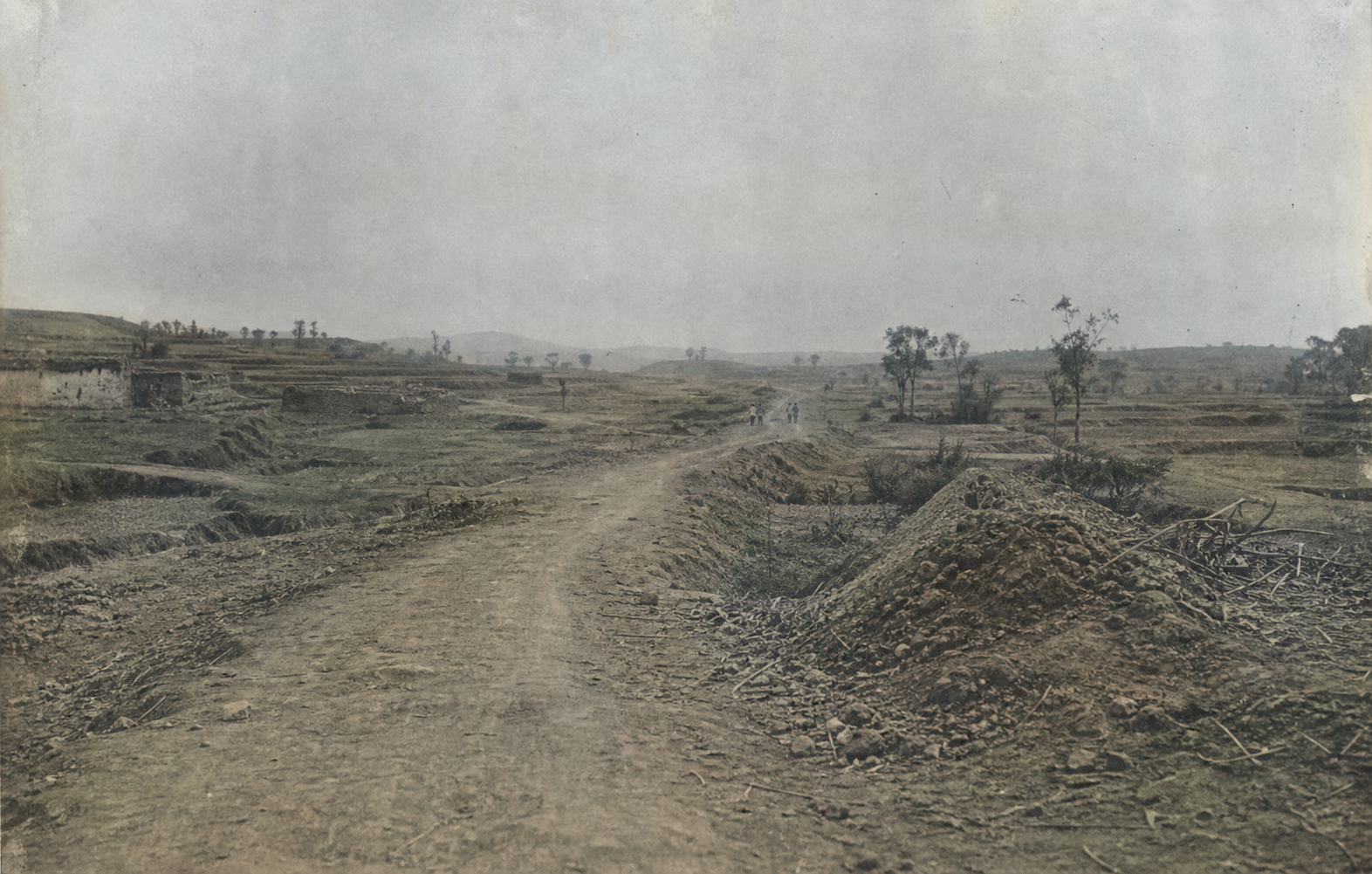
- There are no systematic casualty statistics for either side. After several months of hard fighting along the southern Sichuan line, the National Protection First Army suffered several thousand casualties (figure disputed); Beiyang Army casualties likewise appear only in scattered records.
- Civilians: military disaster and requisitions in the southern Sichuan and western Hunan war zones, with no statistics.
- Finance: the preparations for monarchy cost sums counted in the tens of millions (figures unverified); Yunnan sent troops for half a year by the strength of one province, and after the war its finances were close to bankruptcy.
Aftermath
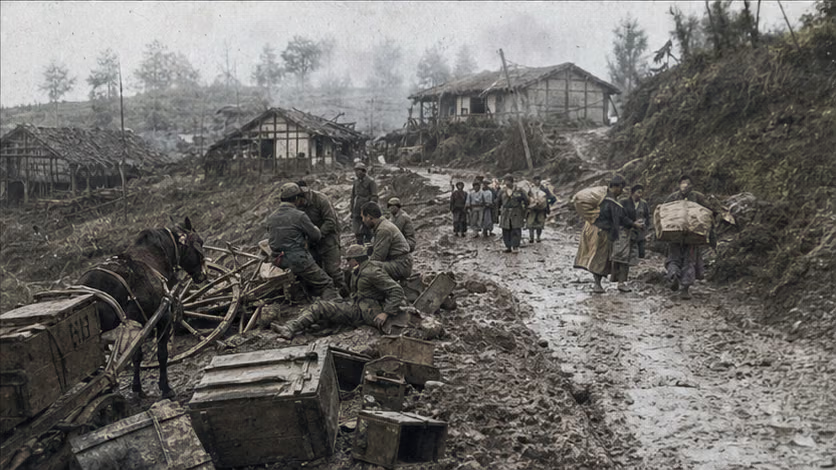
- Li Yuanhong succeeded as president, Duan Qirui formed a cabinet, and the Provisional Constitution and the old Parliament were restored: "recreating the republic" was completed on paper.
- But the fruit fell into the hands of provincial military groups: the Yunnan army remained stationed in Sichuan, the Guangxi clique grew powerful across Guangdong and Guangxi, and Tang Jiyao used Yunnan as his base. From this point on, provincial military governors became territorially entrenched and armies became privately held. The victory of national protection was at the same time the opening of the warlord era (see the articles on Warlord Era Conflicts).
- In 1916.8 Cai E left Sichuan for Japan for medical treatment; in November he died of illness, aged thirty-four. The foremost hero of "recreating the republic" shared none of the fruit, and that instead completed his posthumous name.
- The National Protection narrative became the core of Yunnan's local memory; Huguo Road and Huguo Bridge still remain today (specific development unverified).
How Each Side Records It
- National Protection Army / southern narrative: the righteous first rising that "recreated the republic." Yunnan commemorates the National Protection Uprising every year; within the narrative, there is also a dispute over whether credit belongs to Cai E, Tang Jiyao, or Liang Qichao's instigation, with the Progressive and Kuomintang systems each holding to one side.
- Beiyang narrative: official Beijing government telegrams and documents characterized it under labels such as "Yunnan disorder" and "southwestern incident" as a local rebellion: the same battle had two names, and the name was the position. After the monarchy was canceled, Feng Guozhang, Duan Qirui, and others each claimed for themselves the credit for urging Yuan to withdraw; from then on, the Beiyang system collectively fell silent about this war.
- Later narrative change: textbooks settled it as the "National Protection Movement," incorporated into the progressive narrative of opposing Yuan and protecting the republic; in recent decades, scholarship has reassessed the actual weight of Tang Jiyao and Lu Rongting, and the dispute over "first credit" has reopened. In popular memory, the romanticized layer of Xiao Fengxian once drowned out formal history.
Disputes and Sensitivities
- The dispute over leadership: Tang Jiyao and Cai E -- who resolved on the first rising, and who directed the war situation. Yunnan local narrative raises Tang; the common national-history narrative raises Cai; both sides have archival support.
- Liang Qichao's weight: the essay "Strange Indeed" and the credit for southern coordination are extremely important in the Progressives' own account; Kuomintang-system narratives instead emphasize the Chinese Revolutionary Party's contemporaneous risings and sacrifices in various places. Both accounts are true; the dispute over weight continues to this day.
- Cai E and Xiao Fengxian: the story of Cai E and Xiao Fengxian belongs to the layer of romance, and long occupied popular imagination; it is different from the factual layer of the National Protection War.
- Whether "recreating the republic" holds: the republican signboard was hung back up, but substantive power fell to military groups. Some historians therefore argue that national protection protected only the name.
Contents
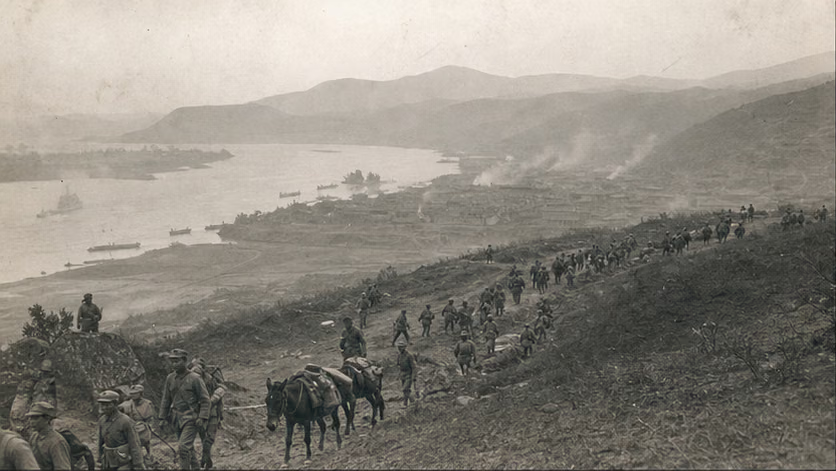
Xufu, western Hunan, and the Yunnan–Guangxi lines are all incorporated into *Battle of Luzhou–Naxi*.
Sources and Open Questions
Main sources: Li Jiannong, *A Political History of China in the Last Hundred Years*; Zhonghua Book Company's *History of the Republic of China*, Part II, Volume 1 (the period of Beiyang warlord rule); Liang Qichao, *Collected Works from the Ice-Drinker's Studio*, letters and telegrams from the National Protection period; Cai E, *Posthumous Writings from Songpo's Military Service*; source compilations titled *National Protection Movement* (compiled by Yunnan and other sides; exact titles unverified). Publicly available online materials are used only as leads, not as grounds for conclusions.
Open questions: the source of the phrase "to fight for the dignity of four hundred million people"; the original text of the secret telegram of the five generals and the definitive list of names; the sources for the various troop-strength bases on both sides (21,000 / 8000 and 380,000 / more than 30,000); casualties of the National Protection First Army; details of the western Hunan front; the sequence of Long Jinguang's troops being disarmed; details of Japan's first indulging and then obstructing the monarchy; the original basis for the two ways of counting the monarchy's duration; details of Cai E's death from illness; the development of Huguo Road and Huguo Bridge; exact titles of the *National Protection Movement* source compilations; the original text of Yunnan's December 23 telegram to Yuan and the wording of the deadline for reply; the exact date of Cai E's arrival in Yunnan; details of Yunnan military-finance raising (salt taxes, public bonds); details of ammunition supply at the Naxi front; phrasing of the relationship between Duan Qirui's and Zhang Jian's departures from office and the monarchy.
All images on this site are AI-generated depictions. They are not historical photographs, not primary sources, and do not depict any real individual.