Engagement Archive · Battle of Luzhou–Naxi
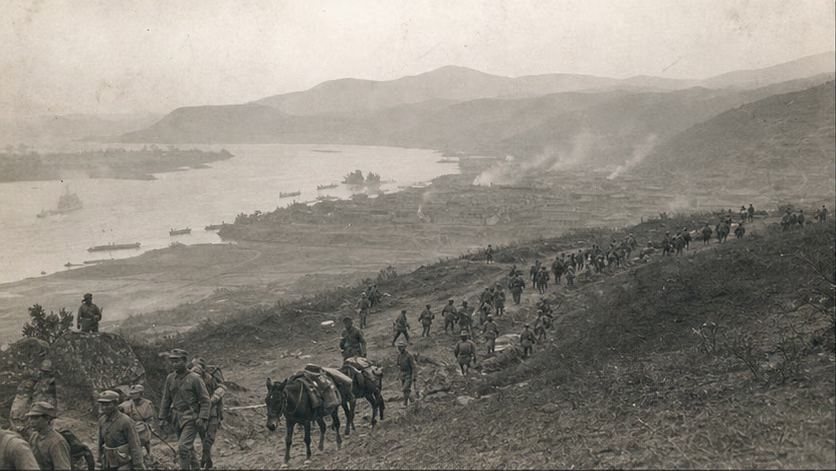
Several thousand National Protection Army troops held the line at Luzhou and Naxi in southern Sichuan against tens of thousands of Beiyang troops for three months; militarily the fighting ended in stalemate, and what collapsed first was Beijing's imperial regime.
Engagement Data
| Item | Details |
|---|---|
| Time | Late 1916.1 – end of March, with the Luzhou–Naxi line held in stalemate for about two months (about three months counted from the National Protection Army's entry into Sichuan) |
| Place | The Luzhou–Naxi line in southern Sichuan (south bank of the Yangtze, around Lantianba, Mianhuapo, and the Yongning River) |
| Affiliation | National Protection War · Southern Sichuan front (for the larger situation, see "National Protection War: Overview") |
| National Protection Army | First Army of the National Protection Army (commander-in-chief Cai E, chief of staff Luo Peijin), mainly Yunnan troops, with Liu Cunhou's Sichuan troops attached |
| Beiyang Army | Expeditionary Army Against Yunnan (commanded by Cao Kun and Zhang Jingyao, official titles unverified), comprising Cao Kun's Third Division, Zhang Jingyao's Seventh Division, Li Changtai's Eighth Division, and others, plus pro-Yuan Sichuan troops |
| Result | Military stalemate; on 3.31 the two sides reached a frontline ceasefire, and after the imperial regime was cancelled the northern troops withdrew from southern Sichuan in succession |
Belligerents
| Item | National Protection Army | Beiyang Army |
|---|---|---|
| Troop strength | The First Army's total force entering Sichuan was six to seven thousand (one basis) / around eight thousand (another basis), with only several thousand actually committed on the Luzhou–Naxi line | Four divisions and more than thirty thousand on the front (one basis) / nearly one hundred thousand including later reinforcements and pro-Yuan Sichuan troops (another basis) -- two bases coexist |
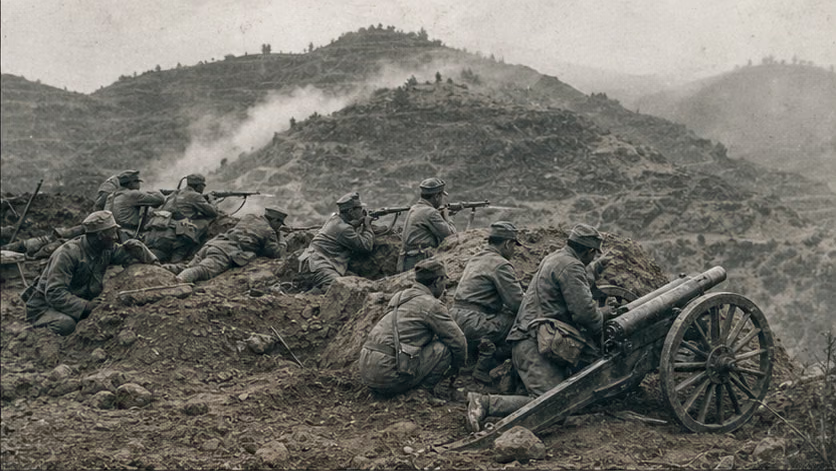
| Firepower | More than ten mountain guns (disassembled and transported into Sichuan by pack animals, number unverified), with rifles and machine guns as the main weapons | Divisional artillery, machine-gun units, and Krupp mountain and field guns |
| Supply | Yunnan committed nearly all it had to the expedition, with pay and equipment both short; records that the front was "without clothing enough to cover the body, without food enough for the next day" are unverified | Depots entered Sichuan along the Yangtze, with ample grain and ammunition; but the transport line was long and depended on the Sichuan river route |
| Morale | A righteous army campaigning against Yuan, conscious of fighting for the republic | Officers and men were generally cool toward the imperial regime; records that they "did not wish to sell their lives for the Yuan family" and went through the motions at the front are unverified |
Terrain and Conditions
(For the larger situation at the end of 1915 -- Yuan Shikai's assumption of the throne, Yunnan's independence, and the nationwide campaign against Yuan -- see "National Protection War: Overview"; here the account is limited to southern Sichuan.)
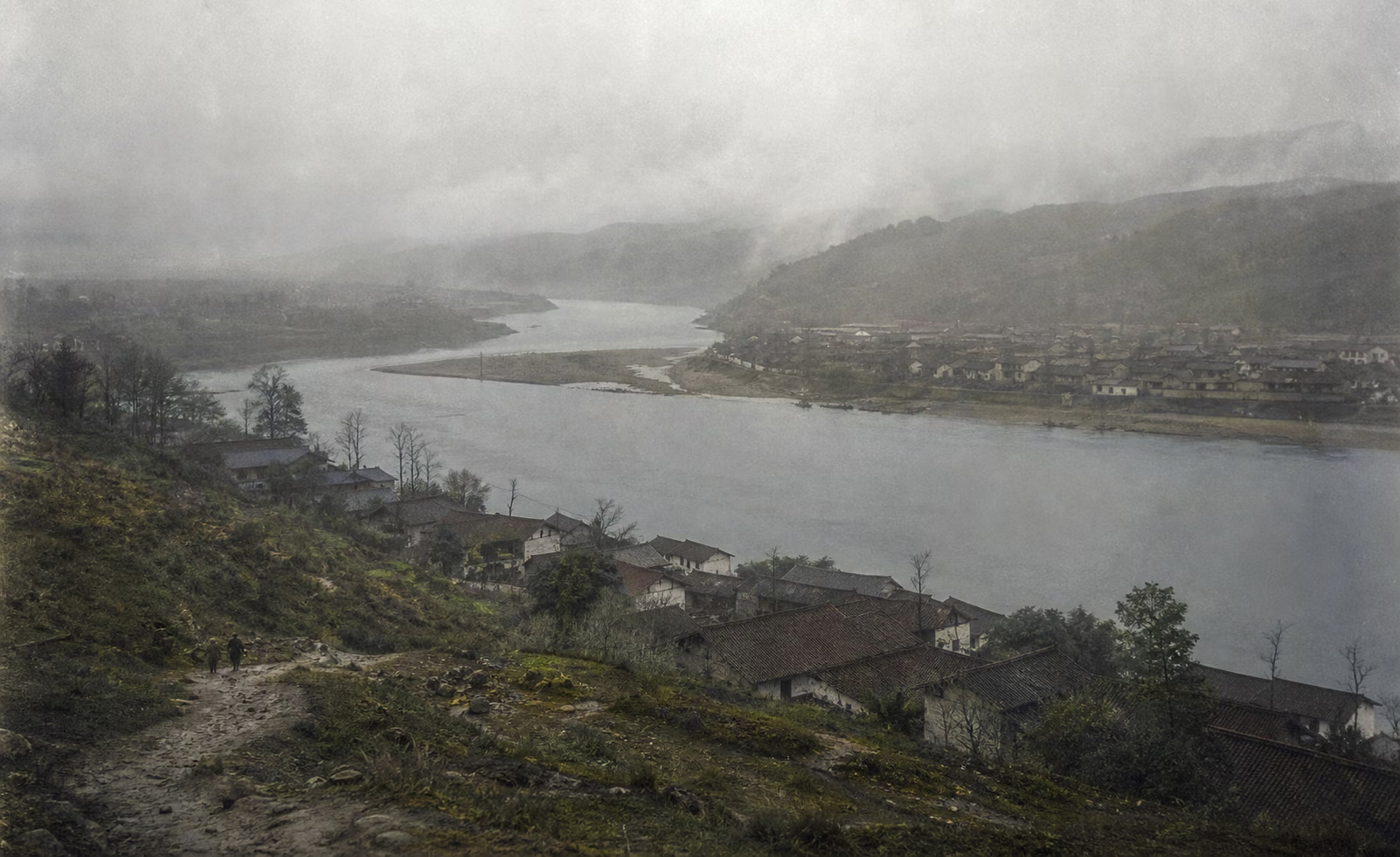
The southern Sichuan corridor: Luzhou controlled the meeting point of the Yangtze and Tuo rivers. The overland route from Yunnan and Guizhou into Sichuan joined Yangtze river transport here, making it the gateway to southern Sichuan. Naxi lay upstream from Luzhou on the south bank, where the Yongning River entered the Yangtze; beyond Naxi lay the mountains of Yunnan and Guizhou. For the National Protection Army's main route northward from Yunnan, everything up to Luzhou was mountain road.
Local sentiment: Liu Cunhou's Second Division of Sichuan troops was stationed at Naxi and on 1.31 issued a local circular telegram against Yuan; the National Protection Army had internal support and guides when it entered Sichuan (details unrecorded). Sichuan gentry and merchants had already been wary of northern troops entering the province, and local attitudes generally leaned toward the National Protection Army (figure disputed).
Terrain: The south bank of the Yangtze was a chain of hills, with much fog and miasma; large units could not deploy, and small units could hide easily. A commanding point like Mianhuapo could be held by a detachment and not necessarily taken by a division -- the advantage in numbers was naturally discounted in the mountains of southern Sichuan.
Why It Was Fought
The Second Revolution was decisively defeated: in the summer of 1913, seven provinces raised banners against Yuan in succession, only to be defeated one by one by the Beiyang Army within two months; Sun Yat-sen and Huang Xing fled to Japan, and southern military and political power passed entirely into Beiyang hands. After that, the obstacles were removed one by one -- the Kuomintang dissolved, the National Assembly dissolved, the Provisional Constitution abolished, and the road to monarchy cleared. In August 1915, the Chou'an Society appeared to advocate monarchy; "citizen groups" in the provinces petitioned to urge acceptance of the throne, and the Political Council, in the name of a National People's Representative Assembly, unanimously urged the enthronement. On December 12, Yuan Shikai accepted the imperial title and designated 1916 as the first year of Hongxian.
Opposition had also begun in August: Liang Qichao published "Strange Indeed, This So-Called Question of State Form," and the Progressive Party openly broke with the imperial system; Cai E, in Beijing, feigned indulgence in wine and women and indifference to politics, seeking a chance to escape. He made his way south by way of Tianjin, Japan, Hong Kong, and Vietnam, reached Kunming on December 19, and settled the plan after several days of military meetings (meeting details unverified). Before Yunnan rose, cautious voices did exist within its ranks; later accounts differ over Tang Jiyao's hesitation about immediately attacking Yuan (accounts vary, unverified). On December 23, Yunnan telegraphed Beijing, demanding cancellation of the imperial system and punishment of the ringleaders, with a deadline for reply; the telegram brought no result. On the 25th, Tang Jiyao, Cai E, and Li Liejun jointly issued a circular telegram: Yunnan declared independence and organized three armies of the National Protection Army. Cai E's First Army entered Sichuan, Li Liejun's Second Army moved toward Guangxi and Guangdong, and Tang Jiyao concurrently commanded the Third Army and remained in the rear.
The main theater was bound to be Sichuan. For Yuan Shikai, Sichuan had to be held -- if Sichuan were lost, the southwest would link into a single bloc and the imperial regime would have no room left to recover. He put Cao Kun and Zhang Jingyao in command of Beiyang elite troops and sent them upriver into Sichuan. For the National Protection Army, the dry route out of Yunnan ran north through the mountains of Yunnan and Guizhou and joined Yangtze river transport at Luzhou -- Luzhou controlled the meeting of the Yangtze and Tuo rivers and was the gateway to southern Sichuan; only by taking it could there be Sichuan, and only then the upper Yangtze. There was also support inside Sichuan: Liu Cunhou's Second Division of Sichuan troops was stationed at Naxi, and on January 31 it issued a local circular telegram against Yuan.
Both sides were racing time, but in different ways. Yuan Shikai wanted a quick victory -- two years earlier, the Second Revolution had been swept away in two months, and this time he was again deploying Beiyang elite troops, intending to show the fence-sitting military governors in the provinces what would happen. What he did not calculate was, first, that several thousand National Protection Army troops would hold tens of thousands of northern troops in the mountains of southern Sichuan for three months, and second, the footing within his own camp -- Xu Shichang did not support the imperial regime and left office early, Duan Qirui claimed illness and refused responsibility for the expedition against Yunnan, Feng Guozhang sat in Nanjing and watched, and the provinces were slow to send troops. Cai E wanted to seize the initiative: on January 16 he led the main force out of Kunming, entered Sichuan by way of Bijie, while Liu Yunfeng's advance echelon occupied Xufu (present-day Yibin) on January 21 and pointed straight at Luzhou. What he knew was that Liu Cunhou was waiting at Naxi (whether there had been a prior agreement is unverified); what he did not know was the strength and speed of the northern troops entering Sichuan, or how passive Duan and Feng would become. Yunnan alone had to support three armies, with pay and ammunition both short -- relying on intercepted salt revenues and emptied provincial coffers (details unverified), with mountain guns disassembled for pack transport and men and horses carrying loads over the mountains. Every round of ammunition brought into Sichuan was one round fewer once fired -- this was not a war that could be allowed to drag on.
Cao Kun's troops traveled upriver by boat, Cai E's troops crossed the mountains northward, and both headed for Luzhou. Luzhou was the key to southern Sichuan; neither side could retreat, and the war became a contest of attrition between Luzhou and Naxi.
Course of the Engagement
| Stage | Time | Main points |
|---|---|---|
| Entering Sichuan and opening the road | Mid-to-late January | Liu Yunfeng's advance echelon occupied Xufu on 1.21; Cai E led the main force out of Kunming on 1.16, entered Sichuan by way of Bijie, and reached Yongning on 1.31 |
| Attack on Luzhou checked | Early February | On 2.5, Yunnan and Sichuan National Protection Army troops jointly attacked Lantianba on the south bank of Luxian and pressed close to Luzhou; blocked by Cao Kun's main force, they withdrew to Naxi -- from this point the attack on Luzhou turned into the defense of Naxi |
| Seesaw at Mianhuapo | Mid-February – early March | Zhu De and three other detachments from Gu Pinzhen's echelon reinforced Naxi; positions on Mianhuapo (commanding ground southeast of Naxi) changed hands repeatedly for more than twenty days, and detachment commander Zhu De made his name there |
| Exhaustion and withdrawal | Early March | With ammunition exhausted and troops worn down, the National Protection Army at one point withdrew from Naxi and fell back to the Dazhouyi line (dates vary by account); Xufu also fell in succession (dates vary by account) |
| Counterattack on the momentum | Mid-to-late March | Guangxi declared independence on 3.15, and the northern troops' morale ebbed; the National Protection Army counterattacked and recovered positions around Naxi |
| Ceasefire | Late March | Yuan Shikai cancelled the imperial regime on 3.22; on 3.31 Zhang Jingyao and Cai E reached a frontline ceasefire, and the line froze |
Casualties and Losses
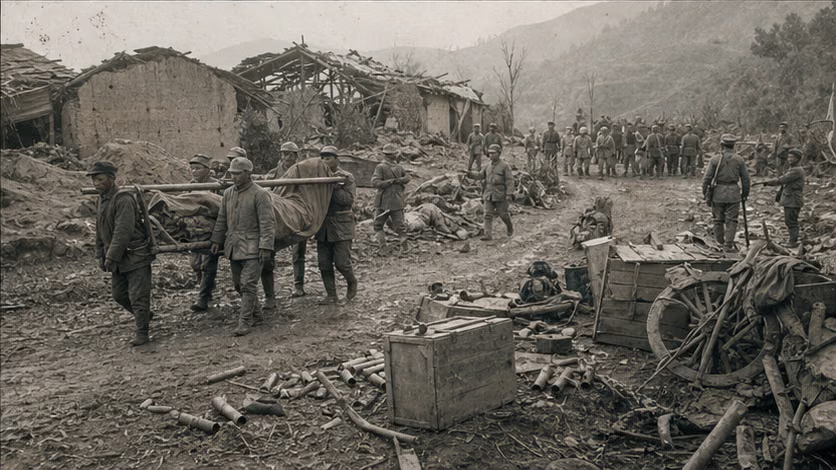
- National Protection Army: casualty figures are several thousand in different accounts, with the statistical basis unverified. Cai E's final instructions specifically asked that "for those killed in battle in Sichuan and those who rendered service, Luo Peijin and others be ordered to verify the facts and submit requests for pensions" -- even after fighting until the ceasefire, this side still did not have a complete roster of its dead.
- Beiyang Army: no reliable casualty statistics have been found (figure disputed); more important than the number killed was the spread of war-weariness.
- Local population: market towns and villages between Luzhou and Naxi repeatedly changed hands; concrete records of the burden on civilians from military corvee and grain requisition are unverified.
Aftermath
- The imperial regime was cancelled on 3.22, and Yuan Shikai died on 6.6; the ceasefire line held until after Yuan's death, and northern troops withdrew from Sichuan in succession.
- During the stalemate and around the ceasefire, Guizhou, Guangxi, Guangdong, and Zhejiang declared independence in succession -- Luzhou–Naxi was not the endpoint of the National Protection War, but it was the turning point: in the three months when the front was locked, the unraveling began politically. Military stalemate overlaid with political collapse: this engagement is a sample of that mechanism.
- In July Cai E was appointed Sichuan military governor and provincial governor; two months later he resigned because of illness, crossed east to Japan for treatment in September, and died of illness in Fukuoka on 1916.11.8, aged thirty-four. On 1917.4.12 he received a state funeral at Yuelu Mountain in Changsha, the first state funeral of the Republic of China.
Accounts of Those Present
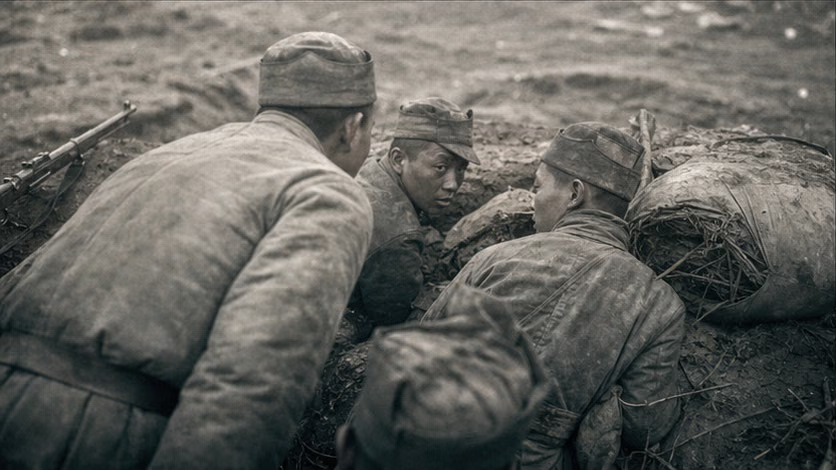
- Cai E's illness: Throughout the command of the battle he was already suffering from lung disease and a throat ailment; his voice was hoarse and he could not speak loudly, so orders were relayed by whispers (details unrecorded). The account that he "coughed blood and collapsed in the command post" appears in memoir writing, but in one source only. After this battle, he had only eight months left to live.
- Zhu De: Detachment commander in the Third Echelon (there are two accounts of the unit number, Sixth Detachment and Third Detachment, unverified), he led his troops in urgent relief of Naxi on 2.17, "marching on an empty stomach, with no time to eat" -- taking over the defense of Mianhuapo on an empty stomach. "Zhu De's name was made at Mianhuapo" (source unverified); this was the man who later became commander-in-chief of the Chinese People's Liberation Army.
- Luo Peijin's oath to the troops: When the position at Naxi's east gate wavered for a time, chief of staff Luo Peijin stepped forward and swore to the troops that "even if we die, we die together here," and the whole army lay down behind the embankment and held to the death (cited in Zhu De Zhuan, original source unverified).
- The other side's thinking: Officers and men on the Beiyang front were cool toward the imperial regime, and descriptions of fighting when pay arrived and watching when pay ran out appear scattered in memoirs; systematic records are unverified -- this was the other half of the reason the stalemate could hold.
The Ground
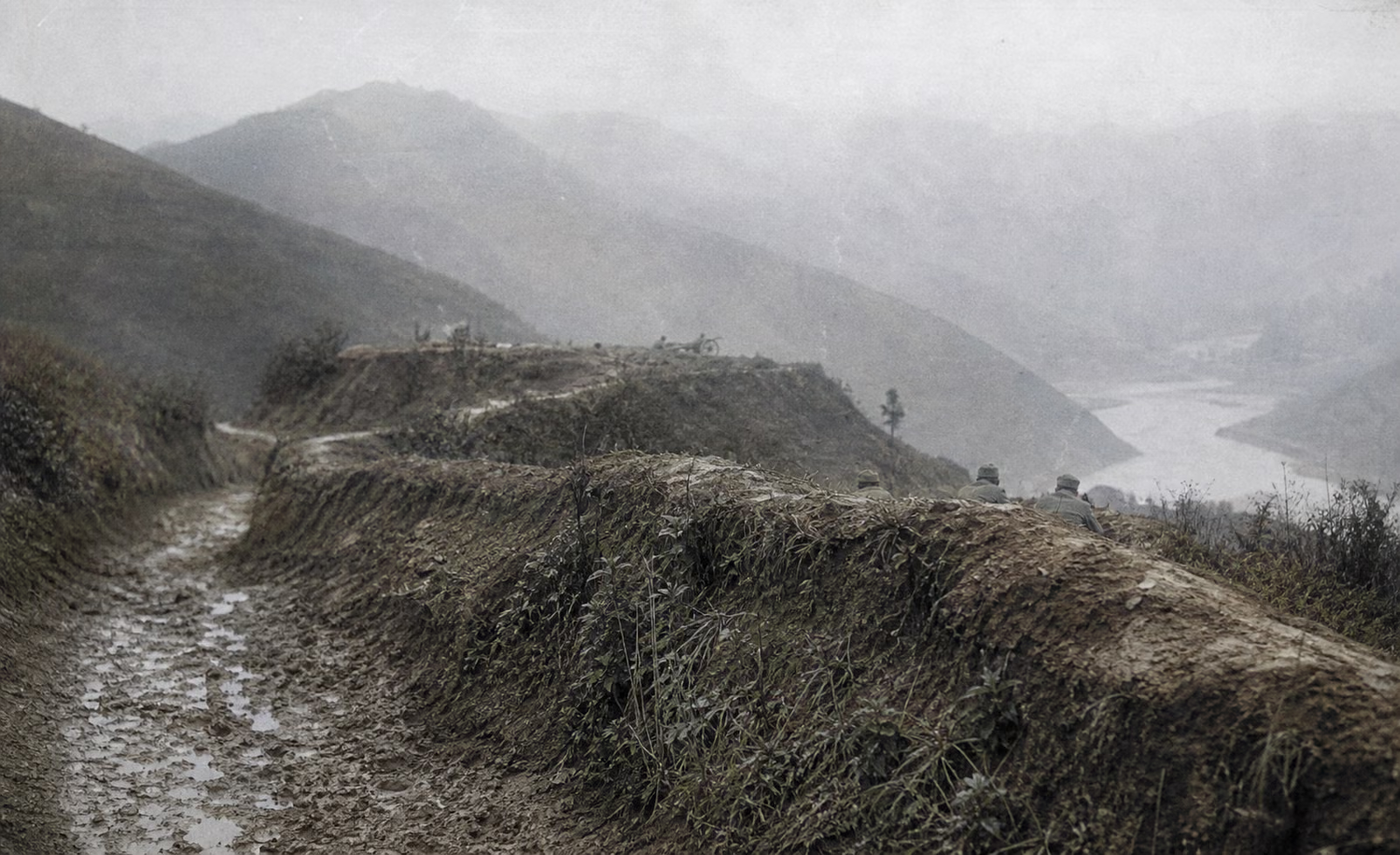
- The Yangtze was both a natural barrier and a supply line: the northern troops relied on the Sichuan river route to move soldiers and guns, while the National Protection Army was in the mountains on the south bank, and the great river separated two worlds.
- Naxi lay in the angle between the Yangtze and Yongning River; attacking Luzhou first required taking Naxi, and defending Naxi required holding Mianhuapo -- the battlefield narrowed layer by layer to a single ridge.
- Mianhuapo: commanding ground southeast of Naxi, a detachment-level defensive frontage, seesaw fighting on a slope, a scale of several hundred meters, changing hands repeatedly for more than twenty days.
- Rain and fog, hills, and pack-transport supply lines -- the firepower and numerical advantages of large formations diminished layer by layer in this terrain.
How Each Side Records It
- National Protection Army / southern narrative: The main theater and turning point of the National Protection War, the prototype scene of "resisting all under heaven from one corner" (the wording "Yunnan and Guizhou resisting all under heaven from one corner" is source unverified); Cai E and Zhu De, famous commanders of two generations, stood on the same ridge, the weightiest stroke in this narrative.
- Beiyang narrative: Official writings say very little. The expedition against Yunnan ended with "the imperial regime cancelled, ceasefire and withdrawal," leaving no way to write military merit; the participating divisions later went their separate ways, and in Beiyang-system memory this battle is close to speechless (figure disputed).
- Later changes in narrative: In mainland historical writing, the center of gravity gradually shifted from "Cai E protecting the republic" to "the place where Zhu De made his name," and commemorative discourse around Mianhuapo almost overshadowed the entire Battle of Luzhou–Naxi. The name itself is a position -- today it is often called the "Mianhuapo Campaign," compressing a three-month front into one mountain. In recent years, local authorities in southern Sichuan have repaired sites and built memorial halls (course of events unverified).
Disputes and Sensitivities
- Troop-strength bases: Behind the disparity of "several thousand against tens of thousands," the two bases (more than thirty thousand on the front / nearly one hundred thousand) differ by several multiples.
- The degree of Beiyang passivity: "Going through the motions" appears mostly in National Protection Army-side accounts and later retrospection, lacking systematic archival corroboration from the northern side.
- The narrative of Zhu De making his name: The weight of Mianhuapo in Zhu De biographies rose with his political status; the military significance of the battle itself and its later commemorative significance have to be handled on separate layers.
- Civil-war subject matter: both sides were Chinese armies, and should be named by unit number and camp as National Protection Army / Beiyang Army, without imposing a frame of praise or blame.
Sources and Open Questions
Known main sources:
- Cai E, Songpo Junzhong Yimo (wartime writings and telegrams, published in Jindaishi Ziliao, 1963, no. 4)
- Huguojun Jishi (a 1916 National Protection Army-side publication)
- Major-event chronologies in the Sichuan provincial-local-gazetteer system (Sichuan Provincial Conditions Network, "Records of Historical Events in the Sichuan Region, 1912–1920")
- Zhu De Zhuan (Central Party Literature Press edition, including details of the fighting at Mianhuapo)
Open questions: the two bases for the First Army's strength entering Sichuan (six to seven thousand / around eight thousand); Beiyang frontline strength (four divisions and more than thirty thousand / nearly one hundred thousand) and the specific official titles then held by Cao Kun, Zhang Jingyao, and Wu Peifu; the exact dates of the National Protection Army's withdrawal from Naxi and Xufu's fall; Cai E's specific throat illness and the single-source account of "coughing blood and collapsing"; the statistical basis for casualties on both sides; the two accounts of Zhu De's detachment number; the source for "Zhu De's name was made at Mianhuapo"; the source for the wording "Yunnan and Guizhou resisting all under heaven from one corner"; the original source for Luo Peijin's oath and Zhu De's "empty stomach" reinforcement telegram; systematic records of passive operations by the northern troops; records of disturbance to civilians in southern Sichuan; Cai E's date of arrival in Kunming and the details of decision-making at the Kunming military meetings; various accounts of Tang Jiyao's hesitation before the uprising; details of the fiscal sources for Yunnan's expedition (intercepted salt revenues, diversion of provincial coffers); records on whether Cai E and Liu Cunhou had made prior arrangements; the timing and reason for Xu Shichang's early departure from office.
All images on this site are AI-generated depictions. They are not historical photographs, not primary sources, and do not depict any real individual.