War Overview · Boxer Rebellion (1899–1901)
Old resentments from missionary cases in Shandong and the rising of the Boxers collided with a court, after the Wuxu Coup, full of anti-foreign anger; "support the Qing and destroy the foreigner" turned from slogan into state policy, bringing the Eight-Nation Alliance into Beijing and Tianjin and 170,000 Russian troops to swallow Manchuria alone, and the two years of disorder ended with the Boxer Protocol and its 450 million taels of indemnity -- the Qing dynasty's last authority was swept away here.
Engagement Data
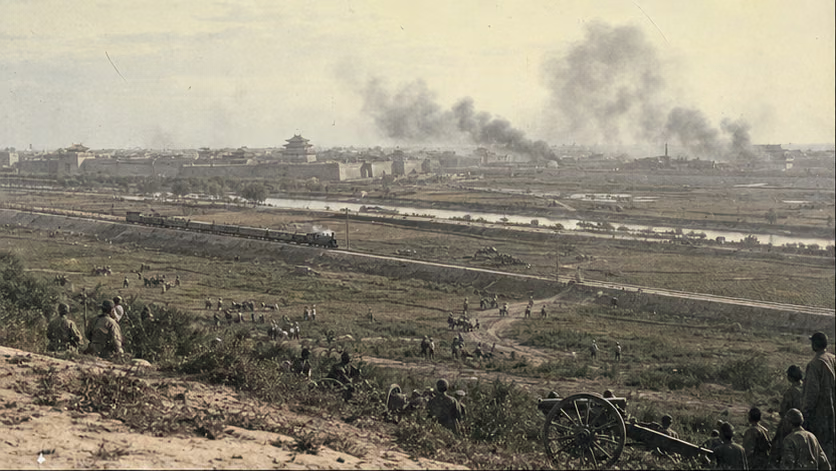
| Item | Details |
|---|---|
| Time | 1899 Boxers rise in Shandong – 1901.9.7 Boxer Protocol (main fighting 1900.6–10) |
| Place | Zhili (Beijing-Tianjin-Baoding), the edge of Shanxi, all of Manchuria |
| Belligerents | Qing court + Boxers / Eight-Nation Alliance (Britain, Russia, Japan, France, United States, Germany, Italy, Austria-Hungary); Manchurian front: Qing forces and local militia of the three northeastern provinces / Russian forces |
| Result | Beijing and Tianjin fell, the two palaces fled west, and all Manchuria was occupied by Russian forces; on 1901.9.7 the Boxer Protocol was signed with eleven states |
Belligerents (War Level)
| Item | Qing forces and Boxers | Alliance forces (inside the passes) | Russian forces (Manchuria) |
|---|---|---|---|
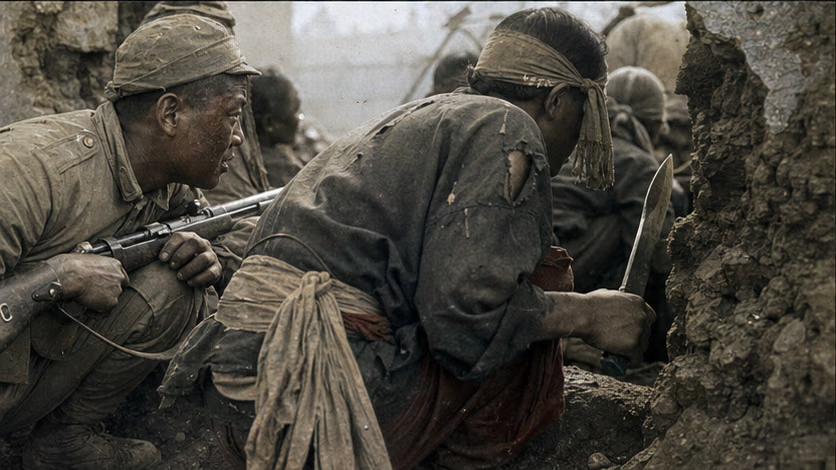
| Strength | On the Beijing-Tianjin line, the Wuwei Army units (the armies of Nie, Song, Ma, Dong, and others) plus those under Ronglu totaled several tens of thousands, though nominal and actual organization did not match (accounts differ); the Boxers had no fixed establishment, and at their height altars stood everywhere in Beijing and Tianjin | The Seymour Expedition began with a little over 2,000 men; by the attack on Beijing there were about 20,000, nearly half Japanese forces, followed by Russian, British, American, and French contingents; the main German force did not arrive in time for the battle | About 170,000 in six columns |
| Equipment | Units such as the Wuwei Forward Division used modern rifles and artillery and had been more recently trained; the other armies mixed cold weapons and firearms; Boxers chiefly used swords and spears | Standard rifles, field guns, machine guns, and a Hai River-Grand Canal supply line | Siberian and Far Eastern garrisons were committed as formed units, with artillery and cavalry complete |
| System | Wavering between war and peace: declarations, halts to attacks, and renewed attacks repeated; edicts and the front line were often out of step | Each country acted on its own; only after September was an alliance commander-in-chief (Waldersee) appointed | Acted independently and was not under alliance control |
Historical Setting
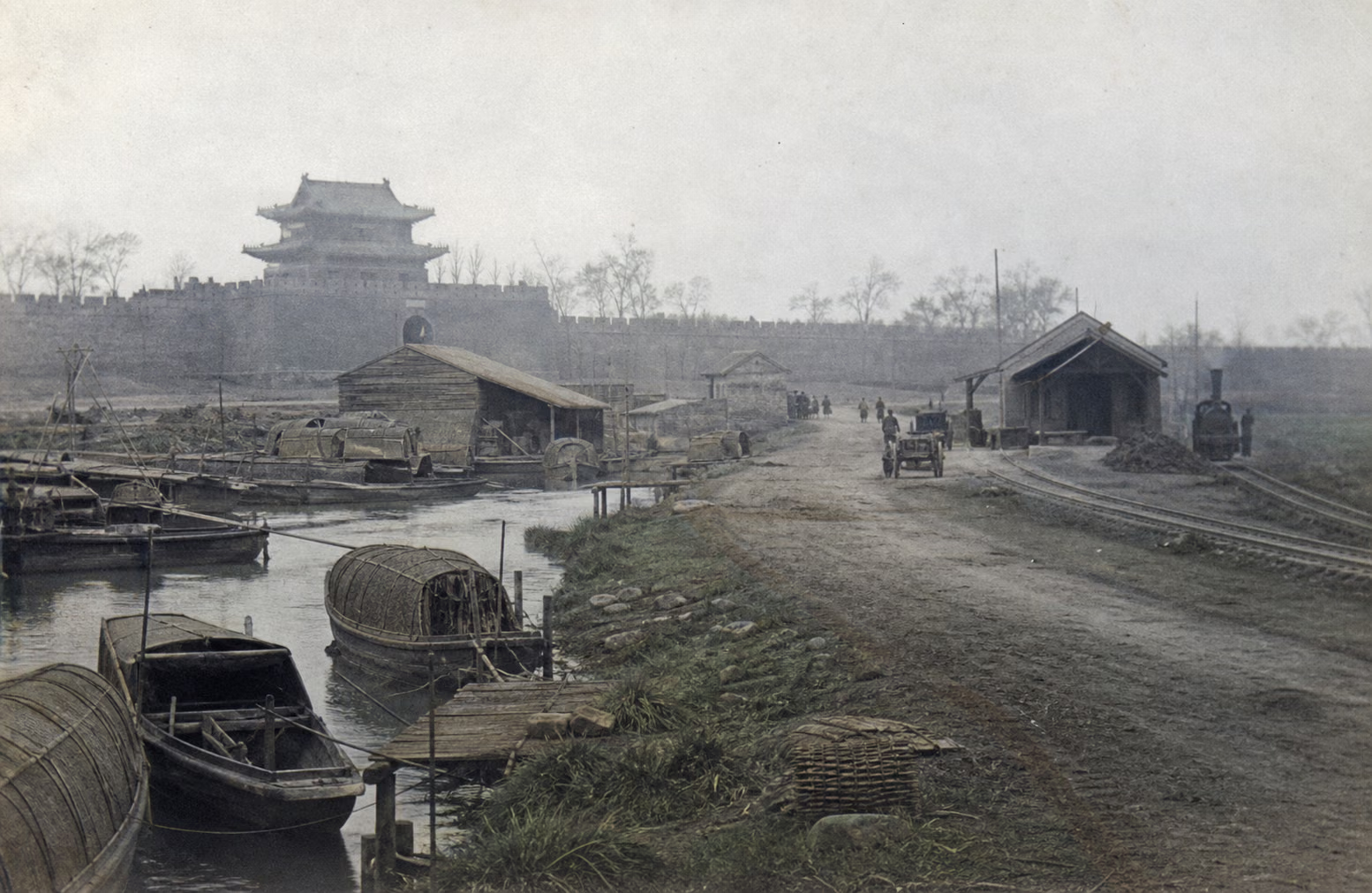
World: after the Second Industrial Revolution, the rush for partition reached East Asia. Africa had already been divided, and the powers' capital export needed new ground; the First Sino-Japanese War had shown the Qing dynasty's hand to the whole world, and "partitioning China" moved from a press topic to a policy option. Alongside it, the "Yellow Peril" circulated in Europe, and expeditionary narratives of the Boxer year borrowed heavily from that tone.
China: after defeat in the First Sino-Japanese War and the Triple Intervention, Jiaozhou Bay, Port Arthur and Dalian, Weihaiwei, and Guangzhouwan were leased in succession, while railway and mining rights were ceded in blocks. Resentment from missionary cases had accumulated for decades, and hostility between converts and non-converts was fiercest in Shandong. At court, after the Wuxu Coup, conservatives held power; the Jihai designation of an heir (1900.1, naming Pujun as da age) met cold treatment from the powers, and the faction around Prince Duan, Zaiyi, grew more bitterly anti-foreign by the day. The court wanted to use the Boxers' hands to vent its anger; this was the near flame of the catastrophe.
The powers: the confrontation between Britain and Russia in the Far East formed the larger background; Germany took the hardest posture after occupying Jiaozhou Bay over the Juye missionary incident of 1897; Japan, newly victorious in the First Sino-Japanese War and eager to earn standing in the club of powers, sent troops with the greatest energy; Russia was publicly a member of the alliance and privately aimed at Manchuria, moving on both tracks at once.
Why It Was Fought
The decision chain has to be picked up from the court's side, because the strangest part of this war is that it had almost no proper decision chain for opening war. At the end of May 1900, the foreign ministers, without waiting for Qing approval, moved several hundred guards from Tianjin into Beijing to protect the legations; on June 10, Seymour led more than two thousand allied troops by train from Tianjin toward Beijing. The ministers' meeting had resolved to send troops before the memorial reporting it reached Beijing. When the news arrived in the capital, the court faced two things approaching at the same time: the allied force on the railway, and hundreds of thousands of Boxers inside and outside the city.
From June 16 to 19, the empress dowager held four imperial conferences in succession (the number and dates of the meetings differ slightly among records, unverified). The question on the table was the same each time: conciliate the Boxers or suppress them, peace or war. The arguments against declaring war were fully stated at the meetings: Xu Jingcheng, Yuan Chang, and others forcefully argued that one country could not possibly prevail against eight, and that besieging the legations was especially contrary to public law; the pro-war faction around Zaiyi and Gangyi answered that popular feeling could be used. What tipped the balance was a foreign note of unclear authenticity: rumor said the powers demanded that the empress dowager return power to the emperor (the authenticity and origin of this note are disputed, unverified). The decision was made on the 19th, and on the 21st an imperial edict was openly issued to "declare war" -- while the alliance had captured the Taku Forts on the 17th, and news of it spread through the capital region precisely between those meetings. The forts were attacked first, the declaration came afterward: half of the court's "resolve" was chased into being by the other side's guns.
When it made the decision, the court's intelligence was rotten to the root. It did not know how many troops the powers could actually send, and treated the guards presently entering Beijing as the whole of the opponent; it did not know that Seymour's force had already been checked at Langfang; it counted the Boxers' "magic arts" as combat power; and it did not know that the viceroys and governors-general of the southeast were at that very moment making other arrangements. The material boundary was just as clear: those able to fight were the Wuwei armies, with Nie Shicheng at Tianjin, Ronglu in the capital, Dong Fuxiang surrounding the legations, and Song Qing and Ma Yukun holding separate sectors. The forces were spread along the Beijing-Tianjin line, and their chains of command belonged to different factions; within days of the opening of war, arms, provisions, and pay were already short, while the Board of Revenue had long been empty. Once the Mutual Protection of Southeast China was established, the richest half of the empire's fiscal base was detached from this "declaration of war." The court was using the resources of one corner of the north to fight a war against the whole world.
The opponents of war paid the highest price. Xu Jingcheng, Yuan Chang, and five others were executed in the marketplace in July and August (dates and detailed charges unverified). Dissent was not unheard; it was killed. Another path of dissent survived: Liu Kunyi, Zhang Zhidong, and others used "counterfeit edict" as their formula, receiving the order but not carrying it out, while Li Hongzhang delayed and watched after being summoned north. The center's orders could not get beyond Zhili. The so-called nationwide unanimity never existed.
The powers' side was not one solid block either. Japan exerted itself most in sending troops: newly victorious in the First Sino-Japanese War, it was eager to secure its seat among the powers, and nearly half the troops attacking Beijing were Japanese. Britain, tied down by the war in South Africa, was glad to let Japan do the work (the claim that the powers subsidized Japanese military expenses remains unverified). Russia was verbally one member of the alliance, while the 170,000 troops in its hands were driving into Manchuria. Within the same war, each held a different objective. Before Seymour set out, the ministers thought the train would depart in the morning and arrive by evening; by the time the main German force arrived, Beijing had already fallen.
Course of the Engagement (Six Phases)
| Phase | Time | Key Points | Separate Chapters |
|---|---|---|---|
| Origins and spread | 1899–1900.5 | Missionary cases and Boxers in Shandong (with sources in the Big Sword Society, Shenquan, and other currents) rose under the slogan "support the Qing and destroy the foreigner"; Yuxian, as governor of Shandong, conciliated and indulged them, while Yuan Shikai, after taking over, drove and suppressed them; in spring 1900 the Boxers poured into Zhili, Beijing, and Tianjin | — |
| Opening of war | 1900.6 | At the end of May, legation guards entered Beijing; on 6.10 Seymour's allied force of more than two thousand set out from Tianjin toward Beijing and was checked at Langfang; on 6.17 the alliance seized the Taku Forts -- the forts were attacked first, the declaration came afterward: on 6.21 the Qing court issued an edict to "declare war" (its objects were generally called "those others," with no country named, and the nature of the edict remains disputed and unverified) | Battles of the Taku Forts and Langfang |
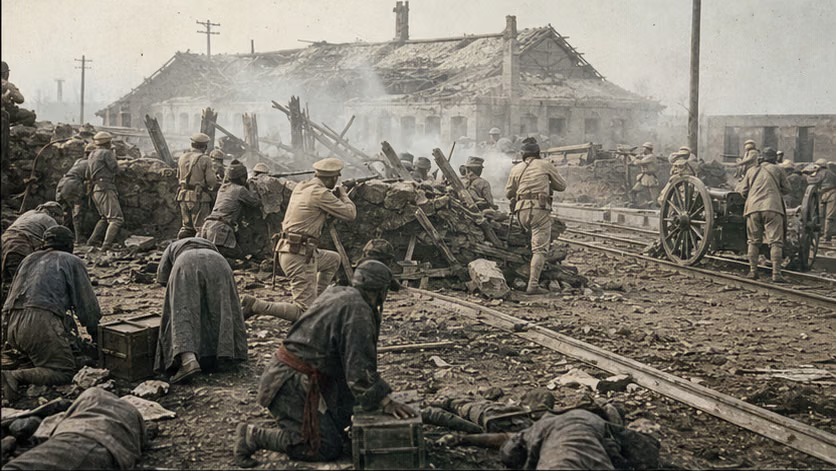
| Tianjin | 1900.6–7.14 | Siege of the Zizhulin concessions and the Laolongtou railway station; on 7.9 Nie Shicheng was killed at Balitai; on 7.14 Tianjin fell, ※ the city was plundered after its fall; the eight nations established the Provisional Government of Tientsin for military rule | Battle of Tientsin (1900) |
| Beijing | 1900.6.20–8.14 | The fifty-five-day siege of the legations ran alongside the siege of Beitang; on 6.20 Clemens von Ketteler was killed; on 8.4 about 20,000 allied troops advanced north from Tianjin, and on 8.14 Beijing fell; on 8.15 the two palaces fled west; ※ three days of looting, zoned occupation, and punitive expeditions followed | Battle of Peking (1900) |
| Manchuria | 1900.7–10 | About 170,000 Russian troops invaded in six columns; ※ the massacres at Blagoveshchensk and the Sixty-Four Villages East of the River; Aigun, Qiqihar, Jilin, and Fengtian fell one after another, and the whole region was lost | Resistance Against Russia in Manchuria (1900) |
| Expeditions and peace talks | 1900.9–1901.9 | Alliance forces (mainly German troops) launched dozens of "punitive expeditions"; the attempt to block them on the Niangzi Pass-Guguan line failed to keep them from entering Shanxi; Li Hongzhang and Yikuang negotiated peace, and the protocol was signed on 1901.9.7 | Blocking Actions at Niangzi Pass and Jingxing |
The other pole that coexisted with the declaration edict was the Mutual Protection of Southeast China. Sheng Xuanhuai threaded the needle, and Liu Kunyi, Zhang Zhidong, Li Hongzhang, and others agreed with foreign consuls that "neither side would disturb the other": the center declared war, the localities stayed neutral, and within one country there were two systems of war and peace. Yuan Shikai in Shandong and Changshun and Zengqi in Manchuria also each stood outside the matter or acted against Russia on their own. The so-called declaration of war was, from beginning to end, only half a war.
Beneath Beijing and the Treaty (1901.9.7)
After occupying Beijing, the alliance ordered the punishment of the "ringleaders," expanded garrison rights, and demanded indemnities; negotiations dragged on for a year. On 1901.9.7, Prince Qing, Yikuang, and Li Hongzhang signed the Boxer Protocol (Peking Protocol) with eleven states:
- An indemnity of 450 million taels of silver, to be paid over 39 years, with principal and interest totaling about 980 million taels; the saying that this meant "one tael per person, as an insult" is very widespread, but its source remains unverified.
- The forts along the line from Taku to Beijing were to be dismantled; the right to station troops around Tianjin went to the foreign states; the legation quarter was marked out as an area under special administration, guarded by foreign troops, and Chinese were forbidden to live there.
- Import of arms and ammunition was forbidden for two years; the "ringleaders" were punished: Zaiyi was exiled, Yuxian executed, Zhao Shuqiao ordered to commit suicide, Dong Fuxiang dismissed from office, and others (details of the list unverified).
- There was another symmetry: the five high ministers who advocated suppressing the Boxers and opposed attacking the legations (Xu Yongyi, Xu Jingcheng, Yuan Chang, Lishan, and Lianyuan) had already been executed by the Qing court itself in July 1900 -- the five ministers for conciliation were first killed by the court, and the pro-war ministers were later killed by the treaty.
Casualties and Losses
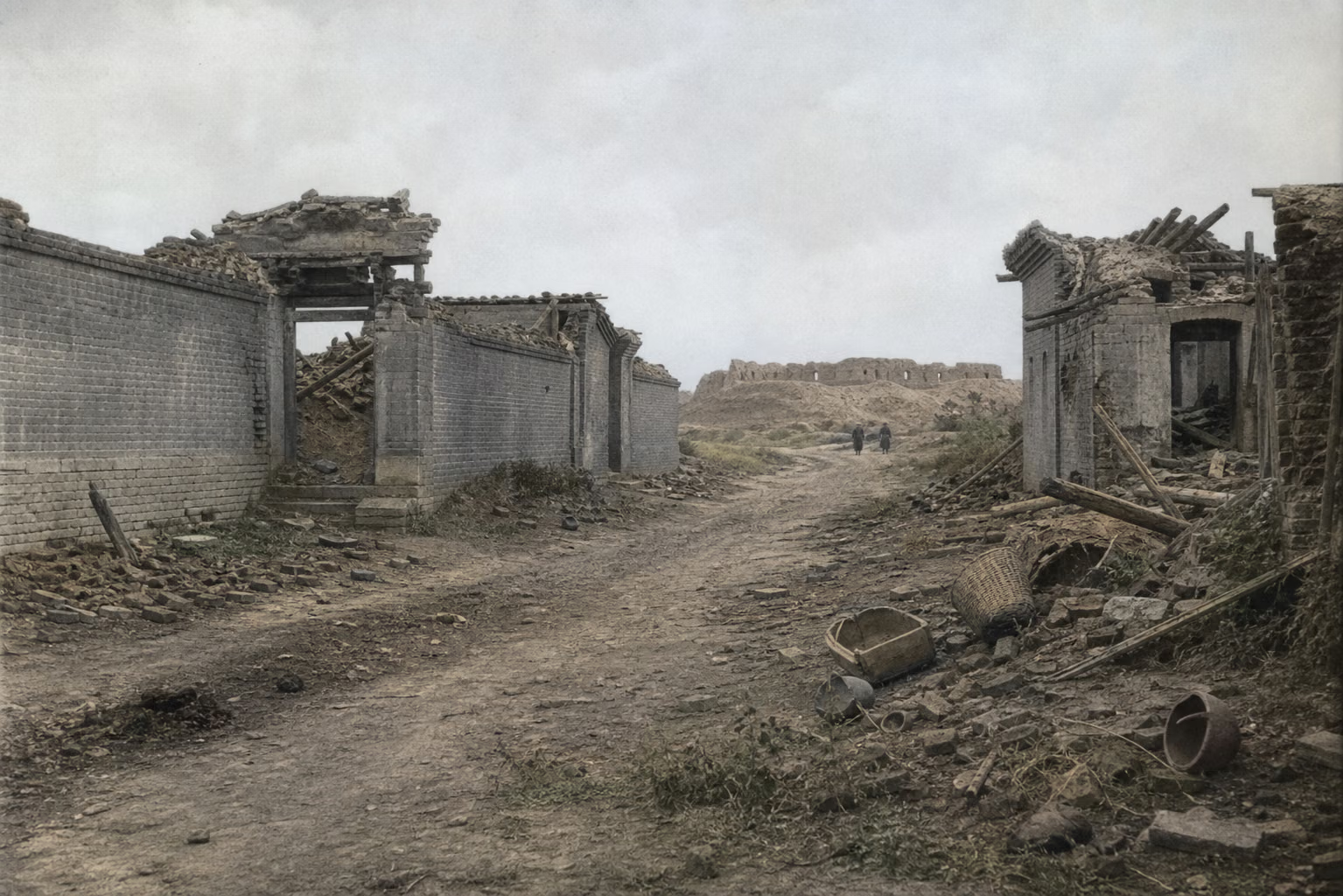
- Chinese soldiers and civilians: there is no overall account of Qing casualties across the engagements; deaths among Boxers and converts are even further from statistics. In Zhili alone, Boxers killed converts ※, alliance forces and Qing forces killed Boxers, and converts used the situation to take revenge ※; violence in several directions compounded layer after layer, and death figures in different localities are scattered through county gazetteers and missionary reports, with differing statistical bases (accounts differ).
- Alliance forces: combat casualties across the engagements inside the passes totaled roughly over a thousand (national battle reports use different statistical bases, and this figure is disputed); deaths from illness and losses during expeditions are counted separately.
- Civilians: ※ after the alliance entered Beijing, looting was openly permitted for three days (national records and memoirs coexist; details unverified), followed by zoned occupation and plunder during the "punitive expeditions" (dozens of them, including Baoding, Zhengding, and Zhangjiakou); ※ Russian troops killed several thousand each at Blagoveshchensk and the Sixty-Four Villages East of the River (figures vary by statistical basis) -- most civilian deaths in the Boxer year have no number.
- Finance: indemnity principal and interest totaled about 980 million taels and were apportioned among the provinces; the financial predicament of the late-Qing New Policies and the foreshadowing of popular unrest are both here.
Aftermath
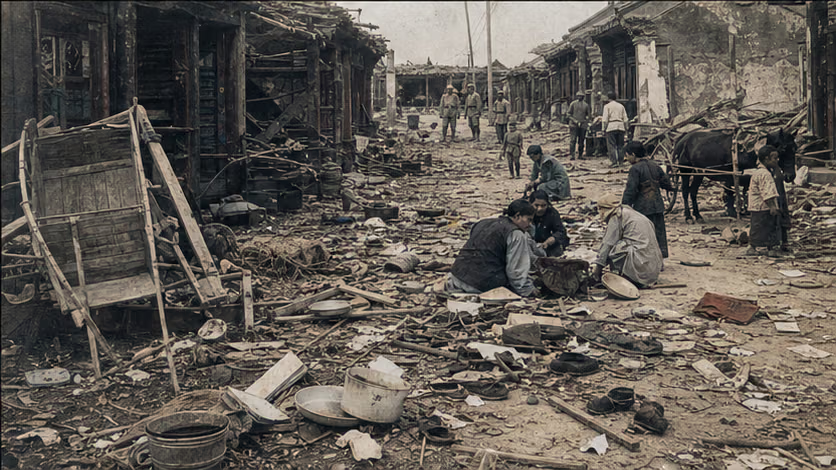
- The Qing court's authority was swept away, and from 1901 it was forced to begin the New Policies (abolishing the civil-service examinations, training the New Army, and preparing constitutionalism all came from here) -- this defeat was the starting point for all reforms in the Qing dynasty's final decade.
- Russian troops stayed in Manchuria and would not leave; withdrawal negotiations dragged on repeatedly, and in 1903 the movement to resist Russia began among students studying abroad; in 1904 the Russo-Japanese War broke out on Chinese soil (see the articles on the Russo-Japanese War under [Foreign War on Chinese Soil]).
- The American "Boxer Indemnity Scholarship Program": beginning in 1908, part of the indemnity was remitted for educational work sending students to the United States, and Tsinghua School emerged from this (details unverified) -- one branch of the indemnity grew into another piece of history.
How Each Side Records It
- The century-long transformation of Chinese narratives: in the year of the events, official language called it the "Boxer bandit disorder"; from the Republic onward it gradually shifted toward the "Boxers' anti-imperialist patriotic movement"; after 1949 it was fixed as a mainstream narrative of a peasant anti-imperialist movement. In recent decades, scholarship has reexamined it again -- the blindness of xenophobia, the ※ deaths of converts, and the court's opportunism have all been put back on the table. One event, three names, each a layer of its age.
- Expeditionary narratives of the various countries: the English-speaking world left behind a large body of memoirs and popular works about the "fifty-five days in Peking" (the 1963 Hollywood film *55 Days at Peking* was the high-water mark of that current); this narrative often borrowed the tone of the "Yellow Peril," casting itself as civilization besieged by barbarism. The place of the three days of looting and the punitive expeditions within it had to be picked out by later historians.
- Missionary martyr narratives: Catholic accounts call it the "Boxer Persecution," and the beatification and canonization of martyred clergy and converts continued for a century. In 2000, the pope canonized 120 Chinese martyrs, setting off a diplomatic dispute between China and the Vatican. The list of martyrs, ※ convert reprisals, and alliance atrocities all sit on the same year's calendar.
Disputes and Sensitivities
- The nature of the "declaration-of-war edict": it named no country and was not delivered to the foreign states; scholars have described it variously as a "declaration of war," an "external mobilization order," and an "internal proclamation" (accounts differ). But the sequence -- Taku attacked first, the edict issued afterward -- is not disputed.
- The characterization of the Boxers: anti-imperialist patriotism / blind xenophobia / a popular uprising used by the court; these three layers of narrative still coexist. Violence in every direction also existed at the same time.
- Mutual Protection of Southeast China: pragmatic protection of territory and people / the beginning of local powers growing beyond the center; both readings coexist.
- The "open attack, covert protection" thesis (accounts that Ronglu's troops showed restraint in besieging the legations) and the reasons for "fifty-five days without a breach" are treated in the Beijing chapter.
Contents
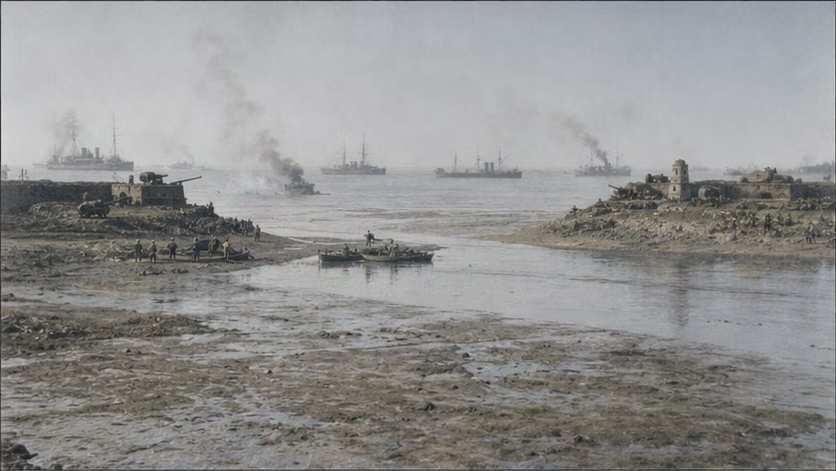 Battles of the Taku Forts and Langfang1900.06The war began with two hands moving at once: Seymour led more than two thousand troops of the Eight-Nation Alliance by train toward Beijing to "protect the legations," only to be trapped near Langfang by severed rail lines, Boxers, and the Gansu Army, unable to advance or withdraw, and half a month later retreated along the canal to Tianjin; without waiting for a declaration of war, the allied fleet moved before dawn on June 17 and seized the Taku Forts -- the alliance fired first, and the declaration-of-war edict came four days later.
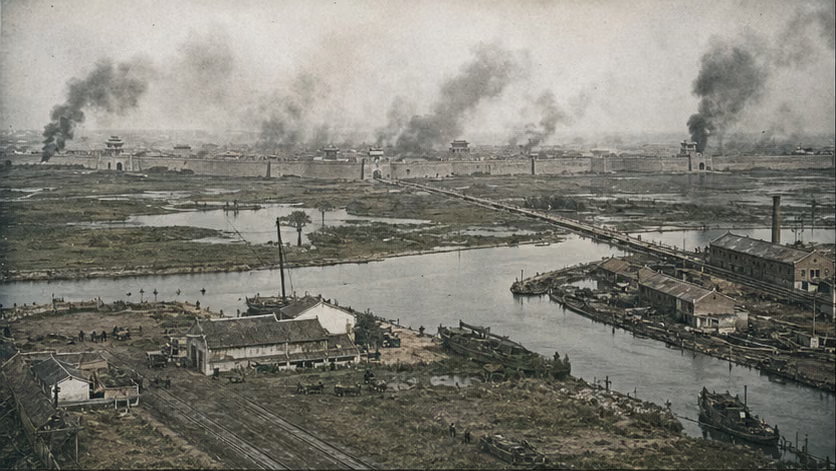 Battle of Tientsin (1900)1900.06One city was turned into two battlefields: inside, Boxers and Qing forces besieged the Zizhulin Concession; outside, Allied troops landed continuously from Taku as reinforcements. Nie Shicheng, the Provincial Commander-in-Chief of Zhili, held one of the Qing army's most modernized units while attacked from front and rear. On 7.9 he was killed in action at Balitai; five days later Tientsin fell. After the breach came massacre and looting, and then modern China's first multinational military government.
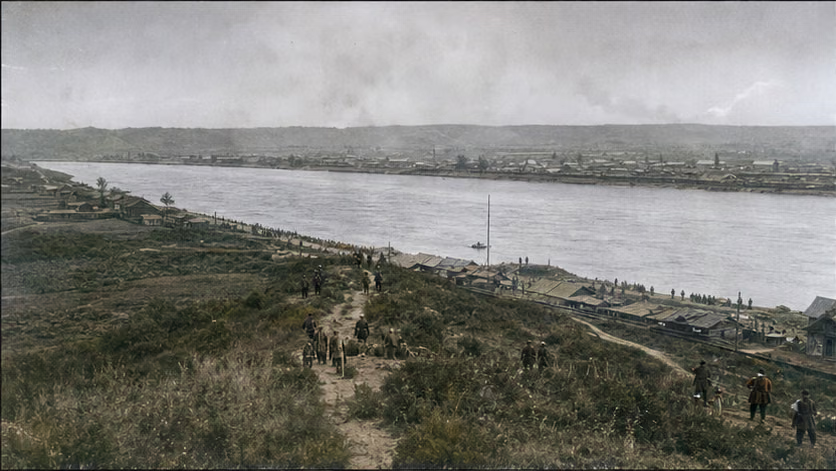 Resistance Against Russia in Manchuria (1900)1900.07Inside the passes, the fight was against 20,000 troops of the Eight-Nation Alliance; beyond the passes, what came was 170,000 Russian troops -- advancing in 6 columns, taking all of Manchuria in 3 months, and before the main operation began, driving several thousand Chinese border residents at Blagoveshchensk and the Sixty-Four Villages East of the River down into the Heilongjiang -- this was the largest military operation of the Boxer year, and the most indistinct page in later memory.
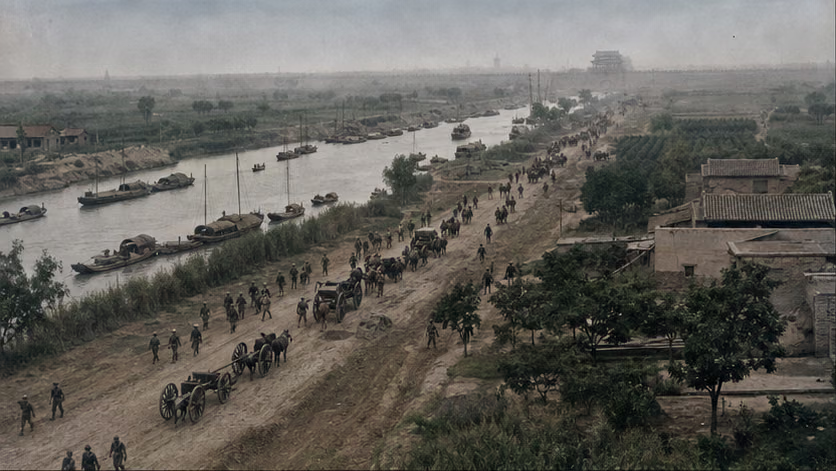 Battle of Peking (1900)1900.08Three lines were twisted around the same city: the Dongjiaomin Lane legation quarter was besieged for fifty-five days without being breached; Xishiku Beitang was besieged for two months, with several hundred dead; 20,000 alliance troops fought from Tianjin along the canal road to Beijing in ten days and took the city in one day. After the fall came three openly permitted days of looting, and nearly a year of zoned occupation and "punitive expeditions."
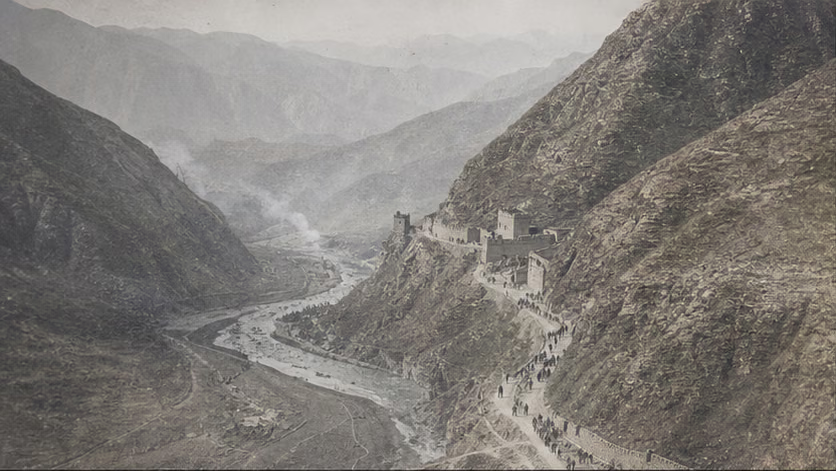 Blocking Actions at Niangzi Pass and Jingxing1900.10After taking Peking, the Allied forces moved west under the name of "punishing Shanxi," hoping to break into the province, but Liu Guangcai's Guangwu Army held them at the Niangzi Pass-Guguan line by using the terrain; from the winter of 1900 to the spring of 1901, repeated attacks failed to get through -- one of the few passes held in the Boxer defeat, small in scale, but shielding the eastern flank of the court in flight to the west.
Sources and Open Questions
Main sources: *Gengzi Guobian Ji* by Luo Dunrong and Li Xisheng's *Gengzi Guobian Ji* (two books with the same title coexist, unverified); *Quanbian Yuwen*; Waldersee's *Notes on the Boxer Disturbance* (translation title unverified); memoirs by those besieged in the foreign legations (Hart, MacDonald, and others, editions unverified); *Qingji Waijiao Shiliao*; the Institute of Modern History, Chinese Academy of Social Sciences, *Historical Materials on the Boxers*; Xiang Lanxin, *The Origins of the Boxer War* (edition unverified); Joseph Esherick, *The Origins of the Boxer Uprising* (translation information unverified).
Open questions: the original text and characterization of the declaration-of-war edict; the source of the "one tael per person" saying; detailed list of the punished ringleaders; the different statistical bases for alliance casualties in the various engagements; details from the various countries' records of the three days of looting; the amounts and procedure of the Boxer Indemnity remissions for education; the different statistical bases for deaths at Beitang and in the legation quarter; baseline troop strength of the Qing forces in the three northeastern provinces; dates and agenda records for the four imperial conferences; authenticity and origin of the "foreign note" (the account of Luo Jiajie's secret report); the claim that the powers subsidized Japanese military expenses; dates and detailed charges for the execution in the marketplace of the five high ministers; correspondence between the declaration-of-war edict and the southeastern viceroys' and governors-general's "counterfeit edict" formula.
All images on this site are AI-generated depictions. They are not historical photographs, not primary sources, and do not depict any real individual.