Engagement Archive · Battle of Peking (1900)
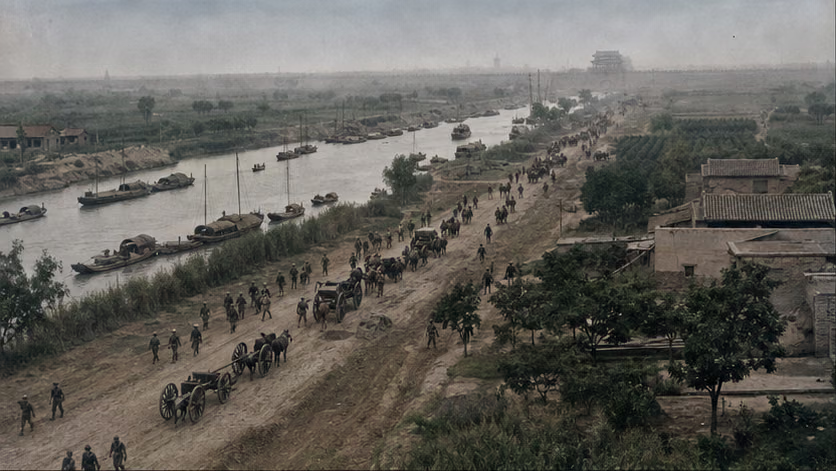
Three lines were twisted around the same city: the Dongjiaomin Lane legation quarter was besieged for fifty-five days without being breached; Xishiku Beitang was besieged for two months, with several hundred dead; 20,000 alliance troops fought from Tianjin along the canal road to Beijing in ten days and took the city in one day. After the fall came three openly permitted days of looting, and nearly a year of zoned occupation and "punitive expeditions."
Engagement Data
| Item | Details |
|---|---|
| Time | 1900.6.20–8.14 (siege of the legations, fifty-five days); mid-6–8.16 (Beitang); 8.4–8.14 (allied advance on Beijing) |
| Place | Beijing: Dongjiaomin Lane legation quarter, Xishiku Beitang; North Canal axis: Beicang–Yangcun–Tongzhou |
| Belongs to | Boxer Rebellion · Zhili theater (see Boxer Rebellion: Overview) |
| Roles | Besieging side (Dong Fuxiang's Gansu Army, Shenjiying, Hushenying, and Boxers) / besieged side (legation guards of eleven states, about 450 men + about 3,000 refugee converts); assault on the city: defenders (Qing forces under Song Qing, Ma Yukun, and others) / attackers (alliance forces, about 20,000) |
| Result | The legation quarter was never breached, and Beitang was relieved on 8.16; Beijing fell on 8.14, and on 8.15 the two palaces fled west; ※ looting, zoned occupation, and punitive expeditions |
Belligerents
| Item | Besieging and defending side | Alliance forces |
|---|---|---|
| Strength | Siege: the Gansu Army, Shenjiying, and Hushenying together over 10,000 (nominal and actual organization unverified) + Boxers; field fighting between Beijing and Tianjin: tens of thousands under Song Qing and Ma Yukun (accounts differ) | Guards about 450 (national statistical bases differ; figure disputed); alliance force advancing on Beijing about 20,000 -- nearly half Japanese forces, followed by Russian, British, American, and French contingents; the main German force did not arrive in time for the battle |
| Firepower | The besieging side had Krupp guns, but much of its shelling went high (accounts differ); field artillery lagged behind the alliance by a generational gap | The guards had only rifles and machine guns; the alliance force advancing on Beijing had field guns and machine guns in full, with assigned roles for assaulting fortified positions |
| Posture | Wavering between war and peace, with attacks halted several times -- during the fifty-five-day siege, the court's orders repeatedly reversed | Single objective: relief; logistics followed up along the North Canal by grain-transport boats |
Terrain and Conditions
(For the larger situation, see Boxer Rebellion: Overview.)
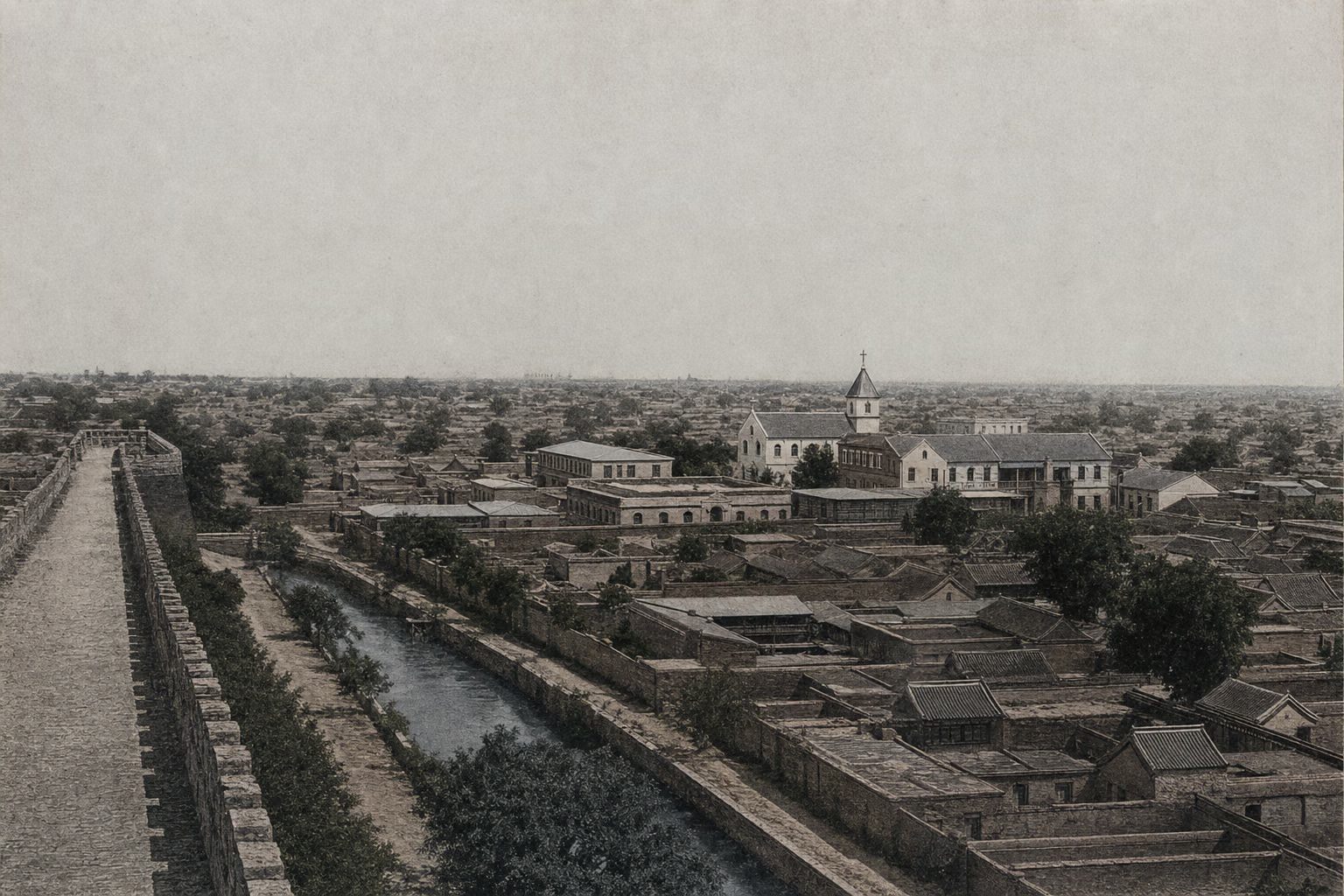
In Beijing after the Wuxu Coup, the court grew steadily more anti-foreign. At the end of May, legation guards entered Beijing; on 6.11 the Japanese legation secretary Sugiyama Akira was killed outside Yongding Gate by the Gansu Army; from 6.13, Boxers entered Beijing in large numbers, ※ burning churches and killing converts, and converts and foreign residents across the city poured into two places of refuge -- the Dongjiaomin Lane legation quarter and Xishiku Beitang. From then on, they were two islands inside the city. On the morning of 6.20, the German minister Clemens von Ketteler was traveling by sedan chair to the Zongli Yamen when he was killed at Dongdan by Enhai, an officer of the Shenjiying -- that afternoon, the siege began.
Why It Was Fought
Set down the fighting in the northeast for the moment -- when Russian troops moved at Blagoveshchensk in July, the focus inside the passes was shifting toward Beijing: Tianjin fell on July 14, and once the alliance used Tianjin as its main base, sending troops to Beijing was only a matter of time. This article returns to the Zhili theater.
The siege had begun nearly two months before the alliance entered Beijing, so the account has to turn back. From June 13, Boxers entered Beijing in large numbers; on the morning of June 20, the German minister Clemens von Ketteler was traveling by sedan chair to the Zongli Yamen when Enhai, an officer of the Shenjiying, killed him at Dongdan. That afternoon, the siege began. The fuse was that single shot.
The declaration of war was not thrown by one fist. Beginning on June 16, imperial conferences were held for four successive days; the pro-war faction was the line of Prince Duan, Zaiyi, and Prince Zhuang, Zaixun. At the meeting on the 19th, a note from the foreign states was reportedly shown, demanding that the empress dowager return power to the emperor; the siege began the next day -- the note was rumored to be forged (accounts differ, unverified). On the 21st, a declaration-of-war edict was issued in the Guangxu emperor's name: "Rather than scrape by and survive, leaving shame for ten thousand ages, how could it be better than to raise great punitive arms and settle the contest once and for all." When this edict was issued, the court lacked more than it possessed: foreign telegram lines were cut off, the true intentions of the powers could not be checked, battle reports from Tianjin came intermittently, and it had no confidence that the viceroys and governors-general in the south would follow.
Why these two places: the legation quarter was the highest target in the capital for "destroying the foreigner," and also the hostages in the Qing court's hands; Beitang was the central Catholic church in North China and the converts' last place of refuge. For the alliance, after the Seymour Expedition failed (see Battles of the Taku Forts and Langfang), relieving the legations had become the first common objective of all the countries: foreign residents and roughly 450 guards were besieged in an enemy capital, and no government could bear that burden.
The calculations of the two sides were separated by a city wall. The court had Dong Fuxiang's Gansu Army and Ronglu's Wuwei Central Division, and had Krupp guns, yet much of the shelling went high (accounts differ). This gave rise to the thesis of "open attack, covert protection" -- whether it wanted hostages or battlefield results, Beijing never thought it through. The Wuwei Forward Division, the formation that could truly fight, was locked in hard fighting at Tianjin; on July 9 Nie Shicheng was killed at Balitai, and the railway and telegraph lines between Beijing and Tianjin were both cut. The forces blocking the alliance on this route were those of Song Qing and Ma Yukun, fighting and falling back. The alliance's calculation was much simpler: relieve the siege, follow the North Canal with grain-transport boats for supply, and reach the city walls in ten days. What they had not calculated was that Russian troops would rush ahead and attack Dongbianmen on the night of August 13 (claim over first credit unverified); what the court had not calculated was that the hostages lost their value on the day the alliance entered the city.
Dissent did exist; it was raised with lives. Yuan Chang and Xu Jingcheng remonstrated against besieging the legations and lightly opening hostilities, and were executed in the marketplace on July 28. On August 11, Xu Yongyi, Lianyuan, and Lishan followed them (detailed charges unverified) -- three days before the city fell, the opponents at court had already been killed off. The south took another road: Liu Kunyi, Zhang Zhidong, Li Hongzhang, and others did not obey the declaration-of-war edict, and concluded the Mutual Protection of Southeast China with the foreign consuls (details of the agreement unverified). The declaration was aimed at eleven states; only several northern provinces carried it out.
On August 14 the city fell, and the next day the two palaces fled west. The legation quarter that had been besieged for fifty-five days was opened from outside by those coming to relieve it, not broken through by those besieged within.
Course of the Engagement
| Phase | Time | Key Points |
|---|---|---|
| Siege of the legation quarter | 6.20–8.14 | Fifty-five days: gunfire, shelling, fire attacks, and tunnel-digging; Prince Su's mansion and the various national legation buildings were fought over wall by wall, yet the quarter was never breached -- the thesis of Ronglu's forces "openly attacking while covertly protecting" (accounts of sending melons and fruit, high shelling, and rebuttals coexist and remain unverified); the Qing court wavered between war and peace, halting attacks several times and resuming them several times |
| Siege of Beitang | mid-6–8.16 | Bishop Alphonse Favier, more than forty French and Italian guards, and more than 3,000 converts were besieged; food ran out, and they lived day by day on bran and husks; the besieging side repeatedly used mines, and the bell tower collapsed; ※ more than four hundred dead, many of them children (statistical bases differ) -- church and besieging-side records coexist; relieved on 8.16 |
| Alliance leaves Tianjin | 8.4–8.12 | About 20,000 set out from Tianjin and advanced north along both banks of the North Canal; Beicang fell on 8.5 and Yangcun on 8.6, while Song Qing and Ma Yukun fought and fell back; Yulu, the viceroy of Zhili, committed suicide after defeat at Yangcun (details unverified); Tongzhou fell on 8.12, and the capital's outer gate was lost |
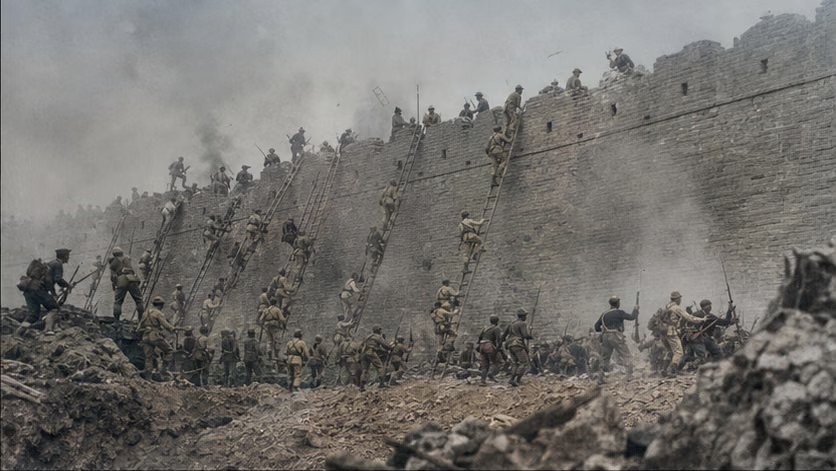
| Assault on the city | 8.13–14 | On the night of 8.13, Russian troops rushed ahead to attack Dongbianmen (claim over first credit unverified); on 8.14, the general assault: Japanese forces attacked Chaoyangmen, American forces were first onto the wall at the Dongbianmen sector, and British forces entered the legation quarter first through Guangqumen and the water gate to relieve the siege -- the fifty-five-day siege ended here |
| Flight west | morning, 8.15 | Cixi took Guangxu and fled in haste through Xizhimen, westward; before leaving, she ordered the eunuch Cui Yugui to throw Consort Zhen into a well ※ (the chain of records for this event remains unverified) |
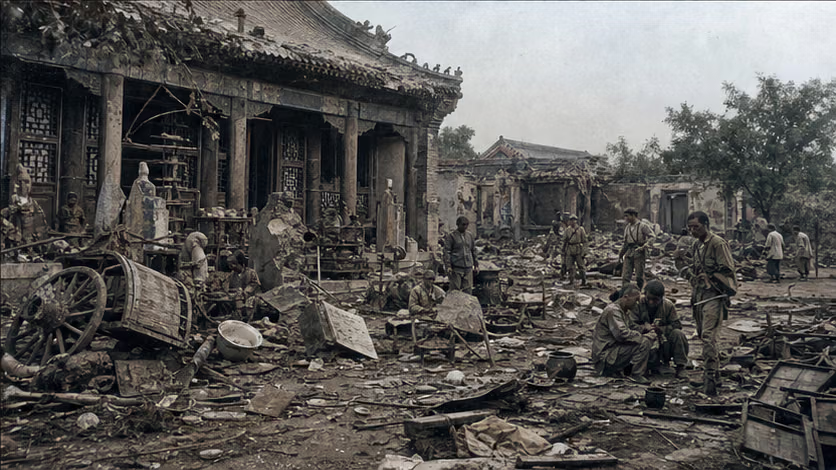
| ※ After the city's fall | from 8.14 | The alliance openly permitted robbery for three days (national records and self-admissions coexist, details unverified), followed by zoned occupation; the Forbidden City, Summer Palace, mansions, temples, and monasteries suffered incalculable losses of cultural objects; in the city, many households of princes and high ministers killed themselves together (Chongqi and others; list unverified) |
| ※ Punitive expeditions | 1900.9–spring 1901 | Alliance forces (mainly German troops) sent out dozens of expeditions from Beijing and Tianjin: Baoding (execution of the provincial administration commissioner Tingyong and other local officials, unverified), Zhengding, Zhangjiakou, and elsewhere. In the name of "punishing Boxer bandits," killing and plunder went with them (number of expeditions and records of atrocities unverified); Waldersee, the alliance commander-in-chief, arrived only at the end of September, and many expeditions occurred during his tenure; Waldersee resided in Yiluan Hall, which was later destroyed by fire |
Casualties and Losses
- Legation quarter: more than sixty guards killed and wounded (statistical bases differ); casualties among the besieged converts were several times that number (figure disputed).
- Beitang: ※ more than four hundred dead, many of them children (church-side count, unverified) -- during the siege, far more converts died of hunger, disease, and explosions than in combat.
- Alliance advance on Beijing: casualties in the actions at Beicang, Yangcun, and the city assault totaled several hundred (national battle-report statistical bases differ); the Qing forces under Song Qing and Ma Yukun collapsed, with no total account of casualties.
- ※ Civilians: there is no count of the dead from the three days of looting, zoned occupation, and punitive expeditions; before this, from mid-June onward, converts killed inside Beijing were also beyond number -- death from many directions entered the account book of the same city.
Aftermath
- Beijing was zoned and occupied for nearly a year; Waldersee's punitive expeditions turned Zhili into the alliance's punishment ground; the westward push along the Baoding-Zhengding line was stopped at Niangzi Pass-Guguan (see Blocking Actions at Niangzi Pass and Jingxing).
- The two palaces stayed in Xi'an, while Li Hongzhang and Yikuang remained in Beijing to negotiate peace; on 1901.9.7 the Boxer Protocol was signed, and in 1902.1 the two palaces returned to the capital (see Boxer Rebellion: Overview).
- At the place where Ketteler was killed, the "Ketteler Memorial" was later erected; after World War I it was moved to Zhongshan Park and retitled "Victory of Justice" (details unverified) -- the three names of one monument are the shifts in this city's spirit across twenty years.
Accounts of Those Present
- Enhai: the Shenjiying officer who killed Ketteler; after the war he was captured and executed by German troops (details unverified) -- the account for one shot was settled on one man's head.
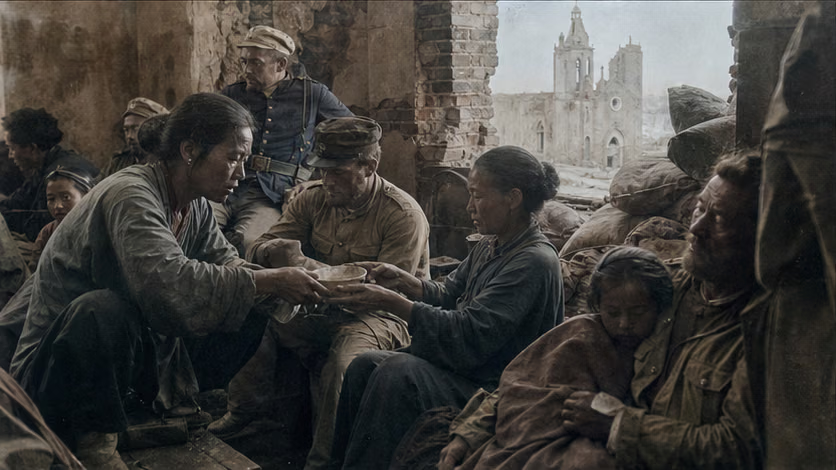
- The Chinese in the legation quarter: about 3,000 refugee converts defended the quarter together with the guards for fifty-five days, building walls, cooking, dying, and being wounded; in the memoirs, they are mostly a silent background (to be collected).
- The children of Beitang ※: church records say that in the later period, after food ran out, most of those dying daily from hunger and illness were children; Favier's diary is the first source for these sixty days (edition unverified).
- Chongqi: the Tongzhi emperor's father-in-law and a former grand secretary; after the city fell, his entire household killed themselves (list and details unverified) -- more than one household of princes and high ministers did this, and the list of those who preserved integrity on the day the city fell is itself another layer of narrative.
- Sai Jinhua and Waldersee: the layers of rumor are extremely thick and belong to the romance layer, not the main text -- in "How Each Side Records It," this is only noted as a phenomenon of circulation.
The Ground
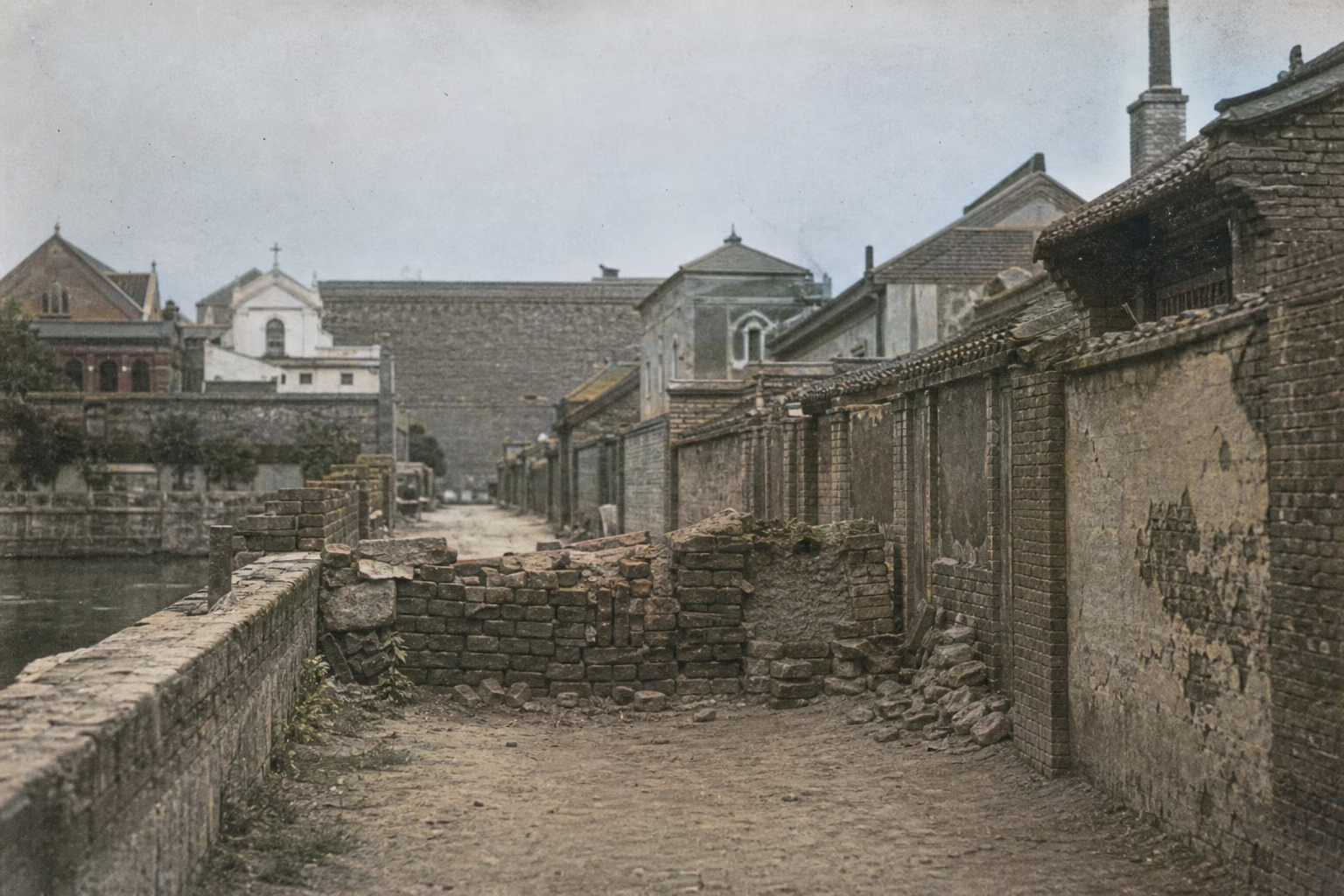
- Legation quarter: a block squeezed between the Imperial Canal and the southern wall of the Inner City, where Prince Su's mansion, the national legations, and churches were packed within one square kilometer and fought over wall by wall -- the smallest scale of siege warfare was the barricade and the courtyard wall.
- Beitang: an isolated fortress on the west side of the Imperial City, surrounded by civilian residences on all sides, with mines attacking from underground -- the siege turned vertically downward.
- Axis of advance on Beijing: the North Canal-Tonghui River formed a water line, with Beicang, Yangcun, and Tongzhou as three points along it. The alliance's logistics relied on grain-transport boats, and the whole offensive was a moving supply line.
- City wall: Russian troops at Dongbianmen, Japanese forces at Chaoyangmen, American forces first onto the wall, British forces through the water gate -- a map of divided tasks from eight directions, where who came first and who came later itself became material for postwar competition over credit.
How Each Side Records It
- The various countries: "fifty-five days besieged in Peking" was one of the most popular China narratives in twentieth-century Europe and America, with memoirs, novels, and films appearing one after another (the 1963 Hollywood film *55 Days at Peking* was the high-water mark). This narrative wrote itself as civilization under siege, carrying the tone of the Yellow Peril from beginning to end; the three days of looting and expeditionary atrocities were not absent from the same authors' writings, but they appeared further back.
- Chinese side: the characterization of the siege of the legations has turned over with the times -- "xenophobic atrocity," "anti-imperialist feat," and "siege under court opportunism" coexist as three readings; "open attack, covert protection" is one of the most durable fasteners in Chinese narratives.
- Church: the martyrdom at Beitang is the central scene in narratives of the Boxer Persecution, with the line of beatification and canonization continuing to 2000 (see the overview); the dead on the besieging side, in the same neighborhood, have no recoverable list of names.
- Phenomenon of circulation: the Sai Jinhua-Waldersee legend is far more active in popular circulation than in historical fact, a typical case in which the romance layer presses down over the archival layer.
Disputes and Sensitivities
- "Open attack, covert protection": accounts of Ronglu sending melons and fruit, high shelling, and rebuttals coexist (accounts differ) -- why fifty-five days passed without a breach, whether from restraint, incompetence, or wavering between war and peace, has no settled answer.
- Consort Zhen's well: the chain of records is narrow and details accumulated over time (accounts differ); the archival layer and the legend layer are not the same.
- Scope and details of the three days of looting: national records and self-admissions coexist, and the specific scale remains unverified -- cite a source for every sentence quoted.
- The 2000 canonization triggered a China-Vatican dispute: the list of martyrs, ※ convert reprisals, and alliance atrocities occurred in the same year and place, while the commemorations on the two sides do not face each other.
Sources and Open Questions
Known main sources:
- Favier's diary and church reports after the relief of Beitang (editions unverified)
- Memoirs of besieged persons such as MacDonald and Hart (editions unverified)
- Battle reports and embedded records of the various countries; Waldersee's *Notes on the Boxer Disturbance* (translation title unverified)
- *Qingji Waijiao Shiliao* and *Historical Materials on the Boxers*; the Jingshan diary (authenticity disputed, source level to be distinguished)
Open questions: the national breakdown and casualty statistical bases for the legation guards; the original church-side statistical basis for the number of Beitang dead; sources and rebuttals for the accounts of Ronglu's "open attack, covert protection"; details of Yulu's suicide; records of the Russian night attack on 8.13 and the contest over credit; detailed national records of the three days of looting; list of those who killed themselves with Chongqi and others; list of officials executed in the Baoding expedition; the history of the Ketteler Memorial; the chain of records for Consort Zhen's well; the sessions, dates, and proceedings of the June imperial conferences (authenticity of the "return-power note" to be checked); original text of the declaration-of-war edict and the sequence of its delivery to the foreign states; charges and execution details for Yuan Chang, Xu Jingcheng, Xu Yongyi, Lianyuan, and Lishan; date, text, and participating viceroys and governors-general for the Mutual Protection of Southeast China; positions and losses of the Wuwei armies from 6–8 (the fighting at Nie Shicheng's Balitai to be checked).
All images on this site are AI-generated depictions. They are not historical photographs, not primary sources, and do not depict any real individual.