War Overview · Taiping Heavenly Kingdom (1851–64)
An uprising of the God Worshipping Society that flared from a village in Guangxi took half the Qing empire in fourteen years, and was finally extinguished by a regional army raised by a scholar-official; the battles were won, but Qing central power was loosened from that point on.
Engagement Data
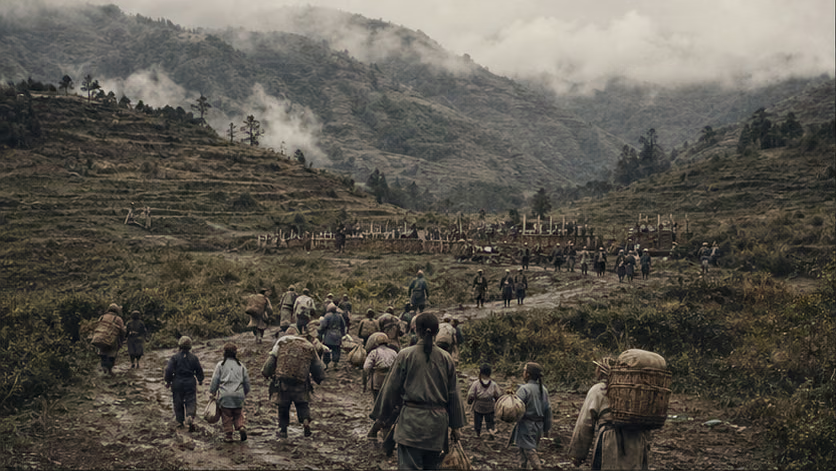
| Item | Details |
|---|---|
| Time | 1851.1.11 Jintian Uprising – 1864.7.19 fall of Tianjing (remnant forces and fighting with the Nian Rebellion continued into the late 1860s; lower limit unverified) |
| Place | Began at Guiping, Guangxi; moved through more than ten provinces; main theater was the middle and lower Yangtze (Anhui, Jiangxi, Hubei, Jiangsu, Zhejiang) |
| Belligerents | Taiping Heavenly Kingdom (capital at Tianjing) / Great Qing (Xianfeng and Tongzhi reigns; the main force shifted from the Eight Banners and Green Standard to the Xiang Army and Huai Army, with armed intervention by foreign powers after 1860) |
| Result | 1864.6.1 Hong Xiuquan died of illness; 7.19 Tianjing fell and the Taiping Heavenly Kingdom perished; the Qing won a ruined victory, and its structure of power was rewritten from then on |
Belligerents (War Level)
| Item | Taiping Army | Qing forces |
|---|---|---|
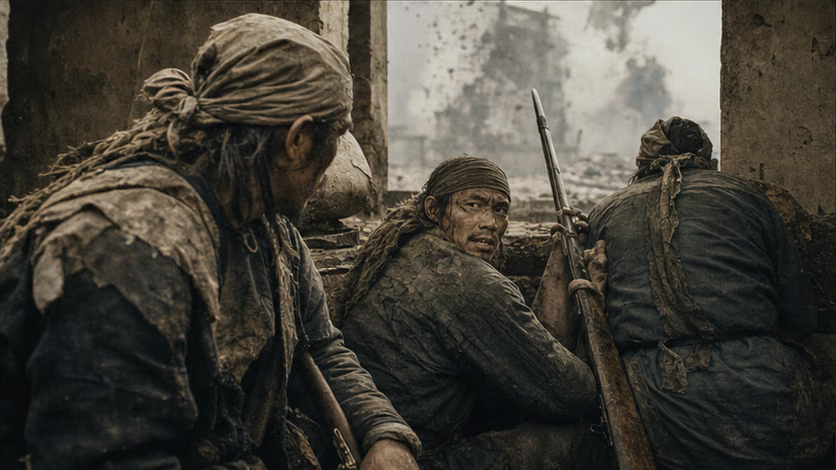
| Strength | About 20,000 at the Jintian rising; the force snowballed on the march, and after taking Wuchang was said to number 500,000 (claimed figure; actual number unverified); in the later phase manpower depended largely on coerced recruitment and incorporation of surrendered forces | A nominal standing force of about 200,000 Eight Banner troops + about 600,000 Green Standard troops, long at peace and unable to stand field warfare; from 1853 Zeng Guofan organized the Xiang Army, and in 1862 Li Hongzhang formed the Huai Army; yongying militia armies replaced regular state troops as the main force |
| Military system | Men and women in separate camps, supply through the Sacred Treasury, and strict discipline in the early phase; later, the various kings governed for themselves and royal titles were granted indiscriminately | The Green Standard was divided into patrol posts and garrisons like a policing force; the Xiang Army was "scholars leading mountain peasants," with soldiers attached to their commanders through layered private ties, maintained by lijin transit taxes; military power and fiscal power were both outside the court's hands |
| Firearms | Primarily cold weapons, with captured heavy matchlocks and locally made cannon; in the later phase Li Xiucheng's forces obtained foreign rifles and artillery through Shanghai (scale disputed) | Green Standard firearms were obsolete; from the 1860s, the Xiang and Huai armies bought large quantities of foreign rifles and artillery and hired foreign instructors |
| Naval forces | Built from civilian riverboats along the Yangtze; at Tianjiazhen, several thousand vessels were burned in one battle, and from then on the Taiping could not regain the waterways | The Xiang Army's navy was central to Zeng Guofan's force-building; in the 1860s there were also attempts to buy warships, such as the Lay-Osborn Flotilla (course of events unverified) |
| Foreign assistance | None; a few Westerners entered Taiping service (including Augustus Lindley; their actions unverified) | After 1860 the foreign powers aided the Qing: the Foreign-Arms Corps / Ever Victorious Army (Ward → Burgevine → Gordon), the Ever-Triumphant Army, and "borrowing foreign troops to assist suppression" |
Historical Setting
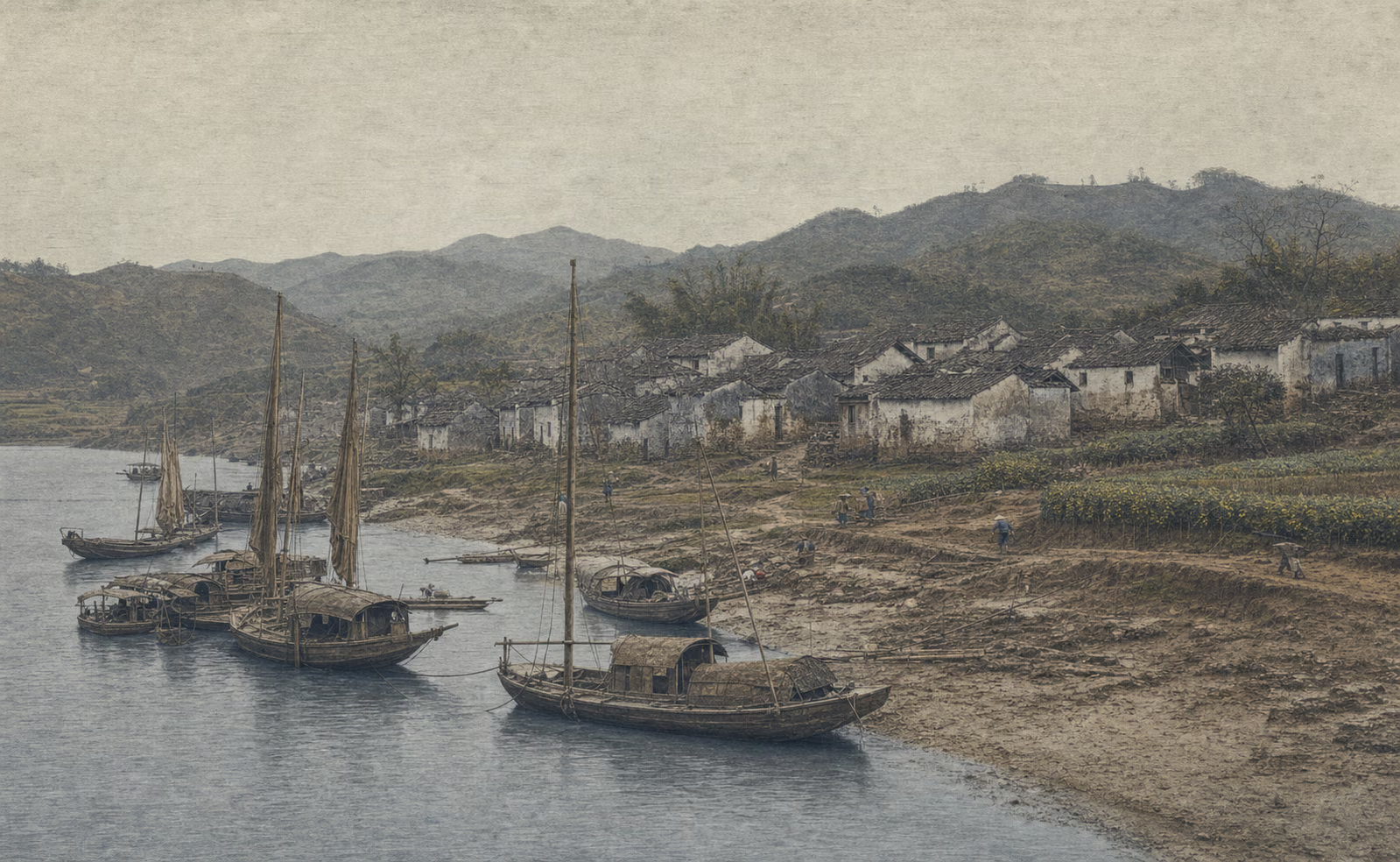
World: The mid-nineteenth century was an age in which the foreign powers turned their gaze eastward. The Crimean War (1853–56) had just held Russia back at the Black Sea, and Britain and France soon joined forces to wage the Second Opium War (1856–60) against China. It overlapped almost completely with the Taiping and Nian Rebellions: when the Anglo-French forces burned the Old Summer Palace in 1860, Li Xiucheng was moving against the outer perimeter of the Jiangnan Encampment. The foreign powers first watched the Taiping in "neutrality," sent envoys to Tianjing to sound them out, then cooled toward them because their doctrine seemed strange and they would not recognize treaty privileges; after the Convention of Peking was signed, the foreign powers shifted to aiding the Qing. In the end, trade interests at Shanghai and the Yangtze treaty ports decided which side they stood on.
China (Qing court): The indemnities from the Opium War were apportioned onto ordinary people, while dear silver and cheap copper cash kept draining them; in Guangdong and Guangxi, repeated disasters fed uprisings across Heaven and Earth Society networks. The Eight Banners and Green Standard had been at peace for 200 years. As the Taiping Army fought from Guangxi to Nanjing, Green Standard forces along the way almost collapsed at first contact. The Jiangnan and Jiangbei Encampments besieged the city for three years without achieving an inch of result, and the court was forced to place its hopes on the local militia of Zeng Guofan, an assistant minister on mourning leave in his home province. Once that step was taken, military power, fiscal power (lijin), and personnel authority fell one after another into the hands of governors-general and governors, and they were never recovered.
The Taiping side: The God Worshipping Society arose among Hakka communities in the Zijin Mountains of Guangxi. Clan violence between locals and Hakka settlers, poor peasants, and charcoal burners made up the lower society from which Feng Yunshan organized a base through several years of preaching. Hong Xiuquan repeatedly failed the examinations, and according to one account, from an illness dream in 1837 and Liang Fa's Good Words to Admonish the Age he pieced together a doctrine in which he was the "second son of God" (details differ among works; unverified). After the Jintian camp assembly, the movement rapidly became militarized: separate camps for men and women, common property in the Sacred Treasury, and the command to destroy evil and preserve righteousness. From 1851.9 to 1852.4 it built its institutions at Yong'an and enfeoffed five kings: Eastern (Yang Xiuqing), Western (Xiao Chaogui), Southern (Feng Yunshan), Northern (Wei Changhui), and Assistant (Shi Dakai). The founding leadership had already taken shape in the second year of the state, and its fracture line, Yang Xiuqing's "Heavenly Father descends to earth" authority overriding the Heavenly King, was buried on the same day.
Why It Was Fought
The fire at Jintian was not lit in a single day. The God Worshipping Society in the Zijin Mountains had originally been a missionary association; official repression and local-Hakka clan fighting forced it step by step into becoming an armed group. In 1850, Hong Xiuquan issued the camp-assembly order: believers sold fields and houses, brought whole households to Jintian, and placed their property in the Sacred Treasury. From that point on there was only advance and no retreat (original text and issue sequence of the camp-assembly order unverified). This order was itself the decision: it staked the entire property of several thousand families on the same future, and the uprising had already been completed before troops were raised. Afterward came the enfeoffment of kings at Yong'an and the breakout northward, with military orders issued briskly and cleanly. Yang Xiuqing used "the Heavenly Father descends to earth" to control the other kings; the efficiency of command and the danger hidden in authority were two sides of the same coin (this judgment unverified).
What truly determined the shape of this war was two orders in the spring of 1853. After taking Wuchang, the army debated whether to go north and take Henan or follow the Yangtze east to Jiangning (records of the decision process unverified). The decision was to move downriver: in March, Jiangning was taken and made Tianjing. Two months later, 20,000 elite troops set out north from Yangzhou and drove straight into Zhili. To attempt the destruction of a state with a detached force was both daring and the posture that had to be presented to the north after fixing the capital. The accounting for an isolated army with no support was already written on the day it set out.
The decision chain in Beijing gave ground ring by ring while remaining passive. When the Jintian affair began, Xianfeng first appointed Lin Zexu as imperial commissioner and sent him south; Lin died en route. Then Li Xingyuan and Saishang'a were sent to encircle and block the rebels, only to watch them go from Guangxi to Nanjing. The accounts of the Eight Banners and Green Standard were fully exposed at this point: regular troops after 200 years of peace could not stop a snowballing army of displaced people; the Board of Revenue's silver reserves also hit bottom. In 1853 Beijing began minting large-denomination copper cash and issuing official notes (details unverified). The court thus made two concessions that would change the next half-century: it ordered Zeng Guofan, an assistant minister on mourning leave, to assist in organizing Hunan militia, handing the right to train troops to a scholar; and it tacitly allowed Lei Yixian to set up customs barriers at Yangzhou and collect lijin, yielding the right to raise funds to the localities. Military power and fiscal power were both released under the annotation, "there really was no other way."
Material limits held both sides very tightly. After the Taiping fixed their capital, Tianjing's grain route depended entirely on the Yangtze. Once the Tianjiazhen fleet was burned, the river surface belonged to the Xiang Army from then on. In the later phase, the Taiping depended wholly on the fertile lands of Jiangsu and Zhejiang, so once Anqing was lost, Tianjing had only one breath left. The Qing side faced another kind of predicament: the state army could not fight, and the armies that could fight could not be paid for by the state. The Xiang Army lived on lijin, donations, and coordinated pay from neighboring provinces; before a commander could take one step forward, he first had to solve where the money would come from.
There were unadopted objections on both sides of the table. Hong Rengan's A New Treatise on Aids to Administration was approved for publication by Hong Xiuquan, but not a single line was truly implemented. In the winter of 1863, Li Xiucheng strongly urged "abandoning the city and moving away," leaving Tianjing to seek food upstream, but Hong Xiuquan refused; Tianjing therefore accompanied its Heavenly King to the end. On the Qing side, Zeng Guofan rose at a call while still on mourning leave, with more than 10,000 followers; someone at court warned that this might not necessarily be a blessing for the state (who said it varies by account). That voice did not prevent the Xiang Army from being built; it was merely remembered again and again in the following ten years and more.
Course of the Engagement (Six Phases)
| Phase | Time | Key points | Article |
|---|---|---|---|
| Jintian Uprising and institutional building at Yong'an | 1851.1–1852.4 | Camp assembly and rising at Jintian, Guiping; defeat of the encirclement by Ulan Tai and Saishang'a; enfeoffment of kings and institution-building at Yong'an; breakout northward in 1852.4 | Advance into Jiangnan |
| Advance into Jiangnan and capital at Tianjing | 1852.4–1853.3 | Setback at Suoyi Ferry (Feng Yunshan killed); more than eighty days before Changsha without taking it (Xiao Chaogui killed); after taking Wuchang, the army moved east down the Yangtze, took Jiangning in 1853.3, and made it Tianjing | Advance into Jiangnan |
| Northern and western campaigns together | 1853.5–1856.6 | The Northern Expedition's 20,000 troops drove alone deep into Zhili and were annihilated at Lianzhen and Fengguantun in 1855; the Western Expedition fought the Xiang Army in a seesaw across Hunan, Hubei, and Jiangxi, and after the great victory at Hukou, Shi Dakai swept across Jiangxi | Taiping Northern Expedition; Western Expedition and Hukou (Taiping western campaign vs. the rising Xiang Army) |
| Peak and self-destruction | 1856.6–1857 | First destruction of the Jiangnan Encampment, breaking a three-year siege; in September of the same year, the Tianjing Incident: Yang Xiuqing was killed, Wei Changhui was executed, and Shi Dakai left in 1857 (destroyed at Zidati on the Dadu River in 1863) | Battles for the Jiangnan and Jiangbei Encampments |
| Late support | 1858–1861 | Chen Yucheng and Li Xiucheng broke the Jiangbei Encampment a second time (1858), then the Jiangnan Encampment a second time (1860), and launched the eastern expedition to Suzhou and Changzhou; Hong Rengan's A New Treatise on Aids to Administration was published in 1859; upstream, the Xiang Army besieged Anqing, which fell in 1861.9, and Chen Yucheng was defeated and died | Battles for the Jiangnan and Jiangbei Encampments (separate articles on the eastern expedition to Suzhou and Changzhou, Anqing, and others remain to be written) |
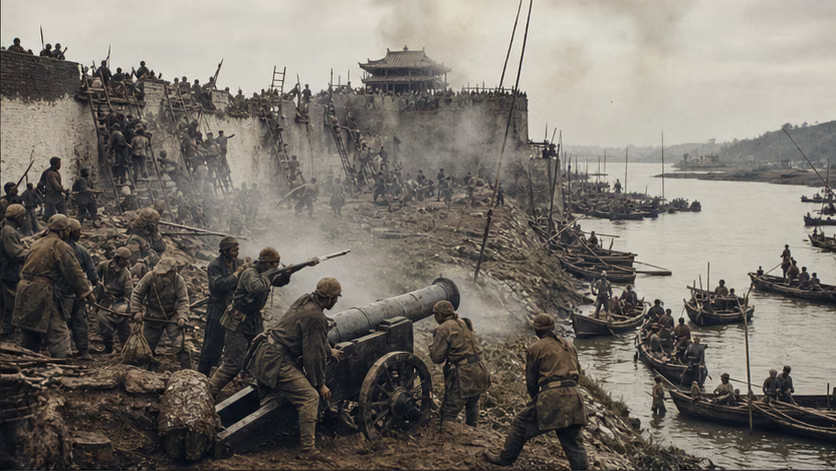
| Endgame | 1861–1864 | Li Hongzhang's Huai Army defended Shanghai, Zuo Zongtang entered Zhejiang, and the Ever Victorious Army joined the war; key places in Jiangsu and Zhejiang fell one after another; 1864.6.1 Hong Xiuquan died of illness, and on 7.19 the Xiang Army tunneled under the walls and blasted the city, bringing Tianjing down. ※ After the city was broken, the Xiang Army massacred and looted; "the long Qinhuai River was dense with corpses" (recorded in Zhao Liewen's Nengjingju Diary; original text unverified) | Separate articles on the fall of Tianjing and others remain to be written |
Casualties and Losses
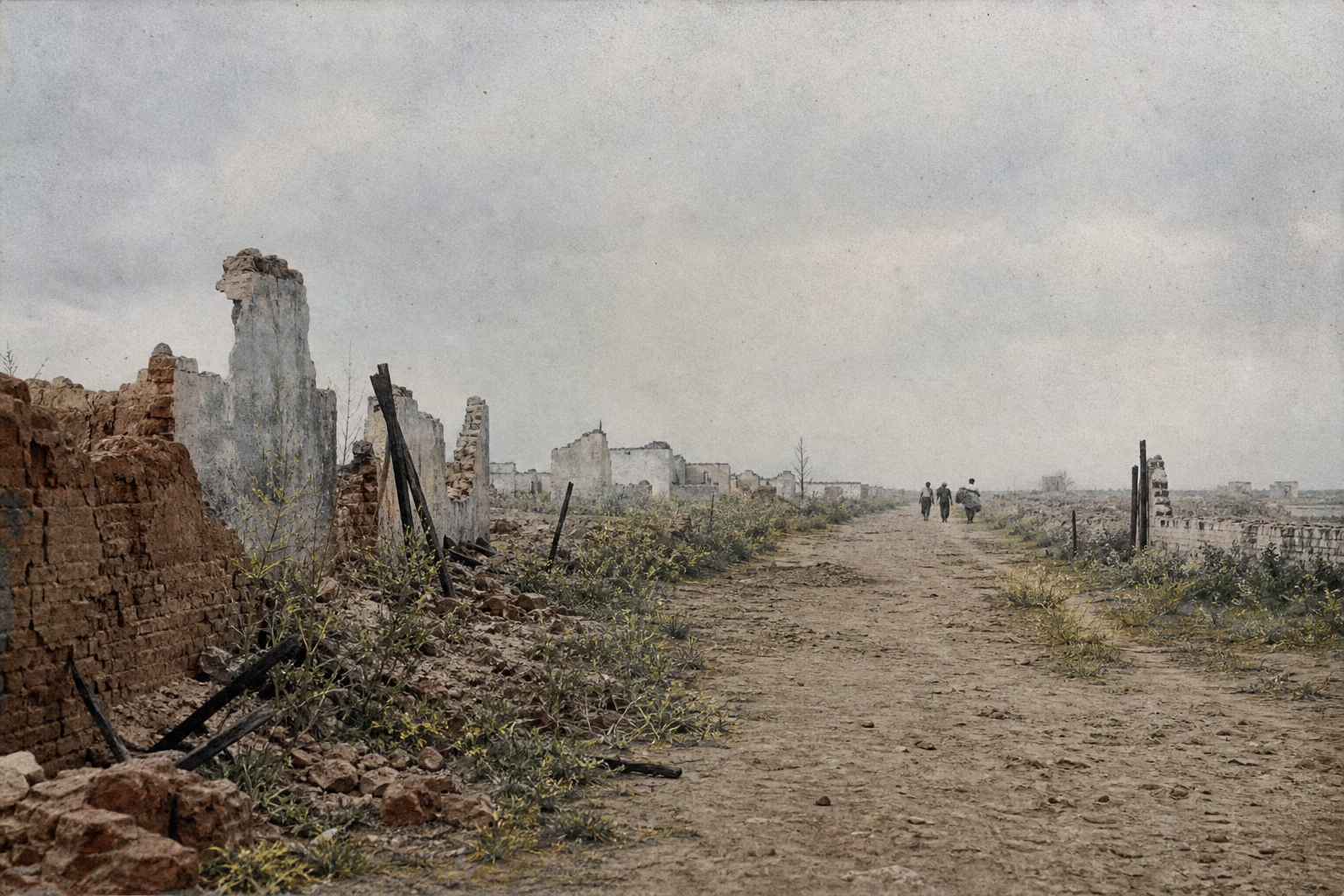
- Total deaths: there is no accepted number. Scholarly estimates range from 20 million to more than 70 million, and the disagreement lies in method rather than in scale:
- Traditional narratives often cite an approximate figure around "20 million" (statistical bases in early Chinese and foreign works; source unverified).
- Early Western estimate: the American missionary Happer (1880) estimated population loss at about 50 million (quoted from modern research summaries; original text unverified).
- Demographic method: Cao Shuji's A History of China's Population: Qing Period, using local gazetteers and back-projection from the 1953 census, estimated population loss in the main war-zone provinces of Jiangsu, Anhui, Zhejiang, Jiangxi, Fujian, and others at about 70 million (five-province basis; another cited version gives 73.3 million across seven provinces, so two accounts of the provincial scope coexist); Ge Jianxiong and others (1999) considered the total loss to be at least 100 million.
- "Population loss" is not the same as "killed": the gap includes battle deaths, epidemic disease (cholera was widespread in the war zones, and some research says disease accounted for more than half of deaths in Jiangsu; unverified), famine, flight, and underregistration. The boundaries of each method differ, and the statistical bases are not the same. What can be said with certainty is that in the main theater, Anhui, Jiangsu, Zhejiang, and Jiangxi did not recover their prewar population density for more than a century; this was one of the deadliest wars in Chinese history.
- Qing forces: the Green Standard and Eight Banners were consumed almost to the point of losing their formations; there is no aggregate account of Xiang Army casualties across the years (counted separately in each article).
- Taiping Army: beyond battle deaths, there are no statistics for executions and suicides after the fall of Tianjing and other places in 1864. ※ Massacre and looting after a city was broken were normal on both sides: the Xiang Army at Jiujiang, Anqing, and Tianjing; the Taiping Army in the Manchu city of Jiangning and through coerced recruitment along the route. These are noted in the separate articles.
- Finance: Qing war expenses have no reliable total (figure disputed); lijin changed from a temporary wartime levy into a regular tax, and local finance grew powerful from then on.
Aftermath
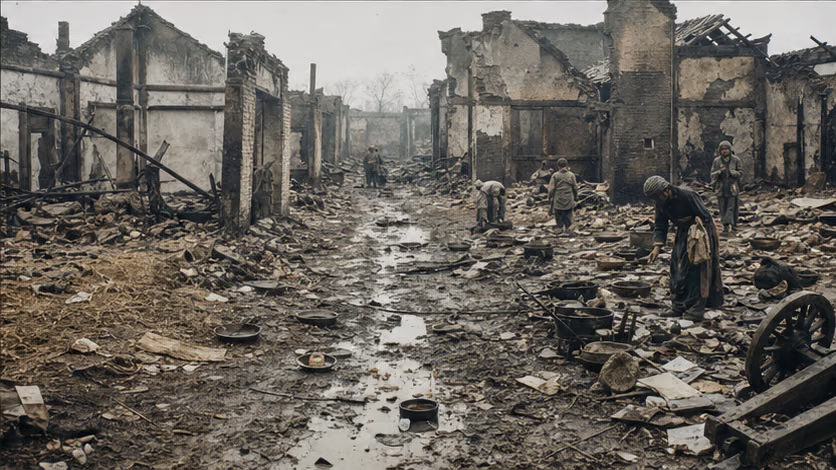
- The price of winning the civil war was the loosening of centralized power: this is the most important line in this article. To raise funds, lijin was opened and collection power lay with governors-general and governors; to fight, yongying militia armies were recruited, soldiers belonged to their commanders, and the power of deployment lay with commanders rather than ministries; to staff offices, recommendations meant that civil and military careers now partly ran through Xiang and Huai Army staffs. After the war, Zeng Guofan voluntarily disbanded part of the Xiang Army to make his position clear, but the system could not go back: Li Hongzhang's Huai Army and Zuo Zongtang's Chu Army took up the relay, while Han Chinese governors-general and governors held half the empire's territory. In 1900, governors-general and governors in the Southeast Mutual Protection dared collectively resist imperial orders; in 1911, the provinces declared independence and scattered at a call. The roots of both lay buried in these fourteen years of the Taiping Heavenly Kingdom.
- The pragmatism of the Xiang-Huai network led directly to the Self-Strengthening Movement. Zeng Guofan and Li Hongzhang both remembered what the foreign rifles and artillery of the Ever Victorious Army had shown them.
- "Borrowing foreign troops to assist suppression" set a precedent: foreign armed forces intervening in a Chinese civil war and settling accounts through treaty interests. It became normal afterward.
- Jiangnan was devastated, and the economic center of gravity accelerated toward Shanghai; the population voids in Jiangsu, Zhejiang, and Anhui were refilled by migration, and the regional pattern was reshuffled (specific flows unverified).
- The Taiping Heavenly Kingdom left no state archives of its own. When Tianjing fell, documents were burned and scattered. The first-hand Taiping materials readable today are mainly prisoner testimonies such as Li Xiucheng's Autobiographical Account and scattered printed documents.
How Each Side Records It
- Qing side at the time: Official documents called the Taiping "Yue bandits" and "long-haired rebels," defining them as rebellious disorder. Zeng Guofan's Proclamation Against the Yue Bandits took the defense of the Confucian order as its mission, turning the war into a war of "defending the teaching": scholar-officials defending Confucius and Mencius, rather than the court defending the state. That mobilizing language was itself evidence of the insufficiency of central authority.
- The Taiping Heavenly Kingdom itself: It founded its state under the banner of "receiving Heaven's mandate to punish the Hu," and denounced the Qing as "demons." Yet very few edicts and documents survive, and palace archives were destroyed together with the fall of Tianjing. Today's understanding of internal Taiping decisions depends mostly on documents captured by the Qing side, foreign eyewitness accounts, and retellings in Li Xiucheng's Autobiographical Account. One side in this war left its history through the hands of its opponent.
- Changes in later narratives: Qing official histories delivered the verdict of "long-haired rebels"; the Republic reversed this into a precursor of revolution: Sun Yat-sen called himself "the second Hong Xiuquan" (source unverified), and Kuomintang party history linked the Jintian Uprising into the revolutionary genealogy. In the 1950s, mainland historiography canonized it as a "peasant uprising against imperialism and feudalism"; the Jintian Uprising was carved on the reliefs of the Monument to the People's Heroes, and "peasant wars push history forward" became the standard formulation. From the 1980s onward came renewed scrutiny: the thesis of a religious millenarian movement, the civil-war framing, reassessments of violence and coercion, and looser evaluations of Zeng Guofan and the Xiang Army. The tension between textbook narrative and plural historiography remains to this day.
Disputes and Sensitivities
- Nature of the war: Peasant uprising / religious movement / civil war: all three characterizations have evidence and blind spots. This article writes within a civil-war frame (symmetrical account of belligerents, atrocities recorded on both sides) and does not decide the nature of the war in advance.
- Death toll: The range from 20 million to more than 70 million is itself both a political and scholarly battlefield; different numbers rest on different statistical bases and methods.
- Hong Xiuquan and the God Worshipping Society: Pioneer of national revolution, theocratic kingdom of a failed scholar, evil cult: these three portraits have long pulled against one another in public narratives, and different audiences are sensitive to different ones.
- Zeng Guofan: The great minister of the Tongzhi Restoration and "Zeng the Head-Shaver" coexist; the gap between the historical reality of Xiang Army city massacres and recent "success studies" enthusiasm around Zeng is a flashpoint in contemporary opinion.
- Tianjing Incident: Whether an edict ordered Wei Changhui to kill Yang Xiuqing, and who bore responsibility for Shi Dakai's departure, remain matters of multiple accounts because the documentation is incomplete (details unverified).
Contents
Whether Shi Dakai's departure and the Dadu River should become a separate article remains to be weighed.
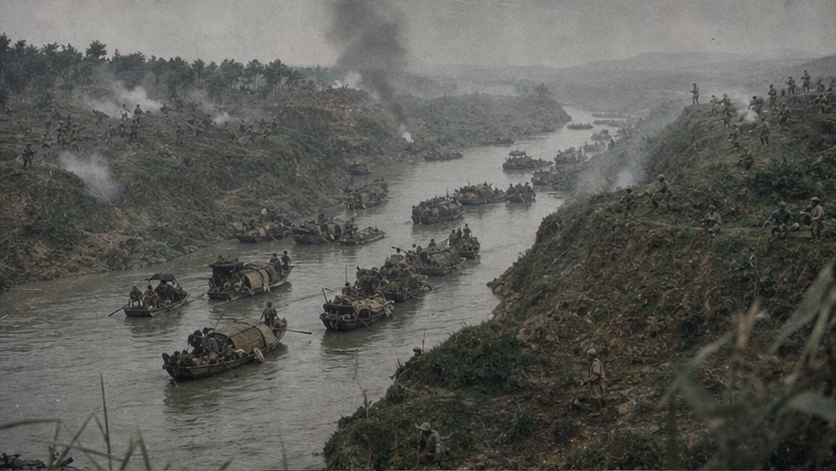 Advance into Jiangnan1851.01A force that rose from a mountain village in Guangxi crossed five provinces in two years, reached the Yangtze, took Jinling and made it its capital -- the course of the late Qing's largest civil war was fixed along this line of advance.
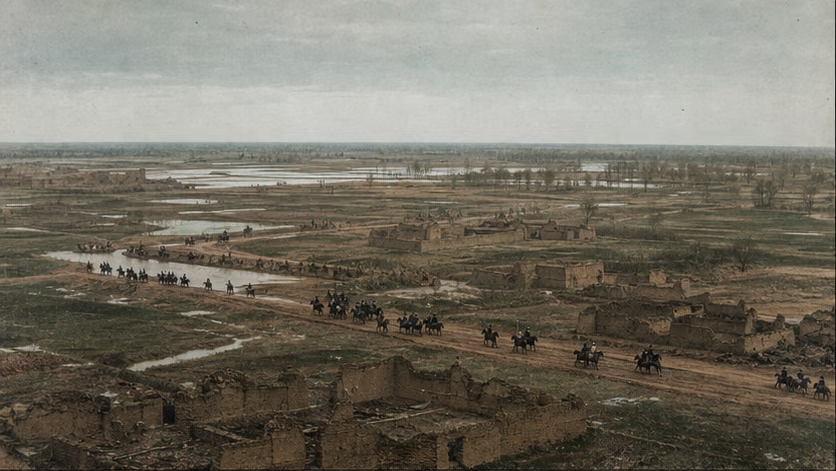 Nian Rebellion1853.01On the plains of Huaibei, a mobile armed force that had "turned infantry into cavalry" maneuvered for fifteen years against Qing blocking and pursuit forces from Senggelinqin to the Xiang and Huai armies; it first destroyed, beside the wheat fields of Shandong, the Qing court's last elite Manchu-Mongol regular force, and then forced into being the "river-defense" encirclement system that used rivers as walls -- its destruction marked the true end of the wars of the Taiping era.
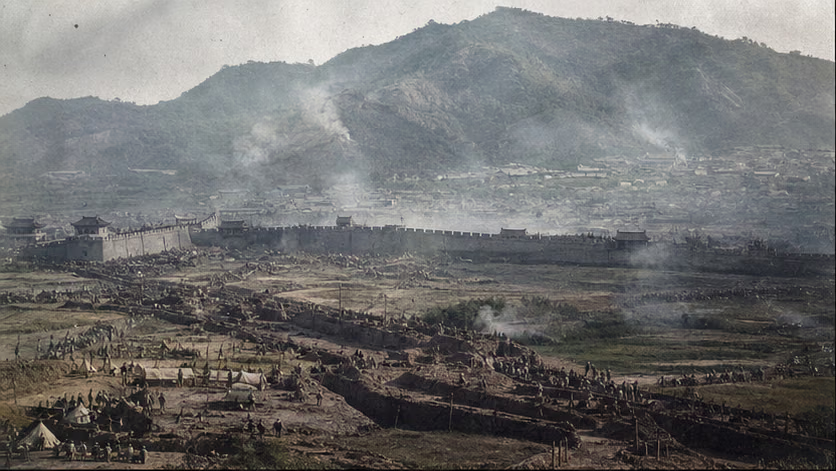 Battles for the Jiangnan and Jiangbei Encampments1853.03The Qing army planted one great encampment at Xiaolingwei east of Tianjing and another on the outskirts of Yangzhou, besieging the city for seven years; the Taiping Army struck twice and shattered them twice--after the first rupture came Tianjing's self-destruction, and after the second the Green Standard's direct line never recovered.
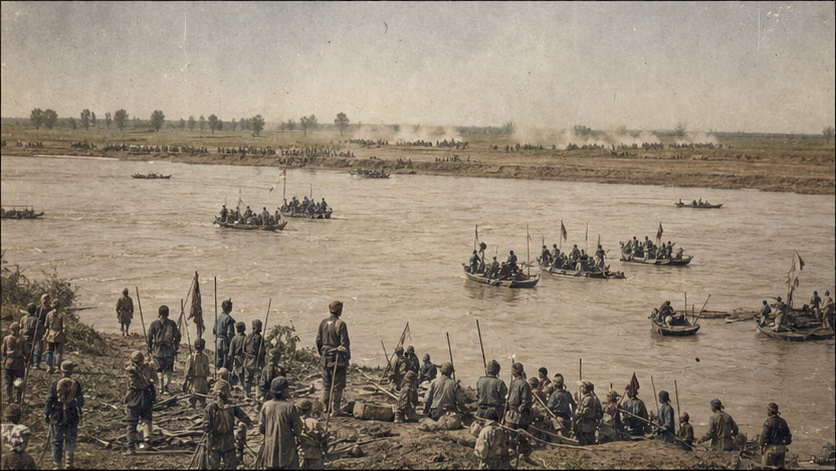 Taiping Northern Expedition1853.05Twenty thousand southern soldiers with no support behind them set out from Yangzhou, drove in one breath to the walls of Tianjin, were surrounded for two years in the bitter cold of northern China, and were annihilated, without a single formation surviving.
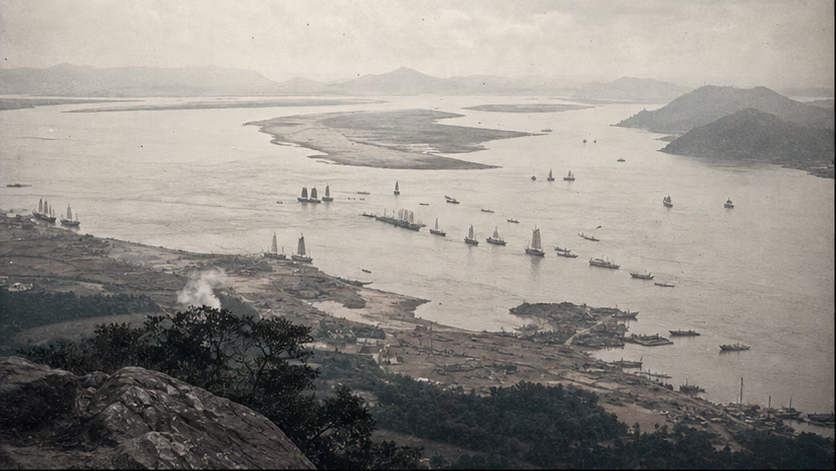 Western Expedition and Hukou (Taiping western campaign vs. the rising Xiang Army)1853.06After fixing their capital at Nanjing, the Taiping Army went upstream on the Yangtze in a western campaign to contend for the upper river; the newly trained Xiang Army came downstream and met it head-on -- three years of seesaw fighting in which the Xiang Army twice nearly died at its debut, until Shi Dakai finally took almost all of Jiangxi and left Zeng Guofan trapped in one corner of Nanchang.
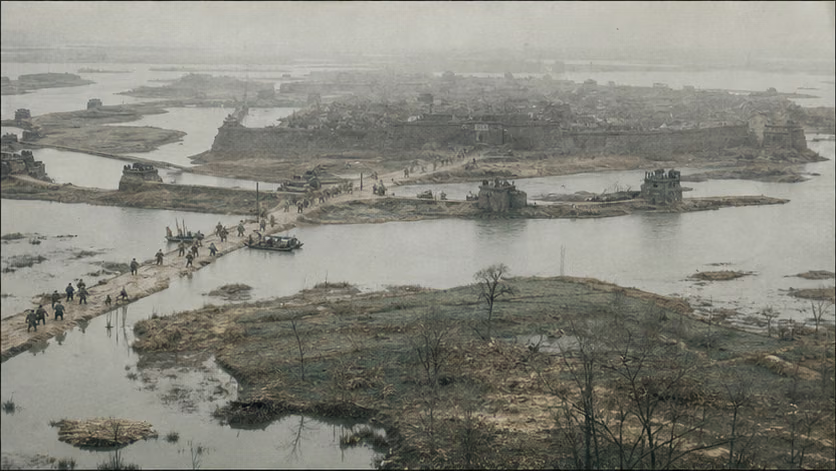 Battle of Sanhe1858.11The sharpest blade of the Xiang Army--Li Xubin's six thousand picked troops took four cities in succession and drove five hundred li deep alone, only to be encircled and destroyed outside Sanhe Town in a morning fog by Chen Yucheng and Li Xiucheng: the Taiping Army's most complete battle of annihilation in its later period.
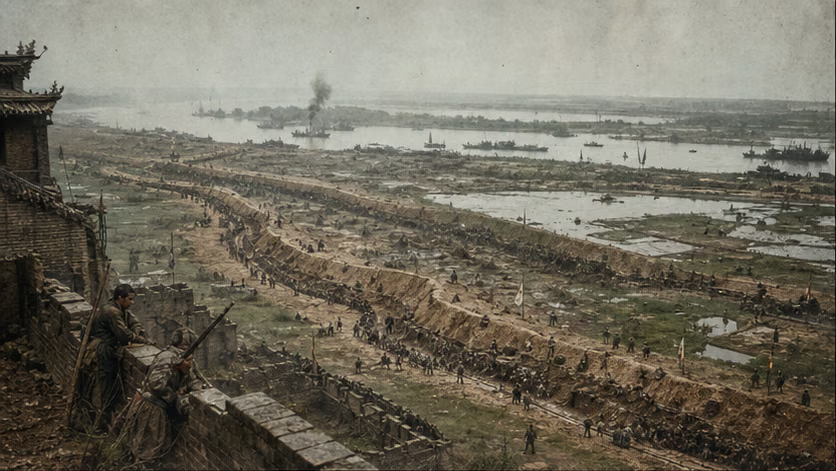 Defense of Anqing1860.01The Xiang Army dug two long trenches outside Anqing and held the city under siege for fifteen months; the Taiping Army's three major relief efforts were all stopped outside the trenches, and on September 5, 1861 a tunnel mine brought down the wall, with more than ten thousand defenders perishing to the last -- from then on Tianjing's upstream gate lay open, and the war could scarcely be turned back.
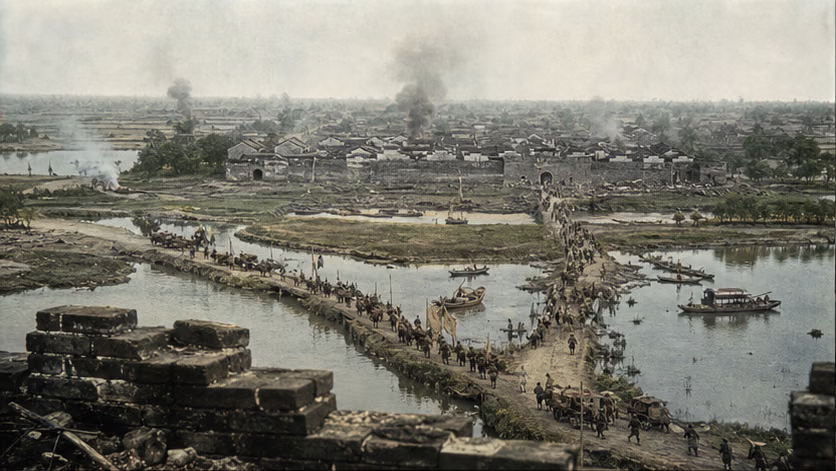 Eastern Expedition to Suzhou–Changzhou and the Battles for Shanghai1860.05In the summer of 1860, Li Xiucheng rode the momentum of the second destruction of the Jiangnan Encampment to sweep across southern Jiangsu and press on Shanghai; across two years, two assaults on Shanghai failed--the battlefield gave victories to both sides, but the lost thing was the pay source: Shanghai was held, Jiangsu and Zhejiang's fiscal wealth followed it, and the Huai Army and "borrowing foreign troops to aid suppression" began from here.
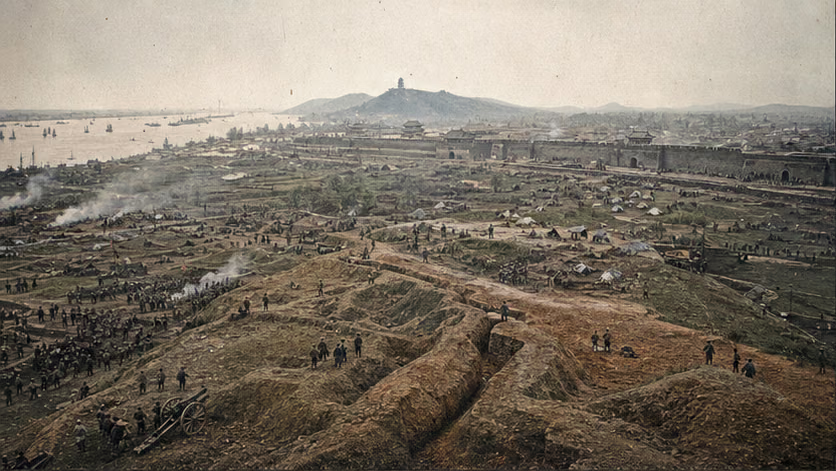 Defense of Tianjing1862.05In May 1862, twenty thousand Xiang Army troops established themselves beneath the walls of Tianjing; they besieged the city for two years and two months, withstood Li Xiucheng's relief assault of a claimed several hundred thousand men over forty-six days, and by trenches, forts, the navy, and grain routes starved this capital until its food was gone. On July 19, 1864, a tunnel mine blasted the wall open -- and with that, the Taiping Heavenly Kingdom came to its end.
Sources and Open Questions
Main sources: Luo Ergang, History of the Taiping Heavenly Kingdom (the comprehensive mainland study, strongly argued and source-critical); Jian Youwen, Comprehensive History of the Taiping Heavenly Kingdom and A Comprehensive Study of Taiping Heavenly Kingdom Institutions (Hong Kong-Taiwan system); Mao Jiaqi, ed., General History of the Taiping Heavenly Kingdom; Jonathan Spence, God's Chinese Son (representative overseas narrative); Cao Shuji, A History of China's Population: Qing Period (demographic method for death estimates); Zhao Liewen, Nengjingju Diary (core first-hand source on massacre and looting after the fall of Tianjing); Li Xiucheng's Autobiographical Account; Zeng Guofan's memorial drafts and family letters; Wang Kaiyun, Record of the Xiang Army; Wang Ding'an, Account of the Xiang Army.
Open questions: specific figures and provincial scope for total-death estimates (Cao Shuji and others); actual Taiping troop strength when Wuchang and Jiangning were taken; terminal year of fighting with the Nian Rebellion; source for Sun Yat-sen's phrase "the second Hong Xiuquan"; sequence between Hong Xiuquan's illness dream and his encounter with Good Words to Admonish the Age; documentary basis for the various accounts of the Tianjing Incident; course of events of the Lay-Osborn Flotilla; actions of Augustus Lindley and other foreign adherents; specific migration flows that refilled Jiangnan after the war; total Qing war expenses; original text and issue sequence of the Jintian camp-assembly order; records of the decision debate after taking Wuchang between moving north and moving east downriver; documentary basis for the judgment that "Yang Xiuqing's control of the other kings combined efficiency with hidden danger"; details of minting large-denomination copper cash, issuing official notes, and the Board of Revenue's silver reserves; original wording of "abandoning the city and moving away" in Li Xiucheng's Autobiographical Account; source of the warning against Zeng Guofan's raising troops.
All images on this site are AI-generated depictions. They are not historical photographs, not primary sources, and do not depict any real individual.