War Overview · Russo-Japanese War (foreign war on Chinese soil) (1904–05)
Two great powers fought for a year and a half on Chinese territory: the victor took lease rights and railways in southern Manchuria; the loser ceded the southern half of Sakhalin; and China, the country whose land had become the battlefield, was asked only once from beginning to end — whether it could remain neutral.
Engagement Data
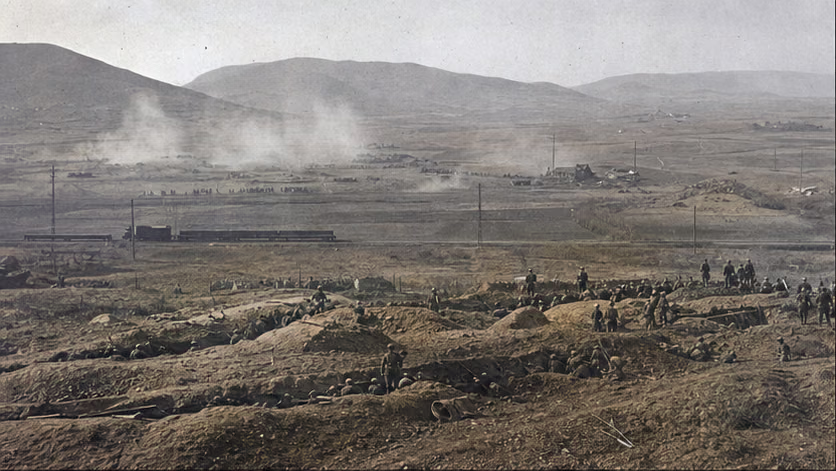
| Item | Details |
|---|---|
| Time | 1904.2.8 (surprise attack on Port Arthur) – 1905.9.5 (Treaty of Portsmouth) |
| Place | Manchuria in China (the "combat zone" east of the Liao River, with the main battlefield on the Liaodong Peninsula — Liaoyang — south of Mukden), the Korean Peninsula, the Yellow Sea, and the Sea of Japan |
| Belligerents | Empire of Japan / Russian Empire (battlefield country: Great Qing, which declared itself "neutral as a non-belligerent") |
| Result | Japanese victory. 1905.9.5 Treaty of Portsmouth: Russia "transferred" to Japan the lease rights to Port Arthur and Dalian, the Chinese Eastern Railway branch south of Changchun (later the "South Manchuria Railway"), and associated interests; ceded the southern half of Sakhalin; and recognized Korea as within Japan's sphere of influence |
Belligerents (War Level)
| Item | Japan | Russia |
|---|---|---|
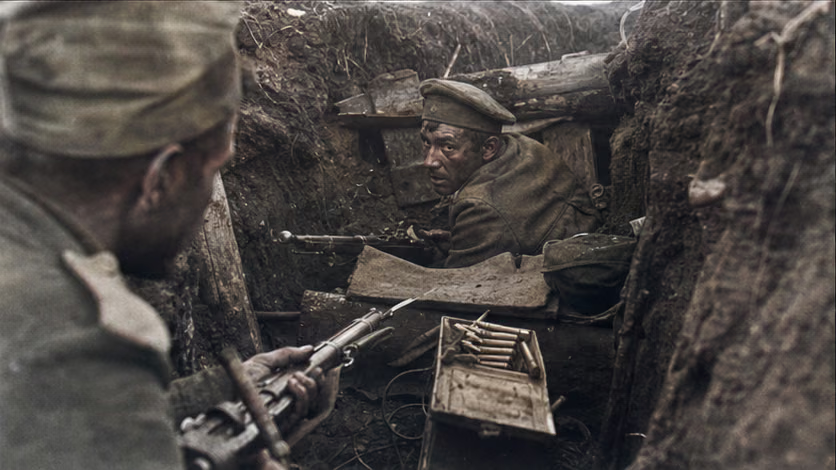
| Total strength | Standing army of more than 200,000; after mobilization the army exceeded 1 million (figures vary by statistical basis and account) | The world's largest total force, but reinforcements to the Far East arrived in sequence; before the Battle of Mukden, about 310,000–370,000 were concentrated there (figures vary by statistical basis and account) |
| Navy | The Combined Fleet had reached a modern scale and was commanded by Togo Heihachiro; from the opening of the war it held command of the Yellow Sea | The Pacific Squadron was divided between Port Arthur and Vladivostok, with its main force at Port Arthur; the Baltic Fleet sailed halfway around the globe to reinforce it and was destroyed in the Battle of Tsushima |
| Firearms | Murata rifles, improved Type 31 quick-firing field guns, 280 mm siege howitzers (gun models and performance remain unverified) | Mosin rifles and quick-firing guns; machine guns, barbed wire, and trenches were used extensively at Liaoyang and Mukden |
| Supply | Short overseas line, chiefly by sea transport | The single-track Trans-Siberian Railway fed the front, with the Lake Baikal section connected by ferry (details unverified), a thousands-of-kilometers line with only one kidney pumping blood |
| System | Two levels of command, Imperial General Headquarters and the General Headquarters of the Manchurian Army, with unified objectives | Court factions obstructed one another; Viceroy of the Far East Yevgeni Alekseyev and front commander Aleksey Kuropatkin had overlapping authority and responsibilities (personnel details unverified) |
Historical Setting
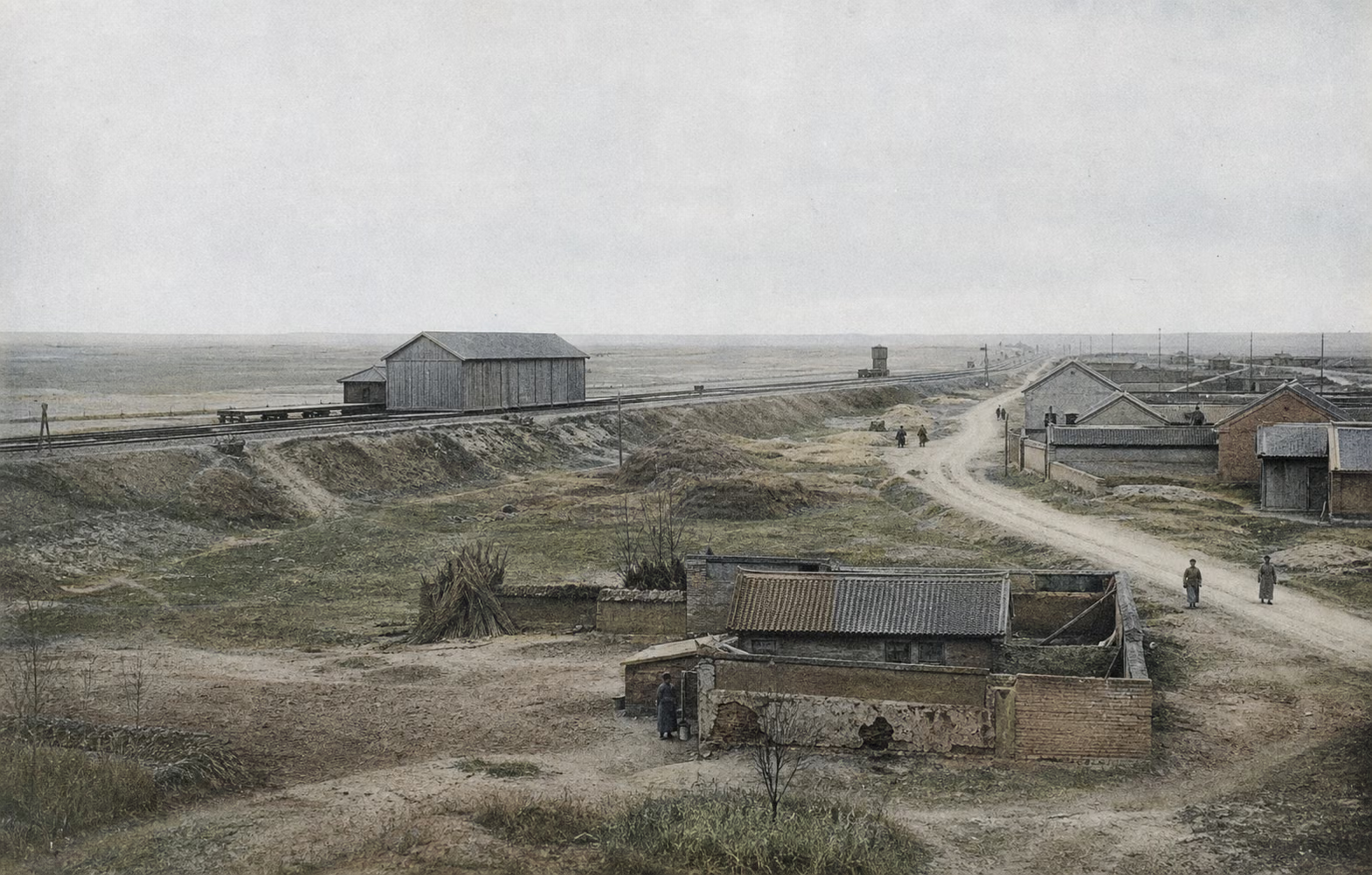
World: by the end of the nineteenth century, the powers' partition of China had already taken shape. After the First Sino-Japanese War, the "Triple Intervention" forced Japan to give Liaodong back; two years later, in 1898, Russia leased Port Arthur and Dalian itself and built a Chinese Eastern Railway branch driving straight into the Liaodong Peninsula — Japan remembered this humiliation for ten years. In 1902, the Anglo-Japanese Alliance was formed, giving Japan British backing; Russia's Franco-Russian Alliance was confined to the European theater and could not reach the Far East effectively (details of alliance obligations remain unverified).
Japan: the Meiji constitutional system had taken shape. After victory in the First Sino-Japanese War, the country exhorted itself with "sleeping on brushwood and tasting gall" and spent ten years expanding and preparing its military. Its bottom line in negotiations with Russia was a "Manchuria-Korea exchange": Japan would recognize Russia's dominant position in Manchuria in return for Russia recognizing Japan's exclusive control of Korea. The negotiations dragged on until they broke down in early 1904, and Japan chose to strike first.
Russia: expansion in the Far East was state policy. Russia built the Chinese Eastern Railway, and in the Boxer Rebellion of 1900 sent more than 100,000 troops under the name of "protecting the railway" and occupied all of Manchuria. In 1902, it signed the Treaty for the Return of the Three Eastern Provinces with the Qing government, promising a phased withdrawal; after the first deadline arrived, Russia repeatedly broke its promises and instead reinforced and held its positions (number of breaches and treaty details remain unverified). Within the court, attitudes toward Japan were dismissive, and the war party and peace party remained entangled until the eve of war.
China (Great Qing): newly defeated in the Boxer crisis, with foreign legation guards stationed in Beijing and Tianjin and Manchuria under Russian occupation, China held sovereignty over Manchuria in name when the war began, but actual administration, garrisons, and railways were all in Russian hands. The court had only one choice: not to fight. How exactly it would "not fight" is the subject of the next section.
Why It Was Fought
The seeds of this war had been planted ten years earlier. The Triple Intervention forced Japan to give back Liaodong; two years later Russia leased Port Arthur and Dalian for itself. "Sleeping on brushwood and tasting gall" was shouted across Japan's court and public sphere for ten years, until by 1903 only one card remained on the negotiating table: the Manchuria-Korea exchange, in which Japan would recognize Russian control in Manchuria in return for Russian recognition of Japan's exclusive position in Korea. Petersburg delayed its reply again and again. In spring and summer of that same year, War Minister Kuropatkin visited Japan, saw its military preparations with his own eyes, and returned home with a more urgent warning against war — he was one of the few people in Russia's upper ranks who took Japan seriously. But his voice could not outweigh Far Eastern hardliners such as Bezobrazov: the capital of the timber company at the mouth of the Yalu River was mixed with the interests of the imperial family and close courtiers, and a hard line toward Japan was business first and state policy only afterward (company equity details remain unverified). Witte — the designer of the Chinese Eastern Railway and of gradual expansion — was removed from the substantive office of finance minister in autumn 1903, and the balance inside the Russian court tipped fully toward the hardline side.
Japan's resolve was clear, and cold. On 1904.2.4, an imperial conference set policy; on 2.6, relations were broken; on the night of 2.8, Port Arthur was attacked (the conference and breakoff dates are the common account). Japan dared to fight because it had made three calculations: the Siberian Railway was single-track and the circum-Baikal section was not yet open, so Russian reinforcements would be a trickle measured by the month; the Baltic Fleet would need more than half a year to sail halfway around the globe, and Japan had to break the Russian Far Eastern army in that half-year; the Anglo-Japanese Alliance blocked France's obligation to aid Russia, London and New York bond markets were open, and half the war costs could be expected from foreign debt (the course of Takahashi Korekiyo's European fundraising remains unverified); and Russia had only a little more than 100,000 troops in the Far East, while Japan could mobilize more than 1 million with the whole strength of the country. What Japan feared was equally clear: its finances could not sustain a long war, so it had to seek a rapid decision. That "rapid decision" would later press out the mountain of corpses below Port Arthur, and also the final decision at Portsmouth to give up indemnity.
On the Qing court's side, the resolve was only one word: hide. Before the war began, provincial officials did voice proposals to ally with Japan against Russia, seize the opportunity to attack the enemy, and recover Manchuria; the result of court deliberation, weighing two harms, was to help neither side (survival of memorials on the pro-Japan proposal remains unverified). There was no capital with which to hide: Manchuria was under Russian occupation, foreign legation guards were stationed in Beijing and Tianjin, Boxer indemnity payments had just begun in installments, and the treasury could not even support an expeditionary army. Neutrality was not a choice; it was an admission that China had no choice. On February 12, the fourth day after the war began, the edict of "neutrality as a non-belligerent" was issued. Two empires opened war on Chinese land, and the role China assigned itself was spectator.
Non-Belligerent Neutrality: Drawing a Battlefield for Two Belligerents on One's Own Territory
On 1904.2.12, the fourth day after the war began, the Qing court issued an edict declaring "neutrality as a non-belligerent" and notified the countries: the area east of the Liao River was designated a "combat zone," and the area west of the Liao River a "neutral zone"; the armies of the two countries were required not to fight in the "neutral zone" (the exact boundary remains unverified).
This document is one of the most absurd texts in modern history:
- The battlefield was on one's own territory, yet neither belligerent was oneself. The so-called "neutrality" was an admission to outsiders: I can no longer govern this land; go ahead and fight.
- The act of drawing the boundary itself gave up sovereignty. Qing local officials inside the combat zone were ordered to continue serving as usual, yet also not to "offend" either side (records of officials' situation remain unverified).
- Still more absurd, the "neutrality" did not match reality. The Kwantung leasehold and the Chinese Eastern Railway were already in the two countries' hands; Japanese troopships landed from Korea; Chinese territory was the corridor through which they advanced against each other. Whether neutrality existed was never for the Qing court to decide.
- The Chinese people inside the combat zone were, in name, protected by this edict; in reality, they were requisitioned by both sides and struck by fire from both sides.※
Course of the Engagement (Phase Table)
| Phase | Time | Key Points | Separate Chapters |
|---|---|---|---|
| Surprise attack on Port Arthur · Battle of Chemulpo Bay | 1904.2.8–9 | Japanese torpedo boats made a night attack on the Russian Pacific Squadron outside Port Arthur; the next day, outside Chemulpo harbor, two Russian ships were sunk; war was declared on 2.10 (the sequence of the night attack and declaration of war has long been debated; see the disputes section) | — |
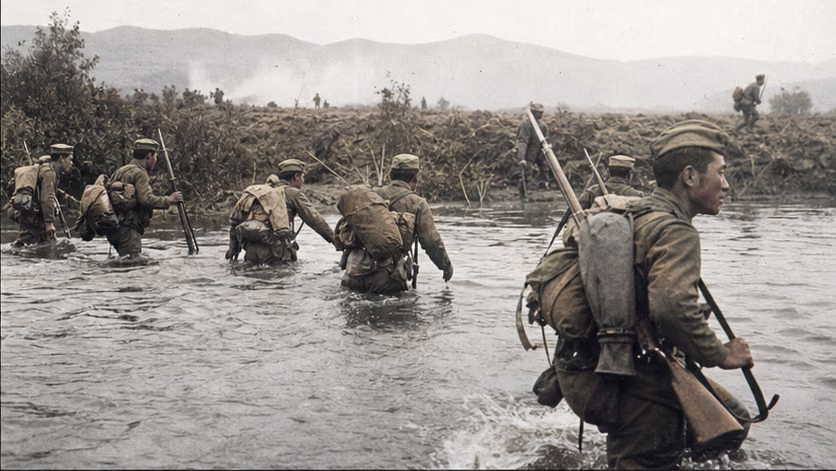
| Battle of the Yalu River | 4.30–5.1 | The Japanese First Army (Kuroki Tamemoto) crossed the Yalu River into Chinese territory; Russian forces withdrew, and the Japanese army stepped onto Manchurian soil | — |
| Battle of Nanshan | 5.25–26 | The Japanese Second Army (Oku Yasukata) stormed Nanshan south of Jinzhou, cutting the link between Port Arthur and the Russian army at Liaoyang; Japanese casualties in one day exceeded 4,000 (Japanese figures), and Imperial General Headquarters in Tokyo suspected a telegraph error had added one zero — this anecdote is widely circulated, but its source remains unverified | — |
| Battle of Delisi | 6.14–15 | Russian forces moved south to relieve the siege of Port Arthur but were repulsed by the Second Army around Wafanggou; from then on Port Arthur stood isolated | — |
| Battle of Liaoyang | late August–early September | The first major battle: Russian forces resisted in sequence from prepared positions, then withdrew north to Mukden; casualties on both sides each numbered in the tens of thousands (figures vary sharply by source and statistical basis) | — |
| Siege of Port Arthur | 1904.8–1905.1.2 | The Japanese Third Army (Nogi Maresuke) besieged the fortress; after three general assaults, it shifted to attacking 203 Meter Hill, then brought artillery fire to bear and sank the fleet inside the harbor; on 1905.1.2, Russian forces opened the city | Siege of Port Arthur (1904–05) |
| Battle of Shaho | October | After Liaoyang, a Russian counteroffensive and a Japanese counterstroke seesawed between the Hun River and the Sha River; attack and defense changed hands, and the line became deadlocked (details of the attack-defense sequence remain unverified) | — |
| Battle of Heikoutai | 1905.1 | Russian forces concentrated for another attack against the Japanese left wing, their last opportunity for a counteroffensive; Akiyama Yoshifuru's cavalry brigade fought hard to hold against the threat to the flank and rear, a line whose details remain unverified | — |
| Battle of Mukden | 2.21–3.10 | The two sides together numbered about 600,000, making it at the time the largest land battle in human history; the Japanese army enveloped both wings, and the Russian army made a general retreat north toward Siping | Battle of Mukden |
| Battle of Tsushima | 5.27–28 | The Baltic Fleet sailed halfway around the globe into the Tsushima Strait, and Togo Heihachiro's Combined Fleet destroyed it in a single day — it had come halfway around the world to be buried. Togo was the captain of Naniwa who sank the Kowshing at Pungdo in the First Sino-Japanese War; eleven years later he decided the outcome here, a single line running through two wars (see the First Sino-Japanese War chapters for details) | — |
| Portsmouth peace talks | 8–9.5 | U.S. President Theodore Roosevelt mediated, and the treaty was signed; Roosevelt received the 1906 Nobel Peace Prize for this | — |
Portsmouth and Beijing: Treaty Rights Passed from Hand to Hand, with China Unconsulted
The China-related clauses of the Treaty of Portsmouth of 1905.9.5: Russia "transferred" to Japan the lease rights to Port Arthur and Dalian, the Chinese Eastern Railway branch south of Changchun (Kuanchengzi) and its associated interests (mines, forest products, railway guards, and so on); ceded the part of Sakhalin south of 50 degrees north latitude; and recognized Korea as within Japan's sphere of influence (Russia refused to pay indemnity, and Japan ultimately gave it up — details remain unverified).
Everything disposed of in this treaty belonged to China, and China was not present. Afterward the Qing government had to come forward itself and complete the paperwork: in 1905.12, in the Sino-Japanese Treaty and Agreement on Manchuria (Beijing), the Qing court was forced to "grant full assent" to the transfer clauses in the Russo-Japanese treaty, and an attached agreement opened another sixteen treaty ports in Manchuria (number unverified). Two foreign countries fought a war; loser and winner alike took things from China; and the winner's share still had to be acknowledged by China's signature and seal.
Casualties and Losses
- Japanese forces: war-level deaths of more than 80,000 (including deaths from disease; Japanese and later research use sharply divergent statistical bases, with varying accounts).
- Russian forces: war-level deaths of more than 70,000 (including deaths from disease; statistical bases diverge sharply, with varying accounts); prisoners taken at Port Arthur and Mukden together exceeded 100,000 (figure disputed).
- Russia's Baltic Fleet was almost completely destroyed in the Battle of Tsushima.
- War costs on both sides: Japan borrowed more than 1 billion yen, half from British and American financial markets (figure disputed); Russia's war costs, added to the pressure of defeat-related payments, burned straight through the empire's finances.
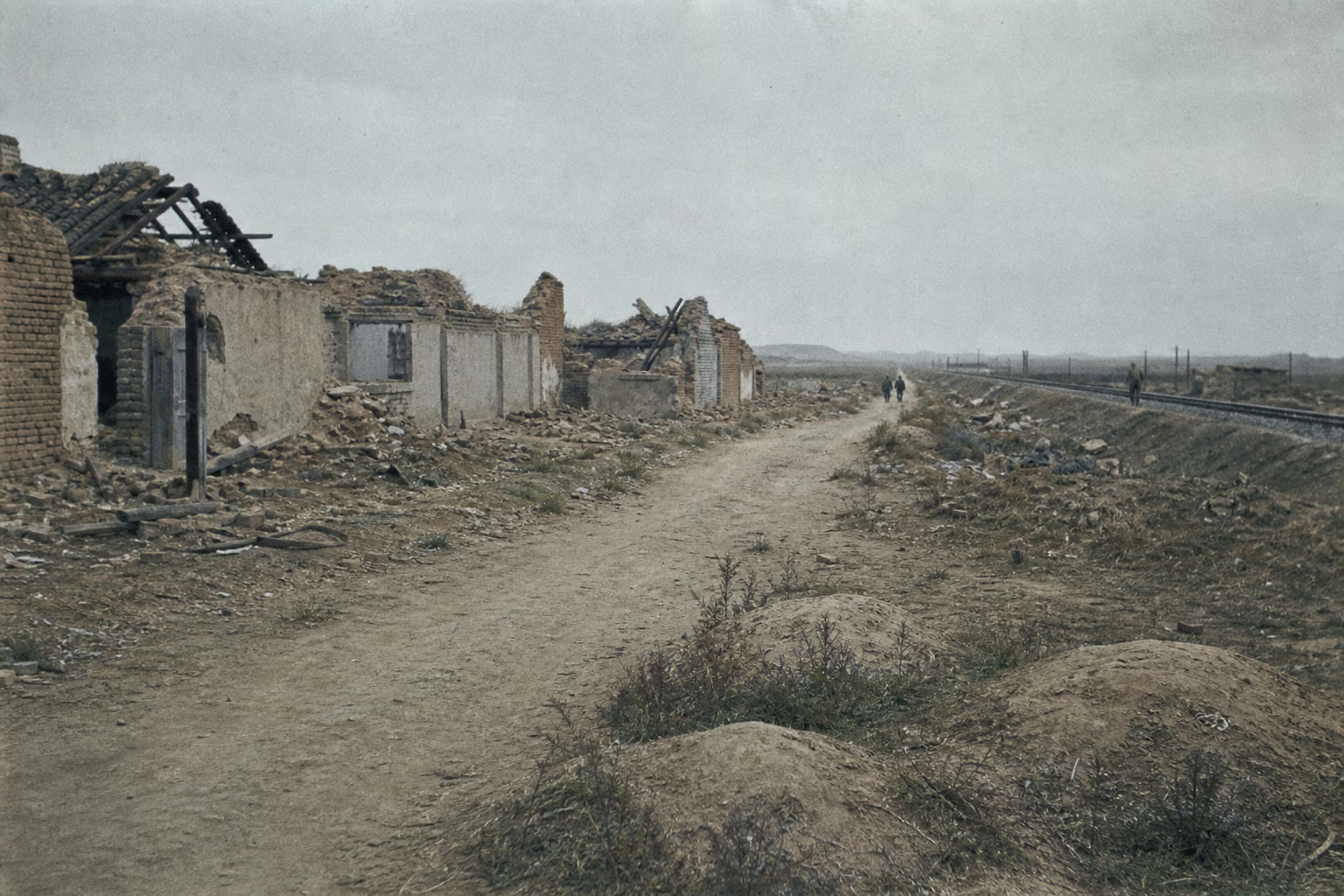
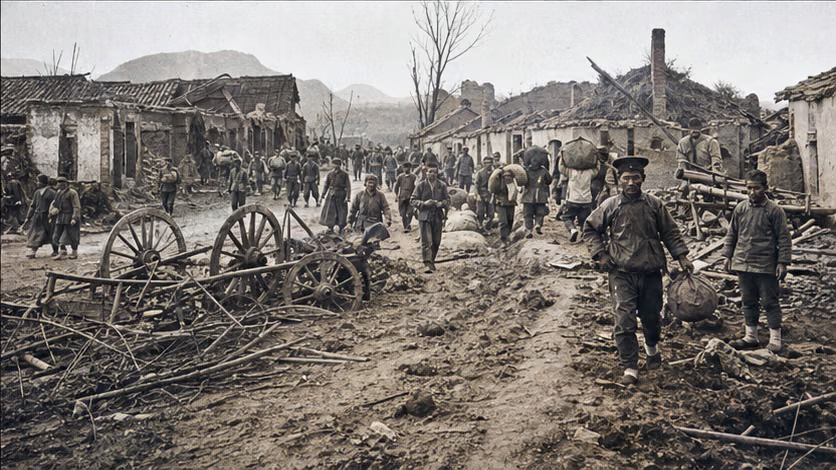
- Chinese civilians: deaths, injuries, and property losses were counted by no one. The three words "no statistics" state the matter by themselves: in the combat zone, large numbers of Liaodong villages were destroyed※; both sides requisitioned laborers, guides, and porters in the hundreds of thousands (figures vary by statistical basis and account); and Chinese scouts and "bandit" armed groups employed by the two sides killed one another behind the lines※. The two belligerents each buried their own dead with ceremony; Chinese casualties did not even have the qualification to enter the statistics.
Aftermath
- Japan obtained the "Kwantung Leased Territory" (the renamed Port Arthur-Dalian leasehold) and the South Manchuria Railway Company (Mantetsu, established in 1906), and stationed guard troops along the railway line in the name of "protecting the railway" — the predecessor of the later Kwantung Army. The soldiers of September 18, 1931, were stationed along the railway line obtained in this war of 1905; straighten this line out, and it is twenty-six years long.
- Russia's defeat set off the Revolution of 1905: St. Petersburg's "Bloody Sunday" (1905.1.22) combined with the disastrous news from Tsushima, imperial prestige collapsed, and in December the regime was forced to issue the October Manifesto and establish constitutional government (details of the revolution remain unverified).
- The news that "yellow people defeated white people" shook Asia: nationalists in Vietnam, India, Turkey, and Iran all read the war as proof that "Asia could defeat Europe." For Chinese intellectual circles, too, it was a stimulant — the number of students studying in Japan rose sharply, calls for constitutional government swelled, and "Japan won because it was constitutional; Russia lost because it was autocratic" became a popular argument. But for the people of Manchuria, this reading was illusory: the result of the war was not that Manchuria escaped occupation, but that the occupier changed from one to two — northern Manchuria remained Russian, southern Manchuria went to Japan, and the dividing line of double occupation was drawn at Changchun. Both layers must be written side by side.
- In 1906, at Sendai Medical College, Lu Xun saw a lantern-slide image of an execution from the Russo-Japanese War: a Chinese man accused of being a "Russian spy" was beheaded by Japanese forces, and the onlookers were also Chinese. From this he abandoned medicine for literature — "however strong and healthy their bodies might be, citizens of a weak and backward nation could only serve as meaningless material for public display and as spectators" (text of the Preface to Call to Arms remains unverified). One by-product of this war was the foremost figure of twentieth-century Chinese literature.
How Each Side Records It
- Japanese side: a national war of "the whole country united," and the high point of the Meiji state system. Narratives of "human bullets" at Port Arthur and 203 Meter Hill and Nogi Maresuke's ritual suicide (1912) became materials for militarist education; the names of the dead enshrined at Yasukuni and regional Gokoku shrines were among the heaviest for this war. War histories fill shelves, but in their narratives China is only the color beneath the map.
- Russian side: the starting point of a defeat and a revolution. Imperial narratives avoided speaking of defeat; Soviet historiography placed it within the frame of "the decay of tsarist autocracy," binding the Russo-Japanese War together with the 1905 Revolution (wording in different periods remains unverified).
- Chinese side: in general-history narratives, this war often occupies only a small section, appended after "Russo-Japanese contradictions" and the "Triple Intervention"; compared with the actual harm it caused to the people of Manchuria, the space it receives is disproportionately slight. In local Manchurian memory and oral tradition, the experience of fleeing "the Japanese and the old Russians" (oral materials remain unverified) is the bottom-level version.
- Its place in world history: machine guns, trenches, heavy artillery, field telephones, trench deadlock, and a 600,000-man battle — this war was a rehearsal for the First World War, and military observers from many countries gathered in Liaodong (the military-observer system is disputed). It verified the form of industrialized total war, and also corrected, or misled, European militaries' estimates of the offensive. Each country's general staff took away its own lessons and used them in Europe ten years later.
Disputes and Sensitivities
- The sequence of surprise attack and declaration of war: the night attack on Port Arthur came first (2.8–9), and the declaration of war came later (2.10), so the charge of "war without declaration" has long been raised; the Japanese side argued that the 2.6 break in relations already constituted a state of war (doctrinal details remain unverified). This dispute mirrors the later narrative of Pearl Harbor in 1941.
- The double edge of the "yellow-white war" narrative: at the time, it was fuel for Asian nationalism, and it is still invoked today; but for Chinese Manchuria, the result of the war was a change of occupier, not de-occupation. Both meanings coexist.
- China as battlefield disappearing from both countries' war histories: Japanese and Russian war histories both take armies as their protagonists; the deaths of Chinese civilians have no archives and no steles. Chinese sources, meanwhile, are extremely scattered. "No statistics" is not an archival gap; it is part of the violence itself.
- Neither belligerent was China, yet the battlefield was Chinese territory; in both countries' war histories, Chinese people mostly retreat into the background of the front line, unlike in all the preceding wars.
Contents
The Yalu River, Nanshan, Delisi, Liaoyang, Shaho, Heikoutai, and Tsushima engagements are included in the phase table of Battle of Mukden and are not given separate chapters.
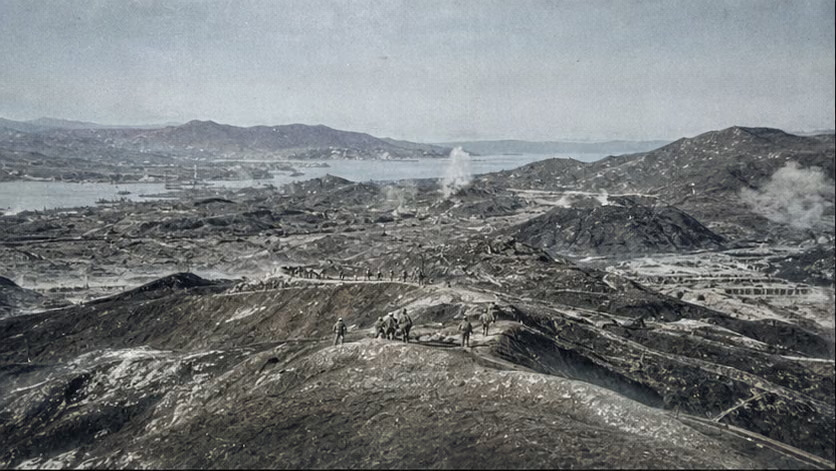 Siege of Port Arthur (1904–05)1904.08Fifty thousand Russian soldiers defended a fortress built on Chinese land; the Japanese Third Army spent three general assaults and a mountain of bodies on 203 Meter Hill, pouring more than fifty thousand men beneath its walls — and ten years earlier, this same city had already been massacred once by the army of the same country.
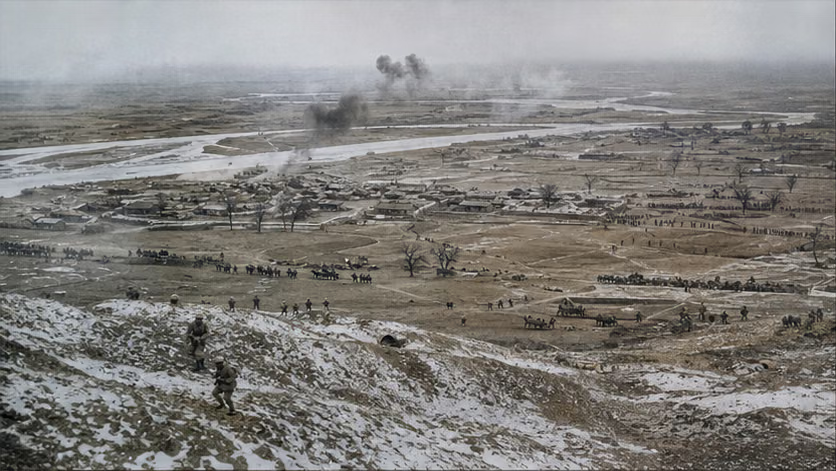 Battle of Mukden1905.02Six hundred thousand Japanese and Russian troops fought for eighteen days on both banks of the Hun River, in what was then the largest land battle in human history: the battlefield was the villages and towns of Mukden, beside imperial tombs, while the "neutral" Qing authorities inside the city could only watch.
Sources and Open Questions
Known main sources:
- Relevant volumes on the Russo-Japanese War in the Japanese Defense Agency War History Office's Senshi Sosho (Japanese official history)
- Russian official war histories and the memoirs of Kuropatkin, Nogi Maresuke, Togo Heihachiro, and other participants (versions remain unverified)
- The Qing government's edict of "neutrality as a non-belligerent" and diplomatic archives concerning the Three Eastern Provinces (Qingji waijiao shiliao and others; file entries remain unverified)
- Later research: studies of the Russo-Japanese War and Manchurian society, and specialized studies of civilian victimization (bibliography still incomplete)
Open questions: total mobilization figures for both sides and the boundaries of each statistical basis; the exact course of the "neutrality" boundary and the original notification text; records of Qing local officials' situation inside the combat zone; the source for the Nanshan casualty anecdote about "one extra zero"; the attack-defense sequence in the Battle of Shaho; accounts of Akiyama Yoshifuru's cavalry brigade at Heikoutai; detailed results of the Battle of Tsushima; details of the indemnity relinquished at Portsmouth; the number of treaty ports opened under the attached agreement to the Treaty and Agreement on Manchuria (sixteen?); how to state the causal chain between Russia's 1905 Revolution and defeat in the war; the original text of Lu Xun's Preface to Call to Arms and details of the Sendai lantern-slide incident; archives on the suffering of Chinese scouts and "bandits" employed by both sides; statistics or case records for the destruction of Liaodong villages; the system of foreign military observers and the location of their reports; details of Bezobrazov's Far Eastern company and court shareholdings; Kuropatkin's impressions from his 1903 visit to Japan and memorials advising against war; details of the imperial conference decision in February 1904; the course of Takahashi Korekiyo's European fundraising; survival of Qing court memorials advocating alliance with Japan against Russia; the actual prewar number of Russian Far Eastern troops.
All images on this site are AI-generated depictions. They are not historical photographs, not primary sources, and do not depict any real individual.