War Overview · Agrarian Revolutionary War (1927–1937)
A civil war fought for ten years: the Chinese Communist Party was driven from urban uprisings into the mountains, where it felt out the road of "the countryside encircling the cities"; the history of how that road took shape is also a history of blood paid on two fronts, internal and external, recorded side by side.
Engagement Data
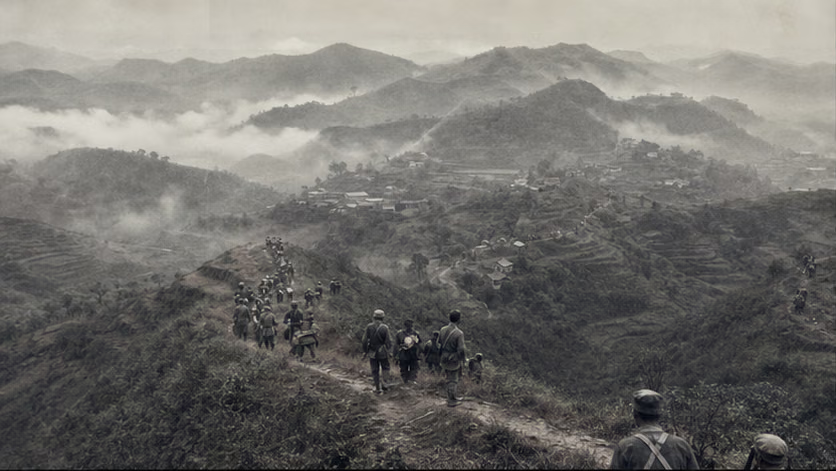
| Item | Content |
|---|---|
| Time | 1927.8 (Nanchang Uprising) – 1937 (formation of the Second KMT–CPC United Front, continuing into the articles on the Fourteen-Year War of Resistance) |
| Place | Across more than ten provinces south of the Yangtze; the main battlefield was in southern Jiangxi and western Fujian (the Central Soviet Area) |
| Belligerents | Red Army (initially called uprising troops and the Workers' and Peasants' Revolutionary Army; reorganized in 1930 as the Chinese Workers' and Peasants' Red Army) / Nationalist Army (National Army) |
| Result | After the main Red Army forces undertook the Long March, they came to rest in northern Shaanxi; in 1936.12 the Xi'an Incident was peacefully resolved, the civil war stopped, and the conflict turned toward the Second KMT–CPC United Front |
Historical Setting
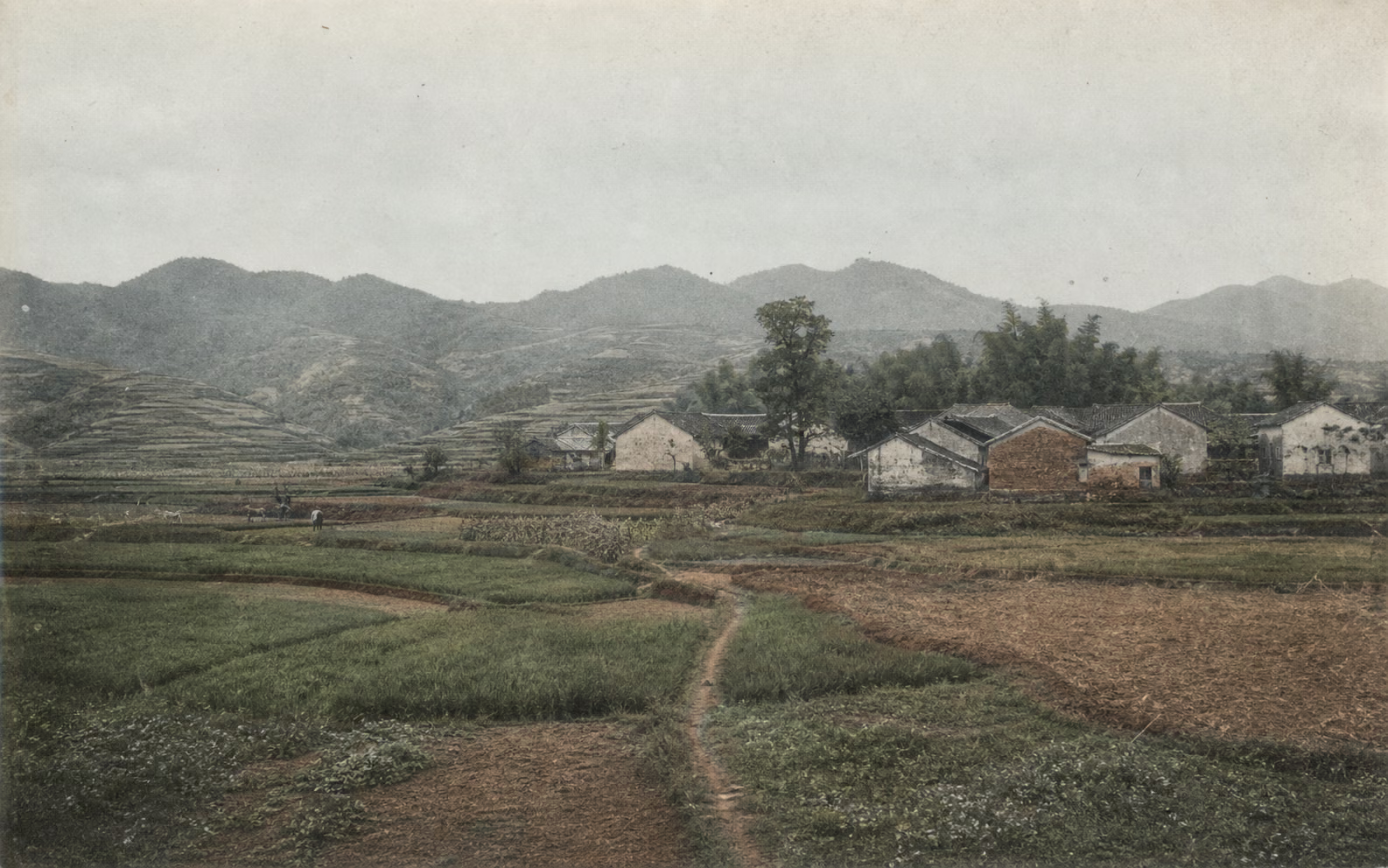
World: In 1929 the Great Depression swept the capitalist world; the Comintern of the Soviet Union directly directed the CPC's early line in ideological terms (the urban-centered line was one strand of this). Japan occupied Manchuria in the 1931 Mukden Incident, attacked Shanghai in the 1932 January 28 Incident, and pressed into North China in 1935. External danger advanced step by step, while the civil war still went on: this was the largest tension in the situation across the decade.
China (the National Government side): After April 12 and July 15 in 1927, Nanjing and Wuhan merged, the KMT completed its "party purge," and the capital was set at Nanjing. After the Northeast changed flags in 1928, the country was formally unified, but in reality regional power holders remained semi-independent. Chiang Kai-shek's regime reorganized the armies of the regional commanders and fought the Central Plains War (1930) while making "Communist suppression" its central task: first "joint suppression," then large-scale "encirclement" campaigns. From 1933 it established a field headquarters in Nanchang and adopted the methods of "three parts military, seven parts political" and blockhouse advance (details of the Fifth Encirclement Campaign plan unverified).
The CPC side: After the failure of the Great Revolution in 1927, Party membership fell sharply from nearly 60,000 to a little over 10,000 (figure disputed), and the Party moved into underground work and armed resistance. On 1927.8.7, the emergency meeting at Hankou (the August 7 Conference) set the policy of land revolution and armed resistance; at the meeting Mao Zedong stated that "one must know that political power is obtained from the barrel of a gun" -- the common summary, "political power grows out of the barrel of a gun," comes from this (original wording unverified). In the ten years that followed, the Party's internal line changed repeatedly: Qu Qiubai's "Left" putschism (late 1927) -> the Li Lisan line (1930 urban uprising and converging on Wuhan) -> Wang Ming's "Left" line (dominating the center from 1931–34), until the turn at the Zunyi Conference in 1935.1.
Why It Was Fought
The Great Revolution died at the moment Chiang Kai-shek acted. On April 12, 1927, the party purge took place in Shanghai; three months later Wuhan broke with the Communists. A Party that had held nearly 60,000 people only months before was down to a little over 10,000 by the second half of the year (figure disputed). Its organizations were broken apart, labor unions and peasant associations were shut down, and remaining in the legal arena meant remaining on a list. At that moment, Comintern instructions and the Party's self-preservation pointed to the same place: taking up arms. On August 1 came the Nanchang Uprising; on August 7 the emergency meeting at Hankou set the policy of armed resistance and land revolution. This was not the optimum chosen from a menu. It was the only solution left after defeat.
The bill for the urban line came due at once: the Nanchang force went south to Chaoshan and was wiped out; the Autumn Harvest force was checked in its attack on Changsha; in December the Guangzhou Uprising failed after three days. All three great uprisings followed the same blueprint of seizing cities and attacking directly. All three failures drove the survivors separately into the mountains. Mao Zedong led the remnants of the Autumn Harvest force to Jinggangshan not because of a blueprint drawn in advance, but because it was a refuge after they could not win. The road later written into history began as the landing place of a chain of defeats.
Nanjing's determination had to wait until it first finished fighting its own people. After the Northeast changed flags in 1928, Chiang Kai-shek first had to deal with former allies; when the Central Plains War ended in 1930, the Nationalist Army that now had its hands free truly turned its muzzles toward the Soviet areas: first "joint suppression," then "encirclement" campaigns larger each time than the last. After the Mukden Incident, foreign danger pressed down, but Chiang's order of priority was first internal pacification, then external resistance: Manchuria could be negotiated, but the Red Army had to be destroyed. This order drew nationwide public opposition even at the time, yet it drove the scale of the encirclement campaigns higher again and again.
Both sides' determination was anchored in material realities. Nanjing's encirclement campaigns required cash: military expenses for hundreds of thousands of troops, imported arms, and the labor and materials for blockhouses and roads; the largest item of finance was pressed onto war. Alongside the blockhouses, another weapon was blockade: salt, cloth, and medicine did not enter the Soviet areas. This blade was dull, but it cut every day. On the Red Army side the boundary was even harder: there was no route for outside aid, ammunition came almost entirely from battlefield captures, each victory supplied the next battle, and each defeat cut through another layer of blood. Soldiers came through Red Army expansion, grain through land tax and attacking local tyrants, but the base areas had finite populations and fields, and the Soviet areas' arsenals could only repair weapons and reload cartridges (production-capacity details unrecorded). By the end of the Fifth Counter-"Encirclement" Campaign, what was being consumed was this remaining stock. There was dissent as well: beyond nationwide opposition to "first internal pacification," within the Red Army Mao Zedong's methods repeatedly diverged from the center's. At the Ningdu Conference in 1932, he left his command post in the Red Army (conference proceedings unverified); after that, the battles in the Central Soviet Area were lost without him.
The Red Army's road was not fixed in one stroke either. The Li Lisan line wanted to converge on Wuhan and water the horses at the Yangtze; it failed. The short, sharp attacks to "keep the enemy outside the gates" failed as well. In the winter of 1933, when the Nineteenth Route Army in Fujian rose against Chiang, whether the Red Army should join with this powerful force that had changed sides was another road that genuinely existed on the table at the time. The alliance did not come about (accounts differ on why it failed; unverified), the blockhouse advance closed in inch by inch, and in 1934.10 the Central Red Army broke out and headed west.
After the Red Army reached northern Shaanxi, the reason the guns stopped lay outside the mountains. The North China Incident pushed resistance to Japan and national salvation to a nationwide boiling point; a government that wished to keep fighting a civil war first had to pass through its own people. On December 12, 1936, in Xi'an, Zhang Xueliang's troops detained Chiang Kai-shek, who had come to supervise the campaign. The civil war fought for ten years ended in a military remonstrance.
Course of the Engagement (Five Phases)
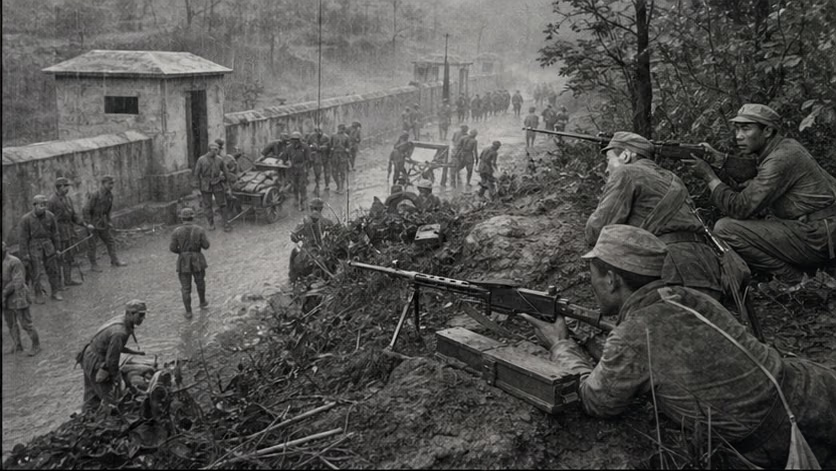
| Phase | Time | Main Points | Separate Articles |
|---|---|---|---|
| Three great uprisings | 1927.8–12 | Nanchang, Autumn Harvest, and Guangzhou: three consecutive defeats for the urban and offensive line; the defeated armies each sought a road of their own -- one part to Jinggangshan, one part into Hailufeng | Nanchang Uprising, Autumn Harvest Uprising, Guangzhou Uprising (1927) |
| Taking to the mountains and forming separate regimes | 1927.10–1930 | Jinggangshan joining of forces (1928.4); armed separate regimes of workers and peasants, "attack local tyrants and divide the land"; the Gutian Conference (1929.12) established ideological Party-building and political army-building; southern Jiangxi and western Fujian connected into the Central Soviet Area, while the Hubei–Henan–Anhui, western Hunan–Hubei, Hunan–Jiangxi, Fujian–Zhejiang–Jiangxi, and other base areas stood alongside it | (Separate articles on the anti-"joint suppression" engagements remain to be written) |
| First four counter-"encirclement" campaigns | 1930.11–1933 | The Nationalist Army's four large-scale encirclement campaigns against the Central Soviet Area were all broken; in the same period Hubei–Henan–Anhui and western Hunan–Hubei successively fell (1932), and the Fourth Front Army of the Red Army moved west into Sichuan–Shaanxi | (Separate articles on each engagement remain to be written) |
| Fifth Counter-"Encirclement" Campaign and the Long March | 1933.9–1935.10 | The Nationalist Army advanced step by step through blockhouse blockade; the Red Army's attempt to "keep the enemy outside the gates" failed, and in 1934.10 it broke out on the Long March; Zunyi Conference (1935.1); in 1935.10 the First Front Army of the Red Army reached northern Shaanxi; in 1936.10 the three main forces joined at Huining | Long March (overview and separate articles remain to be written) |
| Landing in northern Shaanxi and the halt of the civil war | 1935.10–1937 | Eastern Expedition into Shanxi and Western Expedition toward Ningxia (1936, see incorporated lines); 1936.12 peaceful resolution of the Xi'an Incident; in 1937 the Red Army was reorganized as the Eighth Route Army and the New Fourth Army | (Continues into the articles on the Fourteen-Year War of Resistance) |
Three Lines Incorporated into This Article
Baise Uprising and the Zuojiang–Youjiang Base Area (1929.12): Led by Deng Xiaoping, Zhang Yunyi, and others, and making use of CPC influence that had entered the Guangxi Guard Brigade while Yu Zuobo and Li Mingrui were in charge of Guangxi, the Baise Uprising broke out on 1929.12.11, creating the Seventh Red Army and the Youjiang Soviet. In 1930 the Longzhou Uprising created the Eighth Red Army, and together they formed the Zuojiang–Youjiang Base Area. In 1930 the Seventh Red Army was ordered north to attack Liuzhou and Guilin but was checked; after fighting over a thousand li, its remnants entered the Central Soviet Area in 1931 (route details unrecorded).
Red Army Eastern Expedition and Western Expedition (1936): In early 1936 the Red Army crossed the Yellow River into Shanxi (the Eastern Expedition), raised the banner of an "Anti-Japanese Vanguard Army," raised funds and expanded the Red Army, and returned after several months of fighting with Yan Xishan's forces (results and casualty bases vary by account). It then launched a Western Expedition toward Ningxia and Gansu, to receive the Second and Fourth Front Armies of the Red Army as they moved north and to seek a route to the Soviet Union. The two campaigns were one move in the search for living space and external aid after the Long March had come to rest, and they later connected with the dramatic change in the situation before and after the Xi'an Incident.
Southern Three-Year Guerrilla War (1934–1937): After the main force began the Long March, Xiang Ying and Chen Yi led more than 10,000 stay-behind Red Army troops (troop figures vary by account) in maintaining guerrilla warfare in mountain areas across more than ten provinces, including the Jiangxi–Guangdong border. The Central Bureau lost contact with the center and was repeatedly subjected to Nationalist Army "pacification" campaigns; casualties were nearly total, yet the spark was not extinguished. In 1937 the force was reorganized as the New Fourth Army and came out of the mountains. When Chen Yi was surrounded at Meiling in 1936, he wrote *Three Chapters at Meiling* -- "With my head to be severed today, what is my intent?" -- leaving what amounted to a final testament (common account of the writing background; details unrecorded).
The White-Area Front and Errors Within the Party
White areas: White Terror ※. After April 12, the KMT military, police, and secret-service systems hunted down and killed Communists and left-leaning masses across the country: execution grounds, prisons, and secret executions; Longhua in Shanghai and Yuhuatai in Nanjing became emblematic places of death. Party organs were damaged again and again. In 1931 Gu Shunzhang (head of the Central Special Branch) was arrested and defected; the central organs nearly suffered total destruction, and only after Qian Zhuangfei intercepted a telegram and sent warning were they able to move (course unverified). In the same year, General Secretary Xiang Zhongfa was arrested and executed by firing squad. Records of white-area Party organizations suffering losses counted in "hundreds of percent" appear repeatedly (accounts differ by basis).
Errors within the Party: internal purges ※. Bloodier than line errors were the internal purges inside the base areas: in 1930 the campaign against the "AB League" began in Jiangxi and led to the Futian Incident (1930.12, when part of the Twentieth Red Army mutinied and surrounded the provincial action committee, followed afterward by a major repression); the Baiqueyuan purge in Hubei–Henan–Anhui (1931, in which Xu Jishen and many other Red Army commanders were killed), the western Hunan–Hubei purge against the "Reorganizationists," and others spread one after another. For the number killed in this self-slaughter, estimates across the base areas range from several thousand to several tens of thousands; the bases are sharply divergent. This is the part of the war in which Red Army people died at the hands of their own side, and it needs to be on record just as much as battlefield deaths.
The land revolution itself: attack local tyrants and divide the land ※. This was the social revolution that drew hundreds of millions of peasants in: confiscating landlord land and distributing it to poor peasants, burning land deeds, and establishing soviets. It was the root of base-area war mobilization, and it also had a violent side: executions of landlords and local gentry, house searches, "sweeping them out the door," and the excesses and reversals in implementation ("no land for landlords, bad land for rich peasants" was policy for a time) are all on record ※. Mobilization and violence were two sides of the same process; one side must not be taken while the other is suppressed.
Casualties and Losses
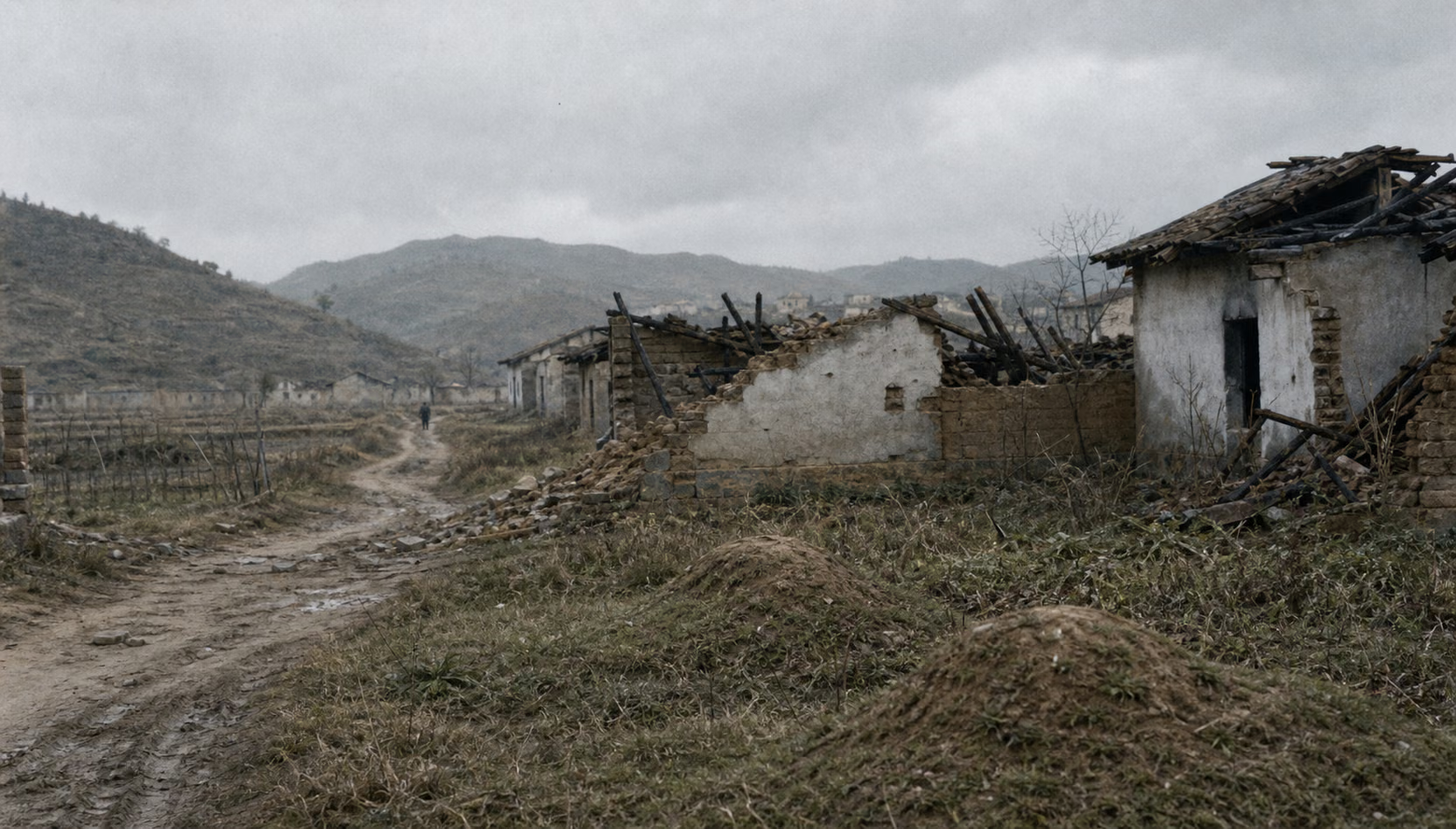
- Military: There is no authoritative statistic for the total number of soldiers killed on both sides in the ten-year civil war; figures are accumulated in the separate articles on each engagement. On the Red Army side, when the main force of the Central Soviet Area set out on the Long March it numbered about 86,000, while roughly 7,000 remained when it reached northern Shaanxi (accounts differ by basis); Nationalist Army casualties in the successive encirclement campaigns are recorded under each engagement.
- Soviet-area population ※: The population of the southern Jiangxi base area fell sharply; in Xingguo county alone, martyrs exceeded 50,000 (county-gazetteer basis, unverified), and the saying that "every family had a martyr" became common. The memory of seventeen young men in Huawu Village planting seventeen pines before joining the army and none of them returning is one point in the cost paid by the Soviet areas.
- Pacification campaigns ※: The Nationalist Army's military pacification of the Soviet areas was accompanied by killing, burning, and blockade. Slogans such as "stones must pass under the knife, thatch must pass through fire, and people must be made into a new breed" appear in records (source and scope unverified); after the Soviet areas were recovered, Nationalist-side archives and Soviet-area records each had their own account of population losses, and the divergences are placed side by side.
- Civilians: Over ten years, war zones were repeatedly pulled back and forth; conscripts, grain, and houses were all consumed by war, with no overall statistic.
Aftermath
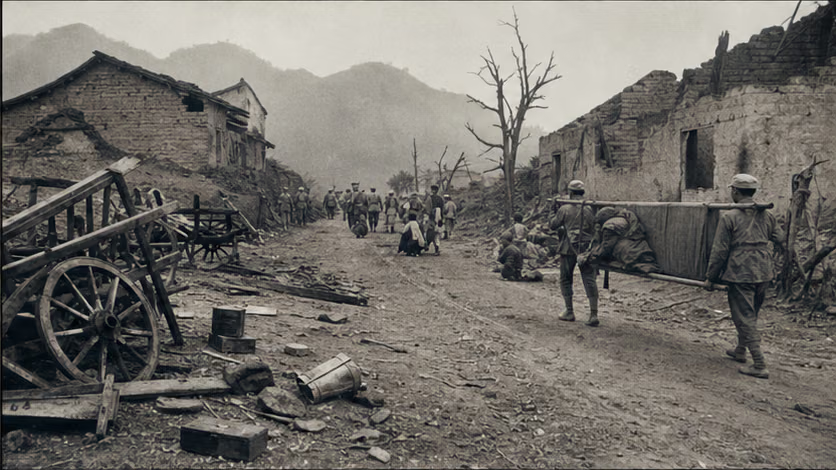
- The civil war halted before external danger: after the Xi'an Incident, KMT–CPC negotiations followed, and in 1937 the Red Army was reorganized as the National Revolutionary Army's Eighth Route Army and the New Fourth Army. The Agrarian Revolutionary War ended, continuing into the articles on the Fourteen-Year War of Resistance.
- Legacy of the road: the countryside encircling the cities; armed seizure of political power; "political power grows out of the barrel of a gun"; the Party commands the gun (Gutian Conference). This set of methods, grown out of defeat, became the overall framework for the twenty-two years of war that followed.
- Legacy of people: the group of commanders who survived these ten years -- the overwhelming majority among the Ten Marshals and senior generals came from this war -- was institutionalized as national memory when ranks were awarded in 1955.
How Each Side Records It
- Communist canonical narrative (the lineage of a single spark starting a prairie fire): failure of the Great Revolution -> three great uprisings -> Jinggangshan -> a single spark starting a prairie fire -> counter-encirclement campaigns -> Long March -> landing point in northern Shaanxi. The key words are "spark" and "road": Nanchang's defeat became Army Day, and Jinggangshan's mountain valley became a point of departure. The purges were long abridged in the canon; after the 1980s, redress and entry into history came gradually.
- KMT "Communist suppression" narrative: characterized as "bandit suppression" before "pacification of the rebellion" -- "Red bandits" roaming, the National Army encircling and suppressing; the Fifth Encirclement Campaign and the pursuit and blocking of the Long March were recorded as military achievements, and "external resistance requires internal pacification first" was recorded as established national policy. After 1949 this narrative receded into Taiwanese textbooks and military-history systems.
- Later and scholarly reconsiderations: three lines run in parallel: first, reconsideration of the urban-centered line (the three great uprisings and the Li Lisan line are reassessed within the tension between Comintern direction and Chinese realities); second, studies of the history of internal purges (the Futian Incident and others are reclassified from "counterrevolutionary incidents" to "self-harm through expanded purges," while the death figures remain under investigation); third, a social-history view of the land revolution (mobilizational effectiveness and the cost of violence are examined side by side).
Disputes and Sensitivities
- Internal purges ※: The characterization of the Futian Incident (whether the "AB League" really existed and whether the incident was counterrevolutionary), and the figures for deaths in internal purges in the various base areas, remain among the most sensitive parts of Party-history research; each side draws on different sources of numbers.
- "External resistance requires internal pacification first": After the Mukden Incident, whether the line should be to suppress the Communists first or resist Japan first became a line dispute; both positions have complete narratives of their own.
- Violence in the land revolution ※: Violence against the landlord class is classified in the canon as "the necessary cost of revolution"; in another type of narrative, it is "an expansion of class struggle." The two accounts are placed side by side, while implementation details (who was killed, how many, and by what procedure) await close checking in the separate articles.
- Long March narrative: The Long March is made into a separate article; but attribution of responsibility for the failure of the Fifth Counter-"Encirclement" Campaign (Bo Gu and Otto Braun vs. the Comintern system) belongs to the overview-level question of responsibility.
Contents
Separate articles on the anti-"joint suppression" engagements and the five counter-"encirclement" campaigns remain to be written; the Long March has a separate overview to be written. The Baise Uprising, the Eastern and Western Expeditions, and the Southern Three-Year Guerrilla War are incorporated into this article.
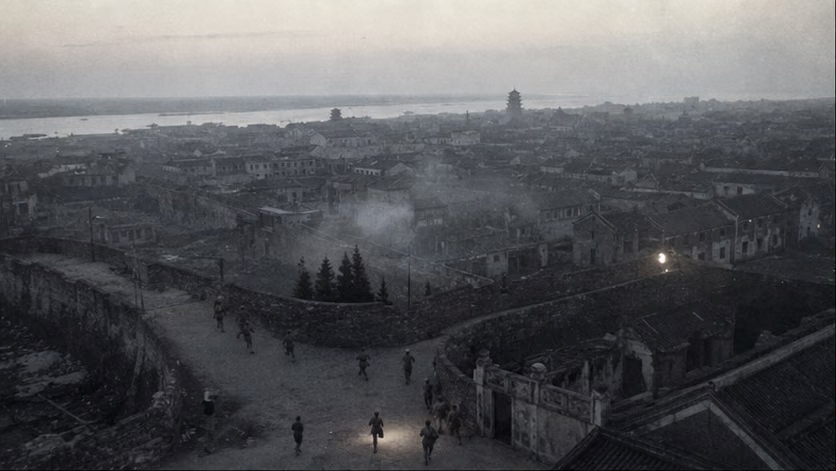 Nanchang Uprising1927.08In the small hours of August 1, 1927, more than twenty thousand troops under Communist control or influence fired the first shot from the walls of Nanchang and took the whole city within hours -- the battle was won, but the later march south to Guangdong lost the main force; the anniversary of that defeat later became the Army Day of the People's Liberation Army.
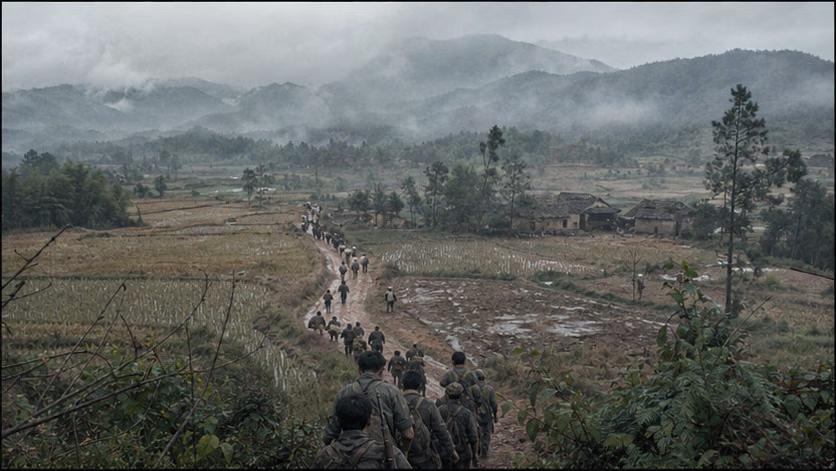 Autumn Harvest Uprising1927.09Five thousand men attacked Changsha; after ten days of defeat, only a little over a thousand remained -- what truly changed history was not the uprising itself, but two decisions made on the road of retreat: at Wenjiashi, they stopped attacking cities; at Sanwan, Party branches were built down to the company level. A defeated army was reinvented in retreat.
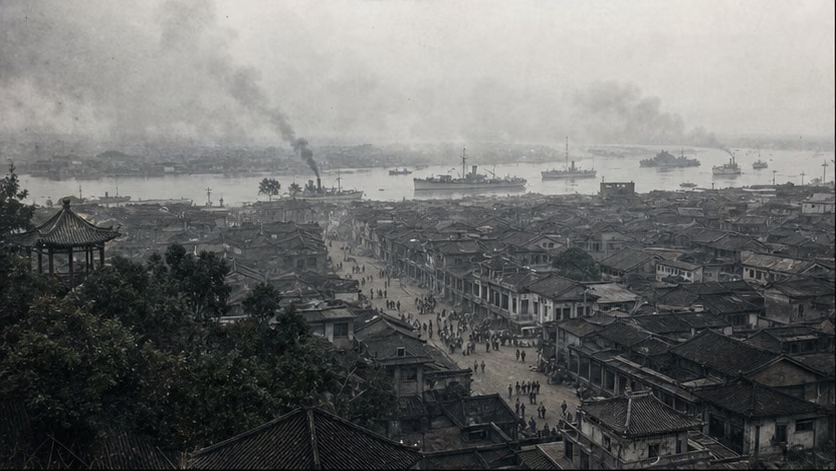 Guangzhou Uprising (1927)1927.12The third uprising at the end of 1927 established a three-day soviet in Guangzhou -- the "Guangzhou Commune" died after three days, its leader Zhang Tailei was killed in street fighting, and the ensuing mass search-and-killing identified people by red neckties and left several thousand dead; the cost of the road of urban insurrection had, by this point, been written to the end.
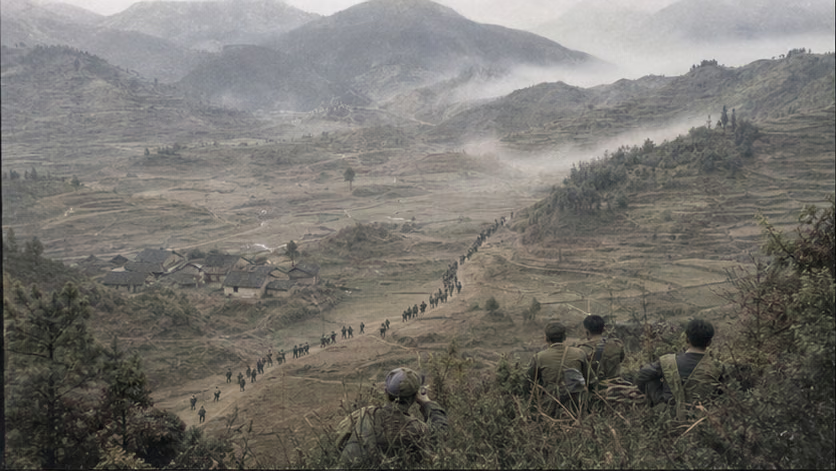 First Three Counter-"Encirclement" Campaigns (Dec 1930–Sep 1931, combined account)1930.12As soon as the Central Plains War stopped, Chiang Kai-shek turned back for three "encirclement and suppression" campaigns against the Central Soviet Area, each with more troops than the last -- and thirty thousand Red Army soldiers won all three with the same method: "luring the enemy in deep," then eating away, bite by bite, the columns that had drilled into their own ground.
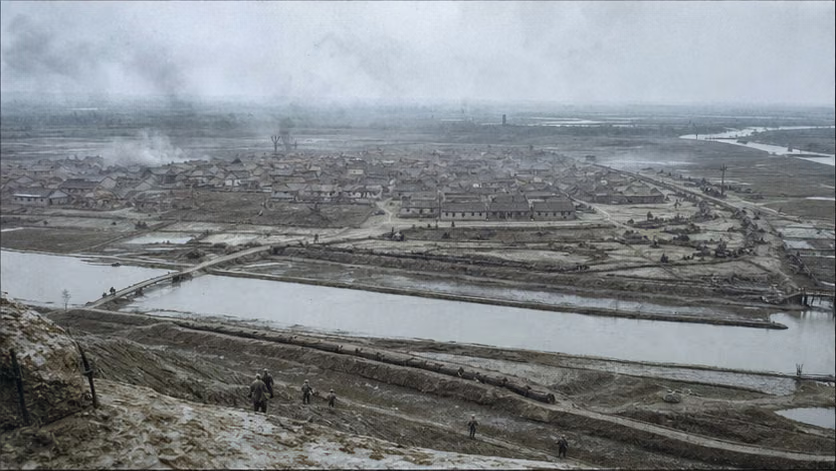 Battle of Sujiabu1932.03The Fourth Front Army of the Red Army in the Hubei-Henan-Anhui base area brought encirclement-and-relief warfare to its peak: it surrounded Sujiabu for forty-eight days, devoured three waves of relief troops one after another, and in the end closed the account on more than thirty thousand defenders and relief troops together; the commander was Xu Xiangqian, thirty years old.
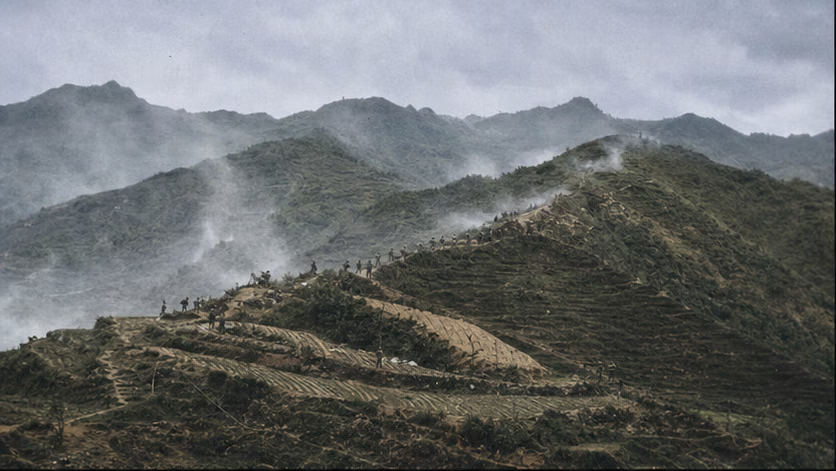 Sichuan–Shaanxi Counter-Encirclement (incl. Defense of Wanyuan)1932.12The Red Fourth Front Army crossed the Daba Mountains into Sichuan and, over 2 years, withstood 2 rounds of encirclement by the Sichuan Army: after a 3-month defense of Wanyuan, a single counteroffensive inflicted 80,000 enemy losses, setting a Red Army record for enemy losses in one engagement; then, to support the Central Red Army, it abandoned in its entirety the base area it had fought out for itself and moved north into the vortex of the Long March.
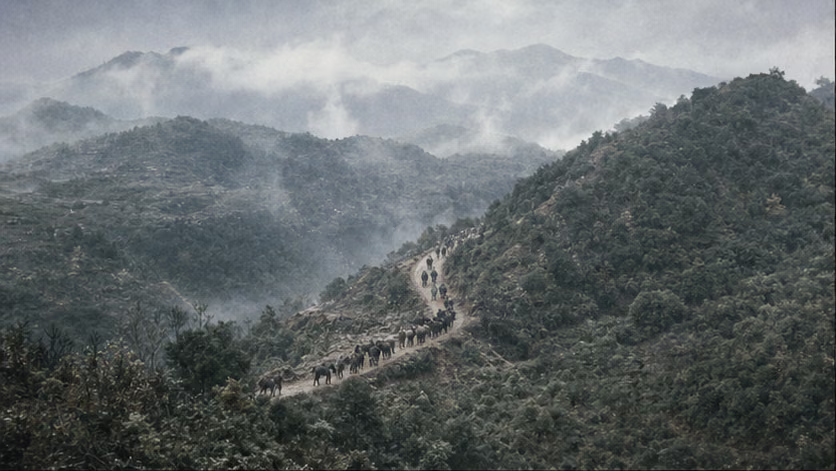 Fourth Counter-"Encirclement" Campaign (1933)1933.02Mao Zedong had already been removed from military command; Zhou Enlai and Zhu De, against telegrams from the rear ordering "separate operations," fought two ambushes in heavy fog and wiped out three of Chen Cheng's main divisions -- the Red Army's last major victory before the "Left"-deviation line took full control, won by disobeying orders at the front.
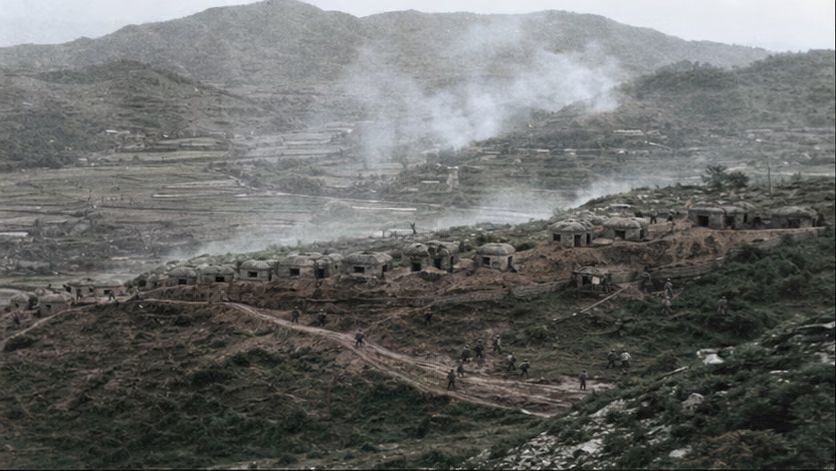 Fifth Counter-"Encirclement" Campaign (1933–34)1933.09Five hundred thousand troops pressed the Soviet Area inward inch by inch with blockhouses and roads; the Red Army held out for a year with "short, sharp assaults" and positional defense -- after Guangchang's 18 days had cost more than 5,000 men, the only road left for 80,000 people was one word: go. The Long March was not a choice; it was the bill for the Fifth Counter-"Encirclement" Campaign.
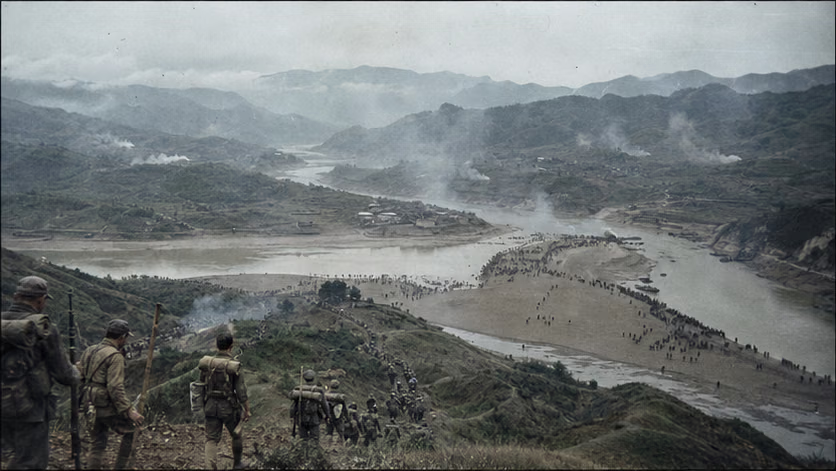 Battle of the Xiang River1934.11Eighty-six thousand people carried printing presses and file chests for a month, only to be stopped on the banks of the Xiang River by an army of 300,000. For seven days and seven nights, the Central Column crossed the river, and the force fell from 86,000 to just over 30,000; the 34th Division, covering the rear, was destroyed, and its commander Chen Shuxiang, gravely wounded and captured, tore out his own intestines. Every turning point of the Long March was dredged up from this river.
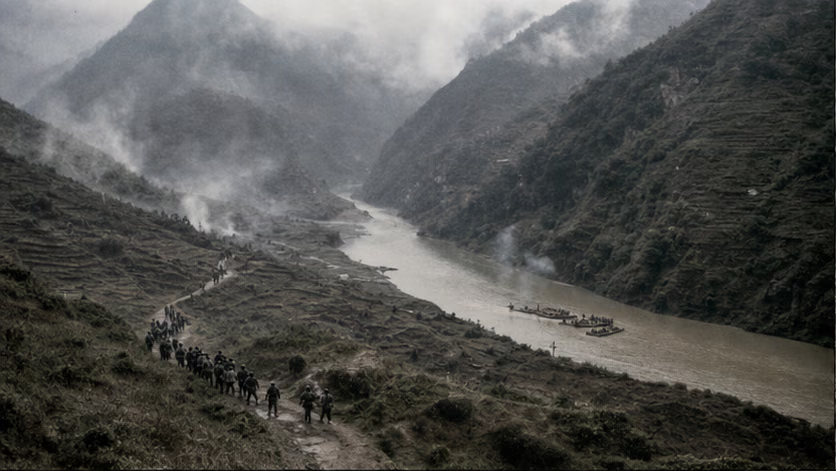 Crossing of the Chishui River1935.01Thirty thousand Red Army troops were blocked by hundreds of thousands of Nationalist forces in the mountains along the borders of Sichuan, Guizhou, and Yunnan; in four months they crossed the same Chishui River four times, traced a wide arc, and walked out of the encirclement -- exhausted, badly reduced, but out.
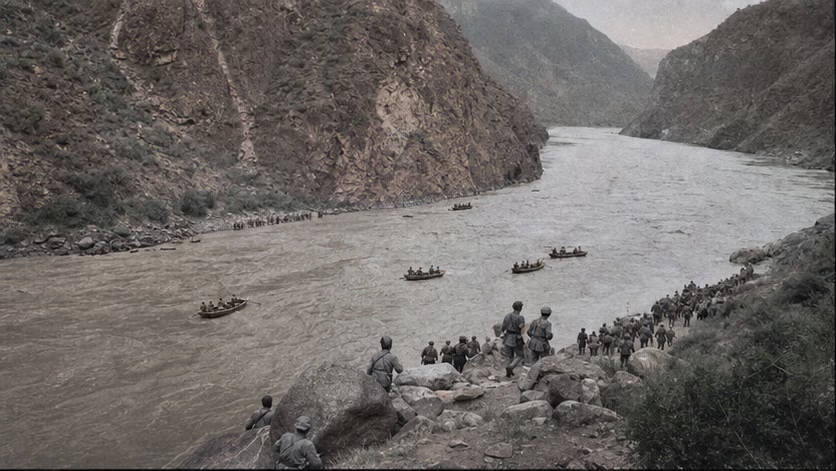 Jinsha River and Dadu River1935.05Thirty thousand Red Army personnel crossed the Jinsha River on a handful of wooden boats; then seventeen men in a single boat seized the Anshunchang crossing on the Dadu River, and twenty-two men climbed the iron chains to take Luding Bridge. From the geographical dead end of a "second Shi Dakai," they forced open a road to survival.
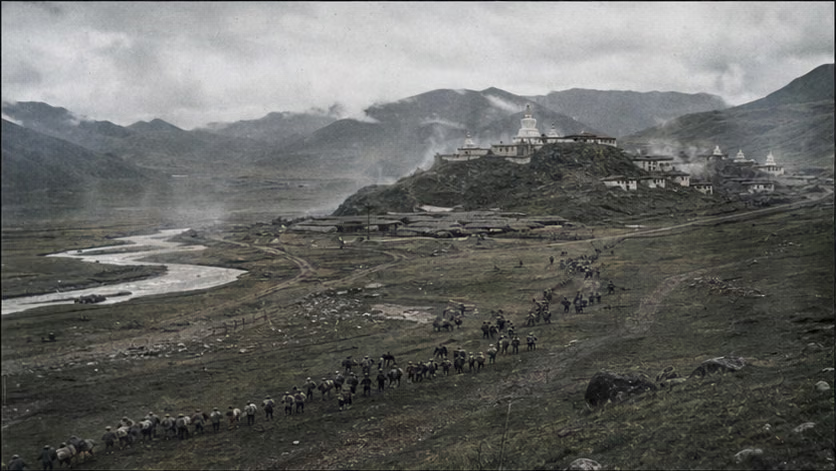 Battles of Baozuo and Lazikou1935.08The Red Army came out of the grasslands with half its men already broken by hunger, then fought two engagements: at Baozuo it destroyed one of Hu Zongnan's divisions, and at Lazikou it climbed the cliffs by night and broke through the pass, opening the door north into southern Gansu and onward toward northern Shaanxi.
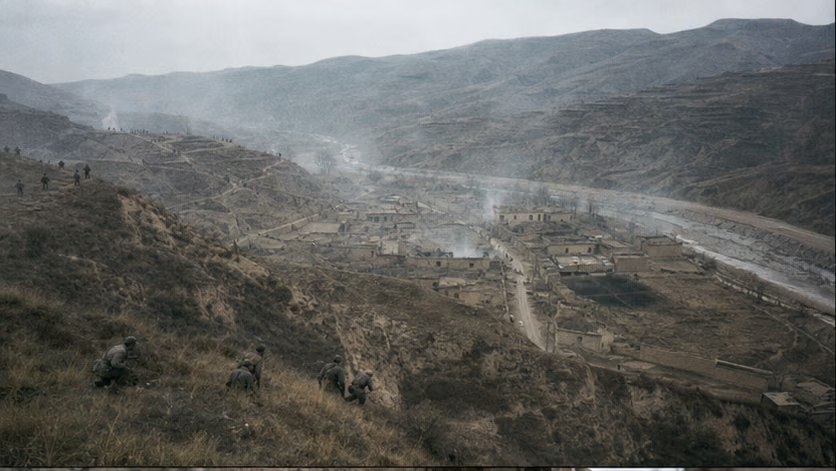 Battle of Zhiluozhen1935.11The Red Army that had reached northern Shaanxi after the Long March joined forces with the Fifteenth Red Army Corps, which had arrived earlier, and annihilated a division of the Northeastern Army at Zhiluozhen. Mao Zedong called this battle a "foundation-laying ceremony": it secured a place to stand, and it also opened the later pattern of both fighting and negotiating with the Northeastern Army.
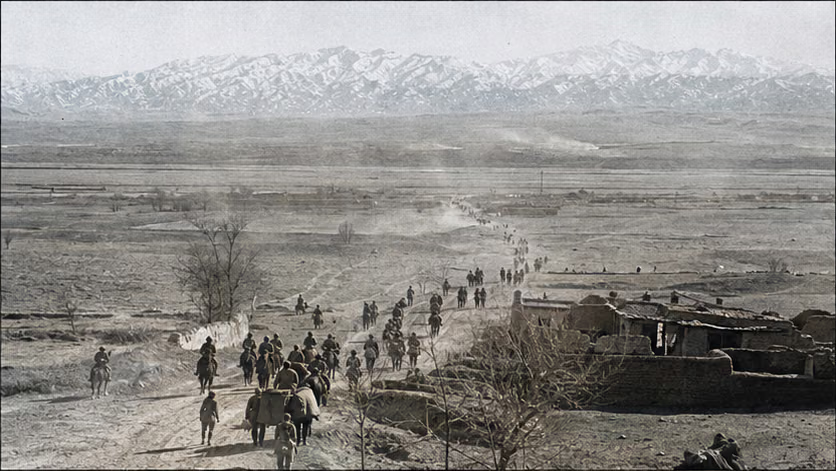 Western Route Army's Battles in the Hexi Corridor1936.10The main force of the Red Fourth Front Army, 21,800 men, was ordered to cross the Yellow River and advance west; it fought alone for four months in the Hexi Corridor and was almost destroyed as an organized force -- the most severe defeat in Red Army military history, and an unresolved case whose characterization was not revised until decades later.
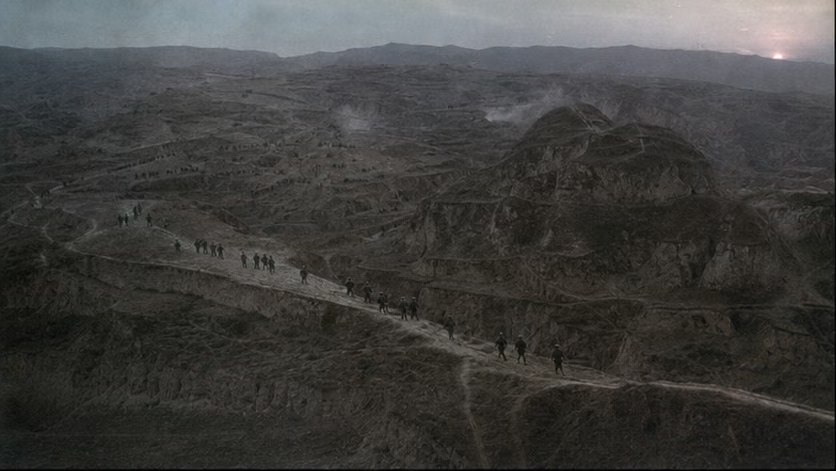 Battle of Shanchengbao1936.11The first battle after the three main Red Army forces joined, and, in the common telling, the last battle of the ten-year civil war: units from the Red Army's three front armies laid an ambush at Shanchengbao in Huanxian, Gansu, and within two days destroyed more than one brigade of Hu Zongnan's pursuing force.
Sources and Open Questions
Main sources: *Selected Works of Mao Zedong*, volume 1 ("Why Is It That Red Political Power Can Exist in China?", "The Struggle in the Jinggang Mountains," and "A Single Spark Can Start a Prairie Fire"); Party History Research Office of the CPC Central Committee, *History of the Chinese Communist Party*, volume 1; *History of the First Front Army of the Chinese Workers' and Peasants' Red Army*; relevant studies by Yang Kuisong, Jin Chongji, and other scholars; Taiwan's Academia Historica and the Ministry of National Defense Bureau of Military History and Translation series on the war history of Communist suppression (the counterpart narrative). Specialized studies such as Dai Xiangqing's *The AB League and the Course of the Futian Incident* are the main clues for the section on internal purges (bibliography unverified).
Open questions: original wording of the August 7 Conference "barrel of a gun" phrase; orders of battle and force sequences for the three great uprisings; statistical bases for Central Soviet Area population and martyrs (the Xingguo figure); the course of the Gu Shunzhang and Xiang Zhongfa cases; source of the phrase "stones pass under the knife and thatch through fire"; the different statistical bases for deaths in internal purges in each base area; the Seventh Red Army's northward route; results of the Eastern and Western Expeditions by statistical basis; details of the writing background of *Three Chapters at Meiling*; details of blockhouse tactics in the Fifth Encirclement Campaign; why the Red Army and the Nineteenth Route Army failed to join during the Fujian Incident (check correspondence between the provisional center and the Comintern, and relevant research); production-capacity details for Soviet-area arsenals; Nanjing's decrees on economic blockade of the Soviet areas and records of enforcement; proceedings of the Ningdu Conference.
All images on this site are AI-generated depictions. They are not historical photographs, not primary sources, and do not depict any real individual.