Engagement Archive · First Three Counter-"Encirclement" Campaigns (Dec 1930–Sep 1931, combined account)
As soon as the Central Plains War stopped, Chiang Kai-shek turned back for three "encirclement and suppression" campaigns against the Central Soviet Area, each with more troops than the last -- and thirty thousand Red Army soldiers won all three with the same method: "luring the enemy in deep," then eating away, bite by bite, the columns that had drilled into their own ground.
Engagement Data
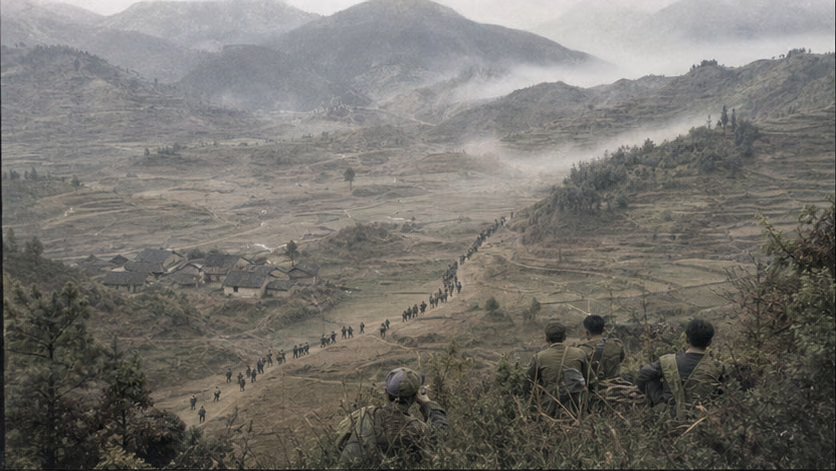
| Item | Content |
|---|---|
| Time | First: 1930.12–1931.1; second: 1931.4–5; third: 1931.7–9 |
| Place | Central Soviet Area: southern Jiangxi and western Fujian (Longgang, Donggu, Futian, Jianning, Xingguo, Liantang, Liangcun, Huangpi, Laoyingpan, Fangshiling, and other places) |
| Affiliation | Agrarian Revolutionary War (for the larger situation, see *Agrarian Revolutionary War · Overview*) |
| Belligerents | First Front Army of the Red Army (Mao Zedong, Zhu De, about thirty thousand-plus) / KMT forces (about one hundred thousand, two hundred thousand, and three hundred thousand in the three campaigns respectively) |
| Result | Three campaigns, three victories; the Central Soviet Area expanded and took shape, and the Chinese Soviet Republic was founded soon after (1931.11) |
Belligerents
| Item | Red Army | KMT Forces |
|---|---|---|
| Strength | About 30,000–40,000, basically unchanged | Rising from one hundred thousand -> two hundred thousand -> three hundred thousand; in the third campaign Chiang personally served as commander-in-chief |
| Equipment | Mainly captured; "no guns, no cannon -- the enemy makes them for us" | Regular equipment; the first and second campaigns used mostly non-direct-line miscellaneous forces, while the third brought direct-line divisions into the field |
| Local conditions | Interior lines inside the base area: Red Guards, intelligence, and scorched-earth evacuation | Fighting on unfamiliar ground, blind in intelligence, with large gaps between columns |
Terrain and Conditions
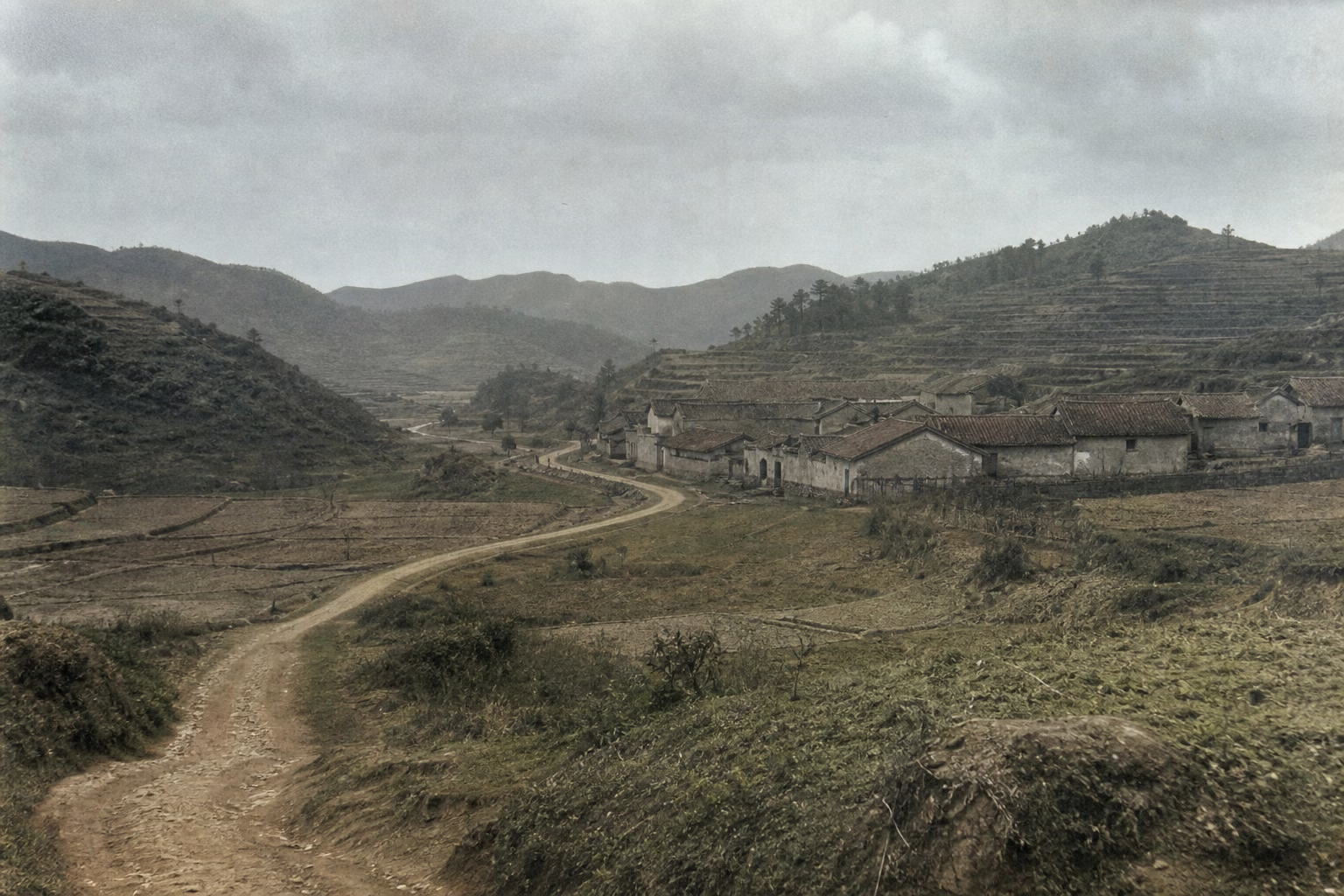
The hilly basins of southern Jiangxi and western Fujian: the mountains were not high, but the roads were winding, and village and lineage society had been turned over by the agrarian revolution -- peasants who had received land delivered grain for the Red Army, carried the wounded, and sealed off information. KMT forces entered ground where there were "no people to see, no grain to find, and no roads to ask for" ※ (the cost of scorched-earth evacuation to rural livelihoods is also noted).
Why It Was Fought
The Guangzhou Uprising died after three days (see *Guangzhou Uprising (1927)*); three attempts at urban insurrection had failed three times, and 1927 closed on that note. In the three years that followed, the defeated armies went up the mountains separately: in April 1928 Zhu De and Mao Zedong joined forces at Jinggangshan, struck local tyrants, redistributed land, and connected the base areas of southern Jiangxi and western Fujian piece by piece. Nanjing could not attend to the mountains during those three years -- Chiang Kai-shek was busy reorganizing and demobilizing the regional warlords and fighting the Central Plains War, with his main forces tied down on the northern battlefield. The two sides grew for three years with their backs turned to one another.
In 1930, two events pulled them back face to face. One was on the Red Army side: the Li Lisan line advocated joining forces at Wuhan, and Red Army actions such as the attack on Changsha made Nanjing reassess the price -- the forces in the mountains were no longer a few bands of scattered troops, but an army capable of attacking a provincial capital. The other was on the Nanjing side: in November the Central Plains War ended, and Chiang Kai-shek freed his hands to turn back and deal with his "malady of the heart." The decision had a concrete point of application: Nanchang established the Field Headquarters of the Generalissimo of the Army, Navy, and Air Force, with Jiangxi provincial chairman Lu Diping as its director to supervise the suppression campaign (the establishment date of the field headquarters and the wording of the deadline orders are unverified). The intelligence in Chiang's hands priced the Red Army as "roving bandits" that could be swept away in passing after the Central Plains War; what he did not have was information from inside the mountains -- after the land had been distributed, this ground had already changed owners, and nothing on Nanjing's maps showed it.
The two sides' calculations were not symmetrical. In the first campaign the KMT committed one hundred thousand troops, mostly non-direct-line miscellaneous forces -- in Nanjing's calculation, this was a large-scale clearing operation, and "roving bandits" could not withstand regular troops advancing in separate routes and striking together. The misjudgment was written on the ground: the columns that entered the base area walked into a place where there were no people to see, no grain to find, and no roads to ask for; peasants who had received land delivered grain for the Red Army, carried the wounded, and sealed off information; fighting on unfamiliar ground, KMT intelligence was blind, and large gaps opened between the columns. The Red Army had thirty thousand-plus men, only a fraction of the opponent's strength, but there was no retreat to speak of -- if the Soviet area could not be held, the political power could not stand; for this side, it was a question of life and death.
Material conditions pinned both sides' methods in place. The Red Army's thirty thousand-plus men relied on captured guns and captured ammunition; if this battle spent its stockpile, the next battle's captures had to replenish it. It could not afford positional confrontation, still less assault on fortified points; it could only let the enemy enter familiar ground and trade space for formation. The Soviet area was both its warehouse and its eyes, but the warehouse was thin: scorched-earth evacuation hid grain in the mountains, leaving the enemy unable to find it, while the Soviet area itself was also tight. KMT equipment, grain, and ammunition moved by road according to regular-army rules; once inside the Soviet area, the roads disappeared, grain had to be carried with the troops, and the farther the columns went, the emptier their bellies and the looser their formations became -- ten times the enemy's strength, but unable to feed a stretched-out net.
The method was first argued through inside the Party: keep the enemy outside the base area, or let them in and fight? The worries of those opposed to "letting them in" were concrete -- once the enemy entered the Soviet area, they would burn, kill, levy, and plunder, and peasants who had received land would suffer the immediate loss; many local cadres could not bear that (the specific participants and wording of the dispute are unverified). What persuaded them was another account: to stand hard on the border with thirty thousand against one hundred thousand was to gamble the entire household on one position; to let the enemy in meant losing jars and pots, but winning back formation. The Luofang Conference finally set the line (details unrecorded), the four words later written into military history: lure the enemy in deep -- give up half of one's own ground in exchange for the opponent stretching out his formation. In December 1930, one hundred thousand KMT troops advanced by separate routes into southern Jiangxi; the Red Army opened the outer perimeter and withdrew toward the middle of the base area.
Course of the Engagement
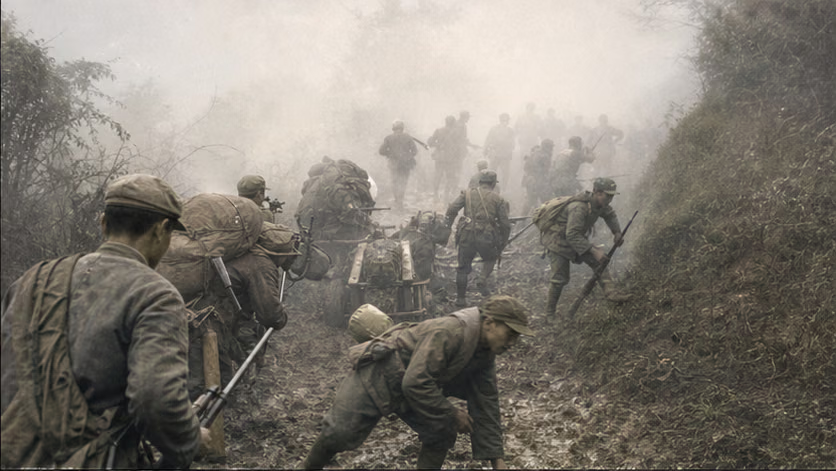
First Campaign (1930.12–1931.1, one hundred thousand against thirty thousand-plus)
| Stage | Main Points |
|---|---|
| Luring the enemy in deep | The Red Army opened the outer perimeter and withdrew to the middle of the base area; the line of "preparing for war, luring the enemy, and concentrating to annihilate" had been disputed inside the Party (Luofang Conference, details unrecorded) |
| Battle of Longgang, 12.30 | Encirclement in heavy fog; Zhang Huizan's 18th Division headquarters and two brigades were completely wiped out, and Zhang Huizan was captured alive -- "fog filled Longgang, darkening a thousand peaks" was written about this battle (source of the poem unverified) |
| Pursuit at Dongshao, 1931.1.3 | Another half of Tan Daoyuan's division was broken, ending the first "encirclement and suppression" campaign |
Zhang Huizan was later publicly tried and executed by Soviet-area crowds (1931.1; the story that his head drifted downriver spread widely -- the matter was later treated by the CPC as a policy lesson, and "not killing captured senior officers" gradually became the rule; the course of the disposal and the wording of the lesson are unverified)※.
Second Campaign (1931.4–5, two hundred thousand against thirty thousand-plus)
| Stage | Main Points |
|---|---|
| "Steady advance, step-by-step entrenchment" | He Yingqin presided, choosing an in-depth advance |
| Fighting opens at Baiyunshan–Futian, 5.16 | The Red Army still lured the enemy in deep, sweeping east from Futian |
| Fifteen days, seven hundred li, five battles and five victories | Consecutive victories at Futian, Baisha, Zhongcun, Guangchang, and Jianning; "in fifteen days, marching seven hundred li and fighting five battles" (combat-report bases vary by account) -- a textbook model of mobile warfare |
Third Campaign (1931.7–9, three hundred thousand against thirty thousand-plus)
| Stage | Main Points |
|---|---|
| Chiang's personal expedition | The line was "drive straight in," with direct-line divisions committed |
| Thousand-li return march | The Red Army returned a thousand li from western Fujian to Xingguo; the "millstone tactic" avoided the enemy's main force and struck its weak points |
| Three victories at Liantang–Liangcun–Huangpi, August | Successive defeats of units under Shangguan Yunxiang, Hao Mengling (six years later he died fighting Japan at Xinkou; cross-reference the Fourteen-Year War of Resistance articles), and Mao Bingwen (combat-result bases vary by account) |
| Laoyingpan and Fangshiling, September | Further annihilation of units including Han Deqin's; just as the Mukden Incident broke out, KMT forces made a general retreat, and the third "encirclement and suppression" campaign ended without a conclusion |
Casualties and Losses
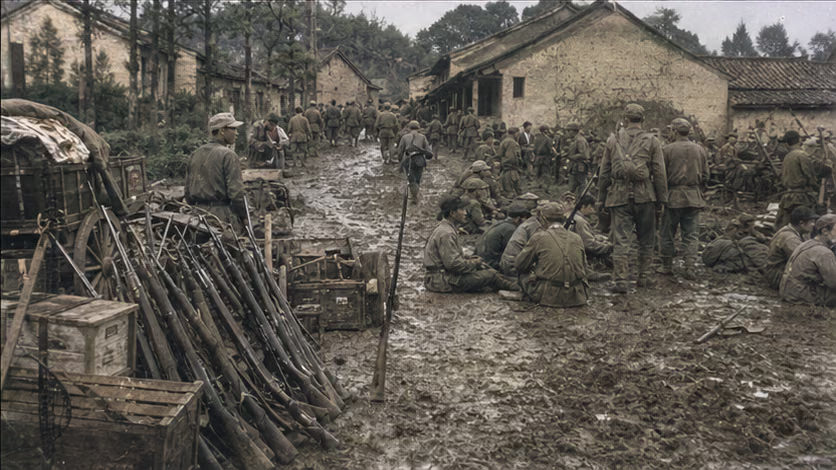
- KMT forces: across the three campaigns, about one hundred thousand were wiped out or captured (figures for each campaign vary sharply by basis, unverified); tens of thousands of guns were captured -- half of the Red Army's equipment came from these three fights.
- Red Army: total casualties numbered in the tens of thousands (bases vary by account), and core cadres were also heavily consumed.
- ※ Soviet-area livelihoods: in three years of tug-of-war, the "encirclement and suppression" armies burned, killed, levied, and plundered wherever they passed ※, while Soviet-area scorched-earth evacuation also overtaxed civilian strength; the Futian Incident suppression campaign (1930.12, just during the first counter-"encirclement" campaign) was self-slaughter ※ -- external war and internal wounds proceeded at the same time; see the overview.
Aftermath
- After the three victories, the Central Soviet Area linked into large contiguous blocks, and in 1931.11 the Chinese Soviet Republic was founded at Ruijin -- military victory was directly exchanged for a form of political power.
- The Mukden Incident changed the political air nationwide, and the dispute over "resisting foreign aggression or first pacifying the interior" became public -- the fourth "encirclement and suppression" campaign was delayed until the end of 1932 (continues in *Fourth Counter-"Encirclement" Campaign (1933)*).
- Mao Zedong's military line (luring the enemy in deep, annihilating the enemy through mobile warfare) took shape through the proof of the three campaigns -- yet his position inside the Party soon declined with the arrival of the "Left"-deviation central leadership (Ningdu Conference, 1932; cross-reference *Fourth Counter-"Encirclement" Campaign (1933)* and *Fifth Counter-"Encirclement" Campaign (1933–34)*) -- the man who won the battles was marginalized, the fuse of the next stage's tragedy.
Accounts of Those Present
- Zhang Huizan: the lieutenant-general division commander captured at Longgang and publicly tried and executed in the Soviet area -- this head later became a negative lesson in prisoner policy, and the Red Army's later propaganda offensive of "treating prisoners well" turned precisely on this point (wording unverified).
- Hao Mengling: the brigade commander defeated by the Red Army in the third "encirclement and suppression" campaign -- six years later he died fighting Japan at Xinkou, the first army commander to die in the War of Resistance. The same person has two identities in two archives, a Whence We Came-style arc of a life.
- "The enemy makes them for us": tens of thousands of guns were captured in the three counter-"encirclement" campaigns -- in the Red Army arsenal's account book, the supplier was written as the opponent's unit designations.
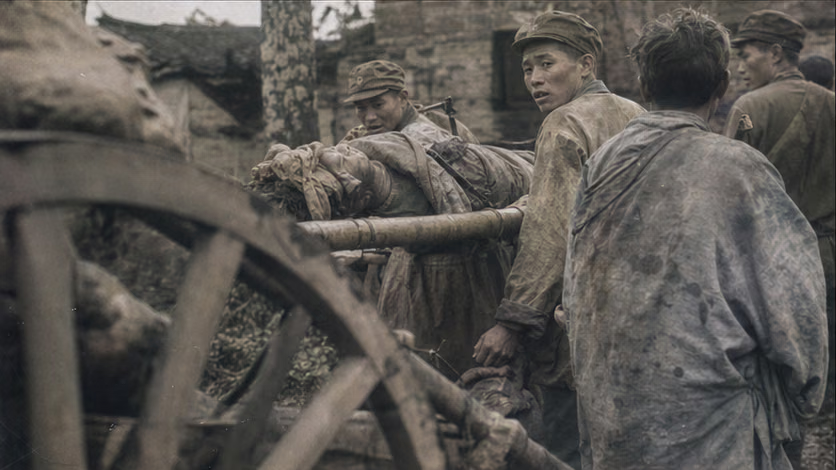
- Xingguo's stretcher teams: an extreme example of Soviet-area mobilization -- young and able-bodied people joined the army, old and young supported the front, and "every household has someone at the front" later became "every household has a martyr" (see the Xiang River line in the overview).
The Ground
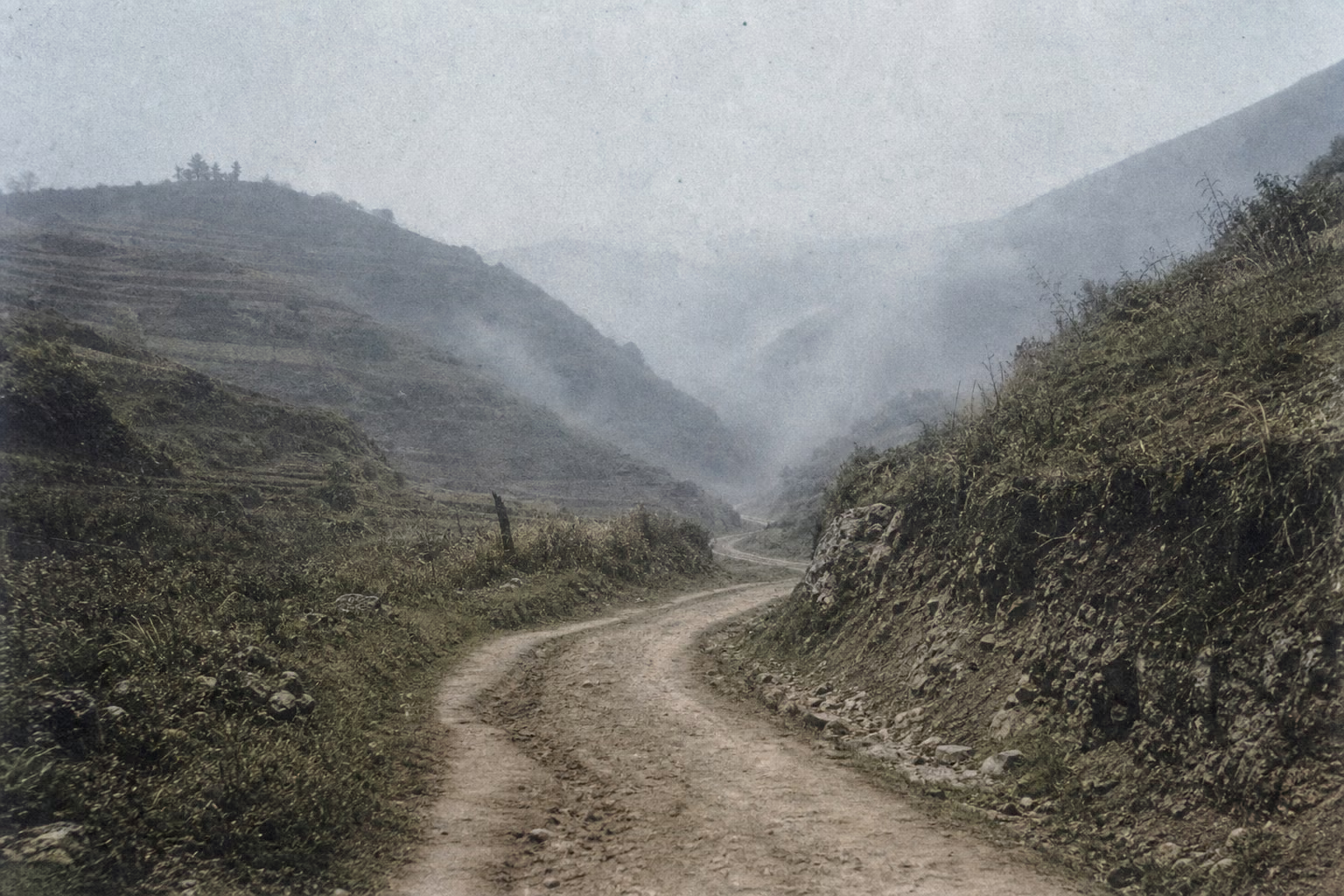
- The "pocket" terrain of hilly basins: Longgang and Huangpi were both basins along mountain defiles -- the spatial prototype of luring the enemy into the pocket and encircling him in fog.
- The "millstone": with the base area as the millstone's center, enemy forces circled on exterior lines while the Red Army turned on interior lines -- the spatial rhythm of wide-ranging maneuver to avoid, then sudden return.
- Intelligence gap: the red countryside was a "black box" to KMT forces -- on the same map, the two armies saw information densities worlds apart; this itself was a spatial mechanism.
How Each Side Records It
- Communist canonical narrative: the three counter-"encirclement" campaigns are a foundational case of "Mao Zedong military thought"; the two lyrics to "Yu Jia Ao" entered textbooks, and Longgang and Huangpi entered the sanctuary of military history.
- KMT narrative: setbacks in "Communist suppression" were attributed to the weakness of miscellaneous forces and the constraint of the Mukden Incident; in its narrative, the suspension of the third campaign proves the priority of "resisting foreign aggression."
- Later scholarship: there is increasing juxtaposed research on the decision process behind "luring the enemy in deep" (the Luofang Conference dispute), combat-result numbers, and the concurrent Futian Incident -- restoring the military myth to complex history.
Disputes and Sensitivities
- Combat-result numbers (the claim of one hundred thousand enemy troops annihilated) differ greatly from KMT-side figures, and multiple accounts coexist.
- The handling and consequences of Zhang Huizan's death -- state the matter while also recording the policy turn.
- The Futian Incident and the counter-"encirclement" campaigns occurred at the same time, with the two timelines overlapping.
Sources and Open Questions
Sources: *A History of the First Front Army of the Chinese Workers' and Peasants' Red Army*; KMT-side "bandit-suppression war histories" (titles and volume numbers unverified); related telegrams in *Collected Military Writings of Mao Zedong*; Huang Daoxuan, *Tension and Limits: The Revolution in the Central Soviet Area* (representative work in Soviet-area social history).
Open questions: the establishment date of the Nanchang field headquarters and the wording of the deadline orders; the various bases for troop strengths and casualties on both sides in the three campaigns; details of the Luofang Conference dispute; the course of Zhang Huizan's disposal; combat-report bases for the five battles and five victories; Hao Mengling's participating post; numbers of weapons captured.
All images on this site are AI-generated depictions. They are not historical photographs, not primary sources, and do not depict any real individual.