Engagement Archive · Fifth Counter-"Encirclement" Campaign (1933–34)
Five hundred thousand troops pressed the Soviet Area inward inch by inch with blockhouses and roads; the Red Army held out for a year with "short, sharp assaults" and positional defense -- after Guangchang's 18 days had cost more than 5,000 men, the only road left for 80,000 people was one word: go. The Long March was not a choice; it was the bill for the Fifth Counter-"Encirclement" Campaign.
Engagement Data
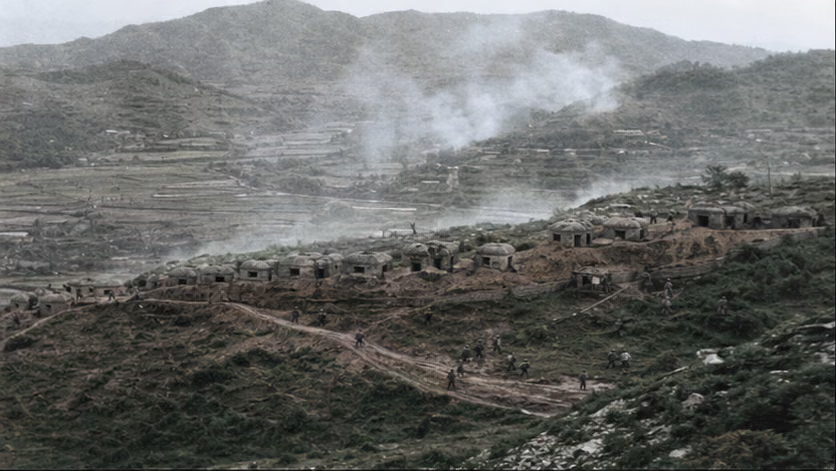
| Item | Content |
|---|---|
| Time | 1933.9–1934.10 (from the fall of Lichuan to the strategic transfer) |
| Place | Around the Central Soviet Area: the line of Lichuan, Guangchang, Jianning, Gaohunao, Yiqian, Wenfang, Xingguo, and Shicheng |
| Affiliation | Agrarian Revolutionary War (for the larger situation, see *Agrarian Revolutionary War · Overview*) |
| Belligerents | First Front Army of the Red Army and local forces, about one hundred thousand (figures vary by account); actual military command lay with Comintern adviser Otto Braun and Bo Gu / KMT forces against the Central Soviet Area, about five hundred thousand (northern route mainly Gu Zhutong and Chen Cheng as the main force, figures vary by account) |
| Result | The Soviet Area's defensive lines were compressed one after another; in 1934.10, 86,000 men of the Central Red Army withdrew, beginning the Long March |
Belligerents
| Item | Red Army | KMT Forces |
|---|---|---|
| Strength | About one hundred thousand, including large numbers of newly expanded Red Army recruits | About five hundred thousand; officers retrained by the Lushan Training Corps, with German advisers (Seeckt and Falkenhausen successively; roles unverified) participating in planning |
| Method | "Left"-deviation line: keeping the enemy outside the gates, positional defense, "short, sharp assaults" | Blockhouse policy: blockhouse clusters + road networks, advancing step by step, with an economic blockade (salt, medicine, and cloth all cut off from entering the area ※) |
| Economy | Soviet Area supplies exhausted: salt shortage, medicine shortage; Red Army expansion and grain requisition pushed civilian capacity to its limit ※ | Logistics depended on the road network, rolling forward under cover |
Terrain and Conditions
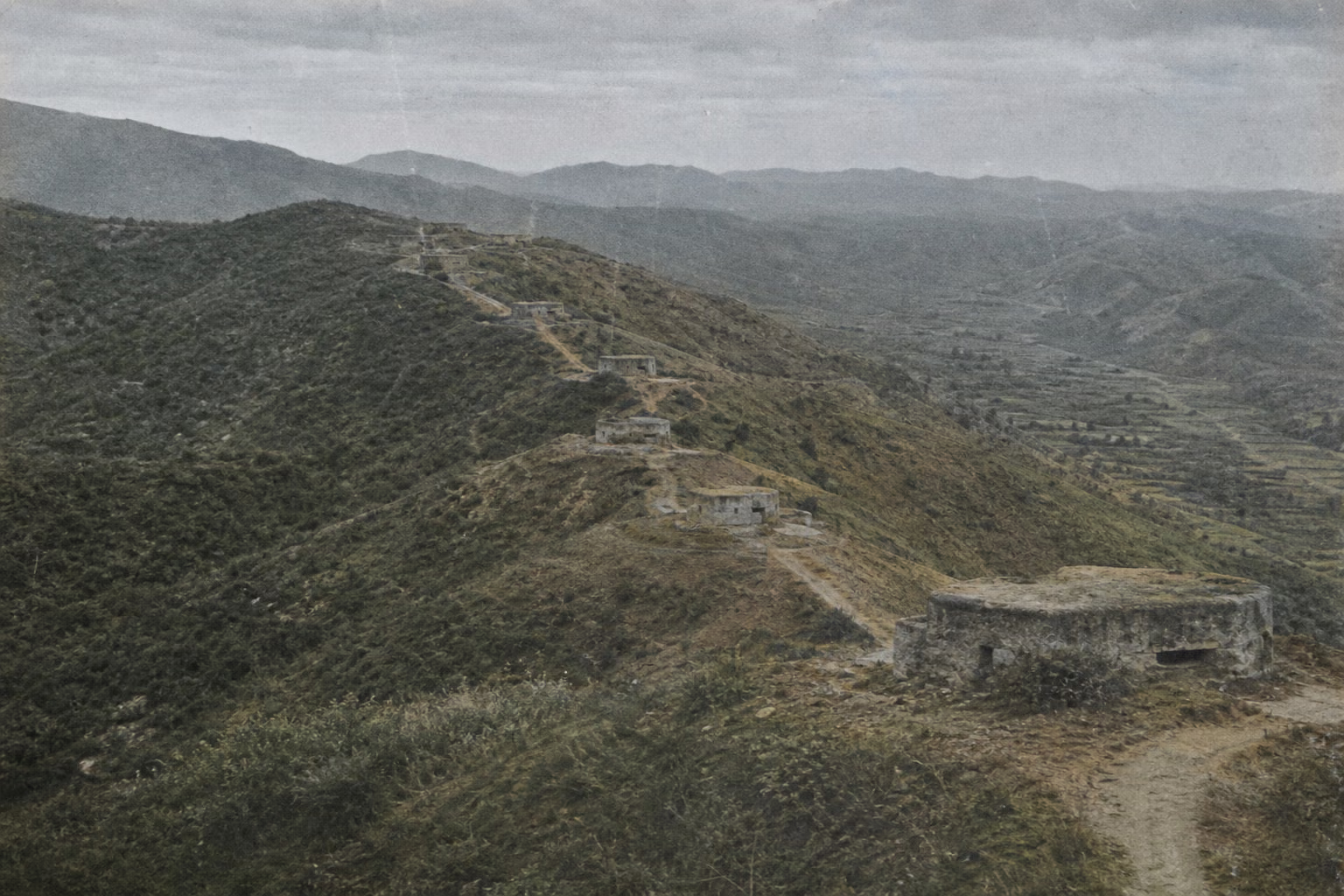
Blockhouses: several thousand (the number built during the "encirclement and suppression" period varies by basis, unverified) wove a net along the edge of the Soviet Area, building each section as the advance moved on -- war became civil engineering. Inside the Soviet Area: the expanded land-investigation movement, aftershocks of suppressing counterrevolutionaries, and sudden Red Army expansion (the slogan of "expanding a million-strong iron Red Army") -- civilian capacity and manpower sources were doubly overdrawn ※. The Fujian Incident (1933.11, the Nineteenth Route Army's Fujian revolt, suppressed in 1934.1) had once been an opportunity to break the outer line; the Red Army did not launch a timely major supporting action -- the dispute over a lost external ally continues to this day (decision responsibility unverified; two views stand side by side).
Why It Was Fought
The ambushes in the thick fog at Huangpi and Caotaigang had annihilated three of Chen Cheng's main divisions (see *Fourth Counter-"Encirclement" Campaign (1933)*), and Chiang Kai-shek called it in his correspondence "the only deep wound of my life" (wording unverified). That defeat taught him two things: no more divided advances seeking a decisive battle, and no more gaps left for the opponent's ambushes. In May 1933 the Tanggu Truce was signed, temporarily quieting the fighting in North China; in the second half of that year, about five hundred thousand troops closed in on the Central Soviet Area from all sides, the Lushan Training Corps rotated officers through training, and German advisers participated in planning (Seeckt and Falkenhausen successively; roles unverified). The method changed into civil engineering -- blockhouses plus roads, building each section as they advanced, while at the same time cutting off the routes by which salt, medicine, and cloth entered the area. It did not seek a decisive battle, only compression: the outcome of the contest in consumption had already been determined by scale before it began. This was the arithmetic of blockhouse policy.
On the Red Army side, those who had won the battles did not win the line. The Fourth Counter-"Encirclement" Campaign had been won at the front over telegraphed orders; after the victory, the "Left"-deviation Central leadership instead took over military affairs fully, and Comintern adviser Otto Braun arrived, moving into the "independent house" at Ruijin. Facing Chiang's new method, Braun and Bo Gu rejected the old practice of luring the enemy in deep -- the method proven by the three earlier counter-"encirclement" campaigns was now set aside -- and fixed on keeping the enemy outside the gates and "not giving up one inch of Soviet Area land." Five hundred thousand against one hundred thousand: two policies of "no retreat" collided, and the war became a contest of attrition between positions and blockhouses, using the Red Army's weakness against the KMT forces' strength.
The organizational nodes by which they came to the stage can be traced: at the Ningdu Conference in 1932.10, Mao Zedong left the Red Army's command post; in early 1933 the Provisional Central leadership moved into Ruijin, and command power was concentrated from then on. At which meeting and in which directive the idea of "keeping the enemy outside the gates" took shape is not fully recorded (unverified). Red Army intelligence was not poor; radio reconnaissance repeatedly broke the opponent's codes (details unverified) -- but knowing that five hundred thousand men were coming, and knowing what to use to stop them, were two different things.
The other half of this battle lay in the account book. After years of war, Red Army expansion, and grain requisition, civilian capacity in the Soviet Area was already near its limit; under blockade, salt shortage and medicine shortage deepened step by step -- before the outer positions were lost inch by inch, the inner-line economy was already suffocating inch by inch.
The details in that account book were uglier still: cartridges depended on reloading and capture, with ammunition allotted by the round (numbers unverified); the financial source from attacking local tyrants had long since run dry, and finances turned over through public-bond paper notes (details unverified); each round of Red Army expansion came tighter than the last, and the manpower source had hit bottom. Dissent did exist: front-line commanders repeatedly criticized positional warfare, and Lin Biao and others suggested shifting to mobile warfare (original text unverified); Mao Zedong advocated breaking the main force out to the outer line at Huichang, but this was not adopted (sequence unverified); after the defeat at Guangchang, the dispute between Zhang Wentian and Bo Gu became public (from later recollections, source unverified). These voices could not get through, because command power was no longer in the hands of the front. In 1934.5 Guangchang fell, and the Central leadership resolved on a breakout; after several rounds of telegrams with the Comintern, the decision was only made in autumn (telegram history unverified). In October, a copy of the enemy's overall encirclement plan was passed circuitously into Ruijin (the story of the "Iron Bucket Plan" is widely circulated, source unverified), and the timetable for departure was fixed from there.
In late September 1933, the northern-route army moved; on September 28, the Soviet Area's northern gate at Lichuan fell. A city was lost at the opening; for the year that followed, the front moved in only one direction.
Course of the Engagement
| Stage | Time | Main Points |
|---|---|---|
| Fall of Lichuan | 1933.9.28 | The northern gate was lost at the opening; subsequent attacks at Xunkou, Xiaoshi, and Zixiqiao, all under the line of "keeping the enemy outside the gates," ran into walls |
| Advance of the blockhouse line | Winter 1933–spring 1934 | The enemy built blockhouses section by section as it advanced; the Red Army's small victories through "short, sharp assaults" could not compensate for the larger trend |
| Fujian revolt missed | 1933.11–1934.1 | The Nineteenth Route Army incident was suppressed after Central Army forces turned back; the outer-line opportunity disappeared |
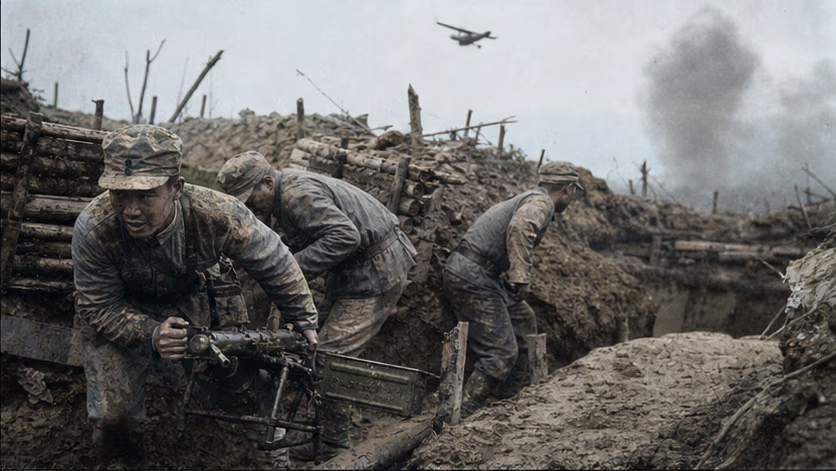
| Defense of Guangchang | 1934.4.10–28 | 18 days of "decisive defensive battle": standing head-on under aircraft and heavy artillery, the Red Army suffered more than 5,500 casualties (figures vary by account), and Guangchang was lost -- the price of Braun-style tactics took concrete form; Peng Dehuai rebuked Braun to his face with "the cub sells the grandfather's fields and feels no pain" (this saying is very widely circulated; source layer unverified) |
| Hard holding on the southern line | 1934.7–8 | Blocking actions at Gaohunao, Wannian Pavilion, and Yiqian: the Red Third Army Corps fought bloody battles from strongpoint to strongpoint, delaying the enemy's southern advance (casualties in each action unverified) |
| One victory at Wenfang | 1934.9 | The ambush at Wenfang (alternate Chinese spelling: 文坊) on the eastern line inflicted more than 4,000 enemy losses -- the only respectable annihilation battle of the entire period (result figures vary by account), but by then it could not change the larger situation |
| Whole line breaks | 1934.9–10 | Xingguo, Ningdu, and Shicheng successively came under immediate threat; in early October the Central leadership decided on transfer, and around 10.10 the central organs and the main force of 86,000 set out -- the Fifth Counter-"Encirclement" Campaign ended with the Long March as its full stop |
Casualties and Losses
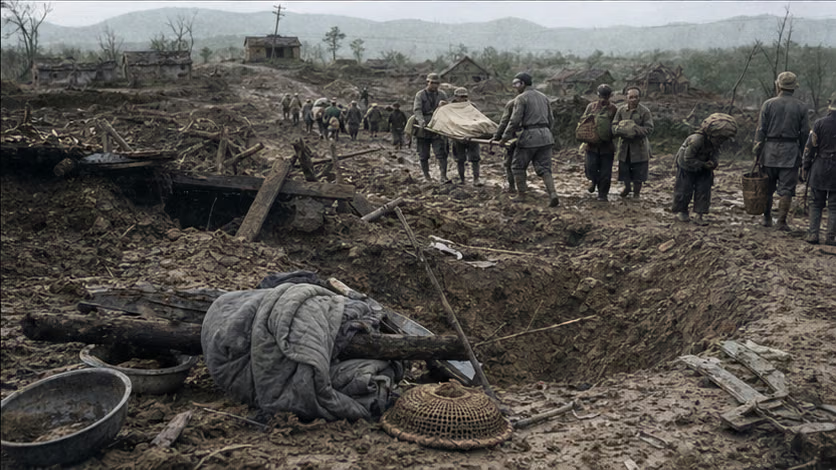
- Red Army: tens of thousands of casualties over a year of hard fighting (combined figures across the actions vary by account); more than 5,500 in the Guangchang action.
- Soviet Area ※: salt and medicine cut off, civilian capacity overdrawn; after the Red Army left, the reprisals of the "encirclement and suppression" armies entering the area to clear the countryside (the folk saying "stones under the knife, thatch under fire" refers to this ※, record unverified) and the fate of the soldiers and civilians who stayed behind (the Three-Year Guerrilla War in the South, also see the overview) -- those left behind bore the heaviest part.
- KMT forces: casualty figures vary by account; given their scale, the consumption was entirely bearable -- this was precisely the arithmetic of blockhouse policy.
Aftermath
- The Long March began (continuing into the bloody fighting on the Xiang River; see also *Battle of the Xiang River*); the Zunyi Conference (1935.1) began the reckoning with this period's military line -- Zunyi's account book was written on every page in the Fifth Counter-"Encirclement" Campaign.
- Chiang Kai-shek's "Communist suppression" reached its military high point here, then was pulled between two fronts by the Red Army's transfer and the deepening Japanese invasion of China (continues into the Fourteen-Year War of Resistance articles).
- Blockhouse tactics, as a model of "trading national strength for space," entered the military textbooks of both sides -- more than 10 years later, when the KMT and CPC exchanged offensive and defensive positions, the blockhouses had changed owners (see *Chinese Civil War · Overview*).
Accounts of Those Present
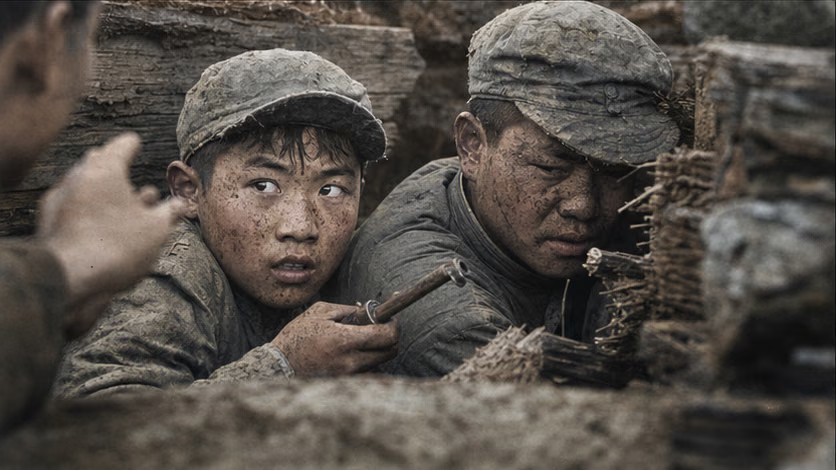
- Otto Braun: the Comintern adviser who could not speak Chinese commanded the war from the "independent house" in Ruijin through maps -- one layer of separation in translation, one in maps, one in the field itself; in those 3 layers of separation, 80,000 people advanced and retreated.
- The 18 days of Guangchang: teenage soldiers newly expanded into the Red Army held fieldworks under heavy artillery -- what the 4 words "decisive defensive battle" meant in positional form, this action answers most directly.
- Peng Dehuai's anger: "the cub sells the grandfather's fields and feels no pain" (source layer unverified) -- 25 years before the Lushan Conference, this commander's temper had already been written at Guangchang.
- Salt ※: under blockade, the price of 1 jin of salt in the Soviet Area equaled several silver dollars (figures vary by account), with salt boiled from nitrate earth and salt traded by barter -- the taste of war came down to a bowl of food.
The Ground
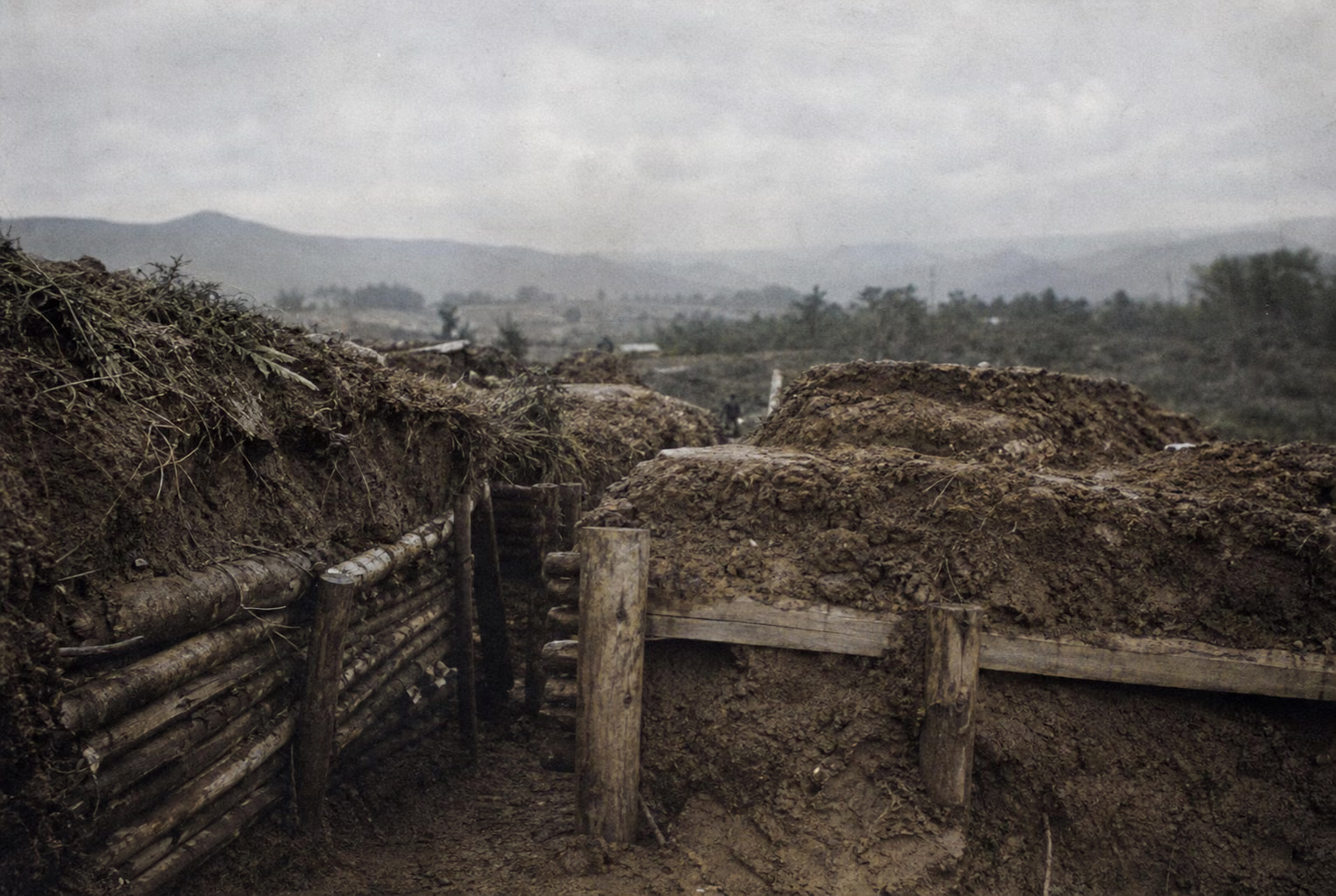
- Blockhouse net: an encroaching space of point-line-surface, with the front moving several li per month -- "slow" itself was a weapon.
- Guangchang front: three-dimensional suppression of fieldworks by aircraft and heavy artillery -- the Soviet Area war's first approach to modern firepower density.
- The strongpoints at Gaohunao and elsewhere: a chain of blocking actions from strongpoint to strongpoint in the southern-line hills, where "how long to hold" replaced "whether it can be held" as the measure -- directly homologous with this series' question of extremity.
- The shrinking map of the Soviet Area: the spatial narrative of a base area's map drawing inward month by month over 1 year is itself the shape of this campaign.
How Each Side Records It
- Communist canon: entered history as a whole as the negative textbook example of the "Left"-deviation military line, with Guangchang as the marker; tactical bright spots such as Wenfang are recorded alongside it.
- KMT side: recorded as the "success of the fifth encirclement and suppression campaign" and a victory of the blockhouse policy; its war histories emphasize "three parts military, seven parts political" (slogan unverified).
- Scholarship: there has been renewed examination of making Braun's responsibility the single cause (the decisive role of the scale gap and economic blockade); social-history research on the Central Soviet Area's late-stage social condition (Red Army expansion, land investigation, civilian capacity) has been a recent focus.
Disputes and Sensitivities
- Attribution of failure: the single-cause account of line error and the structural account of national strength and scale stand side by side -- present the two layers, canonical and scholarly, side by side.
- Decision responsibility for the lost chance to support the Fujian Incident -- two views stand side by side.
- Source layers for famous scenes such as Peng Dehuai's rebuke.
- The fate of those who stayed behind and the decision process behind the "lists of who left and who stayed" (who left and who stayed touches evaluations of multiple historical figures) -- sensitive; mark the layer.
Sources and Open Questions
Sources: *A History of the First Front Army of the Chinese Workers' and Peasants' Red Army*; Otto Braun, *A Comintern Agent in China* (participant's defensive memoir, to be read against other sources); documents related to Bo Gu; Huang Daoxuan, *Tension and Limits*; KMT-side "bandit-suppression war histories."
Open questions: troop strengths on both sides and the number of blockhouses built; casualty figures for Guangchang; results at Wenfang; source for Peng Dehuai's rebuke; salt-price figures; source for the slogan "three parts military, seven parts political"; documents on the decision process for the lists of who left and who stayed; the meeting and directive in which the policy of "keeping the enemy outside the gates" took shape; details of the Red Army's radio-codebreaking work; numbers for ammunition allotment and details of public-bond issuance; original text of Lin Biao and others' suggestions to shift to mobile warfare; sequence and content of Mao Zedong's Huichang breakout proposal; later recollection source for the Zhang Wentian-Bo Gu dispute after Guangchang; telegrams exchanged with the Comintern over the breakout decision; the course by which the copy of the "Iron Bucket Plan" reached Ruijin.
All images on this site are AI-generated depictions. They are not historical photographs, not primary sources, and do not depict any real individual.