War Overview · Sino-French War (1883–85)
To preserve Vietnam, its most important tributary, the Qing dynasty fought the French Third Republic for eighteen months in the mountains of northern Vietnam and on the waters off Fujian and Taiwan: the land front was won in the end, the cabinet in Paris fell, and the treaty still left China the loser.
Engagement Data
| Item | Details |
|---|---|
| Time | 1883.12 (French attack on Sơn Tây) – 1885.6.9 (Sino-French Treaty of Tientsin); if counted from the French reoccupation of Hanoi in 1882.4 or the 1873 Francis Garnier Incident, the statistical basis must be stated separately |
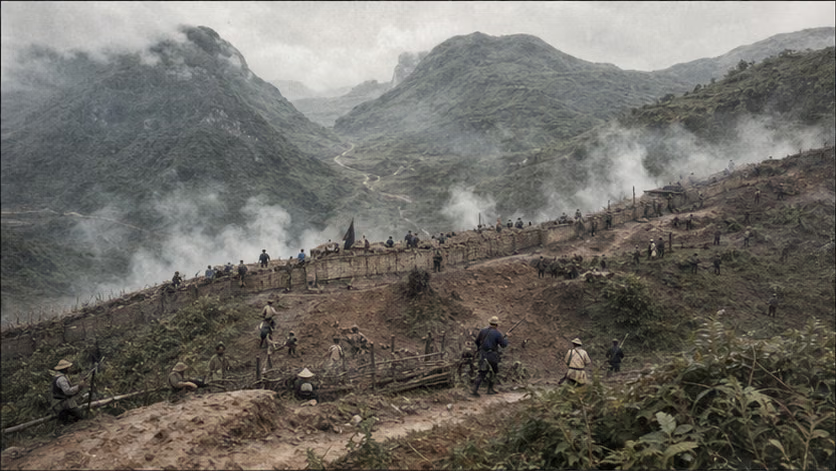
| Place | Tonkin, Vietnam (the line of Sơn Tây, Bắc Ninh, Lạng Sơn, and Zhennan Pass); waters off Fujian and Taiwan (Mawei, Keelung, Tamsui, Penghu); Zhenhai in eastern Zhejiang |
| Belligerents | Great Qing (Guangxu reign, Cixi governing from behind the curtain) / French Third Republic (the pro-war period of the Ferry cabinet) |
| Third parties | Black Flag Army (Liu Yongfu, holding Vietnamese office), troops of Vietnam's Nguyễn dynasty: most of the battlefield lay on Vietnamese soil, and Vietnam was what was being contested |
| Result | 1885.6.9 Sino-French Treaty of Tientsin (the "New Sino-French Treaty"): the Qing dynasty gave up suzerainty over Vietnam, with no indemnity and no cession of territory |
Belligerents (War Level)
| Item | Qing side | French side |
|---|---|---|
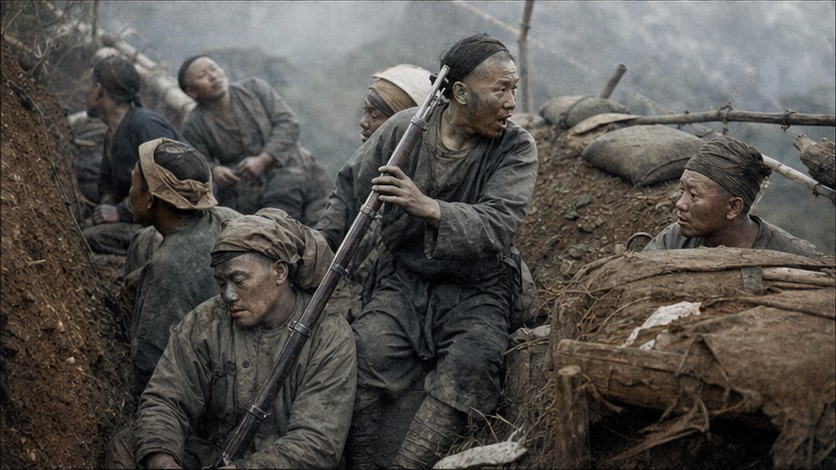
| Total strength | No unified mobilization figure. On the northern Vietnam front, the Guangxi Army, Yunnan Army, and Guangdong Army (including Feng Zicai's Cui Army) together numbered about 50,000 (bases vary, figure disputed); in addition, several thousand Black Flag troops and some Vietnamese troops | The Tonkin Expeditionary Corps peaked at about 16,000 to 20,000 men (accounts differ, unverified), while part of the Far East Squadron blockaded Fujian and Taiwan |
| Infantry firearms | Mixed old and new arms, but large numbers of foreign-purchased breech-loading rifles were already in use (Remingtons, Mausers, and others, unevenly distributed) | Standard-issue Gras breech-loading rifles; artillery consisted of breech-loading rifled guns |
| Navy | Fujian Fleet (destroyed in the Battle of Fuzhou), Nanyang Fleet, and the newly founded Beiyang Fleet; fully inferior in tonnage and rapid-fire capability | Far East Squadron of mixed ironclads and cruisers, under Courbet's command, able to maneuver freely along the coast south of the Yangtze |
| Mobility and logistics | Supply over the mountain roads of northern Vietnam was extremely difficult; losses to miasma and disease often exceeded battle losses | Supply by Red River shipping, likewise broken down by tropical disease: French deaths from illness were several times battle deaths (details unverified) |
| System | The dispute between war and peace ran through the whole war (Li Hongzhang favoring peace, the Qingliu faction favoring war); front-line command was divided among several authorities, with the Guangxi, Yunnan, and Guangdong armies each forming its own system | Cabinet and parliament checked each other, and military funding bills repeatedly became political explosives; front-line commanders (Courbet, Millot, Brière de l'Isle, de Négrier) made decisions on the ground |
Historical Setting
World: The 1880s were the high tide of the powers' partition of Africa and Asia. Britain had taken Egypt; France was reaching into Tunisia, Madagascar, and the Congo, while in the Far East its gaze fell on Indochina. From the 1860s onward, France gnawed away at Vietnam: the 1862 Treaty of Saigon ceded three provinces in Cochinchina, the 1874 treaty opened the Red River, and the 1883 Treaty of Huế turned Vietnam into a protectorate. The blade was moving step by step toward the Qing dynasty's outer fence.
China: The Self-Strengthening Movement was in its ascendant phase. The Tongwen Guan, Jiangnan Arsenal, and Fujian Shipyard had been operating for nearly twenty years, and new-style fleets were taking shape. This was the first time the Qing dynasty fought a foreign war with ships it had built itself and officers trained in its own schools. But the military system, finances, and command structure remained those of the old order: front-line memorials were embellished, the center wavered between war and peace, and provincial armies each acted on their own. The Battle of Fuzhou sank in one morning more than ten years of shipyard achievements. The strained coexistence of "Self-Strengthening results and the old system" is the Chinese main line of this war.
France: In the early Third Republic, republicans treated colonial expansion as a "civilizing mission" and a vessel of national prestige, with Jules Ferry as the standard-bearer. Parliamentary opponents saw the Far Eastern expedition as an adventure that burned money for nothing and delayed "revenge" against Germany. Funding bills and bad news from Tonkin were domestic political explosives waiting to go off. Later, they did.
Why It Was Fought
France's resolve was approved item by item in the chambers of parliament in Paris. In 1883.5, Henri Rivière was killed at Paper Bridge, and the Ferry cabinet immediately asked parliament for reinforcements to Tonkin and additional military funding. For the next two years, every step forward required the votes of deputies to release the money (vote counts and dates for each funding bill unverified). The cabinet's calculation was to make the protectorate created by the Treaty of Huế real, open the Red River, and bring "Tonkin" down from paper onto the ground. From the first day, this calculation had opponents at home: radicals in parliament denounced the Far Eastern expedition as a waste of money that harmed the country and delayed revenge against Germany; each funding bill passed, and each left resentment behind (original wording of opposition speeches unverified). Opposition did not stop the dispatch of troops, but it set the terms of dispatch: not many troops could be sent, and the war could not be dragged out. French strength in northern Vietnam always peaked at only 10,000 to 20,000 men, and every transport had to come from ten thousand li away.
On the Qing court's side, resolve was split from beginning to end. Prince Gong Yixin presided over the Grand Council and avoided war all along: Zeng Jize argued in Paris, Li Hongzhang negotiated in Tianjin, and the Guangxi and Yunnan armies at the front moved into northern Vietnam under the constraint that "provocation must not be opened by us" (original restraining edict unverified). At the end of 1883 Sơn Tây was lost; in spring 1884 Bắc Ninh collapsed. When news of defeat reached Beijing, Cixi used the moment to dismiss Prince Gong's entire Grand Council, and the voices of the war-favoring Qingliu faction entered the inner halls. But changing the Grand Council changed people, not the problem: no funds had been budgeted for this war, grain transport over the mountain roads of northern Vietnam was failing, and losses to disease often exceeded battle losses. The three fleets each acted on their own; Li Hongzhang regarded the newly founded Beiyang Fleet as the capital of self-strengthening and would not lightly commit it to the southern theater (details of memorials and replies on Beiyang's avoidance of battle unverified). The war-peace dispute ran throughout: Li Hongzhang repeatedly memorialized that China should not lightly fight a European power, and he favored peace to the end; the Qingliu faction favored war to the end. Both roads had people walking them; neither road was walked to its end. The Li-Fournier Convention sought peace in 1884.5; the Bắc Lệ (Guanyinqiao) clash shattered it in 1884.6; the defeat at Fuzhou came in 1884.8; only then did the declaration of war arrive late. Every act of resolve was made after the opponent had already acted.
By early 1885, the front had not yet produced a final military result, but the center had already opened a back door: Robert Hart, Inspector-General of the Imperial Maritime Customs, made the connection, and James Duncan Campbell, the Customs official in London, held secret talks with the French Foreign Ministry. A preliminary truce agreement was signed in Paris on 4.4, while the victory report from Zhennan Pass was still on its way north (date when the victory report reached Beijing unverified). The French side was also doing its sums: the northern Vietnam army was exhausted and short of funds, the cabinet was tottering, and holding Penghu as security was enough to let it stop. Two governments, one afraid of breaking its finances and the other afraid of breaking its cabinet: from this point, victory or defeat at the front was uncoupled from success or failure in the treaty.
Course of the Engagement
Prehistory: the Black Flag Army resisted France in the earlier phase. Liu Yongfu's force was originally a remnant of the Tiandihui; during the Tongzhi reign it entered Vietnam, accepted Vietnamese office, and was stationed at Bảo Thắng. In 1873.12, outside Hanoi, it killed the French leader Francis Garnier; on 1883.5.19, in the Battle of Paper Bridge, it again killed the expedition commander Henri Rivière. French court and public were shaken, and reinforcements were sent to Tonkin. From there, the war escalated step by step.
| Phase | Time | Key points | Article |
|---|---|---|---|
| Fighting begins in northern Vietnam | 1883.12–1884.5 | French forces attacked Sơn Tây (December; the Black Flag Army and Yunnan-Guangxi forces were defeated), captured Bắc Ninh (1884.3), and took Thái Nguyên; the Qing line in northern Vietnam collapsed. The Qing court changed the central leadership (the Jiashen replacement of the Grand Council; Prince Gong Yixin was removed). On 1884.5.11, Li Hongzhang and Fournier signed the Li-Fournier Convention (Tientsin Accord), agreeing that Qing troops would withdraw from Tonkin | Land Battles in Northern Vietnam |
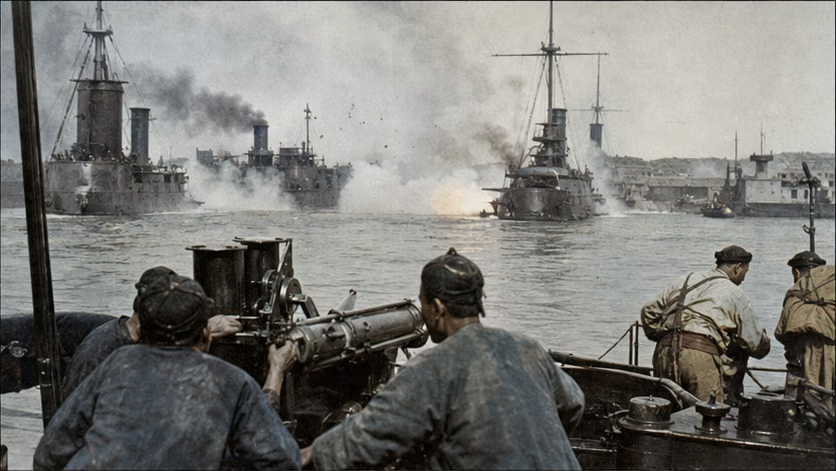
| The Guanyinqiao rupture | 1884.6–8 | The two sides held different interpretations of the withdrawal deadline. On 6.23, the Bắc Lệ (Guanyinqiao) clash occurred; after a setback, France demanded a huge indemnity and sent a fleet to apply pressure. On 8.5 it shelled Keelung; on 8.23, in the Battle of Fuzhou, the Fujian Fleet was destroyed in half an hour; on 8.26, the Qing court issued an edict declaring war on France: a rare formal declaration of war against a foreign power in the modern period | Battle of Fuzhou (Majiang) |
| Taiwan, Penghu, and eastern Zhejiang | 1884.8–1885.4 | In 1884.10, French forces occupied Keelung and were repulsed in an attack on Tamsui (10.8, Huwei); they then announced a blockade of the entire island of Taiwan, and the maritime supply struggle continued until the truce. On 1885.3.1–3, the attack on Zhenhai was repulsed by the batteries and defenders. At the end of 1885.3, France occupied Penghu as "security" | Fighting in Taiwan and Penghu (Keelung, Tamsui, Penghu), Battle of Zhenhai (1885) |
| Reversal on the Guangxi-Vietnam border | 1885.2–3 | On 2.13 French forces captured Lạng Sơn and for a time entered Zhennan Pass, burned the pass, and withdrew. Feng Zicai supervised the army and built a long wall in the defiles before the pass. On 3.23–24, Qing forces checked the French at Zhennan Pass, then took Văn Uyên in pursuit. On 3.28, below Lạng Sơn, de Négrier was badly wounded; French forces abandoned the city, and on 3.29 Qing forces recovered Lạng Sơn. On the western line, the Yunnan Army and Black Flag Army also won at Lâm Thao at the same time (details unverified) | Zhennan Pass and Lạng Sơn |
| Truce and treaty | 1885.4–6 | As early as the beginning of 1885, the Qing court had been holding secret talks with France through Robert Hart, Inspector-General of the Imperial Maritime Customs, and James Duncan Campbell, the Customs official in London. On 4.4, Campbell and Billot of the French Foreign Ministry signed a preliminary truce agreement in Paris; on 4.7 the Qing court issued a truce order, and the front obeyed the edict and withdrew ("stop once victory is gained"). On 6.9, Li Hongzhang and the French minister Jules Patenôtre signed the formal treaty in Tianjin | — |
A comparison within the same ten-day period: News of the French retreat below Lạng Sơn on 3.28–29 returned to Paris, and exaggerated reports of defeat (the so-called "Tonkin Affair" telegram) detonated the Chamber of Deputies. On 3.30, the Ferry cabinet's funding bill was rejected by 306 votes to 149, and the cabinet fell. Victory at the front and the fall of the enemy cabinet occurred within the same ten-day period. But the secret negotiating table in Paris had already settled the matter: what fell was the cabinet in Paris; what was signed was still the treaty in Tianjin.
Treaty Details (1885.6.9, Tianjin)
The Sino-French Treaty of Tientsin, commonly called the "New Sino-French Treaty," was signed by Li Hongzhang and the French minister to China Jules Patenôtre:
- The Qing dynasty recognized France's protectorate over Vietnam, accepting by default the order established by the two Franco-Vietnamese Treaties of Huế of 1883–84. The suzerain-tributary relationship ended here.
- Two overland trading posts were to be designated on China's southwestern border (later set as Mengzi and Longzhou; delimitation details unverified), and France could station consuls there; import and export duties were reduced.
- If China later built railways in the southwestern provinces, it had to "consult and arrange with Frenchmen": the railway-rights clause entered through this door.
- The two sides were to delimit the Sino-Vietnamese border; French forces withdrew from Keelung and Penghu and lifted the blockade of Taiwan.
- No indemnity, no cession of territory: among the series of late-Qing treaties after defeat, this was the "lightest" in its terms. The price was that what was given up was all of Vietnam.
"France won without victory; China lost without defeat" is the most widely circulated judgment (attribution unverified; often attached to Zuo Zongtang's name, with no confirmed original source seen).
Casualties and Losses
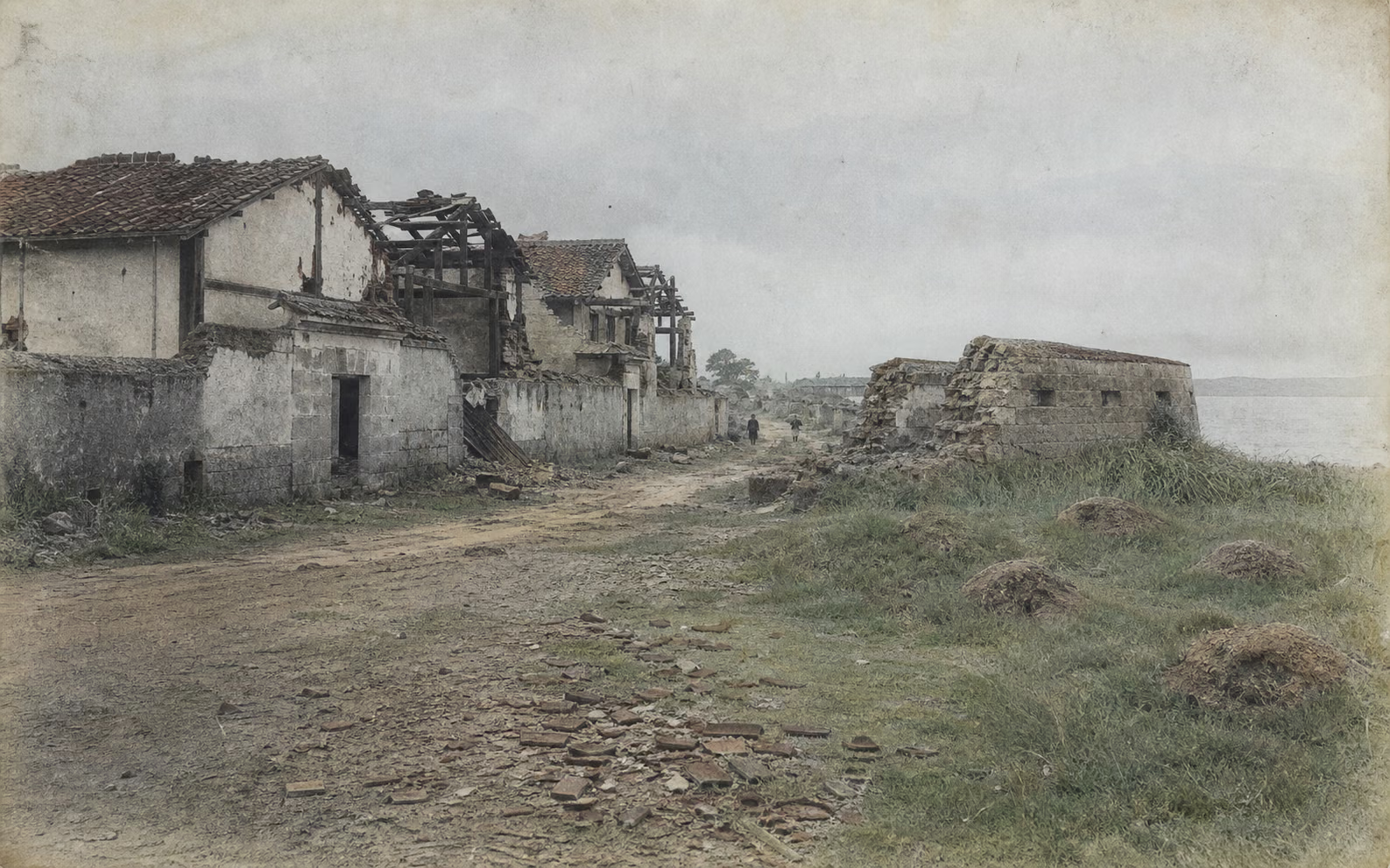
- Qing side: there is no authoritative total for casualties across the whole war; the cumulative total across the engagements should have been above 10,000 (bases vary, figure disputed). In the Battle of Fuzhou about more than 700 were killed (Qing basis; number enshrined at the Mawei Zhaozhong Shrine unverified); the Fujian Fleet was annihilated, and the shipyard and school were shelled. On the northern Vietnam front, deaths from illness and deaths in battle together left many units broken.
- French side: combat deaths across the whole war were about 2,000 (French basis, unverified); deaths from disease were several times that. The true bulk of losses in the Tonkin Expeditionary Corps came from cholera, dysentery, and fevers. For French deaths in the Battle of Fuzhou, Qing statistics give five or six men, while French statistics say only wounded (two bases placed side by side, unverified). Fleet commander Courbet died of illness on 1885.6.11 aboard his flagship in Magong harbor, Penghu, and did not see the treaty signed.
- Zhennan Pass comparison of bases: Chinese battle reports claimed nearly 1,000 or even more than 1,000 French killed and wounded; French battle reports admitted 74 killed and about 190 to 210 wounded (figures differ slightly among sources, disputed). The two sets of figures coexist.
- Civilians: towns and villages in northern Vietnam repeatedly changed hands, and there are no statistics for civilian deaths and displacement. The Keelung mining district and urban streets were repeatedly shelled; Taiwan's blockade of nearly eight months left supplies on the island strained. After the war, the Black Flag Army was ordered disbanded and moved inland, and the situation of Vietnamese civilians accompanying the army goes unrecorded.
- Finance: total Qing war expenses unverified; for France, the additional military funding bill was the 200 million-franc appropriation that brought down the Ferry cabinet.
Aftermath
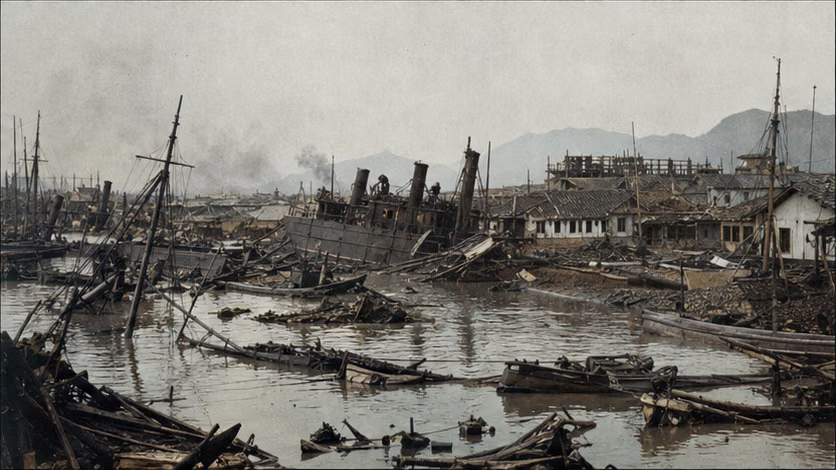
- Vietnam left the suzerain-tributary system. In 1887, France combined northern and southern Vietnam with Cambodia into the "French Indochinese Union" (year unverified): a key link in the collapse of the suzerain-tributary system, with Korea next in line.
- On 1885.10.12 the Qing court approved the establishment of Taiwan as a province, with Liu Mingchuan as its first governor (the formal establishment was not completed until 1887; details unverified): an awakening to coastal defense purchased by eight years of French blockade.
- In 1885.10, the Office for the Administration of Naval Affairs was established, with Prince Chun Yixuan as administrator; edicts to "greatly govern the navy" followed one after another. In 1888 the Beiyang Navy was formed: the tuition of Fuzhou was first paid into the Beiyang account.
- The Black Flag Army was disbanded, and Liu Yongfu led the remnants inland and was granted the rank of zongbing (details unverified); after the Jiashen replacement of the Grand Council, the war-favoring Qingliu faction scattered, and Zhang Peilun was sent to frontier exile.
- France gained Vietnam and trading and railway rights in southwestern China, but at home the "Tonkin War" left behind a bad name, and Ferry bore the nickname "the Tonkinese" for life.
How Each Side Records It
- Chinese side: in modern historical narrative, this is the typical case of "winning the battlefield and losing the negotiation." The great victory at Zhennan Pass entered textbooks, the destruction at Fuzhou entered the starting point of naval history, and both ends are remembered. Taiwan has another layer of memory: the victory at Huwei and Liu Mingchuan's administration of Taiwan are narrated separately in the history of the island and on the far side of the strait (differences in basis unverified).
- French side: called the "Tonkin War" (la guerre du Tonkin), it was submerged in the sequence of colonial wars by Tunisia, Madagascar, and later great wars, and remains a marginal memory. What chiefly remains in French political history is the fall of Ferry.
- Vietnamese side: most of the battlefield lay on Vietnamese soil, and what was being contested was Vietnam's suzerainty. In Vietnamese historical perspective, this war occupies a complex place: the Huế court was pressed from both sides; in 1885 Emperor Hàm Nghi fled, and the Cần Vương movement followed. In anti-French narratives, the Qing dynasty is both reinforcement and another suzerain. Vietnamese materials accessible here are limited.
Disputes and Sensitivities
- "Stop once victory is gained": the victory report from Zhennan Pass and the truce edict fell almost within the same ten-day period, and the resentment of "losing without defeat" has not dispersed in more than a century. But historical research points out that the Paris secret talks had already been settled in early 1885, and that the victory at Zhennan Pass did not enter the bargaining chips (details of the Hart-Campbell channel unverified). When the front was winning, the outcome had in fact already been fixed. Which layer of narrative to adopt must be a conscious decision.
- Declaration of war: the 8.26 declaration-of-war edict was a rare formal posture of declaring war against a foreign power in the modern period. But Fuzhou had been attacked first and the declaration came afterward, eight months after fighting began. The respective advantages and disadvantages of "declaring" and "not declaring" were already the dispute between the Qingliu faction and the Grand Council at the time.
- The name "great victory" at Zhennan Pass: by the French basis, the French force directly facing the Qing army numbered only a little more than 2,000, with 74 killed; by the Chinese basis, this was a victory that reversed morale across the whole line. The scale of the result and the meaning of the battle are two different things.
- Responsibility for Fuzhou: under the constraint of "if they do not move, we do not move," the command responsibility of Zhang Peilun and He Ruzhang, trapped and unable to act, was pursued relentlessly by Qing public criticism at the time and remains sensitive in naval-history narratives today.
- There is no authoritative basis for either total casualties or total war expenses, and source differences are clear.
Contents
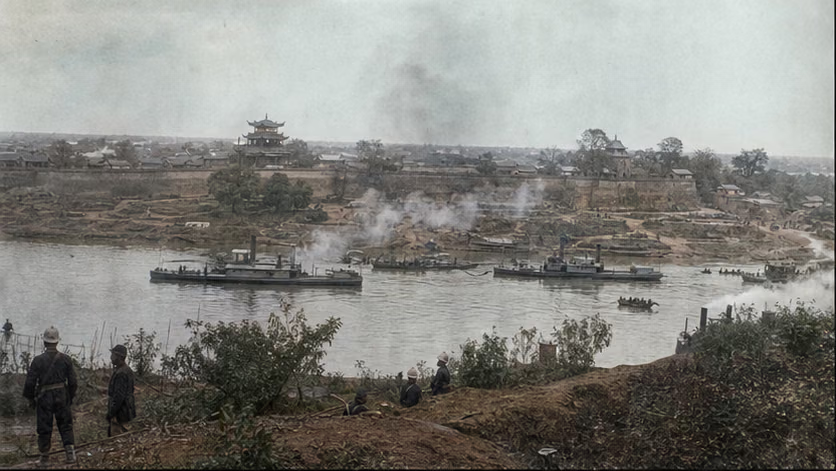 Land Battles in Northern Vietnam (Sơn Tây, Bắc Ninh, Tuyên Quang, Lâm Thao, 1883–85)1883.12Before China and France had declared war, the fighting had already gone on for nearly a year and a half on another country's soil: the Yunnan and Guangxi armies and the Black Flag Army first suffered successive defeats at Sơn Tây and Bắc Ninh, then spent four months besieging a city at Tuyên Quang without taking it, and finally won a recovery at Lâm Thao; the defeats and victories on the eastern and western lines together formed the landward shape of the war.
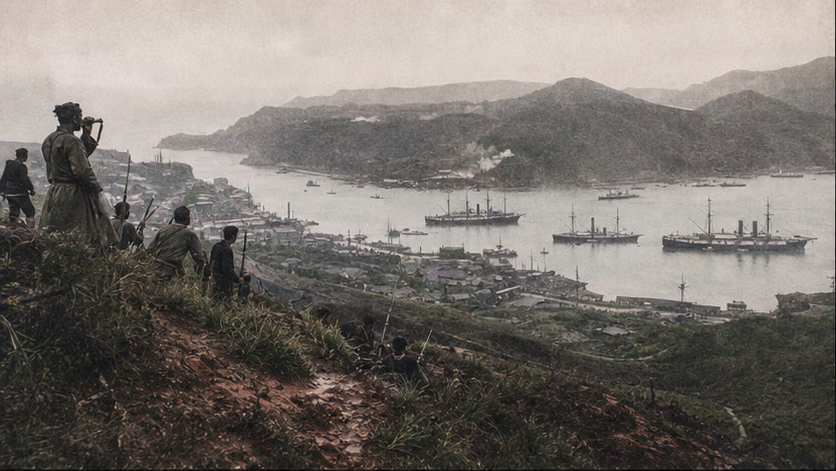 Fighting in Taiwan and Penghu (Keelung, Tamsui, Penghu)1884.08The French Far East Squadron wanted to use Taiwan as a bargaining counter in the peace talks: first attacking Keelung, then advancing on Tamsui, and later occupying Penghu, dragging the war on for ten months. At Tamsui it was driven back into the sea; at Keelung it held the town but never broke out of it; in the end, its commander Courbet died of illness in Penghu, the place he himself had occupied.
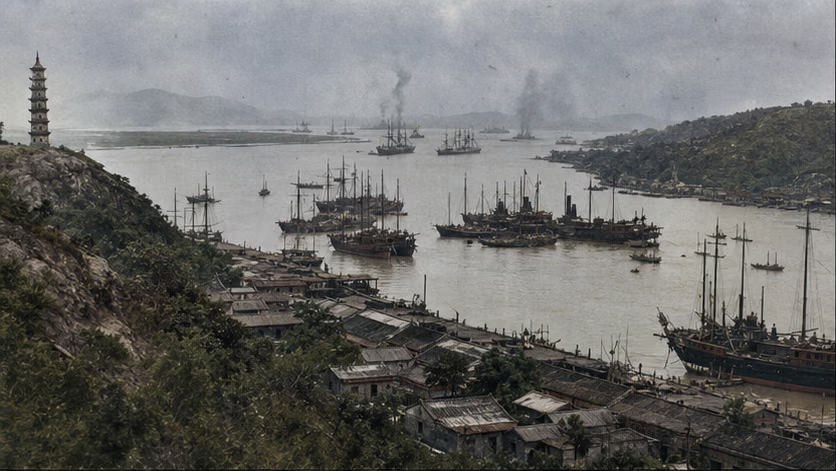 Battle of Fuzhou (Majiang)1884.08For more than a month, two fleets lay in the same harbor, moored face to face; on the afternoon of August 23, 1884, as the ebb tide turned, the French ships opened fire first, and within half an hour nine of the Fujian Fleet's eleven vessels had been sunk or destroyed -- more than ten years of Fujian Shipyard's shipbuilding capital was lost in a single battle inside its own harbor.
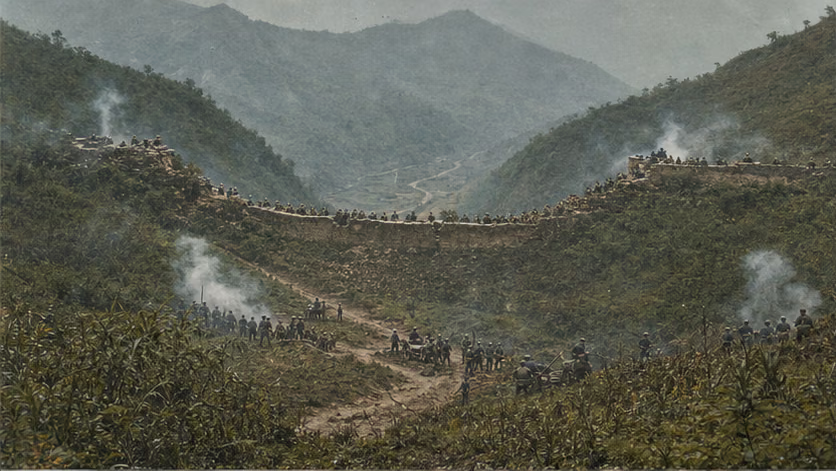 Zhennan Pass and Lạng Sơn1885.02In March 1885, Feng Zicai, nearly seventy years old, held the French Tonkin Expeditionary Corps' Second Brigade before a long wall at Zhennan Pass, then pursued the advantage and recovered Văn Uyên and Lạng Sơn; the French cabinet fell because of it, yet the Qing court immediately stopped the war and negotiated peace, leaving the dispute over "stopping once victory was gained" to argue on for more than a century.
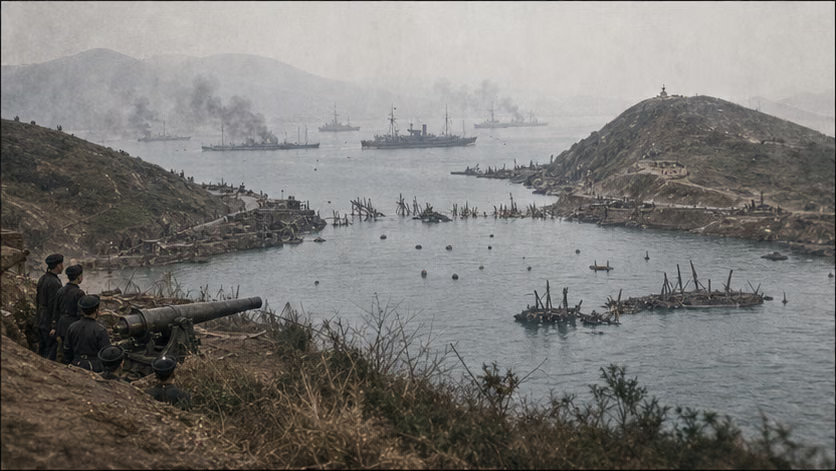 Battle of Zhenhai (1885)1885.02Five ships of the Nanyang Fleet set out to aid Fujian; two were first lost halfway and sank in Shipu Bay, while the remaining three hid inside the mouth of Zhenhai -- and with batteries, mines, and an old garrison officer who personally served a gun, the defenders kept the French Far East Squadron outside until the ceasefire, making this the only harbor the Chinese side held in the Sino-French War.
Sources and Open Questions
Main sources: Zhongguo Shixuehui, ed., Sino-French War (Modern Chinese History Source Series; the first reference for the whole war); National Palace Museum, ed., Historical Materials on Sino-French Negotiations in the Guangxu Reign of the Qing; Luo Dunrong, Zhongfa Bingshi Benmo; Memorials of Liu Zhuangsu (Liu Mingchuan); Hart-Campbell correspondence (selected in China's Customs Confidential Archives); the French-side Garnot, The French Expedition to Formosa (L'expédition française de Formose, 1894; Chinese title unverified), and archives of the French navy and army on the Tonkin expedition.
Open questions:
- Peak strength of the French Tonkin Expeditionary Corps, and itemized figures for French combat deaths and illness deaths across the whole war
- Total Qing casualties and war expenses across the whole war
- Reliable basis for the combined strength of Qing forces on the northern Vietnam front
- Number enshrined at the Mawei Zhaozhong Shrine after the Battle of Fuzhou, and the two original sources for French casualties
- Differences among sources for French casualties at Zhennan Pass (74 killed / 188–213 wounded) to be checked
- Details of the Battle of Lâm Thao
- Process for delimiting the trading posts under the New Sino-French Treaty (the determination of Mengzi and Longzhou)
- The date basis for completion of Taiwan's formal provincial establishment and Liu Mingchuan's actual appointment as governor
- Year when the French Indochinese Union was established
- Original source of the judgment "France won without victory; China lost without defeat," and whether it was said by Zuo Zongtang
- Courbet's cause of death and details of his death from illness in Penghu
- Timeline of the Hart-Campbell secret talks and the Qing court's chain of authorization
- Vote counts and dates of France's successive Tonkin funding bills
- Original wording of French parliamentary opposition speeches against the Tonkin expedition
- Original wording of restraining edicts of the type "provocation must not be opened by us"
- Details of memorials and replies in which Li Hongzhang kept the Beiyang Fleet out of battle
- Date when the Zhennan Pass victory report reached Beijing
All images on this site are AI-generated depictions. They are not historical photographs, not primary sources, and do not depict any real individual.