Engagement Archive · Land Battles in Northern Vietnam (Sơn Tây, Bắc Ninh, Tuyên Quang, Lâm Thao, 1883–85)
Before China and France had declared war, the fighting had already gone on for nearly a year and a half on another country's soil: the Yunnan and Guangxi armies and the Black Flag Army first suffered successive defeats at Sơn Tây and Bắc Ninh, then spent four months besieging a city at Tuyên Quang without taking it, and finally won a recovery at Lâm Thao; the defeats and victories on the eastern and western lines together formed the landward shape of the war.
Engagement Data
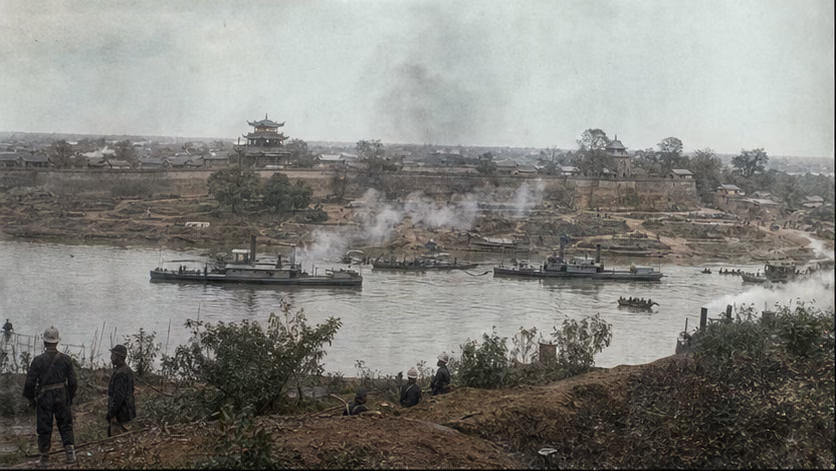
| Item | Details |
|---|---|
| Time | 1883.12 – 1885.3 |
| Place | Tonkin, Vietnam: Sơn Tây and Bắc Ninh (west and north of the Red River Delta) · Tuyên Quang and Lâm Thao (upriver hill-and-valley zone) |
| Belongs to | Sino-French War · Tonkin land theater (for the wider situation, see *Sino-French War: Overview*) |
| Chinese side | Yunnan Army (under the system of Cen Yuying, governor-general of Yunnan and Guizhou), Guangxi Army (under the system of Xu Yanxu, governor of Guangxi), Black Flag Army (Liu Yongfu); some Vietnamese official troops and volunteers cooperated in the fighting |
| French side | Tonkin Expeditionary Corps: Courbet and Millot served successively as commanders; Dominé commanded the defense of Tuyên Quang |
| Two-line pattern | Eastern line: Bắc Ninh—Lạng Sơn—Zhennan Pass direction, held by the Guangxi Army (from Guangxi through Zhennan Pass); western line: Sơn Tây—Hưng Hóa—Tuyên Quang—Lâm Thao direction, held by the Yunnan Army and the Black Flag Army (from Yunnan through Bảo Thắng) |
| Result | Successive defeats at Sơn Tây and Bắc Ninh (1883.12, 1884.3); Tuyên Quang besieged but not taken (1884.11–1885.3); victory reported at Lâm Thao (1885.3) -- thereafter the whole front shifted with the fighting at Zhennan Pass—Lạng Sơn and the ceasefire order |
Belligerents
The four engagements reversed attack and defense from one to another. This table is arranged by camp; each side's role in each engagement is noted under "Course of the Engagement" and in the final row below. At Tuyên Quang, the Chinese side was the besieger and the French army the defender; this must not be inverted.
| Item | Chinese side (Yunnan and Guangxi armies · Black Flag Army) | French army (Tonkin Expeditionary Corps) |
|---|---|---|
| Strength | Sơn Tây: 12 Black Flag battalions plus 5 Yunnan and Guangxi battalions, about 5,000 men (troop figures vary by account); Bắc Ninh: about 20,000 Guangxi troops; Tuyên Quang: the besieging forces gradually rose to more than 10,000 (figure disputed); Lâm Thao: claims of tens of thousands for the Yunnan Army and Black Flag Army both appear; the exact figure awaits verification | Sơn Tây: about 6,000 advancing by land and water (one account gives more; figure disputed); Bắc Ninh: about 12,000 in two brigades; Tuyên Quang: about 600 defenders in the city, and a relief column of more than 3,000 (figure disputed); Lâm Thao: *Draft History of Qing* says "6,000 French troops attacked Lâm Thao" (this claim awaits verification) |
| Firearms | New Western rifles mixed with older heavy matchlocks, swords, and spears; calibers differed chaotically among units; the Black Flag Army was accustomed to close combat | Standard breech-loading rifles and field guns, with gunboats of the Red River flotilla supporting the columns |
| Works and tactics | The Yunnan Army developed the "ground camp" method of trenches, ramparts, and bunkers; at Tuyên Quang they used tunnels and mines to breach the walls | Naval guns and infantry-artillery coordination; at Tuyên Quang, the defenders dismantled civilian houses and imitated ground-camp digging for defense |
| Supply | Cross-border transport from Yunnan and Guangxi, over long roads and many mountains, made grain movement extremely difficult (Cen Yuying repeatedly said so in memorials) | Ship transport on the Red River—Clear River (Lô River) route, escorted by gunboats; during the siege of Tuyên Quang, the water route was cut by the Black Flag Army |
| Role | Defenders at Sơn Tây and Bắc Ninh; besiegers at Tuyên Quang; receiving the attack at Lâm Thao | Attackers at Sơn Tây and Bắc Ninh; defenders at Tuyên Quang; advancing attackers at Lâm Thao |
Terrain and Conditions
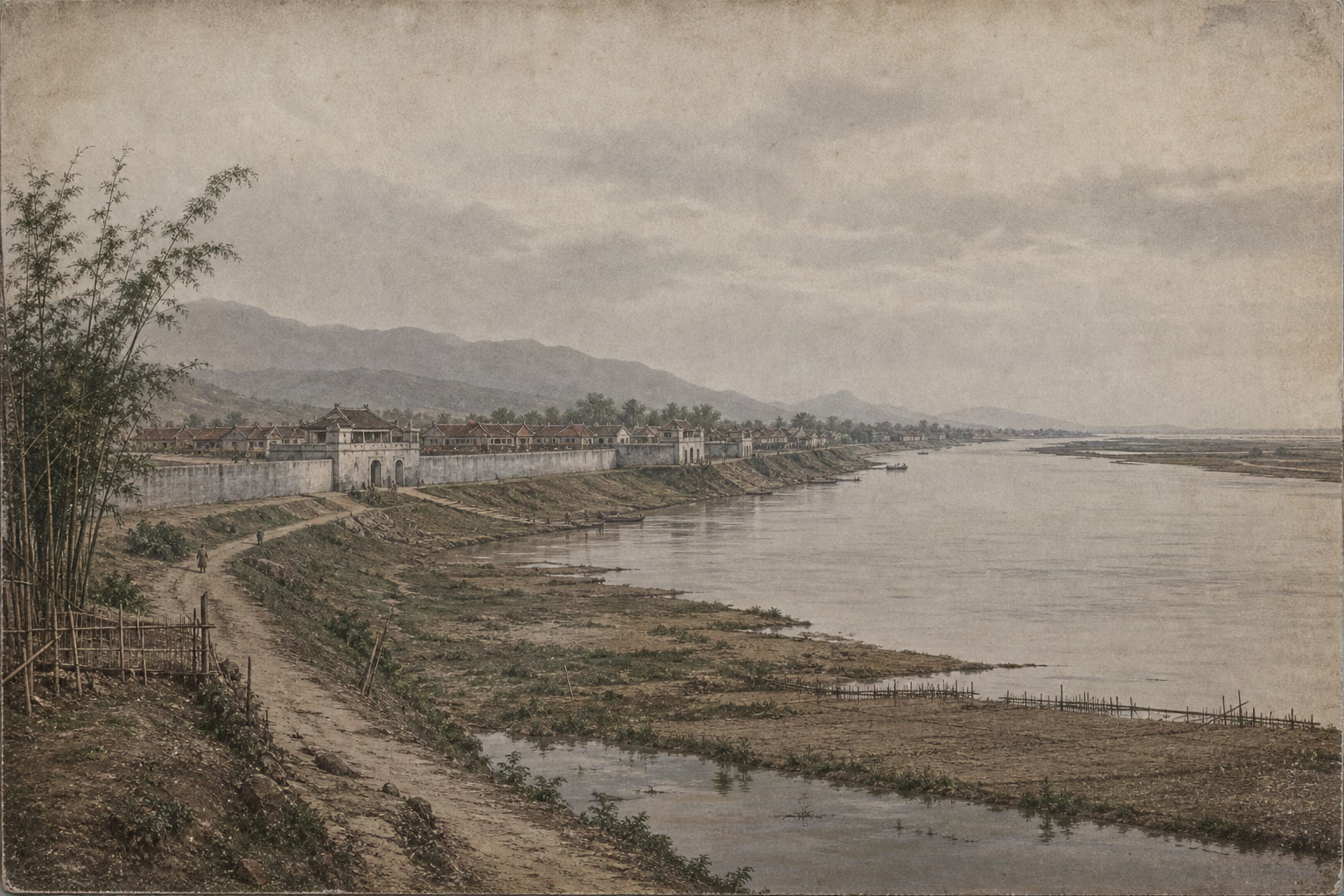
(For the wider situation of the 1880s -- France's steps toward annexing Vietnam, the Qing court's oscillation between war and peace, Mawei and the declaration of war -- see *Sino-French War: Overview*.)
The battlefield lay on Vietnamese soil. Tonkin (the old Vietnamese "Đông Kinh," or "Tonkin" in European usage) was still nominally the territory of the Nguyễn dynasty, but after the Treaty of Huế in August 1883 (1883.8), Vietnam had already been reduced to a French protectorate. With a single order, the Huế court instructed official troops in Tonkin to cease fire and withdraw. After the order, some Vietnamese officials obeyed it, some resigned and recruited local volunteers to continue fighting, and some led their men into the lines of the Qing and Black Flag armies -- the war was being fought in Vietnam, yet Vietnamese people themselves could not enter it in the name of a state. The rural and urban population of Tonkin was caught in between: the Black Flag Army and Qing troops relied on requisitioning along the route and gathering grain locally, while the French relied on waterborne transport; both sides had to pass across this land. Catholic communities in many places stood on the French side, and Chinese sources record Catholic villagers responding to the French army in the fighting around Phủ Lạng near Bắc Ninh (Chinese-source basis; source awaits verification).
The two lines did not have the same ground. On the eastern line, the Red River Delta was flat and webbed with waterways, favoring the maneuver of French gunboats; on the western line, the upriver hills and valleys were mountainous and difficult, favorable to defense and unfavorable to attack. The respective strengths of the Chinese and French forces changed places between the two lines.
Why It Was Fought
It had taken ten years to reach this point. In 1873, Francis Garnier was killed by the Black Flag Army outside Hanoi; in May 1883, Henri Rivière was again killed at Paper Bridge. French political circles were shaken, reinforcements were sent to Tonkin, and in August of the same year (1883.8) gunboats appeared below Huế. A single Treaty of Huế turned Vietnam into a French protectorate. The dignity of the tributary relationship was reduced to one concrete question: the Yunnan and Guangxi armies, which had entered Vietnam by invitation, and the Black Flag Army, which held Vietnamese official titles, were still stationed in Tonkin. The French wanted them gone; Beijing refused. Zeng Jize argued in Paris, Li Hongzhang negotiated in Tianjin, and after years of talks no agreement was reached. The central government swung repeatedly between peace and war, but not one soldier was withdrawn from the front. What could not be settled at the negotiating table was handed over to the gunboats.
Why Sơn Tây? This provincial city on the Red River controlled the route upriver from Hanoi; to the northwest it connected with Hưng Hóa and Bảo Thắng, making it the water gate into Yunnan. The main force of the Black Flag Army, 12 battalions, was stationed there, with 5 battalions of Yunnan and Guangxi troops assisting in the defense, and the Vietnamese tổng đốc Hoàng Tá Viêm was also in the city. For the French army, unless Sơn Tây was removed, an army that refused to leave would always be lodged on the upper Red River; for the Qing side, once Sơn Tây was lost, Hanoi's north would have no barrier left. Why the winter of 1883: the rainy season had passed, the river could still carry ships, land-and-water advance was well suited to the moment, reinforcements from Paris had arrived, and Jules Ferry needed a quick victory to account to the legislature.
Both sides had miscalculated. The French believed the opponent was no more than a mercenary force plus an unruly crowd; Courbet, leading about 6,000 men (one account gives more; figure disputed) by land and water, expected to clear the field in a few days. The Qing side believed that the Black Flag Army's close combat and the city's walls could hold, and also thought negotiations were still underway and the French might not really fight. When Courbet set out from Hanoi on December 11, the two countries had not yet declared war, but the war had already begun.
The Qing court's orders to the front were themselves twisted against one another: the edicts ordered the Yunnan and Guangxi armies to go beyond the passes and take up positions at Sơn Tây and Bắc Ninh for steady defense, while also secretly instructing them not to let the provocation begin from our side (original edict text awaits verification). They were not permitted to retreat, nor permitted to strike first. France's resolve appeared in the accounts: Ferry's cabinet secured appropriations for the Tonkin expedition from the legislature (appropriation details await verification), and with troops for a land-and-water advance and the Red River flotilla at hand, Courbet wanted a quick decision -- to finish the Tonkin campaign before legislative patience ran out.
The assault began on December 14. By the 16th, the defenders' ammunition was nearly exhausted, and that night they abandoned the city and withdrew to Hưng Hóa. After this, Bắc Ninh also fell and the Guangxi Army collapsed; after the declaration of war, the Yunnan Army and Black Flag Army on the western line turned east to besiege Tuyên Quang. Once the French had relieved it, they advanced west again and struck the ground camps at Lâm Thao. This line kept fighting until before the ceasefire telegram reached the front.
The material limit was reached by the Chinese side earlier than by the French: Yunnan-Guangxi cross-border transport had long roads and many mountains, and Cen Yuying repeatedly memorialized that moving grain was extremely difficult (original memorial text awaits verification); the Black Flag Army's pay and weapons relied half on Vietnam and half on aid from Yunnan, and ammunition was in shortest supply. There was dissent too: before the battle, some in the Black Flag Army wavered and wanted to withdraw, and Tang Jingsong, as a guest adviser, urged Liu Yongfu to defend Sơn Tây to the death (from *Diary of Requesting the Tassel*, original text awaits verification). In the Paris legislature, opposition to the expedition also persisted; Ferry's way of containing it was to deliver the victory at Sơn Tây.
Could it have been avoided? Withdrawal had originally been one of the options under discussion, but between withdrawal and non-withdrawal stood the dignity of the tributary order and the screen of the southwest; no one in Beijing could make that decision. Later the decision was made after all -- in the form of the defeat report from Bắc Ninh and a wholesale reshuffle at the center.
Course of the Engagement
| Stage | Time | Key points |
|---|---|---|
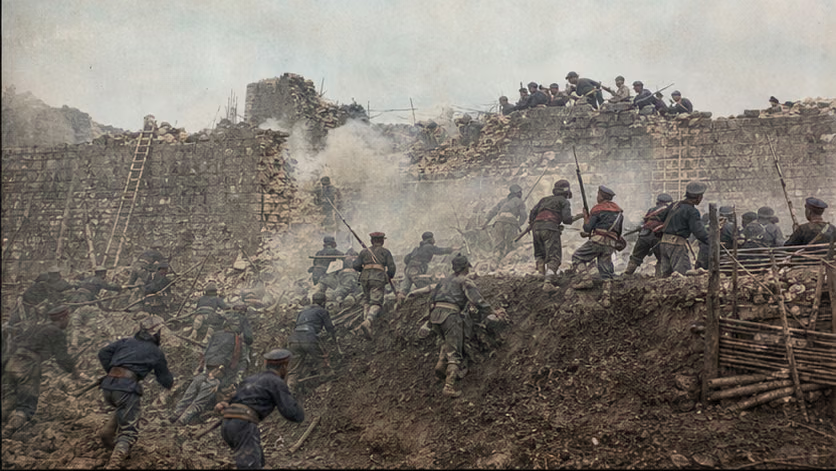
| ① Battle of Sơn Tây | 1883.12.11–16 | Courbet led about 6,000 men from Hanoi by land and water, beginning the assault on the 14th; the defending force was centered on the Black Flag Army, with Yunnan and Guangxi troops cooperating, and the Vietnamese tổng đốc Hoàng Tá Viêm was in the city. The Black Flag Army repeatedly checked the French in close combat; one participating French officer said he had not come under such heavy fire even in the Franco-Prussian War (found in only one account). On the 16th, French bombardment collapsed the West Gate tower and troops broke in; with ammunition nearly exhausted, the defenders abandoned the city that night and withdrew to defend Hưng Hóa |
| ② Battle of Bắc Ninh | 1884.3.8–12 | Millot led about 12,000 men in two brigades (Brière de l'Isle and de Négrier), advancing by land and water and avoiding the front by turning the flank. Xu Yanxu, commander-in-chief of the Guangxi Army, remained fixed at Lạng Sơn and was not at the front; the forward forces of Huang Guilan and Zhao Wo were not under a unified command, and command was confused. After several peripheral engagements they collapsed, Bắc Ninh fell on the 12th, and large numbers of Guangxi troops dispersed without fighting |
| ③ Siege of Tuyên Quang | 1884.11–1885.3.3 | An engagement in which the roles reversed: Dominé led about 600 French troops in defending Tuyên Quang, while the Black Flag Army and Yunnan Army were the besiegers. The besieging forces first cleared the outer positions and completed the encirclement; Liu Yongfu's force held Zuo Yu, using bamboo rafts and timber rafts to block the Clear River and cut the French waterborne supply route. During the siege they dug tunnels under the walls and repeatedly used mines to blast breaches in the ramparts and then climbed the walls for hand-to-hand fighting, but the defenders held them off with trenches, ramparts, and ground camps. The defenders placed letters asking for help in bamboo tubes and glass bottles and cast them into the river to drift toward Hanoi (record unverified). On 1885.3.2, the French relief column (Brière de l'Isle's force, more than 3,000 men; figure disputed) fought at Hòa Mộc and opened the road; on 3.3 it entered the city and lifted the siege |
| ④ Battle of Lâm Thao | 1885.3.23–24 (dates vary by account) | Cen Yuying's Yunnan troops and the Black Flag Army met the westward-advancing French in the Lâm Thao direction. Relying on firm defense in ground camps and flank attacks, they forced the French to withdraw after an unfavorable assault. The Chinese side called it the "Great Victory of Lâm Thao"; memorials reported several French generals killed in battle and the recovery of a number of prefectures and counties in pursuit -- the figures for the result are highly disputed; see "Disputes and Sensitivities." This engagement occurred after the ceasefire order had been issued but before the telegrammed edict reached the front (basis in *Draft History of Qing*) |
Casualties and Losses
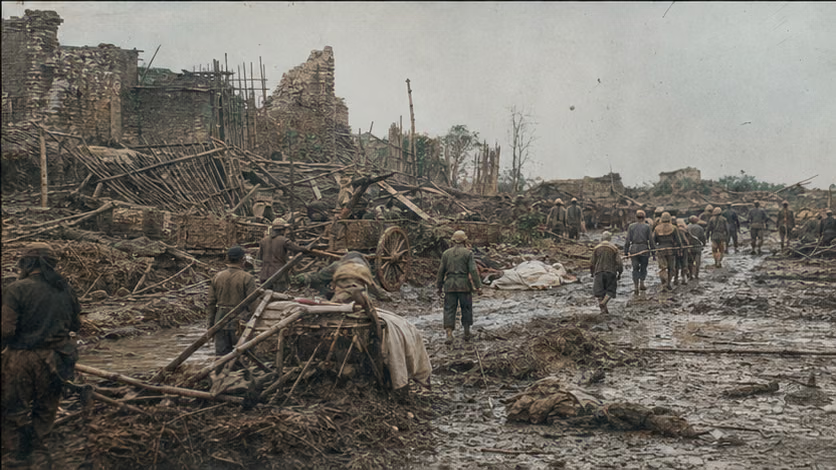
- Sơn Tây: the French side announced 83 killed and 320 wounded (including several officers, French basis; another account gives 85 killed and 240 wounded; both French figures are recorded here, original sources await verification); casualties of the Chinese side and the Black Flag Army have no reliable statistics (figure disputed).
- Bắc Ninh: according to Millot's report, French losses were 26 killed and several dozen wounded (French basis, details unrecorded); the Guangxi Army's losses in dispersal have no exact figure, and the numbers in Xu Yanxu's memorial and postwar investigation differ sharply (figure disputed).
- Tuyên Quang: the French defenders suffered more than 100 casualties during the siege (figure disputed); the relief column lost 76 killed and about 400 wounded at Hòa Mộc, the heaviest single-engagement casualties of the Tonkin Expeditionary Corps (French basis, source awaits verification); Chinese accounts say the besieging side (Black Flag Army and Yunnan Army) suffered several thousand casualties in cumulative wall assaults (figure disputed).
- Lâm Thao: Chinese memorials reported "five French generals killed in battle and the French army routed" (basis in *Draft History of Qing*); French battle reports record limited losses (specific numbers not detailed) -- the gap between the two sides' accounts is very large, and both are retained.
- Vietnamese civilians: all four engagements took place among the towns and villages of Tonkin; after months of siege and the severing of land and water routes, civilian deaths, injuries, and displacement have no statistics.
Aftermath
- The defeat at Bắc Ninh shook Beijing: on 1884.4.8, Empress Dowager Cixi used the successive defeats at Sơn Tây and Bắc Ninh to dismiss the entire Grand Council headed by Prince Gong Yixin and replace it with the group headed by Prince Li Shiduo. Known historically as the "Jiashen Change of the Grand Council," a defeat in Tonkin thereby also accomplished a wholesale reshuffle of the Qing court's central government (historians differ on how much political calculation this contained).
- Accountability for defeated commanders: Xu Yanxu was dismissed and arrested for questioning; Huang Guilan committed suicide out of fear of punishment, and Zhao Wo was arrested, questioned, and sentenced (details unrecorded).
- The center of the war shifted to the eastern line and the coast: the Guanyin Bridge clash, Mawei, the declaration of war, Keelung and Penghu, and then the nearly simultaneous victories at Zhennan Pass—Lạng Sơn and Lâm Thao in 1885.3, followed by ceasefire and treaty talks -- these threads are detailed in *Sino-French War: Overview*.
- The Black Flag Army's postwar position: after the 1885 treaty was concluded, Liu Yongfu led his troops inside the passes and resettled them inland; the history of the Black Flag Army as an independent armed force on the Tonkin battlefield thus came to an end (resettlement process awaits verification).
- Vietnam: after the war, Tonkin was fully brought under French rule, and the Cần Vương movement began in 1885 -- the land battlefield of the Sino-French War later became an old battlefield of Vietnam's anti-French movement.
Accounts of Those Present

- Tang Jingsong requests the tassel: Tang Jingsong, a principal in the Ministry of Personnel, volunteered to enter Vietnam and contact the Black Flag Army. His "requesting the tassel across ten thousand li" left behind the *Diary of Requesting the Tassel*: a civil official serving as liaison among the Yunnan Army, Guangxi Army, Black Flag Army, and Vietnamese officials and gentry. During the siege of Tuyên Quang, he was in the camp outside the city.
- The firing at Sơn Tây: Courbet's artillery was pressed by the Black Flag Army to within 300 yards before volley fire halted the charge. After the battle, French public opinion said "Sơn Tây covered Sedan" -- turning the small city into a screen for the shame of the Franco-Prussian War (French press phrase, quoted secondhand; original source awaits verification).
- Attack and defense learning from each other: Inside Tuyên Quang, the French army dismantled civilian houses and imitated the Yunnan Army by digging trenches and ground camps for a tenacious defense; outside the city, the Yunnan Army used tunnels and mines to attack the walls. The methods of siege assault and counter-siege became teacher and student to each other on a single wall.
- The request for help in the river: The defenders placed emergency letters in bamboo tubes and glass bottles and threw them into the Clear River, letting them drift toward Hanoi. By that point in the siege, water was the only remaining path for communication (record unverified).
- Red wool uniforms: In the Battle of Lâm Thao, French troops withdrew through water; their red wool uniforms absorbed water and became heavy, so they had to discard their clothing to cross the river. More than 1,000 discarded uniforms on the bank were taken as trophies (found only in Liu Yongfu's own account).
- Hoàng Tá Viêm: The Vietnamese tổng đốc, when Sơn Tây fell, is described in Chinese records as "anxious and frightened, without human color" -- between the resistance of Vietnamese officials and the ceasefire order from the Nguyễn court, the individual had no easy way forward or back (record from Chinese notes; source awaits verification).
The Ground
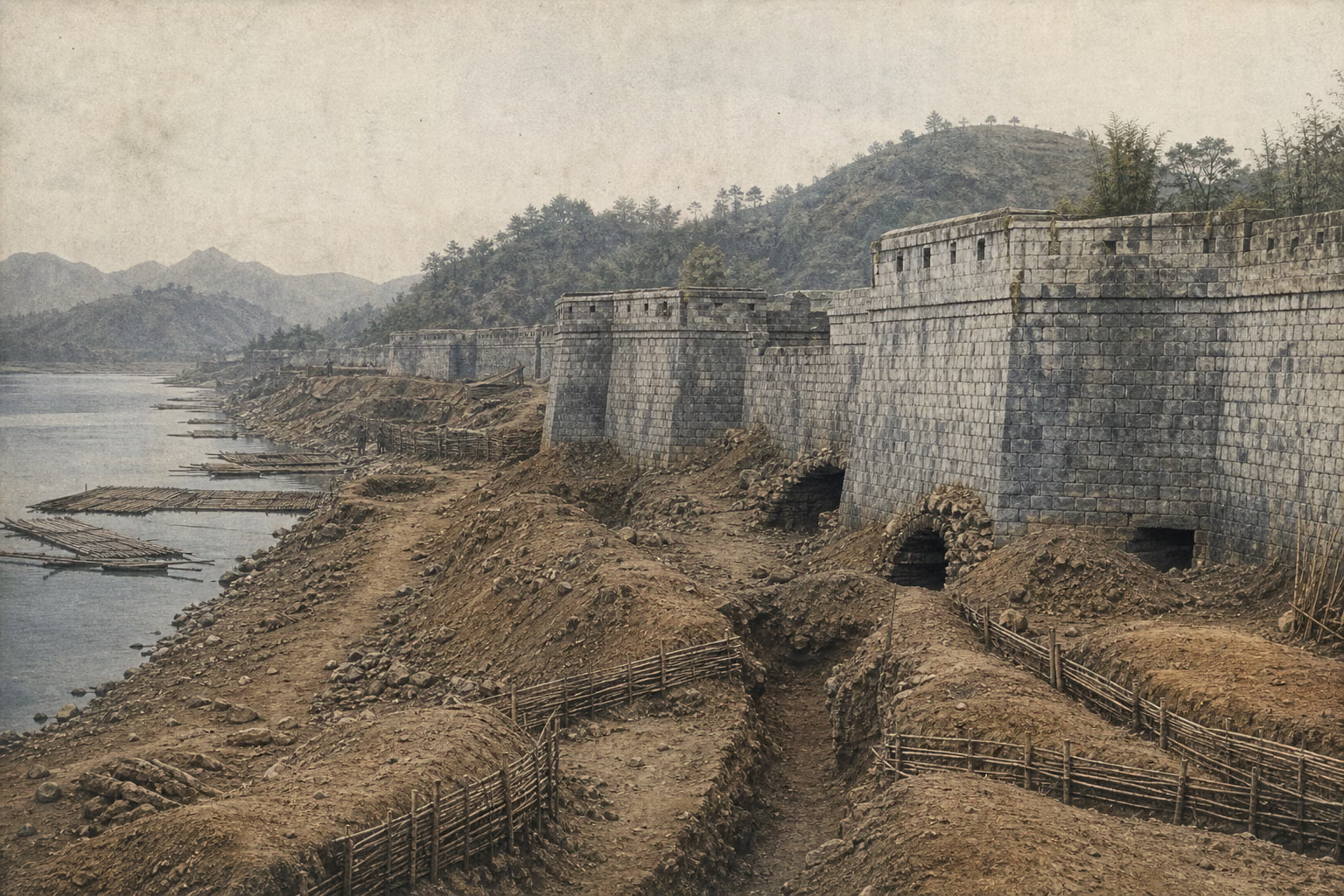
- The eastern and western lines were naturally separate: the eastern line was the flat, water-webbed Red River Delta, where gunboats could reach the city walls directly; the western line was upriver hill country, and the Red River—Clear River valley was the only corridor of maneuver.
- Tuyên Quang stood by mountain and water, with stone walls and batteries; below the walls was close fighting over tunnels and blast points. The Zuo Yu river section was the battlefield for cutting off relief, with bamboo rafts and timber rafts blocking the water surface.
- Sơn Tây city: a provincial city on the Red River bank, with the West Gate tower as the point of breakthrough; temples inside and outside the city and bamboo palisades all served as works ("hanging heavy guns to bombard the old monastery at the West Gate").
- Bắc Ninh: the city stood on the northern edge of the delta, and outlying points such as Phủ Lạng and Dũng Cầu formed a field-defense line; once routed, troops withdrew along the main road toward Lạng Sơn.
- Lâm Thao: a prefectural city in a river valley, with linked ground-camp trenches and ramparts; rivers on the flanks constrained French maneuver and withdrawal routes.
How Each Side Records It
- Chinese side: the Black Flag Army and Liu Yongfu stand at the center of this memory, with "Paper Bridge—Sơn Tây—Tuyên Quang—Lâm Thao" forming a genealogy of anti-French heroes; Lâm Thao and Zhennan Pass are paired as the two great victories. The other side is the defeat at Bắc Ninh and the Jiashen Change of the Grand Council -- how a military defeat became the fuse for political struggle at the center is told differently in official histories and private notes.
- French side: the Battle of Sơn Tây was amplified as revenge for the shame of Sedan; the defense of Tuyên Quang became a page of glory in French colonial narrative, and Dominé became a colonial hero (French commemorative status awaits verification); the heavy casualties at Hòa Mộc entered the mourning lists of the expeditionary force's history.
- Vietnam: the Huế court had yielded, while local officials and people fought on their own. In Vietnamese national-history narratives, this segment is mostly placed in the context of anti-French national salvation, while in both Chinese and Vietnamese narratives, the subject position of Vietnamese people is often only a background (Vietnamese-side historical materials were not consulted for this article).
Disputes and Sensitivities
- Dispute over the results at Lâm Thao: older Chinese accounts say "more than ten prefectures and counties were recovered"; Huang Zheng's textual research reduces this to only "1 prefecture, 1 county, and 4 passes"; Liu Junda further argues that Chinese and Vietnamese forces at the time did not have the conditions for consecutive victories and that Cen Yuying's memorials exaggerated the result -- while Long Yongxing strongly maintains that the great victory was real. This is the largest divergence of accounts in this article; three positions coexist, and there is still no conclusion.
- How to characterize the Black Flag Army: remnant of an anti-Qing uprising, guest army holding Vietnamese official titles, armed force of national heroes -- three identities were layered onto one force, and the commemorative contexts across the two sides of the Taiwan Strait, Hong Kong and Macau, and Vietnam all differ.
- "Defeated despite not being defeated": the gap between victory in the final phase of the land theater and the outcome of the whole war is a war-level controversy, detailed in *Sino-French War: Overview*; this article lists only the facts of each engagement.
- Absence of the Vietnamese perspective: the battlefield was in Vietnam, and records of Vietnamese participation and suffering on all sides are touched on here only from Chinese and French secondhand materials; a dedicated study awaits verification.
- Casualty figures for each engagement generally show large gaps between Chinese and French accounts; this article marks the source side throughout.
Sources and Open Questions
Known main sources:
- Tang Jingsong, *Diary of Requesting the Tassel* (diary of a siege participant; first hand for Tuyên Quang)
- Liu Yongfu, *Historical Draft of Liu Yongfu* (the Black Flag Army side's own account)
- *Memorial Drafts of Duke Cen Xiangqin* (Cen Yuying's western-line memorials; source of the dispute over the results at Lâm Thao)
- Relevant volumes of the biographies of Cen Yuying and Liu Yongfu in *Draft History of Qing*
- French side: Millot's Bắc Ninh battle report; histories of the Tonkin Expeditionary Corps (source for casualties at Hòa Mộc)
- Vietnamese side: *Đại Nam thực lục* and Nguyễn-dynasty archives (not consulted for this article)
Open questions: original sources for French strength at Sơn Tây and the two casualty figures; detailed casualties in Millot's Bắc Ninh report and the original text of Xu Yanxu's memorial; the full circumstances of Huang Guilan's and Zhao Wo's punishments; exact number of Tuyên Quang defenders and the start and end dates of the siege; French archival source for casualties at Hòa Mộc; exact dates and the participating strength of both sides at Lâm Thao; the archival bases for the three accounts of Lâm Thao's results (Long Yongxing / Huang Zheng / Liu Junda); original sources for the two stories of the "red wool uniforms" and the "bamboo-tube request for help"; the resettlement process of Liu Yongfu's troops after moving inland; Dominé's commemorative status in France; traceable source leads for the participation of Vietnamese official troops and volunteers; original wording of the Qing court edict on "steady defense, with provocation not beginning from us"; details of the Ferry cabinet's legislative appropriations for the Tonkin expedition; original text of Cen Yuying's statements about the difficulty of moving grain; the original passage in *Diary of Requesting the Tassel* where Tang Jingsong urged Liu Yongfu to defend Sơn Tây; records of opposition in the French legislature to the Tonkin expedition.
All images on this site are AI-generated depictions. They are not historical photographs, not primary sources, and do not depict any real individual.