War Overview · Second Opium War (1856–60)
Britain and France took two pretexts and turned "treaty revision" into a war that captured the capital; the largest takings went to Tsarist Russia, which had not fired a shot — roughly one million square kilometers.
Engagement Data
| Item | Details |
|---|---|
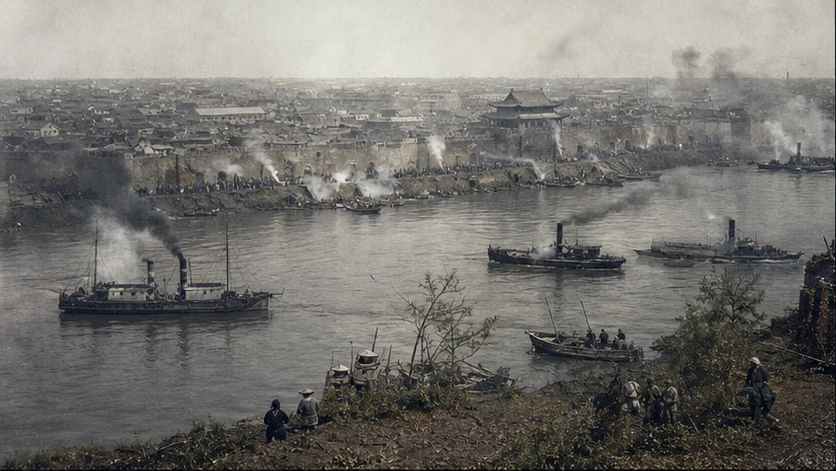
| Time | 1856.10 – 1860.10 (armed conflict began with the British bombardment of Canton after the Arrow Incident; the war ended with the signing of the Convention of Peking; Russian territorial seizure continued to the 1860.11 Sino-Russian Convention of Peking) |
| Place | Pearl River estuary → mouth of the Baihe River in the Bohai Gulf → Tongzhou → Beijing; with Russian territorial seizure north of the Heilongjiang and east of the Ussuri River |
| Belligerents | Great Qing (Xianfeng reign) / primarily the Anglo-French allied forces; the United States and Russia accompanied under the name of "mediation," while Russia was in fact the greatest beneficiary |
| Result | 1858 Treaties of Tientsin; 1860 Convention of Peking; opium trade legalized in practice; Russia took roughly one million square kilometers; although the Qing regime did not fall, the court learned from this point onward how to deal with the powers |
Belligerents (war-level)
| Item | Qing forces | Anglo-French allied forces |
|---|---|---|
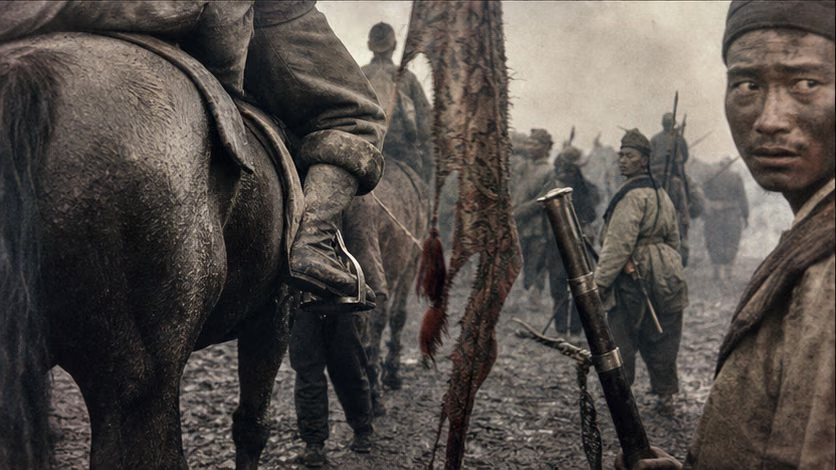
| Total strength | The Eight Banners and Green Standard forces were nominally 800,000 strong, but their main strength was tied down on the Yangtze front against the Taiping Heavenly Kingdom; troops available for redeployment in the capital region and Liangguang were limited. In 1860, relief troops and Mongol cavalry together numbered several tens of thousands (figure disputed) | In the 1860 northern invasion, just over 20,000 men: more than 10,000 British troops (including Indian soldiers) and about 7,000 French troops (figures vary by basis of counting), a modest scale, but their power projection and firepower belonged wholly to another age |
| Infantry firearms | Matchlock muskets, heavy wall guns, swords and spears, bows and arrows: hot and cold weapons mixed together; Mongol cavalry were present on the capital front | Rifled guns were widespread (British Enfield pattern, French Minie pattern), with several times the range and rate of fire of smoothbore guns |
| Artillery | Clay-molded muzzle-loading smoothbore guns; carriages could neither elevate nor traverse, and reused old pieces from the previous war | New artillery refitted after the Crimean War, including Armstrong breech-loading rifled guns (equipment details unverified) |
| Mobility | Overland courier routes for moving troops; cross-provincial transfers often took months | Steam fleets projected force globally; the Crimean War had just ended, freeing troops and ships at exactly the right moment |
| System | Xianfeng made decisions from memorials polished through layer after layer; vacillation between war and negotiation ran through the whole course; after the Taku victory of 1859, the court misjudged the situation | Plenipotentiaries decided on the spot, with Parliament ratifying after the fact; the United States and Russia bore the name of "mediation" while pursuing their own gain |
The Setting
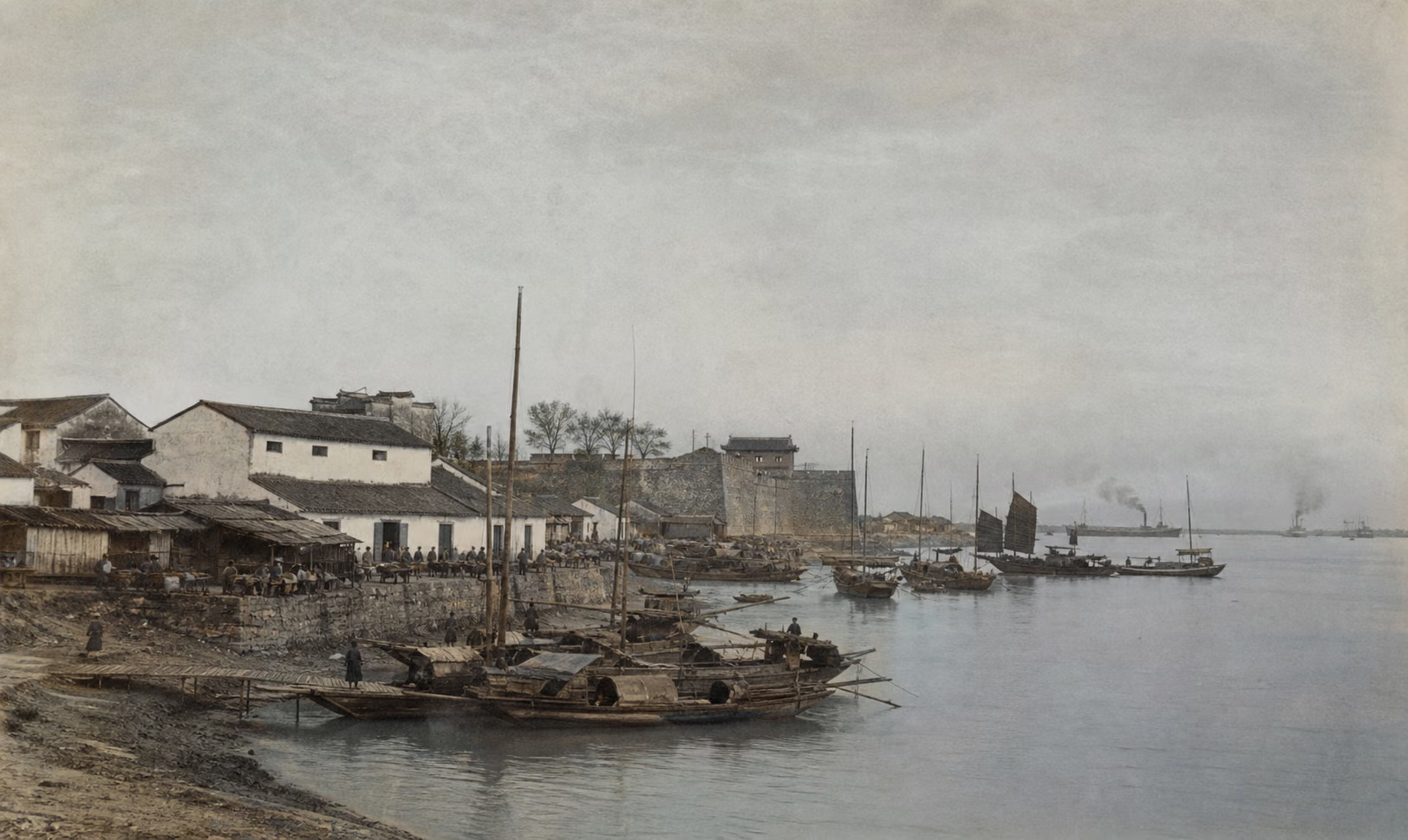
World: The Crimean War (1853–56) had just ended. Britain and France turned from battlefield opponents into allies, and joined hands to come east before the ink on the Treaty of Paris had dried; steam fleets and rifled guns completed their generational shift in these years, sharply lowering the cost of oceanic expeditions; free trade and gunboat diplomacy were, at the time, two sides of the same logic.
China: The Xianfeng court was in distress at home and abroad. The Taiping Heavenly Kingdom had held Nanjing for three years; in 1856 the Tianjing Incident set off internal slaughter without ending the war, and the Qing main forces — the Xiang Army and the Jiangnan and Jiangbei encampments — were all tied to the Yangtze line, fighting on two fronts. State finances had been hollowed out by military expenses and the indemnity from the previous war, and "barbarian affairs" always ranked behind the "rebels" in the court's priorities. In this war the Qing court fought while negotiating, signed and then refused to recognize, recognized and then reversed itself; the root of all that lay here.
Enemy states (mainly Britain and France, with the United States and Russia accompanying): Britain's calculation was that, after the Treaty of Nanking opened the breach, trade growth fell short of expectation, blamed on "too few ports and too many restrictions." In 1854 Britain joined the United States and France in proposing treaty revision, only to be rejected by the Qing court under the formula of "the fixed institutions of the Celestial Dynasty" (details of the treaty-revision negotiations unverified). The Palmerston government needed a pretext, and the Arrow Incident provided it. Napoleon III's Second Empire in France needed overseas military distinction and the right to protect Catholic missions; the Father Chapdelaine incident (1856.2, the Xilin missionary case in Guangxi, in which the French missionary Auguste Chapdelaine was executed) supplied the reason. The United States wanted equal sharing; it sent no troops but accompanied the process throughout. Russia played a different game: Nikolay Muravyov, governor-general of Eastern Siberia, took advantage of the Qing court's inability to look north, and had spent years settling migrants along the Heilongjiang to consolidate the frontier, waiting to collect the fruit. The four states had different objectives; the two words "mediation" contained them all.
Why It Was Fought
This war lasted four years, and in no year did the two sides' calculations line up.
London's chain of decision began with treaty revision: the 1854 revision proposal had been rejected, trade into China again failed to meet expectations, and what the Palmerston government lacked was a plausible pretext. In October 1856 the Arrow Incident occurred. John Bowring, governor of Hong Kong, did not wait for instructions from London, but ordered the navy to bombard Canton — strike first, then ask for ratification. Ratification did not go smoothly: in early 1857, the House of Commons passed a motion censuring the use of force against China; Palmerston dissolved Parliament, went to a general election, and won. Only then did the bombardment off Guangdong rise into an allied expedition by two countries. France's account was different: Napoleon III wanted overseas military distinction and a protector-of-missions title; the Father Chapdelaine incident supplied the reason, and Elgin and Gros were ordered east in the same year. The allied timetable also had an outside weight pressing on it — the Indian Rebellion of 1857. British troops originally bound east were diverted to suppress it, delaying the attack on Canton by a year: London wanted the war, but for a time could not produce the troops.
Beijing's decision-making stood on distorted ground. Xianfeng judged from Ye Mingchen's memorials, polished through layer after layer; before Canton fell and the governor-general was captured, proving the matter, the court's grasp of Guangdong affairs was almost entirely wrong (Xianfeng's original rescript when first hearing of Canton's fall unverified). In 1858, after Taku fell, Guiliang and Huashana signed the Treaties of Tientsin under imperial order; before the ink had dried, regret arose. The clauses on envoys residing in Beijing and Yangtze trade were, in the emperor's eyes, pains that cut to the heart, so he instructed Guiliang and others to use the Shanghai tariff conference to overturn them covertly, though the attempt ultimately failed (imperial edicts and memorials from the attempted reversal unverified). At the 1859 exchange of ratifications, the court directed the envoys to land at Beitang, while the British envoy Frederick Bruce insisted on bringing a fleet armed into Taku — one side demanding exchange of ratifications according to its own procedure, the other assuming that only under the muzzles of guns could a treaty be real. The gunfire on June 25 was the first head-on collision of the two sets of calculations.
The victory at Taku pushed misjudgment to its peak: on this basis the court concluded that foreign navies were not to be feared and that land fighting could be won, and ordered Sengge Rinchen to concentrate on defenses (post-1859 defense-preparation edict unverified). The following year the allied forces landed at Beitang; Sengge Rinchen's arrangement of allowing the enemy to come ashore and then seeking to strike with cavalry (the original memorial on this arrangement unverified) failed in the successive defeats at Xinhe, Tanggu, and Taku. When London and Paris sent a larger force again in 1860, their aims were still drawn clearly: exchange ratifications, indemnities, envoys resident in Beijing, not overthrowing this court. If the Qing court collapsed, there would be no one to perform the treaties, and the Taiping Heavenly Kingdom was still on the Yangtze (decision records showing Britain and France did not want the Qing court overthrown unverified).
Off the table were two more silent calculations: the United States accompanied the whole process without sending a soldier, seeking equal benefits; Russia chose precisely the days when the Qing court was burning on both fronts to put pen to paper — in May 1858, when Muravyov arrayed troops below Aigun and forced a treaty, the Anglo-French fleet was anchored outside the Baihe mouth. Four years later, when the fighting ended, the two countries that had sent money and troops took treaties and indemnities; the one that had not fired a shot took roughly one million square kilometers.
Course of the Engagement (four phases)
| Phase | Time | Main points | Separate articles |
|---|---|---|---|
| Canton | 1856.10–1858.1 | Beginning with the Arrow Incident, British forces bombarded Canton; in 1857 Elgin and Gros led the Anglo-French allied forces in assembling, and in December Canton fell. Viceroy Ye Mingchen of Liangguang was captured (later dying in Calcutta); Governor Baigui remained in office under the supervision of an allied committee — the first local regime in modern China under occupation-army control (this characterization unverified) | Battle of Canton (1856–58) |
| First Taku and the Treaties of Tientsin | 1858.4–6 | The allied fleet sailed north from Canton to the Baihe mouth, taking the Taku Forts in one battle on 5.20 (the fighting lasted about two hours, unverified), and stood below Tianjin; in June, Russia, the United States, Britain, and France signed the Treaties of Tientsin in succession | Three Battles of the Taku Forts (first battle included in the separate article) |
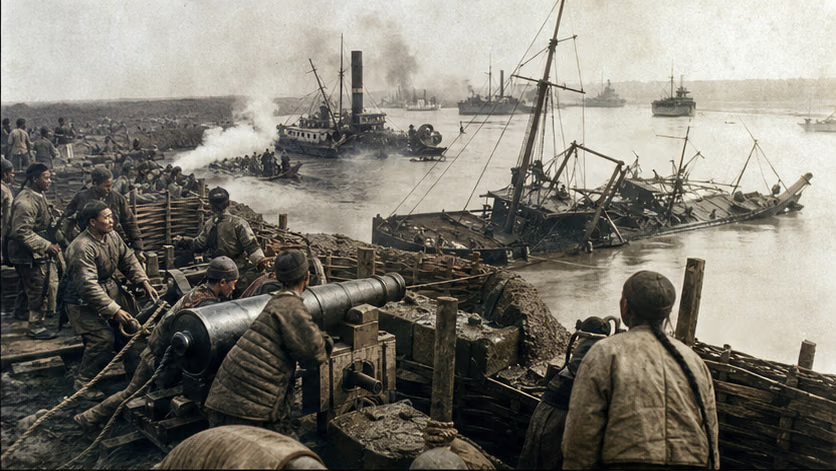
| Breakdown of ratification exchange and the Second Taku | 1859.6 | The British and French envoys insisted on bringing the armed fleet into the Taku mouth to exchange ratifications, refusing the Beitang route; on 6.25 the forts defended by Sengge Rinchen opened fire, and the allied forces suffered a severe defeat, with several ships sunk — the Qing army's only major victory in the entire war | Three Battles of the Taku Forts |
| From the Beitang landing to the fall of Beijing | 1860.8–10 | On 8.1 the allied forces landed at Beitang; defeats followed at Xinhe, Tanggu, and Taku (the Third Taku); on 9.18 Harry Parkes's mission was detained during negotiations at Tongzhou; on 9.21 the Battle of Palikao routed Sengge Rinchen's army; in October Beijing opened its gates and the Old Summer Palace was burned; on 10.24–25 the Convention of Peking was signed | Three Battles of the Taku Forts; Battle of Palikao |
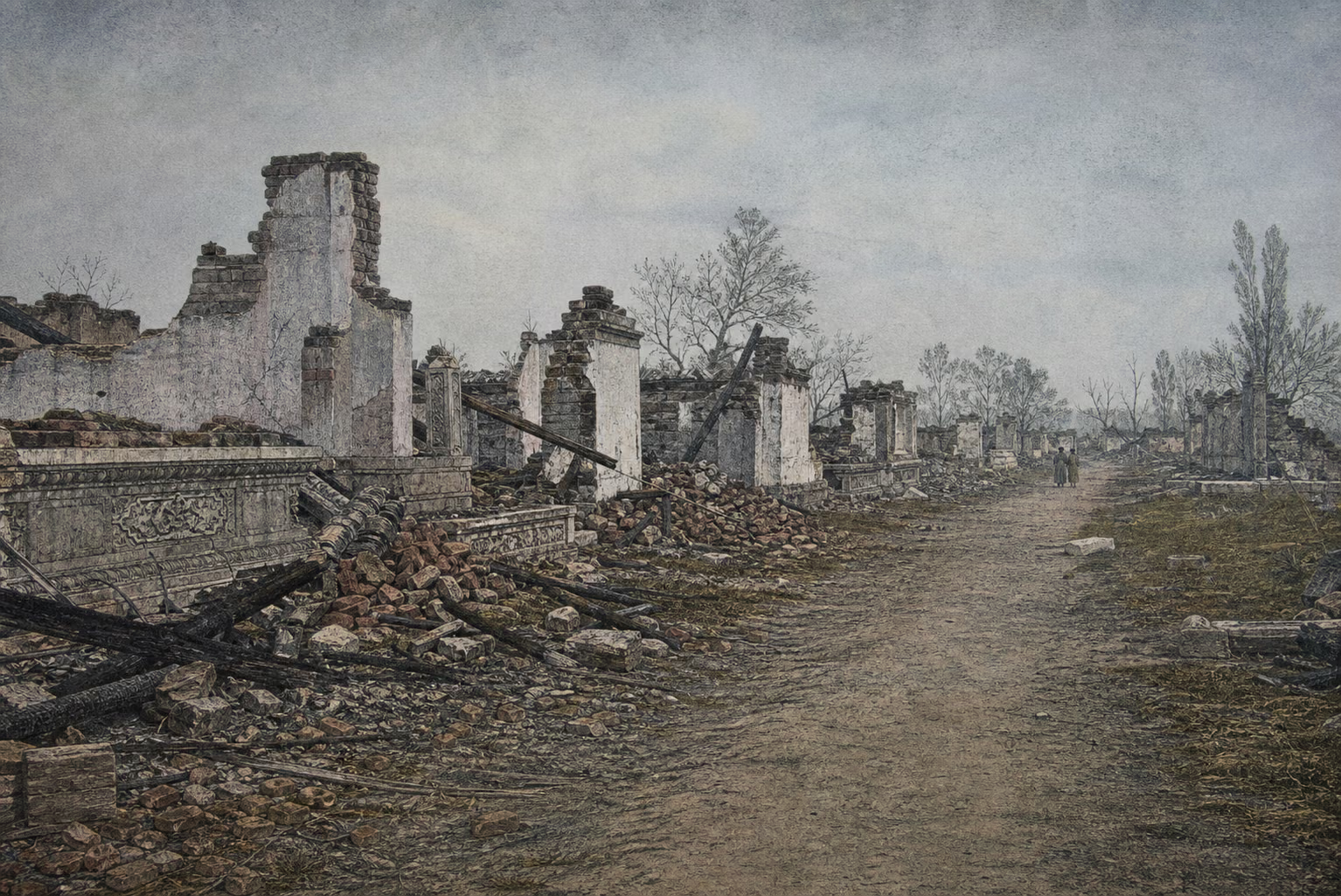
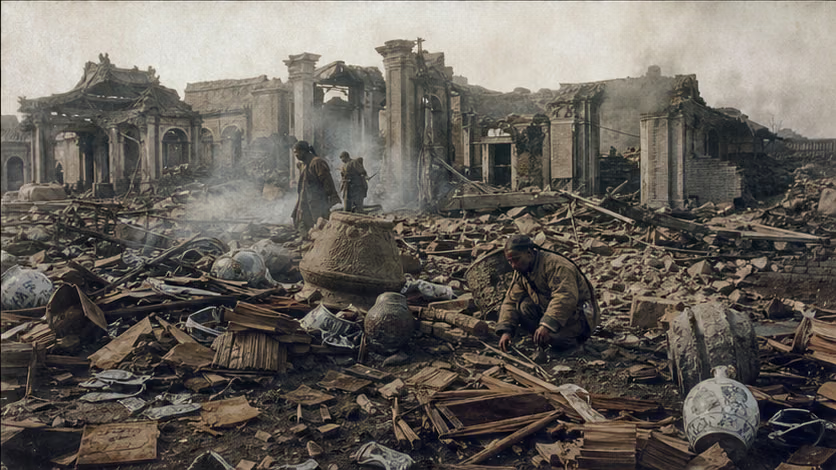
※ Burning of the Old Summer Palace (1860.10, a major atrocity against civilians and cultural property)
Immediate pretext: on 9.18, Harry Parkes led a mission during negotiations at Tongzhou and was detained by Sengge Rinchen's troops; the party numbered about 39 people (including a Times correspondent; headcount unverified), and were divided among different places and abused. By the time they were released in early October, about 20 had died (death figures vary by account). Chain of decision: Elgin decided to burn the Old Summer Palace as personal punishment against the Xianfeng emperor, while the explanation left to Beijing was that "the crime lay with the emperor and did not reach the people"; the French commander Montauban and the envoy Gros did not support burning the palace, but French troops had already participated in several days of plunder (details of French participation in plunder and opposition to the burning unverified). On 10.18–19 British troops carried out the arson, and the fire reached the Old Summer Palace and other gardens in the western suburbs (extent of spread and unit designations of the executing troops unverified). Plunder came first, burning afterward; the participants and the order-givers were not on the same level — this chain of responsibility is treated under "Disputes and Sensitivities."
Treaties: the second batch of unequal treaties
- Treaties of Tientsin (1858.6, four texts with Russia, the United States, Britain, and France): envoys resident in Beijing — the clause the Qing court resisted to the end and saw as a mortal danger; ten additional ports opened: Niuzhuang, Dengzhou, Taiwan, Tamsui, Chaozhou, Qiongzhou, Hankou, Jiujiang, Nanjing, and Zhenjiang (some were later opened elsewhere in practice, such as Niuzhuang actually opening at Yingkou; list of substituted ports unverified); navigation opened on the Yangtze; foreigners permitted to travel inland, trade, and preach; indemnities of 4 million taels to Britain and 2 million taels to France. In November of the same year, the Shanghai tariff conference annexed opium into the tariff under the name "foreign medicine," taxable according to regulation — the opium trade was thereby legalized in practice (amount of silver levied per picul disputed).
- Convention of Peking (1860.10): Tianjin additionally opened as a treaty port; the Kowloon Division (south of Boundary Street) ceded to Britain; Chinese laborers permitted to go abroad — giving the coolie trade a legal opening; missionary clauses extended to inland property ownership (the French text's phrase allowing "renting and buying land and building at will" was privately added by the French interpreter, and accepted into the Chinese text; this story is widely circulated, original source unverified); indemnities increased to 8 million taels each for Britain and France, with additional compensation payments (specific items unverified).
Tsarist Russia: not firing a shot, taking the most
In this war Russia never fired a shot at Qing troops, yet what it took exceeded the combined gains of Britain and France. In May 1858, just as the Anglo-French fleet was sailing north to the Baihe mouth, Muravyov arrayed troops below Aigun and on 5.28 forced Heilongjiang General Yishan to sign the Treaty of Aigun: roughly 600,000 square kilometers north of the Heilongjiang were assigned to Russia, and the territory east of the Ussuri was changed to "joint administration." When the Qing court heard the news, it refused approval and dismissed Yishan, but the matter was already done. In 1860, as the allied forces pressed toward Beijing, the Russian envoy Ignatyev moved between the allied forces and Prince Gong, Yixin, as a "mediator," on one side providing intelligence and maps of Beijing to the allied forces (details of this point unverified), and on the other setting his price for mediation before the Qing court. The Sino-Russian Convention of Peking (1860.11.14) took all of the roughly 400,000 square kilometers east of the Ussuri that had been under "joint administration"; Haishenwai thereby entered Russia and was renamed Vladivostok — meaning "rule the East." The two strokes together totaled roughly one million square kilometers. Britain and France paid and fought a war; Russia, through words and other people's gunboats, took the largest share. This is the heaviest account in the Second Opium War, and also the one most easily covered over by the memory of the burning of the Old Summer Palace.
Casualties and Losses
- Qing forces: there is no overall casualty total for the engagements. In the Battle of Palikao, Qing casualties ranged from over one thousand to three thousand (Qing and Anglo-French records differ greatly, unverified), while the allied side reported only several dozen casualties — the technological gap is written into the casualty ratio.
- Anglo-French allied forces: in the defeat at the Second Taku in 1859, casualties exceeded four hundred and several ships were sunk (Anglo-French basis of counting; specific figures unverified); combat casualties in the 1860 campaign were light, with more deaths from disease than from battle (specifics unverified).
- Civilians and culture: the allied forces plundered where they passed, with records for Canton, Tianjin, Tongzhou, and Beijing; the collections of the Old Summer Palace and the western suburban gardens were scattered, with no statistics. ※ See the section on the burning of the Old Summer Palace.
- Finance: the two indemnities together totaled more than about 16 million taels plus compensation payments (basis of counting and total for each item unverified), with war expenses besides — the military costs of the Taiping Heavenly Kingdom had not yet ended, and another layer was added.
Aftermath
- Xianfeng fled north to Rehe and never returned, dying of illness in 1861; Prince Gong, Yixin, remained in Beijing to handle the "pacification settlement," and the Zongli Yamen was established in 1861 — Qing diplomacy now had a standing institution.
- After the Xinyou Coup (1861), the two empress dowagers and Yixin held power, "borrowing foreign troops to aid suppression," and Chinese and foreign forces began working together against the Taiping Heavenly Kingdom; the lesson of defeat turned into the Self-Strengthening Movement. This was the greatest difference from the First Opium War: after the previous war the court did not wake up; this war reached the capital, and it woke up — at least half the court did.
- After the Shanghai tariff conference, the system of the Inspectorate General of Customs spread (from Horatio Lay to Robert Hart), and for several decades afterward the customs service was one of the Qing court's most reliable revenue sources (for institutional evolution, see later related articles; see the overview for details).
- Russia's eastward expansion was thereby settled, and the northeastern frontier became an unresolved question for the next century.
How Each Side Records It
- Chinese side: the second lesson in the national-humiliation narrative, with the burning of the Old Summer Palace as the core memory; Hugo's letter on the "two robbers" is cited at extremely high frequency in Chinese contexts (path by which the letter entered China unverified). The narrative logic is an intensified version of "backwardness invites beating" — this time, even the capital was lost. Russia's one million square kilometers long ranked behind the Old Summer Palace in popular memory, while historians have consistently treated it as the first loss.
- British side: the name itself is divided — Second China War, Arrow War (putting the pretext into the name), Second Opium War (putting the motive into the name); which name one uses depends on the speaker's position. After the Arrow Incident, Palmerston suffered a setback in the House of Commons, dissolved Parliament, appealed to a general election, and reversed the result (1857 general election; the claim that "Palmerston campaigned on the China issue" unverified), a textbook case of modern public-opinion mobilization. After the war, this conflict quickly faded from British public memory; the Indian Rebellion in the same year and the recently ended Crimean War carried far greater weight.
- French side: remembered as the "China expedition" (expédition de Chine), a chapter in the imperial military-distinction narrative of Napoleon III; Montauban was made "Count of Palikao" (comte de Palikao) for the victory at Palikao — the name of a bridge outside Beijing entered a French noble title, and after the Second Empire fell this title became ready material for republican mockery (specific examples of mockery unverified). The more concrete material evidence is at Fontainebleau: the Chinese Museum of Empress Eugenie displayed things that came from the Old Summer Palace.
- Russian side: the official narrative is "peaceful mediation" and "obtaining the Amur and Maritime regions through peaceful diplomacy." Muravyov is a national hero, later printed on the 5000-ruble banknote (the largest denomination, in circulation from 2006). The Chinese-language memory of the same history is four characters: looting a burning house. The two sides' memories of the same land do not communicate at all.
Disputes and Sensitivities
- The nature of the palace burning and the allocation of responsibility: who began the plunder, the degree to which French troops participated, whether burning the palace was a "necessary reprisal," how to assess Elgin's claim that "the crime lay with the emperor and did not reach the people"; the actual effect of Hugo's letter of condemnation and the way it is used in Chinese contexts. This section is heavily loaded with the positions of sources, and every sentence must be checked back.
- The Arrow itself: whether the ship's Hong Kong registration had expired (the expiration claim appears in Mao Haijian and others; registration-expiry dates vary by account), and whether it was flying the British flag at the time of the incident, are both century-old Rashomon problems — the quality of the pretext is itself a historical case.
- Ye Mingchen: the traditional cartoonish judgment that he "would not fight, negotiate, or defend; would not die, surrender, or leave" coexists with later reassessments of his predicament (source of the couplet and reassessment literature unverified).
- Sengge Rinchen: the national memory of the 1859 Taku victory and the rout at Palikao in 1860 are often cited separately; only by looking at the two together does the full picture of the hot-weapons/cold-weapons technological gap appear. The casualties have two sharply divergent bases of counting.
- The Father Chapdelaine incident: the factual level of the Xilin missionary case (Chapdelaine crossing the border to preach, the charges and procedure by which he was executed) differs greatly between Chinese and French records, and the two sets need to be placed side by side (details unverified).
- The whereabouts and return of cultural objects lost from the Old Summer Palace remain active issues today; any specific object cited must be traced back item by item.
- Counterfactuals of the kind "what if the Qing had stopped after victory in 1859" cannot be falsified.
Contents
The negotiations over the Treaties of Tientsin and the Convention of Peking, and the burning of the Old Summer Palace, are assigned to Battle of Palikao.
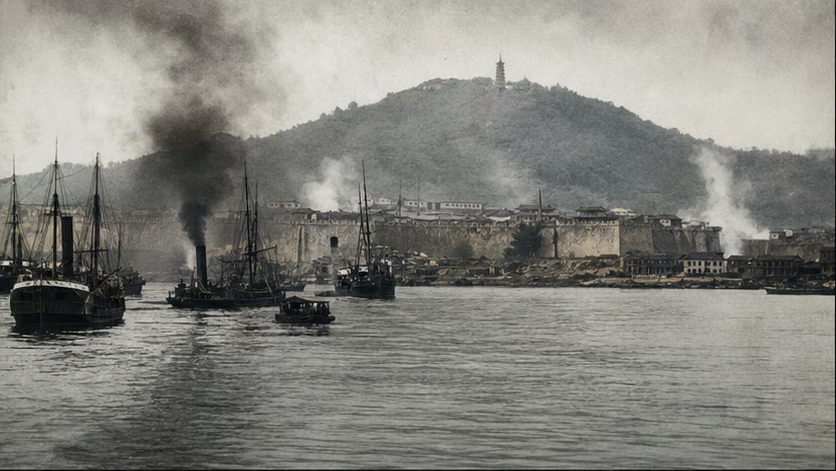 Battle of Canton (1856–58)1856.10Britain and France each found a pretext and assembled an allied force; five thousand men took, in two days, a provincial capital with tens of thousands of defenders. Viceroy Ye Mingchen met the enemy by "not fighting, not negotiating, and not defending"; when the city fell he was captured and sent to India. For the next three years, Canton was nominally governed by the Qing governor Baigui under the supervision of an allied committee: the first provincial capital in modern China to be occupied and jointly administered.
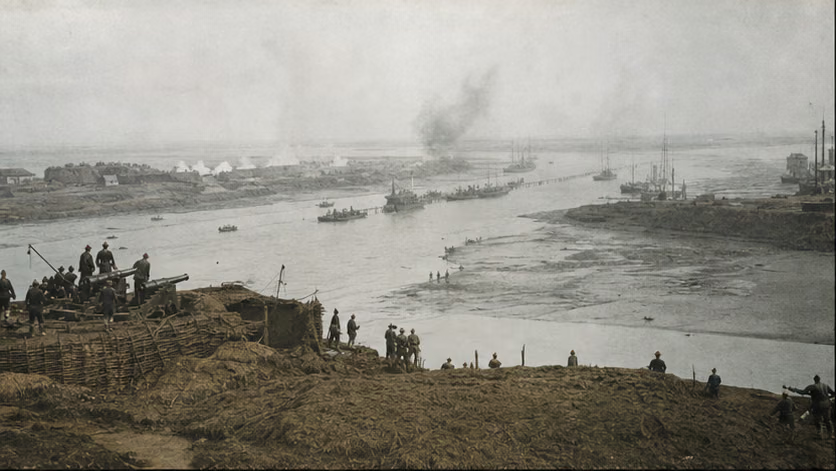 Three Battles of the Taku Forts1858.05At the same river mouth, three battles were fought in three years: in 1858, as soon as the fleet arrived the forts collapsed; in 1859, Sengge Rinchen crippled the ratification-exchange fleet that forced its way in, trapping it inside the river barriers, the Qing army's only clear tactical victory against a foreign power; in 1860, the allied forces bypassed the forts, landed at Beitang, and came in on their flank and rear, so even the strongest forts no longer mattered. One battle was won; the whole situation was lost.
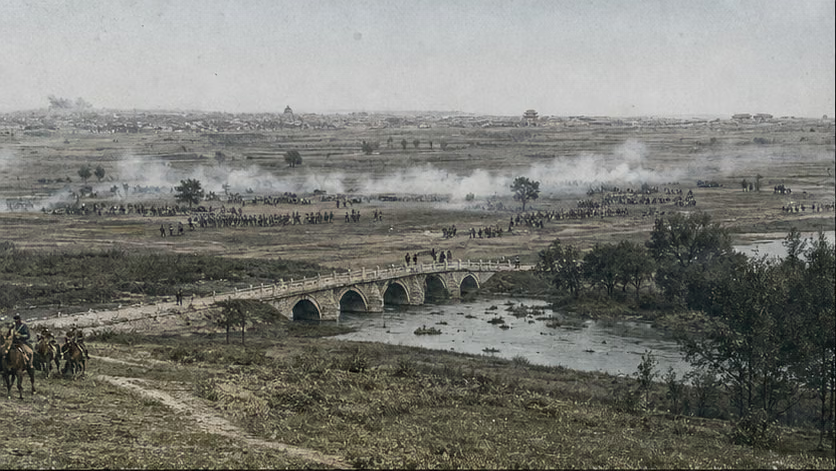 Battle of Palikao (incl. Battle of Zhangjiawan)1860.09On 1860.9.21, the main Qing force under Sengge Rinchen, built around Mongol cavalry, charged head-on at the artillery and infantry squares of the Anglo-French allied forces on a stone bridge west of Tongzhou; the charge was destroyed in a modern fire web, and after this battle Beijing had no troops left to defend it, while the Xianfeng emperor fled north to Rehe.
Sources and Open Questions
Main sources: Mao Haijian, The Qing Empire and the Opium War: The Collapse of the Heavenly Dynasty (this war's first reference); Chouban yiwu shimo: Xianfeng reign; Xia Xie, Zhongxi jishi; the British Walrond edition of The Letters and Journals of James, Eighth Earl of Elgin; the French Henri Cordier, L'expédition de Chine de 1860 (translation of title unverified); the Russian Barsukov, Count Muravyov-Amursky. Because the period is earlier than the main body of modern newspapers, the documentation is mainly official books, memorials, and Western military memoirs.
Open questions:
1. The basis of counting for allied troop strength in 1860 and Qing relief troops; casualties and sunk ships on both sides in the 1859 Battle of Taku; duration of the 1858 Taku battle. 2. The number detained in Harry Parkes's mission, number killed, places of imprisonment, and sequence of release. 3. The unit designations of the troops that carried out the palace burning, and the extent of spread (whether it reached all of the Three Hills and Five Gardens). 4. The expiry date of the Arrow's Hong Kong registration and whether it was flying a flag at the time of the incident. 5. The clauses in the 1854 treaty-revision negotiations and the wording of the rejection; the opium tax rate and wording of the "legalization" clause. 6. The list of substituted ports under the Treaties of Tientsin (Niuzhuang–Yingkou, Dengzhou–Yantai, Chaozhou–Shantou, etc.). 7. The basis of counting and totals for indemnity items (principal indemnity, compensation payments). 8. The original sources for the two casualty counts at Palikao. 9. The original source for the claim that the French text's "property ownership" wording in the Convention of Peking was privately added by the interpreter. 10. Specific records of Ignatyev providing intelligence and maps to the allied forces. 11. The path by which Hugo's letter entered China; examples of republican mockery of the "Count of Palikao." 12. Source of the Ye Mingchen couplet and reassessment literature. 13. Precise figures and measurement basis for Russia's two territorial gains. 14. Decision details on French participation in plunder and opposition to burning the palace; the Chinese and French accounts of the Father Chapdelaine incident. 15. Scholarly wording for characterizing Baigui's Canton regime as under "occupation-army control." 16. Xianfeng's original rescript when first hearing of Canton's fall; edicts and memorials from the attempted reversal at the Shanghai tariff conference. 17. Sengge Rinchen's post-1859 Taku defense-preparation edict; the original memorial on allowing the enemy to land at Beitang in 1860. 18. Decision records for the 1860 British and French expedition's objectives (not wanting the Qing court overthrown). 19. Documentary sequence of Bowring's initial use of force and London's ratification.
All images on this site are AI-generated depictions. They are not historical photographs, not primary sources, and do not depict any real individual.