Engagement Archive · Battle of Canton (1856–58)
Britain and France each found a pretext and assembled an allied force; five thousand men took, in two days, a provincial capital with tens of thousands of defenders. Viceroy Ye Mingchen met the enemy by "not fighting, not negotiating, and not defending"; when the city fell he was captured and sent to India. For the next three years, Canton was nominally governed by the Qing governor Baigui under the supervision of an allied committee: the first provincial capital in modern China to be occupied and jointly administered.
Engagement Data
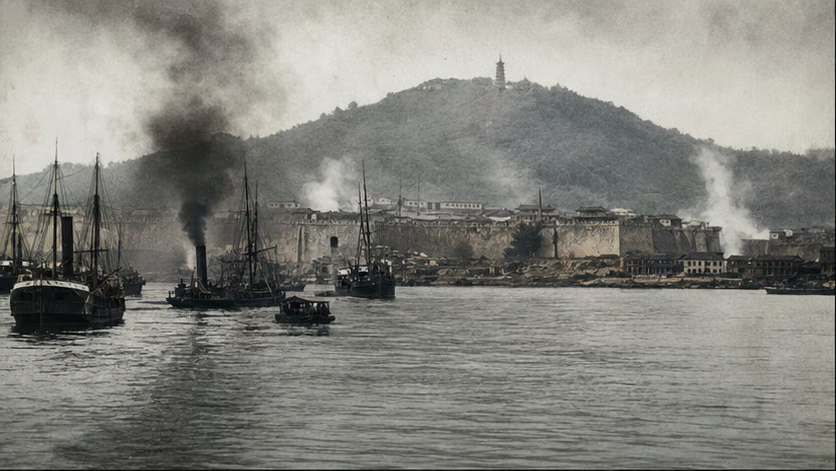
| Item | Details |
|---|---|
| Time | 1856.10 first British attack → 1857.12.29 fall of the city; allied occupation lasted until 1861 |
| Place | Walled city of Canton, Guangdong (inside and outside the walls, north bank of the Pearl River) |
| Affiliation | Second Opium War · Guangdong phase (for the larger situation, see Second Opium War: Overview) |
| Defender | Great Qing: Liangguang Viceroy Ye Mingchen, commanding the Canton Green Standard, Eight Banners, and local militia |
| Attacker | Anglo-French allied forces (British side: Hong Kong governor John Bowring; naval commander in China Michael Seymour; later joined by plenipotentiary Lord Elgin. French side: plenipotentiary Baron Gros) |
| Result | On 1857.12.29 Canton fell; Ye Mingchen was captured and sent to Calcutta, India. Baigui remained as governor under the supervision of an allied committee, and allied occupation lasted until 1861 |
Belligerents
| Item | Defender | Attacker |
|---|---|---|
| Troops | Green Standard and Eight Banner forces inside and outside the city, about twenty to thirty thousand (figures unverified), plus local militia and tuanlian | In the 1857.12 general assault, the allied force committed more than five thousand men (British-French breakdown unverified) |
| Firepower | The city-defense artillery remained broadly at First Opium War level: old muzzle-loaders whose carriages could not elevate or traverse | Naval guns supporting from the Pearl River + field artillery; the infantry was already widely equipped with percussion guns and rifled muskets (specific models unverified) |
| Support | No outside support; court edicts were ambiguous, neither ordering war nor permitting peace (original text of the edicts unverified) | Fleet blockade at the Pearl River estuary; in 1857 British troops were for a time diverted because of the Indian Rebellion, delaying the Guangdong campaign (sequence unverified) |
| Resolve | Ye Mingchen made no arrangements to defend the city and answered with the "six nots"; the defenders collapsed almost at first contact | The objective was clear: take the provincial capital and force the court to the negotiating table |
Terrain and Conditions
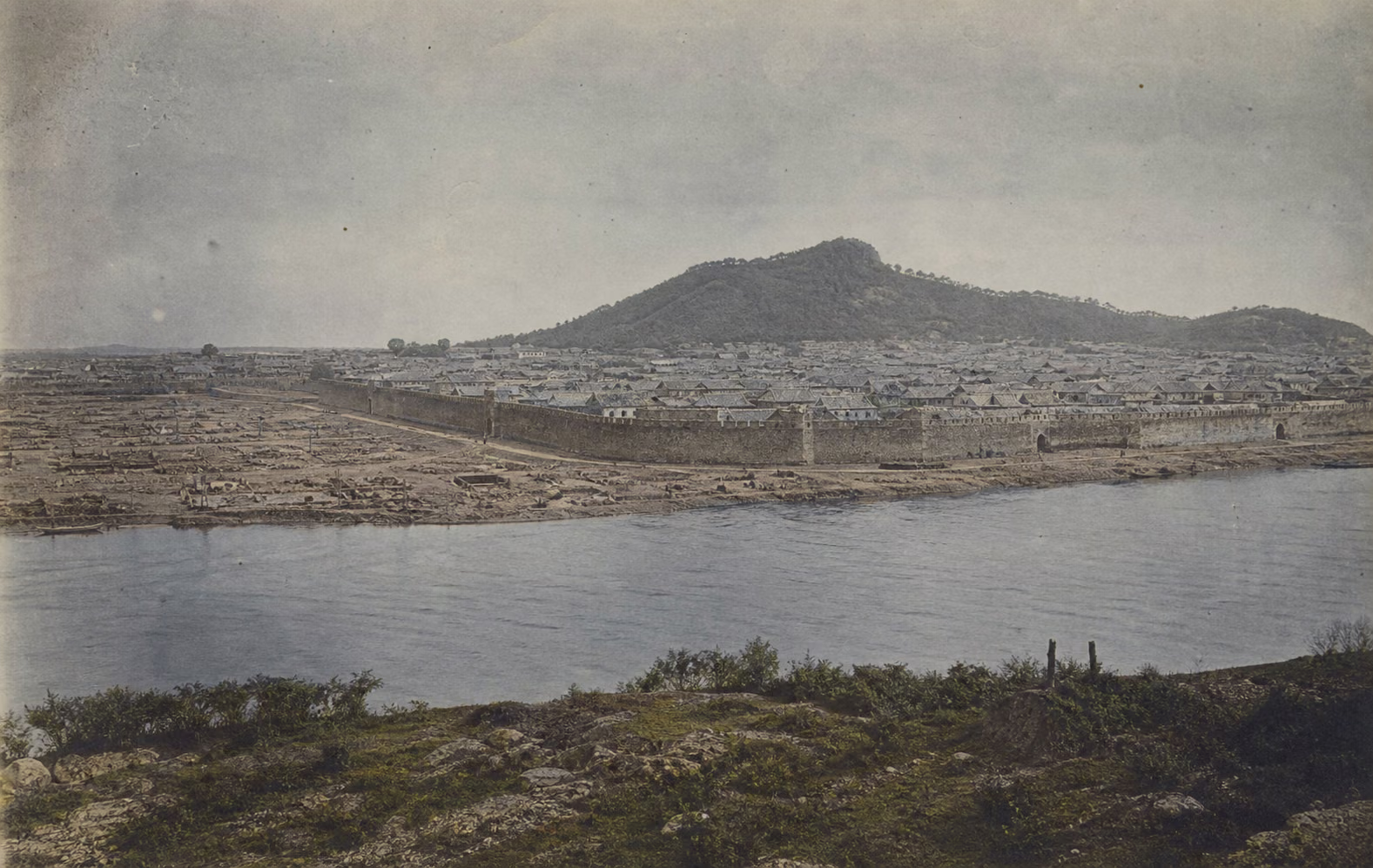
(For the larger situation of the 1850s -- treaty-revision demands, the Taiping Heavenly Kingdom, and the separate calculations of Britain and France -- see Second Opium War: Overview.)
Guangdong: the treaty port with the deepest grievances. Canton was the old site of the single-port trade, and the density of Chinese-foreign friction was the highest in the country. Since Sanyuanli, Cantonese people and foreigners had regarded one another as mortal enemies; the issue of entering the city had been contested for more than ten years, and Guangdong gentry built their standing on the cry of "keeping barbarians out of the city." After the war, the center of trade shifted north to Shanghai. Large numbers of people in the Pearl River Delta who had lived on foreign trade lost their work, and the tuanlian therefore had ample recruits and ample hostility.
The city: the walls had a circuit of about fifteen li (figure disputed), with Yuexiu Mountain to the north. The Thirteen Factories district on the Pearl River at the west of the city was the place where foreigners lived and traded. In 1856.12, a great fire burned the factories district to bare ground: before the fighting had formally begun, business had already burned away. Gentry power was extremely strong. After the city fell, the tuanlian bureau outside the city was set up in Foshan, and the allied occupation never truly got beyond the city circuit.
Why It Was Fought
The cause of this battle has to be divided into two layers: on the surface, a ship case plus a missionary case; underneath, two years of stalled treaty-revision negotiations. In 1854 Britain, the United States, and France jointly proposed treaty revision -- opening additional ports, stationing envoys in Beijing, and allowing navigation on the inland rivers -- and the Qing court rejected it under the formula of "the fixed institutions of the Celestial Dynasty" (details of the treaty-revision negotiations unverified). Palmerston's government in London needed a pretext, and the pretext delivered itself. On 1856.10.8, the Guangdong navy boarded the Arrow, moored in the Pearl River, and arrested twelve Chinese sailors, accusing them of piracy. The vessel belonged to a Chinese merchant and was registered in Hong Kong, but the registration had expired (the claim of eleven days' expiry unverified). Whether the ship was flying the British flag when the incident occurred is recorded differently by Chinese and British sources. Consul Harry Parkes concluded that the British flag had been pulled down and demanded compensation and an apology; Hong Kong governor John Bowring used the situation to apply pressure, and by the end of 1856.10 British forces had acted. The French pretext was the Xilin missionary case of 1856.2: the missionary Auguste Chapdelaine was executed at Xilin in Guangxi, and Napoleon III's Second Empire needed overseas military distinction and the title of protecting missions. Each side needed a defensible reason for going to war, and Canton gave it to them. The real objective was treaty revision; this battle was only the first step used to force the court's hand.
Why Canton? Because it was the place where Chinese-foreign friction was densest: the deepest grievances, the fullest tuanlian forces, and the fullest hostility.
Neither side's calculations lay primarily on the battlefield. Ye Mingchen's method was delay: court edicts were ambiguous, neither ordering war nor permitting peace (original text of the edicts unverified), so he did not prepare for war, negotiate, or flee; the court's account lay on the Yangtze, and "barbarian affairs" always ranked behind the "rebels." The British and French side also had its own timetable: the Indian Rebellion drew away troops meant for the Guangdong campaign, and the general assault was delayed by several months (sequence unverified).
Both sides' resolve was written in their notes. After the pro-war faction in London won a great election victory, Elgin was sent east with troops, and Paris answered with Gros (sequence of appointment and dispatch unverified). The force was limited, but its target was exact: strike one provincial capital and force treaty revision. In 1857.12, Elgin and Gros sent Ye Mingchen a joint note listing entry into the city, compensation, and treaty revision, set a deadline for reply, and stated that the city would be attacked if the deadline passed (date of the note and basis for the deadline unverified). Ye Mingchen rejected it in reply. He dared reject it because he relied on intelligence sent back by informants in Hong Kong: parliamentary strife, the Indian Rebellion, and insufficient troop strength. On that basis he judged the allied threat to be empty intimidation. The intelligence was not wholly wrong; the conclusion was wrong (basis of judgment according to Mao Haijian's research; details unverified). The account that he "consulted spirit-writing to resolve doubts" appears in Qing-era notes (attested in one source of notes only, unverified).
The material boundary of defending the city had already reached bottom. Trade had been half severed since relations worsened in 1856; customs and lijin revenue had sharply declined; military pay depended on contributions; Green Standard troops had long gone unpaid; the gun positions were still old pieces from the previous war. The court's boundary lay on the Yangtze, and its edicts contained only an empty sentence: neither initiate hostilities nor show weakness, while not adding a single tael of military funds or pay. The allied forces were also tight: naval guns were their whole confidence, and their land strength was insufficient for a long occupation. That is why, once the city was broken, they had to set up a committee and keep Baigui in place. The occupation too was improvised.
Another road survives in the record only as a trace: there are very few existing records of civil and military officials in the city asking to prepare defenses or to negotiate peace quickly (no systematic record of dissent seen, unverified). In Xue Fucheng's telling, no one dared speak.
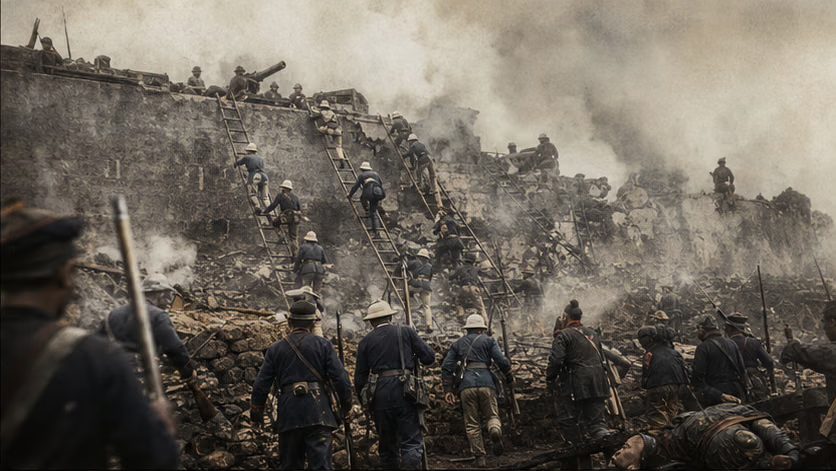
On 1857.12.28, the assembled allied forces opened the general assault by bombardment from the northeast of the city (direction of initiation unverified), and mounted the walls the next day. A provincial capital with tens of thousands of defenders changed hands in two days.
Could it have avoided reaching this point? On the surface, there were other roads: treaty revision could have been negotiated, and the Arrow could have been settled on the basis of expired registration. But one side wanted things it could not obtain at the negotiating table, while the other refused even to negotiate. The pretext was merely an explanation each side could offer at home.
Course of the Engagement
| Stage | Time | Main points |
|---|---|---|
| First British attack | 1856.10.23–29 | Michael Seymour led ships upriver to remove batteries and bombard the viceroy's yamen; on 10.29 British troops briefly entered the viceroy's yamen inside the city, but lacked the strength to hold it and withdrew that day (route of entry and details of withdrawal unverified) |
| Standoff | 1856.11–mid-1857 | Sporadic bombardment and raids went back and forth; ※ British forces burned several thousand households in the suburbs (number unverified); in 1856.12 the great Canton fire destroyed the Thirteen Factories district, and Chinese and British accounts disagreed over responsibility for the fire; Ye Mingchen still made no arrangements to defend the city |
| Allied assembly | Second half of 1857 | British plenipotentiary Elgin and French plenipotentiary Gros arrived in China in succession; on the way, Elgin for a time detached troops to reinforce India because of the Indian Rebellion, delaying the Guangdong campaign by several months (sequence of turning back unverified) |
| General assault and fall of the city | 1857.12.28–29 | On 12.28 the allied forces opened the general assault by bombardment from the northeast of the city; on 12.29 they mounted the walls and seized the commanding height of Yuexiu Mountain (Guanyin Mountain), and the city fell. The defenders offered almost no organized resistance (direction from which the general assault began unverified) |
| Occupation | 1858.1–1861 | On 1858.1.5 the allied forces found and seized Ye Mingchen (place and circumstances of capture unverified), and a few days later sent him to Calcutta; an allied committee was established, while Baigui remained as governor under its supervision. The Foshan tuanlian bureau outside the city continued to harass allied troops and those it called "collaborators with the barbarians" (course of harassment unverified); in 1861 the allied forces withdrew according to treaty (specific withdrawal date varies by account) |
Casualties and Losses
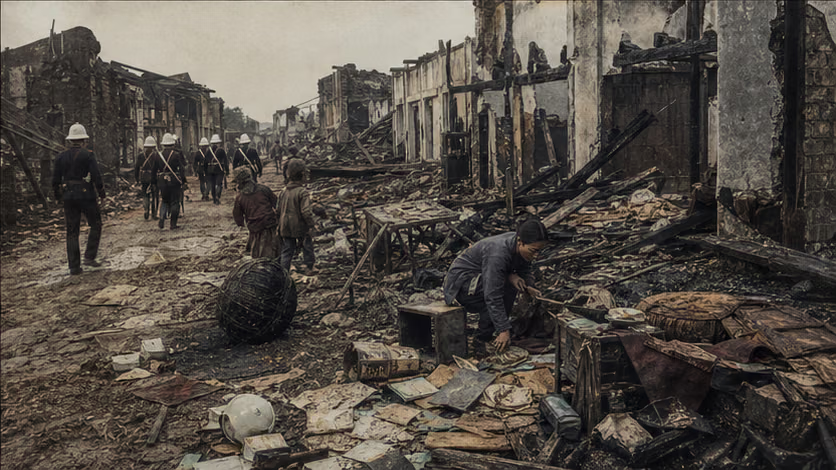
- Defender: there is no reliable casualty count for Qing troops in the fall of the city; different accounts range from several hundred to several thousand (basis of counting varies by account). A Liangguang viceroy was captured, something unprecedented for a provincial high official of the Qing dynasty.
- Attacker: British and French records put allied deaths at just over ten and wounded at about one hundred (British and French basis of counting; specific figures unverified).
- Civilians: ※ several thousand households in the suburbs were burned by British forces (number unverified); ※ the great fire of 1856.12 affected innumerable Chinese shops and households in Xiguan; ※ after the city fell, allied troops entered and looted it (extent unverified). In addition, there are likewise no statistics for executions by the tuanlian of those they called "collaborators with the barbarians" -- both sides used violence against civilians.
- Both sets of figures are incomplete; they are placed side by side as disputed, with no choice made between them.
Aftermath
- The allied forces then went north, reached Taku in 1858.5 (see Three Battles of the Taku Forts), and signed the Treaties of Tientsin in 1858.6. Canton was the first lever that moved the whole situation.
- Baigui nominally remained in office for more than three years under the supervision of the allied committee: the Qing yamen continued to operate as usual, but actual orders had to pass through the committee. This was modern China's first "occupied joint administration," and later occupation governments learned something from it.
- Ye Mingchen was sent to Calcutta and died there in 1859 (the accounts of death by hunger strike and death from illness coexist; basis of counting varies by account).
- Tuanlian resistance to the enemy became one experiment in the Xianfeng reign's policy of "using the people to control the barbarians"; afterward, the cycle of revenge killings among Guangdong officials and gentry, tuanlian, and foreigners continued for many years.
- In 1861 the allied forces withdrew from Canton according to treaty, ending the occupation.
Accounts of Those Present
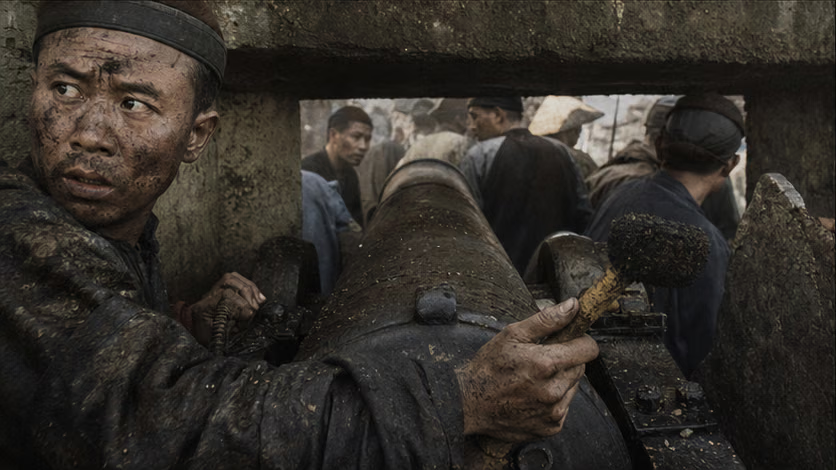
- The "six nots" viceroy: Xue Fucheng recorded that Ye Mingchen "would not fight, would not negotiate, would not defend; would not die, would not surrender, would not leave." In the six years before the city fell, he did not prepare for war, negotiate, or flee, and he did not allow others to flee. Much of his later infamy comes from this sentence.
- "Su Wu on the sea": imprisoned in Calcutta, Ye Mingchen painted every day and refused to eat British grain (the point about not eating enemy grain unverified), calling himself, or being mockingly called by others, "Su Wu on the sea." Whether this was self-designation or a name given by others appears both ways in the record (attribution unverified).
- The capture: when the allied forces entered the city, Ye Mingchen had neither died nor fled, and on 1858.1.5 he was found and seized (time and place details vary by account, unverified). It is said that he once asked to meet the British monarch and question him face to face (this claim unverified).
- Baigui: a Qing governor worked for three years under the eyes of an occupier's committee. He both maintained order in a province and from then on bore the fixed name of "traitor." He died in office of illness in 1859 (date unverified), without waiting for the withdrawal.
- Tuanlian: the Foshan tuanlian bureau was led by officials on the local register (Luo Dunyan and others; list unverified), and carried out attacks on scattered allied personnel and those it called "collaborators with the barbarians." The allied forces offered rewards and retaliated, and the area outside the city knew no peace for three years.
- Harry Parkes: the British consul who insisted during the Arrow Incident that "the British flag had been pulled down" later became the effective member of the allied committee. In 1860, during negotiations at Tongzhou, he was detained by Qing troops; this directly affected the burning of the Old Summer Palace after the Battle of Palikao.
The Ground
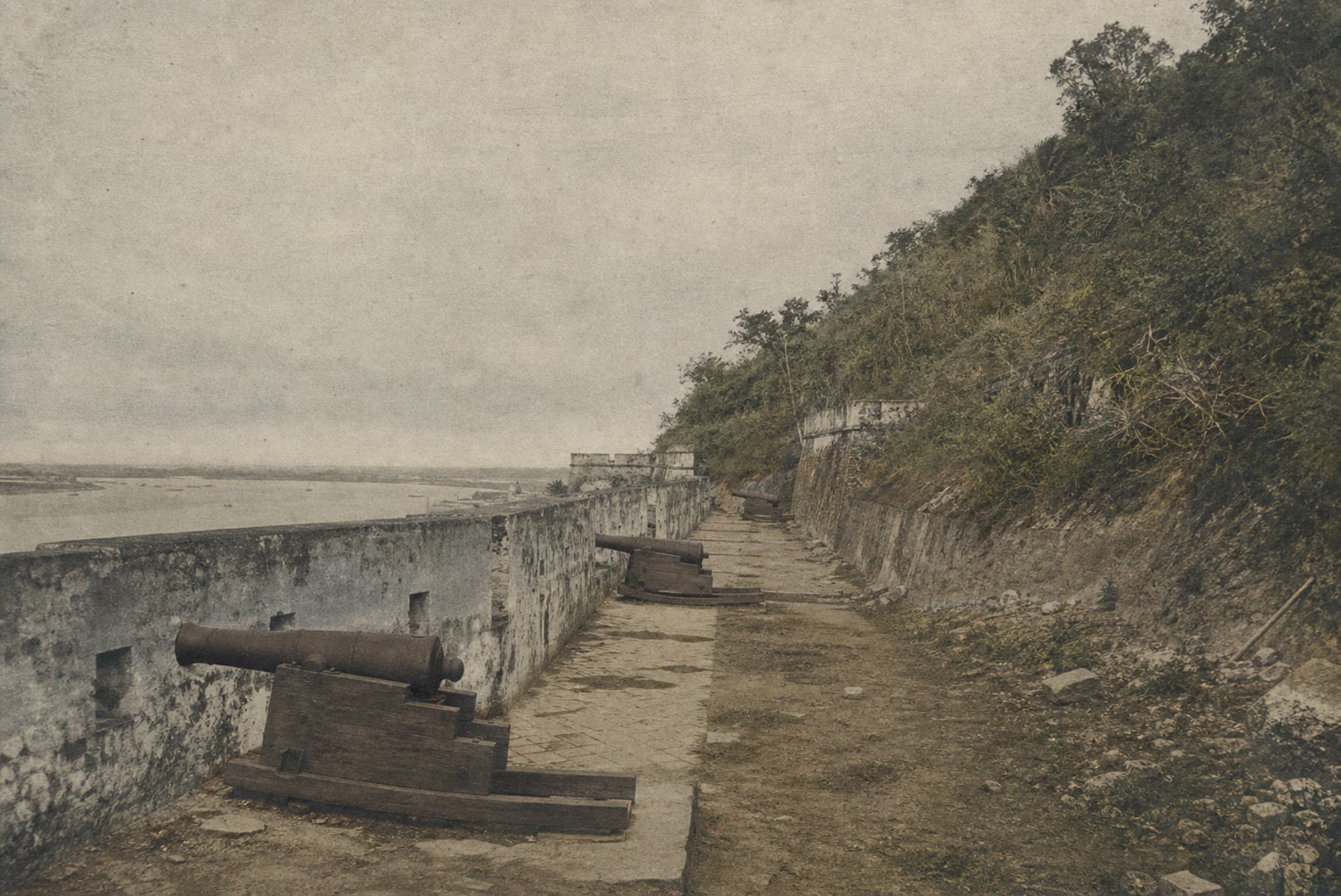
- Yuexiu Mountain (Guanyin Mountain) north of the city was the commanding height over the whole city. The allied forces seized it first on 12.29, and the whole city was immediately under observation and fire; that the defenders possessed the high ground and did not fortify it is the most glaring spatial fact of this battle.
- The Pearl River waterway was the axis of attack from the west: in 1856 British forces moved along the river, took out batteries, and reached the foot of the city. Naval guns were siege guns.
- The Thirteen Factories district west of the city was the physical interface of Chinese-foreign trade. After the great fire of 1856.12, it became ruins: what the war burned away first was the interface itself.
- Space was divided during the occupation: inside the city, the allied committee and the Qing yamen coexisted; outside the city, the tuanlian controlled the countryside; the city circuit became the line between enemy and self.
How Each Side Records It
- British side: the war was already called the "Arrow War" in Britain -- reducing a war that took a provincial capital to a smuggling-enforcement dispute, so that the name itself is a position. In 1857.2 the House of Commons passed Cobden's motion condemning the government's China policy by 263:247 (vote count disputed); Palmerston dissolved Parliament, the pro-war side won the general election by a large margin, and many anti-war MPs lost their seats. The "Canton question" became an issue in a British general election; this was the deepest trace the whole war left in British politics.
- French side: France took the Father Chapdelaine case (the Xilin missionary case) as the great cause for joining the war. The death of a missionary was mobilized in France as a question of religion and national prestige. Gros accompanied the allied forces as plenipotentiary, and after the war France inserted clauses lifting restrictions on missionary activity into the French text of the Treaties of Tientsin (details of the clauses unverified). Pretext and practical interest were both cashed out in the treaty.
- Chinese side: assessments of Ye Mingchen are polarized. Xue Fucheng's "six nots" narrative set the tone for a century: a muddled governor-general who harmed the state. Later writers have also reassessed his predicament -- the court gave him no funds and no aid, its edicts were ambiguous, and neither "war" nor "peace" lay within the viceroy's authority (specific titles in this line of scholarship unverified). Baigui's characterization as a "traitor" is almost uncontested. Another line in local Guangdong memory is tuanlian resistance to the enemy, a continuation of the Sanyuanli narrative.
Disputes and Sensitivities
- The factual disputes over the Arrow: the vessel's registration had indeed expired (number of days expired unverified); whether it was flying the British flag when the incident occurred rests, on the British side, only on Parkes's account (Chinese records rejected it; original archives unverified). In the 1857 British parliamentary debate, this point was already the anti-war faction's focus of attack: the legal foundation for war was unstable from the beginning.
- Ye Mingchen: the two characterizations of "muddled, harming the state" and "reassessing his integrity and predicament" coexist. His not dying and not fleeing when the city fell -- was this the crime of "not dying," or did he have another plan (the claim that he wanted to meet and question the British king, unverified)? This touches the basic definition of the word "integrity."
- The Baigui regime: cooperation or puppet; whether "occupied joint administration" counts as the first prototype of modern colonial rule in China. The wording of characterization is sensitive.
- Civilian atrocities in both directions: ※ British forces burned civilian houses, allied troops looted, and the great fire affected Chinese shops and households; the tuanlian's executions of "collaborators with the barbarians" likewise targeted civilians. Both sides used violence against civilians, and each side still has its own account of who struck first (the cause of the great fire is one example).
Sources and Open Questions
Known main sources:
- Xue Fucheng, "Shu Hanyang Ye Xiang Guangzhou zhi bian" (the work that set the Chinese narrative)
- Chouban yiwu shimo: Xianfeng reign (official archival compilation)
- Xia Xie, Zhongxi jishi (contemporary account)
- Laurence Oliphant, Narrative of the Earl of Elgin's Mission to China and Japan (British aide's account; Chinese title unverified)
- Huang Yuhe, Liangguang zongdu Ye Mingchen (monograph on Ye)
- Mao Haijian, Jindai de chidu: Liangci Yapian Zhanzheng junshi yu waijiao
Open questions: the specific number of defenders and artillery pieces; the British-French breakdown of the allied force of more than five thousand; the 1856.10.29 route into the city and details of withdrawal; the number of days by which the Arrow's registration had expired and the original records on the flag dispute; specific allied casualty figures; the number of suburban households burned; the cause and extent of the 1856.12 fire; the time, place, and circumstances of Ye Mingchen's capture; the basis of the accounts of Ye's death (hunger strike / illness); whether "Su Wu on the sea" was self-designation or mockery by others; the claim that he "wanted to meet the British king and question him"; Baigui's death in office in 1859; the member list and terms of the allied committee; the list of those leading the Foshan tuanlian bureau and the course of its harassment; the House of Commons vote count on the censure motion and details of the general-election result; the original text of the missionary clauses in the French treaty of the Treaties of Tientsin; the specific date of allied withdrawal from Canton; the sequence of Elgin's turning back because of the Indian Rebellion; the direction from which the general assault began; the original source for the Chinese side's "ambiguous edicts"; specific titles in the reassessment literature on Ye; the sequence of Elgin's and Gros's appointments and departures; the date, clauses, and deadline of the joint note from Elgin and Gros in December 1857; Ye Mingchen's Hong Kong intelligence sources and the basis for his judgment in refusing battle (Mao Haijian's research basis); the source in notes for the claim about "consulting spirit-writing to resolve doubts, and nothing happening after fifteen days"; records of whether civil and military officials in the city proposed defense arrangements or peace negotiations.
All images on this site are AI-generated depictions. They are not historical photographs, not primary sources, and do not depict any real individual.