War Overview · War to Aid Vietnam and Resist America (expeditionary service abroad) (1965–73)
Year after year, U.S. bombing pressed down on North Vietnam; over eight years, Chinese support forces went south in 320,000 person-times -- antiaircraft guns guarding bridges, engineers building roads, railway troops repairing lines under fire, naval units sweeping mines -- and more than 1,100 people (basis varies by account) remained buried in Vietnam. This was the second time after the War to Resist U.S. Aggression and Aid Korea that Chinese forces entered a neighboring country to fight U.S. forces head-on; more than a decade later, the two armies that had stood shoulder to shoulder met each other in arms.
Engagement Data
| Item | Content |
|---|---|
| Time | 1965.6.9 first support units entered Vietnam (unit designations unrecorded) – 1973, the last personnel including minesweeping units returned home (month unverified); main rotation period 1965–68 |
| Place | Northern Vietnam: along railway and highway lines north of Hanoi, key air-defense points in the Red River Delta, the approaches to Haiphong Harbor; the aid-to-Laos line was in Upper Laos |
| Belligerents | Chinese support forces (antiaircraft artillery, engineering, railway, minesweeping, logistics; 320,000 person-times in total) -- facing U.S. air power (naval carrier aircraft and Air Force tactical aviation; after 1972 including B-52s); Chinese forces did not enter South Vietnam and did not engage U.S. ground troops |
| Result | Support missions completed: air defense, road construction, emergency repair, and minesweeping lines were put in place, and transport routes were not cut; after the 1968 bombing halt, the main forces returned home in batches, with most withdrawn by 1970.7 (unverified); in 1973.1 the Paris Peace Accords were signed, and U.S. forces withdrew from Vietnam |
Belligerents
| Item | Chinese Support Forces | U.S. Air Power (Opposing Force) |
|---|---|---|
| Strength | Cumulative 320,000 person-times; in the peak year (1967, unverified), about 170,000 were in Vietnam; more than ten antiaircraft-artillery detachments rotated through Vietnam (number of detachments unverified) | During "Rolling Thunder," sorties numbered in the hundreds of thousands (statistical bases vary by account); the naval task force operated from "Yankee Station" in the Gulf of Tonkin, and Air Force aircraft took off from bases in Thailand and South Vietnam |
| Equipment | Mainly 37, 57, 85, and 100 mm antiaircraft guns, with searchlights and gun-laying radar; surface-to-air missiles were Soviet-supplied equipment for Vietnamese forces, not operated by the Chinese side (unverified) | F-105, F-4, A-4, A-6 and other aircraft; electronic jamming and "Shrike" anti-radiation missiles; after 1972, B-52s joined the bombing of the North |
| Situation | Positional air defense: guarding railway bridges, highway hubs, power plants, and steel mills; after attacks, positions shifted, and after bombing, repairs began | Day-and-night air raids, gradually escalated; a bombing buffer was kept along the China-Vietnam border (width unverified), and the ground war did not cross the 17th parallel |
Historical Setting
World: the two Cold War camps were locking horns in Southeast Asia -- Washington's "domino" theory made Vietnam the first tile in its containment line; the Sino-Soviet split had become public, and the two major powers within the socialist camp each aided Vietnam in their own way while measuring themselves against each other; from 1967 onward, a global antiwar wave gradually rose.
China: in 1964, China's first atomic bomb was detonated, and Third Front construction began the same year -- preparation for war was the central axis of state policy, and "U.S. imperialism coming from the southeast" was one of the most concrete operational assumptions of the time; from 1966 onward, the Cultural Revolution brought turmoil, while the aid-to-Vietnam corridors and rotation system continued to operate through that turmoil (institutional details unverified).
United States--Vietnam: the 1954 Geneva Accords divided Vietnam into North and South; in the South, the National Liberation Front was founded in 1960, and guerrilla war caught fire; Washington escalated step by step, from sending "advisers" to "special warfare" and then direct intervention -- each step carried the calculation of "not dragging China in" (the lesson of the Korean War; U.S. decision documents unverified).
Why It Was Fought
After the Battles of Xishankou and Walong ended, China declared a unilateral ceasefire and withdrew, and the gunfire on the southwest border fell silent in November 1962. That same month, Washington had just emerged from the Cuban Missile Crisis; in South Vietnam, U.S. "advisers" already numbered more than ten thousand. Over the next two years, the United States sank step by step into Vietnam: in August 1964, in the Gulf of Tonkin, the destroyer USS *Maddox* exchanged fire with North Vietnamese torpedo boats; two days later, the so-called second-night attack -- later U.S. archival studies generally concluded that nothing had happened that night (level unverified) -- became the pretext for Congress's Gulf of Tonkin Resolution. On 1965.3.2, Operation Rolling Thunder began, and the bombing of North Vietnam became a standing condition; on 3.8, U.S. Marines waded ashore at Da Nang, and ground troops entered South Vietnam.
For Hanoi, bridges, railways, and power plants in the North were now being bombed, and both air-defense and engineering capacity were insufficient; in April, Le Duan led a delegation to China and formally requested that China send support forces, and Liu Shaoqi replied that whatever Vietnam needed and China had, China would do its utmost to provide (wording unverified). For Beijing, this was the second time in fifteen years that it watched U.S. forces press toward the southern gate of the homeland -- the last time was the Yalu River, this time the Red River. Aid was settled policy; the question was how to aid, while stepping along a very finely drawn line. That spring, Zhou Enlai passed four messages to Washington through Pakistani President Ayub Khan: China would not take the initiative in provoking a war against the United States; China meant what it said; China had made preparations; and once war began, there would be no limits (channel and wording unverified). The Americans understood: the ground war never crossed the 17th parallel, and bombing left a buffer along the China-Vietnam border. Both sides used the Korean War as a textbook -- Washington feared producing another Yalu River, while Beijing made the other side know that the Yalu could appear again at any time. Misjudgment lay elsewhere: the Johnson administration believed sustained bombing could press Hanoi back to the negotiating table, a judgment later rejected by U.S. postwar assessments themselves (documents on the assessment of Rolling Thunder's effects unverified).
China's mode of participation thus took shape: no combat troops sent into South Vietnam, no public declaration of war; support forces removed their cap badges and collar insignia and entered North Vietnam -- antiaircraft units protected bridges and roads, engineers built roads, railway troops made emergency repairs, and North Vietnam's rear was connected to China's rear. On June 9, the first units crossed the Friendship Pass (unit designations unrecorded).
There had in fact been another plan on the table: sending air force units into Vietnam to fight. It was discussed, but ultimately not carried out -- Chinese and Vietnamese accounts differ on why it was not done (basis varies by account). The war in the air was left to antiaircraft guns and the Vietnamese forces; China's bottom line was drawn at the ground and the national territory.
Course of the Engagement
| Line | Time | Main Points |
|---|---|---|
| Antiaircraft-artillery rotations | 1965.8–1969.3 (beginning and end unverified) | More than ten antiaircraft-artillery detachments entered Vietnam in rotation, guarding railway bridges, hubs, power plants, and steel mills north of Hanoi (Thai Nguyen, Kep, Yen Bai, and other key points; list unverified); Chinese-side figure: in air-defense combat, 1707 U.S. aircraft shot down, 1608 damaged, and 42 pilots captured (statistical boundaries unverified); the rotations also served as combat training, with antiaircraft units across the whole army taking turns in real combat |
| Engineering road construction | 1965.6–1968 (unverified) | Multiple engineering detachments built and rebuilt trunk roads in northern Vietnam (number of roads and mileage unverified) and national-defense works, both opening the rear and preparing for the operational assumption of "U.S. forces landing in North Vietnam" |
| Railway emergency repair | 1965.6–1969 (unverified) | Railway troops kept the main railway lines north of Hanoi open: bombed and repaired, repaired and bombed again; temporary bridges, bypass lines, ferries in place of bridges (details unrecorded); the transport routes were never cut |
| Bombing halt and withdrawal | 1968.3–1970.7 | Johnson limited bombing in March to south of the 20th parallel and halted all bombing of the North at the end of October; the Paris talks opened; Chinese forces returned home in batches, and most had withdrawn by 1970.7 (unverified) |
| Renewed bombing and minesweeping | 1972.4–1973 | Nixon's "Linebacker" series resumed bombing of the North, and in May mines were laid to blockade Haiphong and other ports; at Vietnam's request, a Chinese Navy minesweeping work team entered Vietnam to clear shipping channels (1972–73, organization and results unverified), alongside salvage and transport support |
| Aid to Laos and resistance to America (combined note) | 1969–1973 | Chinese road-construction units entered Upper Laos to build roads, while antiaircraft units provided air-defense cover (earlier road-construction sections unverified); more than 200 died (basis varies by account) and were buried in Laos -- public materials on this line are thinner, and the whole matter remains unverified |
Casualties and Losses
- Chinese support forces: more than 1100 killed (basis varies by account), more than 4200 wounded (basis varies by account); under the arrangements of the time, the dead were buried locally in dozens of martyrs' cemeteries in northern Vietnam (number of cemeteries unverified) -- they were not brought back.
- Aid-to-Laos line: more than 200 killed (basis varies by account), buried in Laos.
- Material aid: the total amount of China's military and economic aid to Vietnam varies sharply by statistical basis (currency and conversion bases vary, unverified).
- U.S. forces: over the entire air war against North Vietnam, thousands of aircraft were lost (U.S., Vietnamese, and Chinese antiaircraft-result figures stand side by side, with statistical boundaries that do not overlap, unverified).
- ※ Vietnamese civilians: U.S. bombing of northern cities and transport lines caused large numbers of civilian deaths (Vietnamese figures vary by account); records also note Vietnamese civilian workers and militia suffering casualties alongside Chinese officers and soldiers around Chinese garrisons and worksites (unverified).
Aftermath
- In 1973.1 the Paris Peace Accords were signed, and U.S. forces withdrew; in 1975.4 North Vietnam unified the country -- the strategic goal of eight years of support ended with Vietnam's victory.
- The security gain China received: the U.S. ground war was kept south of the 17th parallel throughout, and the operational assumption of an attack "from the southeast" did not become reality; antiaircraft-artillery, engineering, and railway troops gained organized combat experience (the army-building significance of the rotations, briefly noted).
- Parallel aid to Vietnam by China and the Soviet Union, and competition between them, ran through the whole process: the bulk of Soviet aid materials were transshipped through China by rail (transit arrangements and friction unverified), while China rejected Soviet proposals for "joint action" (1965–66, documents unverified) -- aid itself became the arena of the split, and Hanoi balanced between the two aid providers.
- The cracks were already there before victory: Hanoi kept account of differences over the timing of the Paris talks and Nixon's 1972 visit to China (Vietnamese accounts vary by account); after 1975, Vietnam tilted toward the Soviet Union, followed in sequence by the 1978 Treaty of Friendship and Cooperation between Vietnam and the Soviet Union, anti-Chinese expulsions, and the invasion of Cambodia.
- More than a decade later, they met in arms -- in February 1979, the two armies that had once stood shoulder to shoulder fought along the Lang Son and Cao Bang line (see the articles on the *Sino-Vietnamese War*). Some of the roads and fortifications built in those years were used against the Chinese army (details unrecorded).
- The long tail of commemoration: the Chinese martyrs' cemeteries in northern Vietnamese provinces were guarded for decades by Vietnamese localities; visits to sweep the graves rose and fell with relations between the two countries, and from the 2000s onward the two countries cooperated on repairs (details unverified); inside China, this war fought secretly abroad long remained low-profile, and issues of veteran status recognition and benefits dragged on for years (policy milestones unverified).
Accounts of Those Present
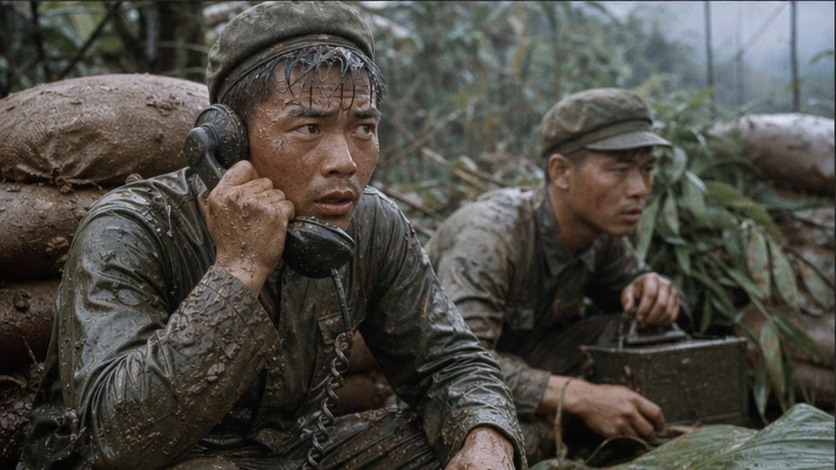
- Soldiers without cap badges: on entering Vietnam, soldiers removed cap badges and collar insignia, and unit designations were changed to "detachments"; for a long time, the war was not acknowledged publicly -- a war experienced by hundreds of thousands, yet one whose destination could not be stated in letters home (secrecy-discipline details unverified).
- The tropics on the position: antiaircraft positions sat between rice fields and jungle, with mosquitoes, malaria, rainy-season floods, and air raids lined up together (this figure for disease deaths and medical attrition is disputed); a battle lasted a few minutes, and the rest was long camouflage, movement, and waiting.
- The bridge repairers: railway troops made emergency repairs on bombed bridge piers, taking bombing by day and working by night; temporary bridges, pontoon bridges, and ferries stood in for bridges -- the "transport line that could not be bombed apart" was held up with human bodies (casualty distribution unverified).
- Cemeteries: the dead were buried where they fell, scattered across dozens of cemeteries in the mountains of northern Vietnam; decades later, reports of Chinese families going to Vietnam to sweep graves gradually increased (individual cases unverified) -- "those who did not come back" are the heaviest layer of this article.
- The pilots on the other side: some U.S. pilots shot down over the North parachuted and were captured, then held in Hanoi prisoner-of-war camps; captured pilots included in the Chinese antiaircraft units' results were transferred to the Vietnamese side by agreement (transfer mechanism unverified) -- there were names on the other side of desperation as well.
The Ground
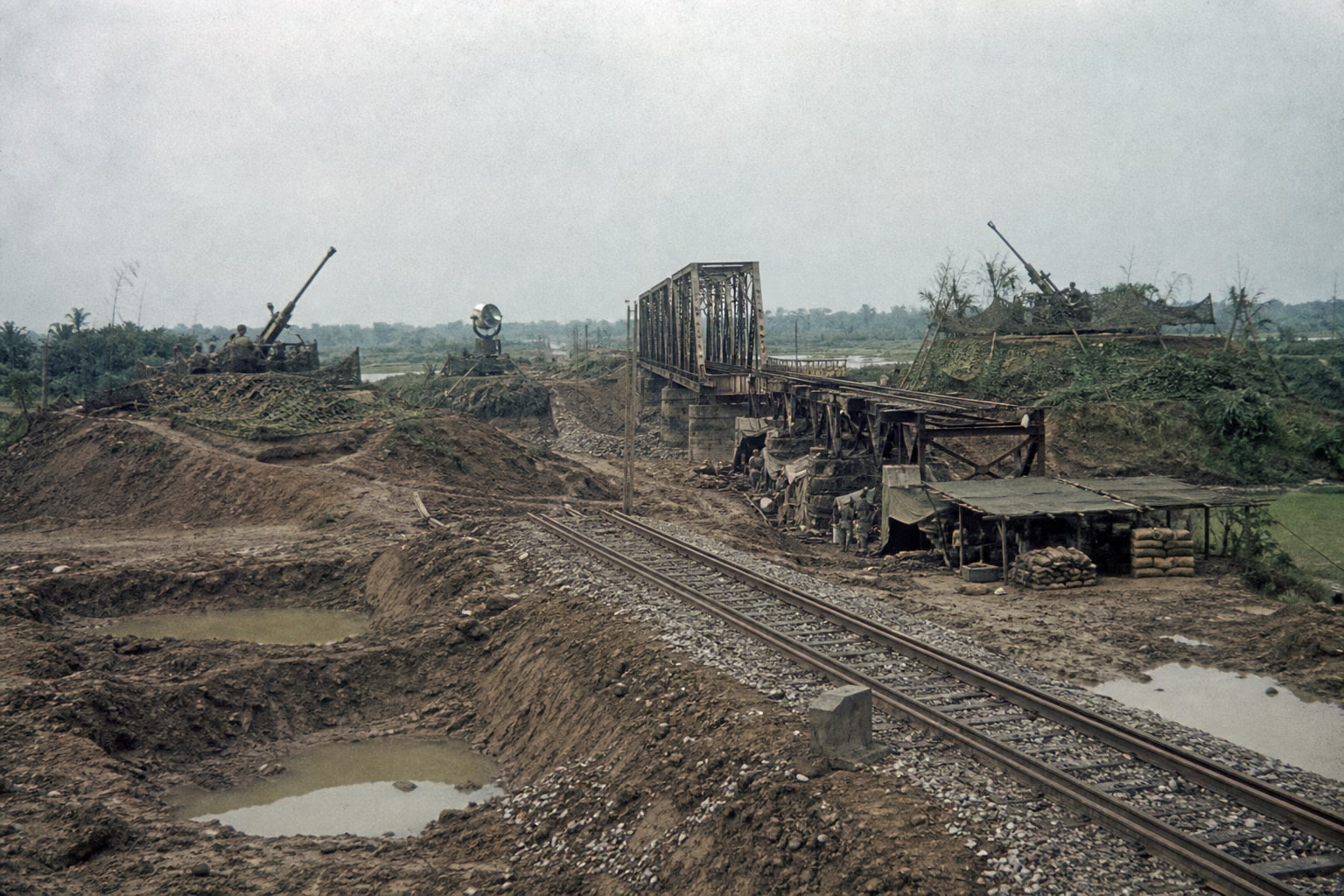
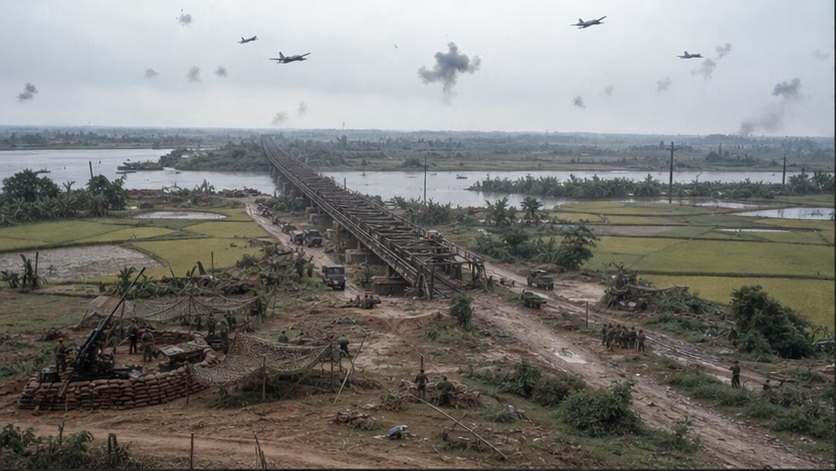
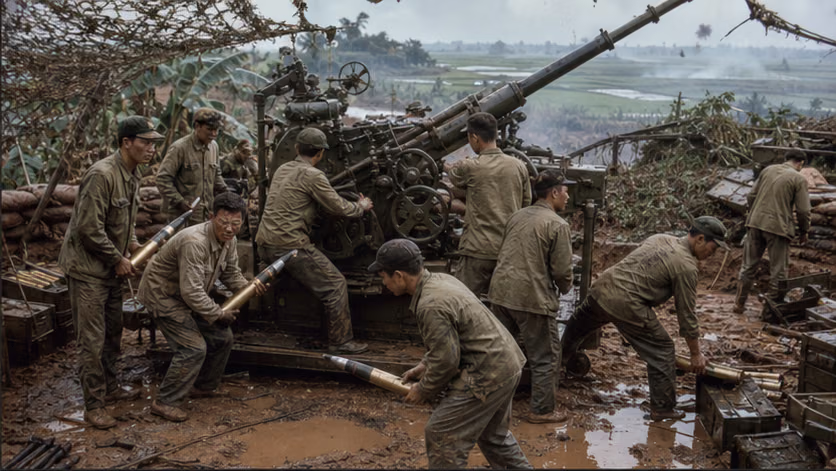
- The spatial grammar of guarding a bridge: antiaircraft-gun groups on both banks of a railway bridge, searchlight arrays, dummy positions and camouflage nets, ammunition points and command posts, with repair teams crouched under the bridge -- the complete terrain kit of positional air-defense combat.
- The enemy was overhead: diving F-105s, A-6s entering at ultra-low altitude, anti-radiation missiles striking radar (the cat-and-mouse of switching radars on and off) -- the rhythm of air-defense combat was long silence and a burst of a few minutes, a rare upward-angle fight in an FPS context.
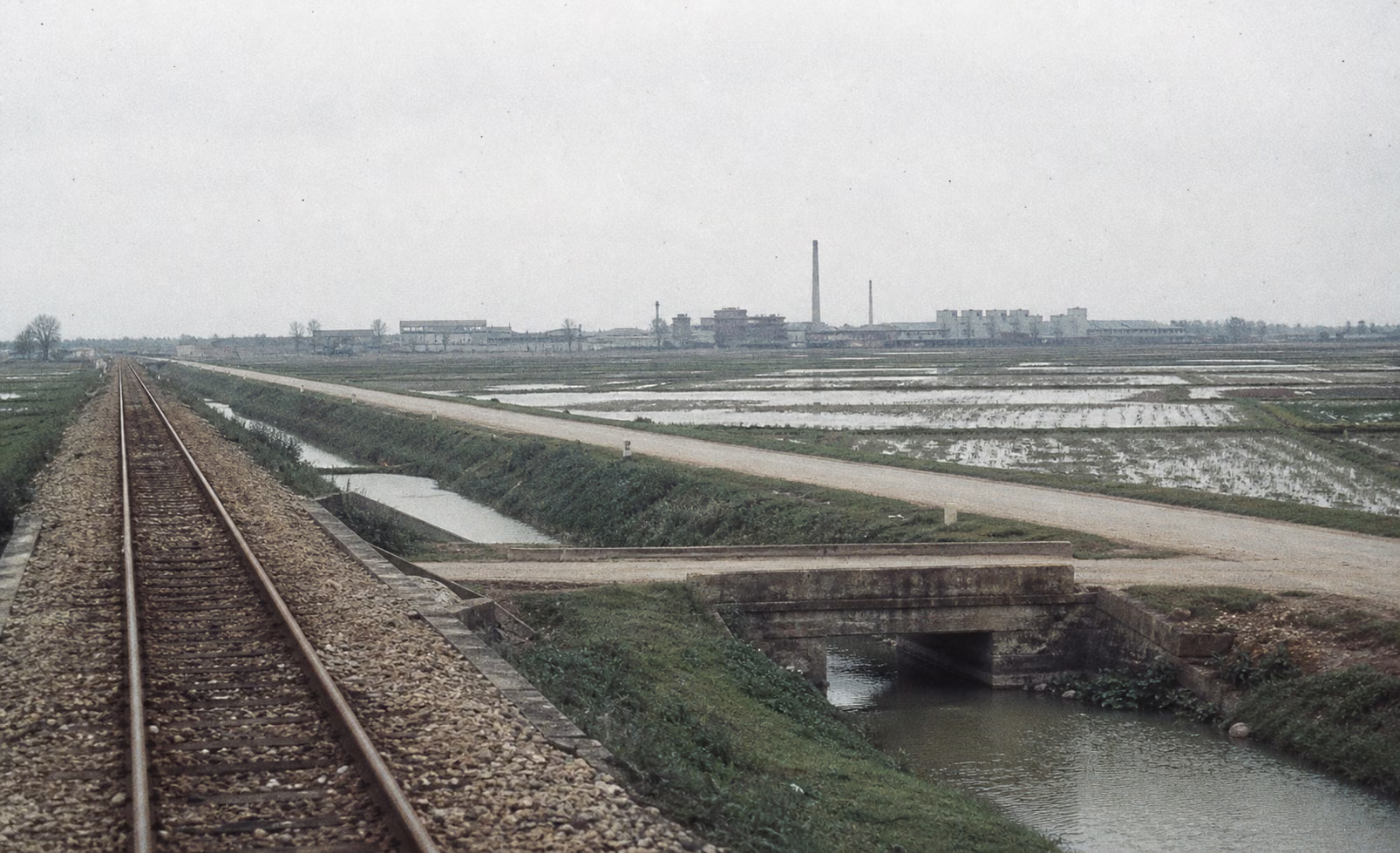
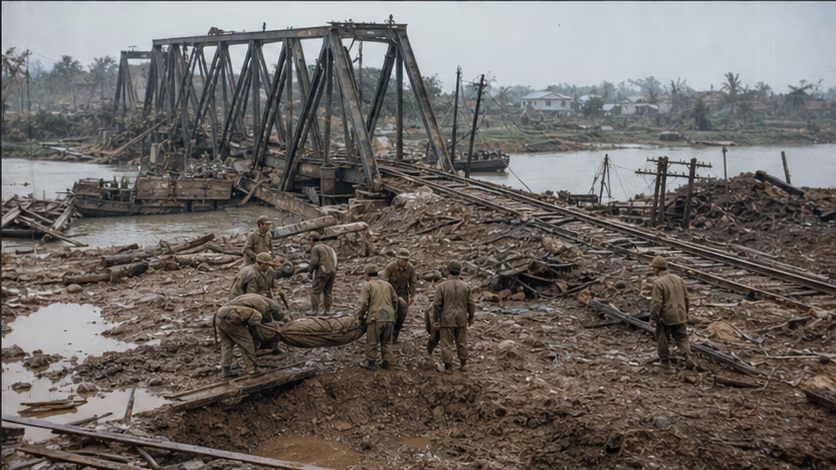
- Linear space: a railway bombed again and again -- craters, broken bridges, temporary bridges, tunnel mouths, with the repair site itself as battlefield.
- Haiphong approaches: minesweeping under the 1972 mine blockade -- an unseen enemy, and the contest between minesweepers and influence mines (operational details unverified).
- Friendship Pass: the gate of going abroad and coming home -- 320,000 person-times crossed the border here, the narrative image of a "gate."
How Each Side Records It
- Chinese side: officially positioned as "Aid Vietnam and Resist America," an expeditionary war abroad named alongside the War to Resist U.S. Aggression and Aid Korea; because of secrecy at the time and the later deterioration of Sino-Vietnamese relations, public memory is far fainter than that of the War to Resist U.S. Aggression and Aid Korea, and veterans' memoirs and military-history series are the main carriers; after the Sino-Vietnamese War, this earlier history of "comrades plus brothers" for a time became an inconvenient prehistory to unfold (a note on the curve of narrative temperature).
- Vietnamese side: official histories record Chinese aid, but its weight in textbooks and commemorative systems rose and fell with Sino-Vietnamese relations -- after 1979 it was for a time downplayed and even made negative, then adjusted back after relations normalized in 1991 (trajectory unverified); the Chinese martyrs' cemeteries in northern Vietnam are thermometers of relations between the two countries.
- U.S. side: the main line of Vietnam War narrative runs between the United States and Vietnam, while Chinese support forces were an "open secret" in intelligence -- Washington determined at the time that Chinese forces were in Vietnam (reconnaissance photography and signals intelligence, declassified documents unverified) and tacitly chose not to say so; both sides jointly preserved the surface of "no expansion."
- Scholarship: archival research in Cold War international history on the China-U.S.-Vietnam triangle -- aid figures, Sino-Soviet competition, and the starting point of the Sino-Vietnamese rift -- is an active field (Shen Zhihua, Li Danhui, and others; bibliography unverified).
Disputes and Sensitivities
- The reversal from aid to enmity: from "comrades plus brothers" to war in 1979, the chain of facts includes aid, disagreements, Vietnam's tilt toward the Soviet Union, and war; the causation of the Sino-Vietnamese War is covered separately in its overview.
- The authenticity of the second night in the Gulf of Tonkin incident: U.S. archival research generally concludes that there was no attack that night, which is not the same thing as the exchange of fire on the first night.
- Total aid and combat-result figures: the Chinese, Vietnamese, and U.S. statistical bases differ greatly.
- The deployment and casualties of Chinese forces in Vietnam were classified at the time; the basis and completeness of figures publicly available today remain unverified, and a single source does not stand.
- Present boundaries: the current state of China-Vietnam relations and the South China Sea issue are outside the scope of this article.
Contents
(Single-article war: the antiaircraft-artillery rotations, engineering, railway, minesweeping, logistics, and aid-to-Laos lines are folded into this article's account; no separate articles are set.)
Sources and Open Questions
Sources: war histories and unit-history series on the War to Aid Vietnam and Resist America by the Academy of Military Sciences and others (bibliography unverified); histories and veterans' memoirs of participating antiaircraft-artillery detachments, railway troops, and engineering troops (unverified); research by Shen Zhihua and Li Danhui on the China-Soviet-Vietnam triangle; U.S. official histories and declassified assessments of Operation Rolling Thunder (unverified); Vietnamese official war histories such as histories of the War Against America for National Salvation (unverified).
Open questions: unit designations and date of the first units entering Vietnam; number of antiaircraft-artillery detachments and rotation sequence; statistical boundaries for aircraft shot down and damaged and captured pilots; exact basis for killed and wounded figures and the number of cemeteries; disease deaths and medical attrition; each basis for total aid; Chinese and Vietnamese accounts of why the plan to send air force units into Vietnam was discussed but not carried out; channel and wording of the "four messages" to the United States; details of the U.S. bombing buffer; documents assessing the effects of Rolling Thunder; organization and results of the minesweeping work team and the month of return home; start and end of aid to Laos and casualty basis; arrangements for transshipping Soviet aid; changes in Vietnamese commemorative narrative; the claim that fortifications built with Chinese aid were turned against Chinese forces in 1979.
All images on this site are AI-generated depictions. They are not historical photographs, not primary sources, and do not depict any real individual.