War Overview · Constitutional Protection War (1917–18)
Sun Yat-sen went south holding up the *Provisional Constitution* to campaign against Duan Qirui, while the southwestern warlords used that banner to guard their own ground; Hunan, the main battlefield for more than a year, was finally called to a halt by the Beiyang commander Wu Peifu himself, and the banner-bearer of constitutional protection was pushed out of Guangzhou by his partners.
Engagement Data
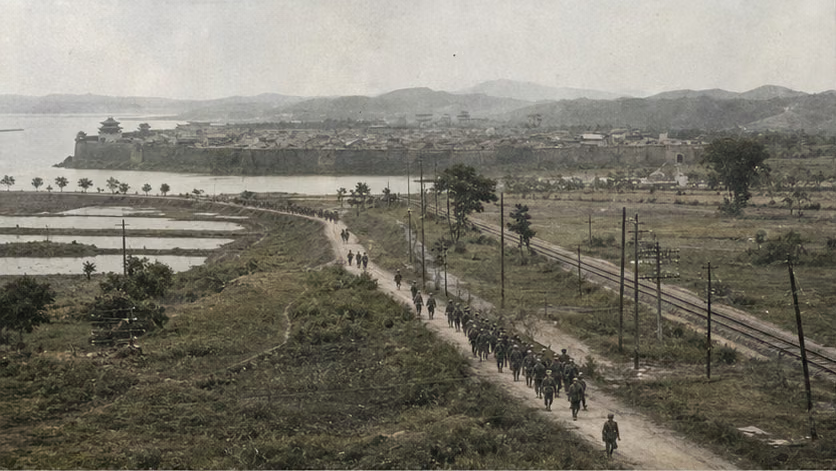
| Item | Content |
|---|---|
| Time | 1917.9 – 1918.11 (gunfire began with southern Hunan autonomy and ended with Beijing's ceasefire order; as a political movement, constitutional protection existed in name only after the military government was reorganized in 1918.5) |
| Place | Main battlefield in Hunan; fighting also occurred in Sichuan, Fujian, and Guangdong (abridged here, unverified) |
| Belligerents | Constitutional Protection Army · Southwestern Allied Army (the Hunan, Guangdong, Guangxi, Yunnan, and Guizhou forces, with no unified commander) / Northern Army (forces under the Beijing government, from both the Zhili and Anhui cliques) |
| Result | No victory or defeat: the front reached a ceasefire and peace talks; the Guangzhou military government was reorganized into a collegiate system of seven directors, Sun Yat-sen left Guangdong for Shanghai, leaving behind the words, "South and North are jackals from the same lair" |
Belligerents (War Level)
| Item | Constitutional Protection Army · Southwestern Allied Army | Northern Army |
|---|---|---|
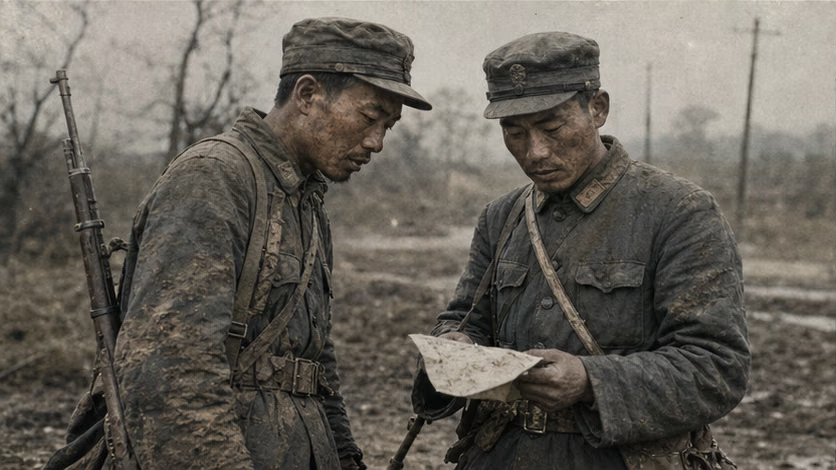
| Total strength | Hunan Army units under Tan Haoming, Cheng Qian, and others, joined with Guangxi and Yunnan troops into a patchwork force; the Hunan main battlefield accumulated tens of thousands of men, but the figures differ by basis and no reliable total exists (figure disputed) | In 1917, two divisions under Wang Ruxian and Fan Guozhang entered Hunan first; in 1918 Cao Kun and Zhang Huaizhi advanced south on two routes, with Wu Peifu's Third Division as the vanguard and Zhang Jingyao's Seventh Division and others following, for a cumulative several tens of thousands to around one hundred thousand men (figure disputed) |
| Equipment | Old provincial armies, uneven in arms and ammunition, with pay and weapons raised locally | Regular Beiyang divisions, with more complete arms and ammunition; in the name of joining the war, Duan Qirui borrowed Japanese funds to buy arms and organize a "War Participation Army," and guns bought with foreign loans were mostly used in civil war (the name and substance of the Nishihara Loans remain unverified) |
| Navy | Cheng Biguang led the main force of the First Fleet south in 1917.7 and attached it to the Constitutional Protection military government | The remainder stayed with Beiyang |
| System | The allied armies each went their own way: Lu Rongting of the Guangxi clique and Tang Jiyao of the Yunnan clique were elected marshals but refused to take office, and the military government's orders did not reach beyond Guangzhou | The Beijing government was nominally unified, but in reality President Feng Guozhang favored peace and Premier Duan Qirui favored war; the Zhili-Anhui split was already present |
Situation
World: The First World War was nearing its end (the European armistice came in 1918.11, and the Beijing government soon ordered a North-South ceasefire; the timing was not coincidental); in 1917.11 came Russia's October Revolution -- beyond the old path, another path had appeared. Looking back ten years later, this line would connect to Sun Yat-sen's choices in his final years.
North (Beijing government): The year 1917 changed three times in one year. The case for declaring war on Germany triggered the conflict between the president and the premier; in May, Li Yuanhong dismissed Duan Qirui, and the military governors' group declared independence. Zhang Xun entered Beijing to "mediate," restored Puyi on 7.1, and failed after twelve days (7.12). Duan Qirui returned as premier in the name of "recreating the republic" -- after the first creation (Xinhai) and the recreation (the campaign against Zhang), Duan refused to restore the *Provisional Constitution* and the old Parliament, and instead organized a Provisional Senate. The name "constitutional protection" arose from this: what was being protected was this constitution. On 8.14 Beijing declared war on Germany and Austria-Hungary. In the name of participation in the war, Duan's faction trained a War Participation Army and borrowed Japanese funds; the edge of armed unification in fact pointed toward the southwest.
South: In 1917.7 Sun Yat-sen went south to Guangzhou with the navy; in August, members of the old Parliament opened an Extraordinary Parliament; in September, Sun was elected generalissimo of the army and navy and the military government was established (9.1 election, 9.10 inauguration; dates vary by account), campaigning against Duan under the banner of "constitutional protection." But the military government's guns were not Sun's guns: the Guangxi and Yunnan power-holders used the name of constitutional protection to secure Guangdong, Guangxi, Yunnan, and Guizhou. Campaigning against Duan was acceptable; obeying orders was not. From its first day, constitutional protection was a joint stock of two different things -- half constitutional demand, half territorial arithmetic.
Why It Was Fought
As soon as news arrived that Duan Qirui refused to restore the constitution and the old Parliament, Sun Yat-sen decided that day to go south. The cards in his hand could be counted: one *Provisional Constitution* as a banner, a group of old members of Parliament unwilling to recognize Duan's government, and one navy that had gone south with him -- Cheng Biguang's First Fleet. The two things missing were even more fatal: an army and money. When the Extraordinary Parliament met, the number of members present did not meet the legal quorum; even the word "extraordinary" was a step it granted itself. Naval pay had to be issued monthly, and the records do not make clear how the military government could sustain this fleet over the long term (source unverified). Without an army, the war constitutional protection meant to fight could only be fought with other people's soldiers; without revenue, those borrowed soldiers could be pulled away by pay at any time. This is why he could only enter Guangzhou and could only partner with Lu Rongting and Tang Jiyao. The account lay here: the banner was his, the guns were theirs.
Each partner had his own resolve. Lu Rongting and Tang Jiyao were elected marshals and refused to take office -- this was not courtesy; it was a declaration. Campaigning against Duan was acceptable; obeying orders was not. What they wanted was quite concrete: Duan's armed unification pointed toward the southwest, and keeping the Northern Army out of Guangdong, Guangxi, Yunnan, and Guizhou was the bottom line. The banner of "constitutional protection" happened to make "guarding territory" sound like "protecting the constitution"; there was no reason not to use it. They calculated this layer very clearly, so clearly that the truth showed from the beginning: if one borrows the banner without spending force, the banner-bearer remains a figurehead. The military government's orders did not go beyond Guangzhou, and the military-political aim of constitutional protection was capped by territorial arithmetic.
On Beijing's side, Duan Qirui's resolve also had an account of its own. He refused to restore the constitution and the old Parliament because restoration would amount to admitting that the government organized after the campaign against Zhang was illegal (this motive is inferred from the factual structure, unverified). In the name of joining the war, he borrowed Japanese funds and organized the War Participation Army; the arms and ammunition bought with foreign loans were mostly used in civil war -- the material foundation of armed unification was borrowed. This line was not without opposition: President Feng Guozhang favored peace, and the president and premier were at an impasse. In 1917.11, the frontline divisional commanders who had entered Hunan, Wang Ruxian and Fan Guozhang, sent circular telegrams advocating peace, and Hunan military governor Fu Liangzuo fled Changsha by night. For a time the peace line went through, and the Northern Army's first entry into Hunan ended in this way. But Duan's faction returned, Cao Kun and Zhang Huaizhi advanced south again on two routes, and the resolve for a second opening of hostilities overrode the first decision to stop.
What truly called the war to a halt was the Beiyang soldiers' own arithmetic. Wu Peifu's Third Division took Yueyang, Changsha, and Hengyang. The fighting was done by the Zhili clique, but the Hunan military governorship was given to Zhang Jingyao of the Anhui clique -- the cost paid in blood did not match the territory apportioned, and to fight farther south would be to pull chestnuts from the fire for someone else. His troops stopped at Hengyang and contacted the southern army around Leiyang over a ceasefire (details of the exchanges remain unverified), then sent circular telegrams one after another stopping the war and advocating peace. This was not a righteous act, nor a clown's performance, but the decision of a frontline commander after the account had been made clear. Only by the time that account was clear, Hunan's civilian strength had already been worn to the edge by both sides raising pay locally.
The southern constraints were of the same kind. The military government's funds came from Guangdong finances and overseas Chinese donations (specific figures unverified), the Guangxi clique held the pay strings, and the troops usable around Sun were extremely thin. In 1917.9, Beijing's appointment of Fu Liangzuo as Hunan military governor triggered upheaval; Hunan Army officers Liu Jianfan and Lin Xiumei announced autonomy at Lingling and Hengyang. The first gunfire sounded in Hunan, not in Guangzhou. From beginning to end, the people who decided whether to fight and whether to stop were the people who had soldiers in hand.
Course of the Engagement (Five Stages)
| Stage | Time | Key Points |
|---|---|---|
| Southern Hunan rises | 1917.9–11 | Beijing's replacement of Tan Yankai with Fu Liangzuo as Hunan military governor in September triggered upheaval; Hunan Army officers Liu Jianfan (Lingling) and Lin Xiumei (Hengyang) announced autonomy (9.18, unverified); two Northern Army divisions under Wang Ruxian and Fan Guozhang entered Hunan, and the Hunan Army joined with Tan Haoming's Guangxi troops to block them; in November Wang and Fan sent circular telegrams from the front advocating peace, Fu Liangzuo fled by night, and the allied army entered Changsha |
| Allied army moves north | 1917.12–1918.1 | In 1918.1 the Hunan-Guangxi allied army took Yueyang, and its vanguard shook Wuhan; western Hubei and the Jing-Xiang region responded with autonomy in succession (details unrecorded); Feng Guozhang's effort to "end the war" failed, and Duan Qirui's armed unification regained the upper hand |
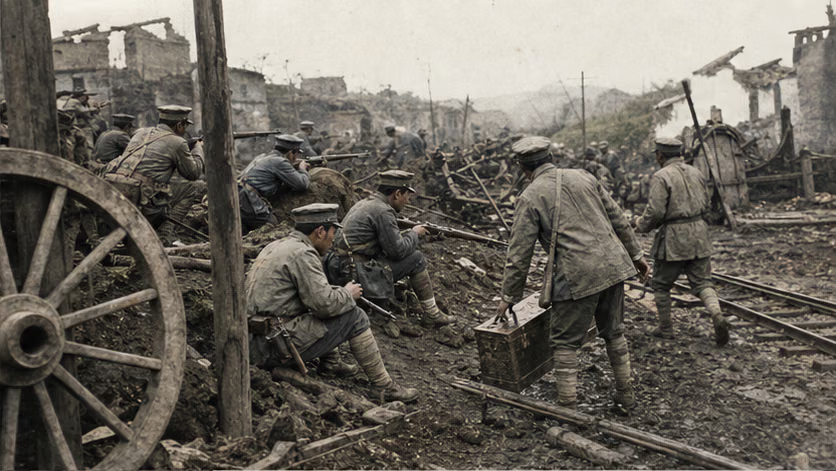
| Northern Army counteroffensive | 1918.3–4 | Cao Kun and Zhang Huaizhi advanced south on two routes, with Wu Peifu's Third Division as the main vanguard: in March it took Yueyang and Changsha in succession (3.26, unverified), and in late April occupied Hengyang; the Hunan Army retreated to southern Hunan. Beijing made Zhang Jingyao military governor of Hunan (3.27, unverified) -- ※ during his two years governing Hunan, Zhang let soldiers ruin the people, and Hunanese called him "Zhang the Poison"; in 1919–20 there was a movement to expel Zhang |
| Frontline refusal to fight | 1918.5–8 | Wu Peifu's military edge stopped at Hengyang and went no farther south -- Hunan had been taken, but the military governorship was given to the Anhui-clique Zhang Jingyao, and the Zhili clique was unwilling to pull chestnuts from the fire for someone else any longer; in May Wu's troops contacted the southern army at Leiyang over a ceasefire (5.25, unverified), and in June southern Hunan ceased fire; from August, Wu Peifu sent circular telegrams one after another stopping the war and advocating peace, directly denouncing armed unification -- Beiyang soldiers themselves called a halt to Beiyang's war, and this other side of military intervention in politics is recorded as it stands |
| North-South ceasefire | 1918.11 | The European war ended and Xu Shichang took office as president; on 11.16 Beijing ordered a ceasefire and troop withdrawal. In February of the following year, the North-South peace conference opened in Shanghai, talked, and produced no result. The gunfire had essentially stopped here, and constitutional protection as a war ended |
The fighting in Sichuan, Fujian, and Guangdong is abridged: the Sichuan National Pacification Army expelled Liu Cunhou (1918.2 Xiong Kewu entered Chengdu, unverified); Chen Jiongming's Guangdong troops aided Fujian and captured Zhangzhou in 1918 (figure disputed); Long Jiguang attacked Guangdong from Qiongya and was defeated in spring 1918 (figure disputed).
Military Government Reorganization and Sun Yat-sen's Departure from Guangdong (1918.5)
The front was still fighting, but Guangzhou's "constitutional protection" had already come apart. The Guangxi clique and Political Study Clique members of Parliament pushed reorganization: on 1918.5.4 the Extraordinary Parliament passed an amendment to the Organic Outline of the Military Government, changing the generalissimo system into a collegiate system of seven directors; Sun resigned as generalissimo that day. On 5.20 the Extraordinary Parliament elected the seven directors, with Cen Chunxuan as chairman-director (list unverified); in late May Sun left Guangdong, traveled through Chaoshan, and went on to Shanghai (dates of the journey vary by account). His farewell circular telegram read: "Looking at our country's great affliction, none is greater than the contest for supremacy among soldiers; South and North are jackals from the same lair. Even the provinces calling themselves protectors of the constitution are unwilling to bow before law and public opinion." ("Circular Telegram Resigning the Generalissimo's Office"; quotation recorded according to the common text, to be fixed against the definitive text in *Complete Works of Sun Yat-sen*, unverified.) The banner of constitutional protection was still hanging; the person of constitutional protection had already gone.
Casualties and Losses
- Soldiers: no credible overall statistics exist; civil-war battle reports each speak for themselves, and the specific figures still await supplementation from the basis used in each engagement.
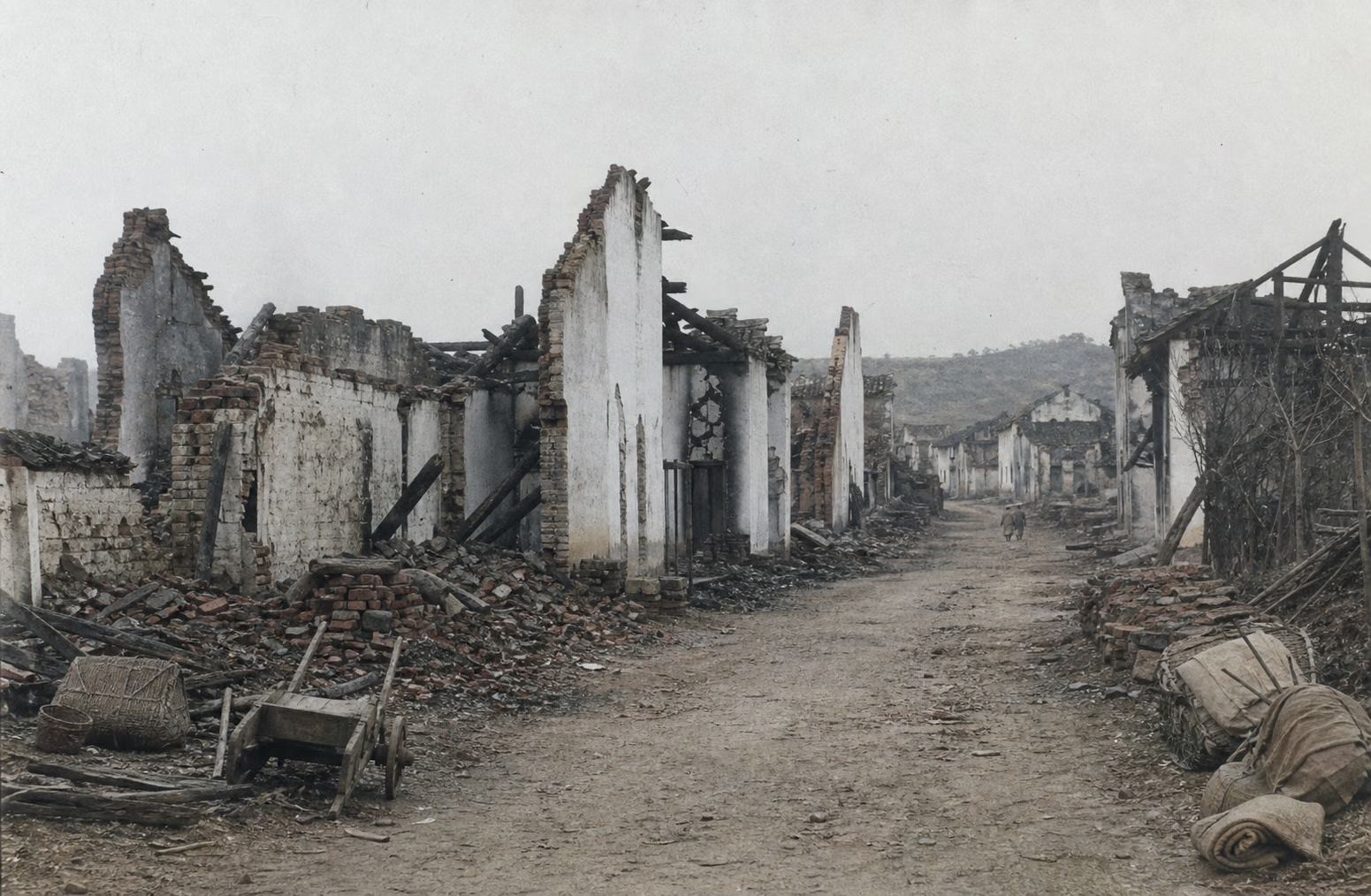
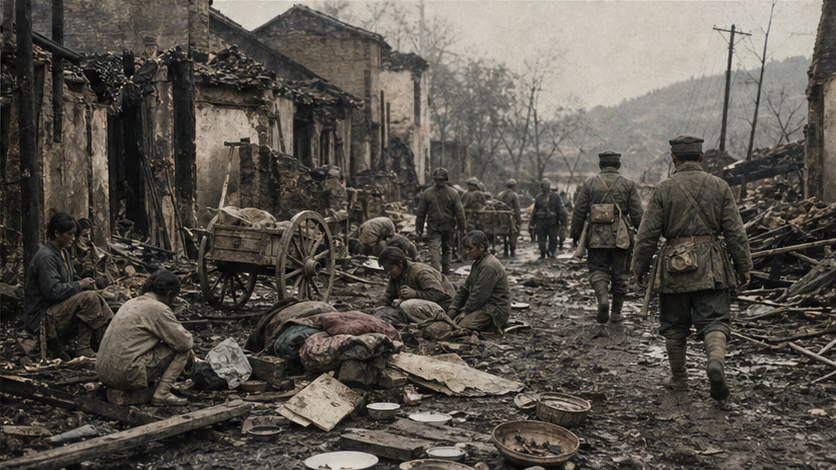
- ※ Hunan civilian military disaster: for nearly two years, Hunan was pulled back and forth between north and south; Changsha, Yueyang, Zhuzhou, Liling, and Xiangtan changed hands several times, and both sides raised pay locally and let soldiers do harm -- plunder followed the Northern Army, while allied-army requisitions were also heavy. Records that all Zhuzhou was burned (1918, said to have been done by Zhang Jingyao's troops), that Liling county seat was nearly reduced to scorched earth, and others are scattered through Hunan provincial sources (all unverified).
- ※ Zhang Jingyao as military governor of Hunan (1918.3–1920.6): he let soldiers ruin the people, coerced opium cultivation, and left education and industry withered; Hunanese called him "Zhang the Poison." From late 1919 the movement to expel Zhang began (Mao Zedong and others participated), and in 1920.6 Tan Yankai's forces drove Zhang out of Hunan.
- Finance: Beijing relied on foreign loans, while the South relied on paper money and local requisitioning; civilian strength in both Hunan and Guangdong was exhausted (specific figures unrecorded).
Aftermath
- Constitutional protection began with a constitutional demand -- one constitution and one old Parliament; it ended in territorial spoils -- the frontline ceasefire depended on territorial arithmetic among warlords, and the Guangzhou reorganization drove away the banner-bearer of constitutional protection himself. The southern and northern warlords fought under the banner of the constitution: constitutional protection in name, territorial struggle in fact.
- Sun's lesson was written in action: one could not rely on one faction of warlords to defeat another. In Shanghai he wrote *The Principle of Sun Wen* and *International Development of China*; after the May Fourth Movement, and after the appearance of Soviet Russia and the Chinese Communist Party, he turned toward alliance with Russia and reorganized the Kuomintang. The failure of the Constitutional Protection War was the direct starting point of the next stretch of history, leading onward to the *Northern Expedition*.
- Beiyang: armed unification went bankrupt, and the Zhili-Anhui contradiction broke out in 1920 as the Zhili-Anhui War; Wu Peifu became famous for stopping the war at Hengyang, and remained active for the next ten years.
- Hunan: after Zhang was expelled, Tan Yankai advocated "Hunan governed by Hunanese," opening the first sound of the movement for federal provincial autonomy.
- The name of constitutional protection did not end: in 1920–22 Sun Yat-sen returned to Guangzhou for a second constitutional protection movement, and was defeated again by Chen Jiongming -- that is another article.
How Each Side Records It
- Southern constitutional-protection narrative (Kuomintang party-history framework): the premier raised high the banner of constitutional protection and twice went south, only to be defeated by warlord betrayal. Constitutional protection is listed as one link in the revolutionary course, and the failure itself is used to prove that "reorganization was necessary, and a party army of one's own was necessary" -- failure is useful inside the narrative.
- Northern (Beiyang) narrative: a war of unification to pacify southern "rebellious military governors"; the Anhui clique recorded the enterprise of armed unification, while the Zhili clique turned Wu Peifu's refusal to fight at Hengyang into the starting point of his reputation for principle. In the same war, Beiyang itself had two ways of writing it.
- Later changes: mainland textbooks placed it in the chapter on "the end of the old democratic revolution," with emphasis on "southern and northern warlords being jackals from the same lair" and Sun Yat-sen's awakening. In recent decades, research has shifted toward southwestern power-holders and local society, and constitutional protection has more often been discussed as one side of the "beginning of warlord melee"; Taiwan has broadly followed the old Kuomintang party-history framework.
Disputes and Sensitivities
- "Constitutional protection" or "separatism": southwestern power-holders used constitutional protection to secure themselves, and historical discussion generally makes different judgments within this framework.
- Wu Peifu's stopping the war at Hengyang: the righteous-act narrative of refusing to fight and advocating peace vs. the practical calculation of Zhili-Anhui division of spoils; both readings have support in historical materials, and are placed side by side.
- Records of atrocities: Zhang Jingyao's atrocities and the Hunan military disaster mostly come from Hunan local sources and contemporary newspapers; the specific items still await item-by-item checking.
- Both sides in the civil war were Chinese armies: belligerents are named by actual formation and camp (Constitutional Protection Army · Southwestern Allied Army / Northern Army), and this article does not follow either side's labels of "rebel" or "traitor."
Contents
There are no separate articles. The military scale of this war was limited, and the Hunan engagements (the attacks and defenses of Changsha, Yueyang, and Hengyang) are incorporated into the stage table above rather than separated into articles; if the Hunan provincial engagements or Sichuan fighting are later split out, links will be attached in this section.
Sources and Open Questions
Main sources: Li Jiannong, *A Political History of China in the Last Hundred Years*; Lai Xinxia et al., *History of the Beiyang Warlords*; Tao Juyin, *Historical Tales from the Period of Beiyang Warlord Rule*; relevant volumes of *History of the Republic of China*, edited by Li Xin and Li Zongyi; *Complete Works of Sun Yat-sen* (Zhonghua Book Company, for checking the original text of the circular telegram).
Open questions:
- Dates of the military government's establishment (9.1 election / 9.10 inauguration)
- The date and proclamation by which Liu Jianfan and Lin Xiumei announced autonomy (commonly given as 1917.9.18)
- Dates when the allied army took Yueyang and when the Northern Army retook Yueyang and Changsha (commonly given as 1918.1.27 / 3.18 / 3.26, must be checked back)
- Appointment date of Zhang Jingyao as Hunan military governor (commonly given as 1918.3.27)
- The respective nodes of Wu Peifu's occupation of Hengyang, contact at Leiyang, and the southern Hunan ceasefire (commonly given as 4.23 / 5.25 / June, must be checked back)
- Dates and original texts of Wu Peifu's various 1918.8 circular telegrams advocating peace (8.7, 8.21, and other accounts coexist)
- Full text of the "Circular Telegram Resigning the Generalissimo's Office" and the phrase "jackals from the same lair," to be checked against the definitive text in *Complete Works of Sun Yat-sen*
- List of the seven directors and the election vote counts
- Dates of Sun Yat-sen's departure from Guangdong and arrival in Shanghai
- Troop-strength bases and casualties on both sides: no statistics; if the reporting bases of each side's battle reports are found, list them side by side
- Original Hunan provincial records of the Zhuzhou and Liling military disasters and of Zhang Jingyao's atrocities while governing Hunan
- Details of the fighting in Sichuan, Fujian, and Guangdong (Xiong Kewu entering Chengdu, Guangdong troops aiding Fujian, Long Jiguang's defeat)
- The name and substance of the Nishihara Loans and the organization of the War Participation Army
- The source of pay for the military government's long-term support of the First Fleet that went south (the funds Sun carried, Guangdong fiscal sharing, and other accounts coexist)
- Fiscal composition of the military government: specific figures for Guangdong finances and overseas Chinese donations
- Duan Qirui's motive for refusing to restore the constitution: the layer that restoring the constitution would prove the other government illegal is inferred from the factual structure, with no direct record
- Details of the exchanges through which Wu Peifu's troops and the southern army contacted each other for a ceasefire around Leiyang (intermediaries, terms, letters, and telegrams)
All images on this site are AI-generated depictions. They are not historical photographs, not primary sources, and do not depict any real individual.