War Overview · Taiwan Strait Crises (1954–1979)
The ink on the Panmunjom signatures had barely dried when the last page of the Chinese Civil War turned back toward the strait: from 1954 to 1979, twenty-five years in all, gunfire twice rang across Kinmen, with the Yijiangshan landing set between them; the civil war was not finished, but settled into a standing confrontation of "firing without landing, blockading without killing off," and in the end it closed with a single statement.
Engagement Data
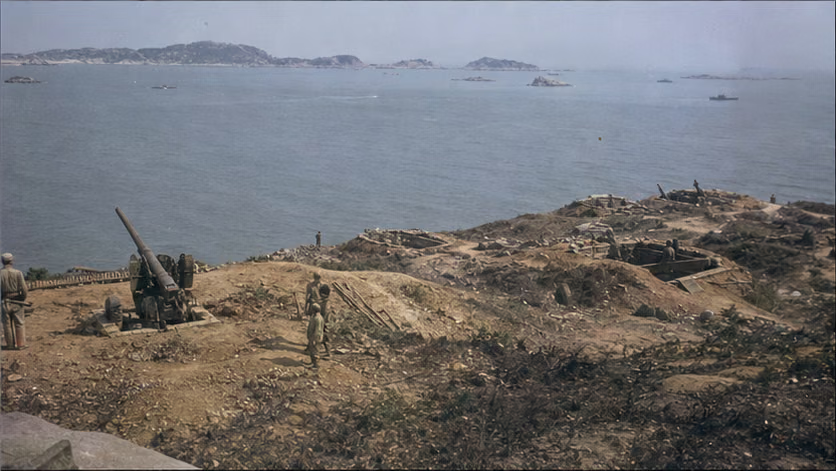
| Item | Content |
|---|---|
| Time | 1954.9.3 first shelling of Kinmen (First Taiwan Strait Crisis) – 1979.1.1 cessation of shelling |
| Place | Taiwan Strait; focused on Kinmen and Matsu, and the offshore islands along the eastern Zhejiang coast (Yijiangshan, Dachen, etc.) |
| Belligerents | Chinese People's Liberation Army / Republic of China Armed Forces; the U.S. Seventh Fleet as the background variable running through the entire period |
| Nature | An unfinished extension of the KMT-CPC civil war; between two peaks of hot war lay twenty years of politicized shelling |
| Result | In 1955, all offshore islands along the eastern Zhejiang coast changed hands; Kinmen and Matsu remained under Taiwan-side control; in 1979, the shelling stopped -- with no armistice document signed |
Belligerents (War Level)
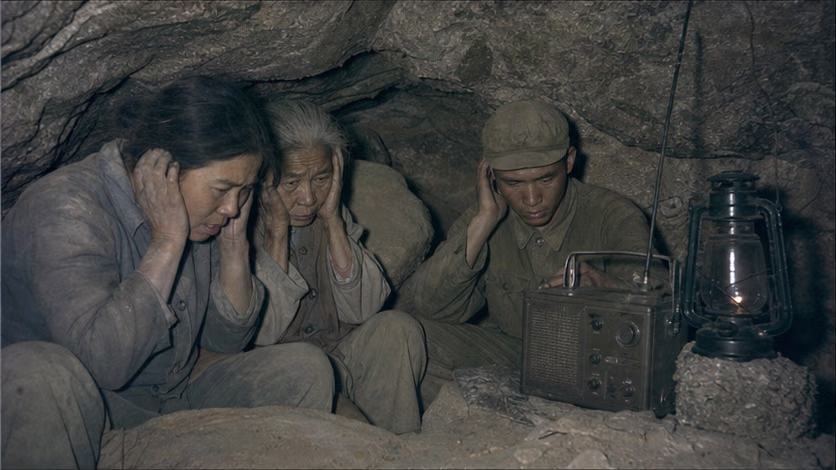
| Item | People's Liberation Army | Republic of China Armed Forces + U.S. Aid |
|---|---|---|
| Army / artillery | The Fujian-front artillery group was the main force; in 1958 several hundred guns were committed (459 pieces is a common caliber-count figure, figure disputed) | Heavy garrisons on Kinmen and Matsu (Kinmen peak roughly 85,000–96,000, bases vary by account), fortified tunnel works |
| Navy | Began from torpedo boats and patrol craft, and by 1955 had formed a landing-operation capability; the main force in the 1958 blockade of Liaoluo Bay | U.S.-made warships escorted supply runs; in 1958 the U.S. Seventh Fleet escorted as far as the three-nautical-mile line |
| Air force | MiG formations seized air superiority over eastern Zhejiang in 1955 and entered Fujian in 1958 to contest air control over the strait | F-84 -> F-86 Sabres; on 1958.9.24, the first combat use in the world of Sidewinder air-to-air missiles |
| Strategic background | In 1958, the southeastern coast shifted into a wartime footing; details of coordination with the Soviet Union remain unverified | U.S.-ROC Mutual Defense Treaty (1954.12) + Formosa Resolution (1955.1); declassified-document line on U.S. discussion of nuclear options (unverified) |
Historical Setting
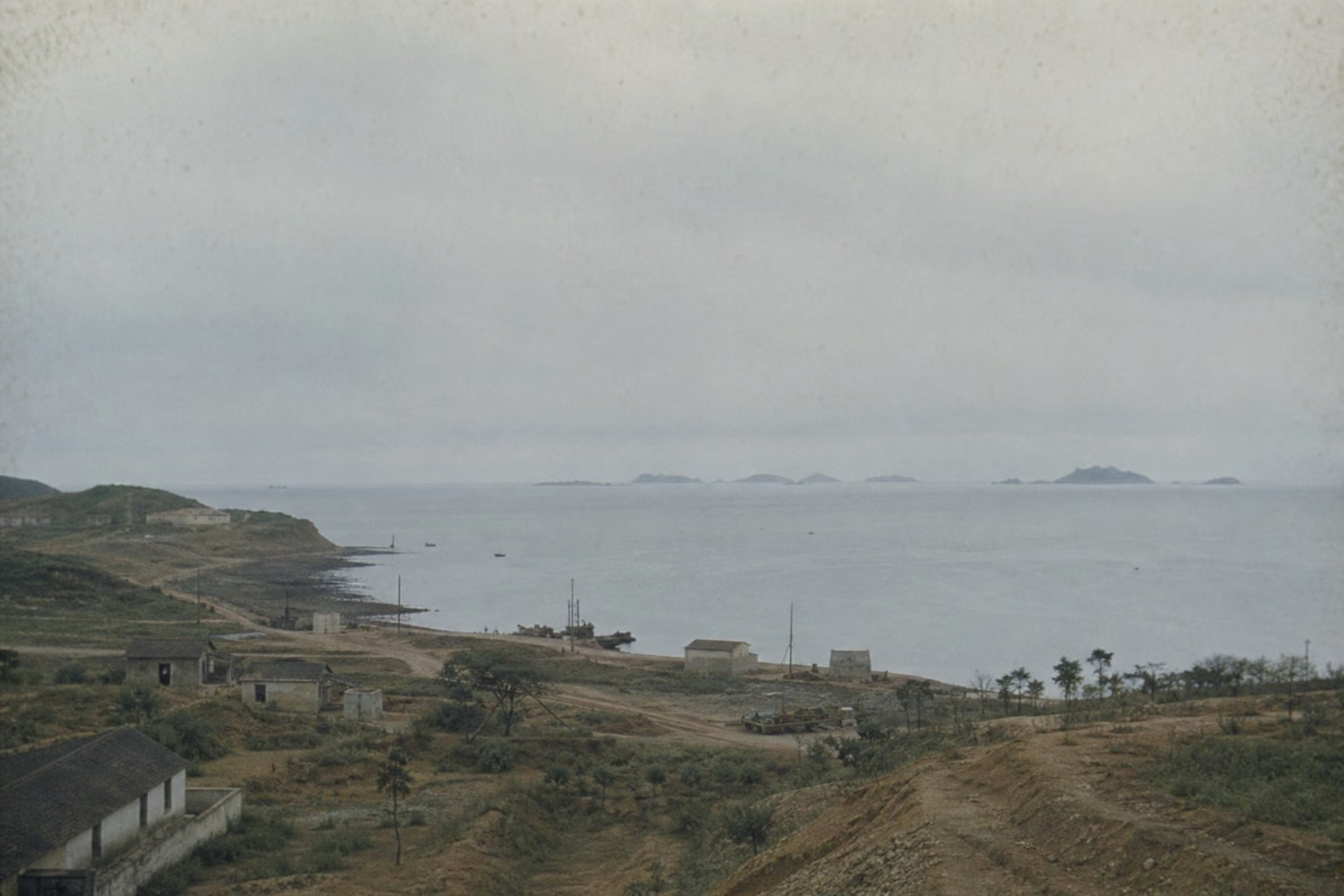
(Continuing from before: 1953.7.27 Panmunjom armistice -- see the closing of *Battle of Kumsong* and *War to Resist U.S. Aggression and Aid Korea · Overview*. After the ceasefire on the Korean Peninsula, the center of Sino-U.S. confrontation moved back to the strait.)
World: the Cold War moved south. After the Korean armistice, the United States wove its defense line toward the chain of offshore islands: in September 1954, the Southeast Asia Treaty Organization was founded; in the summer of 1958, the Middle East crisis saw U.S. and British landings in Lebanon and Jordan, pushing global tension higher. The strait was the hottest stretch of the western Pacific on the Cold War map.
China: the First Five-Year Plan was just beginning, and the southeastern coast was an economic lifeline as well as the only unfinished battlefield -- the slogan "Taiwan must be liberated" ran in parallel with operational plans for the offshore islands. After the 1955 Bandung Conference, the line turned toward probing through negotiation (the Sino-U.S. ambassadorial talks opened in Geneva in 1955.8); amid the tense mobilization under the Great Leap Forward in 1958, the shelling decision stood alongside public statements of "supporting the Middle East" and "pinning down U.S. forces" (original decision-level telegrams unverified).
United States and Taiwan: the Seventh Fleet's entry into the strait in 1950 had already frozen the battlefield (see *War to Resist U.S. Aggression and Aid Korea · Overview*); on 1954.12.2, the U.S.-ROC Mutual Defense Treaty was signed, with deliberate ambiguity over whether the treaty covered offshore islands such as Kinmen and Matsu; in January 1955, the U.S. Congress's "Formosa Resolution" authorized the president to assist in defense. Washington twice tried to persuade Chiang to withdraw from Kinmen and Matsu; Chiang held on -- Kinmen and Matsu were the springboard for "counterattacking the mainland," and also Taipei's anchor for holding Washington in place.
Why It Was Fought
This confrontation was the unclosed tail of the Chinese Civil War. In the 1949 battle at Guningtou, more than nine thousand men who had landed on Kinmen did not return (figures vary by account), and from then on the People's Liberation Army knew the weight of the water in this strait; in June 1950, the Seventh Fleet moved into the Taiwan Strait, and the window for attacking Taiwan was welded shut by outside force. The war on the Korean Peninsula overlaid the strait for three years.
In July 1953, the Panmunjom armistice freed up troops and attention, and the strait returned to the table. Beijing's determination took shape that summer: the Taiwan question had to be placed back on the agenda, and a Korean-style ceasefire line could not be allowed to reproduce itself in the strait -- Washington was negotiating a mutual defense treaty with Taipei, and if the offshore islands were written into that treaty, "two Chinas" might turn from a fait accompli into a legal fact. The joint declaration on liberating Taiwan by the democratic parties and people's organizations was issued in August (declaration text unverified), and on September 3 the shells fell on Kinmen -- fired for Taipei to see, and still more for Manila and Washington to see: whether the treaty covered these small islands had first to be answered.
Washington's answer was to leave the answer blank. The treaty was signed in December 1954; its text named only Taiwan and Penghu, while Kinmen and Matsu were deliberately left in the zone of ambiguity. What the United States wanted was a Taiwan-Penghu defense line, not to guard Chiang Kai-shek's springboard for counterattack, and it later urged Chiang more than once to withdraw from Kinmen and Matsu. Chiang would not withdraw under any circumstances -- Kinmen and Matsu were the facade of his "counterattack against the mainland," and also the anchor that held the United States. Beijing understood this opening: shelling Kinmen and Matsu struck the most painful joint in the U.S.-Taiwan alliance.
When fighting resumed in 1958, the accounting changed. In July, U.S. troops landed in Lebanon, pushing global tension higher; harassment and reconnaissance from across the strait continued; Washington's inclination to "divide and govern across the strait" became increasingly explicit. In the August 23 decision, several layers of motive coexisted: supporting the Middle East, probing the U.S.-Taiwan alliance, and preventing two Chinas (original decision records for each layer of motive unverified). Khrushchev had just left Beijing at the end of July, and the Soviet side is generally said not to have known the shelling plan beforehand (common account, unverified) -- Beijing was unwilling to place the fate of the strait in the hands of any ally. After the fighting began, the blockade could not kill off the islands, and no landing was launched; "firing without landing, blockading without killing off" changed from expedient to policy. With Kinmen and Matsu left in the other side's hands, a visible line remained between the two shores; from then on, the baton of shelling pointed more often at political graduations than at military ones.
This firing continued for twenty years: fire on odd-numbered days, pause on even-numbered days, with propaganda shells replacing lethal shells. On 1979.1.1, as China and the United States established diplomatic relations, Beijing stopped the shelling with a single statement -- the confrontation began in order to prevent the strait from hardening into a national border, and it ended on the same matter.
Course of the Engagement (Two Peaks + Twenty Years of Shelling)
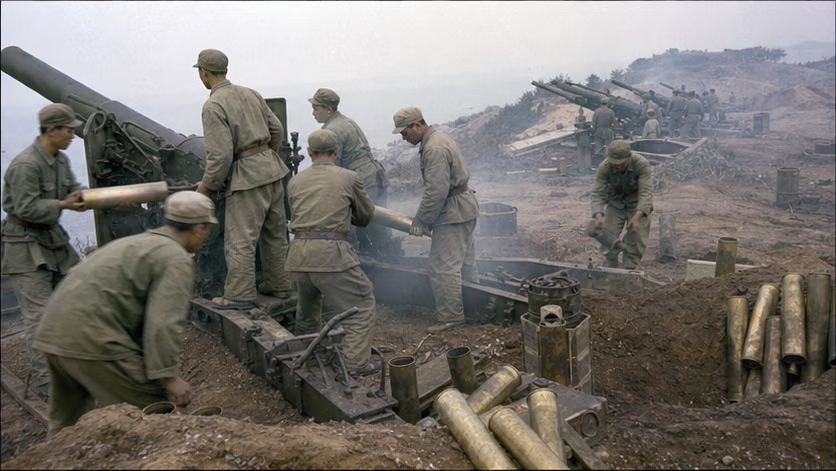
| Phase | Time | Main Points | Separate Articles |
|---|---|---|---|
| First crisis | 1954.9–1955.5 | The opening came with the 1954.9.3 shelling of Kinmen (struck again on 9.22; shell-count bases vary by account); in December the U.S.-ROC treaty was signed; on 1955.1.18 came the Yijiangshan landing -- the People's Liberation Army's first joint operation by the three services; in February the Dachen evacuation took place, and all offshore islands along the eastern Zhejiang coast changed hands; after the Bandung Conference in April, the crisis cooled, and in May the shelling subsided | 1955.01 Battle of the Yijiangshan Islands |
| Interlude | 1955–1958 | The Sino-U.S. ambassadorial talks (Geneva -> Warsaw) dragged back and forth, then were downgraded and interrupted at the end of 1957 (unverified); harassment and reconnaissance continued in both directions; U.S. forces on Taiwan were strengthened (Matador missiles deployed to Taiwan in 1957, unverified) | — |
| Second crisis | 1958.8.23–10.25 | The August 23 first sudden bombardment killed three deputy commanders of the Kinmen Defense Command that day; blockade and counter-blockade at Liaoluo Bay, with U.S. naval escort stopping at the three-nautical-mile line; on 9.24, Sidewinder missiles were first used in combat in an air battle; on 10.6 the *Message to Compatriots in Taiwan* announced a one-week ceasefire, shelling resumed on 10.20, and on 10.25 the *Second Message to Compatriots in Taiwan* set the rule of "shell on odd days, do not shell on even days" | 1958.08 Kinmen Artillery Battles |
| Twenty years of shelling | 1958–1979 | A tacit routine of firing on odd-numbered days and pausing on even-numbered days; propaganda shells gradually became the main form; the large-scale "welcome-and-sendoff shelling" around Eisenhower's 1960 visit to Taiwan (scale varies by account) | — |
| Closing | 1979.1.1 | On the day China and the United States established diplomatic relations, Defense Minister Xu Xiangqian issued a statement: from that day onward, shelling of Greater Kinmen, Lesser Kinmen, Dadan, Erdan, and other islands would cease | — |
Casualties and Losses
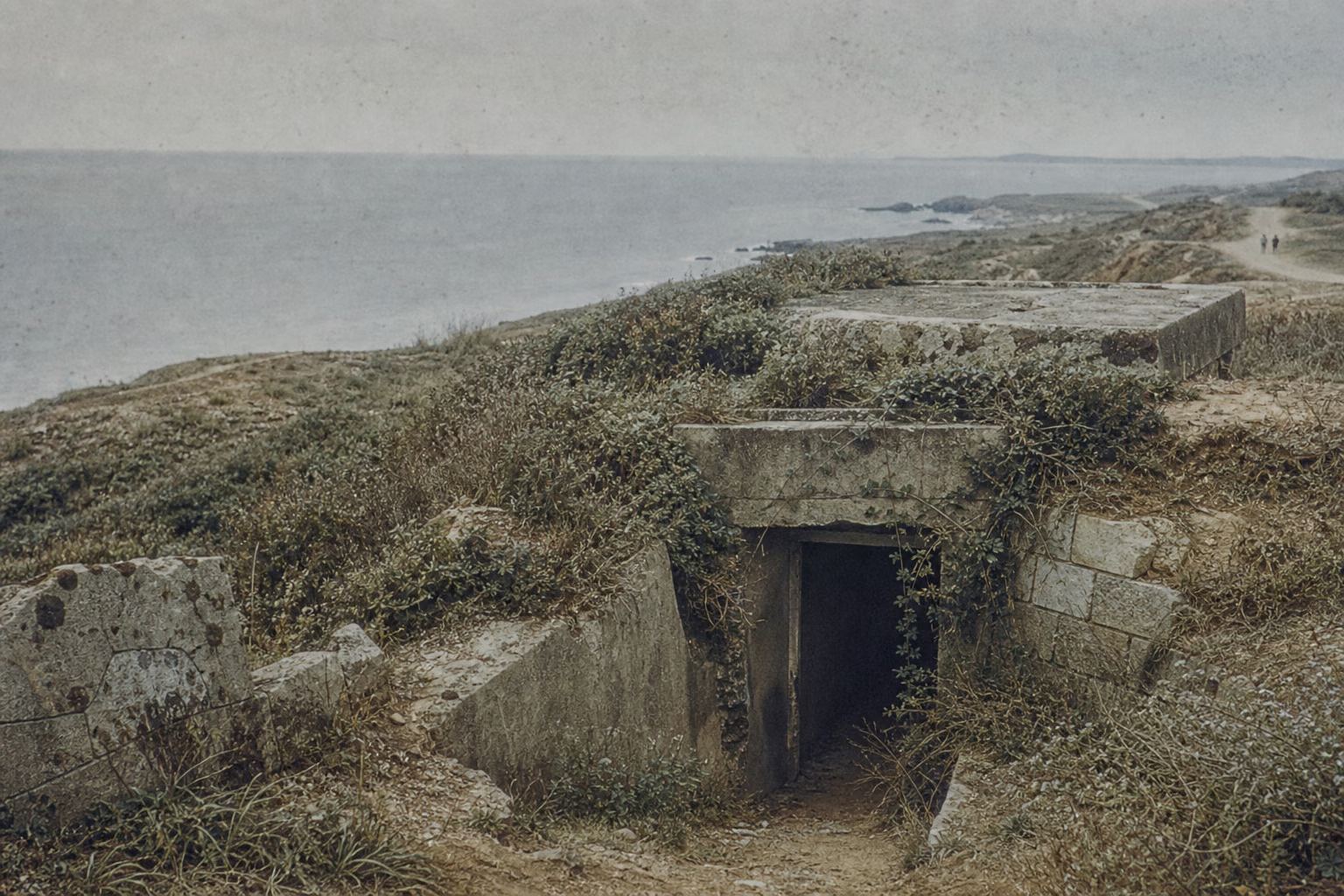
- Casualties in the two peaks were concentrated on Kinmen and Yijiangshan; see the separate articles, where the figures from both sides are placed side by side.
- Dachen evacuation: about 15,000 soldiers and civilians (another count including troops gives 25,000, unverified) were escorted by the U.S. Seventh Fleet to Taiwan -- Taiwan-side accounts call them the "Dachen righteous compatriots."
- ※ Kinmen islanders lived under periodic shelling for twenty years, and the full statistical basis for their livelihoods, casualties, and out-migration remains unverified -- under artillery shells there are no bystanders, only residents.
- This is a set of casualties with modest numbers and enormous political weight: the intention of every round lay beyond the points of impact.
Aftermath
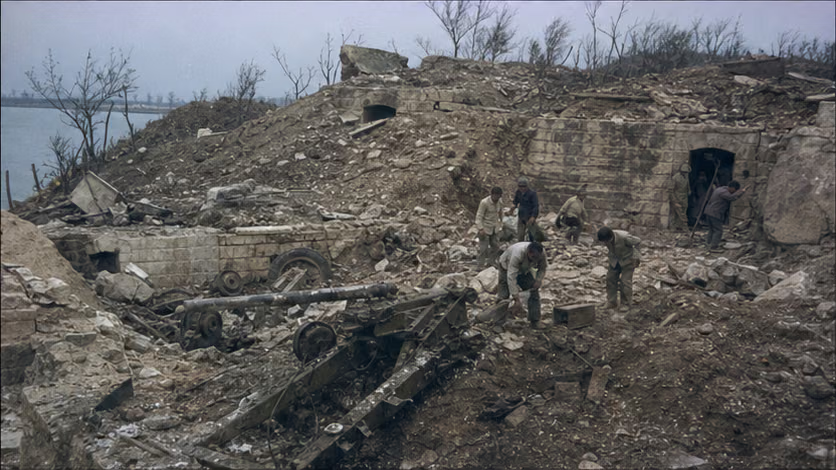
- The 1955 closure: all offshore islands along the eastern Zhejiang coast changed hands, and the Taiwan side lost the northern section of its chain of strongpoints nailed into the mainland's side; the crisis closed by opening the Sino-U.S. ambassadorial talks -- only after the fighting was done could the negotiating table stand level.
- The 1958 closure: the blockade was not completed and no landing was launched, but "firing without landing, blockading without killing off" itself became the result -- Kinmen and Matsu remained in Taiwan-side hands, and also preserved the last visible, tangible line between the two shores; the original context of the Chinese decision leadership's "noose" formulation (September speech at the Supreme State Conference, text unverified) remains unverified.
- The military significance of twenty years of shelling approached zero, while its political significance reached the maximum: shelling became a communication method tacitly accepted by both sides -- fired on odd-numbered days for the other shore to see, and also for Washington and Moscow to see.
- The closing on 1979.1.1: the establishment of Sino-U.S. diplomatic relations, the Standing Committee of the National People's Congress's *Message to Compatriots in Taiwan*, and Xu Xiangqian's statement stopping the shelling were issued on the same day. The defense minister who signed the statement was Xu Xiangqian, who in this archive had fought all the way from the Guangzhou Uprising (1927), Sujiabu (1932), Linfen, Jinzhong, and Taiyuan (1948–49) -- a man who had spent half his life assaulting cities, and who on the shore of the strait unfastened the breechblock of the last gun.
How Each Side Records It
- Mainland: "Shelling Kinmen" as a textbook case of a political and diplomatic battle; the history of vocabulary changing from "Taiwan must be liberated" to "peaceful reunification" is also inside it.
- Taiwan: the "August 23 Battle" is one of the centers of the Republic of China Armed Forces' homeland-defense narrative and is commemorated every year; Wang Shengming of Yijiangshan was enshrined in the National Revolutionary Martyrs' Shrine; the "Dachen righteous compatriots" became one branch of the mainlander community in Taiwan. Kinmen itself changed from battlefield to memorial site -- knives forged from artillery shells are a shared object of popular memory on both sides.
- United States: the two crises are classic cases in the study of crisis management and nuclear-brink decision-making; declassified documents on the 1958 discussion of nuclear options (Eisenhower and Joint Chiefs of Staff levels, unverified) -- disagreements and assessments stand side by side.
- Scholarship: Cold War international history studies the two Taiwan Strait crises alongside the Berlin crises; the two lines are the history of crisis negotiations and alliance management (the theory of "dual deterrence," in which the United States and Taiwan constrained each other).
Disputes and Sensitivities
- Present boundaries: this section concerns historical facts and the records of both sides at the time; it does not read them backward through present-day terminology.
- The intention behind the 1958 decision has multiple interpretations: support for the Middle East, probing the U.S.-Taiwan alliance, preventing "division and rule across the strait," coordination with domestic mobilization, and other accounts coexist.
- The tacit nature of "shell on odd days, do not shell on even days": the two sides never signed any document, and the survival of the tacit arrangement is itself an unverified topic.
- Evidentiary level for U.S. discussion of nuclear options: declassified files state the discussion directly, but this must be distinguished in level from "intention to use."
- The two narratives of the Dachen evacuation ("righteous compatriots" / forced relocation and burning, unverified) are placed side by side.
- Casualty figures differ sharply between the two sides' bases.
Contents
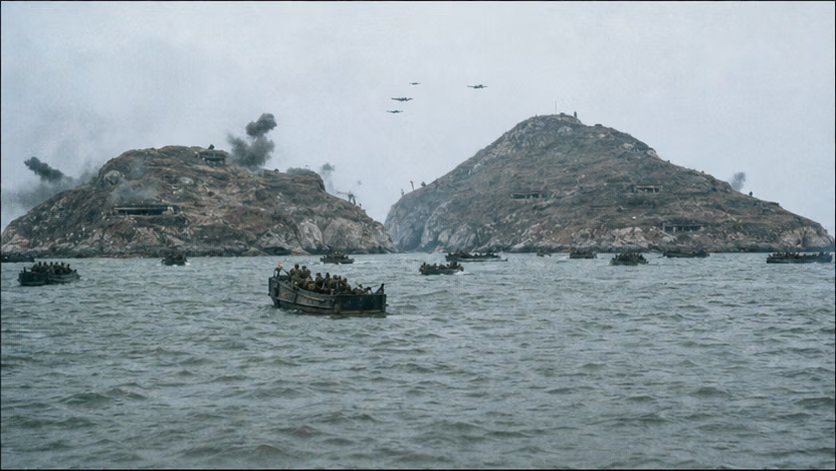 Battle of the Yijiangshan Islands1955.01On January 18, 1955, the People's Liberation Army carried out its first joint landing operation by the army, navy, and air force, taking a 1.2-square-kilometer island in ten hours; less than a month later, all Taiwan-side forces withdrew from the Dachen Islands, and the island chessboard off the eastern Zhejiang coast was brought to a close.
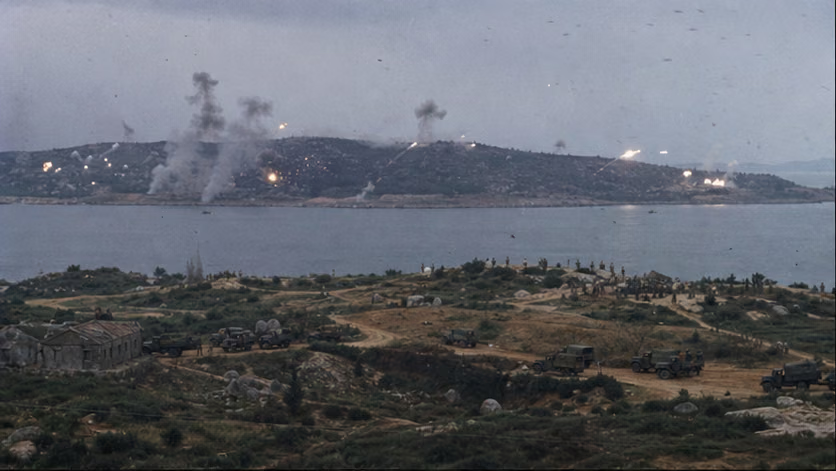 Kinmen Artillery Battles (August 23 Bombardment)1958.08At dusk on August 23, 1958, several hundred guns drove tens of thousands of shells into Kinmen in two hours, and three deputy commanders of the Kinmen Defense Command were killed that day; for the next twenty years, the two shores of the strait fired on odd-numbered days and rested on even-numbered days, until artillery fire became a political language.
Sources and Open Questions
Known main sources:
- Xu Yan, *The Battle of Kinmen* and *The First Contest* (popular Chinese-side war-history accounts, to be checked item by item)
- Taiwan-side *War History of the National Revolutionary Army*, relevant volumes, and memoirs by Wang Dingjun and others (original books to be checked)
- U.S. declassified documents: FRUS 1955–1957 and 1958–1960 China volumes; Eisenhower Library crisis files
- Studies of Cold War international history by Shen Zhihua and others (chapters on the two Taiwan Strait crises)
Open questions: shell counts and command levels for the 1954.9.3 and 9.22 shellings; bases for total artillery pieces in the 1958 artillery groups; peak figures for the Kinmen-Matsu garrison; the level at which the ambassadorial talks were downgraded and interrupted in 1957; timing of Matador missile deployment to Taiwan; scale of the 1960 "welcome-and-sendoff shelling"; each count for the Dachen evacuation population; original text of the "noose" formulation speech; itemized files on U.S. nuclear options; full text of Xu Xiangqian's 1979.1.1 statement; text and issuing level of the joint declaration on liberating Taiwan; decision level and intent records for the 1954.9.3 shelling; original records for each layer of motive in the 1958 shelling decision; evidentiary level for the claim that the Soviet side did not know beforehand.
All images on this site are AI-generated depictions. They are not historical photographs, not primary sources, and do not depict any real individual.