Engagement Archive · Battle of the Yijiangshan Islands
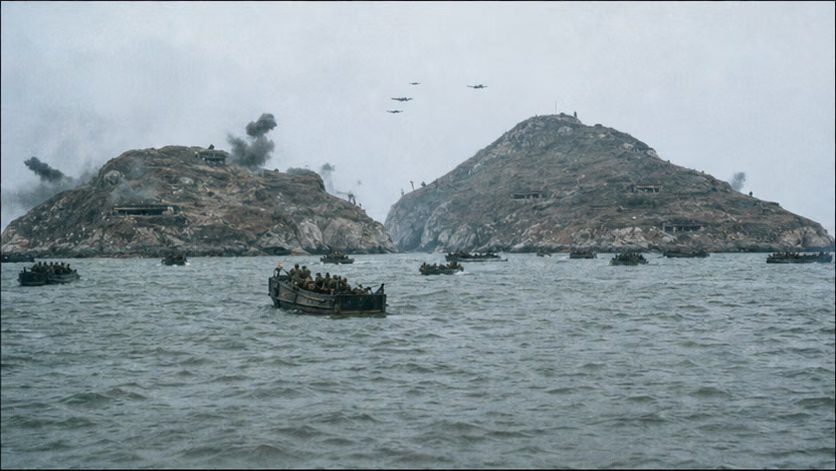
On January 18, 1955, the People's Liberation Army carried out its first joint landing operation by the army, navy, and air force, taking a 1.2-square-kilometer island in ten hours; less than a month later, all Taiwan-side forces withdrew from the Dachen Islands, and the island chessboard off the eastern Zhejiang coast was brought to a close.
Engagement Data
| Item | Content |
|---|---|
| Time | 1955.1.18 – 1.19 |
| Place | Yijiangshan Island off Taizhou Bay, Zhejiang (about 11 kilometers northwest of Dachen Island, in the gateway position) |
| Belongs to | Taiwan Strait Crises · closing engagement of the First Taiwan Strait Crisis (1954.9–1955.5) |
| Attacker | Eastern Zhejiang Frontline Command of the East China Military Region (commander and political commissar Zhang Aiping), with the 178th Regiment, 60th Division, 20th Army as the main landing echelon, supported by naval vessels, air-force formations, and artillery |
| Defender | Republic of China Armed Forces Yijiangshan Area Command (commander Wang Shengming; rank and posthumous promotion unverified), about one thousand garrison troops |
| Result | Landing in the afternoon of 1.18; the island was basically occupied by dusk that day; remnants were cleared in the early hours of 1.19; Wang Shengming was killed (cause of death differs between the two sides' accounts); in February the Dachen Islands were fully evacuated |
Belligerents
| Item | Attacker | Defender |
|---|---|---|
| Strength | Landing infantry of about one reinforced regiment (more than 3,000 is a common figure, unverified), with total participating personnel around ten thousand (figures vary by account) | About 1,000–1,100 men (another count gives 720; both are retained as unverified) |
| Firepower | Artillery groups on Toumenshan and other islands and shores + naval gunfire + aerial bombing, the first joint assault by the three services' firepower | Mortars and machine-gun fire points relying on fortifications; no sea or air support (U.S. ships did not intervene) |
| Navy | Landing craft, gunboats, and torpedo boats participated (more than 180 vessels is a common figure, unverified) | — |
| Air force | Fighter, bomber, and attack-aircraft formations (more than 180 sorties is a common figure, unverified); air superiority over eastern Zhejiang had already been secured | — |
| Fortifications | First full rehearsal of the landing process: sea crossing, transfer, and beachhead assault | The whole island was fortified: three defensive lines, bunker groups, minefields, and core positions |
Terrain and Conditions
(For the larger setting of the Cold War's southward shift in 1954–55 and the signing of the U.S.-ROC treaty, see *Taiwan Strait Crises · Overview*; here the focus is only the sea off eastern Zhejiang.)
Dachen Islands: Taiwan's last and largest chain of strongpoints off the eastern Zhejiang coast: Upper and Lower Dachen were the main islands, while Yushan, Pishan, and Yijiangshan ringed the outer perimeter, with more than ten thousand troops stationed there (figures vary by account). It was a forward base for raiding the mainland coast and monitoring fishing grounds and sea lanes, and also the nail pinned outside Zhejiang's door on Taipei's map.
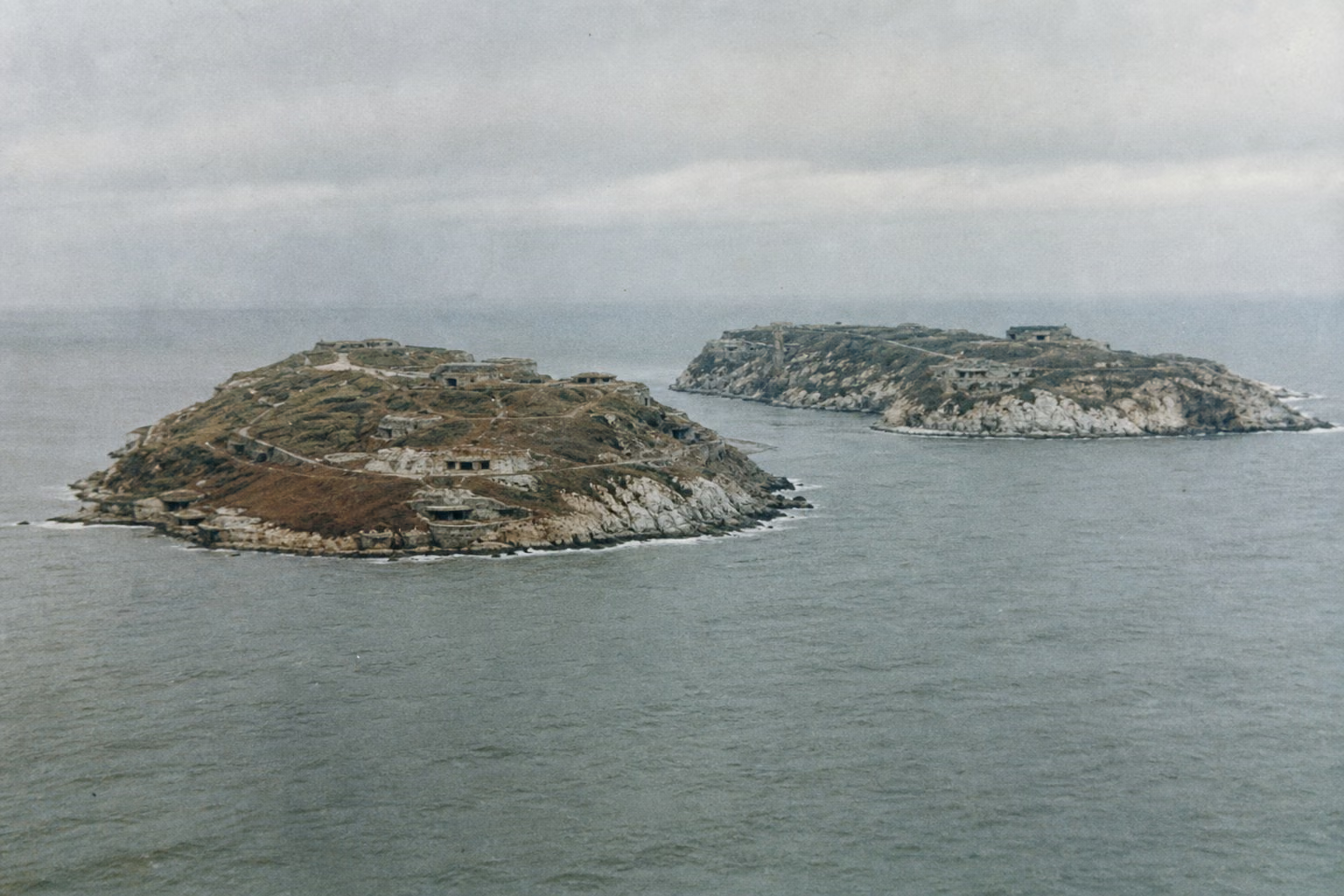
Yijiangshan: The northwestern gateway of Dachen, with an area of only about 1.2 square kilometers, divided into the two small islets of Beijiang and Nanjiang. If it was held, Dachen's northwestern side still had a screen; if it was lost, Dachen was exposed to direct fire. The island was small, but had been fortified for years: the fight was against works, not terrain.
Prelude to air and sea control: From March 1954, the two sides pulled back and forth for half a year in the air and at sea off eastern Zhejiang; on 11.14, navy torpedo boats sank Taiwan's escort destroyer *Taiping* -- the battle's real opening whistle (details of the sinking unrecorded).
Why It Was Fought
After the Panmunjom armistice, the strait became the hottest stretch of Sino-U.S. confrontation (for the larger setting, see *Taiwan Strait Crises · Overview*): the shelling of Kinmen on September 3, 1954 opened the crisis, and on December 2 the U.S.-ROC *Mutual Defense Treaty* was signed. The treaty stated that the United States would help defend Taiwan and Penghu, but deliberately left Kinmen, Matsu, and the farther-north islands off eastern Zhejiang blank. That blank space was both opportunity and risk: Beijing had to move before this ambiguous zone hardened into a fait accompli.
Why eastern Zhejiang rather than Kinmen and Matsu: behind Kinmen and Matsu stood the authorization just passed by the U.S. Congress, while the islands off eastern Zhejiang lay far outside the treaty's fresh ink; and the Dachen Islands blocked Taizhou Bay and harassed fishing grounds and sea lanes, choking the First Five-Year Plan's southeastern coast day after day. Why Yijiangshan: Zhang Aiping strongly advocated taking the gateway first -- the island was small and isolated, and once it was taken, Dachen would fall without being attacked. At a higher level, this was the first joint landing by the army, navy, and air force in twenty-seven years of the army's history; testing the blade on a small island kept the cost controllable. Why January: the treaty was moving through ratification (the U.S. Senate approved it in February, unverified), and Washington was already calculating how to persuade Chiang to withdraw from eastern Zhejiang -- before withdrawal could become an "American-arranged face-saving exit," a victory could rewrite the board.
Each of the three sides had its own ledger: Taipei judged that an island assault would have to be paid for in blood and might drag in U.S. intervention; Washington judged that the island could not be held but was unwilling to say openly that it would be abandoned; Beijing wagered that the United States would not send troops for a barren island outside the treaty. On the morning of January 18, aircraft took off from Ningbo, Jianqiao, and other airfields (details of departure airfields unverified).
There was in fact another path: wait for the United States to pressure Chiang into evacuating the islands, and obtain Dachen without fighting. But that would have handed Washington the right to dispose of the offshore islands -- Beijing wanted to take them itself.
Course of the Engagement
| Phase | Time | Key Points |
|---|---|---|
| Prelude | 1954.3–11 | Air-sea seesaw to seize air and sea control; on 11.14, torpedo boats sank the escort destroyer *Taiping* |
| Assembly | 1955.1.16–17 | Landing echelons reached departure points such as Toumenshan; the weather window had originally been poor, but on the 17th the decision was made (decision details unverified) |
| Fire assault | From 1.18 08:00 | Multiple rounds of air-force bombing; around noon, shore artillery and naval guns opened together (chronologies vary by account) |
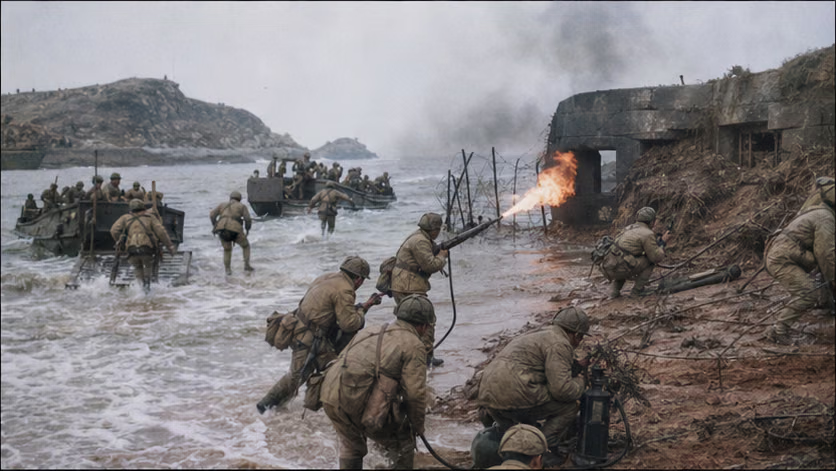
| Landing | Around 1.18 13:30 | Assaults came ashore at multiple beaches, with Beijiang as the main attack direction; the defenders' counterattacks in depth were suppressed |
| Fighting in depth | 1.18 afternoon–evening | Core positions such as Heights 190 and 203 were taken (elevation numbers not yet detailed); by dusk, the whole island was basically under control |
| Clearance | 1.19 02:00 | Remnants on Nanjiang were cleared, and the battle ended |
Casualties and Losses
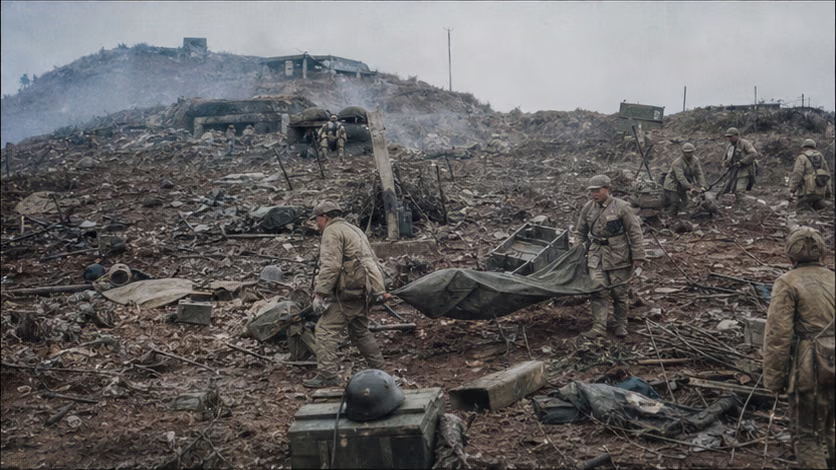
- Chinese-side figures: 519 defenders killed and 567 captured (1,086 total, a common figure, unverified); 393 attackers killed (common figures vary by account), with more than one thousand wounded (unverified).
- Taiwan-side figures: the martyrdom narrative that 720 defenders "fought to the last and not one surrendered alive"; Wang Shengming died by suicide for the cause (Taiwan side) / was killed in action (Chinese side) -- the two accounts are placed side by side, both unverified.
- Whichever set of figures is used: the defenders were nearly wiped out; the attackers' death toll was the real price tag of this "test of the blade."
Aftermath
- 2.8–2.25 Dachen evacuation: escorted by the U.S. Seventh Fleet, about 15,000 soldiers and civilians (another count including troops gives 25,000, unverified) withdrew to Taiwan; island facilities were destroyed before the evacuation (the scope of burning varies by account). Taiwan-side accounts call the military and civilian evacuees the "Dachen righteous compatriots."
- On 2.26 Nanji Mountain Island was evacuated, and all offshore islands along the eastern Zhejiang coast changed hands. The military line of the First Taiwan Strait Crisis closed here, turning into the diplomatic line of the Bandung Conference and the Sino-U.S. ambassadorial talks (see the overview).
- Significance in army history: the first organizational, coordination, and logistics template for a joint landing operation by the three services, long used as a teaching model for landing operations (process of doctrinalization unverified).
Accounts of Those Present
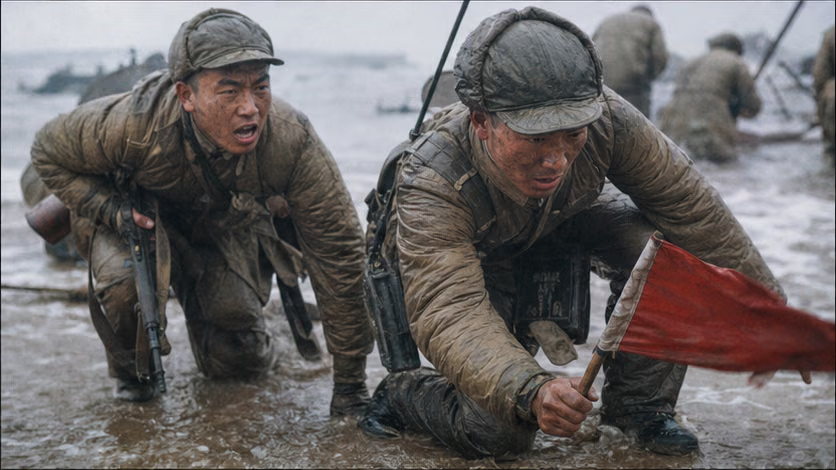
- Wang Shengming: commander of the defenders, who had already made a will and sent away his family before the battle (details unverified); Taiwan enshrined him in the National Revolutionary Martyrs' Shrine, and commemoration of Yijiangshan was built almost around him alone.
- Zhang Aiping: the decision and command of the battle are scattered through his memoir writings (Zhang Sheng, *Coming Through War*); the process by which he rejected the proposal to "take Dachen directly" and argued for striking the gateway first (unverified).
- *Taiping*: in the early hours of 1954.11.14, torpedo boats lay in ambush and sank it -- one of the largest warships lost by the Taiwan-side navy after the Second World War (figures vary by account); the Yijiangshan battle's sea control begins from that night.
- First landing echelon: the beachhead assault on the afternoon of 1.18 was this army's first: engineers blasting obstacles, flamethrowers burning bunkers, signalmen marking channels on the beach, with details scattered in participants' memoirs (titles to be added).
- Civilians on the island: before the battle there were fisherfolk and residents on the island, trapped together with the defenders during the fighting; their postwar whereabouts and statistics remain unverified -- the memory of the small island contains more than soldiers.
The Ground
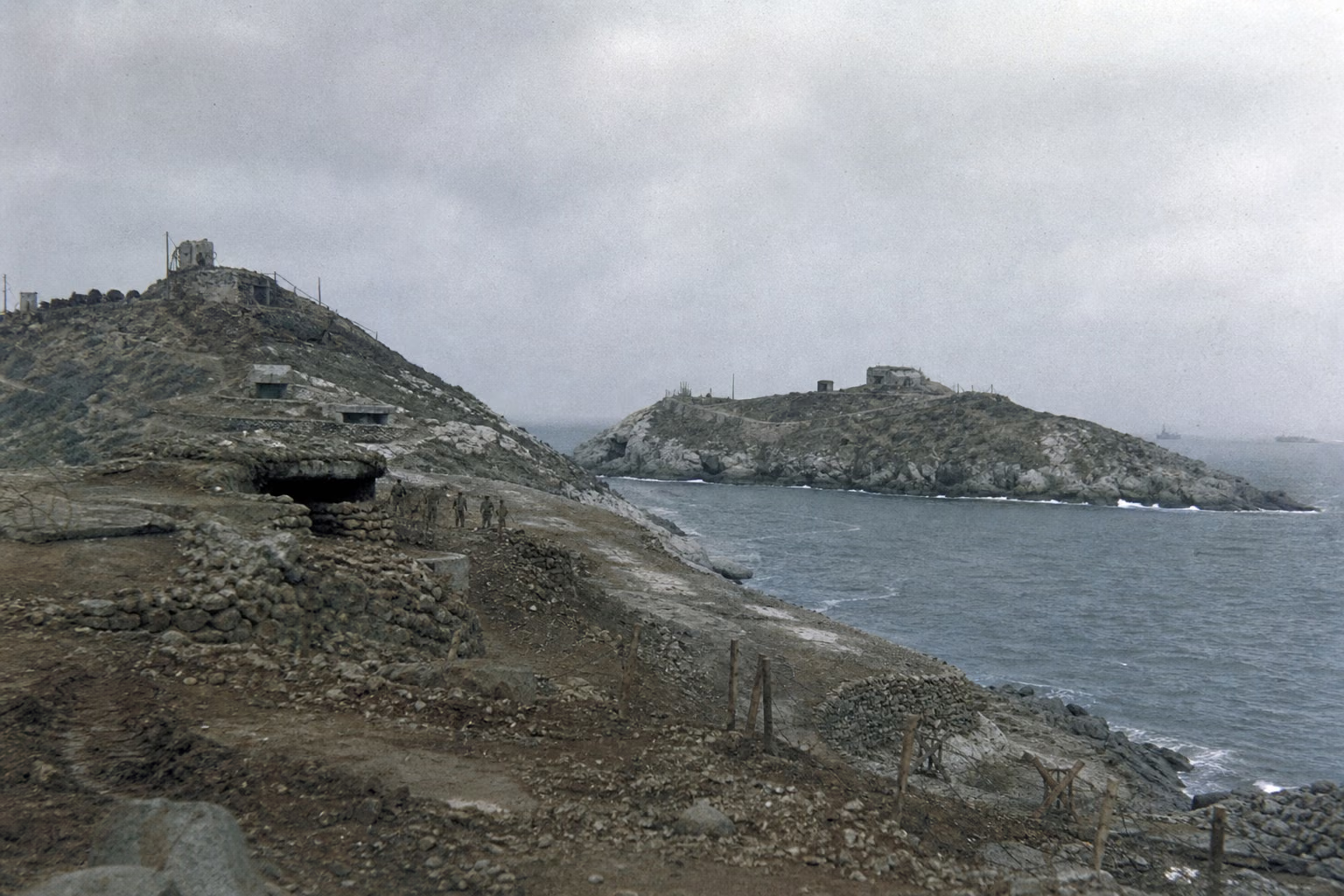
- Yijiangshan is about 11 kilometers from Dachen -- Dachen's guns could reach Yijiangshan, but could not save it.
- The island is divided into Beijiang and Nanjiang, separated by a narrow strait, each independently defended; the core positions were several heights (elevations 190 and 203 unverified).
- Toumenshan Island was the attackers' artillery position, only several thousand meters from Yijiangshan (distance unverified) -- direct-fire shore artillery compressed the "landing prelude" into a few dozen minutes.
- Spatial grammar: a 1.2-square-kilometer fortress island, where the defenders had no depth and the attackers had no room for trial and error -- one battle decided the whole island.
How Each Side Records It
- Mainland: "the first joint landing operation by the army, navy, and air force" -- the starting point of army history and landing-operation doctrine.
- Taiwan: the "Battle of Yijiangshan" centers on a narrative of all defenders dying for the nation, with Wang Shengming enshrined in the National Revolutionary Martyrs' Shrine; commemoration of the "Dachen righteous compatriots" who moved to Taiwan forms its own branch.
- United States: in crisis files, this battle is recorded as the loss of the treaty's ambiguous zone (FRUS volume unverified), directly pushing the decision to "persuade Chiang to withdraw from eastern Zhejiang."
- Local Zhejiang: in 1956, a youth reclamation team landed on Dachen Island, now a memorial site for the "reclamation spirit" -- another layer of memory on the same island.
Disputes and Sensitivities
- The two sets of figures for casualties and defender strength differ sharply.
- Wang Shengming's cause of death has two accounts, suicide for the cause and killed in action; there is still no settled conclusion.
- Narratives of the Dachen evacuation: the Taiwan-side "righteous compatriots" account and accusations of "forced relocation and island burning" (unverified) are placed side by side.
- This is the only first rehearsal of a joint landing by the three services in the whole project; "victory came too quickly" does not mean the battle had no approach. The real seesaw lay in the half-year prelude of air and sea control before it.
Sources and Open Questions
Known main sources:
- Zhang Sheng, *Coming Through War: A Record of Zhang Aiping's Life*
- Relevant chapters in official military histories such as *Military Work of the Contemporary Chinese Armed Forces* (to be rechecked)
- Taiwan-side *War History of the National Revolutionary Army*, chapter on the Battle of Yijiangshan, and commemorative literature on Wang Shengming (original books to be checked)
- FRUS 1955–1957 China volume (U.S. archives)
Open questions: each account of participating strength (landing-echelon numbers, vessel counts, sortie counts); the two counts for defender strength (720 / 1,086); the source for the 393 attacker deaths; Wang Shengming's life, rank, and cause of death; the distance from Toumenshan to Yijiangshan; elevation numbers for the heights; decision details on 1.17; departure airfields; details of the sinking of *Taiping*; each count for the Dachen evacuation population and the scope of island burning; details of the 1956 youth reclamation team.
All images on this site are AI-generated depictions. They are not historical photographs, not primary sources, and do not depict any real individual.