War Overview · War to Resist U.S. Aggression and Aid Korea (1950–53)
One year after its founding, with almost everything still waiting to be rebuilt, China fought the world's foremost power, commander of a 16-country coalition, across the Yalu River for two years and nine months; from Onjong to Panmunjom, the front finally came to rest again at the 38th Parallel. China paid hundreds of thousands of casualties for one result: the era that had begun in 1840, when "anyone could fight their way in," ended here. That is why this war is called the "war of national founding," and why Whence We Came ends with it.
Engagement Data
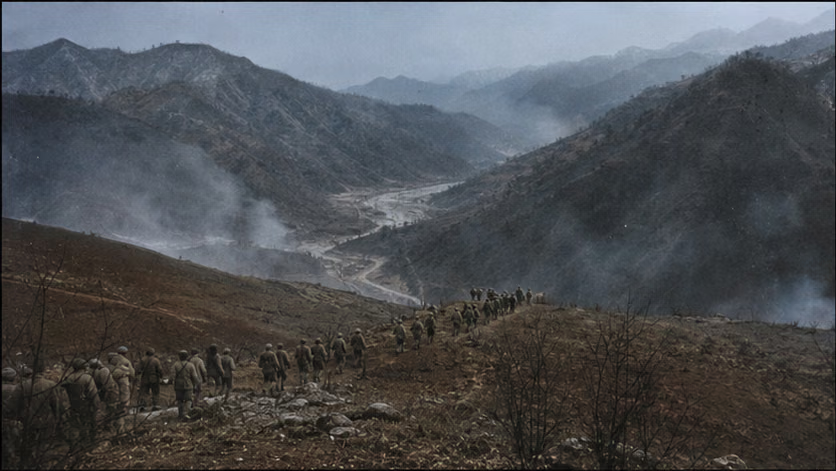
| Item | Details |
|---|---|
| Time | 1950.10.19 the Chinese People's Volunteer Army crossed the river (10.25 first battle -- War to Resist U.S. Aggression and Aid Korea Memorial Day) - 1953.7.27 Panmunjom Armistice |
| Place | The entire Korean Peninsula; Northeast China served as the main rear area (U.S. bombing affected Andong and other places ※) |
| Belligerents | Chinese People's Volunteer Army (Peng Dehuai) + Korean People's Army / the "United Nations Command" (MacArthur -> Ridgway -> Clark): U.S.-led forces from 16 countries + South Korean forces |
| Result | 1953.7.27 Korean Armistice Agreement: the front broadly returned to the 38th Parallel -- an armistice signed, a peace treaty unsigned (to this day) |
Belligerents (War Level)
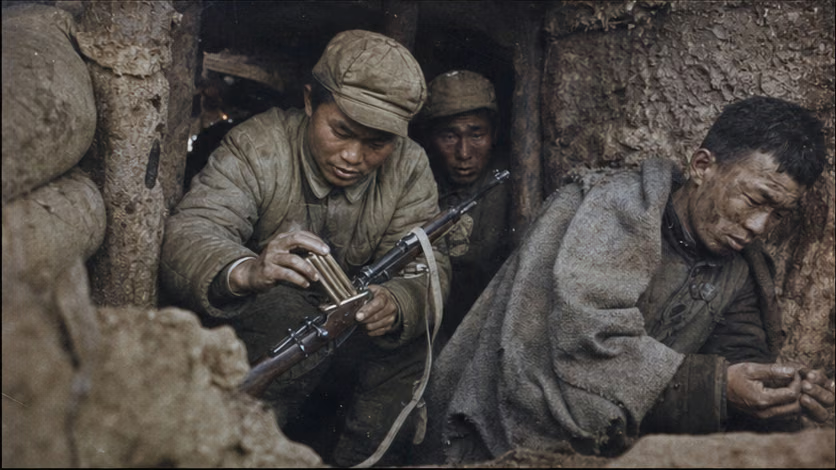
| Item | Chinese People's Volunteer Army | United Nations Command |
|---|---|---|
| Strength | 2.4 million entered Korea in succession (rotation system -- the army-building significance of "rotational combat," noted briefly); peak strength over 1.3 million | Peak about 1.2 million (over 300,000 U.S. troops + over 600,000 South Korean troops + allied forces) |
| Firepower | At the beginning of entry into Korea, one army had less artillery than one U.S. division; it began with no air force and no navy | Full firepower system + absolute air and sea supremacy; nuclear-threat background (atomic-bomb blackmail line unverified) |
| Supply | The limit of the "week-long offensive" (7 days of rations and ammunition carried by the troops -- logistical radius determining operational depth was the Chinese iron rule across the whole war); later, the "steel transport line that could not be smashed or bombed apart" (Hong Xuezhi's logistics system + antiaircraft units) | Modern logistics -- but likewise constrained by the peninsula's terrain and winter |
| Evolution | Reequipping with Soviet weapons during the war, the air force entering combat (MiG Alley cross-referenced in its own article), the tunnel system taking shape -- the process by which an army closed a generational gap during war is itself the main line | Strategic vacillation under three changes of commander |
Historical Setting
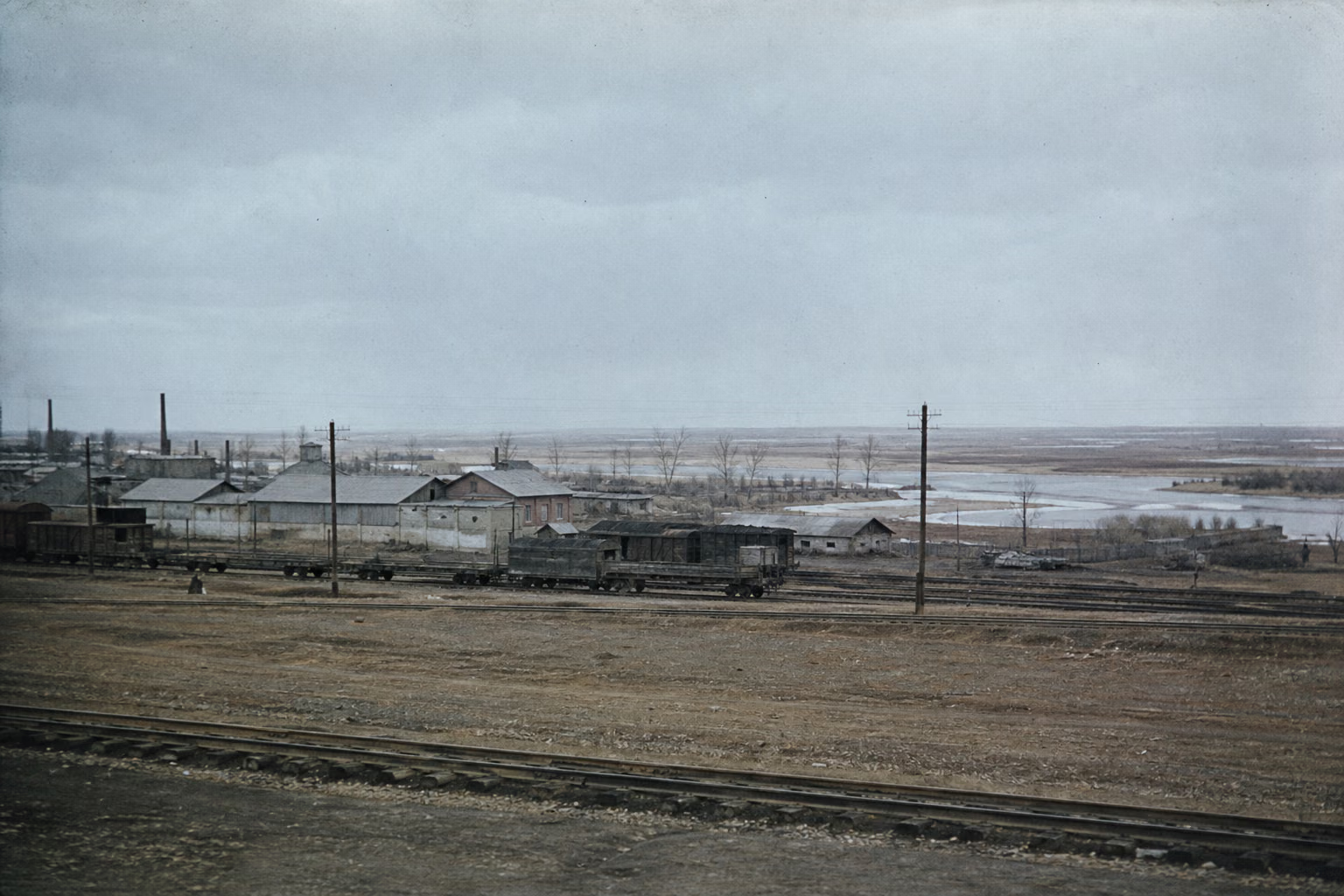
World: the Cold War's first hot war -- NATO newly established, the Soviet nuclear test (1949), the Sino-Soviet Treaty of Alliance (1950.2); the Korean civil war (outbreak on 1950.6.25 -- the international historiography of the war's origins: archival research after declassification into the responsibilities of the North, South, Soviet Union, and China, with levels marked side by side) became internationalized: the United States also intervened in the Taiwan Strait (the Seventh Fleet entered the strait on 6.27 -- once the Korean War sounded, the Taiwan Strait froze: linking into the causal chain of the Battle of Kinmen).
China: one year after the state's founding: economic recovery not yet halfway complete, new areas not yet stable, army demobilization still under way; the difficulty of the decision to send troops (a majority in the Politburo initially did not favor it -- Mao Zedong's telegram saying "the benefits of entering the war are extremely great" and the decision history of Peng Dehuai's pro-war position remain unverified; Stalin's repeated shifts on an air-force commitment, unverified) -- the strategic logic of "throwing one punch so that a hundred punches will not come," and its cost, recorded together.
United States: the decision chain to cross the 38th Parallel and advance north after the Inchon landing (9.15) (the misjudgment of "home by Thanksgiving"); warnings about China's entry into the war (Zhou Enlai, through K. M. Panikkar, conveyed that "if U.S. troops cross the line, China cannot sit by" -- the diplomatic history of the ignored warning remains unverified).
Why It Was Fought
This war did not originally begin on China's border. The Korean War broke out on June 25; after the Inchon landing on September 15, the military situation suddenly reversed. U.S. forces crossed the 38th Parallel and advanced north, the Seventh Fleet had already entered the Taiwan Strait, and the fighting changed from a peninsula civil war into a Cold War front. By October, the question was no longer whether China wished to be drawn into Korea, but whether, if U.S. forces advanced to the Yalu River, China could still keep the danger outside its own gate.
The calculation of the United States and the United Nations Command was clear: use the advantage after Inchon to destroy the Korean People's Army before winter and end the war. MacArthur held air power, sea power, armor, artillery, and modern logistics, and he also had a domestic political timetable in which victory seemed close at hand. What he misjudged was the weight of China's warnings; he assumed that a China founded only one year earlier would not, and could not, enter a frontal war with the United States. North Korea needed regime survival; the Soviet Union needed to avoid a direct collision with the United States. Both pressures finally landed on Beijing's table.
None of Beijing's accounts was light. One year after the state's founding, finance and industry were still recovering, the new areas were not yet stable, and army demobilization ran alongside bandit-suppression campaigns. In the early stage of the Chinese People's Volunteer Army's entry into Korea, there was no air or sea control, heavy artillery was insufficient, the firepower of one army was below that of one U.S. division, and the radius of carried food and ammunition allowed only short, sharp offensives. Northeast China was the industrial base, and also the rear area most directly threatened by bombing. To fight might drag the new China into war with the world's foremost power; not to fight might turn the opposite bank of the Yalu River into a U.S. base, while the Taiwan Strait had already been frozen by the Seventh Fleet.
So the decision to send troops was not made in instant agreement. In early October, the Central Committee Politburo and the Central Military Commission held several discussions over whether to send troops. At first, many opposed the move or had doubts, precisely because of equipment, the air force, finances, and domestic instability. After Peng Dehuai was recalled, he advocated sending troops, while Mao Zedong compressed the issue into one strategic account: "the benefits of entering the war are extremely great; the damage from not entering the war is extremely great" (telegram text and date unverified). The Soviet air-force commitment and its repeated reversals pushed this resolve onto an even narrower edge (specific exchanges unverified).
What finally worked was the arrangement of the "Volunteer Army": politically, it avoided expanding the war without limit through a formal state declaration of war; militarily, it first used night fighting, close combat, and mobile warfare to offset the firepower gap. This choice did not erase material limits; it acknowledged them and then chose another way of fighting. On October 19, the Chinese People's Volunteer Army crossed the Yalu River by multiple routes; on October 25, the first battle opened in the direction of Onjong. The trigger for China's entry into the war fell on the battlefield in northern Korea, but its real weight pressed down on this side of the Yalu River.
Course of the Engagement (Two Stages, Ten Actions)
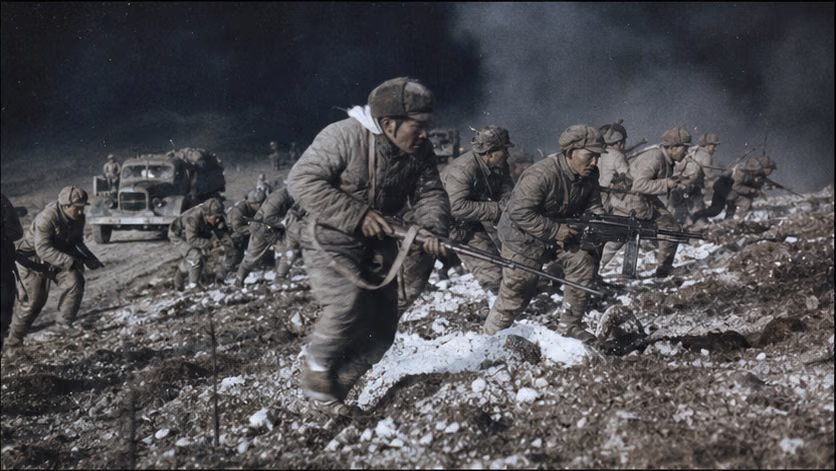
| Stage | Time | Main Points | Separate Articles |
|---|---|---|---|
| Mobile warfare (five phase offensives) | 1950.10–1951.6 | First (opening battle at Unsan), Second (Chongchon River - Battle of Chosin Reservoir: the front was pushed back to the 38th Parallel, the war's greatest reversal), Third (breaking the line and occupying Seoul), Fourth (Han River blocking action - setback at Chipyong-ni - whole-front withdrawal north), Fifth (the largest offensive and the most dangerous withdrawal -- the loss of the 180th Division) -- the full curve from successful surprise attack to the limit of the offensive | Separate articles for each phase offensive |
| Positional warfare (two years) | 1951.6–1953.7 | Armistice negotiations ran alongside positional attrition: "nibbling at taffy," the tunnel system, Triangle Hill (1952.10 -- a firepower footnote to the negotiating table), the strangulation campaign and counter-strangulation (the railway air-war line), Kumsong (1953.7, the final blow before the armistice) | Positional Warfare Phase, Triangle Hill, Kumsong, Air War |
Casualties and Losses
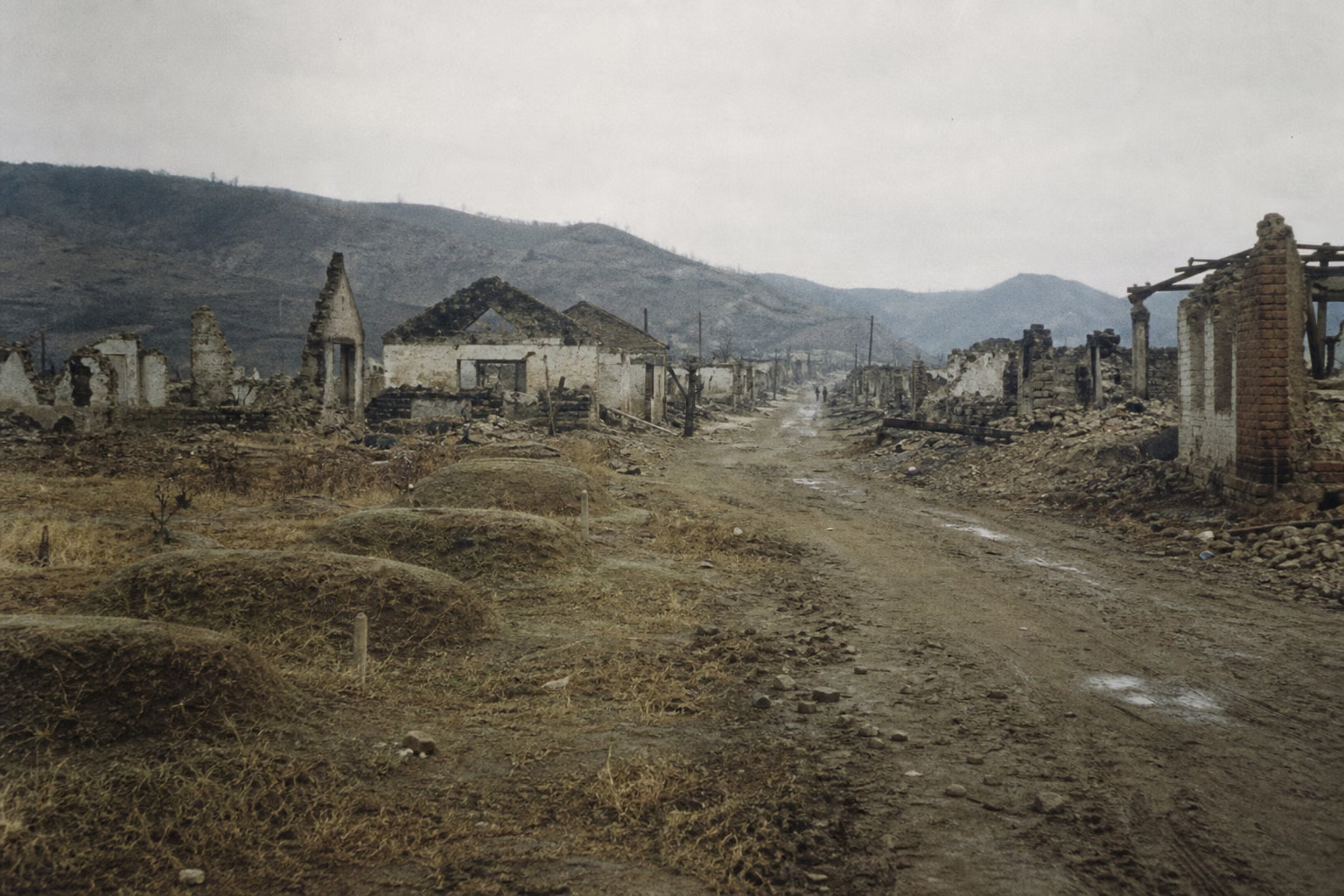
- Chinese People's Volunteer Army: over 197,000 killed (2014 Ministry of Civil Affairs statistical basis: 197,653 -- the official number with names attached); total wounded, sick, and other casualties in the hundreds of thousands (various statistical bases listed side by side, unverified); 21,000 captured (see the disputes section on the prisoner-of-war question).
- United Nations Command: over 36,000 U.S. military deaths (U.S. statistical basis: 36,574) + hundreds of thousands of South Korean military deaths + allied forces -- each side's statistical basis listed side by side; the two sides' numerical systems differ in statistical boundaries.
- Korean soldiers and civilians: millions of soldiers and civilians from North and South died (figures vary widely by source) -- the peninsula itself was the greatest victim: the bill paid by the battlefield country (structurally parallel to the China dimension in the article on "foreign war on Chinese soil" -- this time Chinese troops were on another country's land, and the perspective also reverses with the battlefield country's position).
- ※ Wartime atrocities and disaster nodes: the degree of destruction from U.S. bombing of Pyongyang and other cities (several accounts differ on the basis for saying Pyongyang had "not a cone of standing roof tile" left), bacteriological-warfare accusations and international investigations (the Needham commission -- accusations, investigations, and Cold War archives from all sides listed side by side, with different evidentiary levels), civilian deaths in Sinchon and elsewhere (North Korean narrative and research verification listed side by side, unverified), the two-way conditions in Chinese People's Volunteer Army and United Nations Command prisoner-of-war camps (the Geoje Island incident ※ and the dispute over POW screening -- see the disputes section).
- Inside China: the wartime system of the Northeast industrial belt and bombing losses ※ (records from Andong and other places unverified); the pressure of war expenditures on a recovery-period economy (figures vary by statistical basis).
Aftermath
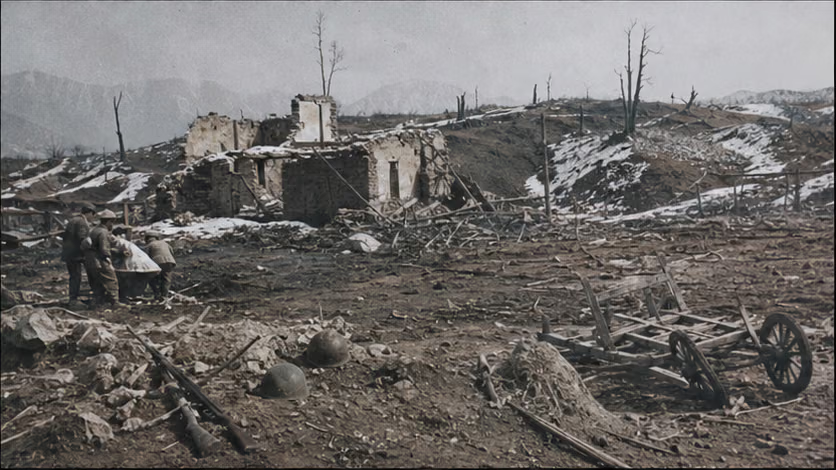
- The military result was the political result: the world's foremost power failed to cross the 38th Parallel -- the international standing of the new China was established through this war (the "entry ticket won by fighting" -- noted briefly with the 1954 Geneva Conference participation line); the closing significance of "from 1840 to 1953": the endpoint of this series' 113-year timeline is the first time a Chinese army held off the strongest opponent outside the national gate -- the structural closing stroke of Whence We Came.
- Twenty years of Sino-American confrontation took shape (the Taiwan Strait frozen, with the Vietnam War background line noted briefly); the strengthening of the Sino-Soviet alliance and the foreshadowing of its cracks (the history of military-aid accounts and "half-price arms purchases" debt remains unverified).
- A leap in army modernization: reequipment with Soviet weapons, the founding of the air force, tunnel engineering, the logistics revolution -- the army that received ranks in 1955 and the army that entered Korea in 1950 were already two different armies (army-building significance).
- The rupture of prisoner-of-war repatriation: of 21,000 captured men, 14,000 went to Taiwan and 7,000 returned to the mainland -- political review of the returnees and their circumstances across decades ※ (the review history of "company theory" and the 1980s line of reexamination and rehabilitation -- the heaviest domestic afterlife of this war, treated briefly, unverified); the "Anti-Communist Righteous Men" narrative for those who went to Taiwan (1.23 Taiwan-side memorial day) -- the same group of prisoners, two different afterlives across the strait.
- Martyrs' remains: Chinese People's Volunteer Army cemeteries where the dead sleep in Korea (Hoechang and others); from 2014, the remains of Chinese People's Volunteer Army soldiers in South Korea have returned to China ("return" as the central ritual of contemporary commemoration -- together with Tengchong National Martyrs Cemetery and the lines of veterans returning to China, it forms the contemporary chapter of this series' theme of "monuments").
How Each Side Records It
- Chinese side: "resisting U.S. aggression and aiding Korea, defending the homeland" -- the narrative of a war of national founding; the history of commemoration's rise and fall (the temperature curve of the narrative amid changes in Sino-American relations -- high heat in the 1950s, low profile in the 1980s, renewed elevation in the 2020s with the phenomenon of The Battle at Lake Changjin -- the history of commemoration is recorded together); the vocabulary history of "the most beloved people" (Wei Wei's reportage).
- U.S. side: "the Forgotten War" (The Forgotten War) -- a memory depression between World War II and the Vietnam War; "Freedom is not free" on the Korean War Veterans Memorial wall in Washington; the shift in military scholarship's evaluation of the Chinese army (Ridgway's respectful phrasing in The Korean War remains unverified -- an opponent's textbook is the hardest certificate, reappearing here).
- South and North Korea: South Korea's national-calamity narrative of the "6.25 War" / North Korea's narrative of "victory in the Fatherland Liberation War" -- each side of the peninsula has its own canon (from a third-party perspective, the battlefield country has its own memory priorities).
- Scholarship: the archival revolution in Cold War international history (origin studies after the declassification of Soviet archives -- Shen Zhihua and others); casualty statistics; prisoner-of-war studies -- three lines.
Disputes and Sensitivities
- How to describe the war's origins -- mark levels according to the current state of international scholarship (archival research and traditional narratives listed side by side).
- The archival layer of the decision to send troops (Politburo divisions, Stalin's reversals) -- state the matter.
- Bacteriological-warfare accusations -- each side's statistical basis listed side by side; this series treats accusations of U.S. atrocities and evidence for Japanese atrocities as having different evidentiary levels.
- Two-way prisoner-of-war conditions and the treatment of returnees ※ -- the most sensitive domestic dimension, with relevant characterizations having changed over time.
- Differences among the casualty-number systems of all sides -- mark the statistical boundaries item by item.
- Defeats such as the loss of the 180th Division (see the Fifth Phase Offensive) also have a place in the war narrative.
Contents
Unsan is placed under the First Phase Offensive; Chipyong-ni is placed under the Fourth Phase Offensive; the Cheorwon blocking action is placed under the Fifth Phase Offensive; White Horse Mountain is placed under the Positional Warfare Phase; MiG Alley is placed under Air War.
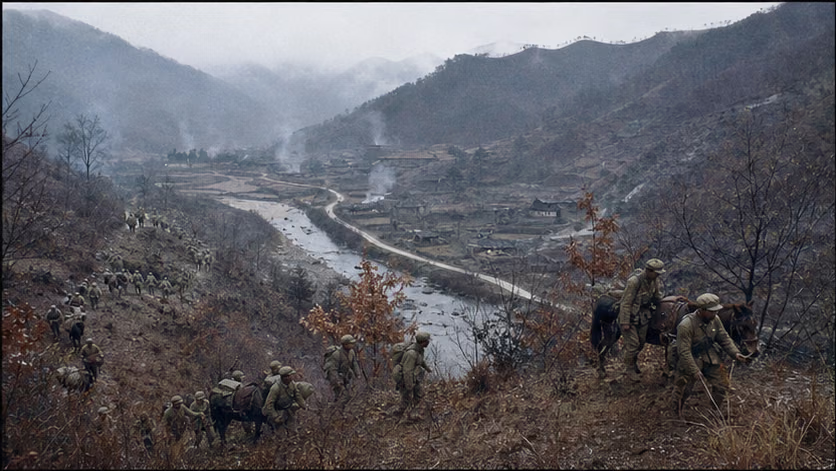 First Phase Offensive (Unsan)1950.10The Chinese People's Volunteer Army's first battle after secretly crossing the river met the South Korean army at Onjong and the U.S. elite at Unsan--the first encounter in the history of the Chinese and U.S. armies was won; then the Chinese forces deliberately halted and withdrew, turning the victory itself into smoke for the next, larger victory.
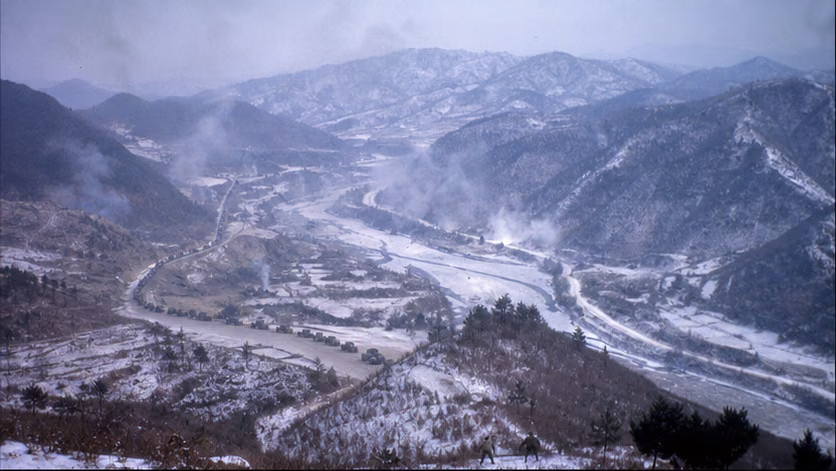 Second Phase Offensive — Overview1950.11The Chinese People's Volunteer Army hid its victory in the First Phase Offensive inside a screen of smoke, luring the "United Nations Command" into a full northward advance, then closed the net on the western and eastern fronts at the same time: in the west, a single night of infiltration along the Chongchon River cut the enemy's retreat; in the east, amid the ice and snow of Chosin Reservoir, the U.S. 1st Marine Division was hunted in encirclement. In one month the front was driven back from the Yalu River to the 38th Parallel. It was the greatest reversal of the entire war, and also its costliest lesson.
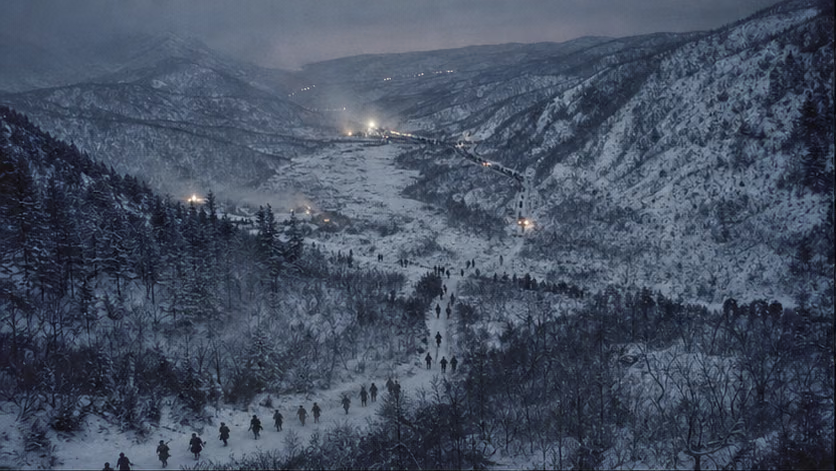 Battle of Chosin Reservoir1950.11On the Kaema Plateau, at thirty or forty degrees below zero, 150,000 men of the Ninth Corps, still in thin cotton uniforms from East China, entered the snow woods and folded the U.S. military's most capable formation, the First Marine Division, into the ice valley of Chosin Reservoir: over seventeen days, the U.S. forces underwent what their own military history calls the "most difficult retreat," while frostbite losses among the Chinese People's Volunteer Army exceeded battle casualties; some companies froze to death on their positions while still holding firing postures. Both armies wrote this place into their own legends, and beneath the ice field lay a shared limit of human endurance.
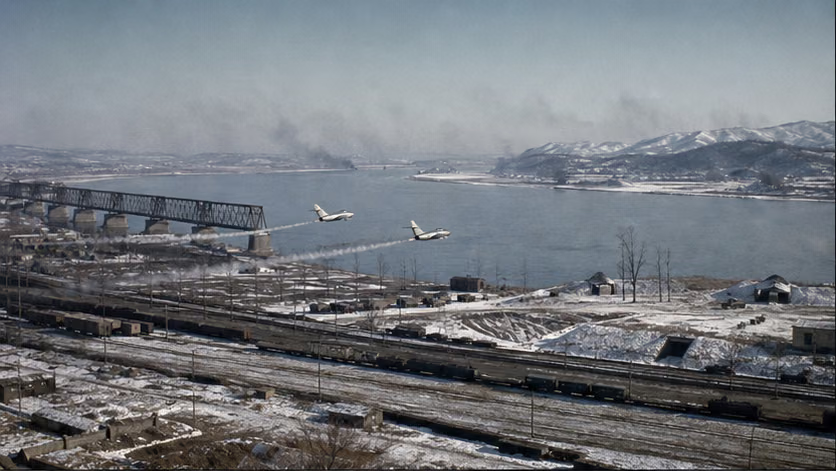 Air War: MiG Alley (Dec 1950–Jul 1953, combined account)1950.12An air force that had not existed three years earlier held a corridor in the airspace over the Chongchon River-Yalu River zone, under the strongest air force in the world: it held, half because crash-trained pilots bought experience with their lives, and half because Soviet pilots in Chinese People's Volunteer Army uniforms did the fighting; both layers stand side by side.
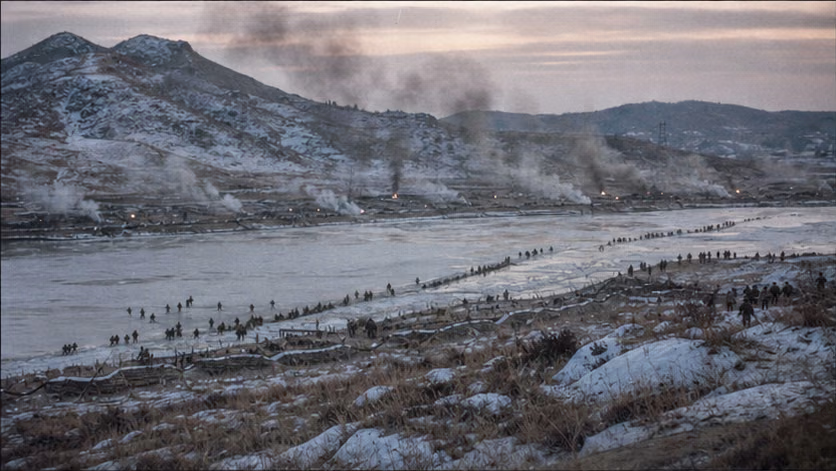 Third Phase Offensive1950.12Crossing the 38th Parallel on New Year's Eve and retaking Seoul three days later -- this was a battle that had to be fought politically; yet the deepest stroke of the engagement lies not in the breakthrough, but in the stopping: on the eighth day, Peng Dehuai withstood all pressure from allies and the front line and ordered the pursuit halted. **To dare to stop amid victory was the true problem this battle left to its opponent and to those who came after.**
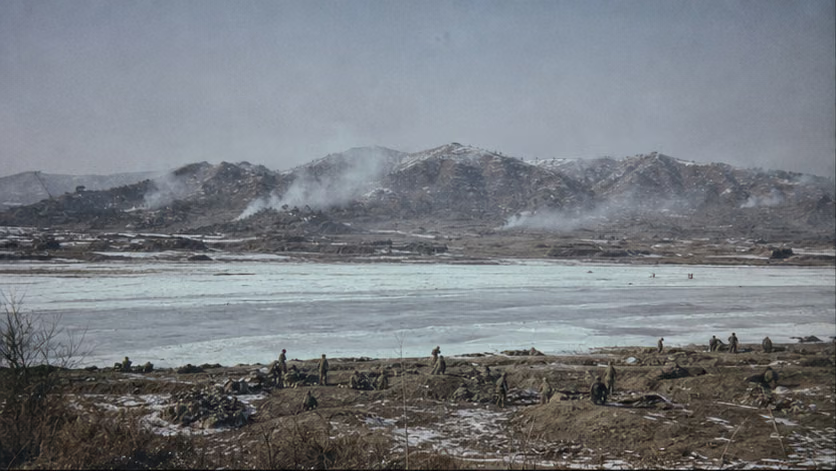 Fourth Phase Offensive (incl. Chipyong-ni)1951.01The opponent had learned how to fight the Chinese People's Volunteer Army: Ridgway used "magnetic tactics" to turn the CPVA's "week-long offensive" back against it after the seventh day; the exhausted Chinese-Korean armies held for fifty days and nights on both banks of the Han River, succeeded in the Hoengseong counterattack, yet were stopped at Chipyong-ni by one regiment in a perimeter position. Here the balance between attack and defense was reset, and here the seed of the Fifth Phase Offensive was planted.
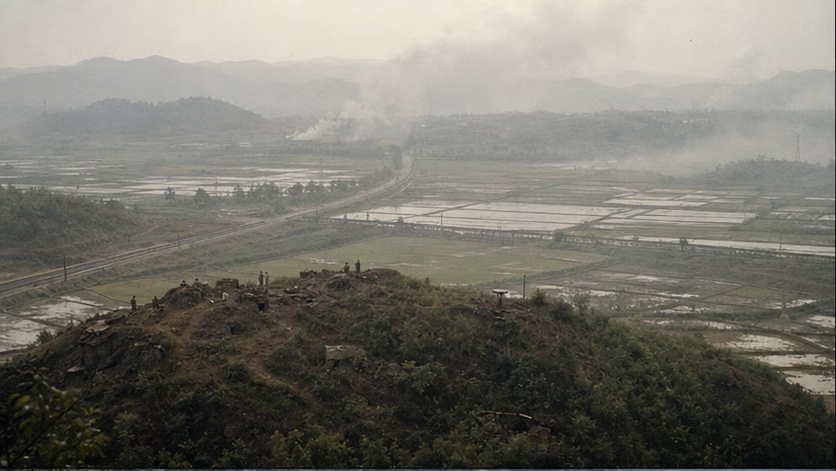 Fifth Phase Offensive1951.04The largest offensive after the Chinese People's Volunteer Army entered Korea was fought through in fifty days: in the first phase it could still move, in the second it pushed far, and during the withdrawal the opponent bit back; one division was broken as an organized formation on the south bank of the Bukhan River, and only after one army nailed itself to Cheorwon with its lives was the front stabilized. The mobile-warfare phase ended here.
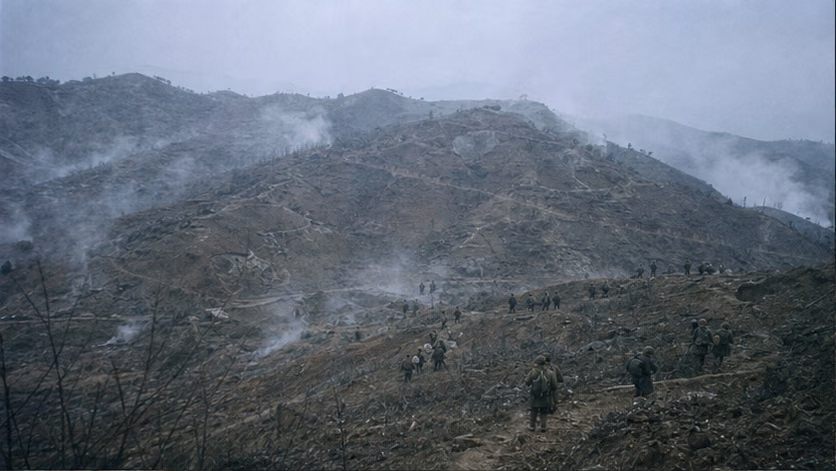 Positional Warfare Phase (Jun 1951–Jun 1953, combined account)1951.06Two years of "fighting while negotiating": every inch argued over at the table had to be paid for with a hill on the front; the "United Nations Command" relied on firepower and strangulation, while the Chinese People's Volunteer Army used tunnels, sniping, and counter-strangulation to turn a front of nearly 250 kilometers into a system, until the signatures came after Kumsong.
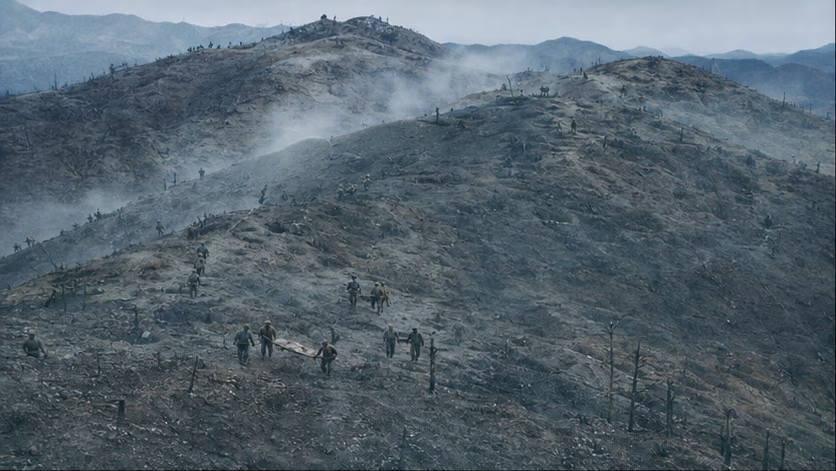 Battle of Triangle Hill1952.10Two hilltops over 3.7 square kilometers, 43 days, and more than 100,000 men from both sides fed into them in rotation: artillery density surpassed that of any battle in the Second World War; the summits were shaved down by two meters, and rock was blasted into powder more than a meter deep. U.S. forces called it "another Heartbreak Ridge beside Heartbreak Ridge"; for the Chinese army, it became a spiritual place-name: what could not be moved at the negotiating table was held at Triangle Hill with tunnels and human lives.
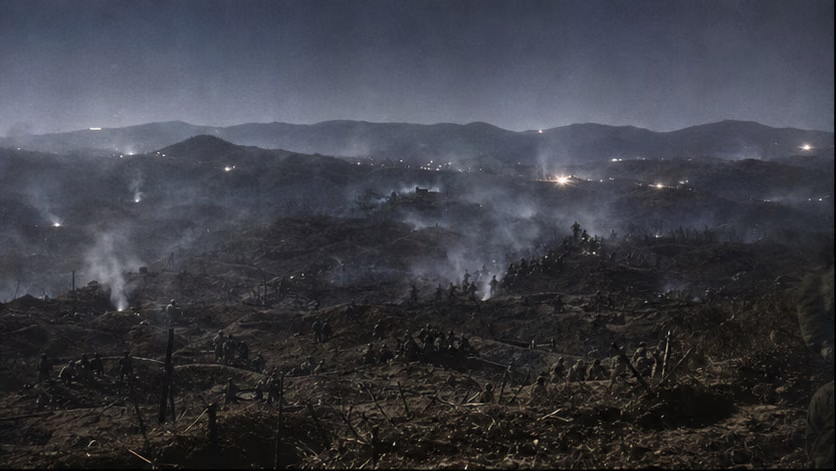 Battle of Kumsong1953.07Fourteen days before the armistice was signed, the Chinese People's Volunteer Army concentrated 240,000 men and every resource accumulated over three years, striking ROK forces but not U.S. forces; in fourteen days it erased the Kumsong salient from the map, and on the night the battle ended, the documents were signed at Panmunjom.
Sources and Open Questions
Sources: History of the War to Resist U.S. Aggression and Aid Korea (three volumes, Academy of Military Sciences); memoirs of Peng Dehuai, Hong Xuezhi, and others; Shen Zhihua, Mao Zedong, Stalin, and the Korean War (representative archival study); Ridgway, The Korean War; official histories of the U.S. Army (volumes by Roy Appleman and others); South Korea's History of the Korean War; database of Chinese People's Volunteer Army martyrs (China Heroes and Martyrs website -- cross-reference the guide to historical materials).
Open questions: the meeting records, chronologies, and participant memoirs for mutual corroboration concerning the Politburo and Central Military Commission discussions in early October over whether to send troops; the original text, date, and sender/recipient of Mao Zedong's telegram saying "the benefits of entering the war are extremely great; the damage from not entering the war is extremely great"; participant accounts of Peng Dehuai being recalled and advocating troop dispatch; the telegram set concerning repeated changes in the Soviet air-force support commitment; diplomatic archives on Zhou Enlai conveying China's warning through Panikkar; the telegram set on the decision to send troops; each side's casualty figures and statistical boundaries; POW numbers and the composition of repatriation; documents on review and rehabilitation of returned POWs; archives from all sides on the bacteriological-warfare investigations; statistical basis for military-aid debt; literature on changes in commemoration history.
All images on this site are AI-generated depictions. They are not historical photographs, not primary sources, and do not depict any real individual.