Engagement Archive · Fourth Phase Offensive (incl. Chipyong-ni)
The opponent had learned how to fight the Chinese People's Volunteer Army: Ridgway used "magnetic tactics" to turn the CPVA's "week-long offensive" back against it after the seventh day; the exhausted Chinese-Korean armies held for fifty days and nights on both banks of the Han River, succeeded in the Hoengseong counterattack, yet were stopped at Chipyong-ni by one regiment in a perimeter position. Here the balance between attack and defense was reset, and here the seed of the Fifth Phase Offensive was planted.
Engagement Data
| Item | Content |
|---|---|
| Time | 1951.1.25 – 4.21 |
| Place | Western front: south bank of the Han River-Seoul-38th Parallel; eastern front: the Hoengseong, Chipyong-ni, and Wonju line |
| Part of | War to Resist U.S. Aggression and Aid Korea · Fourth Phase Offensive in the mobile-warfare stage |
| Chinese-Korean Side | 6 armies of the Chinese People's Volunteer Army (38th, 39th, 40th, 42nd, 50th, and 66th Armies, all in continuous operations without rest or replenishment) + part of the Korean People's Army; in the later phase, relief units such as the 26th Army were committed in succession (unit designations unrecorded) |
| United Nations Command | U.S. Eighth Army (Ridgway): U.S. I, IX, and X Corps, together with South Korean forces, the French Battalion, and other allied units; full-front counteroffensive from 1.25 |
| Result | The Chinese-Korean side fought while falling back, abandoned Seoul on 3.14 (Seoul changed hands for the fourth time), and by 4.21 the front stabilized near the 38th Parallel and shifted to the defensive |
Belligerents
| Item | Chinese-Korean Side | United Nations Command |
|---|---|---|
| Strength | The 6 first-line armies were tired troops left from the first three offensives, with losses unreplenished and food and ammunition unfilled; later relief units were still refitting and training inside China and had not yet arrived in full | About 230,000 on the first line (statistical bases vary by account), with replacements complete and morale restored |
| Firepower | Mainly light infantry; artillery was limited and ammunition short | Full firepower system + Ridgway's doctrine of firepower use: consume attacking infantry with dense artillery fire ("sea of fire"), then follow up and cling |
| Supply | The limit of the "week-long offensive" had been identified and targeted by the opponent: on the seventh or eighth day after an offensive began, it was met by counterattack | Port-road logistics were intact; air interdiction began to intensify |
| Opponent's New Method | -- | "Magnetic tactics": echeloned depth positions; by day, air-ground firepower inflicted casualties; by night, units contracted into perimeter positions and clung; once CPVA food and ammunition were exhausted, they counterattacked. This was supplemented by small probing attacks of the "Operation Wolfhound" type to feel out the front line (from 1.15; operation name and dates vary by account) -- the opponent had found an answer |
Terrain and Conditions
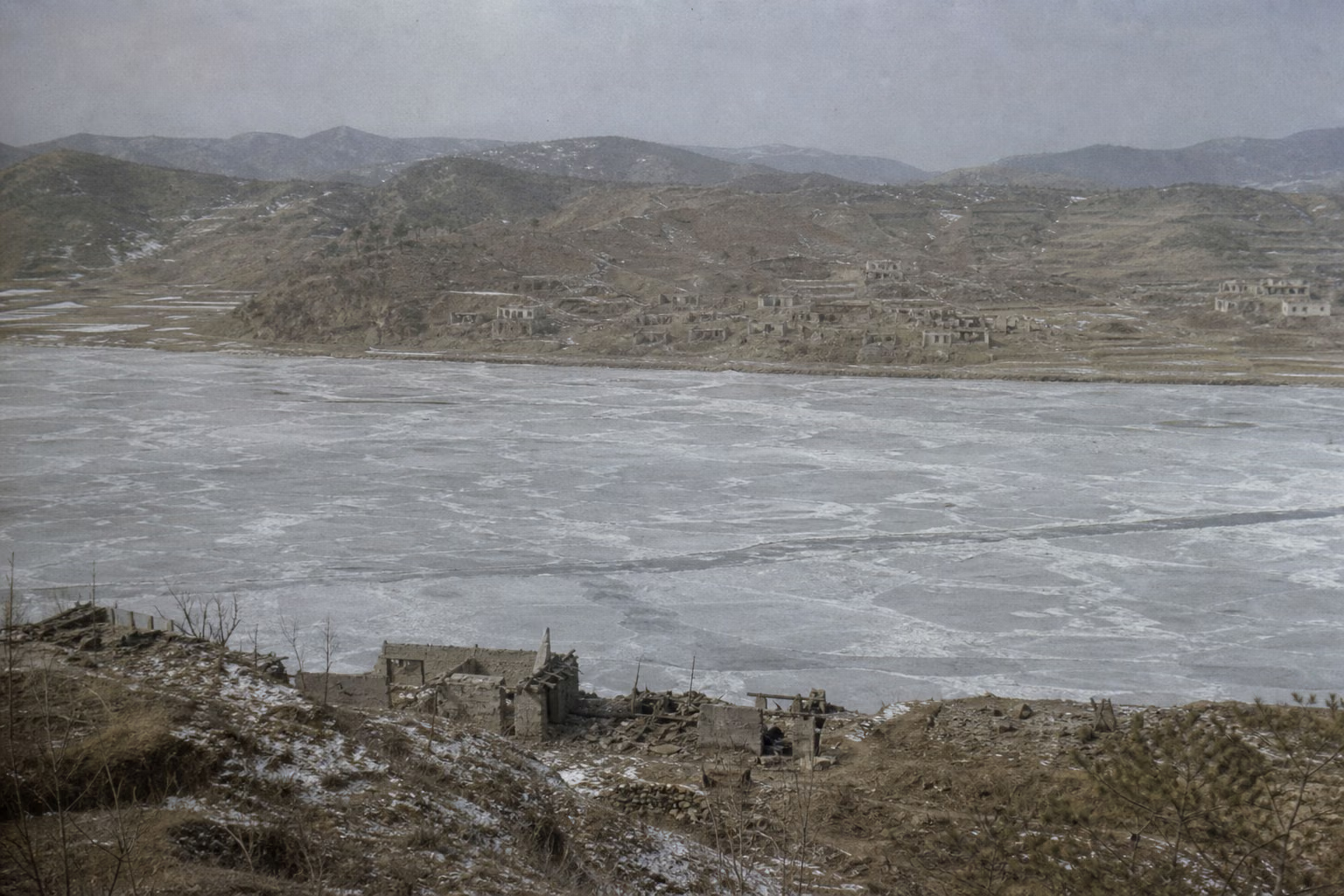
(For the larger situation in the spring of 1951 -- Washington's dismissal of MacArthur (4.11), and the gestation of armistice talks -- see *War to Resist U.S. Aggression and Aid Korea · Overview*; here only the two banks of the Han River are recorded.)
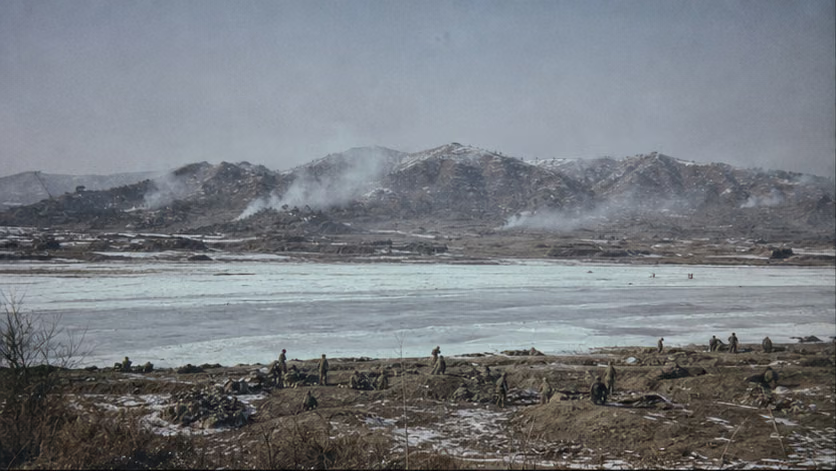
The Han River: a frozen great river and positions with water at their backs. At the end of January, the Han River had not yet thawed, and its ice surface could be crossed -- this was both a convenience for the defenders' maneuver and a hidden danger, because once the river thawed the road of withdrawal south would be cut (part of the 38th Army crossed the river and withdrew to defend in mid-February; details of the thawing sequence remain unverified). The south bank of the Han River was a belt of hills: Surisan, Moraksan, Baegunsan, Gwanggyosan... every hilltop was a fortress, a point of attrition.
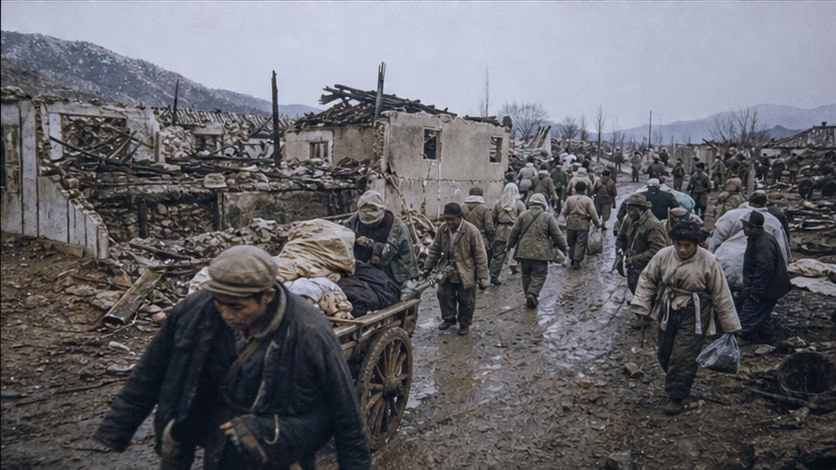
The peninsula's interior in seesaw fighting: over four months, the front rolled back and forth north and south of Seoul -- villages and towns changed hands repeatedly, were repeatedly covered by artillery fire, and civilians fled north and south with the battle line ※ (civilian deaths in this seesaw period were one of the heaviest civilian-dimension chapters of the entire war, but the systematic figure is disputed).
Why It Was Fought
The Third Phase Offensive stopped on 1.8: the Chinese People's Volunteer Army had crossed the 38th Parallel on New Year's Eve, retaken Seoul three days later, advanced to near the 37th Parallel, and then Peng Dehuai, resisting pressure from those who argued for continuing south, ordered the pursuit halted. It stopped because it could no longer move -- six armies had fought three successive offensives, carrying food and ammunition to the limit of the "week-long offensive," with losses unreplenished and food and ammunition unfilled. CPVA headquarters planned to rest for two months, reorganize and replenish, and then seek a spring offensive; the new units refitting and training inside China were still on the road.
The other side did not give those two months. Ridgway took over the Eighth Army at the front on 12.26, and his first lesson after arrival was to read the patterns of the CPVA's first three offensives: choosing attacks by moonlit nights ("moonlight offensives") and setting the limit by seven days of carried food and ammunition ("week-long offensives") -- in his memoir, he treated this summary as the starting point of his entire tactical design. Once the pattern had been read, the timetable was arranged backward: from 1.15, small probing attacks of the "Operation Wolfhound" type were used to feel out the real condition of the Chinese-Korean forward line (operation name and dates vary by account); on 1.25, a large counteroffensive was launched along the whole front (called Operation Thunderbolt by the U.S. side; operation name and code name unverified). The window was chosen precisely: CPVA food and ammunition were at their lowest, its forces at their most tired, and the refitting units had not arrived.
The place was not chosen casually either. Seoul had changed hands three times in half a year and was the heaviest political piece on the board of this war; the Han River was the last great river barrier to its north. At the end of January the river remained frozen, and the ice could be crossed -- a convenience for the defenders' maneuver, but also a hidden danger once thaw cut the road of withdrawal south. The hills on the south bank -- Surisan, Moraksan, Baegunsan -- were each a fortress, and they became the testing ground of "magnetic tactics": killing by air-ground firepower in daylight, contracting into perimeter positions at night and clinging, dragging the fight past the seventh day, and then counterattacking once the opponent's food and ammunition had run out.
The two sides were therefore calculating different things. The U.S. side wanted a limited-objective counteroffensive that would stabilize the front and restore the morale of a newly defeated army -- Ridgway did not intend to gamble again on a deep northward advance. The Chinese-Korean side wanted to trade space for time and hold the main forces in place until relief units arrived. Each side had its misjudgment: CPVA headquarters' rest plan assumed the opponent would grant two months, and that premise did not exist; Ridgway correctly read the rhythm of CPVA offensives, but may not have calculated that the hills beside the Han River would be held one for another for fifty days and nights.
This was not a battle the CPVA wanted to fight, but one it had to answer: on 1.25, before the main forces could rest, they were pushed back toward the two banks of the Han River and entered a forced mobile defense. The road of resting through the winter, which had originally existed, again went untaken, just like the road in *Third Phase Offensive*.
Course of the Engagement
| Phase | Time | Key Points |
|---|---|---|
| Ridgway's counteroffensive | From 1.25 | U.S. I and IX Corps pushed north along the Suwon-Seoul axis, opening the road with a sea of fire and clinging step by step; the Chinese-Korean side responded by "holding in the west and yielding in the east" -- defending the Han River on the western front to gain time, while seeking opportunities to counterattack on the eastern front |
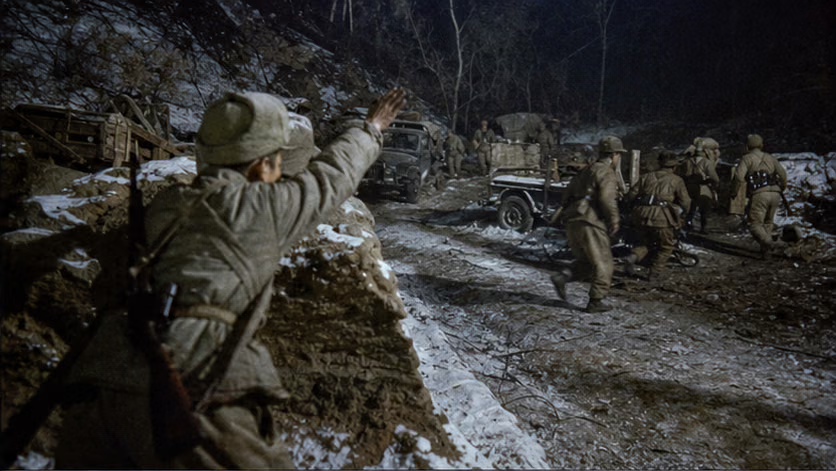
| Blocking action south of the Han River | 1.25–mid-February | The 50th Army (with attached units including the 112th Division of the 38th Army) held the south bank of the Han River, along the Surisan, Moraksan, and Baegunsan line: hill by hill, positions were plowed by artillery fire in daylight and retaken at night -- fifty days and nights (after the 50th Army withdrew across the river in early February, the main force of the 38th Army continued to defend south of the Han River until 2.16–18; the sequence of each army's withdrawal remains unverified). **The 50th Army: descended from the former Nationalist 60th Army that rose in the Changchun uprising (in 1948.10, Zeng Zesheng led his troops in revolt; see *Liaoshen Campaign · Overview*)** -- a unit adapted from an uprising force became an iron army beside the Han River, and its officers and soldiers proved their name with their lives (the "redemption narrative of an uprising unit": they were earning a certificate of qualification in a new army) |
| Hoengseong counterattack | 2.11–2.13 | On the eastern front, seizing the opportunity created by the protrusion of the ROK 8th Division and other units, 4 CPVA armies (elements of the 39th, 40th, 42nd, and 66th Armies) + the Korean People's Army counterattacked at Hoengseong: outflanking, infiltration, and rupture in one night -- Chinese battle reports claimed more than 12,000 South Korean and U.S. troops destroyed (statistical bases vary by account; the U.S. side also acknowledged that the ROK 8th Division was badly mauled). This was the only offensive bright spot in the Fourth Phase Offensive |
| Battle of Chipyong-ni | 2.13–2.15 | After success at Hoengseong, the attack went directly to Chipyong-ni: about 8 CPVA regiments (from the 39th, 40th, and 42nd Armies, temporarily attached and with limited coordination) besieged the perimeter defense of the U.S. 23rd Regiment, 2nd Division + the French Battalion (about 4,500 men) -- the defenders relied on prepared works, tanks forming the core, and air-ground firepower covering through the night; CPVA light infantry assaulted for two successive nights over an exposed snowfield, suffered heavy casualties without breaking the position, and at dawn on 2.15 was forced to lift the siege -- Chipyong-ni: a tactical turning point for the Chinese People's Volunteer Army (from this, the U.S. side established confidence in the "Chipyong-ni model": hold against encirclement and the CPVA offensive can be broken; CPVA headquarters reviewed its deficiencies in assault firepower and coordination -- both armies' military histories treat this as a node) |
| Mobile defense and northward withdrawal | mid-February–March | The whole front shifted into mobile defense, resisting step by step and withdrawing north in stages; on 3.14 Seoul was abandoned -- Seoul changed hands for the fourth time (this time the Chinese-Korean side withdrew in order; damage to the city and the civilian situation remain unverified ※) |
| Front stabilizes | 4.21 | The Chinese-Korean side withdrew to near the 38th Parallel and built defenses; Ridgway likewise had no intention of another deep northward advance (the U.S. decision line for stabilizing the front: the confirmation of limited objectives, unverified). The Fourth Phase Offensive ended; later CPVA army groups (the 3rd and 19th Army Groups, among others) were entering Korea in succession -- the seed of the Fifth Phase Offensive was already in place |
Casualties and Losses
- Chinese-Korean side: Chinese battle reports claimed more than 78,000 enemy losses inflicted in the whole engagement (statistical bases vary by account); its own casualties numbered in the tens of thousands (statistical bases vary by account) -- attrition in the 50th and 38th Armies south of the Han River was especially heavy, and when the 50th Army entered rest and reorganization after the battle, less than half of it was still combat-capable (specific statistical bases vary by account).
- United Nations Command / South Korean army: losses were heaviest among South Korean forces in the Hoengseong counterattack (the ROK 8th Division and others); the U.S. figure for casualties among the defenders at Chipyong-ni (several hundred, details unrecorded), set against CPVA assault casualties, is battlefield evidence for the cost-effectiveness of "perimeter defense + sea of fire."
- Civilians: villages and towns in the seesaw battle zone repeatedly changed hands and were shelled, while streams of refugees moved along the Han River -- systematic figures for civilian deaths in this phase (unverified).
Aftermath
- The balance between attack and defense was reset: from the Third Phase Offensive's "crossing the 38th Parallel and occupying Seoul" to the Fourth Phase Offensive's "abandoning Seoul and withdrawing to defend the 38th Parallel," the course of the war converged here -- after this, the front never again swung north and south on a large scale (with local exceptions such as Kumsong). The Fifth Phase Offensive was the CPVA's last large-scale challenge to the "limit"; after it, the war entered positional warfare (see the overview).
- Echoes of Chipyong-ni: the U.S. Army used this tactical template (perimeter position + firepower attrition) to respond to CPVA assaults, and it ran through the next two years; the CPVA accelerated reequipment, artillery building, and the study of assault tactics -- a defeat became a textbook for both armies at the same time.
- The 50th Army proved its name in one battle: the legitimacy of reorganizing uprising troops was written in blood -- Zeng Zesheng's forces continued to carry heavy missions afterward (in 1955, Zeng Zesheng was awarded the rank of lieutenant general).
- Command changes in Washington: MacArthur was dismissed on 4.11 (the full eruption of the dispute over "expanding the war"), Ridgway took over as commander in chief of the "United Nations Command," and Van Fleet took over the Eighth Army -- the opponent changed commanders but not method.
Accounts of Those Present
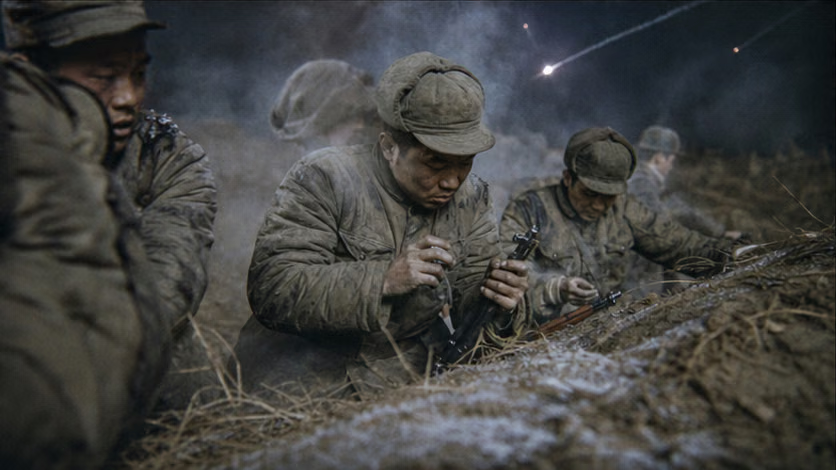
- Fifty days and nights on Surisan: units including the 443rd Regiment, 148th Division, 50th Army held Surisan and Moraksan -- by day the hilltops were shaved down by artillery fire and the works destroyed; by night counterattacks were organized to retake them. After some companies were fought out, cooks and signalmen were filled in (oral accounts and military-history details unverified). The soldiers knew they came from an uprising unit: "this battle has to show the People's Liberation Army" -- the redemption narrative landed on particular hilltops.
- Baegunsan Regiment: the 447th Regiment held Baegunsan for 11 days and nights and received the title "Baegunsan Regiment" (awarded by CPVA headquarters; details unverified) -- on the banner of an uprising unit there was now an honor title named for a mountain beside the Han River.
- The snowfield at Chipyong-ni: assault units closed with the enemy across open snowfields -- the U.S. and French defenders' flares burned all night, and tank guns, machine guns, and mortars formed a perimeter fire net; attacking echelons fell wave after wave in the open ground before the position (the two sides' military histories record the assault process in parallel; details unverified).
- The French Battalion: the French Battalion among the defenders of Chipyong-ni (later another stroke in the memory line of France's return to the Korean War in 1953) -- the sixteen-nation coalition made concrete at a tactical node.
- The 38th Army crosses the Han River again: the closing scene of the blocking action south of the Han River -- with thaw imminent, heavy equipment and wounded crossed the river first, and rearguard units withdrew over ice that was about to crack (sequence and details unverified).
The Ground
- The hill groups south of the Han River: Surisan, Moraksan, Baegunsan -- the same grammar of "hilltop attrition points" as the suburban hills of Hengyang, but with the firepower positions reversed: this time it was the CPVA taking the sea of fire on hilltops without artillery cover.
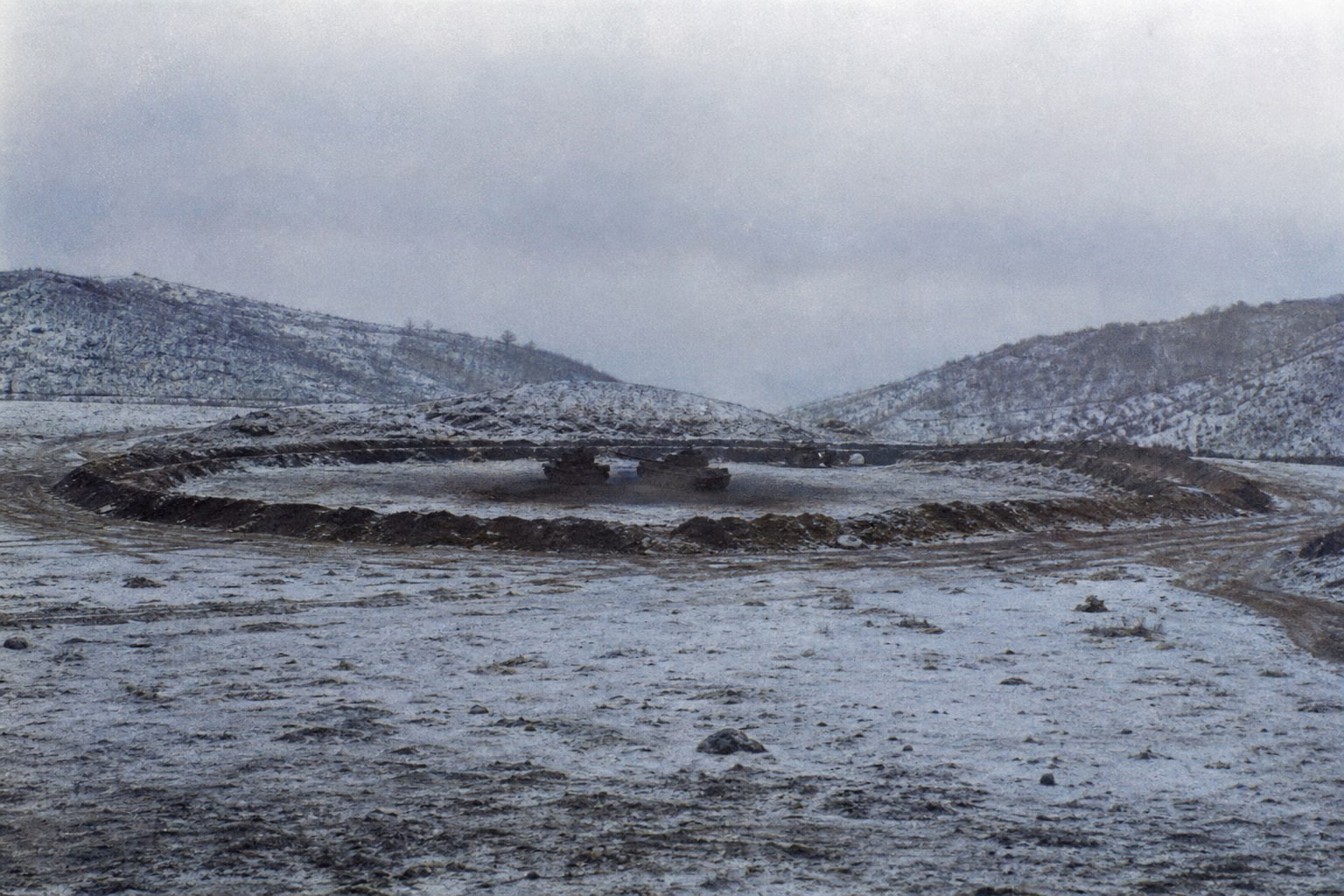
- Chipyong-ni: a small basin at a road junction, with a perimeter position roughly one kilometer in diameter, tanks at the core and trenches as the ring -- the outer contact zone was open, and flares and air-ground firepower covered it at night, leaving a very short window for light infantry assaults.
- The Han River: during the freeze it was a position; during thaw it was a moat -- the seasonal change of one river directly rewrote the defensive deployment.
- Hoengseong: a counterattack battlefield at the junction of mountain roads -- the terrain logic of infiltration and rupture was isomorphic with Samso-ri (see *Second Phase Offensive · Overview*).
How Each Side Records It
- Chinese side: the Han River blocking action (50th and 38th Armies) and the setback at Chipyong-ni both entered history -- victory and review were both written in the open: Chipyong-ni has long been cited in Chinese military history as a specimen for reviewing insufficient assault firepower and poor coordination; the 50th Army's battle on the Han River is the core chapter of the uprising-unit narrative.
- U.S. side: Chipyong-ni is a symbol of "holding" in U.S. Korean War narrative, alongside Chosin Reservoir -- the "Chipyong-ni model" entered tactical doctrine; Ridgway's magnetic tactics are treated in his memoir as the answer to CPVA offensives (relevant chapters of *The Korean War*).
- South Korean side: the severe damage to the ROK 8th Division in the Hoengseong counterattack is a point of review in South Korean military history (*History of the Korean War*, details unrecorded); Seoul changed hands for the fourth time -- the South Korean capital fell four times in two years, and here the depth of war trauma in national memory is evident.
- France: the Battle of Chipyong-ni has long been commemorated in French military history (commemorative activities and literature unverified).
Disputes and Sensitivities
- CPVA assault strength and command at Chipyong-ni: 8 regiments belonged to three armies; who held unified command, and at what level responsibility lay for failed coordination -- Chinese military histories and memoirs give different accounts (unverified).
- Battle-result figures: the Chinese figure of 78,000 enemy losses inflicted in the whole engagement differs greatly from U.S. figures; the 12,000 South Korean troops destroyed at Hoengseong, and both sides' casualties at Chipyong-ni, each have different statistical bases.
- The 50th Army narrative: the "redemption" frame for uprising troops is a later narrative construction; there is a difference between the degree of original writing by participants and the constructed layer (literature unverified).
- Civilian experience during Seoul's four changes of hands ※ -- the records from different sides concerning civilian deaths in the seesaw period differ; unverified.
Sources and Open Questions
Sources: *History of the War to Resist U.S. Aggression and Aid Korea* (Academy of Military Sciences), vol. 2; history of the 50th Army and materials on the Han River blocking action; Ridgway, *The Korean War*; U.S. Army official history by Billy Mossman, *Ebb and Flow*; histories of the U.S. 23rd Regiment and the French Battalion (Paul Freeman's related command accounts unverified); South Korea's *History of the Korean War*; materials on Zeng Zesheng and the 60th Army uprising (see *Liaoshen Campaign · Overview*).
Open questions: the withdrawal sequence and attrition statistical bases for the 50th and 38th Armies south of the Han River; the statistical basis for enemy losses inflicted in the Hoengseong counterattack; the code name and date of "Operation Thunderbolt"; CPVA assault-unit designations, command level, and casualty statistical bases at Chipyong-ni; U.S. doctrinal phrasing of the "Chipyong-ni model"; records of the city and civilians during Seoul's fourth change of hands; civilian-death figures in the seesaw period; the decision line for MacArthur's dismissal.
All images on this site are AI-generated depictions. They are not historical photographs, not primary sources, and do not depict any real individual.