Engagement Archive · Battle of Kumsong
Fourteen days before the armistice was signed, the Chinese People's Volunteer Army concentrated 240,000 men and every resource accumulated over three years, striking ROK forces but not U.S. forces; in fourteen days it erased the Kumsong salient from the map, and on the night the battle ended, the documents were signed at Panmunjom.
Engagement Data
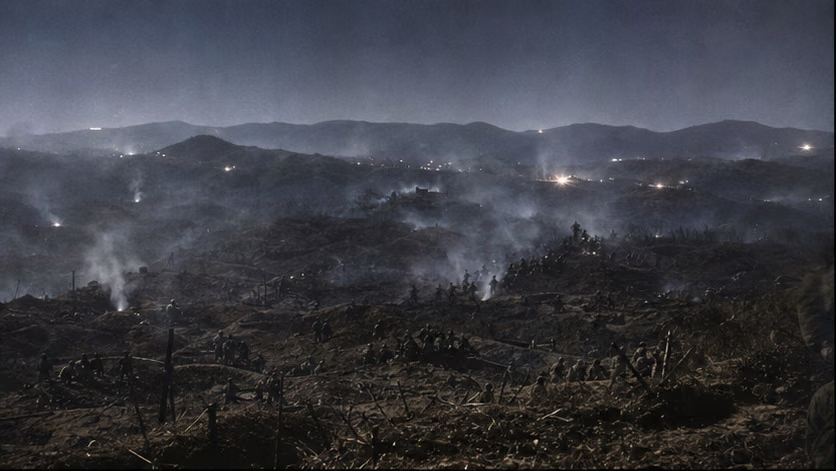
| Item | Content |
|---|---|
| Time | 1953.7.13 – 7.27, 15 days in all |
| Place | The salient south of Kumsong and west of the Bukhan River in Korea (the Kumsong arc: from northeast of Kimhwa in the west to the Bukhan River in the east, with a front about 25 kilometers wide) |
| Part of | War to Resist U.S. Aggression and Aid Korea · the last engagement of the positional-warfare phase (the third phase of the 1953 Summer Counteroffensive) |
| Attacker | The 20th Army Group of the Chinese People's Volunteer Army (Commander Yang Yong), commanding five armies including the Sixty-Seventh, Sixty-Eighth, Sixtieth, and Fifty-Fourth Armies, plus artillery and engineers, about 240,000 men |
| Defender | Four ROK divisions, including the Capital, Third, Sixth, and Eighth Divisions (defending the Kumsong salient, with attached U.S. artillery and air-fire support); the U.S. Eighth Army played a rear support role and did not enter the frontal fighting |
| Result | The Chinese People's Volunteer Army broke through the full defensive depth, advanced over about 160 square kilometers (statistical bases vary), and straightened the front line south of Kumsong; at 10 a.m. on 7.27 the Korean Armistice Agreement was signed at Panmunjom, and at 22:00 that day the ceasefire took effect across the whole line |
Belligerents
| Item | Attacker (Chinese People's Volunteer Army) | Defender (ROK forces + U.S. supporting firepower) |
|---|---|---|
| Strength | 5 armies, about 240,000 men | 4 divisions, about 80,000 men (statistical bases vary) |
| Artillery | More than 1,100 guns concentrated (including Katyusha rocket-artillery regiments); on the night of 7.13, 1,900 tons of shells were poured out in 28 minutes -- the first offensive since the Chinese People's Volunteer Army entered Korea in which it held firepower superiority | ROK divisional artillery + U.S. deep artillery groups and tactical air forces |
| Works | Secretly built pre-attack assembly positions and tunnels before the battle, and lay close in concealment | Permanent defenses in depth, minefields, barbed wire, and bunker complexes |
| Air | No air superiority; the attack was set for night and a window of complex weather | U.S. tactical air forces suppressed by day |
| Political constraint | Strike ROK forces, not U.S. forces: the battle objective, artillery plan, and pursuit depth were all given political ceilings | U.S. forces consciously let ROK forces "bear it themselves" on the front (the decision-making details of the U.S. tradeoff remain unverified) |
Terrain and Conditions
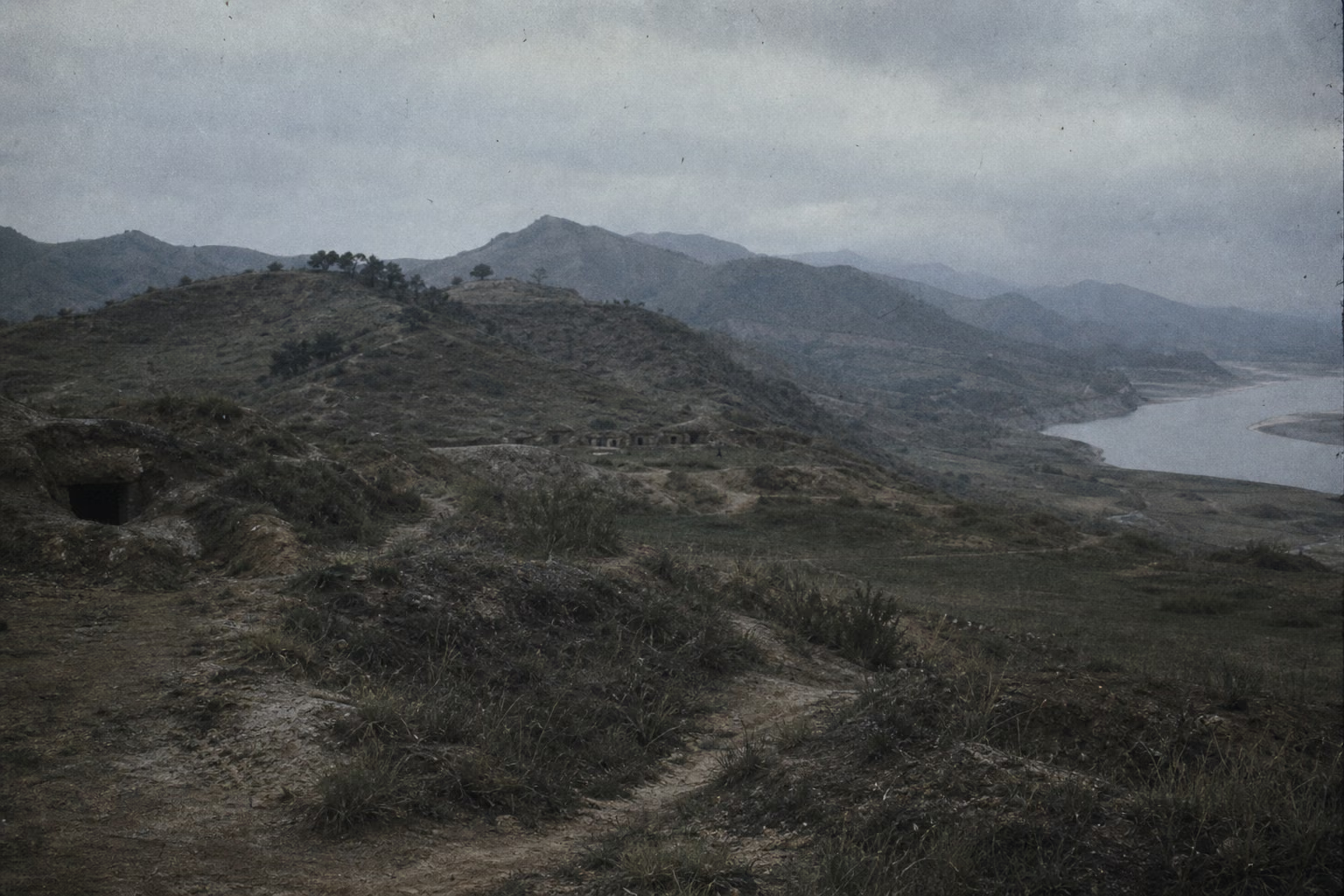
(For the larger situation in 1953 -- Stalin's death, Eisenhower's arrival in office, and the final showdown over prisoners of war -- see *War to Resist U.S. Aggression and Aid Korea · Overview*. Here only the front on the eve of the armistice is recorded.)
The Kumsong salient: by June 1953, the armistice talks had largely agreed to use the actual line of contact as the military demarcation line, while the ROK defensive line south of Kumsong bulged southward into a large arc -- once the ceasefire was signed, that arc would belong to South Korea. Straightening the arc was both a military problem, eliminating a salient driven into one's own side, and the last account to be settled beneath the negotiating table.
The 6.18 incident: just as the armistice agreement was about to be signed, Syngman Rhee unilaterally "released in place" more than 27,000 Korean People's Army prisoners of war (including disputes over policy toward Chinese People's Volunteer Army prisoners of war; figures vary by statistical basis) and openly opposed the armistice. This move pushed the signing process to the edge of breakdown. The response of Chinese People's Volunteer Army Headquarters was to fight one battle, aimed specifically at ROK forces -- the motive of "teaching Syngman Rhee a lesson" appears in many Chinese accounts; the wording of the original telegram remains unverified.
Why It Was Fought
After the Battle of Triangle Hill, the account for Operation Showdown lay plainly on the table: forty-three days and 25,000 casualties, without taking back two hilltops -- after this, the "United Nations Command" never again launched an offensive above battalion scale (the wording in U.S. official military history remains unverified). The side that could no longer move first returned to the negotiating table: in spring 1953, talks that had been suspended for half a year resumed (for the larger situation, see *War to Resist U.S. Aggression and Aid Korea · Overview*), and by June, the armistice terms had largely been settled, with the military demarcation line surveyed according to the actual line of contact. Ninety percent of the issues at the table had already been resolved; what remained was not clauses, but the will to carry them out.
But someone refused to accept the account. On June 18, with signature imminent, Syngman Rhee unilaterally "released in place" more than 27,000 Korean People's Army prisoners of war (figures vary by statistical basis), openly opposed the armistice, and pushed the signing process to the edge of breakdown -- what he wanted was to drag the United States back into the war and continue the "northward advance"; the United States could not control its own ally (the decision-making details of the U.S. tradeoff remain unverified). Chinese People's Volunteer Army Headquarters needed to prove two things: every point along the armistice line had to be settled by strength; South Korea on its own did not have the capital for a "northward advance."
The place was handed over by the map itself. If the boundary were drawn along the line of contact, the ROK defensive line south of Kumsong bulged southward into a large arc, with a front about 25 kilometers wide -- once the ceasefire was signed, that arc would belong to South Korea. Straightening the arc both eliminated a salient driven into one's own side and settled the last account beneath the negotiating table.
The most finely calculated layer was "strike ROK forces, not U.S. forces": the battle objective, artillery plan, and pursuit depth all had political ceilings -- to teach Syngman Rhee a lesson while giving U.S. forces no pretext to widen the war. Across the line there was a corresponding ledger: the U.S. Eighth Army withdrew into a rear support role and let ROK forces "bear it themselves" on the front. The Chinese People's Volunteer Army bet that U.S. forces would not restart the war for an ally's salient, and it bet correctly; Syngman Rhee bet that releasing prisoners could hold the United States in the war, and he lost -- in the end he was pressed back onto the armistice track, at the cost of refusing to sign (the level at which South Korea did not sign and the aftermath remain unverified). The battle motive of "teaching Syngman Rhee a lesson" appears in many Chinese accounts; the wording of the original telegram remains unverified. This was the cleanest case of political-military coordination in the three-year war.
On the night of July 13, more than 1,100 guns poured out 1,900 tons of shells in 28 minutes -- the first offensive since the Chinese People's Volunteer Army entered Korea in which it attacked with firepower superiority. Fourteen days before signature, the final battle began.
It was in fact possible not to fight: tolerate that arc, sign on time, and the war would still stop. But that would have made Syngman Rhee's opposition cost-free -- if on 6.18 he could "release prisoners in place," tomorrow he could reverse himself in place. For the armistice to stand, the person damaging it first had to pay cash once.
Course of the Engagement
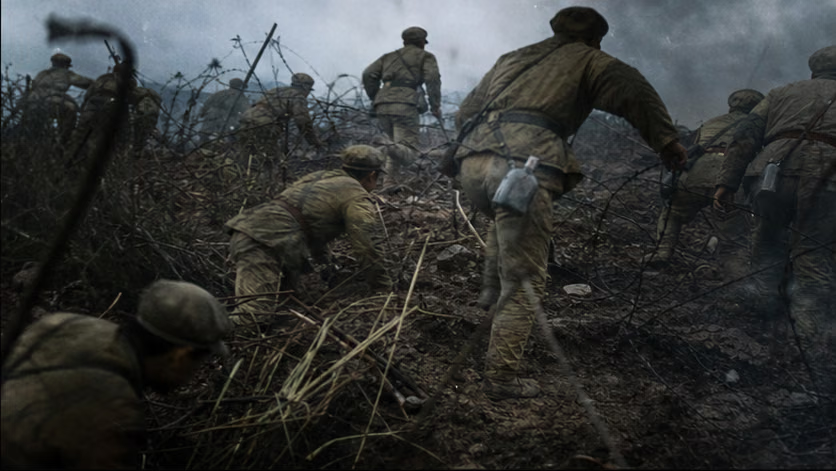
| Phase | Time | Key Points |
|---|---|---|
| Artillery preparation and breakthrough | Night of 7.13 | More than 1,100 guns made a 28-minute sudden strike with 1,900 tons of shells, destroying most of the ROK forward works; multiple armies attacked by night on several routes and broke through the first defensive line before dawn |
| Penetration in depth | 7.13–14 | A 12-man reconnaissance squad of the 203rd Division, 68th Army (the division containing the 607th Regiment; organizational level remains unverified), led by deputy platoon leader Yang Yucai, penetrated to Ichong-dong, took out the headquarters of the ROK Capital Division's First Regiment (the "White Tiger Regiment"), and captured its regimental flag -- the original case behind the later model opera *Raid on the White Tiger Regiment* |
| Expanding the gains | 7.14–18 | The full defensive depth was broken through; the farthest advances reached about 9–15 kilometers (mileage varies by direction and statistical basis), and four ROK divisions south of Kumsong were heavily damaged, with remnants withdrawing south |
| United Nations counterattacks | 7.16–27 | Taylor, commander of the U.S. Eighth Army (his post at the time remains unverified), and ROK forces organized repeated counterattacks by designations amounting to 7 divisions (participating formations and the number of attacks vary by statistical basis); the Chinese People's Volunteer Army shifted to positional defense and repelled more than a thousand counterattacks (figures vary by statistical basis) |
| Ceasefire | 7.27 | The signing took place at Panmunjom at 10 a.m.; at 22:00 that night the ceasefire took effect across the whole line -- the final night of the battle coincided with the instant of ceasefire |
Casualties and Losses
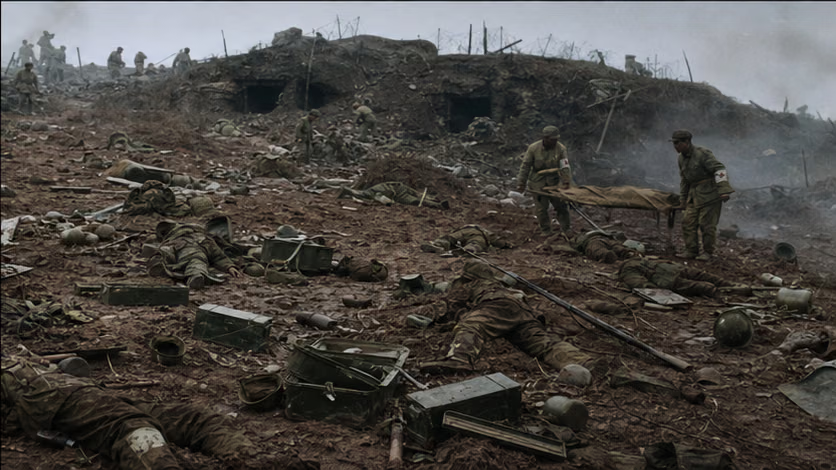
- Chinese figures: 53,000 enemy losses inflicted (including prisoners; the boundary and definition of "enemy losses inflicted" remain unverified), of which ROK forces formed the great majority; the Chinese People's Volunteer Army itself suffered 33,000 casualties (statistical bases vary). The two sets of figures coexist.
- ROK figures: the four divisions in the Kumsong direction suffered heavy losses, especially the Capital Division (this figure as recorded in ROK military history is doubtful); the taking of the "White Tiger Regiment" headquarters is a sore point in ROK military history.
- U.S. casualties were extremely small -- precisely the mirror image of the design of "strike ROK forces, not U.S. forces": U.S. forces also watched an ally's collapse at very low cost.
- The ammunition consumed in the battle exceeded the total for the five mobile-warfare phase offensives (the comparative statistical basis varies) -- the three-year curve from extreme firepower poverty to firepower-enabled breakthrough closed here.
Aftermath
- At 10 a.m. on 7.27, Nam Il, chief representative of the Chinese-Korean side, and Harrison, chief representative of the "United Nations Command" side, signed at Panmunjom (signing procedure: first signing the text, then sending it to the commanders of the two sides for countersignature; procedural details remain unverified); at 22:00 that night, the ceasefire took effect across the whole line. Records by the various armies at the instant of ceasefire -- artillery firing its last batch of shells, front-line sentry posts hearing the other side's guns stop as well -- are scattered through recollections from many sides; specific entries remain unverified.
- The military demarcation line was surveyed according to the actual line of contact on 7.27: the straightened arc south of Kumsong is the physical inheritance this battle left on the map, and it remains there today.
- Syngman Rhee ultimately did not sign -- the South Korean representative refused to sign the armistice agreement (the level at which South Korea did not sign and the aftermath remain unverified). The armistice is an armistice; there is still no peace treaty.
- The Chinese People's Volunteer Army withdrew in batches, and by 1958 had fully withdrawn from Korea (for the pace of withdrawal, see *War to Resist U.S. Aggression and Aid Korea · Overview*).
Accounts of Those Present
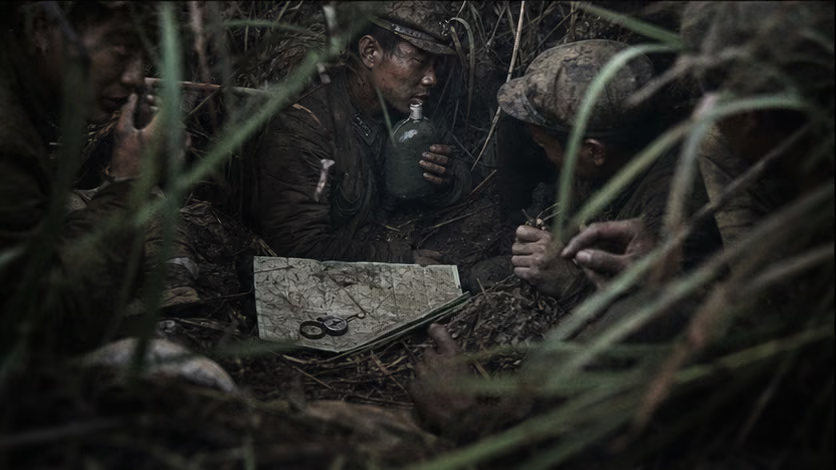
- Raid on the White Tiger Regiment: Yang Yucai led a 12-man reconnaissance squad disguised as ROK troops, penetrated 7.5 kilometers straight to the regimental headquarters at Ichong-dong, ended the fight in a little over ten minutes, and captured the "White Tiger Regiment" flag (the flag is now held by the Military Museum; collection information remains unverified). None of the 12 men was killed (casualty figures vary by statistical basis). Later, the story of these 12 men was written into a model opera; the "Yan Weicai" in the opera and the historical Yang Yucai stand in two layers side by side: the prototype was real, and the opera was processed art.
- 28 minutes: postwar calculations by the artillery group found that 1,900 tons of shells had fallen in 28 minutes -- for a force that three years earlier had entered Korea with "a few shells per man," this was the beginning of another war. Some veteran artillerymen recalled that they "felt pain firing like that" (specific source remains unverified).
- Infantry in concealment: on the eve of the attack, assault detachments lay concealed in the grass before the enemy's forward edge for an entire day, with mosquitoes, hunger, thirst, urine, and feces all dealt with in place -- after Battle of Triangle Hill, the Chinese People's Volunteer Army's discipline for "close-in concealment" had become instinct (the scale of concealment and casualties in the Kumsong direction remain unverified).
- The White Tiger Regiment headquarters tent: when the reconnaissance squad rushed in, ROK officers in the tent were holding an operations meeting (scene details largely come from Chinese military history and Yang Yucai's recollections; ROK records remain unverified).
- The final night: on the evening of 7.27, the artillery of both sides fired through their stocks before the signature took effect -- the last hour before the ceasefire was the densest and quietest wait along the whole line in three years (records by the various armies at the instant of ceasefire remain unverified).
The Ground
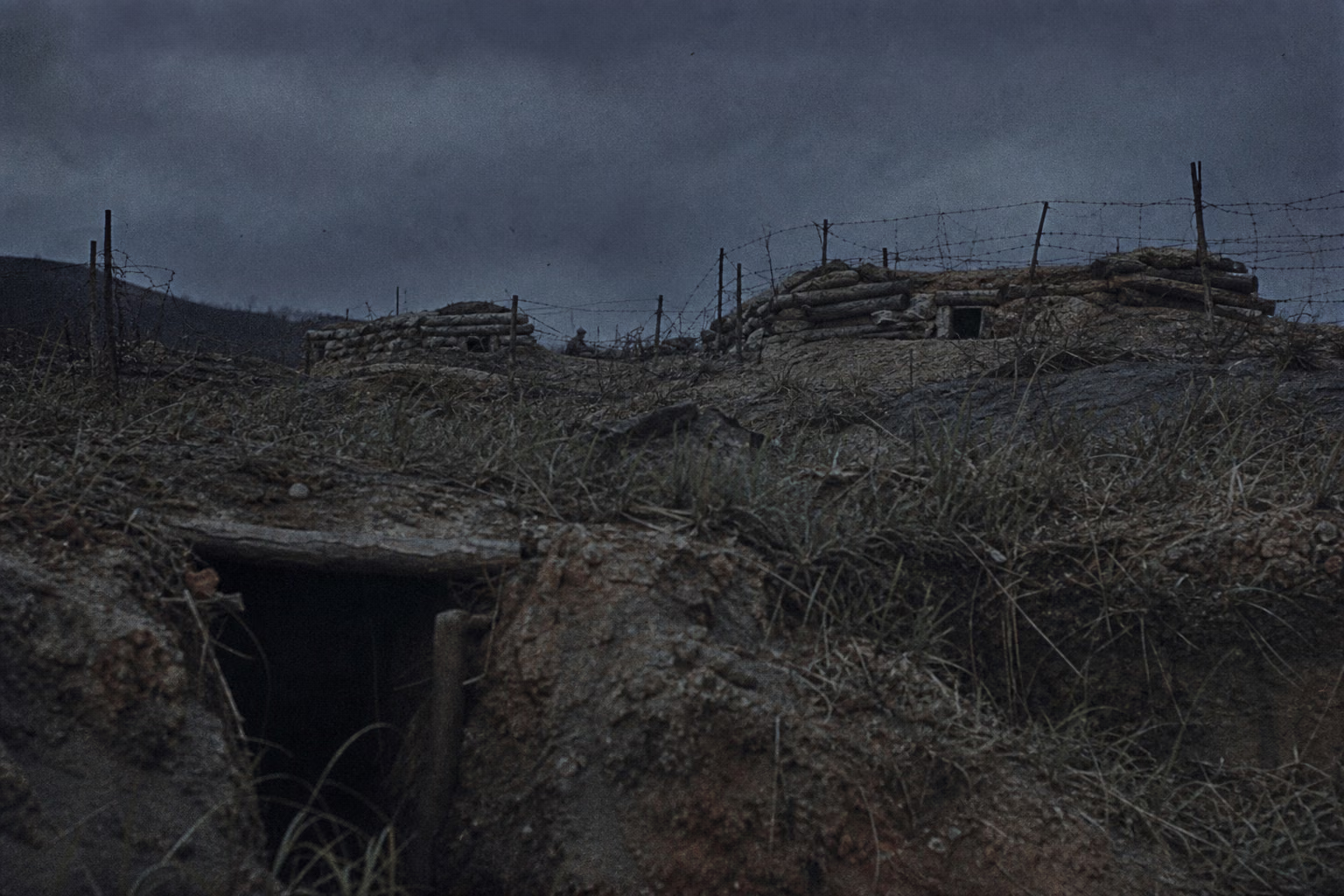
- The geometry of the Kumsong salient: an arc bulging southward, with a front of 25 kilometers and a depth of about 9 kilometers; the battle was the process of "ironing flat" this arc -- the spatial objective was the battle objective.
- The Bukhan River lay on the east side, serving both as a natural barrier and as an obstacle to retreat: as ROK forces collapsed and withdrew, crowding at river crossings was hit by firepower (details unclear).
- Ichong-dong: the in-depth node where the White Tiger Regiment headquarters was located, the "needle's eye" of the penetration route.
- The spatial logic of the three-year war ended here: mobile warfare was a struggle over hundreds of kilometers, positional warfare was a fight for one hilltop, and Kumsong redrew one line straight by firepower inside a fixed coordinate system.
How Each Side Records It
- Chinese side: as the closing battle of the War to Resist U.S. Aggression and Aid Korea and a model of "promoting talks by fighting / promoting signature by fighting," *Raid on the White Tiger Regiment* entered mass memory through model opera; recent narratives also stress the historic reversal in the firepower comparison.
- ROK side: the crushing defeat in the Kumsong ("금성") direction is one of the heaviest pages in ROK military history; the weight in ROK memory of the "White Horse Division" at White Horse Hill is entirely different from that of the Capital Division whose regimental headquarters was taken at Kumsong (later rebuilt and continued in lineage; details unclear).
- U.S. side: U.S. military history records the battle as the "last Chinese communist offensive" before the armistice (the entry "Kumsong salient"; U.S. wording remains unverified), with the emphasis on the political closure of armistice talks rather than on the fighting itself.
- Syngman Rhee's 6.18 prisoner release and refusal to sign are protected differently in U.S. and ROK narratives: the U.S. side stresses its effort to "press the ally into compliance," while the ROK side stresses the humiliation of "not being consulted" -- the divergence itself is also recorded here.
Disputes and Sensitivities
- Interpretation of "strike ROK forces, not U.S. forces": the Chinese side records it as political wisdom, while from the ROK perspective it is the hidden pain of an "ally watching from the side"; both layers of narrative coexist.
- Statistical basis for battle results: the gap between 53,000 enemy losses inflicted and the losses acknowledged by the ROK side, as well as the question of how Korean supplementary troops were counted among "prisoners captured," remain questions of statistical basis.
- The historical fact-model opera double layer of Raid on the White Tiger Regiment: dramatic processing (numbers, plot) and the historical original case have a boundary.
- The core question of this battle is "why fight after the winning position had already been set" -- the answer is political, not military; this is a lesson in "war as a political tool."
Sources and Open Questions
Known main sources:
- *History of the War to Resist U.S. Aggression and Aid Korea* (Military Science Press, Chinese official account), chapter on the Battle of Kumsong
- Recollections by Yang Yong, Wang Ping, and other 20th Army Group commanders (titles to be added)
- Yang Yucai's own recollections and Military Museum collection records for the "White Tiger Regiment" flag
- Military history of the ROK Ministry of National Defense (volumes on the Kumsong direction; original books to be checked)
- U.S. Army history *Truce Tent and Fighting Front* (Walter Hermes, on armistice talks and the final offensives)
Open questions: the complete order of battle for all participating armies; the specific designations and immediate deployments of the four ROK divisions; the original statistical basis in artillery battle reports for 1,100 guns, 1,900 tons of shells, and 28 minutes; the organizational subordination of the 607th Regiment and 203rd Division; the original battle report on the number of men, route, and casualties of Yang Yucai's reconnaissance squad; the original telegram for the motive of "teaching Syngman Rhee a lesson"; the statistical basis for the number of prisoners released on 6.18; the formations and number of United Nations counterattacks; the boundary of the statistical basis for 53,000 enemy losses inflicted / 33,000 own casualties; the comparative statistical basis for battle ammunition consumption versus the total of the five mobile-warfare phase offensives; details of the 7.27 signing procedure and records by the various armies at the instant of ceasefire; the level at which South Korea refused to sign the armistice agreement and the aftermath; the postwar reconstruction of the Capital Division and the lineage of the "White Tiger Regiment" designation.
All images on this site are AI-generated depictions. They are not historical photographs, not primary sources, and do not depict any real individual.