Engagement Archive · Fifth Phase Offensive
The largest offensive after the Chinese People's Volunteer Army entered Korea was fought through in fifty days: in the first phase it could still move, in the second it pushed far, and during the withdrawal the opponent bit back; one division was broken as an organized formation on the south bank of the Bukhan River, and only after one army nailed itself to Cheorwon with its lives was the front stabilized. The mobile-warfare phase ended here.
Engagement Data
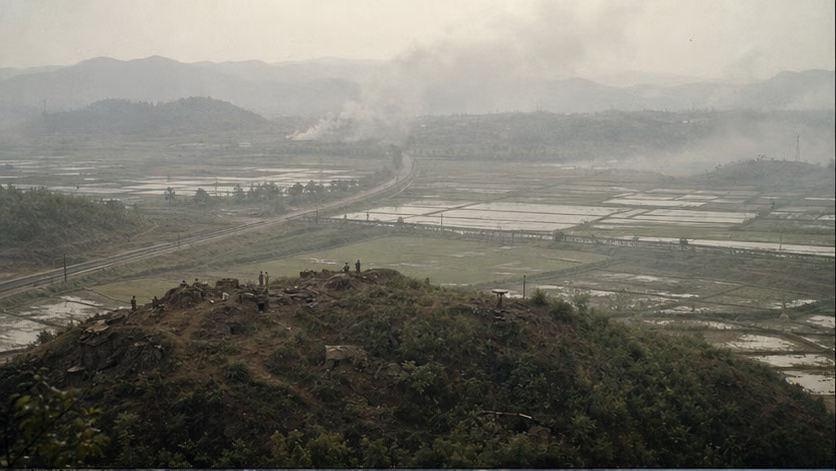
| Item | Content |
|---|---|
| Time | 1951.4.22 – 6.10, 50 days in all |
| Place | North and south of the 38th Parallel on the Korean Peninsula: the Seoul direction on the western front, the Hyeon-ri direction on the eastern front, and the Bukhan River-Cheorwon-Yeoncheon line |
| Part of | War to Resist U.S. Aggression and Aid Korea · the last major engagement of the mobile-warfare phase |
| Maneuvering Side | Chinese People's Volunteer Army (Commander Peng Dehuai): Third, Ninth, and 19th Army Groups and the previously deployed armies, about 600,000 on the first line (figures vary, including accounts of more than 600,000, unverified); the Korean People's Army fought in coordination |
| Pursuit-and-Blocking Side | the "United Nations Command" (Commander-in-Chief Ridgway): the main force of the U.S. Eighth Army (after Walker's death Ridgway took over as army commander; his exact post at the time and the handover date remain unverified), ROK forces, and British, Turkish, and other brigade-level units |
| Result | After two successful offensive phases, the Chinese People's Volunteer Army exhausted itself and withdrew; on 5.23 the United Nations Command counterattacked across the whole line; most of the 180th Division was destroyed; the Cheorwon blocking action ended on 6.10, and the front stabilized near the 38th Parallel |
Belligerents
| Item | Maneuvering Side (Chinese People's Volunteer Army / Chinese-Korean side) | Pursuit-and-Blocking Side (United Nations Command) |
|---|---|---|
| Strength | 3 army groups and 11 armies on the first line, about 600,000 men (including the newly entered Third and 19th Army Groups) | About 340,000 (including ROK forces; figures vary by account) |
| Firepower | Artillery had increased somewhat (including the first large-scale use of Soviet-made Katyusha rocket artillery; timing unverified), but overall still lagged far behind | Overwhelming artillery, tanks, and air power; Ridgway's "magnetic tactics" -- contract by day, consume with firepower, counterattack at night |
| Air | Basically none | Absolute air superiority |
| Supply | Shoulder carrying, pack animals, and night motor transport; the offensive limit was roughly a "seven-day offensive" (the source of the "week-long offensive" formulation remains unverified); during the engagement, rear supply lines had already reached their limit | Mechanized supply, a closed loop of firepower and logistics |
| Condition | The Third and 19th Army Groups had just entered Korea: unfamiliar with the terrain, unfamiliar with the opponent, and unfamiliar with the density of U.S. firepower. The tuition for new troops was paid all at once in the later part of the engagement | After repeated rest and replenishment, Ridgway had already read the supply rhythm of the Chinese People's Volunteer Army |
Terrain and Conditions
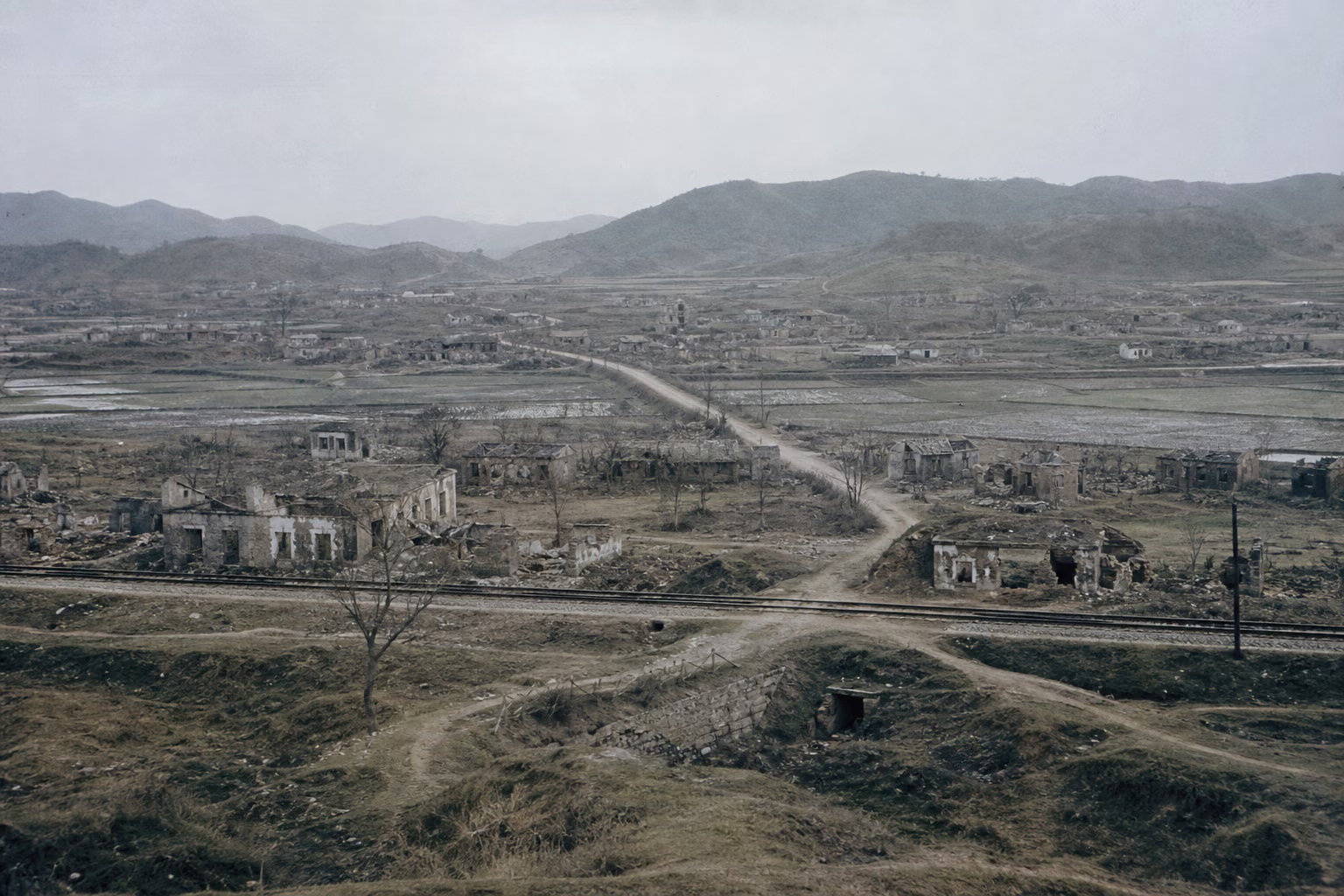
(For the wider three-layer situation of the world, the United States, and China -- Truman's dismissal of MacArthur, and the first appearance of a negotiating atmosphere -- see *War to Resist U.S. Aggression and Aid Korea · Overview*. Here only the front is recorded.)
A corridor fought over four times. Within half a year, the front had been pushed back and forth four times between the Yalu River and the 38th Parallel; villages and towns north and south of the 38th Parallel changed hands repeatedly, while civilians were killed, fled, or were displaced. When the Fifth Phase Offensive began, both sides already had a ledger of the other's methods: U.S. forces knew the Chinese People's Volunteer Army's offensive could not last more than seven to ten days, and the Chinese People's Volunteer Army knew the density of the U.S. fire net. But "knowing" and "being able to withstand it" were two different things.
Cheorwon as a place: the "Iron Triangle" formed by Yeoncheon-Cheorwon-Kimhwa was the railway and road hub of central Korea, the heart through which rear supplies of the Chinese People's Volunteer Army were stockpiled and transferred. If Cheorwon were lost, the gateway in the center would be thrown open, and the hundreds of thousands of troops withdrawing north would be bitten through at the waist. This is why the battle at the end of May had to be fought.
Why It Was Fought
The Fourth Phase Offensive closed on April 21: the Chinese People's Volunteer Army abandoned Seoul, crossed the Han River, and withdrew hill by hill to the vicinity of the 38th Parallel; Ridgway also did not advance north again in great depth, and offense and defense rebalanced here. But balance did not mean a halt. Washington had just relieved MacArthur of command on April 11; Ridgway was promoted to commander-in-chief of the "United Nations Command," and Van Fleet took over the Eighth Army -- the opponent changed commanders without changing methods. On the Chinese People's Volunteer Army side, meanwhile, the Third and 19th Army Groups were entering Korea one after another, bringing first-line strength to about 600,000 (figures vary, including accounts of more than 600,000, unverified): the largest hand dealt since entry into Korea had just arrived.
The hand was large, but time became tighter. The United Nations Command's northward advance again pressed close to the 38th Parallel, and the atmosphere of ceasefire talks was beginning to appear between Washington and Beijing. At this point in the war, whoever seized battlefield initiative first would have one more piece of solid evidence at the future table. The judgment of Chinese People's Volunteer Army Headquarters was to strike another major battle while the United Nations Command had not yet found firm footing and while its follow-on troops had just arrived, regain battlefield initiative, and preferably annihilate several U.S. divisions as organized formations (the wording of the original telegram setting the engagement objective remains unverified). This was a decision made ahead of the opponent: seizing the first move, and betting that the new troops could be plugged in and used immediately.
There was no freedom to choose the place. The front lay across both sides of the 38th Parallel: to the west was the open corridor toward Seoul; to the east, the valleys around Hyeon-ri; in the middle, the "Iron Triangle" formed by Yeoncheon-Cheorwon-Kimhwa held the railway and road hub of central Korea, the heart through which rear supplies of the Chinese People's Volunteer Army were stockpiled and transferred. On this board, the direction of advance was Seoul; the vital point of retreat was Cheorwon.
Both sides made their calculations against an opponent they thought they already knew. The Chinese People's Volunteer Army knew the density of the U.S. fire net; U.S. forces knew the Chinese People's Volunteer Army's offensive could not last more than seven to ten days. Magnetic tactics had been tested in the Fourth Phase Offensive, and what Ridgway was waiting for was precisely the moment when the offensive reached its ceiling and food and ammunition ran out. On this side, he bet correctly. On the other side, Chinese People's Volunteer Army Headquarters bet that the new troops could be plugged in and used immediately, and lost: the Third and 19th Army Groups were unfamiliar with the terrain, unfamiliar with the opponent, and unfamiliar with the density of U.S. firepower. In hindsight, "sending troops unfamiliar with the opponent straight into a major battle" was one of the roots of the later loss of control. And "knowing" and "being able to withstand it" were, from the start, two different things.
At dusk on April 22, a night assault began across the whole line, and the engagement opened.
There was in fact another road: to rely on the established positions near the 38th Parallel and hold fast, letting the new troops absorb their tuition in defense while waiting for the negotiating table to take shape. But the United Nations Command was pressing north, and holding fast meant handing over the initiative together with the 38th Parallel; with spring giving way to summer, the next rainy season would belong to the side with roads and trucks. Chinese People's Volunteer Army Headquarters chose the first move.
Course of the Engagement
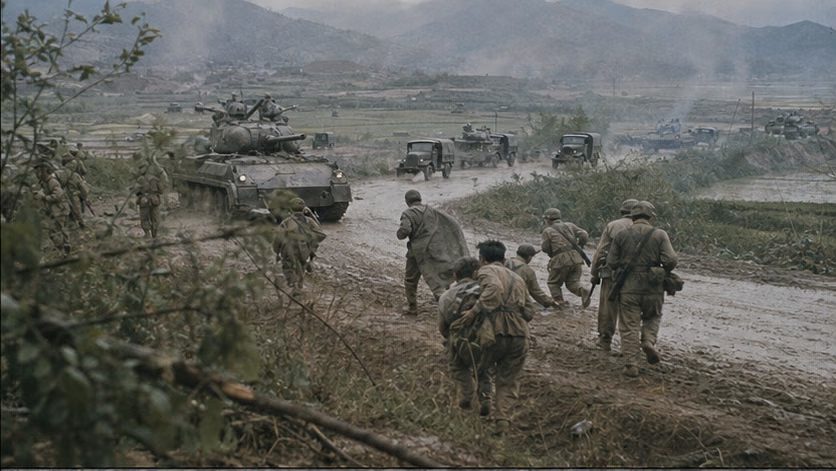
| Phase | Time | Key Points |
|---|---|---|
| First phase (western front) | 4.22–4.29 | Night assaults broke through across the whole line and drove directly toward the area north of Seoul; U.S. forces withdrew in order under "magnetic tactics"; the Chinese People's Volunteer Army advanced 70–80 kilometers but failed to envelop the main U.S. force, and stopped the offensive on 4.29 |
| Second phase (eastern front) | 5.16–5.21 | The main force shifted east, and in the Hyeon-ri direction succeeded in enveloping and destroying most of the ROK Third and Ninth Divisions (more than 10,000 enemy losses inflicted, figures vary by account) -- the cleanest stroke of the entire engagement; but the supply line had been stretched to its limit, and food and ammunition were both exhausted |
| Offensive halted, main forces shifted north | 5.21–5.22 | Peng Dehuai ordered the offensive halted and the main forces transferred for rest and reorganization -- the moment when the offensive reached its ceiling |
| United Nations Command counterattack across the whole line | From 5.23 | Ridgway seized the interval in the Chinese People's Volunteer Army's transfer and used motorized task forces to wedge along roads and split the line; their speed of penetration far exceeded expectations, and the withdrawal organization of multiple Chinese People's Volunteer Army armies was disrupted |
| 180th Division encircled | 5.24–5.29 (timing unverified) | The 180th Division of the 60th Army was ordered to cover the transfer of the main forces and wounded on the south bank of the Bukhan River, and was encircled by U.S. and ROK forces; the breakout scattered, and the division lost more than 7,000 men (about 3,900 wounded and captured, figures vary by statistical basis) -- the largest single organized-formation loss of the Chinese People's Volunteer Army |
| Cheorwon blocking action | 5.28–6.10 | The 63rd Army's 24,000 exhausted troops blocked four U.S. divisions for thirteen days and nights and held the Cheorwon hub; the whole army was nearly broken |
| Front stabilized | 6.10 | Both sides largely returned to a standoff near the 38th Parallel; from late June onward, the atmosphere of ceasefire talks became concrete |
Casualties and Losses
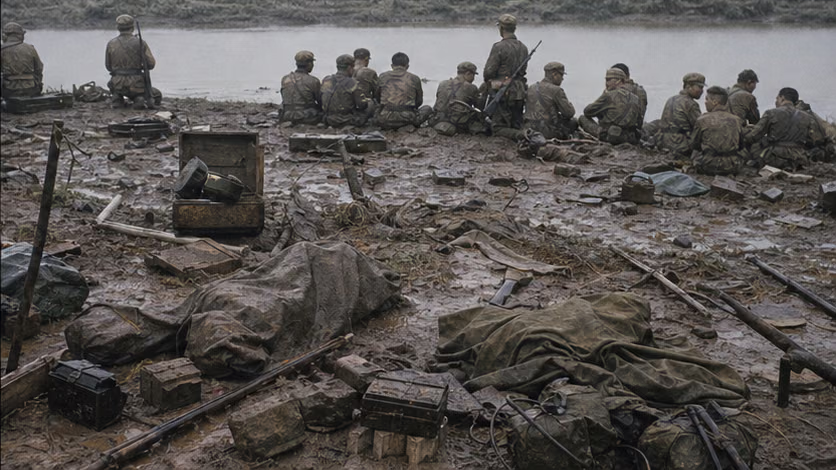
- Chinese figures: 82,000 enemy losses inflicted (including prisoners; the boundary of the statistical basis remains unverified).
- The Chinese People's Volunteer Army itself suffered 85,000 casualties (figures vary by account) -- the first engagement since entry into Korea in which Chinese People's Volunteer Army casualties exceeded enemy losses inflicted. The two sets of figures coexist.
- 180th Division: the whole division lost more than 7,000 men, including about 3,900 captured (a substantial share of all Chinese People's Volunteer Army prisoners, exact proportion unverified). This is the heaviest sample in accounts of defeat: not "sacrifice," but destruction as an organized formation and large numbers captured.
- 63rd Army: after the Cheorwon blocking action it had basically lost combat effectiveness and was withdrawn for replenishment; the Peng-Fu conversation about "how many men are left in the 63rd Army" is widely circulated, but the original wording and command level remain unverified.
Aftermath
- The mobile-warfare phase ended. Both sides had seen the ceiling clearly: the Chinese People's Volunteer Army could not push past its supply limit, and U.S. forces could not afford to retake all of Korea. In June, ceasefire negotiations began (at Kaesong, later moved to Panmunjom), and the war entered two years of "fighting while talking."
- Internal review of the engagement: Peng Dehuai's self-criticism at an expanded meeting of the Chinese People's Volunteer Army Party committee has circulated as the claim that this was "one of the four great defeats of his military career" -- the source of the original wording and the level of the "four great" list remain unverified, but Chinese official military histories do not avoid either the existence or the severity of the review.
- The aftermath of the 180th Division was another account entirely: after breaking out and returning to his unit, division commander Zheng Qigui was disciplined (dismissal, demotion; the details of the punishment vary by account and remain unverified), and his later years were difficult. The 180th Division's designation was once discussed for cancellation, then retained and rebuilt (the full rise and fall of the designation remains unverified). Officers and soldiers who broke out and returned, and those who returned after captivity, each had their own fate in the political movements of the following decades.
- The "nail tactics" of Fu Chongbi, commander of the 63rd Army -- scattering the troops into small groups in depth, making U.S. forces gnaw down one hilltop after another -- became a rehearsal for the defensive tactical turn of the Chinese People's Volunteer Army. The method at Cheorwon later grew into tunnel defense.
Accounts of Those Present
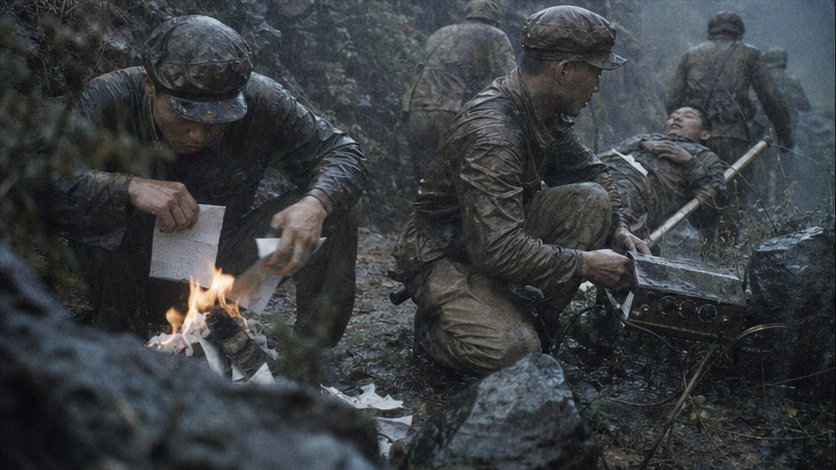
- The breakout of the 180th Division: radios were smashed, codes were burned, and the troops split into many groups to find their own way through the mountains on a rainy night. Some groups got out; some ran out of ammunition and were captured; some fought guerrilla actions for months behind enemy lines before returning to their units (numbers and process of return unverified). A division did not have one ending; it had several thousand endings.
- "How many men are left in the 63rd Army": it is said that Peng Dehuai asked Fu Chongbi on the telephone how long he could still hold and how many men were left in the army, and that Fu answered something like "we'll talk after the fight is over" -- multiple versions of the dialogue circulate, all listed as unverified. What can be confirmed is that the 63rd Army was reduced from 24,000 men to less than half (specific figure disputed), and Cheorwon was not lost.
- The tuition of new troops: some units of the Third and 19th Army Groups had never even seen U.S. night-battle flares when they entered Korea; when the flares lit up, they thought dawn had come (specific battle examples unverified). "Unfamiliar with the opponent" was not an abstract judgment; it was the first time for company after company.
- The speed of the counterattack: troops accustomed to the idea that "U.S. forces fight by the book" discovered on May 23 that tank task forces could drive dozens of kilometers along roads in a single day, and that the retreat route could be lost before the front line. For many units, breakout began with "the sound of tanks coming from behind."
- Stretchers and wounded first: the order received by the 180th Division was to cover the transfer of the wounded and the main forces, and it could not withdraw before the transfer was completed. Its final position was pinned in place by that order (original order text unverified).
The Ground
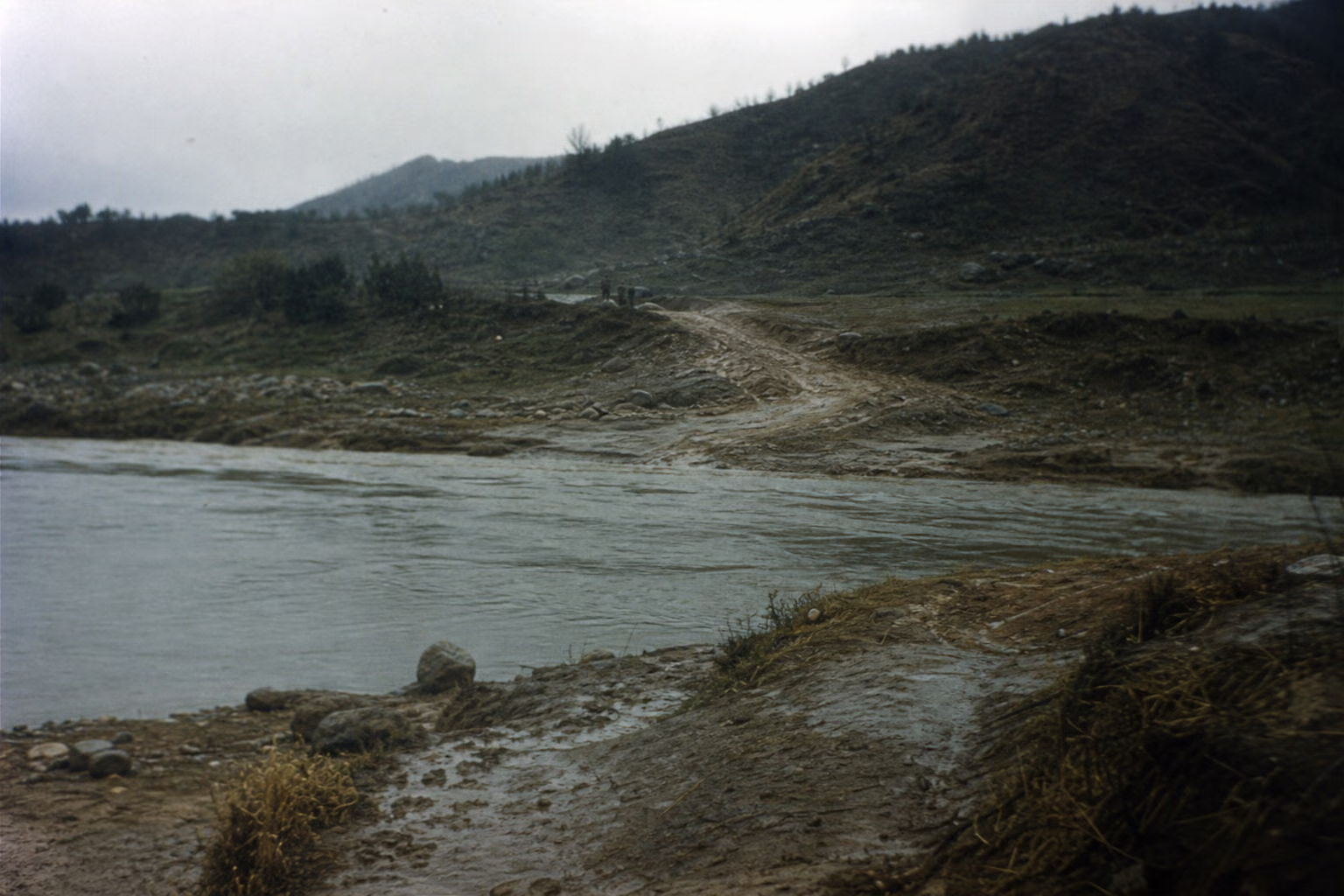
- Three axes: the western-front Uijeongbu-Seoul corridor (the push of the first phase); the eastern-front Hyeon-ri valley (the encirclement of the second phase, with the road following the river valley and the hills on both sides deciding whether the pocket could close); and the central Yeoncheon-Cheorwon-Kimhwa "Iron Triangle" (the board of the blocking action: hills, rice paddies, and one railway).
- Bukhan River: the spatial grammar of the 180th Division's encirclement -- a river to the south, a retreat route that had to cross it, and crossing points under the opponent's artillery fire.
- Cheorwon's depth: the 63rd Army did not build one line; it built dozens of points, with spacing arranged according to the habits of U.S. tank penetration -- the geometry of "nail tactics."
- The alternating rule of night and day: the Chinese People's Volunteer Army attacked at night, while U.S. forces counterattacked in daylight and on roads. The rhythm of the engagement was shaped by the alternation between nighttime infantry assaults and daytime mechanized counterattacks.
How Each Side Records It
- Chinese side: official military histories say the engagement "achieved victory" while also recording the loss of the 180th Division and the lessons in operational guidance; in recent years, popular narratives have shifted their center of gravity toward the Cheorwon blocking action (often presented in films and documentaries), while public memory of the 180th Division is comparatively thin and sensitive.
- U.S. side: Ridgway's memoir lists the May counterattack as a point of pride (the culmination of the series of offensives including "Operation Killer" and "Operation Ripper"; operation names and timing unverified); U.S. military histories call it the "May offensive" ("the Chinese army's Fifth Phase Offensive"; the English battle names First/Second Spring Offensive remain unverified).
- ROK side: the destruction of most of the ROK Third and Ninth Divisions in the Hyeon-ri direction is a sore point in ROK military history, usually reviewed in terms of "intelligence failure" and "command confusion" (ROK military-history wording unverified).
Disputes and Sensitivities
- Characterization of the engagement: three characterizations coexist: "costly victory," "draw," and "defeat." Peng Dehuai's own account, the results claimed, and the casualty figures are all points of dispute; the two sets of figures coexist.
- Attribution for the 180th Division: for decades, Chinese military historians have debated the relative weight of higher command (the army group-army chain of orders) and the division's own handling. The issue involves evaluations of specific living and deceased persons, and the divergence in materials remains heavy.
- Prisoners of war: the postwar destinations of those captured in this engagement (repatriation / going to Taiwan) touch cross-Strait narratives and are a war-level sensitivity (see the disputes section of *War to Resist U.S. Aggression and Aid Korea · Overview*).
- The 180th Division and Cheorwon are two sides of the same engagement: one side is failure, the other sacrifice in exchange for stabilization. To speak only of Cheorwon and not of the 180th Division is mythmaking; to speak only of the 180th Division and not of Cheorwon is to lose the real structure of the engagement.
Sources and Open Questions
Known main sources:
- *History of the War to Resist U.S. Aggression and Aid Korea* (Military Science Press, Chinese official account)
- Ridgway's memoir *The Korean War* (from the perspective of the U.S. army commander)
- Memoirs and military-history studies related to the 63rd Army and the 180th Division (titles to be added)
- Military history by the War History Compilation Committee of the ROK Ministry of National Defense (ROK account; original work to be checked)
Open questions: the precise statistical basis for the forces committed to the engagement (600,000 / more than 600,000 and the order of battle); the timing of Ridgway's assumption of command of the Eighth Army and its relation to Walker's death; the first phase's advance distance and prisoner figures; enemy losses inflicted in the Hyeon-ri encirclement; the day-by-day timing of the 180th Division's encirclement and breakout; the different statistical bases for the 180th Division's losses (sources for more than 7,000 / 3,900 captured); Zheng Qigui's punishment and later years, and the rise and fall of the 180th Division designation; the original wording and command level of the Peng-Fu "how many men are left in the 63rd Army" dialogue; the original text of Peng Dehuai's "four great defeats" self-account; casualties of the 63rd Army in the Cheorwon blocking action; the earliest source of the "week-long offensive" formulation; the timing of the first use of Katyushas; the operation codenames and timing of the U.S. May offensives.
All images on this site are AI-generated depictions. They are not historical photographs, not primary sources, and do not depict any real individual.