Engagement Archive · Second Phase Offensive — Overview
The Chinese People's Volunteer Army hid its victory in the First Phase Offensive inside a screen of smoke, luring the "United Nations Command" into a full northward advance, then closed the net on the western and eastern fronts at the same time: in the west, a single night of infiltration along the Chongchon River cut the enemy's retreat; in the east, amid the ice and snow of Chosin Reservoir, the U.S. 1st Marine Division was hunted in encirclement. In one month the front was driven back from the Yalu River to the 38th Parallel. It was the greatest reversal of the entire war, and also its costliest lesson.
Engagement Data
| Item | Details |
|---|---|
| Time | 1950.11.25 – 12.24 |
| Place | Western front: both banks of the Chongchon River (Kaechon, Kunu-ri, Samso-ri, Ryongwon-ni); eastern front: Chosin Reservoir area (see the separate article) |
| Belongs To | War to Resist U.S. Aggression and Aid Korea · Second Phase Offensive in the mobile-warfare phase (called the "Chongchon-Chosin campaign" by the U.S. side) |
| Chinese People's Volunteer Army | Western front: 13th Army Group, 6 armies (38th, 39th, 40th, 42nd, 50th, and 66th Armies); eastern front: Ninth Army Group (20th, 26th, and 27th Armies, Song Shilun) |
| United Nations Command | Western front: U.S. Eighth Army (Walker), commanding U.S. I Corps and IX Corps, ROK II Corps, the Turkish Brigade, and others; eastern front: U.S. X Corps (Almond), commanding the 1st Marine Division, 7th Infantry Division, and others |
| Result | General retreat of the "United Nations Command" on both the western and eastern fronts; on 12.6 the Chinese People's Volunteer Army recaptured Pyongyang, and the front was pushed back near the 38th Parallel |
Belligerents
| Item | Chinese People's Volunteer Army | United Nations Command |
|---|---|---|
| Strength | About 230,000 on the western front and about 150,000 on the eastern front, about 380,000 in total (statistical bases vary by account) | About 220,000 front-line troops in total (western and eastern fronts combined; statistical bases vary by account) |
| Firepower | Mainly light infantry; mortars were the principal battalion- and company-level supporting fire; the Ninth Army Group entered Korea on the eastern front without winter clothing (East China troops were rushed north, cotton-padded clothing incomplete -- the main body of the frostbite account; see Battle of Chosin Reservoir) | Full firepower system + absolute air superiority; but forces advanced rashly in separate columns, leaving a large gap between the western and eastern fronts |
| Supply | Forward movement by human labor; several days of food and ammunition carried by the troops; in mountains and snow, motor traffic was difficult | Road logistics -- both strength and lifeline: once the retreat route was cut, heavy forces became dead weight |
| Opponent's Posture | Induced by the show of weakness after the First Phase Offensive, believing that the enemy before them consisted only of tens of thousands of "volunteers" | MacArthur launched the "Home by Christmas" general offensive on 11.24 -- the offensive was counterattacked the next day |
Terrain and Conditions
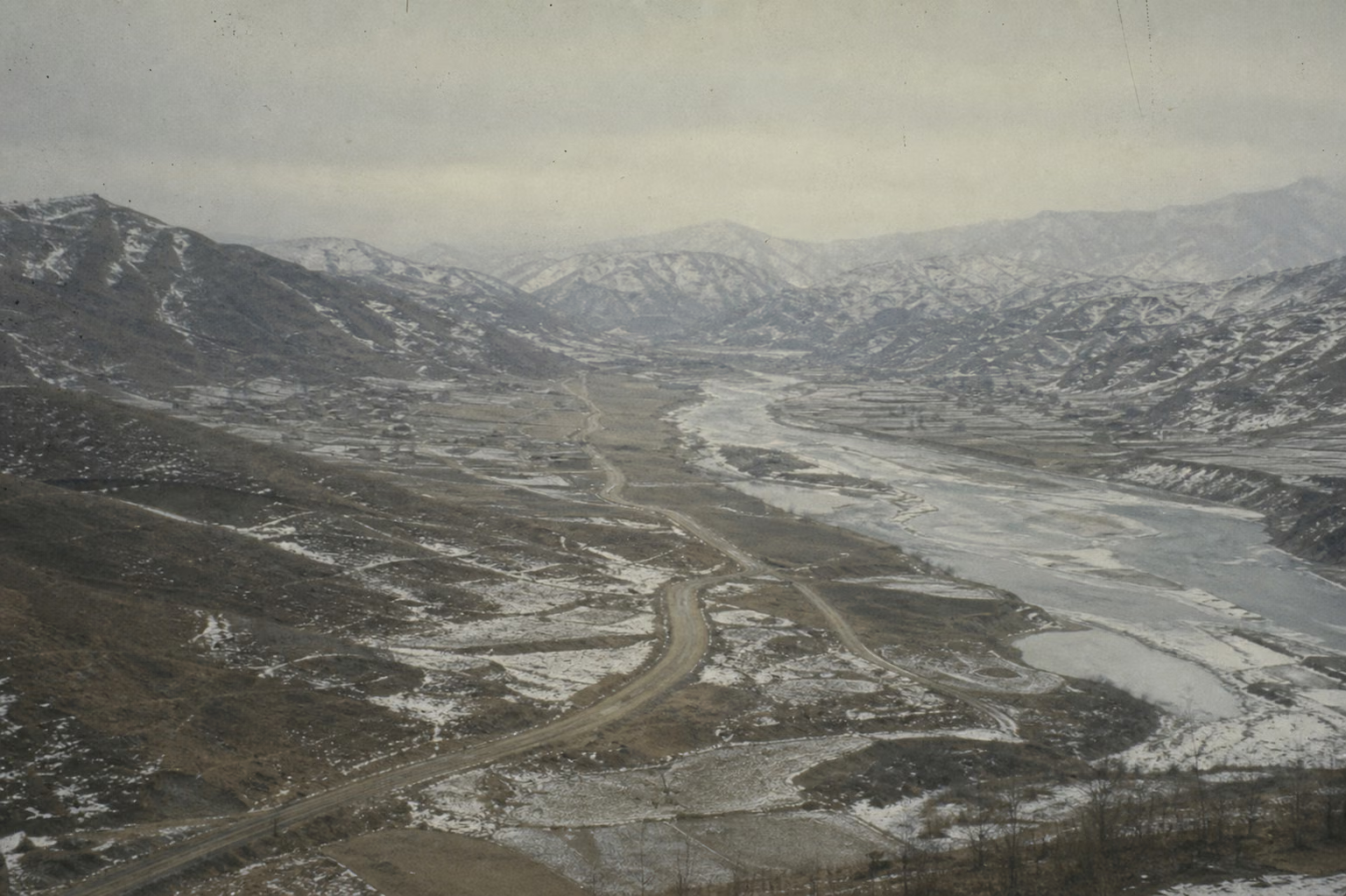
(For the wider situation at the end of 1950 -- the "United Nations Command" decision to advance north, and mutual misjudgments between China and the United States -- see War to Resist U.S. Aggression and Aid Korea: Overview. This section records only the Chongchon River and the Gaema Plateau.)
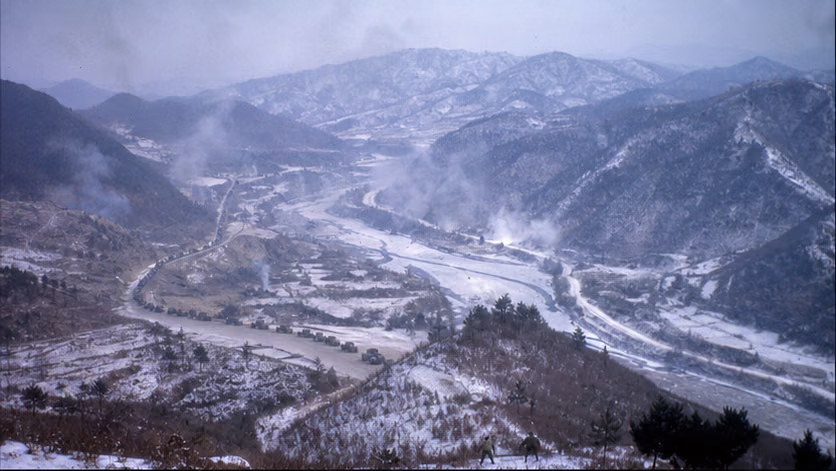
The mountain pocket north of the Chongchon River. The Kaechon-Kunu-ri line was the waist of western-front communications: the roads north branched here, and the roads south also converged here. Farther south, Samso-ri and Ryongwon-ni were the road defiles from Kunu-ri toward Sunchon and Pyongyang -- cut one link, and the whole line is blocked. This was the pocket Peng Dehuai chose.
Extreme cold. In late November, temperatures in northern Korea abruptly dropped to twenty or thirty degrees below zero; on the Gaema Plateau in the eastern front, conditions were still worse. Cold inflicted casualties on both sides, but for the Ninth Army Group, short of winter clothing, without bivouacs, lying on ice and snow, it was a different order of destruction (for the detailed eastern-front frostbite account, see Battle of Chosin Reservoir).
Civilians of the battlefield country: North Korean residents were caught between the general offensive and the general retreat -- bombing, routed soldiers, roads jammed by withdrawal, and villages after armies from both sides had passed through. The roughly 90,000-100,000 Korean civilians who fled south with the troops during the Hungnam evacuation (Hungnam evacuation, statistical bases vary by account) are one account in the battlefield-country dimension in the east; the population flows before and after the recapture of Pyongyang on the western front are another (unverified).
Why It Was Fought
The First Phase Offensive had been won, but the Chinese People's Volunteer Army did not pursue the victory. On November 5 the entire front halted; the main forces withdrew and concealed themselves, abandoned some worn equipment, reduced contact, and deliberately staged a victory as if it had been only a "symbolic troop dispatch, already repulsed" (details of the show-of-weakness deployment orders unverified). MacArthur's headquarters believed it: based on prisoner statements and battlefield contact, its assessment was that only several tens of thousands of "volunteers" had entered Korea (original text of the U.S. intelligence assessment unverified). On November 24 he launched a general offensive on both the western and eastern fronts, promising soldiers they would be "home by Christmas."
This was exactly the step the Chinese People's Volunteer Army was waiting for. The opponent advanced rashly in separate columns, leaving a large gap between the western and eastern fronts, while all heavy forces were committed to a few river-valley roads -- those roads were both strength and lifeline: once the retreat route was cut, heavy equipment became dead weight. During this period, the Ninth Army Group's 150,000 men were rushed north from East China and secretly entered Korea to take over the eastern front; on the western front, the six armies of the 13th Army Group completed their concentration in the mountains north of the Chongchon River. The pocket Peng Dehuai selected lay at Kaechon-Kunu-ri: the roads north branched here, and the roads south also converged here; farther south, the two defiles at Samso-ri and Ryongwon-ni meant that cutting one link would block the entire line.
Time, too, stood on the ambusher's side, but with extreme cruelty: in late November a cold wave arrived suddenly, twenty or thirty degrees below zero, impartial toward the side lying in ambush and the side advancing rashly -- while for the Ninth Army Group entering Korea in thin East China winter clothing, it was a different order of destruction (for the frostbite account, see Battle of Chosin Reservoir).
At dusk on November 25, the western front counterattacked first; two days later, it opened simultaneously in the snowy night at Chosin Reservoir on the eastern front. This was the only time in the entire war when the opponent walked onto the battlefield completely according to the Chinese side's design ("luring the enemy deep in" from conception to execution is regarded in military history as a textbook case of mobile warfare); and it was also the costliest lesson, with victory and the bill placed in the same pocket.
Course of the Engagement
| Stage | Time | Main Points |
|---|---|---|
| Showing weakness to lure the enemy | 11.6–11.24 | The main forces of the Chinese People's Volunteer Army withdrew and concealed themselves; the forward line fought while falling back; U.S. forces probed northward, then launched the general offensive on 11.24 |
| Western-front counterattack | 11.25–11.27 | At dusk on 11.25, the whole front counterattacked: the 38th and 42nd Armies first broke the ROK II Corps at Tokchon and Nyongwon (most of the 7th and 8th Divisions were destroyed, statistical bases vary by account), tearing open the operational gap; they then rolled toward Kaechon and Kunu-ri against the U.S. flank and rear |
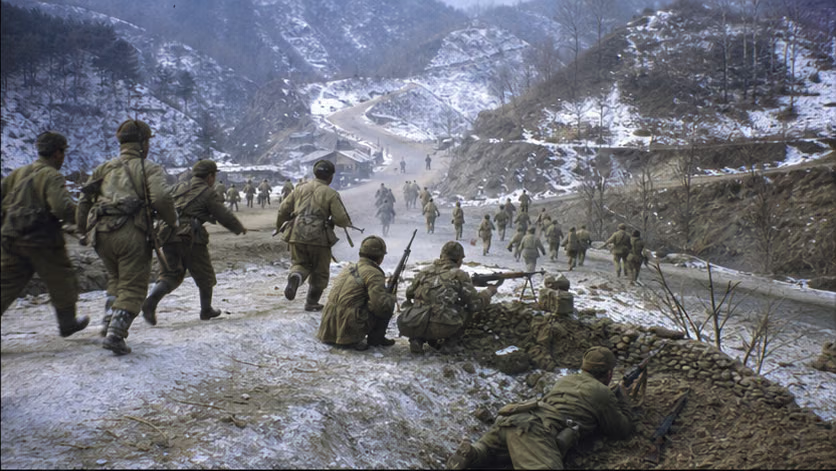
| Infiltration to Samso-ri | 11.27–11.29 | The 113th Division of the 38th Army forced a 72.5-kilometer march in 14 hours (crossing mountains and rough ground, fighting while moving), seized Samso-ri on the morning of 11.28, then split off forces to occupy Ryongwon-ni -- the U.S. IX Corps' two roads of escape south were blocked at the same time; the 113th Division faced enemies on both sides and held against converging attacks from north and south (the note that the U.S. 1st Cavalry Division coming north to relieve and the encircled U.S. troops fleeing south were "one kilometer apart yet could not meet," details unverified) |
| Blocking action at Songgufeng | 11.30 | 3rd Company, 1st Battalion, 335th Regiment, 112th Division, 38th Army held Songgufeng (an unnamed height beside the road northeast of Ryongwon-ni, later known by this name); one company held off the flood of the U.S. 2nd Division's escape south for an entire day -- after the battle, only 7 men remained in the whole company (the figure comes from Wei Wei's reportage; military-history statistical bases vary by account); Wei Wei's Who Are the Most Beloved People described precisely this battlefield -- the relation between text and battlefield: one piece of reportage made this small height into a battlefield memory for the whole nation, while the battlefield itself was harsher than the text |
| General retreat on the western front | 12.1–12.6 | The U.S. Eighth Army abandoned Kaechon and Kunu-ri, breaking out southward along the roads amid pincer attacks and roadblocks (abandoning large amounts of equipment; the U.S. 2nd Division suffered especially heavy losses); on 12.6 the Chinese People's Volunteer Army recaptured Pyongyang; on 12.23, U.S. Eighth Army commander Lieutenant General Walker died in a traffic accident during the retreat (his jeep collided with a ROK Army truck, details unverified) -- his successor was Ridgway (for his arrival and impact, see Third Phase Offensive) |
| Eastern front at Chosin Reservoir | 11.27–12.24 | The Ninth Army Group divided and encircled the U.S. 1st Marine Division and other units in the Chosin Reservoir area, inflicting heavy damage; U.S. X Corps evacuated by sea from Hungnam Harbor (evacuation completed on 12.24) -- for the whole process and the frostbite account, cross-reference Battle of Chosin Reservoir; this article does not repeat it |
| Engagement closes | 12.24 | On the western front, the "United Nations Command" withdrew south of the 38th Parallel; the Second Phase Offensive ended |
Casualties and Losses
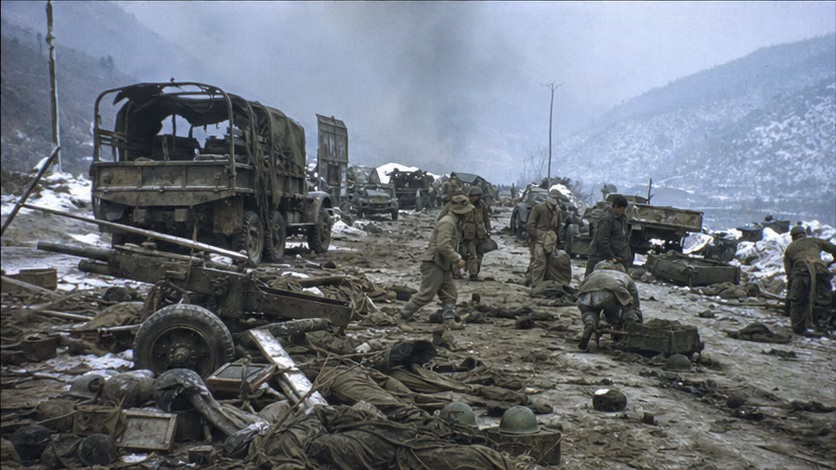
- United Nations Command: Chinese battle reports claimed more than 36,000 enemy losses inflicted (including more than 24,000 U.S. troops, statistical bases vary by account); U.S. descriptions of the western-front retreat include "the longest retreat in American military history" (source and original wording unverified). The U.S. 2nd Division, the Turkish Brigade, and ROK II Corps suffered the heaviest losses.
- Chinese People's Volunteer Army: tens of thousands of combat casualties (statistical bases vary by account); on the eastern front, the Ninth Army Group lost tens of thousands to frostbite (the largest share of that army group's attrition) -- the account of a force crippled by non-combat losses; see Battle of Chosin Reservoir. Casualty density at company- and platoon-level blocking points such as Songgufeng and Feihushan on the western front was extremely high.
- Civilians: North Korean civilian deaths amid bombing and ground operations by both sides, and flows of people fleeing south (Hungnam and elsewhere); systematic figures (unverified).
Aftermath
- Change in the course of the war: the front moved from the Yalu River back to the 38th Parallel, and the "United Nations Command" shifted from strategic offensive to strategic defense and withdrawal -- in the following two and a half years, the front never again went far north of the 38th Parallel (with local exceptions such as Kumsong). The "Chongchon-Chosin campaign" as the war's turning point is a consensus across the military histories of all sides.
- Chinese People's Volunteer Army prestige and hidden dangers grew together: the Soviet Union accelerated military aid and reequipment (Sino-Soviet military-aid accounts unverified; cross-reference the overview); at the same time, the crack between the political impulse to "fight across the 38th Parallel" and the army's actual limits was exposed as early as the Third Phase Offensive.
- Inside the U.S. side: the conflict between MacArthur and Washington became public (the dispute over expanding the war, until his dismissal in 1951.4); Ridgway took command of the Eighth Army and began targeted study of the Chinese People's Volunteer Army -- the opponent's learning curve began after this engagement (see Third Phase Offensive and Fourth Phase Offensive).
- "Long Live Army": the phrase "Long live the 38th Army" in Peng Dehuai's commendation telegram gave the 38th Army the name "Long Live Army" (original telegram text and wording unverified) -- from criticism after the First Phase Offensive to being named "long live" after the Second Phase Offensive, the character arc of the 38th Army is complete.
Accounts of Those Present
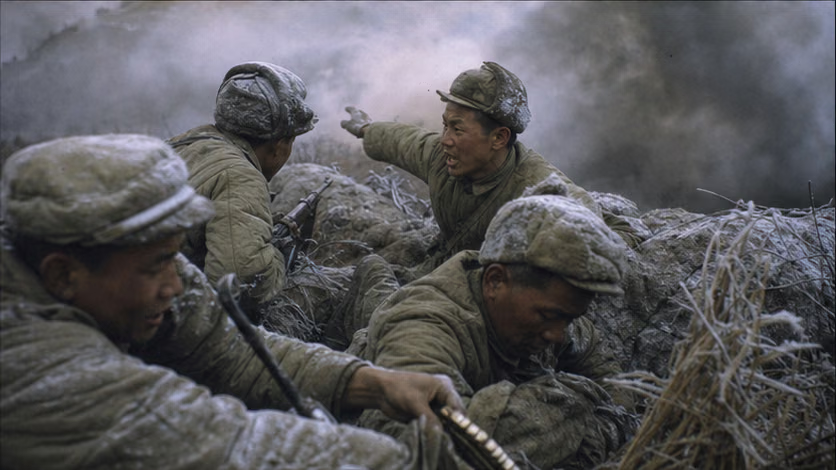
- 72.5 kilometers: the 113th Division's infiltration was a night cross-country forced march -- throwing away packs, eating only fried flour, moving at a run; guides, mountain roads, forked roads: hesitation at any point would lose the opportunity. The first task after reaching Samso-ri was to repair fortifications, because behind them was the fleeing enemy and in front of them the relieving enemy.
- Third Company at Songgufeng: after blocking until ammunition was exhausted, they continued fighting with bayonets, stones, and teeth (reported in the reportage; battlefield details are subject to military-history statistical bases, unverified); when the battlefield was cleared after the battle, some martyrs' bodies still held fighting postures -- a reconstruction of the scene behind Wei Wei's "Who Are the Most Beloved People": the text had not embellished it; the battlefield was already enough.
- The reverse of "home for the New Year": the U.S. promise of a "Christmas Offensive" and the month of general retreat that followed formed the most famous propaganda reversal of the war -- U.S. participants' memoirs wrote about it at length (specific works unverified).
- Walker's death: an army commander died in a traffic accident on the road of retreat -- a Korean military truck, a stretch of icy road. One of the war's highest-ranking generals died not in combat but in a traffic accident amid a rout; the manner of death itself was a condensed image of that month.
- The Ninth Army Group without winter clothing: East China troops entered Korea in southern winter clothing; when the trains passed Shenyang, border-defense soldiers took off cotton-padded clothing and threw it onto the cars (oral accounts, unverified) -- the eastern front's frostbite account is already foreshadowed in this single detail.
The Ground
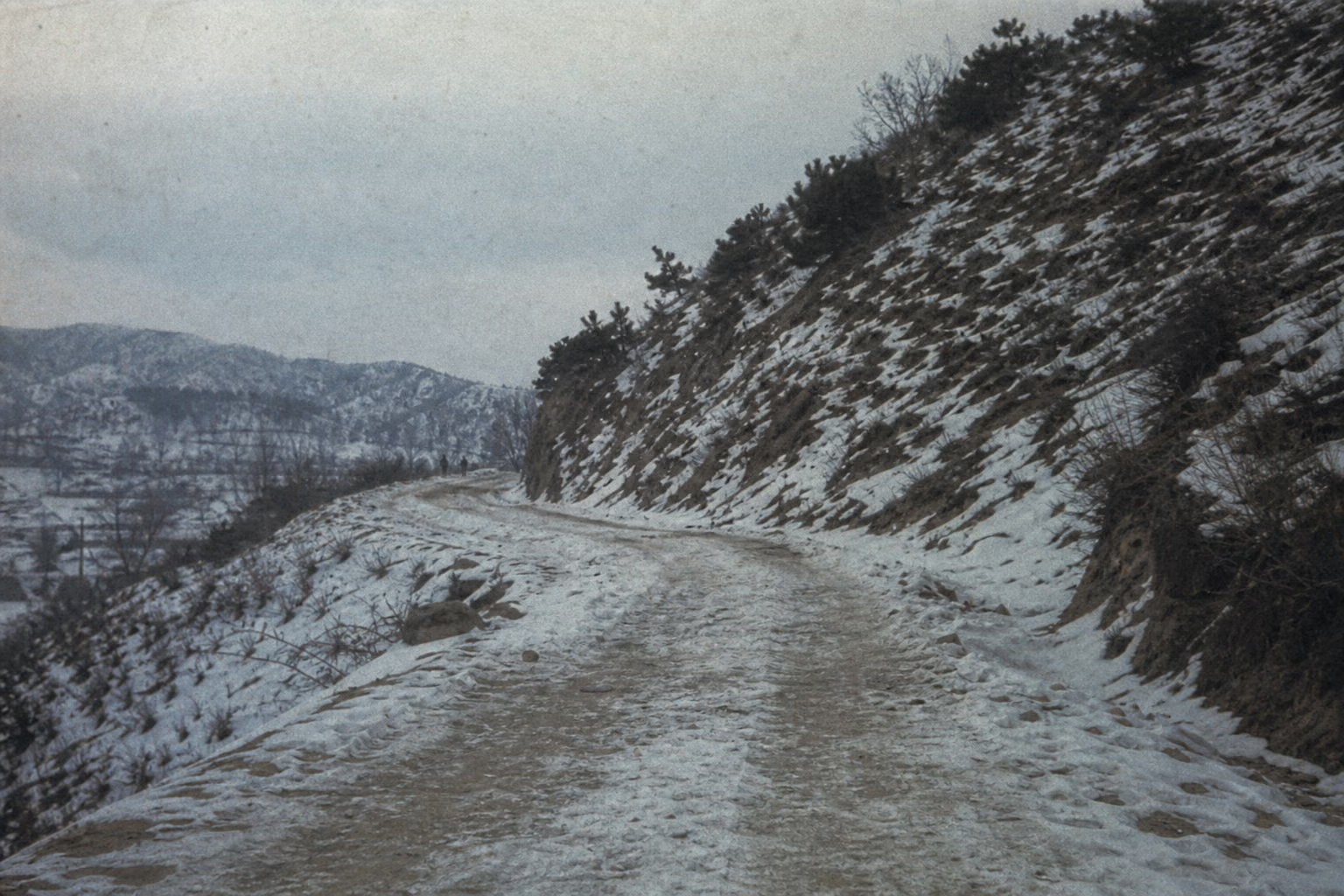
- Samso-ri-Ryongwon-ni: two roads and several defiles; blocking them rewrote the campaign -- "cutting the retreat route" was the key to success in this mobile warfare.
- Songgufeng: an unnamed height only several dozen meters high beside the road, a point blocking action measured by a single company -- very small in spatial scale, very high in time pressure.
- The Chongchon River valley and the Kaechon-Kunu-ri corridor: the feasible zone for mechanized forces was locked to the roads, while the side moving cross-country was instead free -- terrain asymmetrically selected between two kinds of armies.
- Eastern-front Chosin Reservoir: snowfields, frozen lake surface, road passes (see the separate article; not repeated here).
How Each Side Records It
- Chinese side: "fundamentally reversing the military situation" -- the Second Phase Offensive is the peak of the five phase offensives in Chinese military-history narrative; the two symbols "Long Live Army" and "the most beloved people" both emerged from this engagement and entered national memory through Wei Wei's reportage.
- U.S. side: the most unforgettable month in "the Forgotten War" -- military histories call it the "longest retreat" (source unverified); the U.S. Army 2nd Division's defeat at the Chongchon River and the 1st Marine Division's breakout at Chosin Reservoir are narrated inside the U.S. military as disaster and glory respectively (a note on the coexistence of the two narratives).
- South Korean side: the collapse of ROK II Corps at Tokchon-Nyongwon is a page repeatedly reviewed in South Korean military history (details in History of the Korean War not yet specified).
- Civilian memory of the battlefield country: bombing, flight, and the Hungnam evacuation each form their own narratives on the northern and southern sides of the peninsula (unverified).
Disputes and Sensitivities
- The Chinese figure of 36,000 enemy losses inflicted and U.S. loss statistics have differences of statistical boundary.
- Evaluation of Chosin Reservoir results: the account of fully destroying the U.S. "Polar Bear Regiment" (31st Regimental Combat Team), and the two Chinese and U.S. sets of figures for 1st Marine Division losses -- cross-reference the separate article for item-by-item marking.
- Original text of the "Long live the 38th Army" telegram -- a highly symbolic historical source; the original remains unverified.
- Frostbite attrition figures -- Chinese publications give varying statistical bases.
- Details of the Songgufeng fighting: the differences between the reportage text and military-history records; military history is the standard, while the value of the text is explained separately -- do not take literature as historical evidence, and do not devalue historical evidence because of literature.
Sources and Open Questions
Sources: History of the War to Resist U.S. Aggression and Aid Korea (Academy of Military Sciences), Vol. 1; history of the 38th Army; Wei Wei, Who Are the Most Beloved People (first published in People's Daily, 1951.4; dates vary by account); relevant volumes of U.S. Army official history by Appleman, Disaster in Korea and Ridgway Duels for Korea; U.S. 1st Marine Division histories (Lynn Montross and others); South Korea's History of the Korean War.
Open questions (unverified): original text of the "Long live the 38th Army" commendation telegram; military-history calculation of the 113th Division's infiltration mileage and time; military-history statistical basis and casualty list for Third Company at Songgufeng; source of the phrase "longest retreat in American military history"; each side's casualty figures and statistical bases; civilian figures for the Hungnam evacuation; each statistical basis for the Ninth Army Group's frostbite attrition (see Battle of Chosin Reservoir); U.S. records of the details of Walker's traffic accident.
All images on this site are AI-generated depictions. They are not historical photographs, not primary sources, and do not depict any real individual.