Engagement Archive · Air War: MiG Alley (Dec 1950–Jul 1953, combined account)
An air force that had not existed three years earlier held a corridor in the airspace over the Chongchon River-Yalu River zone, under the strongest air force in the world: it held, half because crash-trained pilots bought experience with their lives, and half because Soviet pilots in Chinese People's Volunteer Army uniforms did the fighting; both layers stand side by side.
Engagement Data
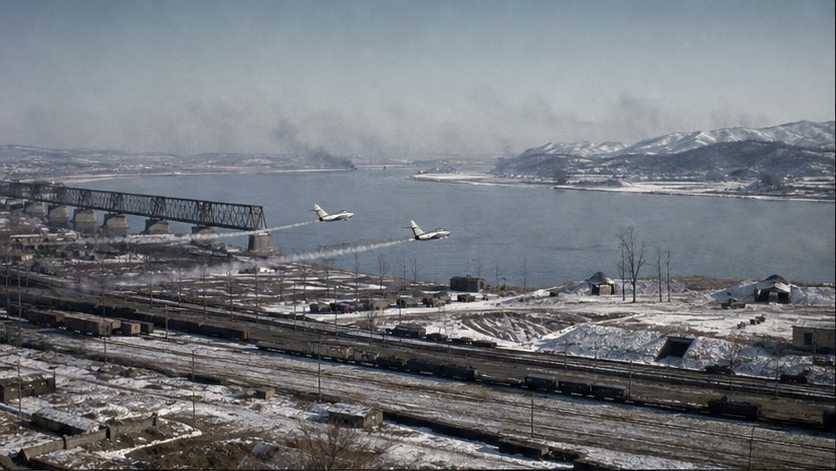
| Item | Details |
|---|---|
| Time | Dec 1950 (Chinese People's Volunteer Army Air Force organized its combat order of battle) - Jul 1953 armistice; Chinese People's Volunteer Army Air Force first combat action on 1951.1.21 |
| Place | The "MiG Alley" of northwestern Korea: the airspace from north of the Chongchon River to the Yalu River, roughly 150×250 km (range varies by account); also including airspace for bombing operations such as Taehwa-do |
| Affiliation | War to Resist U.S. Aggression and Aid Korea · air front (a combined account running in parallel with the ground positional warfare) |
| Chinese-Korean-Soviet side | Chinese People's Volunteer Army Air Force (commander Liu Zhen); the Soviet Air Force's 64th Fighter Aviation Corps secretly entered the war; Korean People's Army Air Force (limited strength, details unrecorded) |
| the "United Nations Command" side | U.S. Far East Air Forces (mainly the Fifth Air Force), naval carrier aviation, and squadrons from the Commonwealth, South Korea, Australia, and others |
| Result | MiG Alley remained under Chinese-Korean-Soviet control for an extended period, giving rear-area lines of communication a shallow air shield; the Chinese People's Volunteer Army Air Force grew from 0 to more than ten fighter divisions (division count varies by account); both sides' claims differ by orders of magnitude |
Belligerents
| Item | Chinese-Korean-Soviet side | the "United Nations Command" side |
|---|---|---|
| Main aircraft types | MiG-15 / MiG-15bis (superior high-altitude performance, climb rate, and service ceiling) | F-86 "Sabre" (superior level maneuvering, diving, and gunsight), F-80/F-84 fighter-bombers, B-29 bombers |
| Pilots | Many Chinese People's Volunteer Army pilots were selected from the army and crash-trained in aviation schools; when entering Korea they averaged roughly dozens to just over a hundred flight hours (figures vary by account); Soviet pilots were veterans of World War II | U.S. pilots included large numbers of World War II veterans, with many "aces"; average flight hours were several to more than ten times the Chinese figure (figures vary by account) |
| System | Ground radar guidance + "near-field operations" from airfields along the Yalu River (taking off almost directly into the battlefield); Soviet forces carried much of the actual combat while the Chinese People's Volunteer Army learned while fighting | Full early-warning, escort, aerial refueling, and search-and-rescue systems; Far East Air Forces bomber groups conducted strategic bombing across North Korea |
| Rules of concealment | Soviet pilots wore Chinese People's Volunteer Army uniforms, radio communications forbade Russian (details of rule enforcement and exceptions unverified), and pilots did not pursue across the front line (to avoid capture and exposure) | U.S. pilots knew perfectly well that the other side included Russians, while Washington and Moscow jointly maintained an "open secret" |
Terrain and Conditions
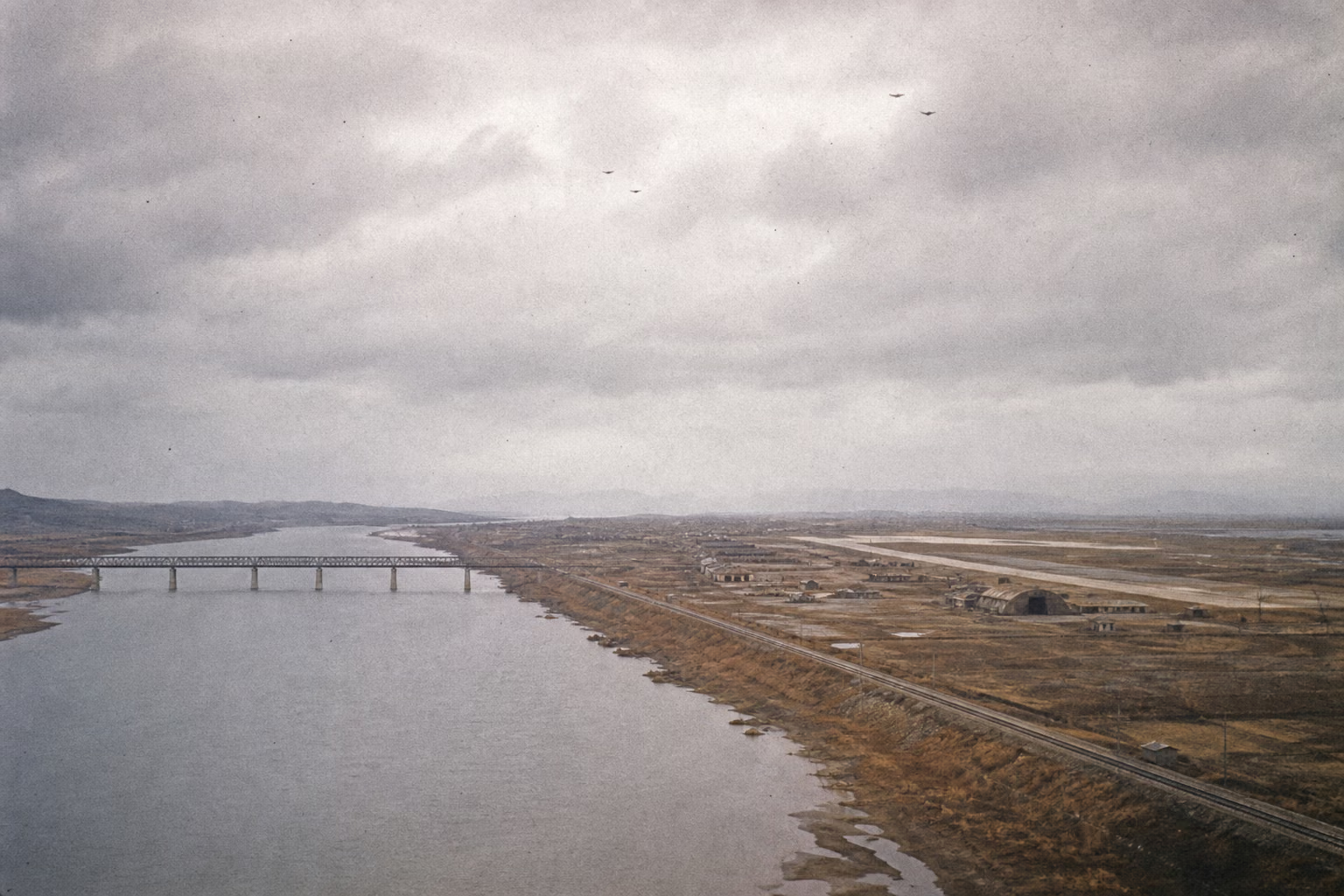
(For the three-layer Cold War setting in which the United States and the Soviet Union avoided direct war, see War to Resist U.S. Aggression and Aid Korea · Overview. This entry covers only the air front.)
A corridor that had a name on the map. "MiG Alley" was the name U.S. pilots gave it: from the Chongchon River northward to the Yalu River, MiG-15s appeared in formations, with the advantage in altitude and climb, while F-86s, constrained by range, could stay in the corridor for only about 20 minutes (loiter time varies by account). South of the corridor, down toward Pyongyang, U.S. fighter-bombers and B-29s ruled the air; inside the corridor, the Chinese-Korean rear lifelines--railways, bridges, airfields--had a thin chance of survival.
Yakovlev could not get there; Stalingrad was in the sky: the Soviet 64th Fighter Aviation Corps used the Luda base area as its rear base (details of basing and rotation unverified) and entered the war as organized units. The particular feature of this air war was that one of the two main forces in the fighting officially did not exist.
Why It Was Fought
By the end of 1950, the ground war had pushed the front back from the Yalu River to the 38th parallel--here the line changes, from the ground to the sky. This air front began when the Chinese People's Volunteer Army Air Force organized its combat order of battle in Dec 1950 and continued until the Jul 1953 armistice, running in parallel with the ground positional warfare and therefore written here as a combined account; this section covers only its point of origin.
This line was forced into being. When the Chinese People's Volunteer Army entered Korea it had not one aircraft, and U.S. absolute air superiority turned the ground war into one-sided daylight hunting: by day troops could not move, convoys could not roll, command posts could not let smoke rise--the mobile-war pattern of "lying low by day and moving by night" was not a tactical choice but a condition of survival. The rear could endure even less: North Korea's railways, bridges, and cities were being disabled section by section under bomber formations, while the Anton line across the Yalu River already lay within the operating radius of U.S. aircraft.
The result of asking the Soviet Union for aid had two layers, and the two layers stand side by side. Moscow supplied aircraft and helped China crash-build an air force; at the same time, Stalin secretly sent the 64th Fighter Aviation Corps into the war: Soviet pilots wore Chinese People's Volunteer Army uniforms, were forbidden to speak Russian on the radio, did not pursue across the front line (details of rule enforcement and exceptions unverified), and entered the war as organized units from airfields along the Anton line, holding the most critical year, 1951. The particular feature of this air war lies exactly here: one of the two main forces in the fighting officially did not exist. U.S. pilots knew perfectly well who was across from them, while Washington and Moscow jointly maintained this open secret--because saying it aloud meant the Third World War.
On the Chinese side, the air force had been founded only in Nov 1949 and was just over a year old when it entered Korea. Pilots were selected from army combat cadres, flew dozens of hours in trainers, converted to the MiG-15, and went against World War II veterans whose flight hours were ten times their own (flight-hour figures vary by account)--an air force had to learn inside the war, paying tuition in combat losses by batch.
In Nov 1950, the first Soviet fighter divisions entered Yalu River air defense (first-combat date varies by account); on 1951.1.21, Li Han of the Fourth Air Division damaged one U.S. aircraft, recorded as the Chinese People's Volunteer Army Air Force's first combat result. The airspace of roughly 150 by 250 km from north of the Chongchon River to the Yalu River (range varies by account) later acquired a name on U.S. pilots' maps: MiG Alley.
Course of the Engagement
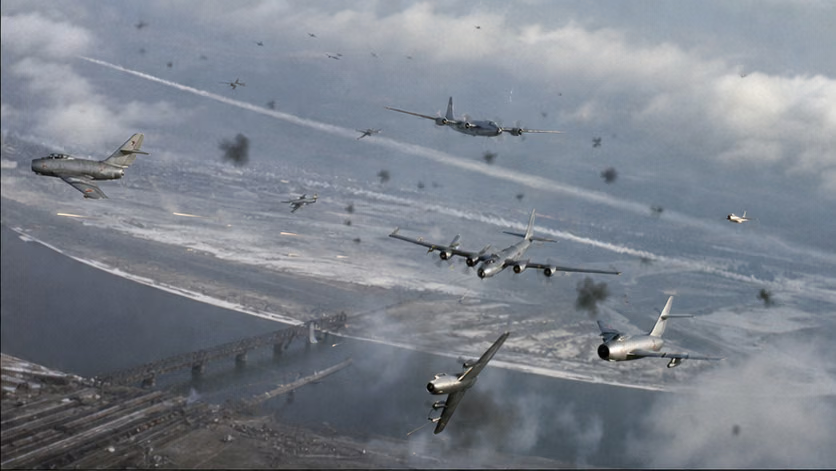
| Phase | Time | Key Points |
|---|---|---|
| Soviets first | From 1950.11 | The first Soviet fighter divisions entered Yalu River air defense (first-combat date and claim figures vary by account), buying time for the Chinese People's Volunteer Army Air Force to take shape |
| Chinese People's Volunteer Army first combat | 1951.1.21 | Li Han of the 28th Group, Tenth Regiment, Fourth Air Division damaged one U.S. aircraft (the Chinese People's Volunteer Army Air Force's first combat result; damage level varies by account between Chinese and U.S. records); further results followed on 1.23 and 1.29 |
| Large-scale participation | From 1951.9 | The Third and Fourth Air Divisions and other units rotated into Korea; continuous large-formation air battles in Sep-Oct (claims for the engagements of 9.25, 10.2, 10.10, and 10.16 differ sharply between the two sides, unverified) |
| Operation Strangle airspace | 1951.8-1952.6 | MiG Alley and Operation Strangle (see Positional Warfare Phase) were two sides of the same coin: U.S. bomber formations advanced north, and MiGs intercepted them--the airspace over the Chongchon River bridge zone became a repeated point of impact |
| Bombing Taehwa-do | 1951.11 | Chinese People's Volunteer Army Air Force Tu-2 bombers bombed Taehwa-do three times: on 11.30, the third raid was ambushed by F-86s and suffered heavy losses (figures vary by account, including 4 aircraft shot down from a 9-aircraft formation)--the most painful day for the Chinese People's Volunteer Army Air Force bomber units; the level of coordination failure between La-11 escort and MiG cover is unverified |
| Ace against ace | 1951-53 | Wang Hai Group (the "Wang Hai Group" of 6 men shot down or damaged 29 enemy aircraft, Chinese figures vary by account); Liu Yudi shot down 4 aircraft in one solo air battle (Chinese account); on 1952.2.10, Zhang Jihui shot down the U.S. "double ace" Major Davis (George Andrew Davis)--the U.S. side acknowledged Davis's death, while Chinese and U.S. accounts differ over who shot him down (the Soviet-archive claim that it was a Soviet result remains unverified) |
| F-86 reinforcements and equilibrium | 1952-53 | The U.S. military sent F-86Fs into Korea and rotated in veterans, making the struggle for the corridor stalemated; Chinese People's Volunteer Army Air Force divisions took turns entering combat, training through battle |
| Armistice | 1953.7.27 | The air war ended with the ground ceasefire; cumulative Chinese People's Volunteer Army Air Force claims for enemy aircraft shot down and damaged (Chinese count: 330 shot down / 95 damaged; Soviet results counted separately; U.S. acknowledged losses were far lower--the several accounting systems are left side by side, unverified) |
Casualties and Losses
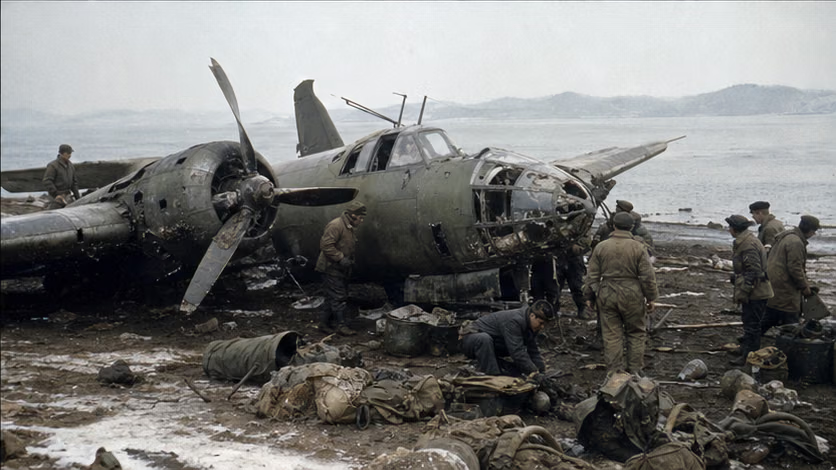
- Chinese figures: the Chinese People's Volunteer Army Air Force shot down 330 enemy aircraft and damaged 95; its own losses (including 231 aircraft shot down and 116 pilots killed) remain unverified.
- Soviet figures (archives declassified after the dissolution of the Soviet Union): the 64th Fighter Aviation Corps claimed more than a thousand victories, with its own losses at roughly 335 aircraft and about 120 pilots killed (declassified archival numbers vary by account, unverified).
- U.S. figures: acknowledged air-combat losses were far below Chinese and Soviet claims. Gun-camera interpretation, attribution of crashes, and combat-claim reporting layered three kinds of error on top of one another; the three sides' numbers differ by several multiples.
- Taehwa-do: in the 11.30 bomber formation, 4 of 9 Tu-2 aircraft were shot down, 4 damaged, and 15 aircrew killed (figures vary by account)--the price of a gap in bomber escort, paid all at once.
- Crash-trained pilot casualties: the average age at death of Chinese People's Volunteer Army Air Force pilots was extremely low (statistics unverified)--dozens of flight hours against opponents with thousands of hours; every batch of new pilots paid tuition in combat losses.
Aftermath
- The Chinese People's Volunteer Army Air Force went from 0 to a fighter force with complete division-regiment organization; the Korean battlefield was its coming of age. These pilots and commanders later formed the skeleton of the People's Air Force.
- The experience of MiG Alley fed directly into the air-defense system and aviation-industry decisions of the new China (the import of MiG-15/17 production lines led to the beginning of the J-5, with the exact chain of succession details unrecorded).
- Archives on Soviet participation were gradually declassified in the 1990s: Soviet military cemeteries (the pilot graves in the Luda Soviet Martyrs Cemetery), combat reports of the 64th Aviation Corps, and rotation sequences of divisions were made public one after another--one of the Cold War's largest open secrets thereby moved from "legend" into "archive."
- The secrecy tacitly maintained by both the United States and the Soviet Union itself became a specimen for Cold War studies: both governments knew the other side was directly participating, and both chose not to say so--because saying it aloud meant the Third World War.
Accounts of Those Present
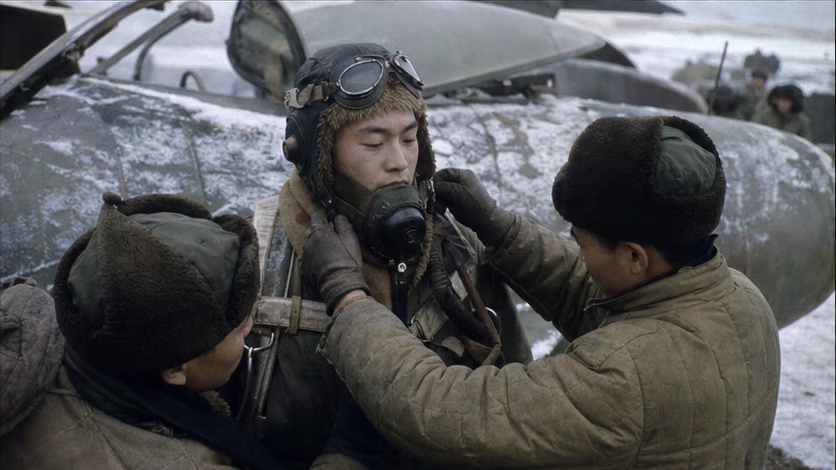
- Crash training: many Chinese People's Volunteer Army Air Force pilots were selected from army combat heroes and squad or platoon leaders, studied basic education for several months before entering aviation school, and flew dozens of hours in trainers before moving to the MiG-15--the exact average flight hours at entry into Korea remain unverified, but the comparative structure of "dozens of hours against a thousand hours" is not in dispute.
- "201 signal": Soviet pilots' radio discipline--no Russian, use Chinese-style call signs, wear Chinese People's Volunteer Army uniforms; in real combat, when the pressure came on, Russian still burst out, and U.S. monitoring records were full of it (source of monitoring records unverified). Public secrecy and disciplined exceptions: this is the most human detail of the secret war.
- Zhang Jihui and Davis: after the air battle of 1952.2.10, the Chinese side found Davis's identity tags and pistol at the crash site (details of physical evidence unverified) and announced that Zhang Jihui had shot him down; the U.S. side acknowledged Davis as missing/killed; years later, Soviet archive researchers argued that it had been a Soviet victory--a case in which all three sides have their own evidentiary logic, and they must be written side by side.
- Liu Yudi's four aircraft in one battle: on 1951.11.23, he shot down 4 aircraft alone (Chinese account; combat report and gun-camera records unverified); against the background of a "crash-trained air force," such a record was talent, and also probability.
- The 4 minutes over Taehwa-do: on the third bombing raid of 11.30, the formation was ambushed over Taehwa-do by more than 30 F-86s (encountered force varies by account); after the Tu-2 formation was broken up, gunners fought on their own--Bi Wubin, flying alone and on fire, dropped his bombs before crashing into the sea (details of the deed unverified). The Chinese People's Volunteer Army Air Force's official history does not avoid this day of the bomber force.
- "Wang Hai Group": Wang Hai himself later served as commander of the air force (1985-1992, term unverified)--from squadron leader in MiG Alley to air force commander, one man's career is the first half of this air force.
The Ground
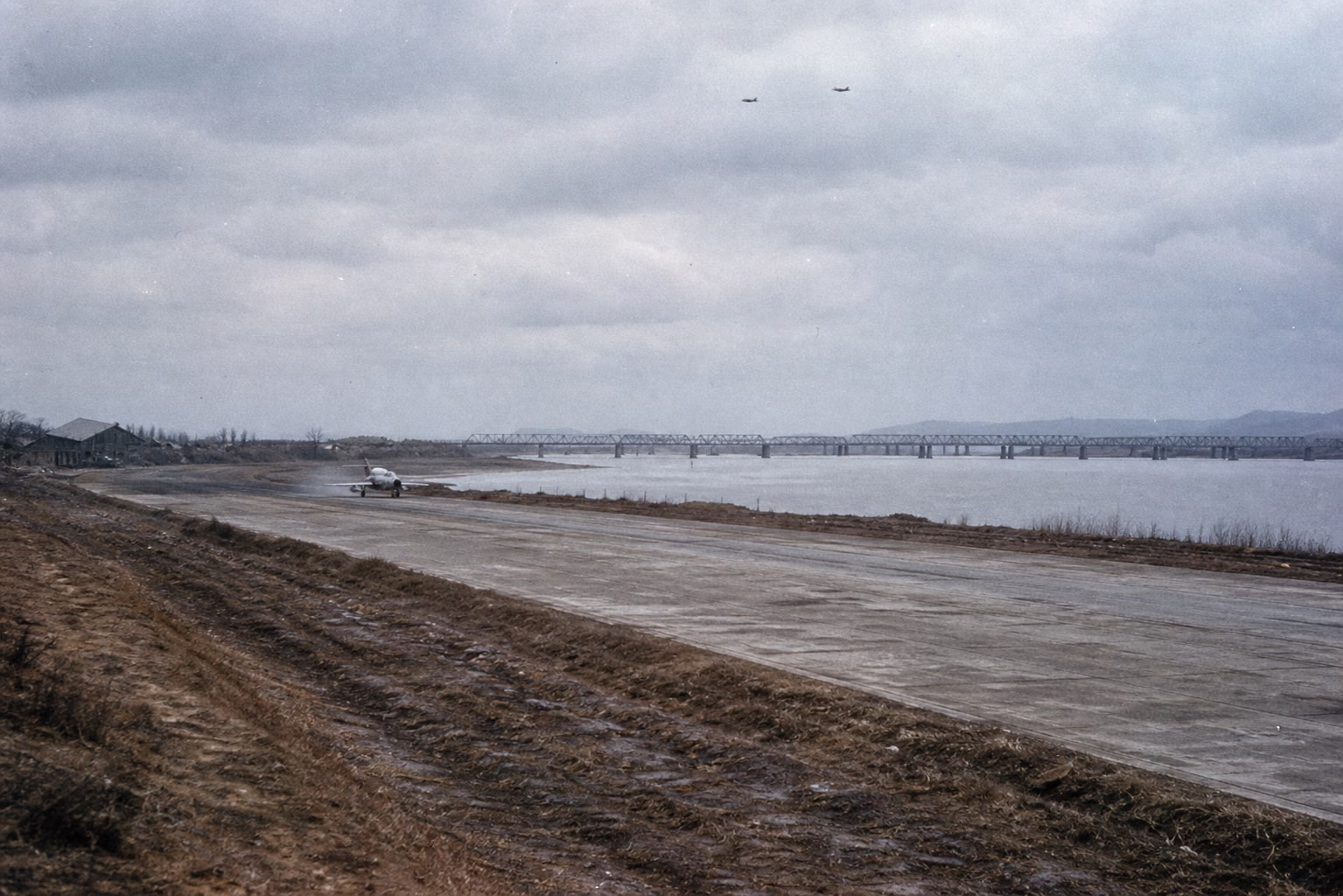
- Vertical chessboard: the MiG-15's ceiling and climb advantage lay "above," while the F-86's diving and level-turn advantages lay "below"--the outcome of an air battle often depended on who held altitude at the moment of engagement.
- The corridor's time window: when an F-86 took off from a base in South Korea, it had only about 20 minutes of loiter time left once it reached the corridor--the "corridor" was both space and fuel tank (loiter time varies by account).
- The Yalu River "airfield fence": airfields along the Anton (Dandong) line were placed close to the river; MiGs took off directly into the battlefield and landed directly out of theater--U.S. pilots were constrained by orders not to pursue across the river (level of the orders and exceptions unverified). This political boundary was the largest spatial mechanism of the air front.
- Strangling layer and escort layer: B-29s entering the corridor by day required heavy escort; after the "Black Week" of Oct 1951 (B-29s repeatedly suffered heavy blows, U.S. military-historical term unverified), B-29s switched to night operations--when an aircraft type is forced into night action, that is a hard indicator of the corridor's control.
How Each Side Records It
- Chinese side: the narrative of the Chinese People's Volunteer Army Air Force "astonishing the world with its first feat" coexists with narratives of individual aces; the Taehwa-do losses are recorded in official military histories but are thin in public memory.
- Soviet/Russian side: participation remained secret for a long period during the Soviet era; after declassification in the 1990s, Russian publications on the history of the 64th Aviation Corps and rosters of aces appeared (bibliography to be completed), emphasizing the Soviet forces' subjecthood in the combat results--a dispute with the Chinese narrative over each side's share of agency.
- U.S. side: U.S. Air Force histories acknowledge that MiG Alley could not be taken for an extended period. The exchange ratio between the F-86 and the MiG-15 (the U.S. side claimed roughly 10:1; later studies generally regard this as exaggerated, with revised figures around 3-4:1, unverified) has itself become a scholarly case.
- The three sides' victory figures remain mutually unaccepted to this day.
Disputes and Sensitivities
- Combat-claim statistics: the three sides' figures differ by several multiples, with the differences arising from gun-camera interpretation, crash confirmation, claim-reporting systems, and other links.
- The subjecthood of Soviet participation: Chinese narratives long downplayed the Soviet share, while Russian declassified narratives emphasize the Soviet forces as primary; the "two layers of truth" are placed side by side, with no ratio assigned (the ratio itself is unverified and sensitive).
- Davis's death: the dispute between Zhang Jihui's victory claim and a Soviet victory claim concerns the factual foundation beneath a hero narrative; the relevant physical evidence and sources remain divided.
- The boundary war over the ban on crossing the Yalu River: accusations that U.S. pilots pursued across the river and accusations from the Chinese/Soviet side that airfields were attacked (the disputed incident of U.S. aircraft striking Anton airfield remains unverified) involve the red-line narrative of "expanding the war," with each of the three sides giving its own account.
Sources and Open Questions
Known main sources:
- History of the War to Resist U.S. Aggression and Aid Korea (Academy of Military Science Press, Chinese official history), chapter on air operations
- Chinese air force military-history materials (combat-report compilations for the Third and Fourth Air Divisions, archival holdings to be checked)
- Soviet declassified archives and Russian research: histories of the 64th Fighter Aviation Corps (Russian archives cited in English-language studies such as Zhang Xiaoming, bibliography to be completed)
- U.S. Air Force history, The United States Air Force in Korea (Robert Futrell)
- Memoirs and oral histories of Wang Hai, Liu Yudi, Zhang Jihui, and others (entries to be completed)
Open questions: figures for Chinese People's Volunteer Army pilots' average flight hours at entry into Korea; the first-combat date of the Soviet 64th Aviation Corps, rotation sequences of divisions, and definitive declassified archival numbers for victories and losses; the range of "MiG Alley" and F-86 loiter-time figures; each side's claims for the large-formation air battles of 1951.9-10; the successive composition, losses, and level of escort-coordination failure in the three Taehwa-do bombing raids; the evidentiary chain for Zhang Jihui's shooting down Davis and Soviet archival counterclaims; combat reports and gun-camera records for Wang Hai Group and Liu Yudi's claims; Chinese figures of 330 shot down / 95 damaged and own-loss figures; U.S. exchange-ratio claims and later revised studies; sources for Soviet pilots' radio discipline and monitoring records; level of the order banning crossing the Yalu River and the disputed U.S. strike on Anton; the original U.S. military-history wording for the B-29 "Black Week"; the count of Chinese People's Volunteer Army Air Force participating divisions; Wang Hai's term as air force commander.
All images on this site are AI-generated depictions. They are not historical photographs, not primary sources, and do not depict any real individual.