Engagement Archive · Third Phase Offensive
Crossing the 38th Parallel on New Year's Eve and retaking Seoul three days later -- this was a battle that had to be fought politically; yet the deepest stroke of the engagement lies not in the breakthrough, but in the stopping: on the eighth day, Peng Dehuai withstood all pressure from allies and the front line and ordered the pursuit halted. To dare to stop amid victory was the true problem this battle left to its opponent and to those who came after.
Engagement Data
| Item | Content |
|---|---|
| Time | 1950.12.31 – 1951.1.8 |
| Place | From the full length of the 38th Parallel to the Seoul-Suwon line; main axis: lower Imjin River-Uijeongbu-Seoul |
| Part of | War to Resist U.S. Aggression and Aid Korea · Third Phase Offensive in the mobile-warfare stage |
| Chinese-Korean Side | 6 armies of the Chinese People's Volunteer Army (38th, 39th, 40th, 42nd, 50th, and 66th Armies) + 3 corps of the Korean People's Army, about 310,000 on the first line (statistical bases vary by account); commanded by the Chinese-Korean Joint Command |
| United Nations Command | U.S. Eighth Army (Ridgway, took over on 12.26): U.S. I and IX Corps, 5 South Korean divisions, and others, defending prepared positions along the 38th Parallel |
| Result | Broke through the defenses along the 38th Parallel, retook Seoul on 1.4 (Seoul changed hands for the third time in the war), and advanced to near the 37th Parallel; on 1.8 the Chinese-Korean side voluntarily stopped the offensive |
Belligerents
| Item | Chinese-Korean Side | United Nations Command |
|---|---|---|
| Strength | About 310,000 on the first line (the 6 armies of the Chinese People's Volunteer Army were formations in continuous operations, without rest or replenishment -- tired troops assaulting fixed positions was the ground color of this engagement) | More than 200,000 on the first line (statistical bases vary by account), with morale badly shaken by the general retreat after the Second Phase Offensive |
| Firepower | Mainly light infantry, with limited artillery; night infantry assaults were the only answer to the firepower gap | Full firepower system + air superiority; but the defense line was a hastily built set of positions in depth |
| Supply | The front extended southward, lengthening the forward-supply distance; seven days of rations and ammunition were carried by the troops -- the limit of the "week-long offensive" entered its countdown | Logistics lines supported by the ports of Incheon and Busan remained intact |
| Morale and Command | Momentum of victory | The Eighth Army had just been defeated, and command had changed hands (Walker died in a traffic accident; Ridgway took over at the front) -- U.S. military history acknowledges that a mood of withdrawal pervaded the force at the time (original text unverified) |
Terrain and Conditions
(For the larger situation at the beginning of 1951 -- the United Nations ceasefire feeler and the U.S. domestic debate over "expanding the war" -- see *War to Resist U.S. Aggression and Aid Korea · Overview*; here only the ground south of the 38th Parallel is recorded.)
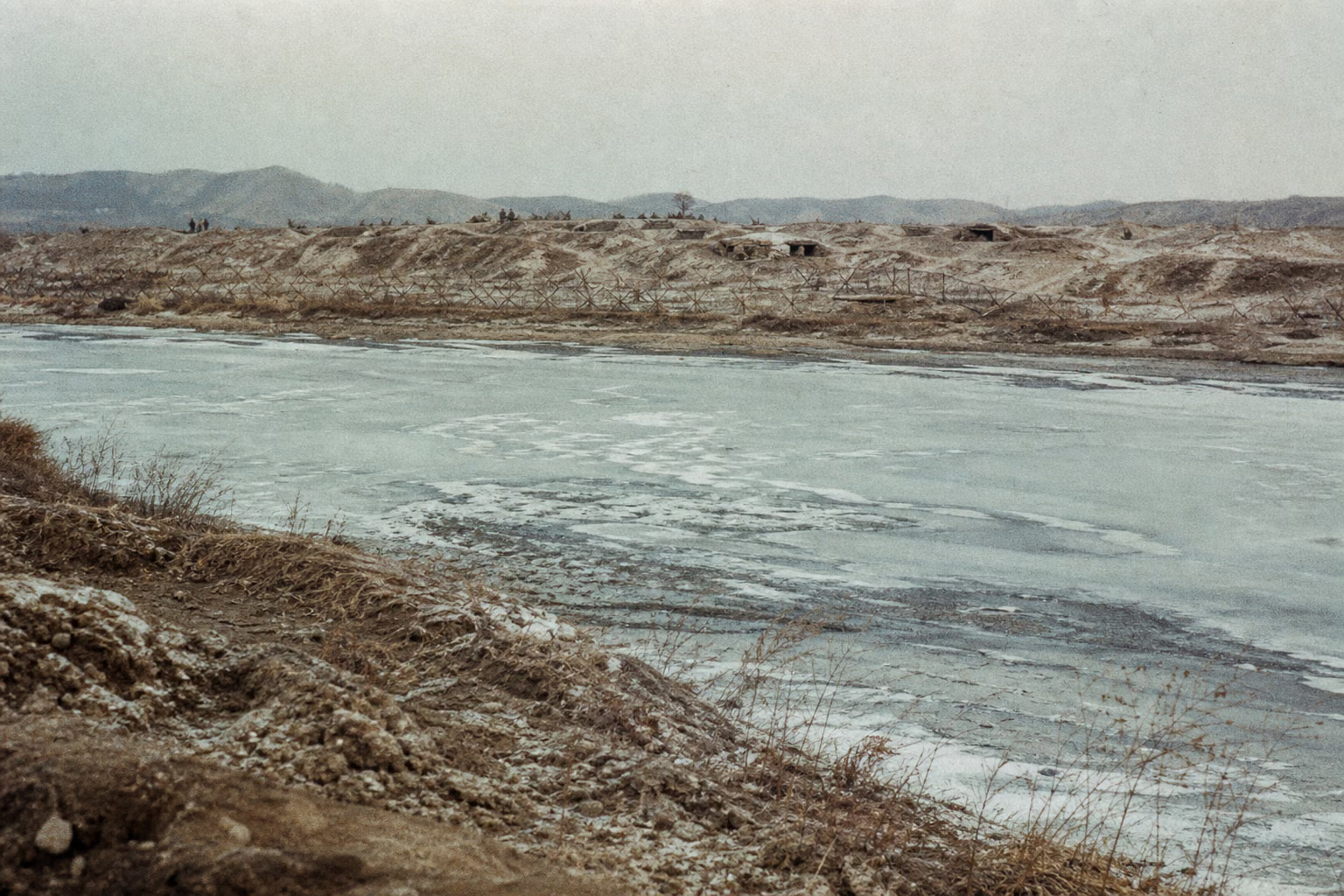
The 38th Parallel: a line whose name both attackers and defenders knew. The war began here in June 1950; in October U.S. forces crossed it from south to north; in December the Chinese-Korean side prepared to cross it once more, from north to south. Along the line were positions in depth that South Korean forces had spent months preparing: minefields, barbed wire, trenches, and fire points. The rivers across the front (the Imjin River, Hantan River, and others) were frozen or half-frozen -- whether men and guns could cross the ice was the practical engineering problem of New Year's Eve (ice-condition records at each breakthrough point unverified).
Seoul: a city changing masters for the third time in half a year. On 6.28 the People's Army occupied Seoul; on 9.28 the United Nations Command recaptured it; on 1.4 Chinese-Korean forces entered again -- a city on the scale of a million people changed hands three times in half a year, and each change of hands came with large-scale flight south. The flow of refugees on the Han River was a fixed image of the city in this period (the bombing of the Han River pedestrian bridge ※ was an old event from June; details of the refugee flow here unverified).
Why It Was Fought
The Second Phase Offensive closed on December 24: the "United Nations Command" retreated across both the eastern and western fronts, Pyongyang was recaptured, and the front returned to the 38th Parallel. The battle had been won, but the troops had also been emptied out -- for two successive offensives they had carried rations and ammunition to the limit of the "week-long offensive," and the armies had received no rest or replenishment. Peng Dehuai initially planned to let the troops stop, rest, and winter over (telegrams concerning the rest plan unverified).
But on the map lay a line whose name both attackers and defenders knew. In June 1950 the war had begun here, and in October U.S. forces had crossed it from south to north; in December it was the Chinese-Korean side's turn to decide whether to cross once more from north to south. To stop north of it was, in effect, to accept the legitimacy of the line. And just at this moment, the thirteen-nation United Nations ceasefire proposal was placed on the table (the "Committee of Three" plan, 1950.12) -- the Chinese side judged that the ceasefire feeler was meant to let the newly defeated U.S. forces catch their breath and fight again, and that politically it needed to cross the line to gain a negotiating position (the full chain of the decision to "fight across the 38th Parallel": the telegrams between Mao Zedong and Peng Dehuai, and the Chinese response to the ceasefire proposal, all remain unverified). Militarily it was possible to stop; politically it was necessary to fight -- the balance between Peng Dehuai's concerns and political necessity is the decision line of this article. The originally available road of winter rest was thus not taken.
The objective was therefore set within narrow limits: break through the 38th Parallel, destroy part of the South Korean army, and stop after advancing to the 37th Parallel. This restraint reserved space for the "dare to stop" of eight days later.
The opponent was also changing its calculations. Walker died in a traffic accident on the road of retreat on December 23, and Ridgway took over the Eighth Army at the front on December 26; after arriving, what he read in the force was a pervasive mood of withdrawal (original text from U.S. military history unverified). He therefore deployed a defense in echelon along the prepared positions of the 38th Parallel, preparing to exchange space for time -- across the line, an opponent was taking shape that no longer intended to stand rigidly in place, but no longer intended to collapse again either.
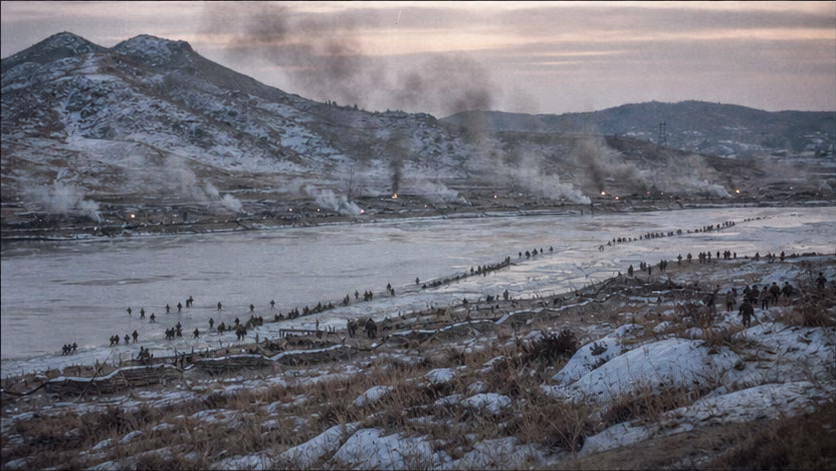
At dusk, 17:00, on December 31, 1950, on New Year's Eve, short artillery preparations struck across the whole front, and the infantry waded, crossed on ice, and stepped over the frozen and half-frozen Imjin and Hantan Rivers -- for the South Korean positions, the first sound of the New Year was salvo fire.
Course of the Engagement
| Phase | Time | Key Points |
|---|---|---|
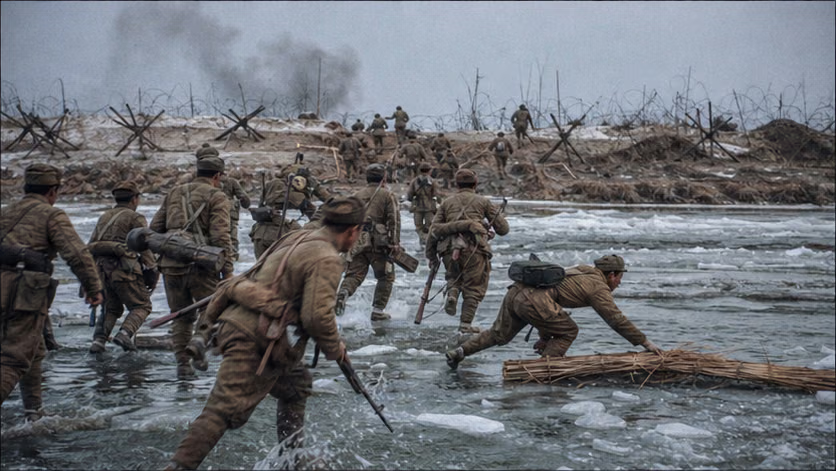
| New Year's Eve breakthrough | From 1950.12.31 17:00 | The offensive began across the whole line on New Year's Eve: after a short artillery preparation, infantry waded / crossed on ice over the rivers; in the Imjin River direction, the 116th Division of the 39th Army broke through the forward edge in a little more than 10 minutes (breakthrough times varied by division, unverified) -- the fronts of the South Korean 1st, 2nd, and 5th Divisions were torn open in succession |
| Development in depth | 1.1–1.3 | The armies wedged toward Uijeongbu and Dongducheon, cutting apart the South Korean depth; Ridgway personally went to the front to supervise and ordered withdrawal in echelon -- U.S. and South Korean forces abandoned the 38th Parallel positions and moved south (Ridgway's decision account of "ordering the abandonment of Seoul after inspection" remains unverified) |
| Seoul retaken | 1.4 | The 50th Army, part of the 39th Army, and the 1st Corps of the People's Army entered and occupied Seoul -- Seoul changed hands for the third time; the leading battalion of the 50th Army crossed the Han River first (details of the leading elements in the Goyang-Seoul direction unrecorded) |
| Advance to the 37th Parallel | 1.5–1.8 | Some forces advanced to the line north of Suwon, Wonju, and Yeoju; part of the People's Army moved toward Hoengseong. During the pursuit, the organized U.S. withdrawal in echelon was largely not caught (enemy losses inflicted were mainly South Korean troops) |
| Pursuit halted | 1.8 | Peng Dehuai ordered the offensive stopped across the whole front, ending the engagement. At this moment, the Soviet ambassador to Korea and Kim Il Sung's side argued for continuing the advance south while in victory (the level of Stalin's side's attitude -- direct pressure or relayed statement -- remains unverified), and there were also voices among front-line commanders calling to continue fighting. Peng held the line on the grounds that "rations and ammunition are exhausted, the troops are extremely tired, both flanks are exposed, and the enemy has set ambushes to lure us in" (specific telegrams concerning Peng's disputes with all sides, and details of his meeting with Kim Il Sung, remain unverified). In hindsight, Ridgway was organizing the counteroffensive of "magnetic tactics" (from 1.15, the probing offensive "Operation Wolfhound"); Chinese-Korean forces continuing south would have run into a prepared fire net |
Casualties and Losses
- United Nations Command / South Korean army: Chinese battle reports claimed more than 19,000 enemy losses inflicted (mostly South Korean troops, statistical bases vary by account); U.S. figures for losses coexist with this. By withdrawing in echelon, U.S. forces avoided the destruction of their main force -- Ridgway traded space for time.
- Chinese-Korean side: casualties ranged from several thousand to more than ten thousand (various statistical bases vary by account); the real cost lay in the overdraft of physical strength, rations, and ammunition -- planting the seed of passivity in the Fourth Phase Offensive.
- Civilians: the southward refugee flow before and after Seoul changed hands for the third time (people fleeing over the ice on the Han River -- photographs and records unverified); repeated changes of hands damaged villages and towns in the combat zone ※.
Aftermath
- The political gain landed: by crossing the 38th Parallel and occupying Seoul, the Chinese side gained concrete proof in the struggle over its position in ceasefire negotiations (in 1951.1, the Chinese side put forward a line including a ceasefire and the withdrawal of foreign troops; diplomatic details unverified).
- The opponent's learning curve took shape: after taking office, Ridgway immediately read patterns out of the Chinese People's Volunteer Army's first three offensives -- choosing nights according to the lunar phase ("moonlight offensives") and setting the limit by seven days of rations and ammunition ("week-long offensives") -- and designed countermeasures accordingly: do not stand rigidly on the front edge; cling by positions in echelon, drag the battle past seven days, then counterattack after its rations and ammunition are exhausted (the full formation of "magnetic tactics" came in the Fourth Phase Offensive; see *Fourth Phase Offensive*). From this battle onward, the Chinese People's Volunteer Army no longer faced an opponent stunned by defeat, but one beginning to "build a model" of it.
- The controversy over halting the pursuit continued after the war: participants' recollections and the military histories of various countries each had their own judgment on "whether the halt was right," but the fact that Ridgway launched a probing counteroffensive on 1.15 and a full counteroffensive on 1.25 supplied a battlefield footnote to Peng's decision.
- The Chinese People's Volunteer Army entered rest and reorganization -- only for a little more than ten days, before the Fourth Phase Offensive was interrupted by the opponent's counterattack.
Accounts of Those Present
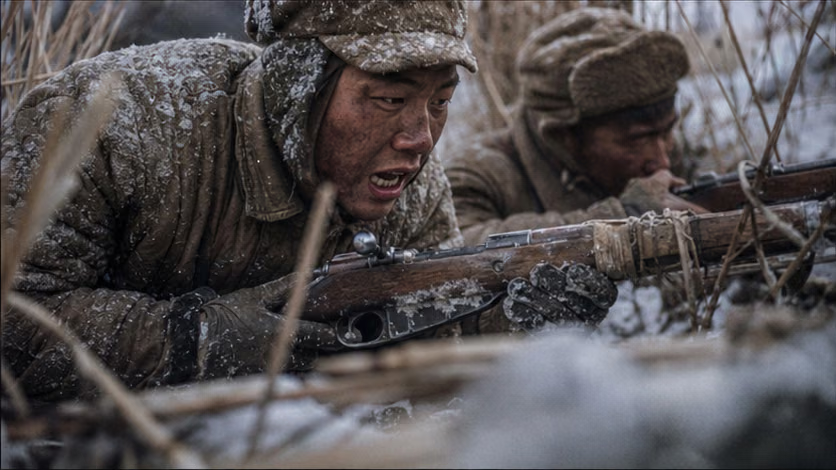
- Crossing the river on ice: at the Imjin River breakthrough points, engineers measured ice thickness at night, laid door planks, and spread straw to prevent slipping; at some crossing sites the ice was blown open by artillery fire, assault teams waded through the water, and cotton trousers turned into ice shells as soon as they reached the bank (oral-history details for each breakthrough point unverified).
- The New Year's Eve artillery preparation: the attack was set for dusk on the last day of 1950 -- for the South Korean positions, the first sound of the New Year was salvo fire.
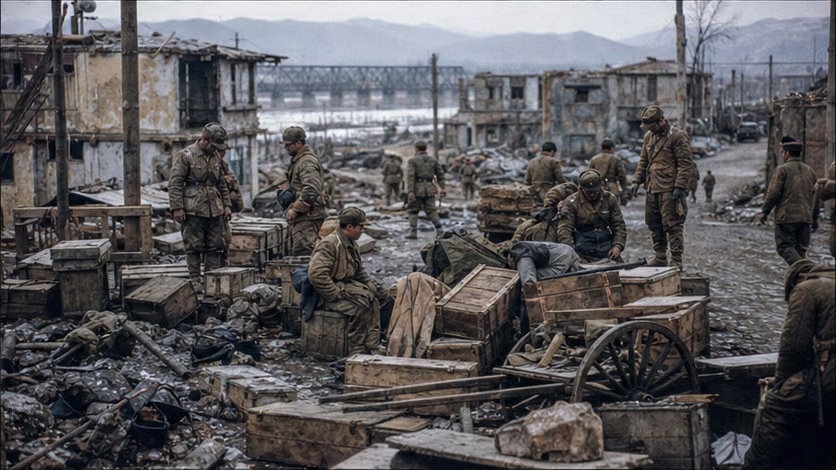
- Entering Seoul: when the leading units of the 50th Army crossed the Han River, the Seoul urban area was largely empty (civilians had withdrawn south with the U.S. forces) -- the third entrants' description of the city was "empty city" and military supplies left everywhere before they could be carried away (details unverified).
- Peng Dehuai's stop order: a braking order at the highest point of victory -- Peng later described this as one of the hardest decisions of his military career (the corresponding passage in *Peng Dehuai's Autobiography* remains unverified); among those who argued with him were nominal companions-in-arms -- allied pressure is written here as a battlefield variable.
- Ridgway's grenades: the image of Ridgway, after taking office, touring the front with two grenades hung from his shoulders (U.S. records) -- the posture of the opposing commander itself was a signal: the Eighth Army no longer intended to retreat.
The Ground
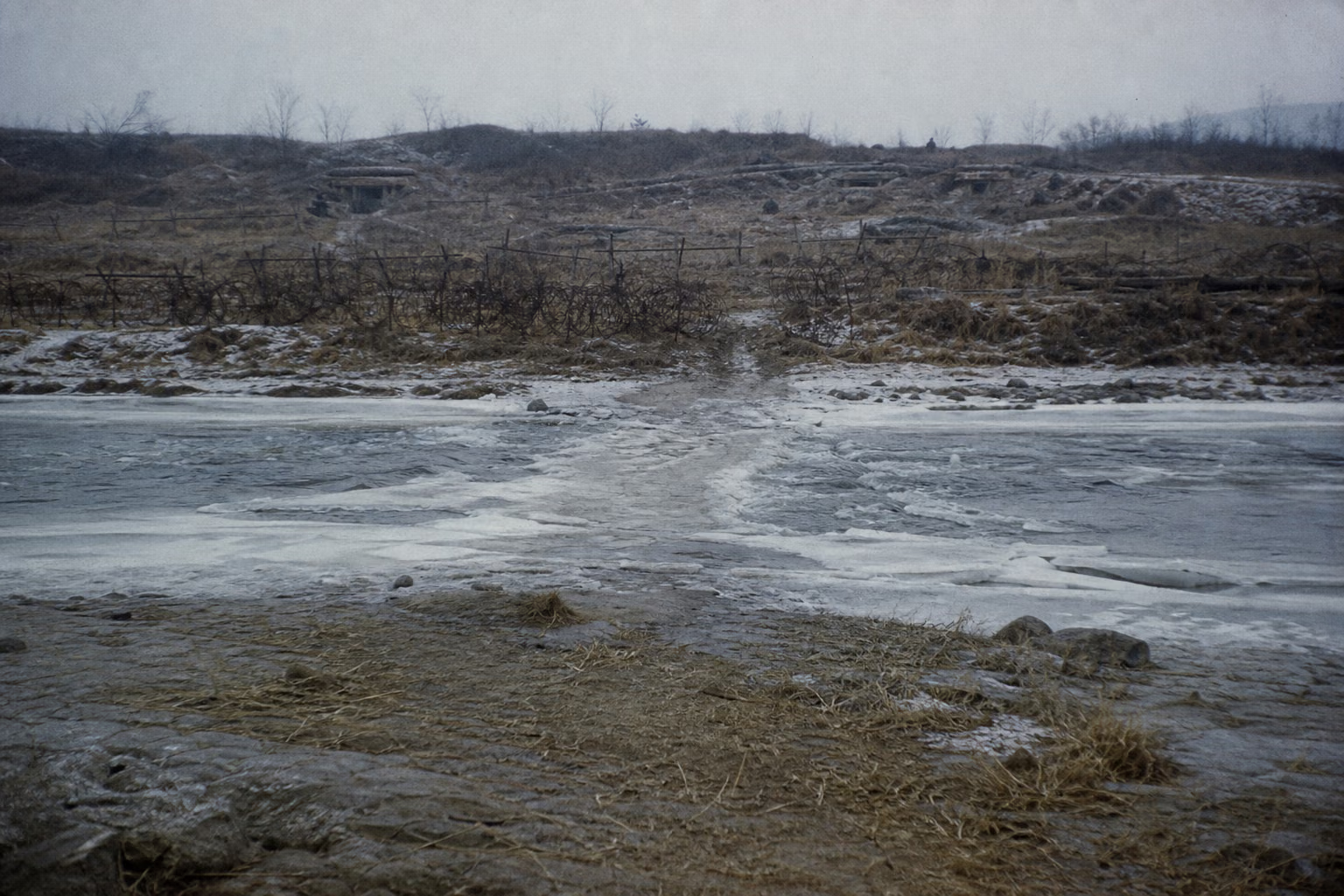
- Imjin River: frozen river surface + prepared positions on the far bank -- the success or failure of "assaulting fixed positions across rivers" depended on ice conditions, the choice of breakthrough point, and the timing of the artillery preparation.
- 38th Parallel positions in depth: several kilometers of depth made up of minefields, barbed wire, and fire points -- after the breakthrough, it was still necessary to "wedge into the depth."
- Seoul and the Han River: city, river bridges, and refugee flows -- the urban space at the moment of changing hands (empty city, crossing points, the two-way human flow of rout and entry).
- Pursuit and stopping: the "stop line" near the 37th Parallel was itself a spatial decision -- drawing a line on the map not to be crossed required greater reason than crossing it.
How Each Side Records It
- Chinese side: breaking through the 38th Parallel and retaking Seoul are high points in national memory (the domestic public enthusiasm at the time for "driving the U.S. army into the sea," and the top leadership's alertness toward it -- a note on Mao and Peng suppressing quick-victory thinking, unverified); "halting the pursuit" is treated in military-history narrative as a classic example of Peng Dehuai's military rationality.
- U.S. side: Ridgway's military history records this period as the rebuilding phase of the Eighth Army -- the withdrawal from Seoul is phrased as part of a "prearranged plan" (original text unverified), creating tension with his private acknowledgment of the force's disarray; Ridgway's *The Korean War* summary of the patterns in Chinese People's Volunteer Army offensives is the most valuable first-hand material from the opponent's perspective.
- South Korean side: the capital fell for the third time in half a year, a stroke in South Korean narrative memory of national humiliation (*History of the Korean War* details unrecorded); the Han River refugee flow is one of the core images in South Korean national memory of the 6.25 War.
Disputes and Sensitivities
- "Whether it was right to fight across the 38th Parallel / whether it was right to halt the pursuit" -- controversies in both directions coexist in Chinese military history and participants' memoirs.
- Levels of phrasing concerning Stalin / Kim Il Sung's pressure: direct instruction, embassy relay, Korean-side position -- the evidentiary strength differs across accounts (unverified).
- Chinese, U.S., and South Korean bases differ on enemy losses inflicted.
- Records of Chinese-Korean troop discipline and municipal administration during the occupation of Seoul differ across sides (unverified).
Sources and Open Questions
Sources: *History of the War to Resist U.S. Aggression and Aid Korea* (Academy of Military Sciences), vol. 1; Peng Dehuai, *Peng Dehuai's Autobiography*; Ridgway, *The Korean War*; U.S. Army official history Billy Mossman, *Ebb and Flow*; South Korea's *History of the Korean War*; Shen Zhihua's related archival studies.
Open questions: telegrams concerning the decisions on rest and crossing the line; diplomatic details of the 13-nation ceasefire proposal and the Chinese response; breakthrough times of each division in the New Year's Eve breakthrough; details of the leading units entering Seoul; the full telegram record of the decision to halt the pursuit and records of the meeting with Kim Il Sung; the level of phrasing for pressure from Stalin's side; each side's casualty bases; records of the Seoul refugee flow and occupation-period municipal administration.
All images on this site are AI-generated depictions. They are not historical photographs, not primary sources, and do not depict any real individual.