Engagement Archive · Battle of Triangle Hill
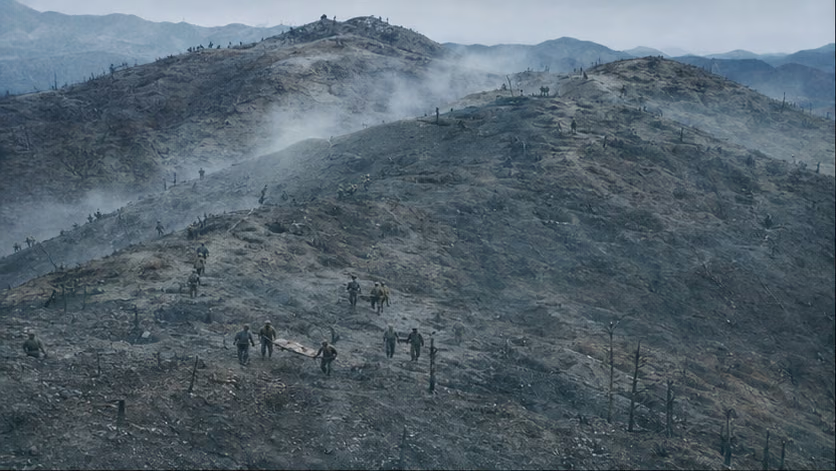
Two hilltops over 3.7 square kilometers, 43 days, and more than 100,000 men from both sides fed into them in rotation: artillery density surpassed that of any battle in the Second World War; the summits were shaved down by two meters, and rock was blasted into powder more than a meter deep. U.S. forces called it "another Heartbreak Ridge beside Heartbreak Ridge"; for the Chinese army, it became a spiritual place-name: what could not be moved at the negotiating table was held at Triangle Hill with tunnels and human lives.
Engagement Data
| Item | Content |
|---|---|
| Time | 1952.10.14 – 11.25, 43 days |
| Place | The forward area of Wusheng Mountain north of Kumhwa, Korea: Height 597.9 and the northern hill of Height 537.7 (called "Triangle Hill" and "Sniper Ridge" by the U.S. side) -- total area about 3.7 square kilometers |
| Attacker | the "United Nations Command" (Van Fleet planned "Operation Showdown"): mainly the U.S. Seventh Division and ROK Second Division, with more than 60,000 committed in succession (statistical bases vary by account) |
| Defender | The Chinese People's Volunteer Army's 15th Army (Qin Jiwei), beginning with the 45th Division, later relieved by the Twelfth Army; 43,000 committed in succession (statistical bases vary by account) |
| Result | On 11.25 the Chinese People's Volunteer Army restored and consolidated all surface positions -- "Operation Showdown," originally estimated at 5 days and 200 casualties, ended in the reality of 43 days and 25,000 casualties (the U.S. estimate's statistical basis varies by account) |
Belligerents
| Item | Chinese People's Volunteer Army | United Nations Command |
|---|---|---|
| Firepower | Mountain- and field-artillery groups, later joined by "Katyushas" (the rocket-artillery salvo line remains unverified) -- the Chinese People's Volunteer Army's first engagement-level artillery duel | More than 1.9 million artillery shells + more than 5,000 aerial bombs (statistical bases vary by account) -- firepower density per unit area exceeded the Second World War record (the origin of the term "Van Fleet Load," noted briefly) |
| Fortifications | Tunnel system: when surface positions were lost, troops shifted into tunnels to hold out, then counterattacked at night, a two-layer "surface-tunnel" method of fighting (the formation history of tunnel tactics) | Surface fortifications were equally difficult to survive in under comparable fire |
| Supply | The death corridor of frontline transport teams (where the story of an apple belongs -- see "Accounts of Those Present"); the extremes of thirst and oxygen deprivation inside the tunnels (accounts of moistening the throat with urine are summarized briefly; unverified) | Conventional logistics |
Terrain and Conditions
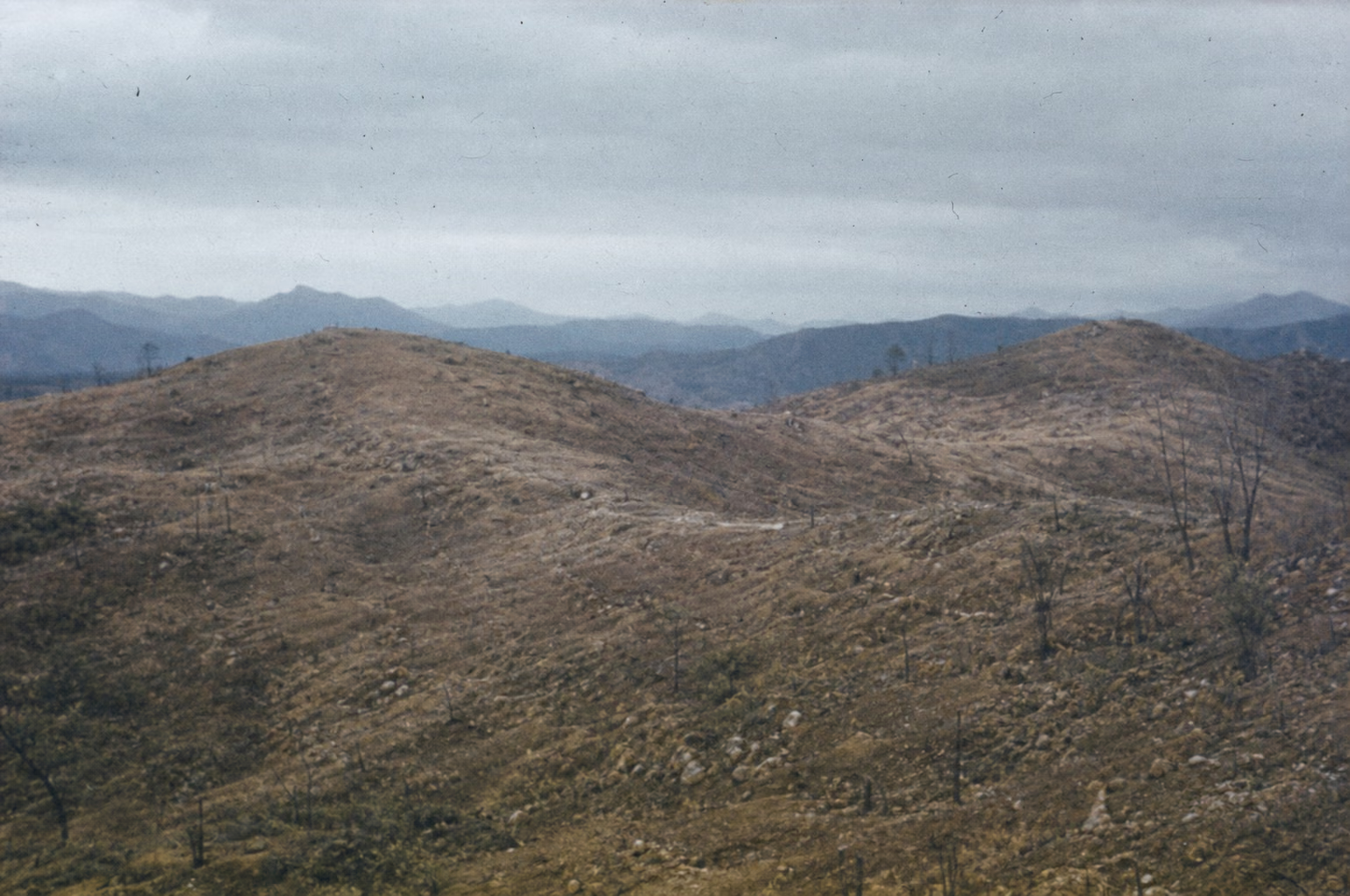
Autumn 1952: armistice talks had deadlocked over the prisoner-of-war issue (see also the overview); the front had been stalemated for more than a year -- both sides needed a battle that would make the other understand there was no bargain in continuing to fight. Wusheng Mountain was the gateway of the central front (the level of the saying "lose Wusheng Mountain and for 200 li there is no defensible terrain" remains unverified); the two heights behind Shangganling village were its forward supports -- the negotiating table's geographic footnote: the battle was fought for the talks, and the talks were decided by the battle.
Why It Was Fought
By the second autumn of positional warfare, the line had already sat for a year on the actual line of contact of November 1951. The strangulation campaign had been bombed and lost; the accounts of Bloody Ridge and Heartbreak Ridge had been settled: the cost of attack and defense was inverted, and whoever attacked paid the premium (see *Positional Warfare Phase*). The remaining chips were on the negotiating table, and in October 1952 the talks had just deadlocked and broken off over prisoner-of-war repatriation (see also the overview): with the table empty, only the battlefield could still speak. Both sides needed a battle that would make the other understand there was no bargain in continuing to fight.
The place Van Fleet chose was the two heights in front of Wusheng Mountain: 597.9 and the northern hill of 537.7, marked on U.S. maps as "Triangle Hill" and "Sniper Ridge." Wusheng Mountain was the gateway of the central front (the level of the saying "lose Wusheng Mountain and for 200 li there is no defensible terrain" remains unverified), and these hillocks, only several hundred meters high, were the support points it extended forward: take them, and the situation north of Kumhwa improved a fraction, adding one real chip to the table. This was the negotiating table's geographic footnote: the battle was fought for the talks, and the talks were decided by the battle.
The timing, too, had been selected. October was the final month before voting in the U.S. presidential election, and the stalemated war in Korea was the White House's hottest account; on the 6th of the same month, the 38th Army was making a strong assault on White Horse Mountain (see *Positional Warfare Phase*) -- when Van Fleet launched "Operation Showdown" at this moment, it carried both the political clock of pressure on the talks and a calculation to regain the autumn initiative.
Both sides misread one entry in their accounts. Van Fleet estimated: two battalions, 5 days, 200 casualties (the U.S. estimate's statistical basis varies by account) -- he calculated firepower, but did not include the tunnels: after surface positions had been plowed up, the defenders moved into the mountain and retook the ground at night; that variable was absent from the firepower model. On the Chinese People's Volunteer Army side, the 15th Army had judged in advance that the main direction of the allied autumn offensive would be the Xifangshan and Pyonggang Valley line, with the Wusheng Mountain front configured only as an auxiliary direction (the judgment and details of artillery deployment remain unverified) -- when 300,000 shells fell before dawn on 10.14, the judgment had just been proved wrong.
The Chinese People's Volunteer Army's response had only one logic: yielding not an inch of ground was the negotiating position. The positional-warfare principles of "nibbling" and "holding every inch" now collided with Showdown's firepower and became a meat grinder. Neither side had expected what it would become: the planned 5 days became 43 days, and the two hilltops over 3.7 square kilometers took in more than 100,000 men in succession. The battle's loss of control -- a small objective rolling into a major battle -- is the military core of this article.
In fact, Van Fleet could have chosen not to fight: during the recess in the talks, he could have held position and waited for Washington's new master to set policy. But in political terms, holding position read as weakness, and in the autumn of 1952 the "United Nations Command" could least afford weakness.
Course of the Engagement
| Phase | Time | Key points |
|---|---|---|
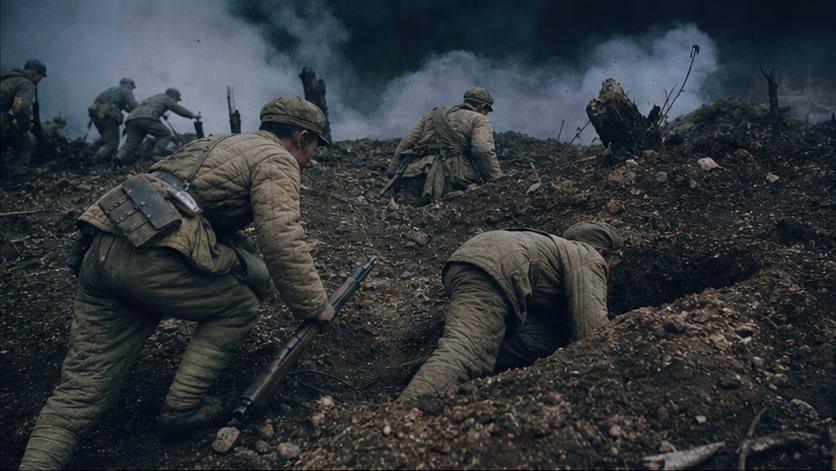
| Surprise attack and seesaw | 10.14–20 | U.S. and ROK forces opened the first day with 300,000 artillery shells; surface positions changed hands repeatedly (several times in a single day, and the cumulative figure of positions being lost and retaken 59 times varies by account); the 45th Division's casualties rose sharply (the unit-number line for companies wiped out as formed units remains unverified) |
| Holding in the tunnels | 10.21–29 | The surface was temporarily lost and troops moved into tunnels: the tunnel extreme of no water, no food, oxygen deprivation, and wounded who could not be evacuated (the tunnel as island -- an underground version of the Hengyang-style extremity, an intertext); small teams struck out at night to harass the enemy -- "daytime was theirs, nighttime was ours" |
| Decisive counterattack | 10.30–11.5 | The 15th Army and Twelfth Army relieved one another, with artillery concentrated: the major counterattack on 10.30 restored the main peak of 597.9; from 11.1 the Twelfth Army entered the battle in rotational combat |
| Consolidation | 11.6–25 | Repeated final contests for the northern hill of 537.7; on 11.25 the whole line was restored and consolidated -- the battle closed |
Casualties and Losses
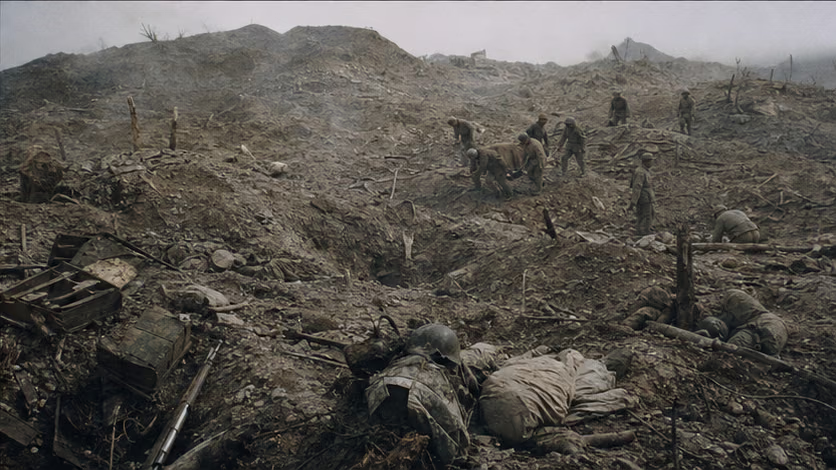
- Chinese People's Volunteer Army: 11,500 casualties (statistical bases vary by account); the 45th Division suffered more than 5,000 casualties, and 27 companies were reorganized (statistical bases vary by account).
- United Nations Command: 25,000 casualties (Chinese statistical basis) / about 9,000 (U.S. statistical basis) -- one of the largest-gap samples between two statistical systems: statistical boundaries (whether ROK forces are included, whether sick personnel are included) differ markedly.
- The mountain: the elevations of the two heights were shaved down by about two meters by artillery fire, and the topsoil became powder -- the terrain itself became a casualty (postwar measured statistical basis varies by account).
Aftermath
- After "Operation Showdown," the United Nations Command never again launched an attack above battalion scale against Chinese People's Volunteer Army positions (the wording in U.S. official history remains unverified) -- Triangle Hill defined the ceiling of positional warfare: no one should expect to move anyone again; the armistice came half a year later.
- Tunnel warfare entered the textbooks; the 15th Army became famous from this point (it later became an airborne force -- the unit-honor line of the "Triangle Hill troops," noted briefly).
- The film *Shangganling* (1956) and *My Motherland* -- "a great river" became a national memory beyond the battle (an interlude traveled farther than the battle itself: a sample of musicalized commemoration); the heroic lineage of Huang Jiguang (10.19, blocking a gun port with his body -- the evidentiary levels of the records and textual criticism of his deed: comrades' testimony and propaganda texts are marked by layer, not dissolved), Sun Zhanyuan, Hu Xiudao, and others.
- U.S. memory: Triangle Hill occupies limited space in U.S. military history (the silence of "we do not mention it again" is also a mode of recording -- structurally parallel to the memory asymmetries of Sanyuanli and Sihang Warehouse; this time the silent side is the United States).
Accounts of Those Present
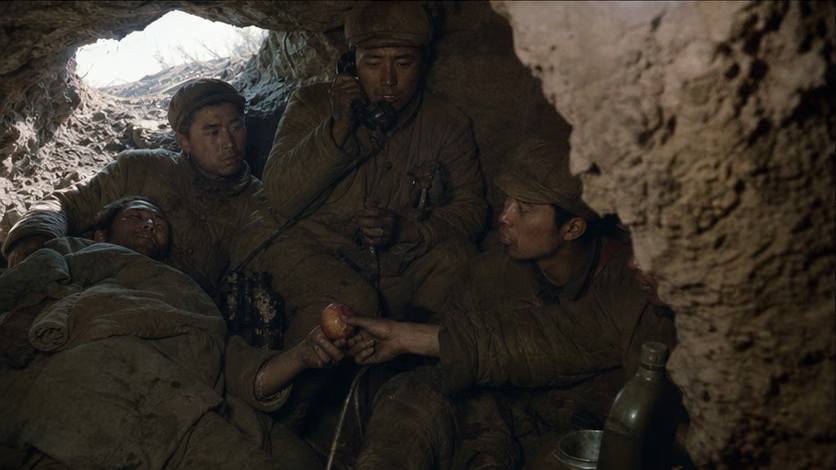
- An apple: an apple carried into the tunnel by the transporter Liu Mingsheng was passed around among 8 people, who each took a bite and still did not finish it before passing it around a second time (the episode is recorded in multiple memoirs and textbooks -- the textual source line remains unverified) -- the ethics of distribution at the limit of hunger and thirst, one of the smallest objects in this series' "Accounts of Those Present."
- Huang Jiguang: during the counterattack on 597.9, he blocked a machine-gun firing port with his chest -- eyewitness testimony from comrades, records of the state of the body, and later propaganda texts belong to different layers of material.
- Songs in the tunnels: in oxygen-starved tunnels, soldiers sang softly to keep themselves conscious (a common pattern in veterans' oral accounts) -- the source of the screen's "a great river" 4 years later lay here.
- The field-telephone operator's voice: after shouting himself hoarse and losing his voice, he bit the handset wire in his mouth to transmit vibration (detail layer unverified) -- the battle of the signalmen.
- Van Fleet's son: his son had earlier gone missing in air combat over Korea (1952.4 -- a commander's private cost, unverified) -- also a human dimension of the opponent.
The Ground
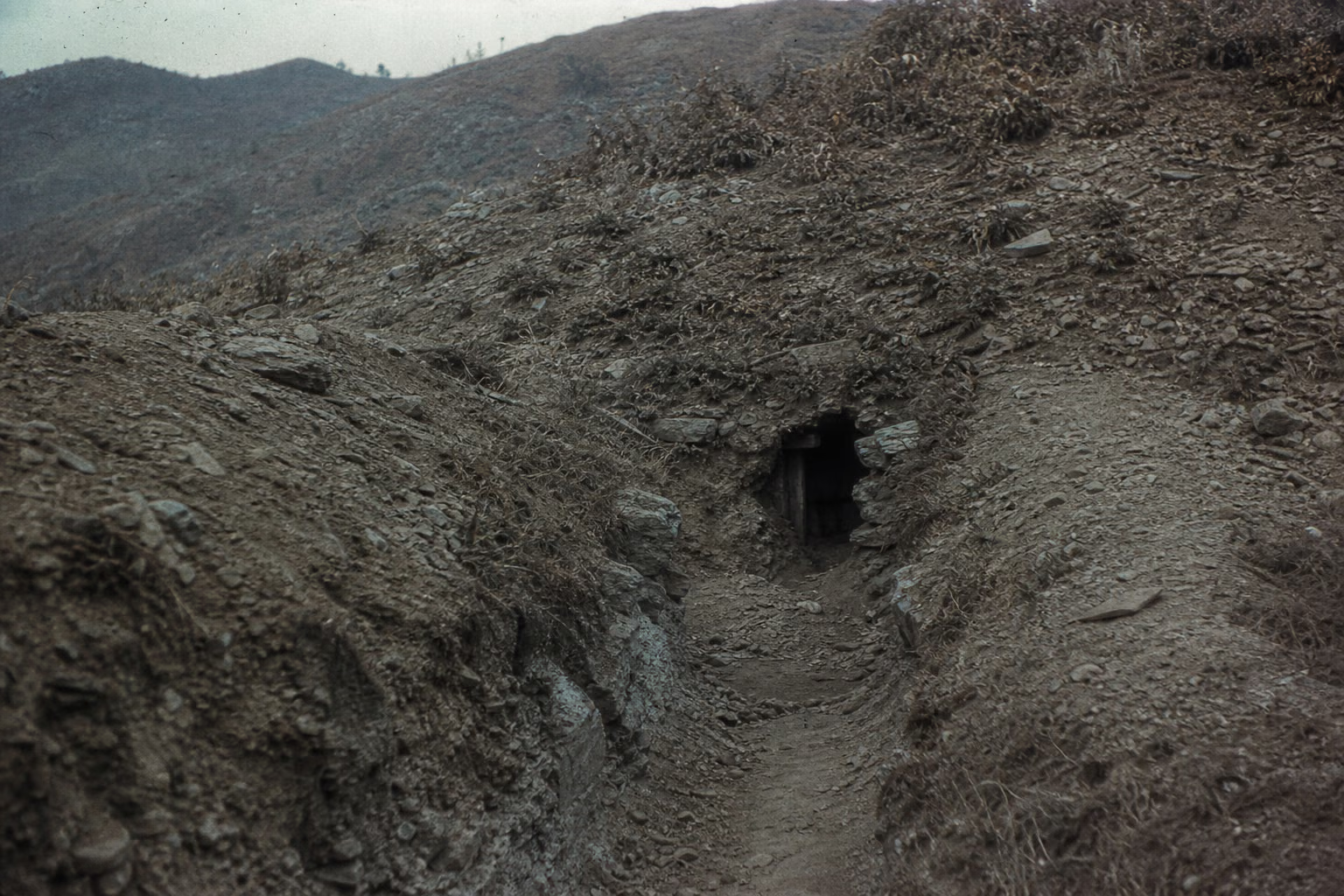
- The extreme density of 3.7 square kilometers: the highest unit-area intensity in the whole series -- the ultimate sample of "small space, major battle" (in the same lineage as Hengyang and Songshan, but more extreme).
- The two-layer space of surface and tunnel: loss of the surface did not equal defeat, a vertical depth -- the concept of "position" was redefined: the greatest innovation in the series' attack-defense mechanisms, and a core asset for design.
- Day-night ownership: the temporal division between daytime suppression by air and artillery and nighttime close-combat recapture (the day-night lineage of Luodian-Chosin Reservoir-Triangle Hill comes to a close here).
- Evacuation and transport corridors: the death zone of frontline transport -- "the journey of an apple" as a unit of spatial narrative.
- A mountain shaved down by two meters: the physical rewriting of battlefield terrain -- space itself is part of the casualty statistics.
How Each Side Records It
- Chinese side: a spiritual-totem-level battle -- "Triangle Hill spirit" entered political vocabulary; the nationalization of the film and *My Motherland*; the 15th Army narrative.
- U.S. side: Triangle Hill is technically recorded as a "failed limited offensive," with far less space than in Chinese accounts -- the inversion of memory volume (the initiating side records less, the defending side writes greatly -- a mirror of Sanyuanli).
- Korean side: the casualties of the ROK Second Division on Sniper Ridge have their place in Korean War history (Korean statistical bases vary by account) -- the third party's account is also recorded.
Disputes and Sensitivities
- The enormous gap between the two sides' casualty statistical bases -- statistical boundaries differ markedly, making this one of the most prominent cases of statistical-basis divergence in the whole series.
- A layered presentation of records concerning Huang Jiguang and other heroes -- respect and evidence stand together.
- The level at which to state the strategic value of the "Wusheng Mountain gateway."
- Military review of the scale at which the battle was launched and the process by which it lost control (the U.S. internal review line on Van Fleet remains unverified).
Sources and Open Questions
Sources: *History of the War to Resist U.S. Aggression and Aid Korea*, volume on positional warfare; the 15th Army's *Summary of the Battle of Triangle Hill* (archive entry unverified); Qin Jiwei's memoirs; histories of the U.S. Seventh Division and ROK Second Division; Hermes, *Truce Tent and Fighting Front* (the U.S. official-history volume on positional warfare).
Open questions: the casualty figure sets and statistical boundaries for both sides; numbers of artillery shells and aerial bombs; the number of times positions changed hands; tunnel casualties and extreme-condition records; the Huang Jiguang testimony set; the source line of the apple story; Van Fleet's estimate text.
All images on this site are AI-generated depictions. They are not historical photographs, not primary sources, and do not depict any real individual.