War Overview · Chinese Eastern Railway Incident (foreign war on Chinese soil) (1929)
Half a year after the change of allegiance, Zhang Xueliang tried to recover the Chinese Eastern Railway; in three months, the Soviet Far Eastern Army drove the Northeastern Army back to the negotiating table: the advisers who had taught the Northeastern Army how to fight came back to fight the Northeastern Army, while the closest observer in the stands was the Japanese Kwantung Army, which would act two years later.
Engagement Data
| Item | Details |
|---|---|
| Time | 1929.7.10 (forcible takeover of the Chinese Eastern Railway)–12.22 (Khabarovsk Protocol) |
| Place | Eastern Sino-Soviet border sector: Tongjiang-Fujin (mouth of the Songhua River), Manzhouli-Zhalainuo'er (western front), Suifenhe (eastern front) |
| Belligerents | Northeastern Army (Zhang Xueliang) / Soviet Red Army Special Far Eastern Army (commanded by Blyukher, the "General Galen" of the Northern Expedition) |
| Result | Crushing defeat of the Northeastern Army; the Khabarovsk Protocol restored Soviet rights and interests on the Chinese Eastern Railway to the status quo ante |
Belligerents
| Item | Northeastern Army | Soviet Army |
|---|---|---|
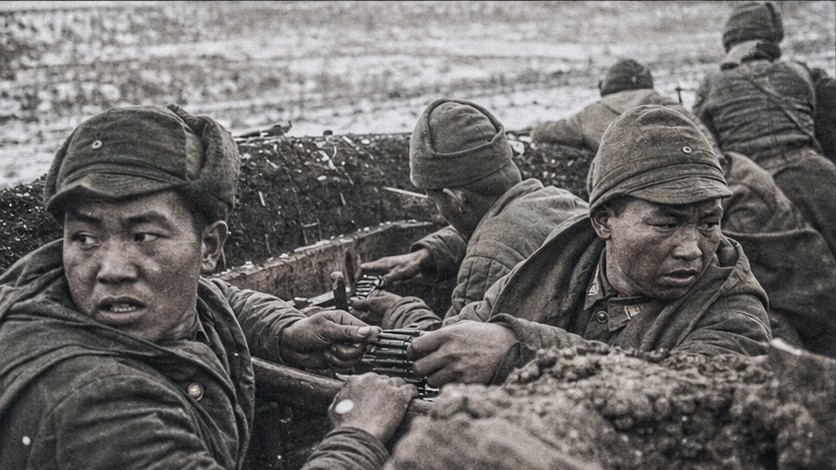
| Strength | About 100,000 across the border fronts in total, with brigades actually committed piecemeal (figures vary by statistical basis) | More than 40,000 in the Special Far Eastern Army (figures vary by statistical basis), used in concentrated fashion |
| Technology | Old vessels of the river-defense fleet; army equipment was not weak, but coordination was poor | Combined land-river-air operations: Amur Flotilla, aviation, tanks (the claim that this was the T-18's combat debut is unverified) |
| Command | Each front fought on its own, with reinforcements slow to arrive | Unified command under Blyukher, choosing points for annihilating blows |
Terrain and Conditions
(The larger situation in 1929 -- the wave of "revolutionary diplomacy" to recover rights after the Northeastern change of allegiance, and the National Government's movement to revise unequal treaties -- is explained within this piece: under the 1924 Sino-Soviet agreement, the Chinese Eastern Railway was under "joint management" by the two countries, but real power lay with the Soviet side; the Northeastern authorities saw it as lost sovereignty, and Nanjing was glad to see Zhang Xueliang take action against the Soviet Union.)
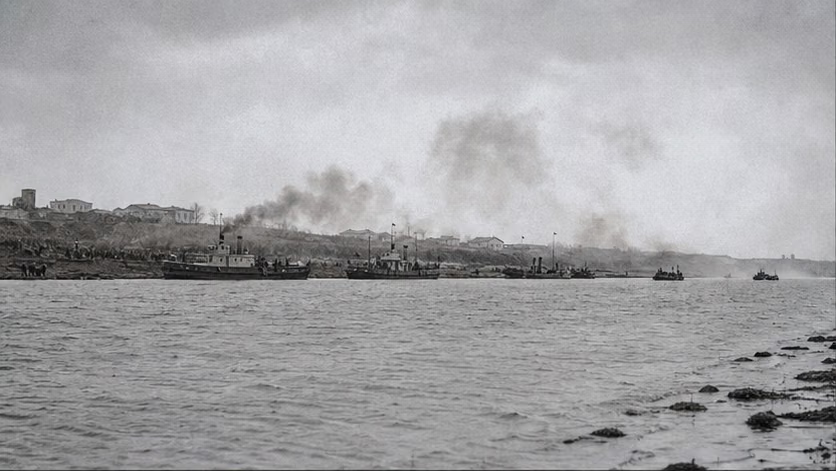
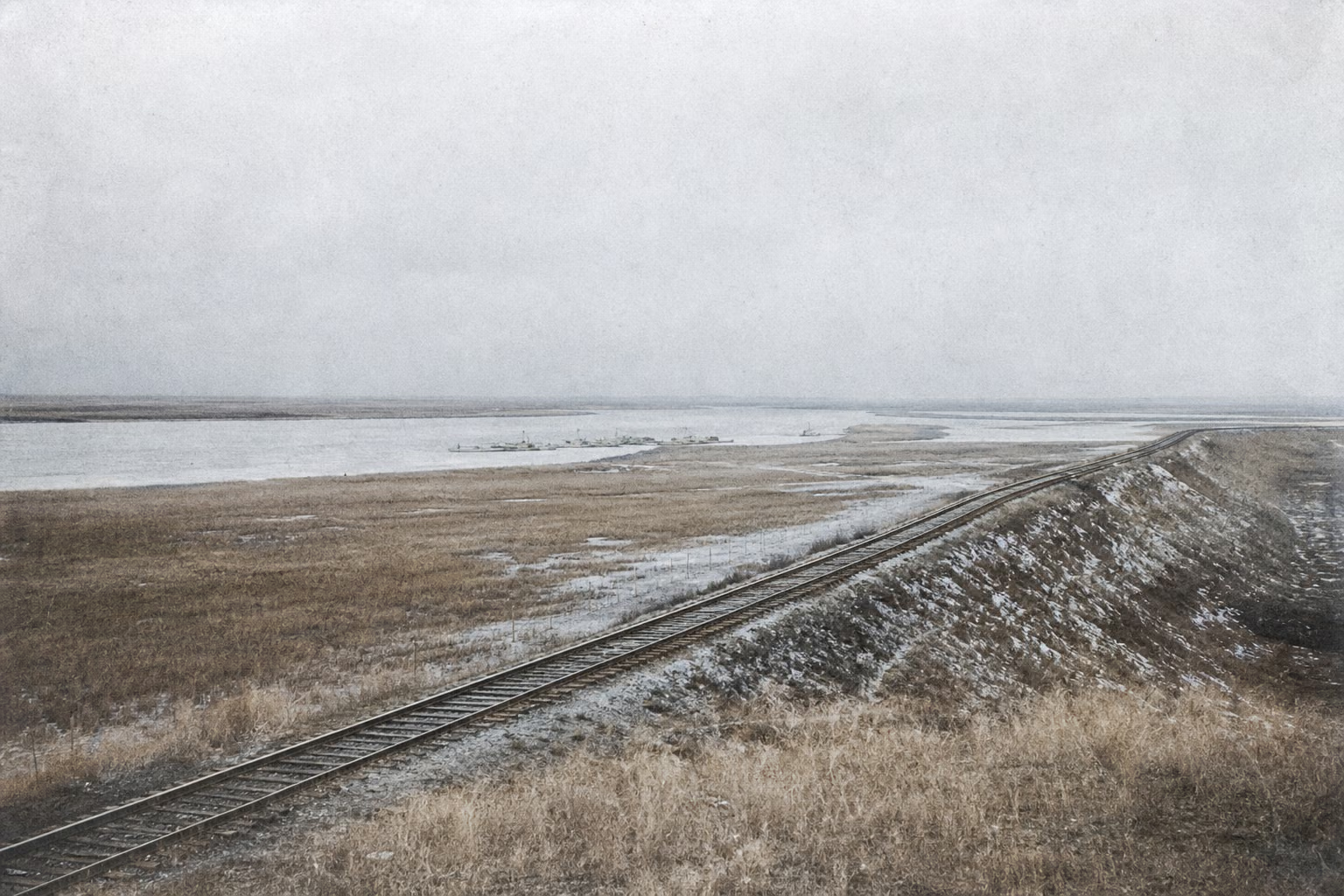
The two ends of the border differed. On the western front, Manzhouli-Zhalainuo'er was a grassland railway line, bitterly cold in winter; on the eastern front, Tongjiang lay where the Songhua River enters the Heilongjiang, and was the anchorage of the river-defense fleet.
Why It Was Fought
The "unification" inside Shanhai Pass had already returned to its old shape by the spring of 1929: the demobilization conference failed to cut troop numbers, the Chiang-Gui War opened in March, and in May Chiang and Feng showed their hands again (see Chiang-Gui and Chiang-Feng Wars). Outside the pass, the situation was different: the Northeastern change of allegiance was only half a year old, Zhang Xueliang had newly taken control of the Northeast, and he was recovering authority and establishing his prestige. In January 1929 he executed Yang Yuting and Chang Yinhuai, drawing power into his own hands; the next step fell on railway rights held by foreigners.
The Chinese Eastern Railway was the most conspicuous case. This railway across northern Manchuria was, under the 1924 Sino-Soviet agreement, under "joint management" by the two countries, yet real power lay with the Soviet side; the Northeastern authorities saw it as lost sovereignty. That year, Nanjing's "revolutionary diplomacy" and movement to revise unequal treaties were swelling the atmosphere for recovering rights to its fullest, and Nanjing was glad to see Zhang Xueliang take action against the Soviet Union. The "central government," tangled in war inside the pass, could not send troops, but could afford vocal support.
The calculations on the two sides were not equal. The Northeastern authorities were wagering that Moscow, newly settled and still insecure, would not launch a major war over a railway: seize control by force, create a fait accompli, and then exchange it for recognition at the negotiating table. For the Young Marshal, this move meant the recovery of sovereignty externally and the establishment of authority internally. Moscow's position was simpler: restore the railway rights to the status quo, without yielding an inch; talks were possible, but if talks failed, war would be used to force them forward. The misjudgment lay on the Northeastern side: it underestimated both Soviet military strength and Moscow's resolve. Zhang Xueliang's later oral history also acknowledged that this campaign was rash (the relevant oral-history chapters are unverified); he had still less expected that the commander opposite him would be the National Revolutionary Army's chief military adviser during the Northern Expedition, "General Galen" Blyukher.
The decision was made in early July: Zhang Xueliang went to Beiping to meet Chiang Kai-shek, and Chiang strongly advocated recovering the Chinese Eastern Railway (the meeting date and content vary by account, unverified). The intelligence in the Northeastern authorities' hands leaned toward what they wanted to hear: White Russian emigre groups and border reports mostly said famine was severe inside the Soviet Union, that Far Eastern forces were hollowed out, and that they were not fit for a war (this account circulated widely; original reports unverified). What was missing was precisely a tested measure of Soviet combat power. The last time the Northeastern Army had fought a major battle against a foreign army was already a generation earlier.
The material balance was there to see; no one made the calculation carefully. The Northeastern Army claimed several hundred thousand men, but only about 100,000 stood on the border, and they were divided across separate fronts. Its river-defense fleet consisted of old vessels; opposite it stood a field army coordinating flotilla, aircraft, and tanks. The Trans-Siberian Railway was in Soviet hands, bringing personnel and materiel eastward without interruption; the Chinese Eastern Railway had only just changed hands, and had not yet become transport capacity for those who had seized it (this judgment is inferred from railway control and the speed of the two armies' deployment; no direct record, unverified). Northeastern finances were among the richest in the country, but money was not the boundary; distance and season were. By November, severe cold stood on the side that was prepared.
There had been objections at the table. Zhang Zuoxiang opposed the use of force, for a plain reason: they could not win (often seen in memoir material; original source unverified). The objection was not accepted, because the recovery of rights was the national-policy atmosphere in Nanjing and also what the Young Marshal needed to establish his prestige after newly taking control of the Northeast.
On 5.27, the Northeastern authorities' military police searched the Soviet consulate in Harbin. On 7.10, they forcibly took over the Chinese Eastern Railway, dismissed the Soviet director, and arrested and expelled Soviet personnel. On 7.18, the Soviet Union announced the severance of diplomatic relations and massed troops on the border. Negotiations remained deadlocked for three months, and artillery fire along the border grew more frequent. From October onward, the Soviet Army took action.
Course of the Engagement
| Stage | Time | Key Points |
|---|---|---|
| Border friction | 8–9 | Shelling and small-scale clashes continued, and both sides increased their forces |
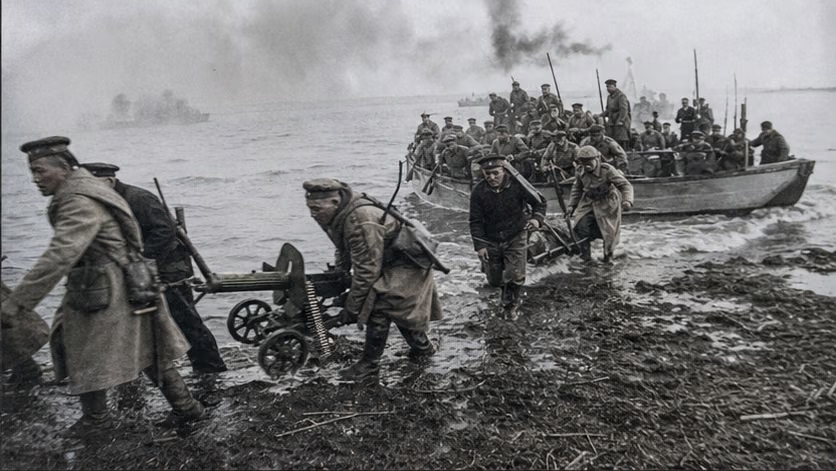
| Battle of Tongjiang | 10.12 | The Soviet Amur Flotilla and landing forces attacked Tongjiang: the Northeastern river-defense fleet answered in haste, and its main vessels were almost all sunk or damaged (vessels including Lijie and Lisui were sunk or destroyed; vessel names and detailed losses are unrecorded); the river-defense fleet was destroyed; Tongjiang fell |
| Battle of Fujin | 10.31–11.2 | Soviet troops advanced again upriver, and Fujin fell |
| Zhalainuo'er-Manzhouli | 11.17–20 | Decisive battle on the western front: Soviet troops encircled both sides of the railway. Han Guangdi's brigade of the Zhalainuo'er garrison fought bitterly; Brigade Commander Han Guangdi was killed, and nearly the entire brigade was wiped out. Liang Zhongjia's brigade at Manzhouli was surrounded and captured after ammunition and reinforcements were exhausted (Liang Zhongjia died of illness after being captured; details unrecorded) -- two Northeastern Army brigades were destroyed as organized units |
| Armistice and peace talks | Late November-12.22 | The Northeastern authorities sought peace; on 12.3 came the Shuanglinkou draft agreement, and on 12.22 Cai Yunsheng signed the Khabarovsk Protocol as representative: the Chinese Eastern Railway returned to its pre-conflict status, Soviet rights and interests were fully restored, and the armed recovery of rights gained nothing |
Casualties and Losses
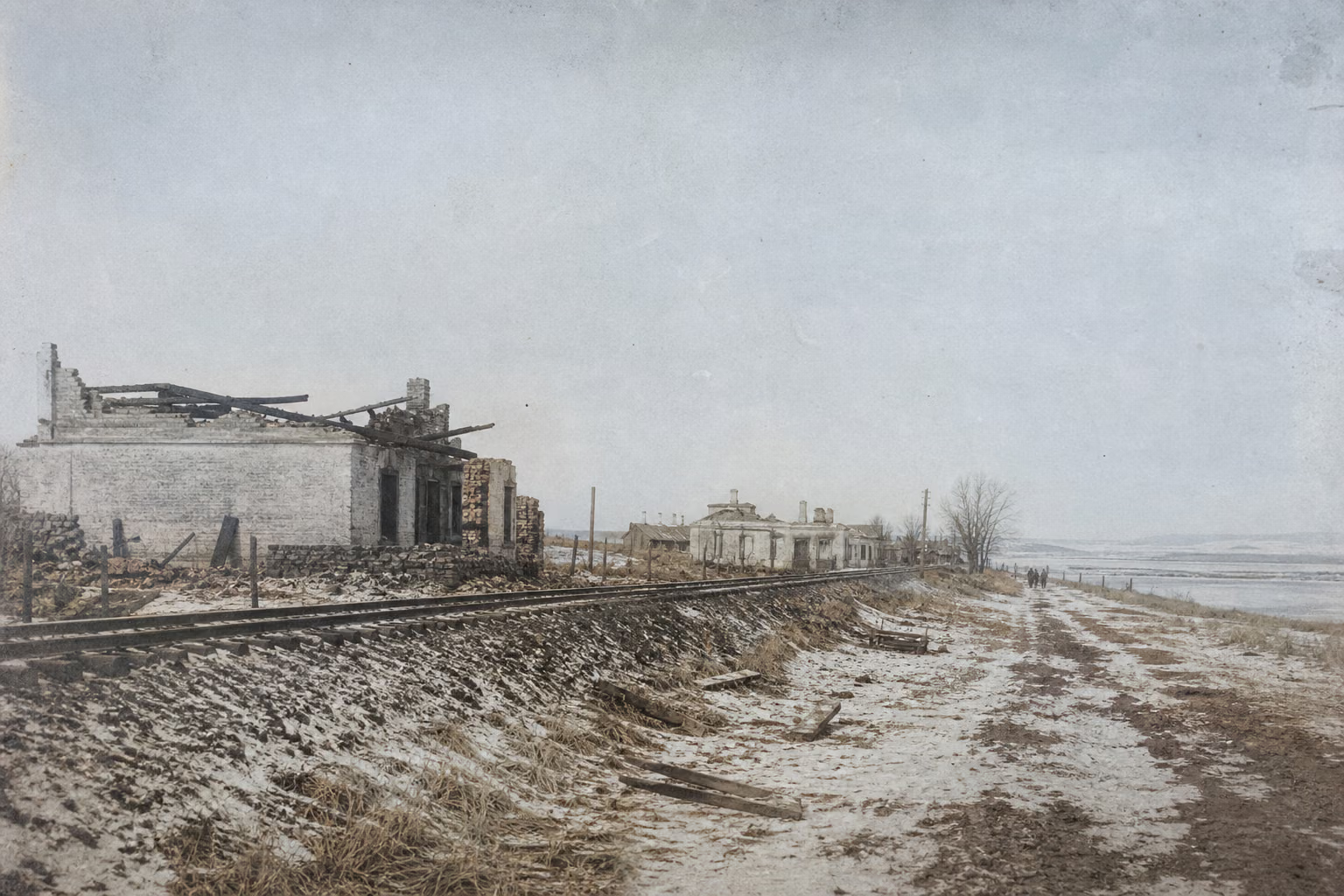
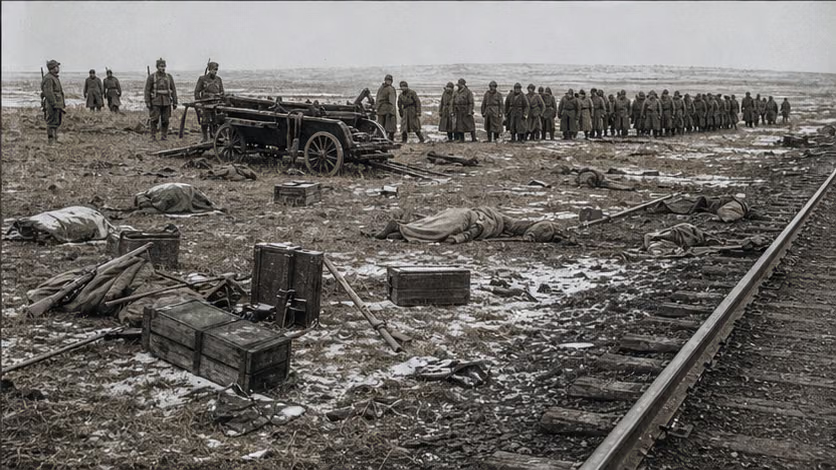
- Northeastern Army: killed, frozen to death, and captured totaled nearly 10,000 (figures vary sharply by statistical basis; one account gives more than 7,000 captured); the river-defense fleet was destroyed; two entire brigades were eliminated.
- Soviet Army: self-reported more than 140 killed and more than 600 wounded (Soviet figures, unverified).
- ※ Civilians: residents in the Manzhouli and Zhalainuo'er battle zones were displaced, and towns along the river at Tongjiang and Fujin suffered military depredation (record unverified); fragmentary memoirs describe the conditions of Northeastern Army officers and soldiers in prisoner-of-war camps (figure disputed).
Aftermath
- Japan in the stands: the Kwantung Army observed the Northeastern Army's mobilization, coordination, and combat power at close range throughout. Staff officers, including Ishiwara Kanji, used this to assess that "the Northeastern Army was not to be feared" -- part of the nerve behind the Mukden Incident was fed by the defeat on the Chinese Eastern Railway (Japanese staff-assessment texts unverified). This is the heaviest line in this piece.
- Through this campaign, Zhang Xueliang came to understand deeply that he could not face foreign powers alone. Thereafter, in negotiations with Japan, he tended toward avoiding war -- one psychological foreshadowing of the 1931 policy of "non-resistance" (interpretive layer; level marked).
- The controversy over the slogan "armed defense of the Soviet Union": the CPC's use of this slogan at the time triggered a major dispute inside and outside the party. Chen Duxiu publicly dissented and was soon expelled from the party (1929.11) -- a collision between national position and international line, and a sensitive point in party history, stated plainly (sources unverified).
- Nanjing refused to ratify the Khabarovsk Protocol in full, and the restoration of Sino-Soviet diplomatic relations dragged on until 1932 -- a diplomatic loose end.
- Blyukher received the Order of the Red Banner for this campaign and was promoted to Marshal of the Soviet Union; in 1938 he died in Stalin's purge (a brief note, the return stroke of history).
How Each Side Records It
- Soviet side: written into military history as the Red Army's first major external victory, the preface to the "Lake Khasan-Khalkhin Gol" sequence; in propaganda, it was a "self-defensive counterattack."
- Chinese side (at the time): Nanjing and the Northeast blamed each other -- the advocates of "revolutionary diplomacy" and the executors passed responsibility back and forth; defeat was taboo inside the Northeastern Army.
- Chinese side (later): long kept low-key. It was caught in the narrative gap between "anti-Soviet" and "defending sovereignty," with textbooks usually passing over it in a single stroke; in recent years research has gradually increased (Zhang Xueliang's oral history, declassified Soviet archives).
- Japanese side: the Kwantung Army's "observation reports" were the most serious readers. This layer of narration is rarely seen in Chinese histories.
Disputes and Sensitivities
- Responsibility for the decision: the views that Zhang Xueliang acted rashly, that Nanjing egged him on, and that the Soviet side acted deliberately stand side by side.
- The slogan "armed defense of the Soviet Union" and Chen Duxiu's expulsion -- national and class narratives collided head-on here.
- The assessment of Northeastern Army combat power and the causal chain leading to non-resistance in the Mukden Incident -- this is an interpretive layer, not fatalism.
- Casualty and prisoner figures vary sharply by statistical basis and source.
Contents
(The battles of Tongjiang, Fujin, and Zhalainuo'er-Manzhouli are folded into this piece and not treated as separate entries.)
Sources and Open Questions
Sources: relevant chapters of Zhang Xueliang's oral history; the collected volume Materials on the Chinese Eastern Railway Incident (bibliographic details unverified); Soviet military histories and translated archival texts (Special Far Eastern Army battle reports unverified); Kwantung Army observation assessments (Japanese archives unverified).
Open questions: the various figures for troop strength, casualties, and prisoners on both sides; detailed losses of the river-defense fleet; details of the lives and actions of Han Guangdi and Liang Zhongjia; texts of the Shuanglinkou draft agreement and Khabarovsk Protocol; assessment texts by Ishiwara Kanji and others; literature on the "armed defense of the Soviet Union" controversy; the claim that the T-18 tank made its combat debut; the date and content of Zhang Xueliang's July 1929 Beiping meeting with Chiang; the Northeastern authorities' sources of intelligence on the Soviet Union (White Russian reports); the original source for Zhang Zuoxiang's opposition to the use of force; the relation between control of the Chinese Eastern Railway and the speed of the two armies' deployment.
All images on this site are AI-generated depictions. They are not historical photographs, not primary sources, and do not depict any real individual.