War Overview · Xinhai Revolution (1911–12)
A shot outside Wuchang, fourteen or fifteen provinces changing flags within four months, and two thousand years of imperial rule finally closed by an abdication edict: the negotiating table fought the last battle in place of the battlefield, while beneath that surface the ethnic massacres and the backlash of Yuan Shikai's rule are recorded on this same page.
Engagement Data
| Item | Details |
|---|---|
| Time | 1911.10.10 Wuchang Uprising – 1912.2.12 abdication of the Qing emperor (the prehistory of the revolution begins with the founding of the Revive China Society in 1894; see the separate article Successive Uprisings of the Revolutionary Party) |
| Place | Nationwide: the first uprising at Wuchang -> provincial responses -> the Wuhan front and North-South peace talks (Shanghai) |
| Belligerents | People's Army (Revolutionary Army) / Qing forces (including the Beiyang Army commanded by Yuan Shikai) |
| Result | 1912.1.1 the Nanjing Provisional Government was established and Sun Yat-sen took office as provisional president; 2.12 Empress Dowager Longyu, in the name of the Xuantong Emperor, issued the abdication edict, and the Articles of Favorable Treatment of the Qing Imperial House were issued as well; 2.13 Sun Yat-sen resigned; 2.15 Yuan Shikai was elected provisional president |
Political Situation
The world: The Russo-Japanese War of 1904–05 taught all of East Asia a lesson: a constitutional state had defeated an autocratic one (as contemporaries read it). The great powers' spheres of influence in China had hardened, and their posture of being ready for another major war at any time instead gave China a brief window for an "unintervened" internal upheaval: during the revolution the powers declared neutrality, held back on loans, and left the question of recognition to the republican government (details unrecorded).
The Qing court: The New Policies begun in 1901--training a new army, abolishing the civil service examinations, and preparing constitutionalism--were meant to prolong the dynasty's life, but in practice produced its gravediggers. The New Army was literate, read newspapers, and formed associations; the constitutionalists gained a legal platform in the provincial assemblies. In 1911.5 the "Imperial Clan Cabinet" appeared (of thirteen ministers, nine were Manchu and seven were members of the imperial clan; figures vary by basis), and the constitutionalists' last layer of illusion collapsed. In May, the policy of nationalizing trunk railways was announced, directly lighting the powder keg.
Railway Protection Movement: The Sichuan-Hankou and Guangdong-Hankou railways were taken into state ownership, and the handling of private share capital angered gentry, merchants, and shareholders. The Sichuan Railway Protection Association arose, followed by the Chengdu Bloodshed of 1911.9.7: Governor-General Zhao Erfeng lured the railway-protection leaders into detention, then ordered troops to fire on petitioners in front of the governor-general's yamen, killing and wounding several dozen people (figures vary by basis; unverified)※. As the Sichuan situation decayed, the Qing court transferred the Hubei New Army into Sichuan for suppression, leaving Wuchang's defense hollow. This was the direct precondition for the first uprising to break out in Wuhan.
Revolutionary Party: From the Revive China Society in 1894 to the Tongmenghui in 1905 (Tokyo), more than ten uprisings over sixteen years had almost all failed, but the revolutionaries had found their way from secret societies into the New Army (see the separate article Successive Uprisings of the Revolutionary Party). In Wuhan, the Literary Society and the Progressive Association infiltrated revolutionary party members into the lower ranks of the Hubei New Army. The first uprising was not an accident; it was only waiting for a spark.
Why It Was Fought
For the revolutionary side, begin with how its resolve was forced into being. The Wuchang rising had been prepared: the Literary Society and the Progressive Association had worked inside New Army barracks for years, and the date was set and then changed (original dates and postponements vary by account; unverified). On October 9, a bomb accidentally exploded at the Hankou Baoshanli office; rosters and proclamations fell into the hands of the governor-general's office; and Ruicheng closed the city and searched it by name. Peng Chufan, Liu Fuji, and Yang Hongsheng were executed in public on the morning of the 10th. For the party members in the barracks, the question was no longer "when to rise," but whether to sit and wait for arrest or fight to the death. When the Eighth Engineer Battalion opened fire on the evening of October 10, it was a battle with no route of retreat. That the three towns were recovered in two days surprised even the insurgents themselves. The reason for that success lay in the opponent's emptiness: the elite of the Hubei New Army had already entered Sichuan to suppress the Railway Protection Movement, and among those left in Wuchang, half were the revolutionaries' own people.
Each province responded with its own calculations, but the skeleton was the same: the New Army wanted a way forward, the provincial assemblies wanted authority, and local gentry and merchants wanted order. When those three forces came together, the threshold for "independence" fell so low that a proclamation and a white flag could cross it. There were not many provinces where the Revolutionary Party truly controlled the situation. In most cases, recovery was a joint business of the New Army and the constitutionalists. This determined everything that followed: the revolution had a great banner, but no unified army and no unified purse.
The Qing court did not decide slowly. On October 12 it sent Yinchang to command the campaign, but the Beiyang troops did not obey Yinchang; they obeyed Yuan Shikai. On October 14 Yuan was appointed governor-general of Huguang, but declined on grounds of a foot ailment. On October 27 Yinchang was recalled, and Yuan was appointed imperial commissioner with authority over the armies at the front. In early November he was further appointed prime minister of the cabinet. The regent who had dismissed this man with his own hands three years earlier now handed the military seal and the chancellor's seal back to him step by step; each step was forced by reports of defeat. After receiving the seals, Yuan Shikai fired in both directions: at the front, Feng Guozhang stormed Hankou and Hanyang, making a demonstration to the revolutionaries and to the court at the same time; meanwhile Yuan sent secret envoys to Wuchang to test the possibility of peace talks (the course of these missions is unverified). What he wanted was not to extinguish the revolution, but to keep both the revolution and the court in existence, with both priced by him. He read the Beiyang blade accurately, but misread its price. Later, the Beiyang generals jointly telegraphed their support for a republic, and the handle of the blade finally slipped from the Qing court's hands.
The material account was coldest of all. After the Boxer indemnities and the New Policies, the Qing treasury had already hit bottom; wartime military expenses depended on borrowing from foreign banking consortia, and the negotiations dragged on into the peace talks (the course of wartime borrowing is unverified). The revolutionary provinces were poorer still: once independent, they withheld customs duties, salt taxes, and lijin, each governing on its own. When the Nanjing Provisional Government was established, its treasury was empty, and it lived by issuing military bonds and banknotes. Neither side could afford a long war. This was the hardest underlying logic of the North-South peace talks, harder than the breadth of mind claimed by either side.
Opposing voices remained present throughout. In the southern camp, peace talks and yielding office were not unanimous decisions: among party members there were many who favored continuing the war and launching a Northern Expedition, and the provisional government had once deployed several armies for such an expedition (deployment details unverified), but the plan finally stopped for lack of pay, weapons, and obedience from provincial forces. Within the Qing court, those who opposed abdication were the Royalist Party: Liangbi, Tieliang, and others raised the banners of restoring monarchy and removing Yuan Shikai. On January 26, 1912, Liangbi was wounded by a bomb thrown by the revolutionary Peng Jiazhen and died three days later. With the Royalist Party leaderless, the last roadblock to abdication was removed. On February 12, Empress Dowager Longyu issued the abdication edict in the emperor's name. Two thousand years of imperial rule were closed by a single edict: not because either side had won, but because neither side could keep fighting.
Course of the Engagement (Five Stages)
| Stage | Time | Main points | Separate article |
|---|---|---|---|
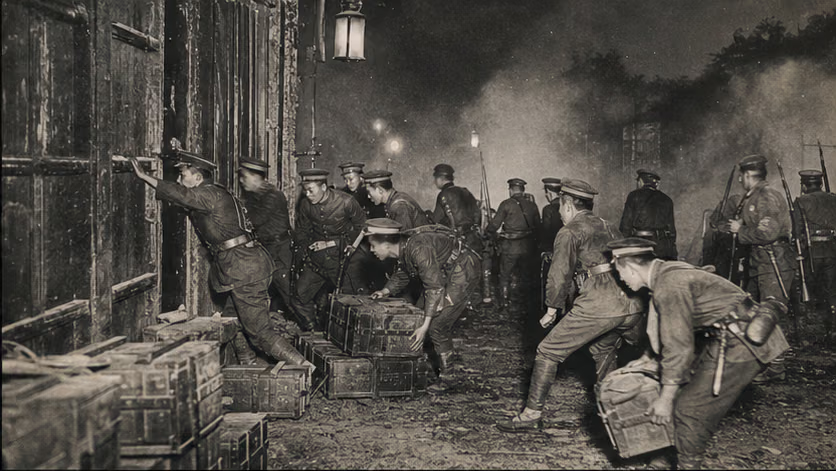
| First uprising at Wuchang | 1911.10.10–11 | On 10.9, a bomb accidentally exploded at the Hankou Baoshanli office and the roster was seized; New Army party members were arrested overnight according to the roster. On the evening of 10.10 the Eighth Engineer Battalion opened fire, took the Chuwangtai arsenal, and captured Wuchang in one night. On 10.11 Hanyang and Hankou fell in succession; the Hubei Military Government was established and Li Yuanhong was made military governor | Wuchang Uprising |
| Provincial responses | 10.22–December | Within one and a half months, Hunan, Shaanxi, Shanxi, Yunnan, Jiangxi, Guizhou, Zhejiang, Jiangsu, Guangxi, Anhui, Fujian, Guangdong, Sichuan, and other provinces--fourteen or fifteen in all--declared independence one after another (the number and sequence of provinces vary by basis; unverified): Changsha 10.22, Xi'an 10.22, Taiyuan 10.29, Kunming on the "Double Ninth" 10.30, Shanghai 11.3, Hangzhou 11.5, Fuzhou 11.9, Guangzhou 11.9, and others (each provincial date remains to be checked one by one) -- most provinces changed flags without fighting, and where troops did move, the matter was often settled in a single night | (Provincial recoveries are incorporated into this article) |
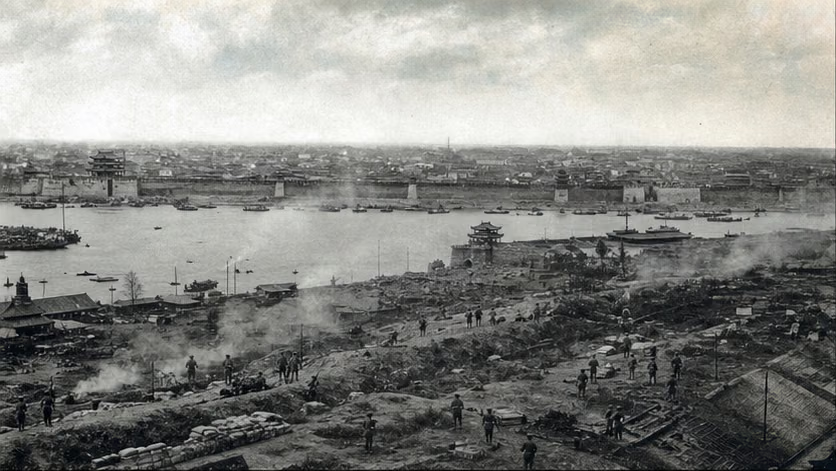
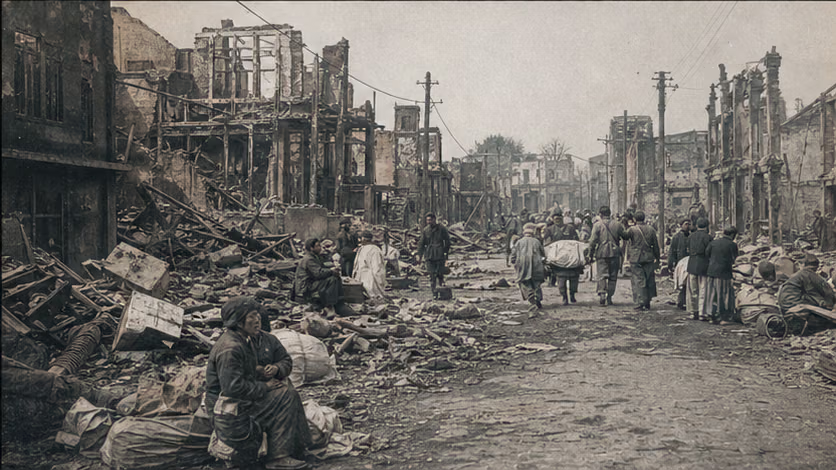
| Wuhan seesaw | 10.18–12.1 | Defense of Yangxia (Hanyang–Hankou): Qing forces (Beiyang) advanced south; Hankou fell on 11.1 and Hanyang on 11.27. Feng Guozhang's troops set Hankou on fire; the blaze spread for three days and nights, with severe civilian deaths, injuries, and displacement ※. Yet Wuhan held the Beiyang main force for forty-one days, buying time for provincial recoveries | Defense of Yangxia (Hanyang–Hankou) |
| Peace talks and state-building | 1911.11–1912.1 | Yuan Shikai came out in November to form a cabinet, holding military power and firing in both directions. North-South peace talks opened in Shanghai (Tang Shaoyi representing the north, Wu Tingfang the south). On 1912.1.1 the Nanjing Provisional Government was established, and Sun Yat-sen took office as provisional president | — |
| Abdication and transfer of power | 1912.2 | On 2.12 Empress Dowager Longyu issued the Qing emperor's abdication edict (the edict included the phrase "Yuan Shikai shall organize a provisional republican government with full authority"; how this phrase entered the edict is itself a disputed point). On 2.13 Sun resigned; on 2.15 Yuan Shikai was elected provisional president | — |
Two Points of Focus
- A single edict: Two thousand years of imperial rule were not flattened by conquered cities and seized territory; they were ended by an abdication edict. Compared with the bloody wars of dynastic replacement in earlier ages, which often ran for more than a decade, much of this "revolution" was completed at the negotiating table. The appearance of a "low-intensity dynastic replacement" is real, and it is also partial.
- Beneath the surface: In the provincial recoveries, massacres of Banner garrisons and Banner civilians occurred in many places ※; the massacre in the Manchu city of Xi'an was the gravest (see "Disputes and Sensitivities"). The revolution began with republicanism and ended with Yuan in power; provincial military governors grew entrenched; the seeds of early republican warlordism had already been planted in these four months.
Casualties and Losses
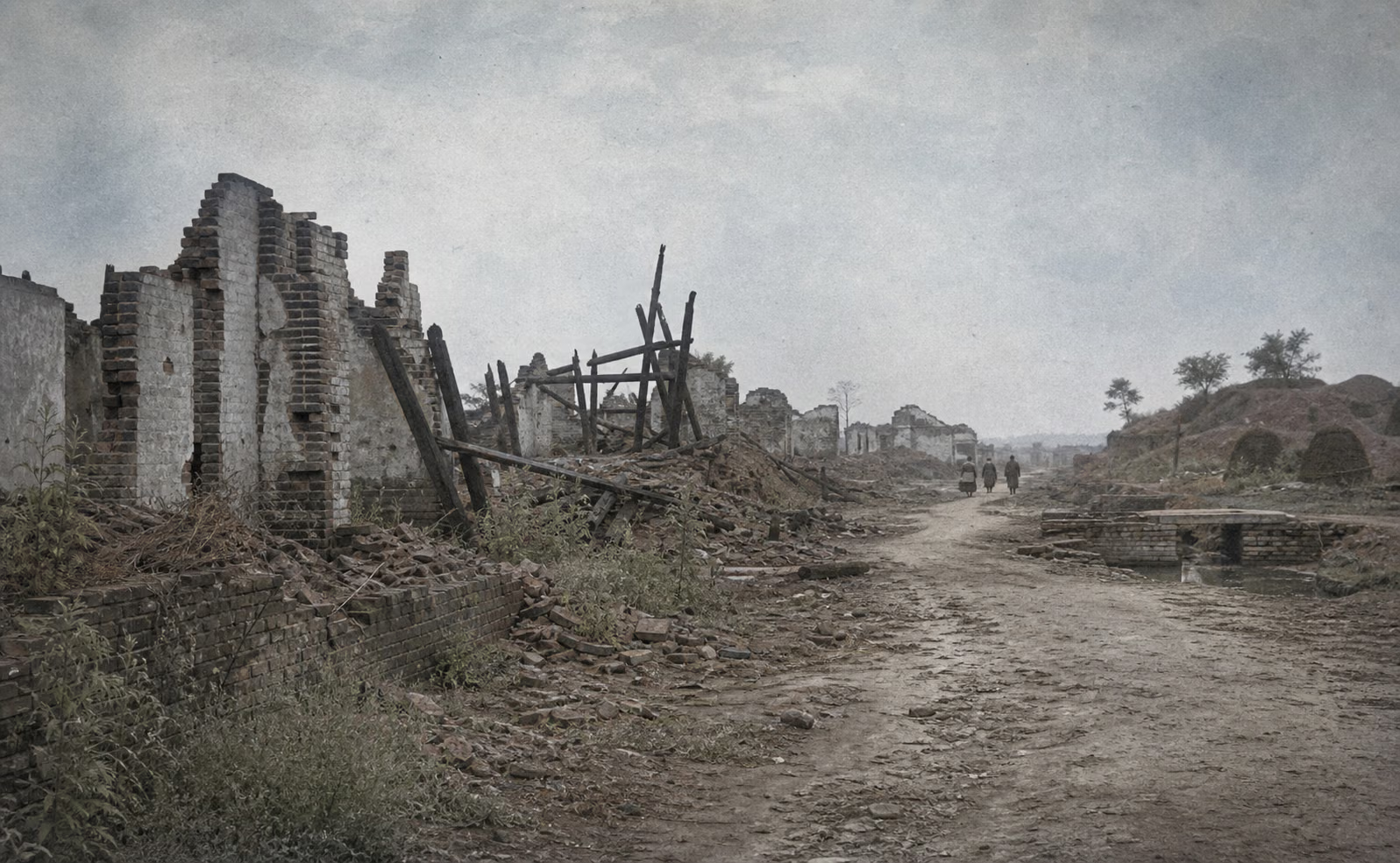
- There is no authoritative total for deaths in the fighting nationwide. Compared with previous civil wars of dynastic replacement, it was low: most provinces were settled by proclamation. But casualties were severe where fighting concentrated:
- Wuhan front: in the Defense of Yangxia (Hanyang–Hankou), People's Army and Qing casualties each numbered in the thousands, and there are no statistics for civilian deaths, injuries, and displacement in the Hankou fire (figures vary by basis).
- Xi'an: in the massacre of the Manchu city, "several thousand" Banner civilians died (accounts differ sharply, from more than one thousand to several tens of thousands, with no reliable enumeration; unverified)※.
- Taiyuan, Nanjing, Chengdu, and other battle sites have separate casualty counts, but none are precise.
- Military expenses: the Qing government stalled, and the revolutionary provinces raised funds and provisions on their own; the government in the first year of the Republic was fiscally anemic from birth, and the root of the Reorganization Loan (1913) lay here.
Aftermath
- The Republic of China was founded, the first republic in Asia; but "the revolution has not yet succeeded." The provisional constitution, parliament, and party politics were quickly distorted under Yuan's rule. The Second Revolution (1913), the National Protection War (1915), and the Constitutional Protection War (1917) followed one after another; the second half of the revolution would continue fighting for decades.
- The Articles of Favorable Treatment of the Qing Imperial House: after abdication, the Qing imperial house remained in the Forbidden City, kept its honorific title, and received 4 million taels annually. The small court inside the palace lasted until 1924, when Feng Yuxiang forced it out of the palace and revised the conditions (cross-reference; details unrecorded).
- The provincial military-governor pattern: the revolution was completed by provincial New Armies and military governors. Military and civil authority grew province by province, and the center struggled to reclaim power. These were the seeds of early republican warlordism (see the articles on Warlord Era Conflicts).
How Each Side Records It
- Revolutionary narrative: In the line from the Tongmenghui to the Kuomintang to the Nationalist Government, the settled framing is "the Wuchang Uprising first, the Xinhai Revolution founding the republic"; Huanghuagang is the spiritual point of origin, and the national revolution of "expelling the Manchus and restoring China" is placed alongside the political revolution of "founding a republic."
- Qing court and loyalist narrative: Abdication is recorded as a dignified act in the manner of "yielding the throne." The edict described it as "abdication," and favorable treatment was enjoyed. Circles of Qing elder loyalists regarded themselves as holdovers; Zheng Xiaoxu, Luo Zhenyu, and others saw the revolution as calamity and disorder, and many later entered the line of Puyi's restoration and Manchukuo. That belongs on another page (see the related articles on Manchukuo, to be established).
- Later changes: After 1949, mainland historiography incorporated it into the framework of the "old-democratic revolution," affirming its overthrow of imperial rule while judging it "an incomplete bourgeois revolution." Across the Strait, the Republic of China is upheld as orthodox, and the "Xinhai Revolution" and "Wuchang Uprising" remain central axes of commemoration. In the last thirty years, scholarly attention has shifted toward constitutionalists, railway protection, local society, and ethnic violence; the debates over "was revolution inevitable" and "did reform have a chance" continue to the present.
Disputes and Sensitivities
- Ethnic violence ※: During provincial recoveries, killings of Banner civilians in Manchu cities occurred--most gravely in Xi'an, with records also from Jingzhou, Fuzhou, Taiyuan, Nanjing, and other places (local death figures differ sharply by basis; unverified). The slogan of "anti-Manchu" became city-slaughter-level revenge in several cities. This is a page long omitted from revolutionary narratives.
- Chengdu Bloodshed and the Hankou fire ※: Zhao Erfeng's 9.7 order to fire at petitioning civilians before the governor-general's yamen, and Feng Guozhang's burning of Hankou for three days and nights, are recorded together as acts of severe suppression.
- The substance of "low intensity": Overall casualties were lower than in earlier dynastic replacements, but "low intensity" was structural fortune--the neutrality of the great powers, centrifugal forces within the Qing court, and Yuan Shikai betting on both sides--not restraint by either side.
- Sun Yat-sen yielding office: Whether yielding office to Yuan Shikai was "preserving the larger situation" or "the revolution's fatal compromise" has had two coexisting readings for a century. How the phrase "Yuan Shikai shall organize a provisional republican government with full authority" entered the abdication edict bears directly on the narrative of legal succession.
- Reform or revolution: In recent years, sources on constitutionalism and railway protection have been reread, but counterfactuals such as "if the Imperial Clan Cabinet had come a few years later" have no answer in the historical record.
Contents
Successive uprisings of the Revolutionary Party from 1895 to 1911 are treated together. Provincial recoveries are not given separate articles, but incorporated into the relevant passages of this article.
 Successive Uprisings of the Revolutionary Party (1895–1911)1895.10Sixteen years, more than ten uprisings, almost all failures--failure moved from secret-society action to the New Army, and each attempt came a little closer to the vital point, until it accumulated into Wuchang in October 1911.
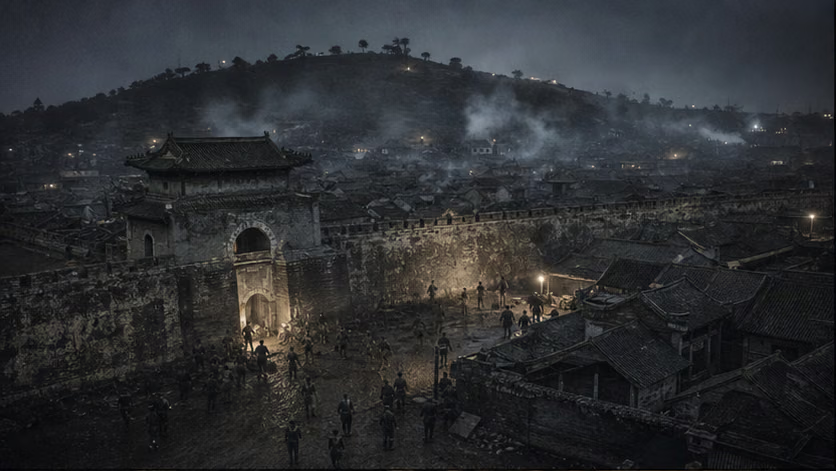 Wuchang Uprising1911.10A hurried rising after an office was exposed and a roster seized -- with no Tongmenghui leader present, New Army soldiers and junior officers made a revolution overnight, and two days later Qing rule in Huguang collapsed.
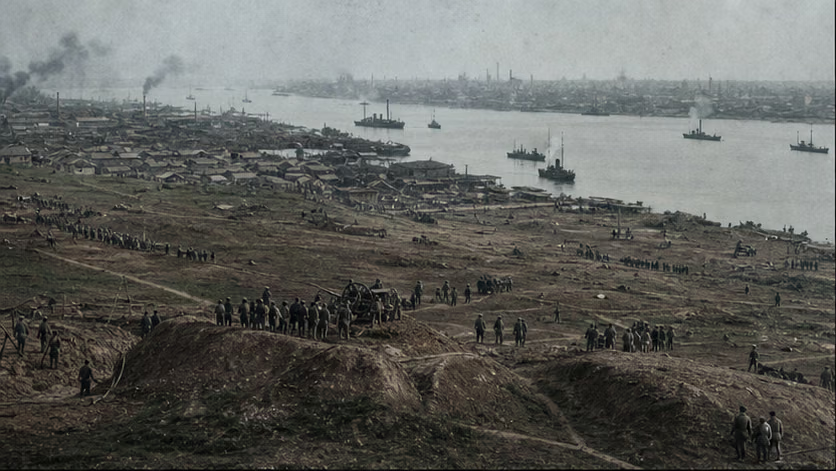 Defense of Yangxia (Hanyang–Hankou)1911.10For forty-one days, the People's Army lost battle after battle at Hankou and Hanyang, yet pinned the Beiyang main force fast at the three towns of Wuhan: a military defeat in every immediate sense, but one that won time for the independence of more than ten provinces across the country.
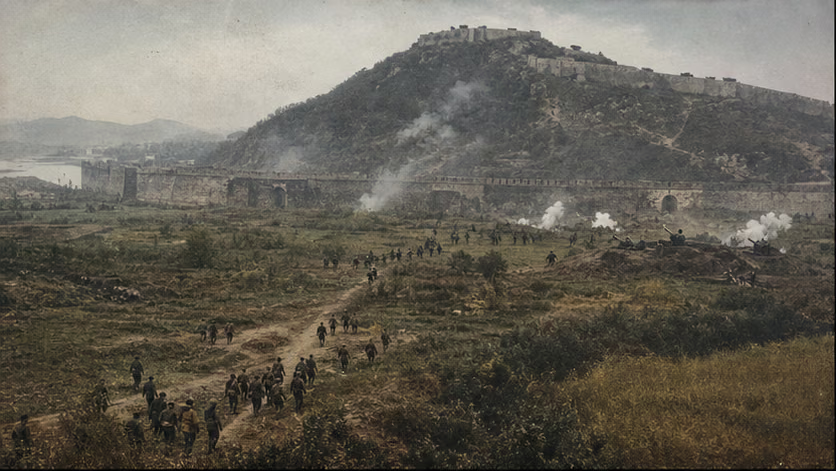 Battle of Nanjing (1911)1911.11Six days after Hanyang fell, the Jiangsu-Zhejiang Allied Army took Nanjing: the center of gravity lost at Wuhan was raised again in the southeast, and two months later this city became the seat of the Provisional Government of the Republic of China.
Sources and Open Questions
Main sources: Zhang Xianwen et al., eds., History of the Xinhai Revolution (multi-volume; a main reference in mainland scholarship); Jin Chongji, Before and After the Xinhai Revolution; Hu Shengwu and Jin Chongji, Draft History of the Xinhai Revolution; Feng Tianyu, History of the Xinhai First Uprising; studies by the Canadian sinologist Lee En-han and others on ethnic violence (specific bibliography unverified); the original texts of the Qing Emperor's Abdication Edict and the Articles of Favorable Treatment of the Qing Imperial House.
Open questions: the number and sequence of the fourteen or fifteen provinces that declared independence (each provincial recovery date to be checked one by one); the number of members in the Imperial Clan Cabinet; casualties in the Chengdu Bloodshed; deaths in the Xi'an Manchu city (different figures to be listed side by side); casualties on both sides in the Defense of Yangxia and civilian deaths and injuries in the Hankou fire; details of the great powers' declarations of neutrality; how the phrase "Yuan Shikai shall organize [the government] with full authority" entered the edict; Feng Yuxiang's 1924 forcing of the court from the palace and the details of the revision of the favorable-treatment conditions; lists of provincial military governors and the military-political pattern; the originally planned date of the Wuchang Uprising and the various accounts of its postponement; the course of Qing wartime borrowing from foreign banking consortia; details of the Nanjing Provisional Government's Northern Expedition deployments; Royalist Party activity and the details of Liangbi's assassination; the course of Yuan Shikai's envoys and contacts with Wuchang.
All images on this site are AI-generated depictions. They are not historical photographs, not primary sources, and do not depict any real individual.