Combined Account of Uprisings · Successive Uprisings of the Revolutionary Party (1895–1911)
Sixteen years, more than ten uprisings, almost all failures--failure moved from secret-society action to the New Army, and each attempt came a little closer to the vital point, until it accumulated into Wuchang in October 1911.
Engagement Data
| Item | Content |
|---|---|
| Time | 1895.10 Guangzhou Uprising (failed before launch) - 1911.4.27 Huanghuagang Uprising |
| Place | Mainly Guangdong and Guangxi, also the Hunan-Jiangxi border, the Yunnan-Vietnam border, and Anhui-Zhejiang (assassinations and scattered incidents are not counted in the engagement sequence) |
| Uprising side | Revive China Society (1894–1905) / Tongmenghui (after its founding in Tokyo in 1905) |
| Suppression side | Qing provincial governors and governors-general, Green Standard and defense battalions; in the later phase, New Army units also took part in suppression |
| Result | More than ten uprisings all failed; but through them the revolutionary party completed its turn from the secret-society line to the New Army line, and revolutionary forces penetrated the Qing army itself |
Belligerents (Common Features Across the Uprisings)
| Item | Uprising side | Suppression side |
|---|---|---|
| Strength | Usually several dozen to several hundred: secret-society members, miners, New Army soldiers, and returned-student "picked vanguard" men; Ping-Liu-Li at one point gathered tens of thousands, the only large-scale scene | Mainly local defense battalions and Green Standard forces; in urgent cases several provinces jointly suppressed them; suppression of Ping-Liu-Li used forces from Hunan, Hubei, Jiangxi, and Jiangsu |
| Firepower | Mainly pistols, bombs, and foreign-purchased rifles, sustained by smuggling; running out of grain and ammunition was the common cause of defeat across the uprisings | Standard-issue guns and artillery, with ample ammunition |
| System | Directed remotely from bases in Hong Kong, Tokyo, and Nanyang; the people who rose repeatedly miscarried or dispersed because fundraising failed, weapons were detained, or informers leaked the plans | The court ordered governors and governors-general to "arrest them strictly and make sure they are seized"; local authorities used high-pressure collective punishment |
Terrain and Conditions
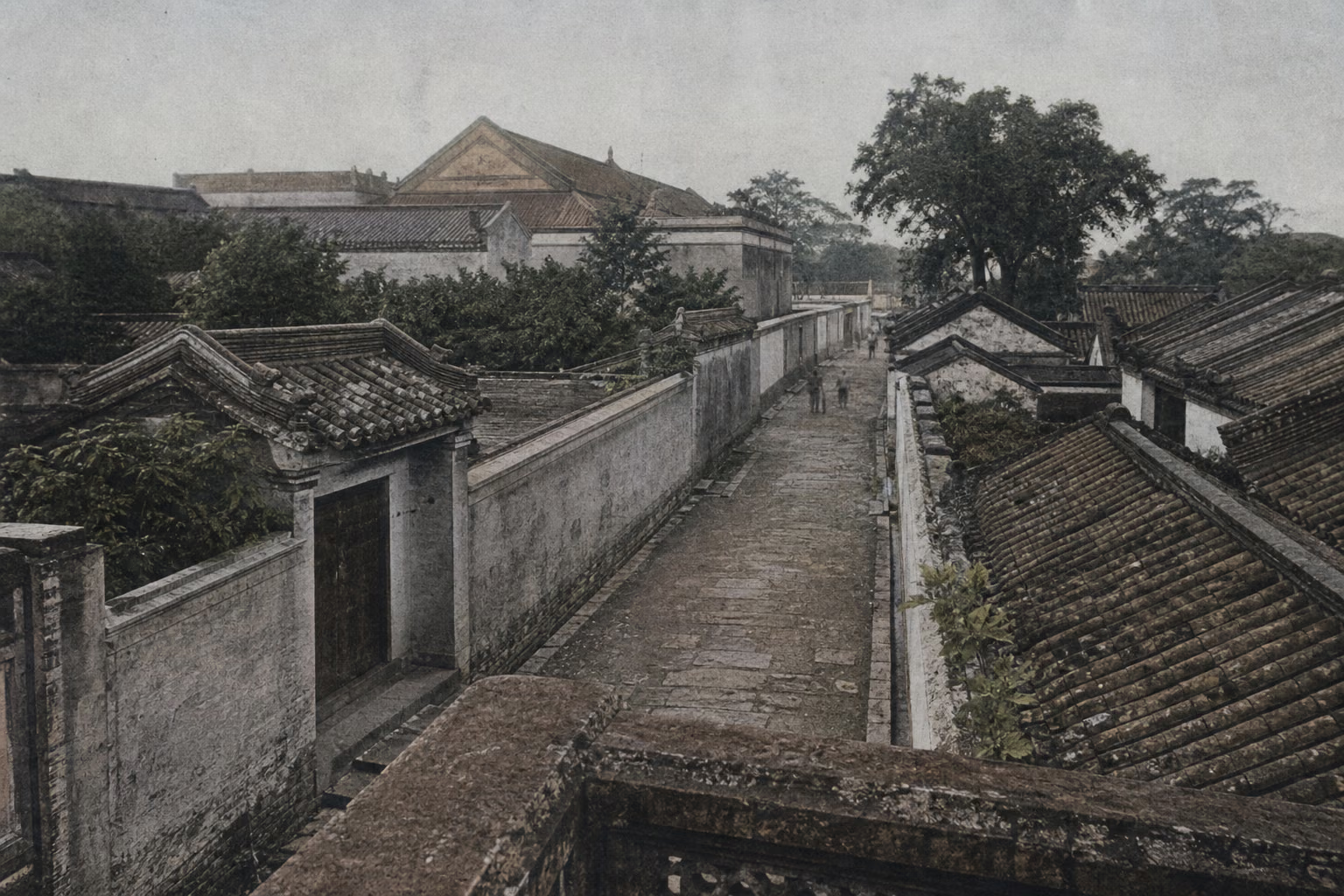
For the larger situation--the deadlock of the New Policies and constitutionalism, the Railway Protection Movement, and penetration of the New Army--see *Xinhai Revolution - Overview*. Here the focus is only on the uprising zones: Guangdong-Guangxi, the Hunan-Jiangxi border, and the Yunnan-Vietnam border. Secret-society networks (the Triads and the Gelaohui) were dense; miners, salt smugglers, and roaming soldiers moved through them. The Guangdong-Hong Kong, Yunnan-Vietnam, and Guangxi-Vietnam frontiers were long, and weapons could be smuggled in from Hong Kong, Annam, and Nanyang. The revolutionary party chose these places because they were farthest from the court and closest to secret societies and overseas supply. Precisely because they were far away, none of the more than ten uprisings truly shook the court's core.
Why It Was Fought
Tainan fell on October 21, 1895, and by then Resistance Against the Japanese Takeover of Taiwan (1895) had lost its larger momentum. Five days later, according to the Revive China Society's agreement, Guangzhou was supposed to rise. The first uprising and the cession of Taiwan took place in the same year; this was no coincidence. In June of the previous year, Sun Yat-sen and Lu Haodong had gone north to Tianjin and submitted a memorandum to Li Hongzhang: Sun had already tried the road of reform, and the door did not open. In November, while the First Sino-Japanese War was at its height, the Revive China Society was founded in Honolulu (1894); from then on, its purpose was to overthrow the Qing court through armed uprisings. The next spring, the Treaty of Shimonoseki was signed, ceding Taiwan and imposing an indemnity of 200 million taels; metropolitan-examination candidates in Beijing jointly petitioned the throne, calling for rejection of peace, relocation of the capital, and reform. The same defeat forced out two roads: the candidates moved upward; the Revive China Society moved toward guns. Three more years passed, and the Hundred Days' Reform ended in a coup, with the Six Gentlemen executed in the marketplace. The road through the court had been walked once in public, and it did not go through.
The uprisings were chosen for Guangzhou, and for more than ten years afterward for Guangdong-Guangxi, Hunan-Jiangxi, and the Yunnan-Guangxi borders, for the same reason: here the court's reach was shortest, the secret-society net was densest, and the routes for smuggling weapons from Hong Kong, Annam, and Nanyang were nearest. Their strength was only enough to act in places like these.
The first engagement failed before it began. The plan to rise was settled in Hong Kong, while weapons purchases and recruitment were arranged from overseas (division-of-work details unverified); the agreement was to rise on the Double Ninth Festival, October 26, but the weapons were detained and the matter leaked. Lu Haodong and others were arrested and died for the cause--the man who had gone to Tianjin the previous year to submit the memorandum died in Guangzhou that year.
The sixteen years that followed were repetitions of the same method. In the early phase they relied on secret societies: contact existing anti-Qing secret associations, give them money and weapons, have them rise, and hope that one success would bring responses from other provinces. The years chosen for uprisings also stepped into cracks in court politics: another rising at Huizhou in the year of the Boxer Rebellion; in the winter after the Tongmenghui was founded (Tokyo, 1905), Ping-Liu-Li gathered tens of thousands. But after more than ten attempts, the secret societies proved usable but unreliable: makeshift crowds, leaks, sudden rising and sudden dispersal; once grain and ammunition were cut off, they collapsed. Money and guns all came from overseas; overseas Chinese donations were the only source of pay, and weapons depended entirely on smuggling. When fundraising failed and weapons were detained, an uprising had already lost half of itself before it began: Yiwei, Huizhou, Qin-Lian Shangsi--the same frontier repeated itself for sixteen years. In the suppression side's paperwork, these people were always listed together with secret-society bandits and ordinary bandits. Governors and governors-general followed edicts to "arrest them strictly and make sure they are seized," dealing with revolution as bandit suppression through high-pressure collective punishment; suppressing Ping-Liu-Li used forces from four provinces. Holding down one place was not difficult. What they had not counted on was that the new-style army used for suppression was exactly where the other side would go next.
Dissent also persisted inside the revolutionary party itself. After the secret-society line failed repeatedly, Zhang Taiyan, Tao Chengzhang, and Sun Yat-sen broke publicly over funds and direction, and the Restoration Society was separately revived (full sequence of events unverified); Tan Renfeng, Song Jiaoren, and others shifted toward advocating an uprising in the Yangtze interior, and in July 1911 separately organized the Central Tongmenghui in Shanghai. The decision to stake the whole party's strength on one more gamble in Guangzhou was fixed at the Penang Conference in November 1910 (records unverified)--all Huanghuagang's capital was wagered on this decision.
After 1907, the center of gravity moved toward the New Army: no longer borrowing others' hands, but developing revolutionary party members directly among the Qing army's own soldiers. In 1910, Ni Yingdian led the Guangzhou New Army in an uprising; it failed, but proved that the New Army could defect as an organized unit. The core of the Wuchang Uprising--the Literary Society and the Gongjinhui inside the New Army--was accumulated through these sixteen years of defeats.
Overview of the Successive Uprisings
| Time | Uprising | Key Points |
|---|---|---|
| 1895.10 | Guangzhou Uprising (Revive China Society) | Failed before launch: weapons were detained, the matter leaked, and Lu Haodong and others were arrested and died for the cause--Sun Yat-sen later called Lu "the first person in Chinese history to sacrifice himself for republican revolution" (original quotation unverified) |
| 1900.10 | Huizhou Uprising (Sanzhoutian) | Zheng Shiliang led secret-society members in an uprising; after fighting for more than ten days, they dispersed when grain and ammunition were exhausted; Zheng Shiliang died suddenly in Hong Kong the following year (cause of death unverified) |
| 1906.12 | Ping-Liu-Li Uprising | Tens of thousands of secret-society members and miners along the Hunan-Jiangxi border; the first major uprising after the Tongmenghui was founded; Qing forces from four provinces jointly suppressed it ※, and those killed through collective punishment numbered in the thousands (figures vary by account); Liu Daoyi died for the cause, and Sun Yat-sen wrote a mourning poem (original text unverified) |
| 1907.5 | Chaozhou Huanggang Uprising | Secret-society members rose and were defeated after seven days |
| 1907.6 | Huizhou Qinvhu Uprising | Secret-society members rose and were soon defeated |
| 1907.9 | Qin-Lian Fangcheng Uprising | They briefly took Fangcheng, then withdrew when reinforcements were cut off |
| 1907.12 | Zhennan Pass Uprising | Held the fort for three days; Sun Yat-sen came in person from Hanoi to supervise the battle at the fort: "For more than twenty years I have opposed the Qing government; only today have I personally fired artillery at Qing troops" (original quotation unverified)--the only time the premier personally came to the battle line |
| 1908.3 | Qin-Lian Shangsi Uprising | Fought for more than a month, ran out of ammunition, and withdrew into the Shiwan Mountains |
| 1908.4 | Yunnan Hekou Uprising | Held Hekou for more than a month; Qing forces encircled it, and the remaining troops withdrew into Vietnam, where they were disarmed and dispersed |
| 1910.2 | Guangzhou New Army Uprising (Gengxu Uprising) | The first sound of the New Army line: Ni Yingdian led New Army troops in an uprising; Ni was killed in action, and the rising soon failed |
| 1911.4.27 | Guangzhou Uprising (Huanghuagang Uprising) | See the next section |
The assassination line and the uprising line ran in parallel; this article notes it only briefly: Wen Shengcai's assassination of Fu Qi, the Guangzhou general (1911.4, a little more than ten days before the Huanghuagang Uprising); Wang Jingwei and others' plot to bomb the regent Zaifeng (1910, exposed before execution and punished with imprisonment); Xu Xilin's assassination of Enming and the Anqing Uprising (1907, in the Restoration Society system), and others.
Huanghuagang Uprising (1911.4.27)
The Tongmenghui put the strength of the whole party into preparations for more than a year, raising funds in Nanyang and the Americas and buying weapons in Japan. The original plan was a ten-route attack on Guangzhou, with Huang Xing as minister in overall charge. As the date approached, plans leaked repeatedly and deployments changed again and again; the plan was temporarily changed to four routes, and when the time came only Huang Xing's route actually launched. Huang Xing led more than 130 "picked vanguard" men (headcounts vary by account), with white cloths wrapped around their arms and black-faced rubber shoes on their feet, straight against the governor-general's office of Guangdong and Guangxi. Governor-General Zhang Mingqi had already heard the news and fled. The party members burned the office and came out, then fought Qing troops under naval commander Li Zhun in street fighting for a day and a night. Greatly outnumbered, they were defeated and scattered. Huang Xing was wounded in the right hand and lost two fingers, then escaped into Hong Kong.
Afterward, the revolutionary Pan Dawei risked death to come forward, collect seventy-two bodies, and bury them at Honghuagang in the eastern suburbs. Disliking the common sound of the name, he changed it to "Huanghuagang"--hence the "Seventy-Two Martyrs of Huanghuagang." Later textual research put the actual number of dead at more than eighty-six (number verification unverified). This battle was only half a year before the Wuchang Uprising, and the Qing court's destruction had already entered its countdown. Sun Yat-sen later judged: "In this battle, blue blood flew, noble spirit filled the four quarters, grasses and trees held sorrow for it, and wind and cloud changed color because of it... the value of this battle may truly startle Heaven and Earth and move ghosts and spirits to tears, and shall live as long as the revolutionary battle at Wuchang" (*Preface to Brief Accounts of the Huanghuagang Martyrs*, quotation to be checked against the original).
Casualties and Losses
- Uprising side: across the successive uprisings, those killed in action or executed for the cause totaled several hundred; in the Huanghuagang engagement, more than eighty-six died (textually established figure, unverified). A large number of core members (Lu Haodong, Liu Daoyi, Ni Yingdian, Lin Juemin, Fang Shengdong, Yu Peilun, and others) died in young adulthood.
- Suppression side: there are no systematic statistics for Qing casualties across the engagements; Ping-Liu-Li, Qin-Lian, and other engagements had combat casualties, but each engagement's archival statistical basis remains unverified.
- Civilians ※: harsh suppression was the norm--during the suppression of Ping-Liu-Li, those killed through collective punishment numbered in the thousands (figures vary by account); after each engagement, records of "summary execution on the spot," collective punishment of families, and the burning of villages appear repeatedly. On the uprising side, records also exist of secret-society uprising areas suffering plunder and disturbance of civilians, but the weight is not comparable to that of the suppression side (details unrecorded).
Aftermath
- Under repeated failure, the revolutionary party did not disperse; instead it completed a line upgrade: secret societies -> New Army. The 1910 Guangzhou New Army Uprising failed, but proved that the New Army could defect as an organized unit--half a year later, the Wuchang Uprising followed exactly this road.
- Huanghuagang shook the whole country: the funeral of the Seventy-Two Martyrs, continuous newspaper reporting, and the circulation of Lin Juemin's *Letter to My Wife* changed the "revolutionary party" from "bandits" in court documents into people lodged in the minds of the scholar-gentry. The Qing side's perception was also changing: the regent Zaifeng did not dare kill Wang Jingwei in his case, which had already set the tone of guilty diffidence in the dynasty's final years (details unrecorded).
- Overseas fundraising and the overseas Chinese networks in Nanyang and the Americas were fully mobilized through the Huanghuagang engagement, becoming the revolution's financial artery.
Accounts of Those Present
- Letter to My Wife: Lin Juemin, twenty-four years old, wrote his final letter late at night in Hong Kong's Binjianglou three days before the uprising: "I love you with all my heart; it is precisely this thought of loving you that makes me brave enough to face death," and "I would not refuse a hundred deaths in sacrifice, yet to make you worry is truly more than I can bear." After finishing it, he entrusted this letter and another letter to his father to a friend for delivery. "Accounts of Those Present" here comes down to one final family letter.
- Fang Shengdong: a student in Japan, he wrote a farewell letter to his father: "A man in this world who cannot establish merit and achievement to strengthen the motherland and let his compatriots enjoy happiness may struggle and die, and that too is great joy." He fought until his ammunition was exhausted and died.
- Yu Peilun: the "Bomb King," who had maimed one hand while making homemade bombs; in the Huanghuagang Uprising, he charged with bombs hung across his chest, was captured when his strength ran out, and died for the cause at twenty-five.
- Huang Xing's severed fingers: two fingers of his right hand were severed, and from then on he styled himself "Eight Fingers" (figure disputed); after being wounded he fled, and still directed the fighting at Hanyang (see the article on Defense of Yangxia).
- Pan Dawei collecting the bodies: without someone collecting the martyrs' bodies, there would be no Huanghuagang. Pan Dawei came forward as a civilian to arrange burial, and was wanted afterward--another kind of person in an age of atrocities.
The Ground
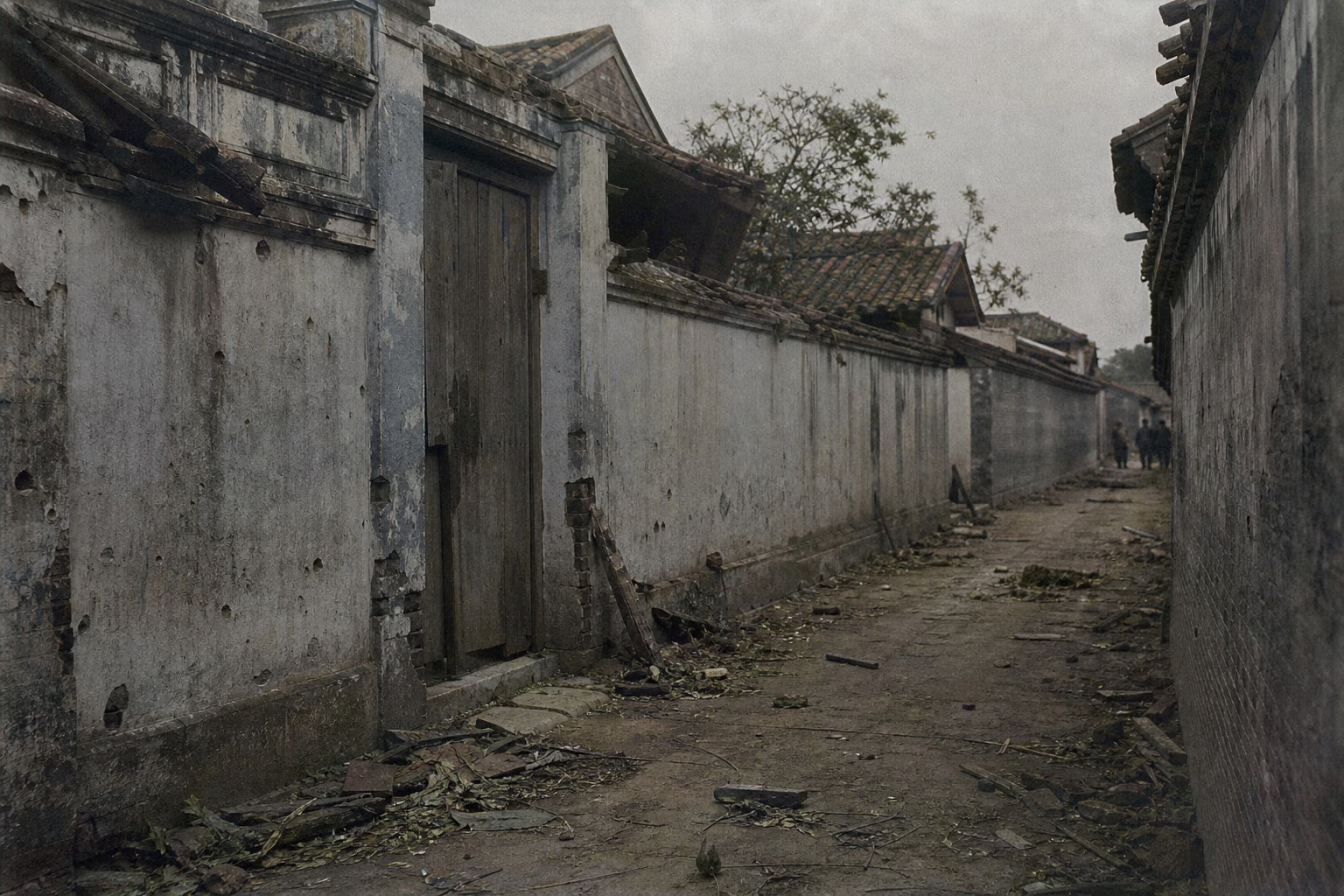
- The spatial grammar of the uprisings was "roving": secret societies occupied market towns, seized forts, and burned government offices, leaving as soon as they succeeded. Not a single engagement aimed at holding ground--until the New Army line produced the idea of "holding a provincial capital."
- Zhennan Pass: a fort on the China-Vietnam border; gun positions on the mountaintop overlooked the frontier, and this was where Sun Yat-sen fired artillery. The frontier was the lifeline--retreat meant entering Annam.
- Guangzhou city (Huanghuagang): the governor-general's office of Guangdong and Guangxi (around present-day Yuehua Road; location unverified) was the attack point; residences such as Xiaodongying were starting points; the street-fighting route ran through the old city--a spatial sample of a "decapitation operation."
How Each Side Records It
- Revolutionary narrative: Huanghuagang is the spiritual point of origin--"noble spirit endures forever"; the Seventy-Two Martyrs entered the shrine for loyal martyrs, and 4.27 (later fixed as 3.29 for Youth Day; reason unverified) became a memorial day. "One falls, another follows" forms the skeleton of the revolutionary view of history: failure as the stepping stone to success.
- Qing court and loyalist narrative: official documents uniformly called them "bandits" and "rebels"; in suppression documents, the revolutionary party was listed together with secret-society bandits and ordinary bandits. In loyalist writing, they were viewed as "making disorder." The Qing side's contempt and later recognition are two pages of the same account.
- Later changes: after 1949, mainland historiography incorporated this into the sequence of the "old democratic revolution," and Huanghuagang commemoration continued. Recent research has begun to take stock of the revolutionary party's use and abandonment of secret societies in the secret-society line, and of what the people in uprising areas actually experienced--the back side of "revolutionary romance" is gradually being filled in.
Disputes and Sensitivities
- "Uprising" or "rebellion": the characterization follows the regime; different terms are used at different narrative levels.
- The secret societies' account: the revolutionary party used secret societies to launch uprisings, and after failure often left them to be suppressed. The secret-society system's own historical memory is not consistent with the Tongmenghui's orthodox narrative (relevant research bibliography unverified).
- The assassination line: the cases of Wen Shengcai and Wang Jingwei were already subject to mixed praise and blame at the time. This article notes them briefly and does not include them in the engagement sequence, but Wang Jingwei's early image as a death-bound fighter and the contrast with the second half of his life became an important contrast in later narratives.
- Number of martyrs: "seventy-two" is the number of bodies collected; the textually established number is more than eighty-six. Both numbers are written together.
Sources and Open Questions
Main sources: Zou Lu, *Draft History of the Chinese Nationalist Party*, volumes on the various uprisings; Feng Ziyou, *Anecdotal History of the Revolution*; collected writings related to Huang Xing and Sun Yat-sen; *Xinhai Revolution* (source-material series on modern Chinese history); *Brief Accounts of the Huanghuagang Martyrs* and the original text of Sun Yat-sen's preface; original facsimiles of Lin Juemin's *Letter to My Wife* and Fang Shengdong's final letter.
Open questions: the original wording of Lu Haodong as "the first person to sacrifice himself for republican revolution"; the number killed in the suppression of Ping-Liu-Li and the original text of Sun Yat-sen's mourning poem for Liu Daoyi; the original wording of Sun Yat-sen's "personally fired artillery at Qing troops" at Zhennan Pass; the number of Huanghuagang picked vanguard men who set out and the textually established number of the dead (more than eighty-six); word-for-word checking of the quotation from *Preface to Brief Accounts of the Huanghuagang Martyrs*; Zheng Shiliang's cause of death; the details of Zaifeng not killing Wang Jingwei; the origin of 3.29 Youth Day; the site of the former governor-general's office; Hong Kong-side division of work and weapon-purchase details in the Yiwei Guangzhou Uprising; the break between Zhang Taiyan, Tao Chengzhang, and Sun Yat-sen and the sequence by which the Restoration Society was revived; records of the Penang Conference (1910.11) and details of fundraising and weapons purchase.
All images on this site are AI-generated depictions. They are not historical photographs, not primary sources, and do not depict any real individual.