Engagement Archive · Positional Warfare Phase (Jun 1951–Jun 1953, combined account)
Two years of "fighting while negotiating": every inch argued over at the table had to be paid for with a hill on the front; the "United Nations Command" relied on firepower and strangulation, while the Chinese People's Volunteer Army used tunnels, sniping, and counter-strangulation to turn a front of nearly 250 kilometers into a system, until the signatures came after Kumsong.
Engagement Data
| Item | Content |
|---|---|
| Time | 1951.6 – 1953.6 (the Battle of Kumsong is treated in a separate article; see *Battle of Kumsong*) |
| Place | A full-line standoff near the 38th Parallel: from Kaesong-Munsan in the west, through the Cheorwon-Kimhwa-Pyonggang "Iron Triangle" and Triangle Hill in the center, to the Bukhan River-Mundung-ni-east coast in the east |
| Affiliation | War to Resist U.S. Aggression and Aid Korea · Positional Warfare Phase (combined account: summer-autumn defensive operations in 1951, strangulation and counter-strangulation, the tunnel system, sniping and roving artillery fire, White Horse Mountain, and the prelude to the 1953 summer counteroffensive) |
| Chinese-Korean side | The Chinese People's Volunteer Army rotated its corps groups in succession, keeping 4-6 armies on the first line; railway troops and antiaircraft units entered Korea as organized systems; the Korean People's Army cooperated |
| "United Nations Command" side | U.S. Eighth Army (after Ridgway left, Clark succeeded as commander in chief; timing unverified), the main South Korean forces, the Commonwealth Division, and others; all available forces of the Far East Air Forces were committed to "Operation Strangle" |
| Result | The front stabilized near the November 1951 line of contact, essentially the later Military Demarcation Line; in 1952-53 it entered a stalemate of positional attrition and limited offensives |
Belligerents
| Item | Chinese-Korean side | "United Nations Command" side |
|---|---|---|
| Positions | The tunnel system took shape in 1952 (the "underground Great Wall"; total mileage varies by statistical basis), developing from field fortifications to tunnels and then to a defensive system with tunnels as its skeleton | Permanent-style fortifications, minefields, barbed wire, and artillery groups in depth |
| Firepower | Artillery grew stronger year by year but remained inferior; sniping artillery and roving guns made up part of the gap | Absolute firepower superiority, with the Van Fleet Day of Fire as its emblematic expenditure |
| Air | MiG Alley protected the shallow depth of the rear area (see *Air War: MiG Alley*), while the front line still had no air superiority | Full air superiority; from 1951.8 to 1952.6 the air force strangled rear transport lines through Operation Strangle |
| Logistics | Railway-troop emergency repair + antiaircraft protection of roads + methods such as "one-way transport" and "nose-to-nose river crossing" (details unrecorded); transport volume rose under bombing instead of falling | Sea and air supply, with industrial logistics running from the home country to Japan to Korea |
| Personnel attrition | Sniping and roving-artillery campaigns and limited counterattacks: small costs accumulated into larger results | The summer and autumn offensives paid casualties out of proportion to gains at Bloody Ridge and Heartbreak Ridge |
Terrain and Conditions
(For the opening of armistice negotiations, the negotiation structure at Panmunjom, and the three larger layers of the U.S.-Soviet Cold War and domestic politics in each country, see *War to Resist U.S. Aggression and Aid Korea · Overview*. This article records only the front.)
A front that settled in. In the year of mobile warfare, the front moved more than a thousand kilometers north and south; after the summer of 1951, it stopped near the 38th Parallel and stayed there for two years. Units dug fortifications, stockpiled ammunition, cared for wounded men, and ran literacy classes along a single line; relief was like changing shifts. For the first time, the war acquired an "everyday."
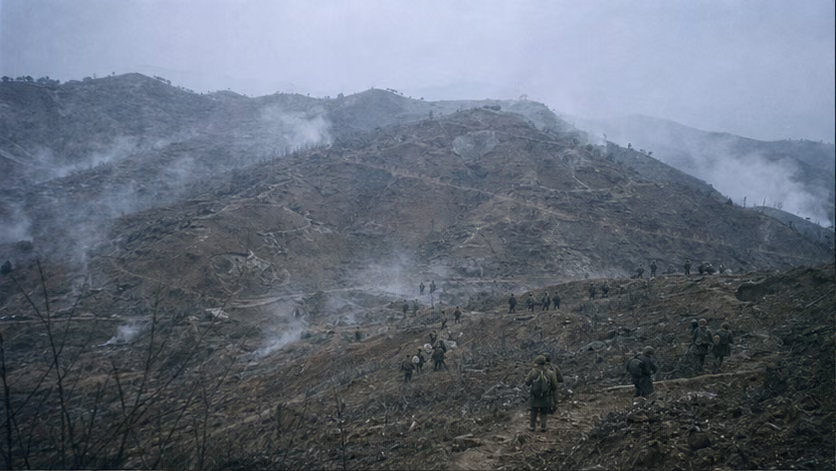
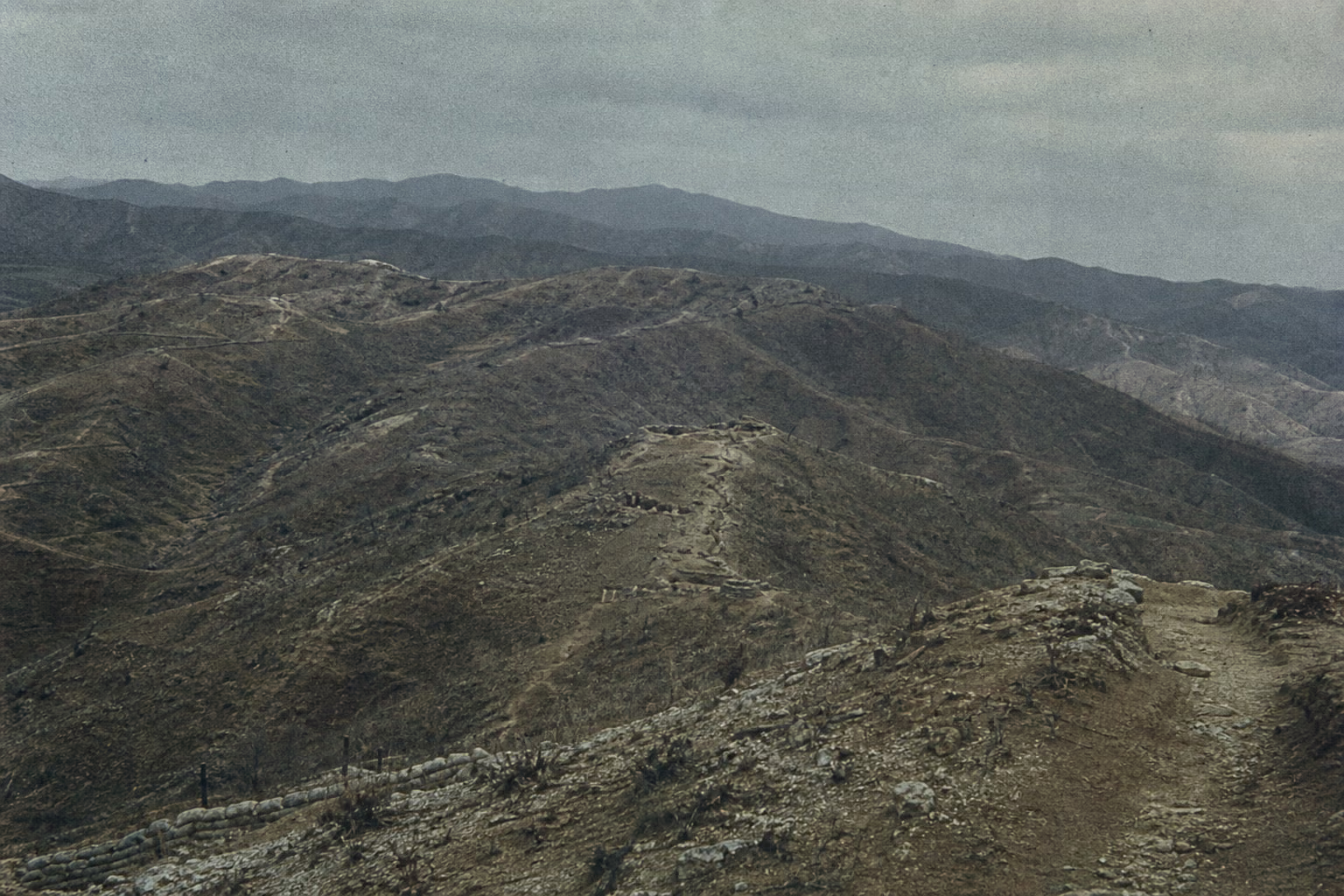
The mountains were everything. This stretch of front lay across the waist of the Korean Peninsula, all hills and mountains. Whoever held a hill had an observation post that could see several kilometers farther, and artillery that could be several degrees more accurate. Most of the fighting across these two years was therefore for hills a few hundred meters high: Bloody Ridge, Heartbreak Ridge, Old Baldy, Maryang San, Mundung Stream, Baektai Mountain, White Horse Mountain, and Triangle Hill (Triangle Hill is treated in a separate article or indexed through the overview; see the article index in *War to Resist U.S. Aggression and Aid Korea · Overview*).
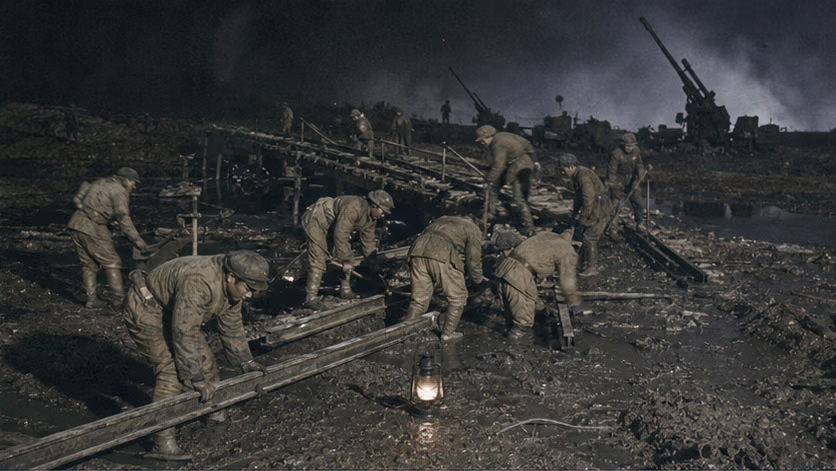
The second front behind the front. As the front line stopped, aerial strangulation turned the rear into a battlefield: bridges over the Chongchon River, Taedong River, and Yalu River; junctions at Anju, Kaechon, and Sinuiju; roads that could move traffic only at night. The line held by railway troops and antiaircraft troops was no quieter than the infantry line.
Why It Was Fought
These two years of positional warfare were not chosen by either side; they were the result of being unable to push farther. The Fifth Phase Offensive ended after fifty days: the Chinese People's Volunteer Army exhausted itself and withdrew, one division was broken on the south bank of the Bukhan River, and the 63rd Army nailed itself to Cheorwon with its lives. On June 10, the front returned to the area near the 38th Parallel. Eight months in Korea and five phase offensives had worked through the same problem five times: the Chinese People's Volunteer Army could not push beyond the limit of supply, and the U.S. military could not afford the cost of reoccupying all Korea. Both sides had seen the ceiling of the offensive (see *Fifth Phase Offensive*). Mobile warfare had reached its end.
Once that was clear, the table was set out. On June 23, the Soviet representative Malik proposed ceasefire negotiations at the United Nations; on July 10, the negotiations began at Kaesong (later moved to Panmunjom). But when there were no concessions available at the negotiating table, bargaining chips had to be taken from the battlefield: the "United Nations Command" sought to "use military pressure to promote negotiations" and launched summer and autumn offensives from August onward; the Chinese People's Volunteer Army needed to hold its existing line of contact and shifted into positional defense. Negotiating and fighting were two faces of the same thing: every sentence contested by the negotiators meant one more day of fighting at the front. That is the literal meaning of "a double act."
The place was therefore the stopped line itself: from Kaesong-Munsan in the west, through the Cheorwon-Kimhwa-Pyonggang "Iron Triangle," to Mundung-ni and the east coast, nearly 250 kilometers of mountain country across Korea's waist. Where the line stopped was where the future boundary would be drawn. After the two sides discussed the line in November 1951 according to the actual line of contact, every hill a few hundred meters high became a unit of bargaining at the table. Behind it lay another second front: strangulation and counter-strangulation.
Both sides' calculations eventually came down to cost. The "United Nations Command" believed that firepower could stand in for advance: at Bloody Ridge and Heartbreak Ridge, ridge line after ridge line was contested; the two major summer and autumn offensives together advanced only by kilometers, while the "United Nations Command" side suffered more than 100,000 casualties (statistical bases vary by account). "Pressure to promote negotiations" proved, in reverse, that the line could not be broken. Operation Strangle systematically bombed North Korea's railway network for a year, trying to make the front "bleed"; in June 1952, the "United Nations Command" side acknowledged that the objective had not been achieved (original U.S. assessment unverified). The Chinese-Korean calculation was the opposite: tunnels, sniping and roving artillery, and transport lines repaired as they were bombed, grinding day after day at very small cost. The inversion of offensive and defensive cost was what these two years were truly fighting over.
The trigger can be dated precisely to August 18, 1951: the "United Nations Command" summer offensive opened on the eastern-front positions of the People's Army, and the ridge lines of Bloody Ridge began to change hands (offensive start dates vary by account). Only five weeks after negotiations began, the first named mountain had already become a ridge of blood.
In fact, another road had always been on the table: ceasefire in place. By the summer of 1951, since both sides were already sitting down at Kaesong, stopping on the line of contact should have been easy. But whoever stopped first would in effect admit that the line at that moment was the outcome, so both sides first wanted to push the line to a more favorable position before stopping. That push lasted two years.
Course of the Engagement
| Phase | Time | Key Points |
|---|---|---|
| 1951 summer defensive campaign | 1951.8-9 | The "United Nations Command" summer offensive mainly attacked the eastern-front positions of the People's Army: at Bloody Ridge, ridge lines were fought over one by one, with heavy casualties and limited gains; in the central front at Mundung-ni and elsewhere, the Chinese People's Volunteer Army defended during the field-fortification period (the sequence of fighting at Mundung Stream and Baektai Mountain remains unverified) |
| 1951 autumn defensive campaign | 1951.9-10 | The "United Nations Command" autumn offensive: Heartbreak Ridge (the U.S.-South Korean battle name is retained) was fought for another month; on the western front, Maryang San and other points were repeatedly contested by Chinese-British and Chinese-U.S. forces (ownership and sequence of each point remain unverified). The two major offensives together advanced only by kilometers, while the "United Nations Command" side suffered more than 100,000 casualties (statistical bases vary by account) -- "pressure to promote negotiations" proved, in reverse, that the line could not be broken |
| Operation Strangle | 1951.8-1952.6 | The Far East Air Forces systematically bombed North Korea's railway network through "Operation Strangle," aiming to make the Chinese-Korean front line "bleed" |
| Counter-strangulation | Same period | Railway troops repaired lines as they were bombed, antiaircraft troops protected roads and bridges in echelon, night "one-way transport" was used (one-direction traffic), and temporary bridges and temporary lines were prepared in advance (details and sources for these methods unverified); front-line supply rose instead of falling. In June 1952, the "United Nations Command" side acknowledged that Operation Strangle had failed to achieve its objective (original U.S. assessment unverified) |
| Tunnel system takes shape | Throughout 1952 | From shellproof dugouts to tunnel networks that could quarter troops, store grain and ammunition, and serve for both fighting and living: the "underground Great Wall" -- total mileage unverified by statistical basis; Triangle Hill (1952.10-11) was the highest test of tunnel defense |
| Sniping and roving-artillery campaign | 1952-53 | Front-line units organized sniping and mobile single-gun fire: Zhang Taofang's record of 214 kills in 32 days (using a Mosin-Nagant rifle without optical sight; details of the man and the weapon are unrecorded); cumulative enemy losses inflicted by the whole army's sniping and roving-artillery campaign remain unverified by statistical basis. "Nibbling at taffy" -- grinding day after day at very small cost |
| Battle of White Horse Mountain | 1952.10.6-15 | The 38th Army (the "Long Live Army") was checked in its attack on the South Korean Ninth Division's White Horse Mountain positions: before the battle, Gu Zhongjiao, a cultural instructor in the 340th Regiment, defected and leaked secrets (defection episode and level of impact unverified); the South Korean army was prepared in advance, U.S. firepower leaned in support, and the 38th Army withdrew after failing to take the position -- in the same month as Triangle Hill, this is the record of a defeat for the "Long Live Army" |
| 1953 summer counteroffensive | 1953.5-6 | As the armistice agreement neared signature, the Chinese People's Volunteer Army launched point-by-point counterattacks at battalion and company scale and straightened the front (engagements in the first and second attacks remain unverified); after Syngman Rhee "released in place" prisoners of war in June, the spearhead turned toward South Korean forces -- the prelude to the Battle of Kumsong (see *Battle of Kumsong*) |
Casualties and Losses
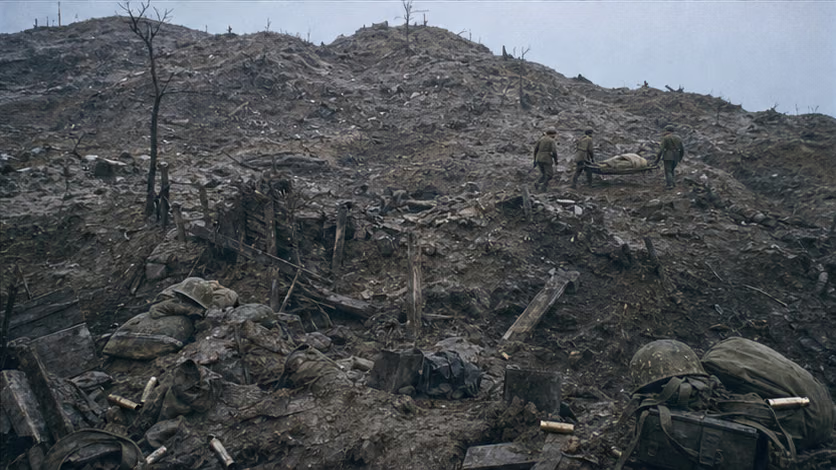
- Cumulative Chinese People's Volunteer Army casualties in the positional-warfare phase are dispersed across individual engagements, and the total for the whole phase remains unverified; the "United Nations Command" side likewise lacks a unified published phase total (statistical bases vary by account).
- The two major summer and autumn offensives of 1951: the "United Nations Command" side suffered more than 100,000 casualties (U.S. acknowledged figures vary by statistical basis) in exchange for moving the line north by several kilometers. This was the first appearance of the cost structure of the positional-warfare phase; over the next two years, the ratio broadly did not change.
- White Horse Mountain: the 38th Army suffered more than 6,700 casualties (statistical bases vary by account) and did not take the position; the South Korean Ninth Division also suffered heavy casualties (South Korean statistical bases vary by account). Defeats have bills too.
- Casualties among railway troops, antiaircraft troops, and Korean civilians along the transport lines during Operation Strangle are scattered across records and remain unverified.
- The sniping and roving-artillery campaign inflicted more than ten thousand cumulative enemy losses at very small cost to itself (statistical bases vary by account) -- the most asymmetric cell in the cost structure.
Aftermath
- The front became the boundary: the actual line of contact in November 1951 and the Military Demarcation Line of July 1953 differed little. Two years of positional warfare produced a net result close to zero on the map, and the political result that "stopping on this line" became an outcome both sides could accept.
- The Chinese People's Volunteer Army completed its transformation from a mobile-warfare army into a positional-warfare army: tunnels, artillery, logistics, and communications were all upgraded; counter-strangulation built a full set of modern logistics experience against air attack (this is where the slogan of a "steel transport line that could not be smashed or bombed apart" came from -- evidentiary details and source of the slogan unverified).
- The negotiations themselves were interrupted for a time in October 1952 over the prisoner-of-war issue and resumed in April 1953. The correspondence between the rhythm of negotiation and the rhythm of the battlefield is the core narrative mechanism of the whole phase.
- For the Battle of Kumsong (1953.7) and the signing of the armistice, see *Battle of Kumsong*.
Accounts of Those Present
- The naming of Bloody Ridge and Heartbreak Ridge: these two names were given by U.S. reporters and soldiers themselves. Once enough of their own blood had flowed, the contour lines on the map acquired names. The battle names are retained, and U.S. and South Korean military histories use them.
- A day for the railway troops: a bomb crater was still smoking by day, and by night men went in to repair it; if a bridge was blown, they used a temporary bridge, and if that too was bombed, they used an underwater bridge (with the bridge deck submerged and invisible from the air -- details of this method unrecorded). "Tonight's bridge must be open tonight" was not a slogan but a procedure.
- Zhang Taofang: from Xinghua, Jiangsu, a soldier of the 24th Army, he killed or wounded 214 enemy troops with 436 rounds (statistical basis and personnel details unrecorded), and later became one of the first generation of fighter pilots in the new China -- from sniper record holder to pilot, two branches of service in one man's life.
- Gu Zhongjiao: a cultural instructor in the 340th Regiment of the 38th Army, he defected to the enemy before the Battle of White Horse Mountain. The attack plan he provided enabled the South Korean Ninth Division to adjust deployments overnight and the U.S. military to reinforce firepower (Chinese research differs over the content of his statements and the actual level of effect, unverified). The defection of a non-combatant changed the direction of an army-level offensive. This is the hardest layer to write in the defeat at White Horse Mountain, and also the most crucial.
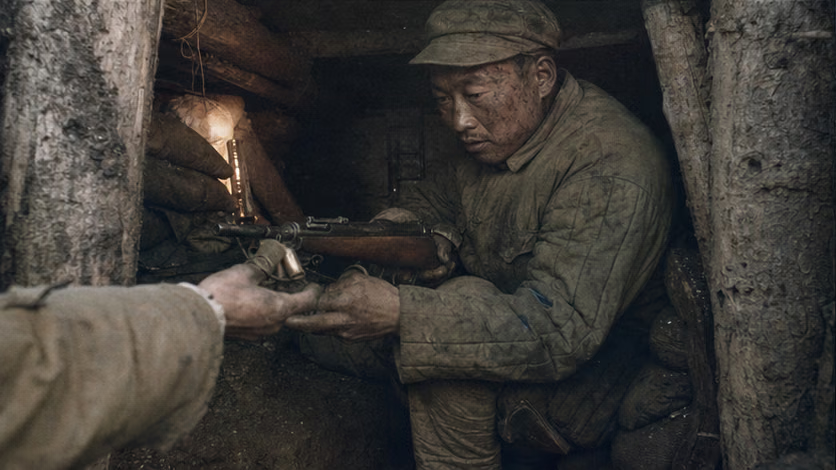
- Life in the tunnels: after the tunnels took shape, front-line companies lived inside the mountains for months: sleeping on planks laid over ammunition boxes, lighting oil lamps, collecting rainwater, defending against poison gas (filter layers), and counter-mining (listening for the sound of the other side digging tunnels). Triangle Hill pushed this life to its limit, but it was the everyday condition of the whole line for two years.
- Negotiation tents and front-line telephones: when the ownership of a hill was argued over in the tents at Panmunjom, the telephone lines at the front heated up. "Behind every sentence at the negotiating table is a hill" was not rhetoric in this phase, but the work process of that day.
The Ground
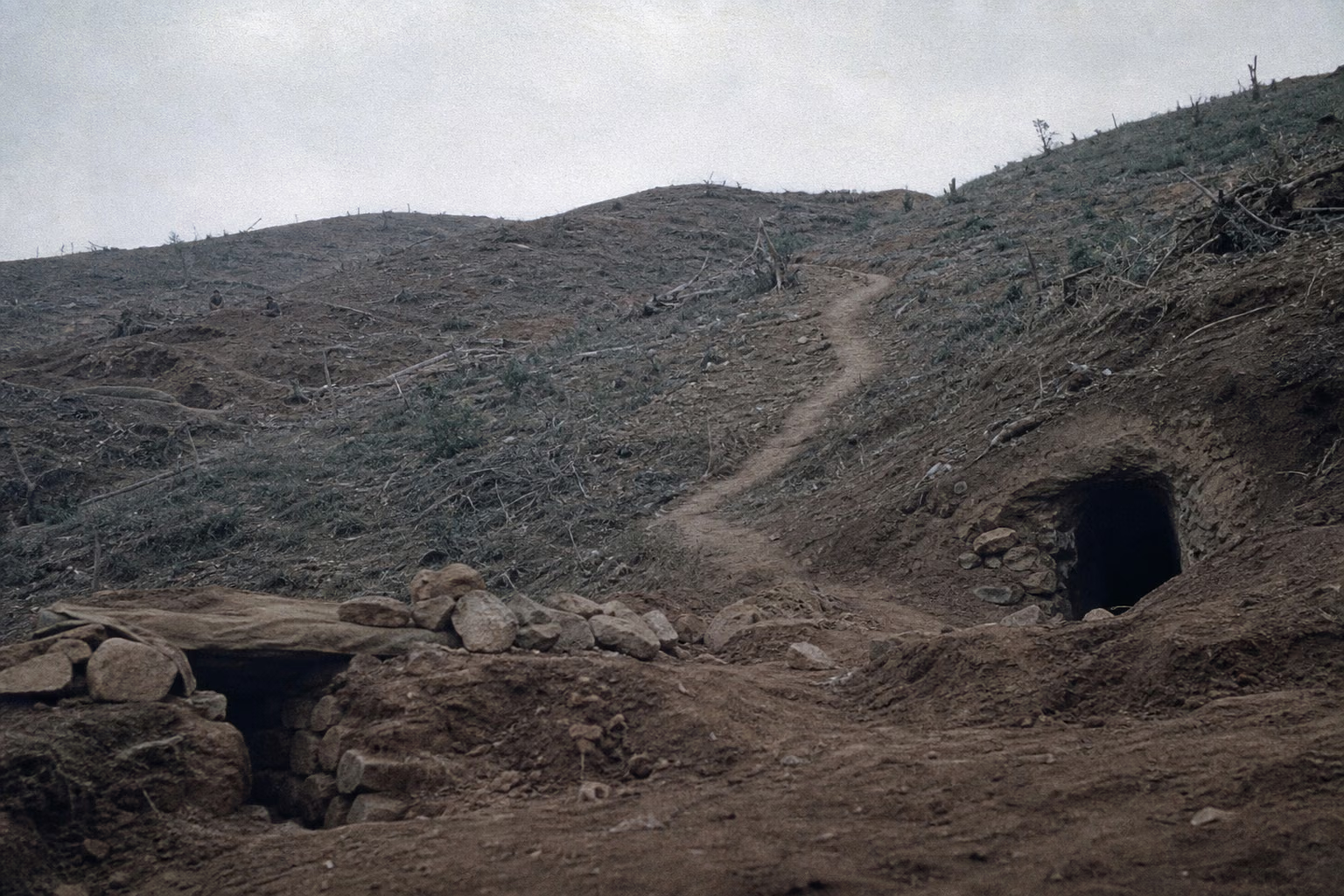
- Three horizontal structures: first-line positions (hilltops-tunnels-minefields), artillery and supply nodes in depth (the Sinanju-Kaechon-Sunchon junction group), and the aerial strangulation layer (Chongchon River bridges, Taedong River bridges, night roads).
- The spatial grammar of a single hill: reverse-slope tunnels, ridge-line fighting, windows of artillery coverage, and night supply paths. Triangle Hill is the extreme sample of this grammar.
- White Horse Mountain: a twin-height position made up of Hill 394.8 and Hill 281.2, with frontal uphill attack and flanks constrained by the terrain of the Yeokgokcheon valley (terrain details unrecorded).
- Time dimension as space: daytime belonged to the "United Nations Command" (firepower and air), night to the Chinese-Korean side (transport and harassment); the 24 hours of a day were cut into two battlefields.
How Each Side Records It
- Chinese side: the 1951 summer-autumn defensive operations and counter-strangulation are the source of the "steel transport line" narrative; White Horse Mountain was long uncommon in public narratives and has begun to enter accounts in recent military-history research.
- U.S. side: Bloody Ridge and Heartbreak Ridge are classic cases in U.S. military history of the cost of "limited war," and directly entered the U.S. domestic discussion over war policy (details of public reaction unverified); the failure of Operation Strangle was written into U.S. Air Force histories as self-critique (original text unverified).
- South Korean side: White Horse Mountain is recorded by the South Korean army as the "Great Victory at White Horse Hill," and the South Korean Ninth Division was therefore named the "White Horse Division" (division emblem and lineage unverified). The same defeat/victory is recorded separately in each side's archives.
- The two-year deadlock over prisoner-of-war negotiations is narrated very differently by the three sides and belongs to a whole-war-level dispute (see the disputes section in *War to Resist U.S. Aggression and Aid Korea · Overview*).
Disputes and Sensitivities
- Causation of the defeat at White Horse Mountain: Chinese military historians differ over which weighed more, Gu Zhongjiao's leak or the 38th Army's own command decision to assault an enemy prepared in advance; the differences in source material are evident.
- Statistical bases for results and casualties: figures for enemy losses inflicted and casualties across the whole phase each follow their own systems; multiple bases coexist, with no single figure for now.
- Narrative boundaries of sniping and roving artillery: turning sniper records into individual legend (the screen adaptation of Zhang Taofang's story) can easily slide toward myth; the relevant record numbers must be read together with their statistical basis.
- The core of this phase was not a single decisive battle, but a "system": institutionalized cycles of bridge repair, road protection, tunnel digging, the daily practice of sniping, and so on.
Sources and Open Questions
Known main sources:
- *History of the War to Resist U.S. Aggression and Aid Korea* (Academy of Military Science Press, Chinese official history)
- U.S. Far East Air Forces assessment files on Operation Strangle (USAF Historical Division; specific file numbers to be checked)
- South Korean Ministry of National Defense military histories (volumes on Bloody Ridge, Heartbreak Ridge, and White Horse Mountain; original books to be checked)
- Memoirs of Chinese People's Volunteer Army generals such as Yang Dezhi and Hong Xuezhi (chapters on logistics and positional warfare)
Open questions: the day-by-day sequence of Bloody Ridge and Heartbreak Ridge and the "United Nations Command" casualty bases; the sequence of fighting at Mundung Stream and Baektai Mountain; the original U.S. assessment of bomb tonnage and destruction rate in Operation Strangle; details and sources for repair and transport methods such as "one-way transport," "nose-to-nose river crossing," and "underwater bridge"; the total mileage basis for the tunnel system; the cumulative enemy-losses basis for the sniping and roving-artillery campaign; personnel-file details for Zhang Taofang's sniper record; the full chain of the Gu Zhongjiao incident (course of defection, statement contents, and postwar whereabouts); each basis for 38th Army casualties and South Korean Ninth Division casualties at White Horse Mountain; organization and results of engagements in the first and second attacks of the 1953 summer counteroffensive; the timing of Clark's succession as commander in chief of the United Nations Command; the earliest source for the phrase "steel transport line that could not be smashed or bombed apart"; and the U.S.-acknowledged figure for total casualties in the "United Nations Command" 1951 summer-autumn offensives.
All images on this site are AI-generated depictions. They are not historical photographs, not primary sources, and do not depict any real individual.