Engagement Archive · Autumn Harvest Uprising
Five thousand men attacked Changsha; after ten days of defeat, only a little over a thousand remained -- what truly changed history was not the uprising itself, but two decisions made on the road of retreat: at Wenjiashi, they stopped attacking cities; at Sanwan, Party branches were built down to the company level. A defeated army was reinvented in retreat.
Engagement Data
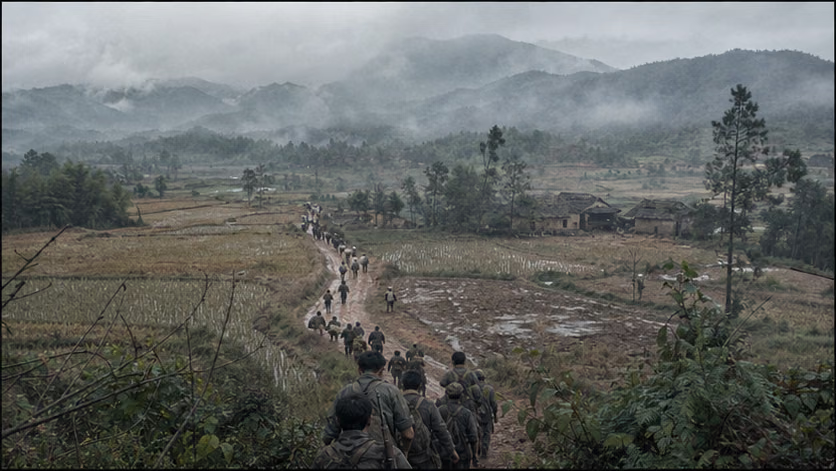
| Item | Content |
|---|---|
| Time | 1927.9.9 uprising; 9.19 turn at Wenjiashi; 9.29 Sanwan Reorganization; reached Jinggangshan in October |
| Place | Hunan-Jiangxi border: Xiushui, Tonggu, Anyuan -> Pingjiang, Liuyang -> Wenjiashi -> Sanwan -> Jinggangshan |
| Affiliation | Agrarian Revolutionary War (for the larger situation, see *Agrarian Revolutionary War · Overview*) |
| Belligerents | First Division, First Army, Workers' and Peasants' Revolutionary Army (Front Committee secretary Mao Zedong, commander-in-chief Lu Deming, about five thousand) / KMT forces stationed in Hunan and Jiangxi, plus local militia |
| Result | The attack on Changsha failed, and the force lost more than half its strength; it turned toward the Luoxiao Mountains and opened the Jinggangshan base area |
Belligerents
| Item | Workers' and Peasants' Revolutionary Army | KMT Forces and Local Militia |
|---|---|---|
| Strength | Three regiments, about five thousand: based on the Wuhan Guard Regiment, Anyuan miners, and Hunan-Jiangxi peasant troops (order of battle unverified) | Regular troops plus militia units, posted in the counties; total strength far superior |
| Equipment | Several thousand rifles, mixed composition | Standard equipment |
| Weakness | Newly formed army, mixed composition, hastily incorporated bandit troops defected in battle (Qiu Guoxuan's unit turned coat, unverified) | -- |
Terrain and Conditions
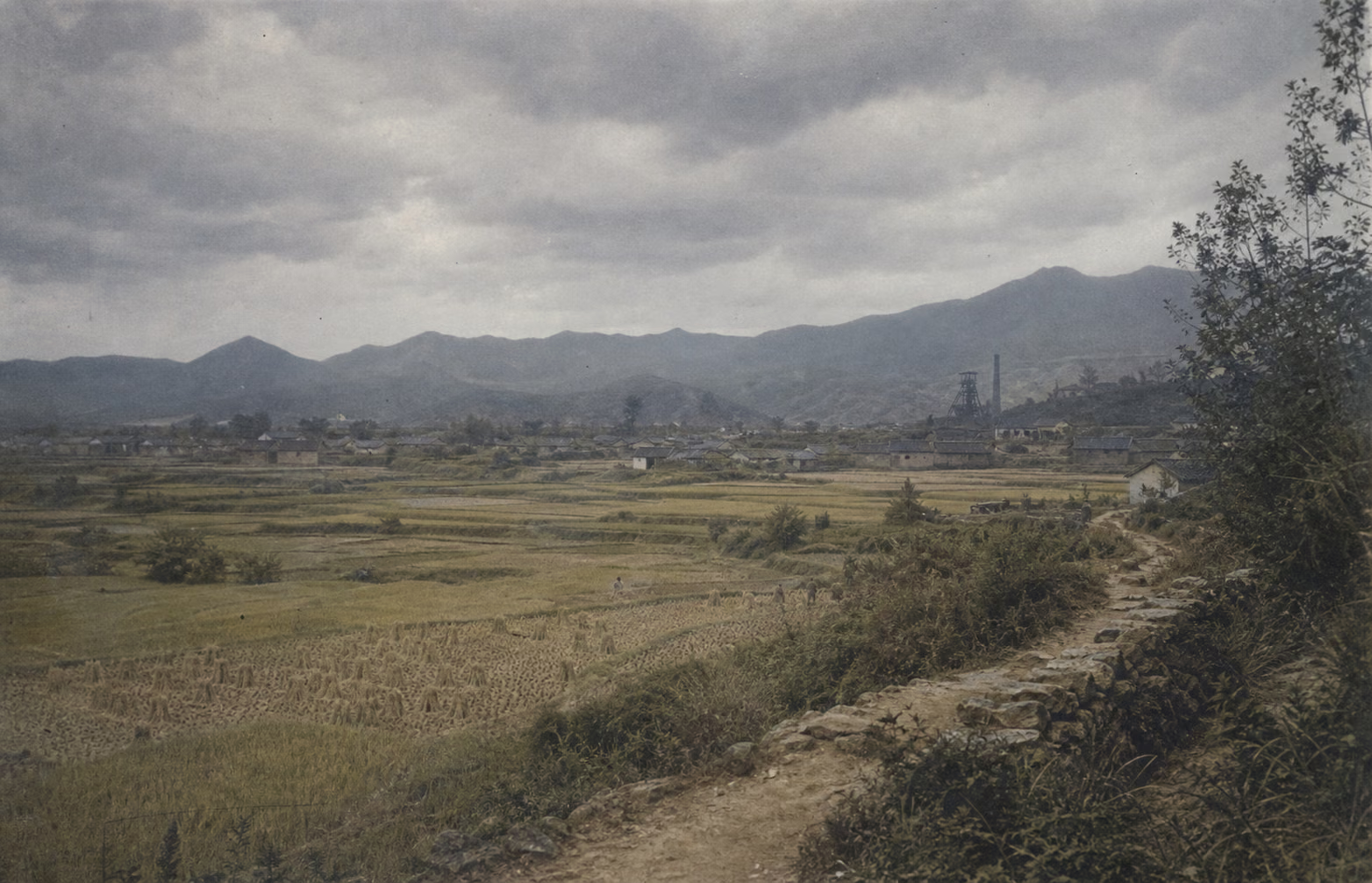
The Hunan-Jiangxi border after the failure of the Great Revolution: after the Mari Incident (1927.5, Changsha), the worker and peasant movement in Hunan was bloodily purged ※, and the backbone members of the peasant associations were either dead or scattered; the worker organization at the Anyuan coal mine was one of the uprising's main foundations. The name "Autumn Harvest Riot" came from the autumn harvest season itself -- the original idea was that peasants would join the uprising after cutting the rice.
Why It Was Fought
The guns at Nanchang sounded in the early hours of August 1; two days later, the uprising army withdrew from the city and went south to Guangdong in search of a sea outlet (see *Nanchang Uprising*). The first shot answered whether to fight; it did not answer where to fight, or how. On August 7, the Central Committee held an emergency meeting in Hankou and set the general policy of armed resistance and land revolution -- at the meeting, Mao Zedong said that political power is obtained from the barrel of a gun (original wording unverified). After the meeting, the provinces made separate arrangements for Autumn Harvest Riots; on the Hunan route, Mao Zedong returned to Hunan as the Central Committee's special commissioner to organize them.
Choosing Hunan meant choosing an existing base. During the Great Revolution, Hunan's peasant movement stood at the head of all provinces; the Anyuan coal mine had an organized worker body, and there was also a regular-army foundation -- the Wuhan Guard Regiment, which had failed to reach Nanchang and had turned into the Hunan-Jiangxi border. The target was set at Changsha: a provincial capital, and at this time the Party's target was still the city. The timing was set at the autumn harvest, and the name "Autumn Harvest Riot" came from this -- the original idea was that peasants would join the uprising after cutting the rice; in early September, the rice was just ripening.
The Workers' and Peasants' Revolutionary Army's calculation was that three regiments would rise separately from Xiushui, Anyuan, and Tonggu, converge on Changsha, and wait for peasants in the surrounding countryside to rise in response. Attacking the provincial capital was almost a Party-wide consensus at the time; there was no second voice. The misjudgment had two layers. One was external: the imagined mass peasant uprising did not come. After the Mari Incident, the backbone members of Hunan's peasant associations were either dead or scattered; their strength had already been bloodily purged away four months earlier. The other was internal: Qiu Guoxuan's hastily incorporated unit turned coat in battle (course unverified), and the First Regiment first suffered heavy losses under the guns of its own side. On the KMT side, the Hunan-Jiangxi garrison plus county militia units were far superior in total strength; in their records, this was merely one "bandit disturbance" in Hunan and Jiangxi, and the proclamations were brief -- no one treated these five thousand men as opponents who needed to be remembered.
The decision took concrete form in several places. After the August 7 Meeting, the Hunan Provincial Committee was reorganized, and Peng Gongda took over as secretary. The original plan for four routes to launch simultaneously across the province was contracted through several Provincial Committee meetings to the area around Changsha (the dates and details of the contraction are unverified), while the Central Committee's reply disapproved (original letter unverified). In early September, Mao Zedong arrived at Anyuan, and the three regiments' designations, routes, and date for the converging attack were set at the meeting (deployment details unverified). The material boundary around this plan was very clear: the Party organization in Hunan had gone underground four months earlier, and funds, communications, and arms were all cut off; peasant troops made up the majority of the five thousand, there were not enough guns, and spears and broadswords filled out the numbers; there was no rear, and the wounded could only move with the force. The intelligence gap was just as large: that the provincial capital's defenses were empty was the uprising side's basic judgment, but the basis has not been preserved (unverified). The dissent on the table had only one register -- the Provincial Committee argued over the scope of the uprising, not over whether to attack cities. The real opposition appeared only after defeat: at the Wenjiashi Front Committee meeting, division commander Yu Sadu advocated turning back to attack Changsha again, Mao Zedong argued for retreating toward the countryside, and Lu Deming stood with the latter (no meeting record survives; the details of the dispute come from later participant recollections, source unverified).
On September 9, the uprising began, and railway workers tore up the Zhuzhou-Pingxiang line in support (details unclear); the three regiments rose in succession. Beforehand, there had been no debate over whether to attack Changsha.
Course of the Engagement
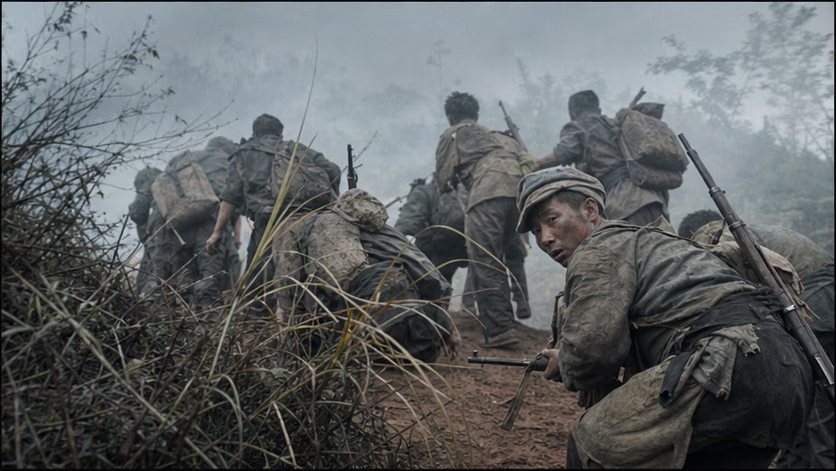
| Phase | Time | Main Points |
|---|---|---|
| Separate-route uprising | 9.9-11 | The three regiments rose separately from Xiushui, Anyuan, and Tonggu, and the plan to converge on Changsha unfolded in succession; railway workers tore up the Zhuzhou-Pingxiang line in support (details unclear) |
| Setback | 9.11-17 | The First Regiment was hit by a defection and surprise attack from Qiu Guoxuan's incorporated unit, suffering heavy losses; after the Second Regiment took Liling and Liuyang, it was encircled and routed; the Third Regiment was also checked -- the converging attack on Changsha came to nothing |
| Wenjiashi turn | 9.19 | After fierce debate at the Front Committee meeting, the decision was made: abandon Changsha and move south along the Luoxiao Mountains to "go up into the mountains" -- the first turning point from attacking cities toward the countryside (details of the meeting debate unclear) |
| Losses at Luxi | 9.23 | The rearguard was attacked; commander-in-chief Lu Deming was killed in action, aged twenty-two |
| Sanwan Reorganization | 9.29 | Sanwan, Yongxin: of the five thousand men, fewer than a thousand remained, and they were reorganized into one regiment; Party branches were built in the companies, Party representatives were installed above the company level, and soldiers' committees practiced democratic management -- an organizational operation remade the army |
| Up into the mountains | October | After the Gucheng meeting and the Dacang encounter, the force gained acceptance from Yuan Wencai and Wang Zuo's two bandit armed groups and entered the Ciping area of Jinggangshan (Yuan and Wang later died in mistaken killings in 1930 ※; cross-reference the suppression section in the overview) |
Casualties and Losses
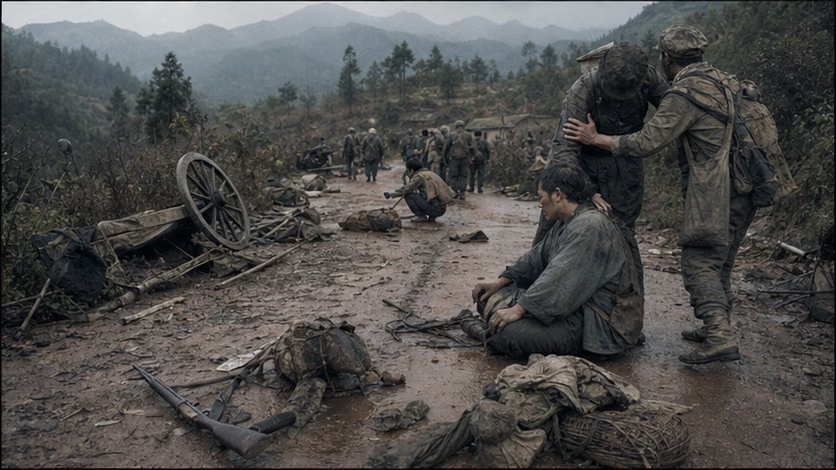
- Uprising troops: five thousand set out, and fewer than a thousand remained by Sanwan -- losses and departures together amounted to eighty percent; Lu Deming and a number of other backbone cadres were killed in action.
- ※ Along the route: retaliatory collective punishment during militia "village clearing" (record unverified); the White Terror in Hunan since the Mari Incident was the underlying color of the uprising's bloodshed.
- Changsha was not touched, and the city's civilians suffered no war calamity.
Aftermath
- Opening of the Jinggangshan base area -- the first testing ground for "the countryside surrounding the cities"; in 1928.4, Zhu and Mao joined forces, and the Fourth Red Army was established.
- The institutional legacy of the Sanwan Reorganization (the Party commands the gun, soldiers' committees) became the source code of the later people's army's organizational form -- the real "result" of this article is the institution, not the fighting.
- The fixation on attacking Changsha did not vanish immediately (in 1930, the Li Lisan Line attacked Changsha again; cross-reference the overview) -- a line shift was a process, not an instant.
Accounts of Those Present
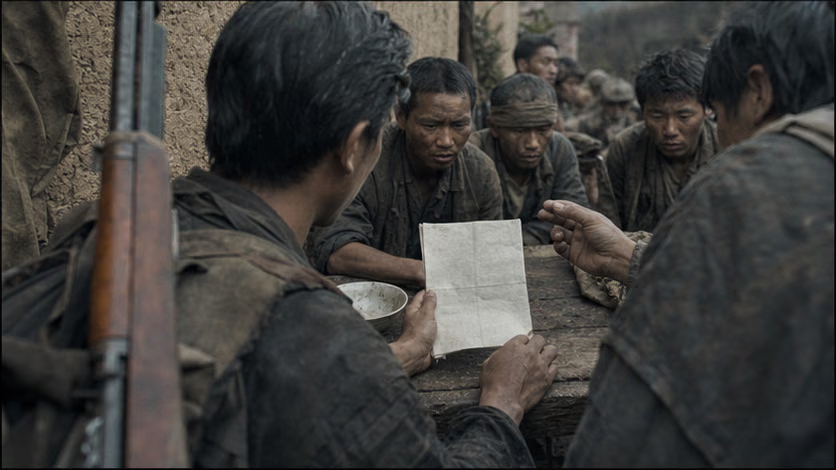
- Lu Deming: second class at Whampoa, twenty-two-year-old commander-in-chief, killed on the road while covering the retreat -- the remnant army he escorted later changed China, while he himself stopped in the autumn of 1927.
- The drill ground at Wenjiashi: on the drill ground of Liren School, Mao spoke to the remaining troops -- the metaphor of "small stones smashing a large water jar" circulated widely (original wording unverified); below the platform, the soldiers were hungry and exhausted, listening to a scholar say they should go up into the mountains.
- The Sanwan roster: the fewer than one thousand men willing to stay were registered anew -- the list of those who voluntarily remained is closer to the true starting point of an army than a muster roll of five thousand men.
- Yuan Wencai and Wang Zuo: bandit leaders who accepted the defeated army into the mountains, and three years later died in mistaken killings by their own side ※ -- the heaviest hidden line in the Jinggangshan narrative.
The Ground
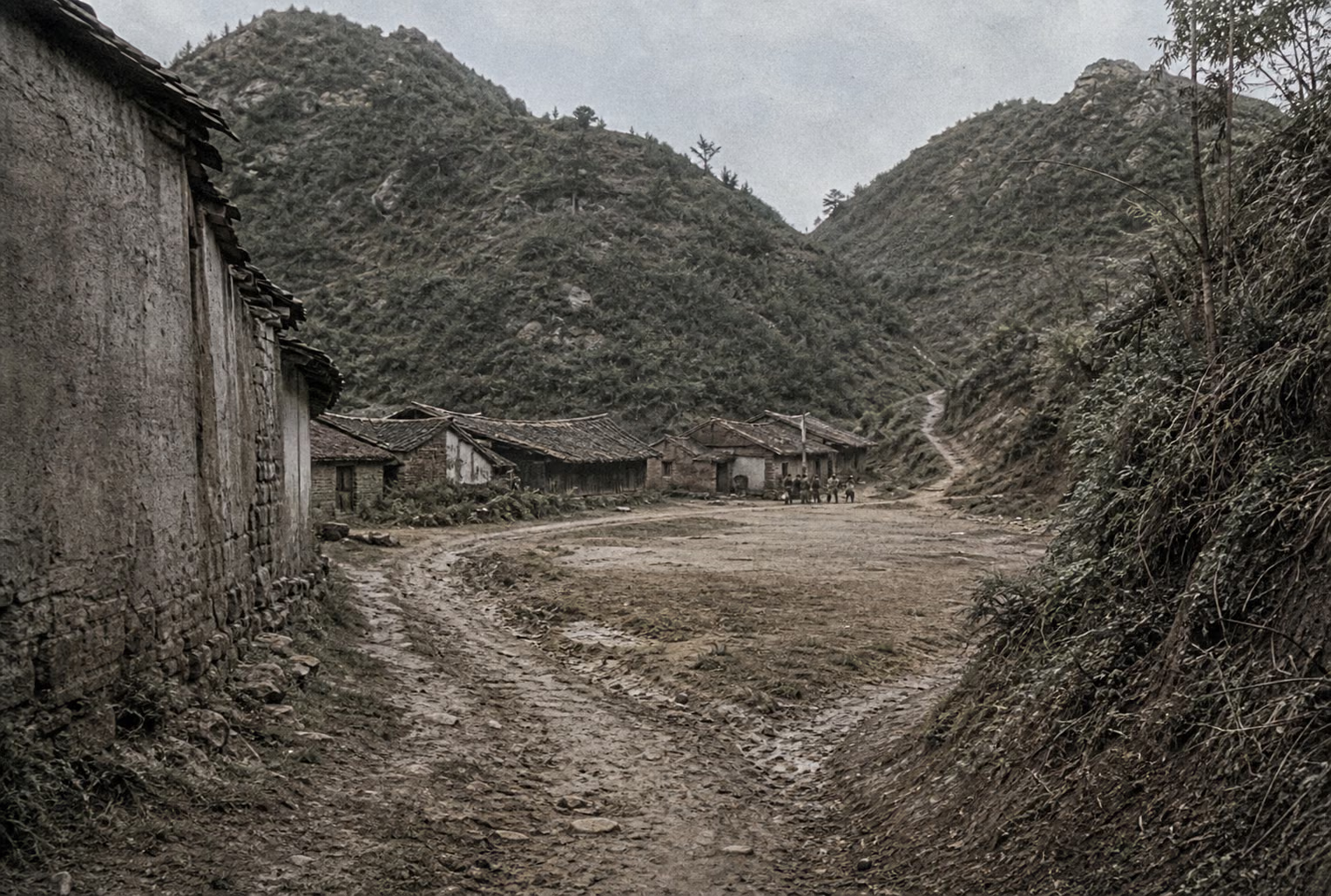
- The advance triangle on the Hunan-Jiangxi border: Xiushui, Anyuan, and Tonggu as three points of departure, all pointing toward Changsha; after the collapse, the scattered force contracted to the single point of Wenjiashi -- the spatial "drawing-in" was also the narrative turning point.
- Luoxiao Mountains: the terrain shift from the plain (the urban target) toward the mountains (the survival target) was the physical form of the line shift.
- Sanwan: a one-night reorganization in a small mountain hollow village -- the largest institutional event occurred in the smallest space.
How Each Side Records It
- Communist canonical narrative: one of the three great uprisings alongside Nanchang and Guangzhou, later rising above them because of its status as the "starting point of the road"; Wenjiashi and Sanwan entered textbooks, and the Autumn Harvest Uprising memorial sites became a system.
- KMT side: at the time it was treated as one Hunan-Jiangxi "bandit disturbance," with brief records (its "pacification" proclamations unverified).
- Later scholarship: by reexamining the decision-making process behind the "turn" (the Front Committee debate, multiple plans for where to retreat) and the deaths of Yuan and Wang, it restores myth to a history of choices.
Disputes and Sensitivities
- The details of the Wenjiashi meeting debate and the attribution of the decision to "go up into the mountains" -- the layer of historical sources and the layer of later recollection must be kept separate.
- The course of Qiu Guoxuan's unit turning coat (the failure of the incorporation decision) is unverified.
- Yuan Wencai and Wang Zuo were mistakenly killed in 1930 ※ -- cross-reference the suppression section in the overview; it should not be omitted because of commemorative narrative.
- Evaluation of the target of attacking Changsha: complete negation (doctrinairism) and contextual understanding (Party-wide consensus at the time) should be read side by side.
Sources and Open Questions
Sources: *Collected Materials on the Autumn Harvest Uprising*; relevant months in *Chronicle of Mao Zedong*; participant recollections by Luo Ronghuan and others (collected in *A Single Spark Can Start a Prairie Fire*); local Party-history materials from the Hunan-Jiangxi border.
Open questions: the order of battle and actual numbers of the three regiments; the course of Qiu Guoxuan's unit turning coat; the evidentiary level of the Wenjiashi meeting record; the course of Lu Deming's death; the source of the original wording of the "small stones" speech; the different accounts of the number who stayed at Sanwan; the course of the mistaken killings of Yuan and Wang and the date of their rehabilitation; the meeting dates and plan details for the Hunan Provincial Committee's contraction of the uprising plan; the Central Committee's original letter criticizing the Hunan Provincial Committee; details of the Anyuan deployment meeting; the intelligence basis for the uprising side's judgment that Changsha's defenses were empty; the participant recollection sources for the Wenjiashi meeting debate (Yu Sadu's proposal and Lu Deming's attitude).
All images on this site are AI-generated depictions. They are not historical photographs, not primary sources, and do not depict any real individual.