Engagement Archive · Nanchang Uprising
In the small hours of August 1, 1927, more than twenty thousand troops under Communist control or influence fired the first shot from the walls of Nanchang and took the whole city within hours -- the battle was won, but the later march south to Guangdong lost the main force; the anniversary of that defeat later became the Army Day of the People's Liberation Army.
Engagement Data
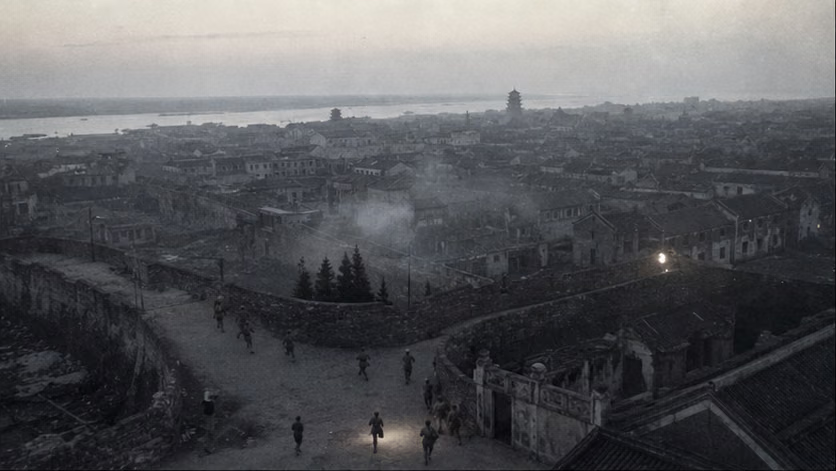
| Item | Content |
|---|---|
| Time | 1927.8.1 (uprising) – early October (failure in Chaoshan, dispersal of the main force) |
| Place | Nanchang, Jiangxi -> south through Jiangxi, Fujian, and Guangdong, ending at Chaoshan and Sanheba |
| Affiliation | Agrarian Revolutionary War · first of the three great uprisings |
| Uprising side | CPC Front Committee (secretary Zhou Enlai); commander-in-chief He Long; Ye Ting, Zhu De, Liu Bocheng, and others participating in command |
| Suppression side | KMT forces under Zhu Peide (Nanchang garrison) and later blocking forces from Guangdong, Jiangxi, and Guangxi |
Belligerents
| Item | Uprising Troops | KMT Forces |
|---|---|---|
| Strength | Over twenty thousand: He Long's 20th Army, Ye Ting's 24th Division of the Eleventh Army, Zhu De's officer education regiment of the Third Army, and other units (orders of battle and numbers vary by account, unverified) | Over three thousand defenders inside Nanchang (figure disputed); forces outside the city and later blocking them far exceeded this |
| Firepower | Regular-army standard equipment; took baggage and supplies south after the uprising | Thin forces inside Nanchang; surrounding KMT forces on each route had intact organization |
| Situation | Surprise attack inside the city, catching the defenders off guard | Caught unprepared and disposed of within several hours |
Terrain and Conditions
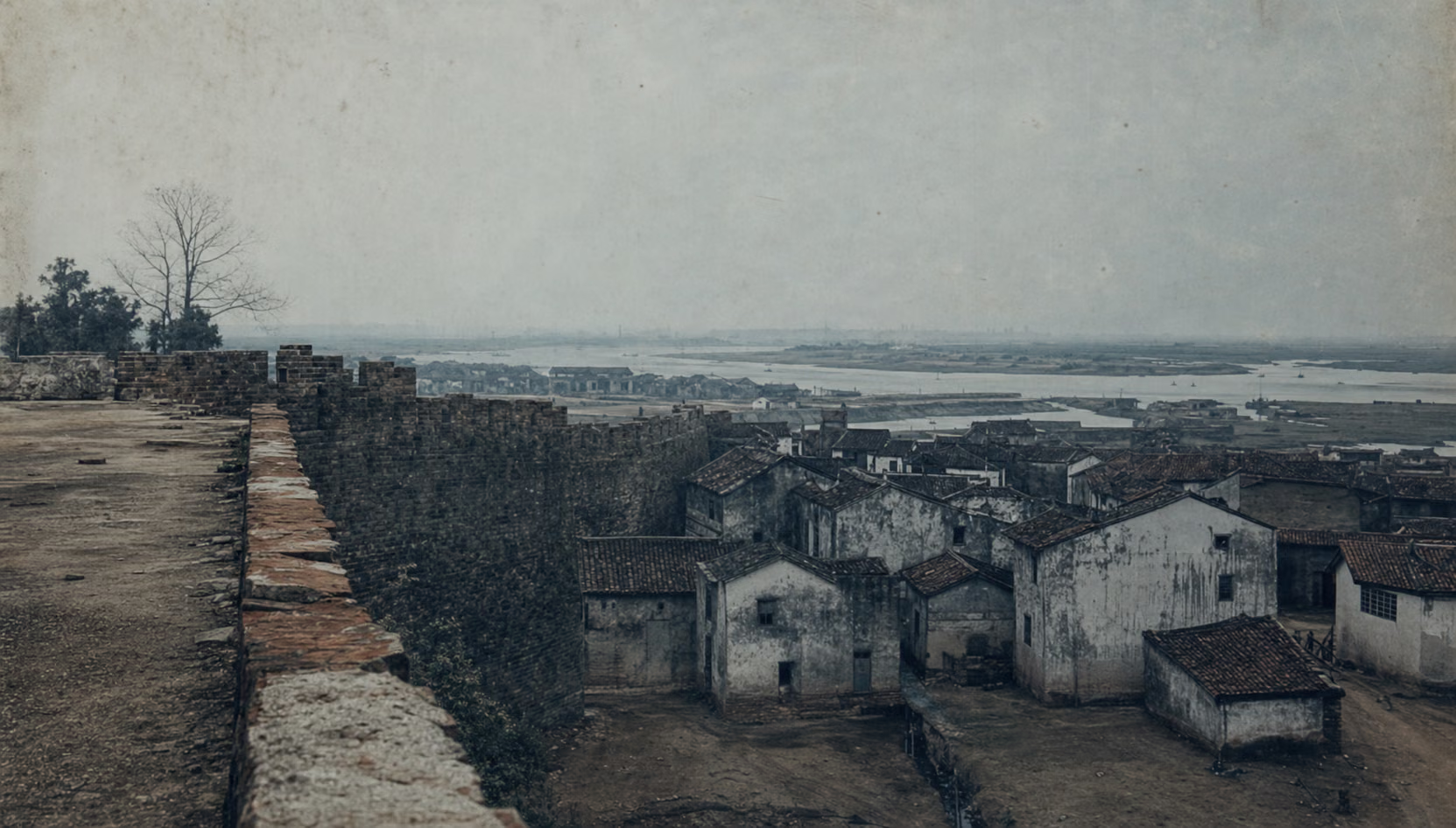
(For the larger situation of the KMT–CPC split in 1927 -- April 12, July 15, and the Ninghan reunion -- see *Agrarian Revolutionary War · Overview*; this article covers only Nanchang.)
Nanchang: the capital of Jiangxi, rear area of Zhu Peide's Fifth Front Army. After the Wuhan National Government "split with the Communists," the troops under CPC control were concentrating along the Nanchang–Jiujiang line (originally assigned to join the eastern expedition against Chiang). The garrison inside Nanchang was thin, and the city's defense was in Zhu Peide's hands rather than in those of the uprising troops' core opponents -- this was where the opportunity for the uprising came from. The attitude of Zhang Fakui's Second Front Army in the direction of Jiujiang was ambiguous, the largest variable before and after the uprising.
Why It Was Fought
Shanghai was a city first opened by its own workers; Nanjing was taken by force -- in March 1927, the Northern Expeditionary Army secured the lower Yangtze (see *Battles of Shanghai and Nanjing*). Half a month later, the guns turned around: on April 12, the Shanghai Workers' Pickets were disarmed, and the dead numbered in the thousands (bases vary by account); on July 15, Wang Jingwei's group in Wuhan also announced that it would "split with the Communists." Nanjing and Wuhan purged the Party in succession, the Great Revolution collapsed from within, and Party membership fell sharply from nearly 60,000 to a little over 10,000 (figure disputed). The CPC had only two choices left before it: sit still and wait for death, or take up guns.
Where the guns would be fired was decided by the map. Around the time of the "split with the Communists," the troops most deeply under Party control or influence -- He Long's 20th Army and Ye Ting's 24th Division of the Eleventh Army -- were concentrating toward Jiujiang and Nanchang in the name of the eastern expedition against Chiang. At Jiujiang sat the main force of Zhang Fakui's Second Front Army, whose attitude was ambiguous and whom they could not move against; Nanchang was the rear area of Zhu Peide's Fifth Front Army, with only over three thousand defenders inside the city (figure disputed) and empty defenses. More than twenty thousand against three thousand, by surprise -- and the days in which organized troops were still in their own hands were shrinking day by day.
The decision fell in Wuhan: in late July, the Standing Committee of the provisional Central Political Bureau decided to launch an uprising in Nanchang, where the army under Party control was relatively concentrated, to establish a Front Committee, and to send Zhou Enlai to Nanchang as its secretary to take charge (meeting date and voting circumstances unverified). When the decision was made, what Wuhan could see was Nanchang's empty defense and the troops concentrating there; what it could not see were two things -- whether Zhang Fakui would follow, and whether there really would be a ship offshore in the Dongjiang to receive external aid: the latter had no written commitment that can be checked (source unverified), yet the whole southward plan was staked on it. The uprising side's calculation was not limited to one city -- taking the city was only the first step. The fixed policy was to withdraw from Nanchang immediately, march south to Guangdong, take the Dongjiang sea outlet, receive Soviet external aid, rebuild a base area, and then launch the Northern Expedition again. This "sea outlet for external aid" route came from the Comintern's urban-centered thinking, and later self-criticism held that it was precisely this route that pushed twenty thousand men onto a thousand-li road of no return; but on the table at the time, it was the most complete plan. The suppression side had little calculation to speak of: Zhu Peide did not expect his own rear provincial capital to become the site of an uprising, and the Nanchang garrison was caught unprepared.
The material boundary drawn around this plan was hard. The more than twenty thousand men were regular troops of the Northern Expedition, well equipped, but Nanchang was not a base area: once the captured warehouses in the city had been consumed, there was no rear, every round of ammunition fired was one less, and grain and fodder depended on requisition along the road. On paper, the southward route was written as Dongjiang, sea outlet, external aid; what the paper did not write was the thousand li itself -- high summer, mountain roads, dysentery and malaria, desertion beginning on the first day after leaving Nanchang, and attrition before contact with the enemy (attrition ratio unverified).
Another road had indeed been on the table: return to Guangdong together with Zhang Fakui, using his banner to go south. But Zhang Fakui's attitude remained ambiguous, and in late July this road was abandoned -- better to act oneself than to stake one's life on another man's hesitation. Nor was there no dissent: with the uprising imminent, Zhang Guotao arrived in Nanchang, bringing a Comintern telegram -- if there was no certainty of victory in the uprising, it would be better to postpone it (telegram wording unverified). He argued for waiting. The Front Committee argued through the night and did not accept the proposal: the troops were already in place, word had already leaked, and the arrow was on the string. This difference later entered various self-criticisms -- waiting a few days might perhaps have waited out Zhang Fakui, but it would not have brought that ship.
At the end of July, He Long (not yet a Party member) led the 20th Army, and Ye Ting led the 24th Division, into Nanchang one after another. In the small hours of August 1, the guns sounded. The uprising kept using the unit designation "Second Front Army of the National Revolutionary Army" and still acted in the name of the KMT left -- when the first shots were fired, it was still under the KMT flag.
Course of the Engagement
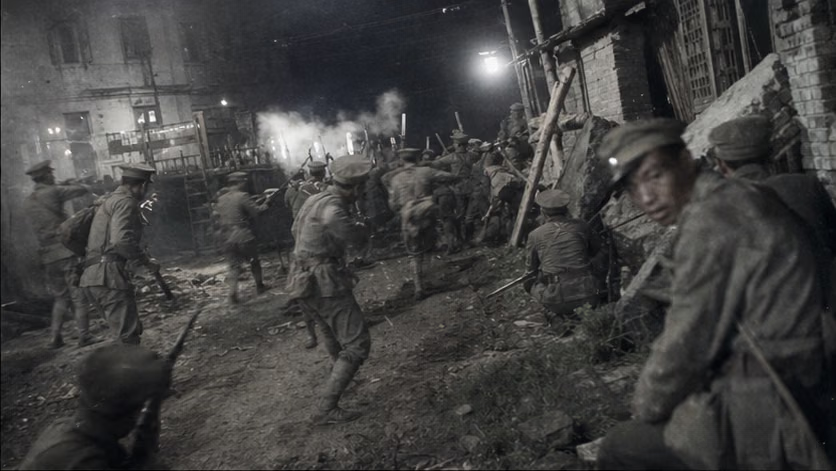
| Phase | Time | Main Points |
|---|---|---|
| Uprising | Early hours of 8.1 | Surprise attacks according to the predetermined plan; after several hours of fierce fighting, the whole city of Nanchang was controlled by dawn, and large quantities of guns, ammunition, baggage, and supplies were captured |
| Reorganization and decision | 8.1–8.3 | A Revolutionary Committee was established and a manifesto issued; fixed policy: withdraw from Nanchang, march south to Guangdong, take the Dongjiang sea outlet, seek Hailufeng and Soviet external aid, rebuild a base area, and then launch the Northern Expedition again |
| Hard march south | 8.3–mid-September | A high-summer expedition; desertion and death from illness were severe, and before contact with the enemy the force had already been reduced by nearly half (attrition ratio unverified); the fighting at Rentian and Huichang broke through blocking enemies (Huichang was the largest battle on the southward route, around 8.30, dates vary by account); the troops entered Guangdong via Tingzhou and Ruijin |
| Defeat at Chaoshan | Late September–early October | The force split: the main force went down to Chaoshan, while one part (Zhu De's force, about three thousand) stayed at Sanheba to cover the rear; from late September to early October, the main force suffered successive defeats at Tangkeng and Chaoshan and dispersed; the leadership organs withdrew by sea to Hong Kong |
| Remnants fighting on | October–1928.4 | The Sanheba remnants joined with broken units that had broken out of Chaoshan; Zhu De and Chen Yi gathered and reorganized them (the reorganization at Tianxinwei in Anyuan, Jiangxi, and the speech in the form "those willing to continue the revolution, follow me" circulated widely; original wording unverified), then fought on through southern Jiangxi and southern Hunan -> 1928.1 Southern Hunan Uprising -> 1928.4 ascent to Jinggangshan and joining forces with Mao Zedong's troops |
Casualties and Losses
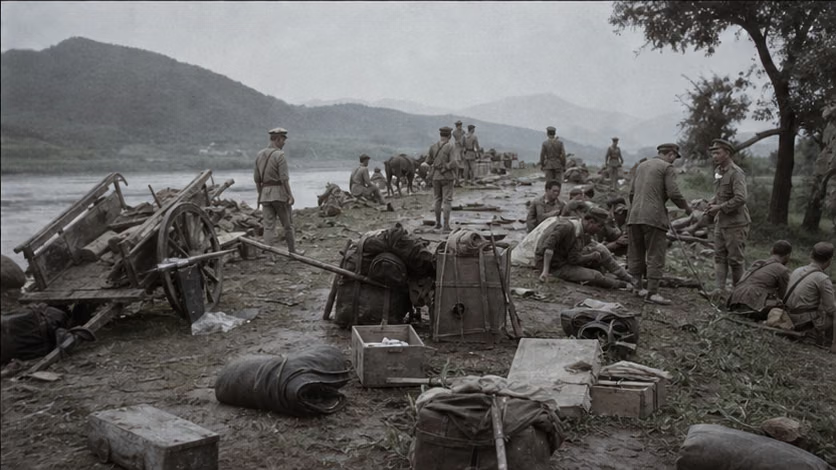
- Uprising troops: casualties in the fighting inside Nanchang were light; the cost came mainly on the southward road -- more than half deserted or died of illness, and the main force of more than twenty thousand was essentially lost in the Chaoshan fighting. What survived in organized form was roughly eight hundred men brought up to Jinggangshan by Zhu De and Chen Yi (the "eight hundred men" account is common, but bases for the number vary).
- KMT forces: more than three thousand Nanchang defenders were wiped out; casualties in blocking battles such as Huichang are not detailed.
- Civilians: requisition along the southward route and disturbance in the war zones; no statistic.
Aftermath
- Militarily: a complete failure -- the city could not be held, the sea outlet was not taken, external aid was not received, and the main force was spent.
- Politically: from this point the CPC had its own army. "August 1" was later set as the Army Day of the Chinese People's Liberation Army -- the day of a defeat became the army's founding day; what was commemorated was not victory or defeat in that battle, but the fact that "from this point, there were guns."
- The spark went up to Jinggangshan: in 1928.4, the remnants under Zhu De and Chen Yi joined Mao Zedong's forces and were combined into the Fourth Red Army -- the survivors of the Nanchang Uprising became one part of the Red Army's frame.
Accounts of Those Present
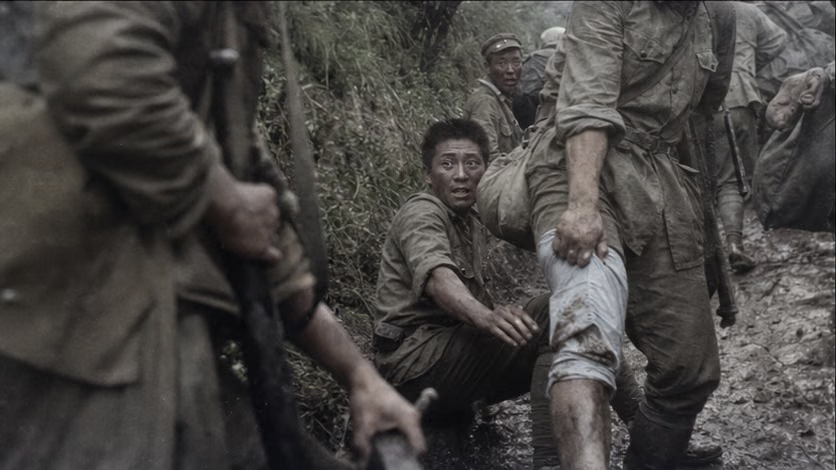
- He Long's army flag: He Long was not yet a Communist Party member at the time of the uprising, but served as commander-in-chief; on the southward march he joined the Party at Ruijin (place unverified). An army commander staked everything he had on an uprising whose odds were unclear.
- Battle of Huichang: the battle with the largest casualties on the southward route, and also the hardest fight; Chen Geng suffered a serious leg wound in this engagement and was taken by a roundabout route through Hong Kong and Shanghai for treatment (course unverified).
- The split at Sanheba: Zhu De's decision to remain behind as rearguard was later repeatedly retold as a historical fork -- those who stayed survived; the main force that went down to Chaoshan was gone.
- Reorganization at Tianxinwei: on the edge of dispersal, Zhu De said, "those willing to continue the revolution, follow me" (original wording and occasion unverified). The force scattered from one or two thousand down to eight hundred; from those eight hundred came three marshals and one senior general (common account, list unverified).
- The young men on the list: among the regiment- and battalion-level cadres at the time of the uprising were men who later included Lin Biao, Su Yu, and Chen Yi -- on the walls of Nanchang in 1927 stood half of the later people's army's command layer.
The Ground
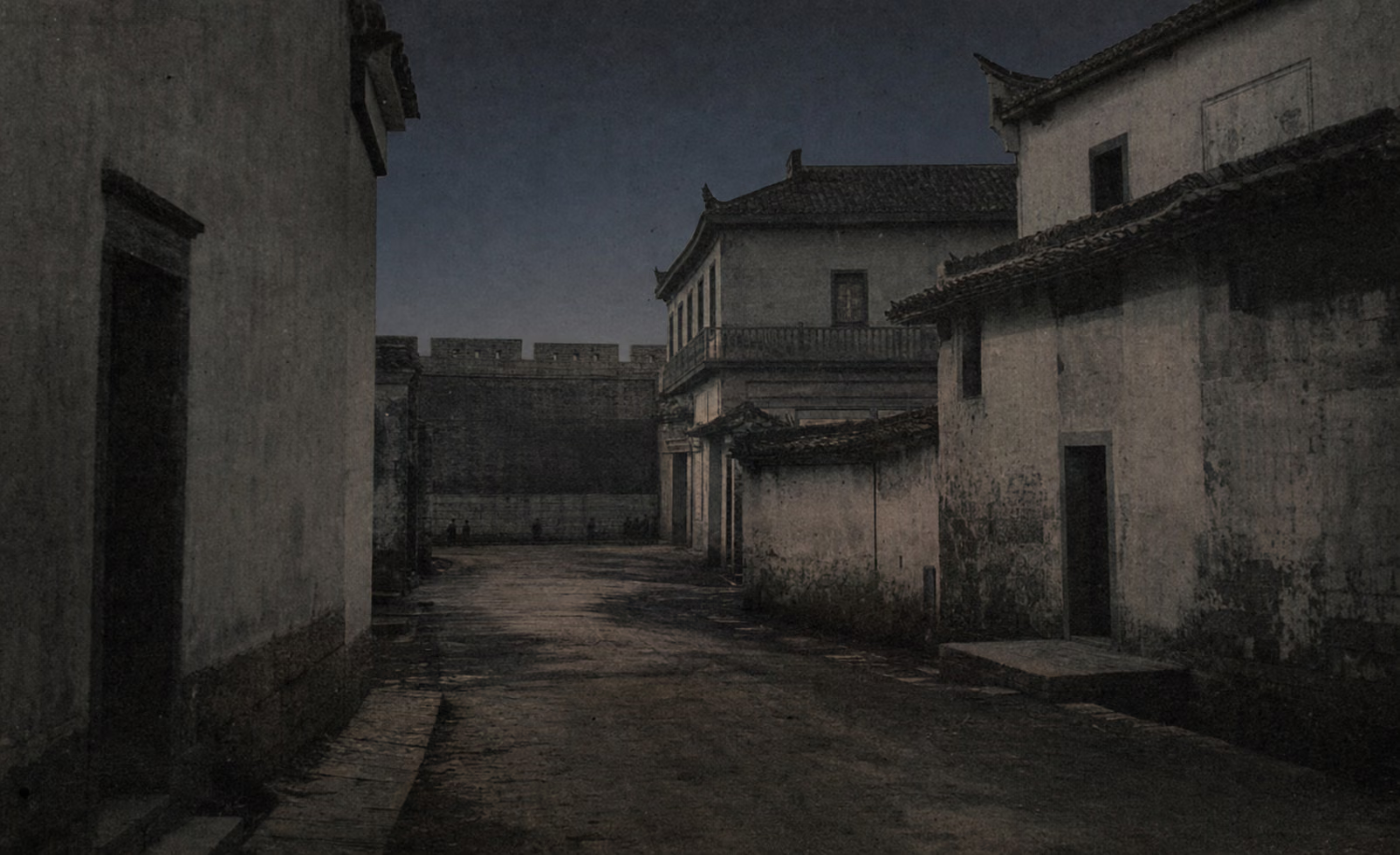
- Nanchang city: a provincial capital on the lower Gan River plain, with city walls, old streets, and enemy headquarters (the Jiangxi Grand Hotel was the Front Committee's station, and the general headquarters was also set up there) -- the uprising was a night urban surprise attack, measured in a few streets and a few strongpoints.
- Southward route: Nanchang -> Fuzhou -> Ruijin -> Tingzhou -> Shanghang -> Sanheba/Chaoshan, running a thousand li from north to south; brutal heat, mountain roads, and lack of doctors and medicine -- the largest enemy in this battle was not the blocking KMT forces, but the expedition itself.
- Sanheba: a ferry town at the confluence of three rivers in the upper Han River, a place for covering the rear with one's back to the water -- the spatial carrier of the action called "splitting the force."
How Each Side Records It
- Communist canonical narrative: the beginning of the army, the "first shot," the place where the army flag was raised; the defeat is incorporated into the genealogy of "preserving the spark" and connected with the joining of forces at Jinggangshan.
- KMT "Communist suppression" narrative: the "Nanchang Riot" -- rebel troops roamed into eastern Guangdong, where National Army forces pursued, suppressed, and scattered them; in official military histories, it is the prelude to "bandit suppression."
- Later and scholarly reconsiderations: the focus is the southward decision -- knowing that the thousand-li expedition was ahead and that external aid was remote, why was it necessary to go to Guangdong? Reconsideration points to the Comintern thinking of "urban centers" and "a sea outlet for external aid"; another view holds that there was nowhere else to go at the time. The two accounts coexist.
Disputes and Sensitivities
- The error of the southward decision: in recent years the canonical narrative has openly acknowledged that going south was part of an erroneous line, but the finer division between "the decision was wrong" and "the execution was wrong" remains under discussion.
- Leadership list and ranking: whether Zhang Guotao attended the meeting and the details of the Front Committee list differ among archival records (figure disputed).
- The symbolic order of the "first shot": the narrative ranking of Nanchang among the three great uprisings of Nanchang, Autumn Harvest, and Guangzhou is itself part of Party-history writing; the archive orders events by historical fact and does not adopt symbolic weight.
Sources and Open Questions
Main sources: *Nanchang Uprising* (Party-history materials series); Liu Bocheng, *An Account of the Nanchang Riot from Beginning to End* (early participant document); Chen Yi's recollections on guerrilla warfare in southern Jiangxi and the joining of forces at Jinggangshan; Taiwan-side war histories of pacification / Communist suppression, early volumes (counterpart narrative).
Open questions: the meeting date and circumstances of the provisional center's decision on the Nanchang uprising; the original text of the Comintern telegram on the Nanchang uprising; the level of commitment in the plan to receive Soviet external aid at the Dongjiang; the date on which Zhang Guotao went to Nanchang and the details of the Front Committee dispute; the complete order of battle of the uprising troops and actual numbers present in each army; the number of the Nanchang defenders; the date and casualties of the Battle of Huichang; the attrition ratio on the southward march; the original wording of the Tianxinwei speech; the specific combat sequence of the Chaoshan defeat; the number of men Zhu De brought up to Jinggangshan; the place where He Long joined the Party; details of the Front Committee list.
All images on this site are AI-generated depictions. They are not historical photographs, not primary sources, and do not depict any real individual.