Engagement Archive · Western Route Army's Battles in the Hexi Corridor
The main force of the Red Fourth Front Army, 21,800 men, was ordered to cross the Yellow River and advance west; it fought alone for four months in the Hexi Corridor and was almost destroyed as an organized force -- the most severe defeat in Red Army military history, and an unresolved case whose characterization was not revised until decades later.
Engagement Data
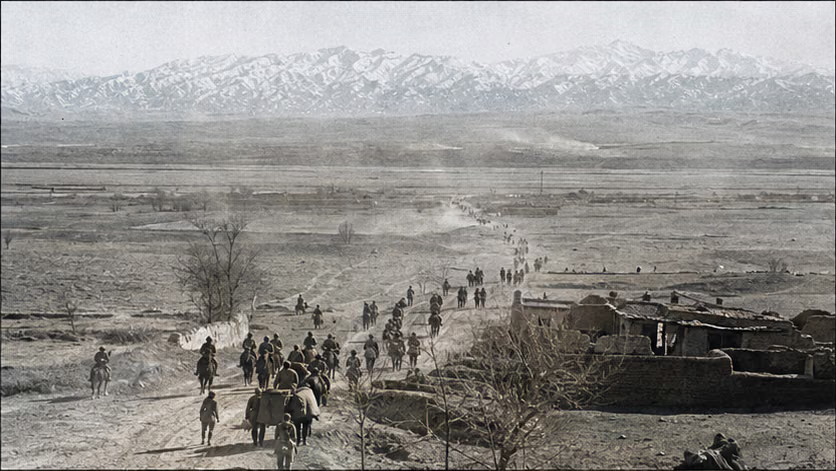
| Item | Content |
|---|---|
| Time | 1936.10.28 river crossing – 1937.3.14 division of forces at Shiwo (remnants reached Xinjiang by the end of April) |
| Place | Along the Gansu Hexi Corridor: Jingyuan -- Jingtai -- Gulang -- Yongchang -- Shandan -- Linze -- Gaotai -- Nijiayingzi -- Liyuankou -- Shiwo Mountain -- Qilian Mountains |
| Affiliation | Late Agrarian Revolutionary War; evolved out of the Ningxia Campaign plan |
| Western Route Army | Red Fifth Corps, Red Ninth Corps, Red 30th Corps, and headquarters, 21,800 men in all ("21,800" is the common basis, source unverified); Chen Changhao, chair of the Military and Political Commission; Xu Xiangqian, commander-in-chief; Wang Shusheng, deputy commander-in-chief |
| Ma-family Army | Forces under Ma Bufang (Qinghai) and Ma Buqing (Fifth Cavalry Division), mainly cavalry; estimates for regular troops plus militia differ sharply (accounts ranging from over 30,000 to over 120,000 coexist, unverified) |
| Result | The Western Route Army was almost entirely destroyed: about 7,000 killed in battle and about 6,000 captured (figures vary); only Li Xiannian's detachment, about 400-plus men, reached Xinjiang and was met there |
Belligerents
| Item | Western Route Army | Ma-family Army |
|---|---|---|
| Strength | 21,800 (common basis, source unverified) | Regular troops and militia combined: accounts ranging from over 30,000 to over 120,000 coexist; no choice is made among them (figure disputed) |
| Equipment | Mainly rifles, very few machine guns or artillery pieces, and no ammunition replenishment beyond what was carried | Mainly cavalry, with complete firearms and convenient local supply |
| Logistics | No rear area, no replenishment of manpower, no source of ammunition; the force grew smaller as it fought | Fighting on home ground, with soldiers and militia available for local conscription |
| Terrain adaptation | Infantry trudged through desert and Gobi in severe cold, freezing and hungry | Cavalry held every mobility advantage in the open corridor terrain |
Terrain and Conditions
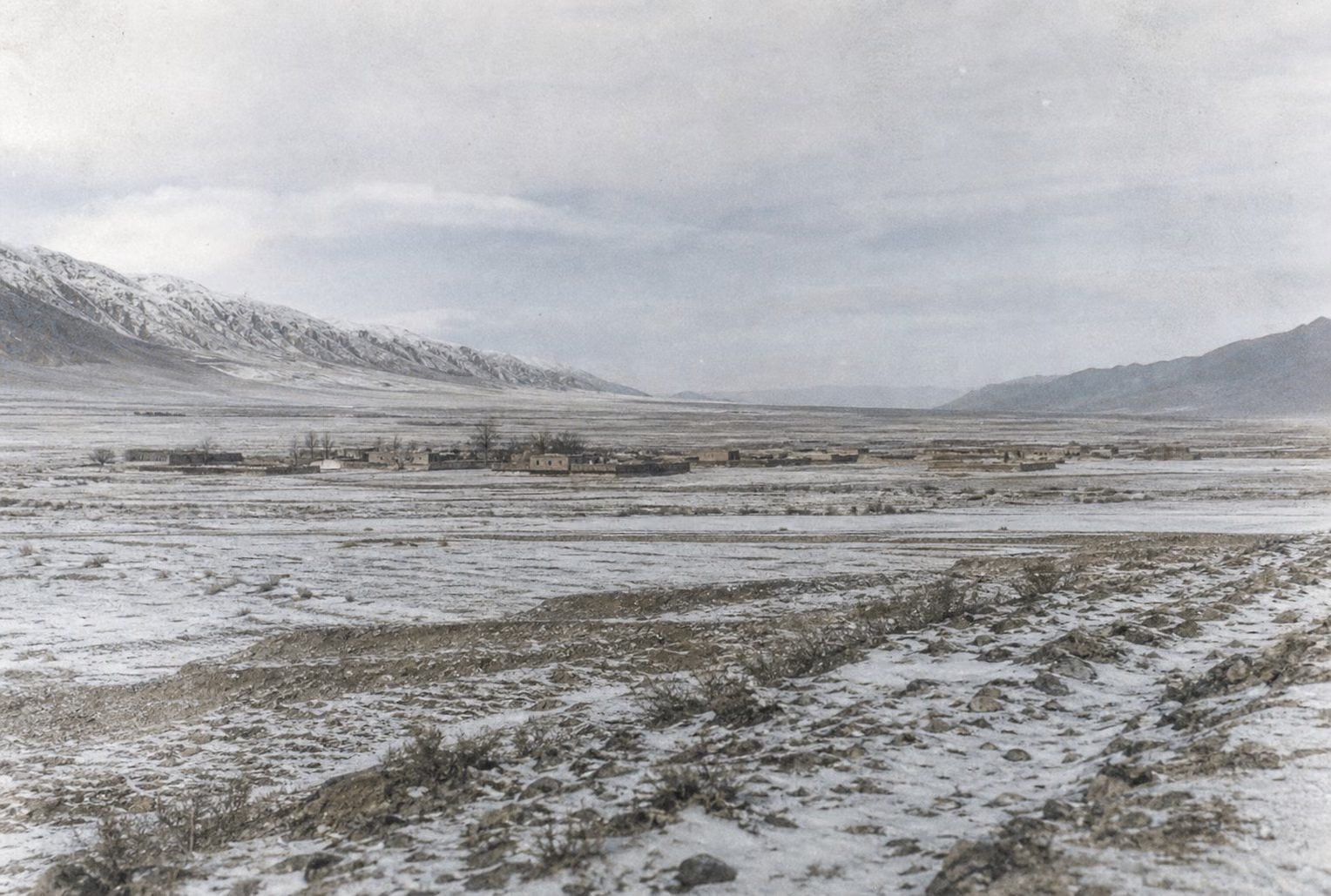
(For the larger situation in 1936 -- the linkup of the armies, encirclement campaigns, and the crisis in North China -- see *Agrarian Revolutionary War · Overview*; this article covers only the Hexi Corridor.)
The Hexi Corridor: a long, narrow oasis belt of more than a thousand li between the Qilian Mountains and the Beishan ranges (Longshou Mountain and Heli Mountain), sparsely populated and inhabited by both Hui and Han communities. This was the territory that the brothers Ma Bufang and Ma Buqing had managed for years -- warlord rule overlapped with ethnic and religious networks, and regime, army, and local society were bound together. An outside Han army could scarcely put down roots. It was deep winter; between towns and villages lay dozens of li of Gobi snowfield at a time. What the Western Route Army entered was a corridor with no mass base, no rear area, and nowhere to retreat.
Why It Was Fought
The "foundation-laying ceremony" at Zhiluozhen had given the Red Army a foothold (see *Battle of Zhiluozhen*), but the place could not sustain a large army. In 1936, the Red Army first launched an eastern expedition into Shanxi, raising the banner of an "Anti-Japanese Vanguard Army" to raise funds and expand the army; then it moved west toward Ningxia and Gansu to meet the Second and Fourth Front Armies as they came north -- two moves aimed at the same thing: living space, and opening a passage to the Soviet Union (see the overview). In October, the three main forces linked up at Huining. The three main forces of ten years of civil war had finally gathered in one place, and so had the shortages of grain, pay, ammunition, and winter clothing -- outside aid changed from an idea into an urgent need.
The Center immediately settled on the Ningxia Campaign plan: take Ningxia and open an aid route to the Soviet Union -- the plan was recorded in the October *Operational Program for October* (title commonly used, date of composition unverified). When making this decision, the Center could see that Shaanxi-Gansu could not sustain the three main forces and that Ma Hongkui's strength in the Ningxia direction was not strong; what it could not see was which route Soviet aid would take or when it would arrive -- the passage was the premise of the decision, and also the least settled part of it (unverified). The Red Fourth Front Army's Red 30th Corps, Red Ninth Corps, Red Fifth Corps, and headquarters, 21,800 men in all (common basis, source unverified), were ordered to cross the Yellow River westward (around 1936.10.28; the crossing point was in the area of Hubaokou, Jingyuan, and the details of the crossing schedule remain unverified). After the crossing, the military situation changed abruptly: Nationalist forces cut the connection between the Red Army main force east of the river and the force west of the river, and the Ningxia Campaign plan was suspended. In early November, the Center telegraphed the force west of the river to form the "Western Route Army"; its mission changed to establishing a base area in Hexi and linking up with Xinjiang when the opportunity arose (the telegram's contents and the process of change remain unverified).
The mission changed; the opponent did not. The Hexi Corridor was the territory that the brothers Ma Bufang and Ma Buqing had managed for years -- for the Ma brothers, an outside army entering the corridor was digging at their roots, and they committed regular troops and militia in full (combined estimates ranging from over 30,000 to over 120,000 coexist, unverified); for the Western Route Army, this was a corridor with no mass base, no rear area, and nowhere to retreat: cavalry had every advantage in open ground, while the Red Army had mainly rifles, no replenishment for the ammunition it carried, and fewer men with every fight. The food for more than 20,000 people fell on a sparsely populated corridor; gathering grain meant competing with Hui and Han civilians for food. The river crossing took place in late autumn, and winter clothing was not ready -- it did not take four months to see that this corridor could not feed a large army (no record has been found of an assessment, before the crossing, of what the corridor could sustain). Neither side could retreat: if the Ma-family Army retreated, it lost its territory; behind the Western Route Army was the Yellow River, and ahead was deep winter.
In early to mid-November, the Western Route Army first fought the Ma-family Army at Yitiaoshan in Jingtai; after securing the bridgehead, it advanced west. Over the following months the mission was adjusted several times -- advance west, remain in place, advance west again -- and the force lingered for more than a month around Yongchang and Shandan, missing the mobility window before deep winter and step by step becoming a lone army. The question of "why it stopped in the corridor instead of moving on" is precisely the core of the unresolved case that followed for the next half-century (see "Disputes and Sensitivities").
A road back did appear at one point. After the Xi'an Incident, the Center briefly sent a telegram asking about the possibility of returning east, and the Military and Political Commission replied that it favored continuing westward (for the exchange of telegrams, see Xu Xiangqian's *A Review of History* and related document collections; original telegrams unverified). Xu Xiangqian himself had objected to the halt along the Yongchang-Liangzhou line and advocated moving west without pause (same book, chapter unverified). Dissent could not change the frame of the telegrammed orders: the mission came from the Center, and those issuing the orders did not have first-hand information from Hexi. As for the river crossing itself, it came from the Center's unified deployment; no record has been found of front-line commanders publicly opposing it.
Course of the Engagement
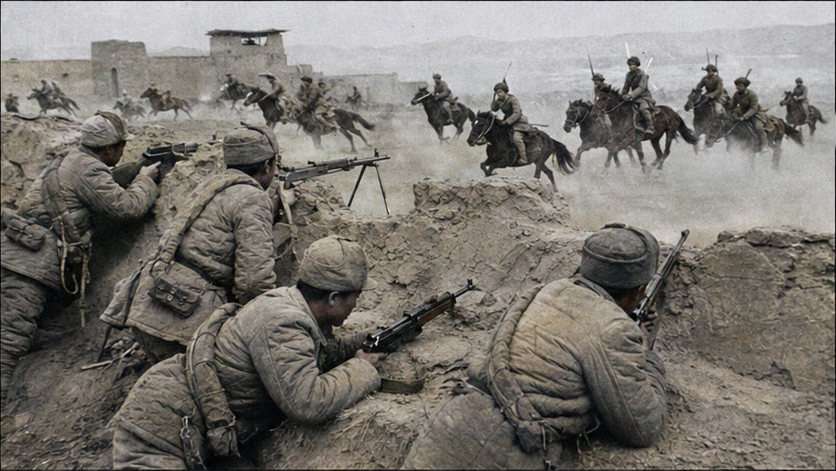
| Phase | Time | Main Points |
|---|---|---|
| River crossing | Around 1936.10.28 | 21,800 men of the Red Fourth Front Army crossed the Yellow River westward |
| Yitiaoshan | Early to mid-November | First battle against the Ma-family Army at Yitiaoshan in Jingtai; both sides had gains and losses, and after securing the bridgehead the Red Army advanced west |
| Gulang | Mid-November | The Ninth Corps fought bitterly in Gulang county seat, losing more than half its strength. Corps chief of staff Chen Bozhi, 25th Division commander Wang Haiqing, and others were killed in action (roster unverified); corps commander Sun Yuqing was wounded and later captured, taken under guard to Xining, and killed there (1937; chronological details unclear) |
| Yongchang and Shandan | Late November – December | The force remained and fought for more than a month along the Yongchang-Liangzhou line, with attrition increasing daily; during the Xi'an Incident it was ordered to return east and then again to advance west (original texts of the telegram exchange unverified) |
| Gaotai | 1937.1.12 – 1.20 | Fifth Corps commander Dong Zhentang led about 3,000 men in defending Gaotai county seat. After nine days of bloody fighting the city fell, the entire force died, Dong Zhentang was killed in action, and his head was cut off and sent to Xining ※ (see "Accounts of Those Present") |
| Nijiayingzi | 1937.1 – 2 | The main force contracted to Nijiayingzi in Linze; for more than forty days the sides fought back and forth, contesting fortified hamlets house by house until ammunition and manpower were exhausted |
| Liyuankou | Early March | During the breakout, the blocking action at Liyuankou; Ninth Corps political commissar Chen Haisong and others were killed in action (roster unverified) |
| Division of forces at Shiwo | 3.14 | Shiwo Mountain meeting: Chen Changhao and Xu Xiangqian left the force and returned east to report; the remnants were organized into three detachments for dispersed action |
| Qilian Mountains | March – end of April | Li Xiannian and Li Zhuoran led the Left Detachment across the Qilian Mountains; at the end of April they reached Xingxingxia on the Gansu-Xinjiang border and were met there |
Casualties and Losses
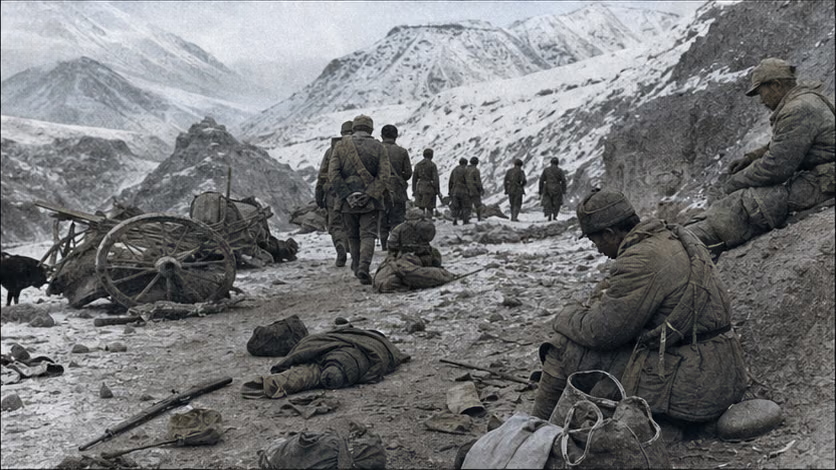
- Western Route Army: about 7,000 killed in battle; about 6,000 captured (accounts from 5,600 to 7,000 coexist, unverified)※ -- many of the captured were massacred or buried alive, and accounts of collective killings remain in places such as Xining (records of "mass graves" and the like, unverified); many others were incorporated into "supplementary regiments" and sent under guard to Qinghai for hard labor, building roads and opening wasteland, with countless deaths. Some were rescued by the Eighth Route Army offices in Lanzhou and Xi'an and returned to the army (figure disputed).
- Those who broke out and reached Xinjiang: about 400-plus people (accounts ranging from 400 to 700-plus coexist, unverified).
- Ma-family Army: casualty estimates differ sharply (accounts ranging from several thousand to more than 10,000, unverified).
Aftermath
- The 400-plus people who reached Xinjiang later returned to Yan'an in succession and became one of the seed groups for technical branches of the later people's army, including aviation and armor.
- Unresolved case over characterization: At the 1937 Yan'an meeting, the failure of the Western Route Army was assigned to the bankruptcy of the "Zhang Guotao line," and survivors long bore the identity of "the defeated." In the 1980s, Chen Yun and Li Xiannian (himself a Western Route Army participant) pushed for reexamination: after Chen Yun's instruction, Li Xiannian wrote *Explanation of Several Historical Questions Concerning the Western Route Army*, submitted it to the Center, and received approval (during 1982–83; document title and the chronology of instructions unverified). The Western Route Army was newly recognized as having "acted on the orders of the Central Military Commission" and as having carried out the Center's deployment. The change in characterization is itself a layer of historical fact.
- Commemoration: Gaotai has the Memorial Hall of the Chinese Workers' and Peasants' Red Army Western Route Army, and Xining, Zhangye, and other places also have memorial facilities; the oral histories of survivors and captives were not compiled in succession until as late as the 1980s and 1990s.
Accounts of Those Present
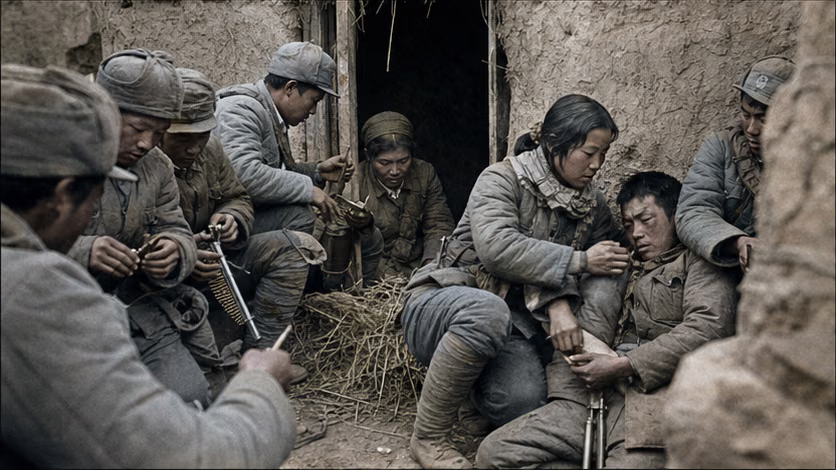
- Nine days at Gaotai (1937.1.12–20)※: Fifth Corps commander Dong Zhentang led about 3,000 men in defending Gaotai county seat. The force was thin and ammunition limited, and it fought bloody battles for nine days and nights; on 1.20 the city fell, almost all defenders were killed, and after Dong Zhentang was killed in action his head was cut off and sent to Xining for "public display." Dong Zhentang had been one of the leaders of the Ningdu Uprising and the old commander of the Red Fifth Corps.
- Sun Yuqing: commander of the Ninth Corps; wounded in the Battle of Gulang, then captured after his unit was scattered and sent under guard to Xining, where he refused to surrender and was killed (1937; chronological details unclear).
- Women's Anti-Japanese Vanguard Regiment※: an organized body of about 1,300 women fighters who undertook blocking actions, medical rescue, and transport. After the defeat, those captured were subjected to sexual violence, sold, and forced into marriage; survivors hid their names for decades and drifted through the northwest -- their oral histories were only later recovered piece by piece (written sources and oral accounts coexist; summary statement; accounting bases vary).
- More than 6,000 captured※: beyond massacres and live burials, large numbers of captives were incorporated into hard labor, with countless deaths; those rescued and returned to the army were only a portion of them (figure disputed).
- Li Xiannian's Qilian Mountains: the Left Detachment's 400-plus people crossed the Qilian Mountains, marching for dozens of days and nights (number of days varies by account) through wind and snow, and emerged from the mountains with clothing unable to cover their bodies -- for decades afterward he pushed to restore the Western Route Army's name.
- Chen Changhao: chair of the Military and Political Commission; after the division of forces at Shiwo, he left the force and returned east. After the founding of the People's Republic, he served as deputy director of the Central Compilation and Translation Bureau, and during the "Cultural Revolution" he died by suicide (his self-criticisms and memoir materials unverified).
The Ground
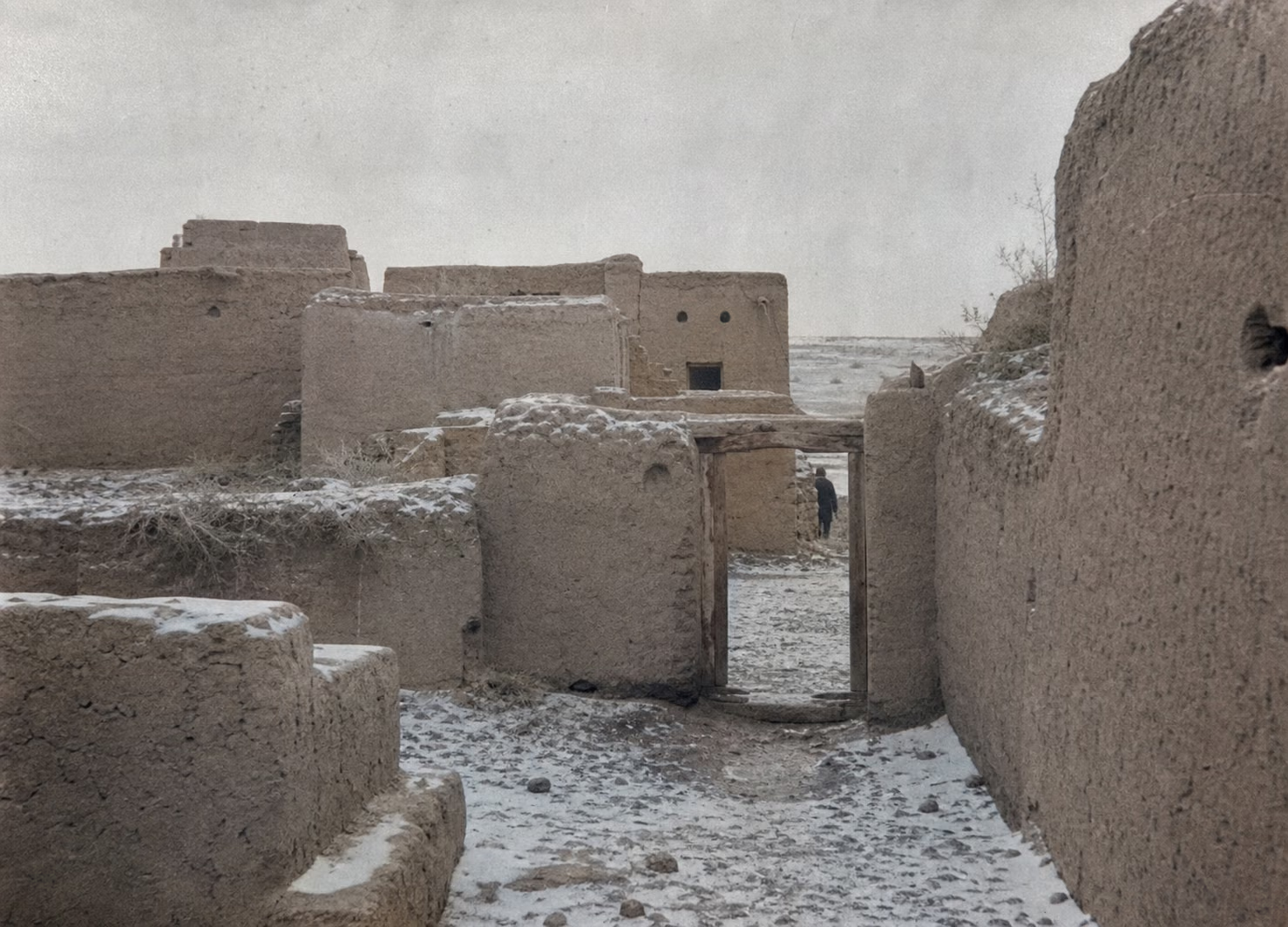
- The Hexi Corridor is a geographic passage of more than a thousand kilometers: the Qilian Mountains to the south, Heli and Longshou to the north, and between them a string of oases (Wuwei, Yongchang, Shandan, Zhangye, Linze, Gaotai) -- one line in, and one line out.
- Fortified-hamlet warfare: Nijiayingzi consisted of dozens of linked earthen enclosures, changing hands repeatedly for more than forty days, enclosure by enclosure and house by house.
- Cavalry against infantry: in the open Gobi and corridor terrain, cavalry shock and envelopment were almost impossible to solve; the Red Army could only rely on fortified hamlets and offset the advantage through night fighting and close combat.
- The final escape route was through snow mountains: Liyuankou, Shiwo Mountain, the Qilian Mountains, and Xingxingxia.
How Each Side Records It
- Red Army canon: from 1937 to the early 1980s the old characterization held it to be a "victim of the Zhang Guotao line"; after the 1980s it was revised into a tragic failure by forces "acting on the orders of the Central Military Commission." In recent years commemoration and research have gradually increased, and the "Western Route Army" has reentered official narrative.
- The other side: the Ma-family Army and the Kuomintang side long publicized this engagement as an achievement in "pacification"; Qinghai local documents vary in detail (to be checked).
- Later reconsideration: the command responsibility for the river-crossing decision and the repeated changes of mission, and the telegram exchanges among the Central Military Commission, Zhang Guotao, and Chen Changhao, remain questions under document-by-document checking in the historical field; the work of compiling oral histories of captives and the women's regiment is still underway.
Disputes and Sensitivities
- Unresolved case over responsibility: the shift between the old characterization (Zhang Guotao line) and the new reexamination (acting on Central Military Commission orders) involves the allocation of responsibility among Zhang Guotao, Chen Changhao, and central command -- the documentary chain itself is sensitive (original texts of the instruction and the *Explanation* unverified).
- Repeated mission changes: in the months after the river crossing, the Center's telegrammed orders were adjusted repeatedly (advance west / establish a base area / return east / advance west again); "why it remained in the corridor" remains the core dispute.
- Fate of the captives※: massacres, live burials, hard labor, and the situation of women captives belong at the level of a major humanitarian disaster. This article gives a summary statement, sets different figures side by side, and does not choose one.
- Relationship to the "last battle": the sequence of Western Route Army operations continued after Shanchengbao (1936.11.21–22) until March 1937; for the boundary of the commonly used basis that calls Shanchengbao the "last battle of the ten-year civil war," see the "Aftermath" section of *Battle of Shanchengbao*.
Sources and Open Questions
Known main sources:
- Xu Xiangqian, *A Review of History* (memoir of the Western Route Army commander-in-chief)
- Li Xiannian, *Explanation of Several Historical Questions Concerning the Western Route Army* (1983, original text unverified)
- *Military History of the Fourth Front Army of the Chinese Workers' and Peasants' Red Army*
- Specialized studies of the Western Route Army by Dong Hanhe and others, and compiled oral histories of survivors (bibliography unverified)
Open questions: the original basis for the figure of 21,800 river-crossing troops; sources for the different estimates of total Ma-family Army strength; the crossing schedule and crossing-point details; the roster of those killed at Gulang; chronological details of Sun Yuqing's capture and killing; original texts of the Western Route Army's east-return / west-advance telegram exchanges during the Xi'an Incident; exact strength of the Gaotai defenders and details of the city's fall; competing figures for captives (5,600–7,000); different bases for the number and fate of the Women's Vanguard Regiment; the number in Li Xiannian's detachment that reached Xingxingxia (400–700); number of days marching through the Qilian Mountains; document titles and instruction chronology for Chen Yun and Li Xiannian in 1982–83; figures for "supplementary regiment" hard labor and rescues back to the army; text and composition date of *Operational Program for October*; the basis for judgments about the Soviet aid route when the Ningxia Campaign plan was decided; original texts of the telegram by which the Center asked about returning east after the Xi'an Incident and the Military and Political Commission's reply favoring westward advance; memoir chapter in which Xu Xiangqian advocated advancing west without pause; whether there are records of pre-crossing assessments of the Hexi Corridor's material capacity and Ma-family Army strength.
All images on this site are AI-generated depictions. They are not historical photographs, not primary sources, and do not depict any real individual.