Engagement Archive · Sichuan–Shaanxi Counter-Encirclement (incl. Defense of Wanyuan)
The Red Fourth Front Army crossed the Daba Mountains into Sichuan and, over 2 years, withstood 2 rounds of encirclement by the Sichuan Army: after a 3-month defense of Wanyuan, a single counteroffensive inflicted 80,000 enemy losses, setting a Red Army record for enemy losses in one engagement; then, to support the Central Red Army, it abandoned in its entirety the base area it had fought out for itself and moved north into the vortex of the Long March.
Engagement Data
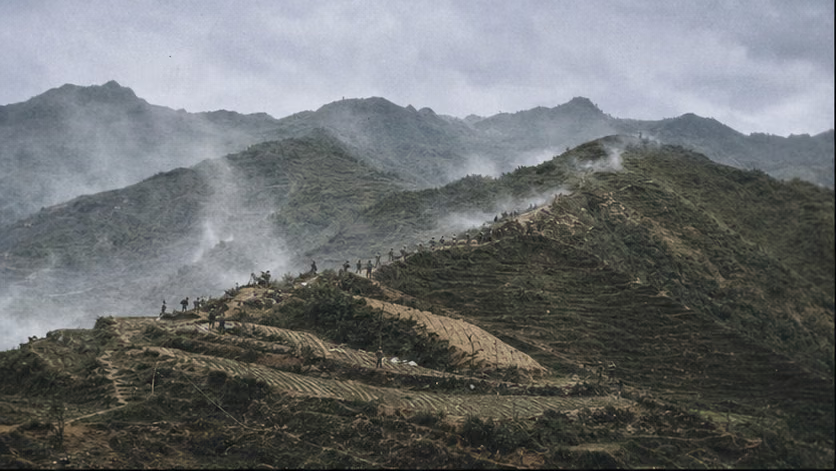
| Item | Content |
|---|---|
| Time | 1932.12 entry into Sichuan – 1935.3 forced crossing of the Jialing River and westward advance (countering the three-route encirclement: 1933.2–6; countering the six-route encirclement: 1933.11–1934.9) |
| Location | Northern Sichuan: the Sichuan–Shaanxi Soviet Area centered on Tongjiang, Nanjiang, and Bazhong; the Wanyuan line was the decisive ground of the six-route encirclement |
| Belongs to | Agrarian Revolutionary War (for the wider situation, see Agrarian Revolutionary War · Overview) |
| Belligerents | Red Fourth Front Army (Xu Xiangqian, commander-in-chief; Chen Changhao, political commissar; Zhang Guotao in political command; more than 10,000 entered Sichuan and expanded to more than 80,000) / Sichuan Army: in the three-route encirclement, Tian Songyao's forces (about 60,000); in the six-route encirclement, Liu Xiang coordinated 6 routes (about 200,000 on paper, figures vary by account) |
| Result | Both rounds of counter-encirclement ended in victory; after the 1935.3 Jialing River Campaign, the Sichuan–Shaanxi Soviet Area was deliberately abandoned and the army advanced west |
Belligerents
| Item | Red Fourth Front Army | Sichuan Army |
|---|---|---|
| Strength | About 15,000 on entering Sichuan; within 1 year it expanded to 80,000 (recruitment figures vary by account) | In the six-route encirclement, 200,000 on paper; the warlords of each route had different calculations |
| Method | "Contracting the position": withdraw line by line, lengthen the enemy's front, exhaust him, then launch a general counteroffensive -- Xu Xiangqian's signature method | Advance by separate routes; in a long fight, each force preserved its own strength |
| Terrain advantage | The Daba Mountains were rugged, farmland was scarce, and grain was thin -- the base area's ceiling for supporting troops was low | Home ground for manpower and pay, but mutual suspicion among factions |
Terrain and Conditions
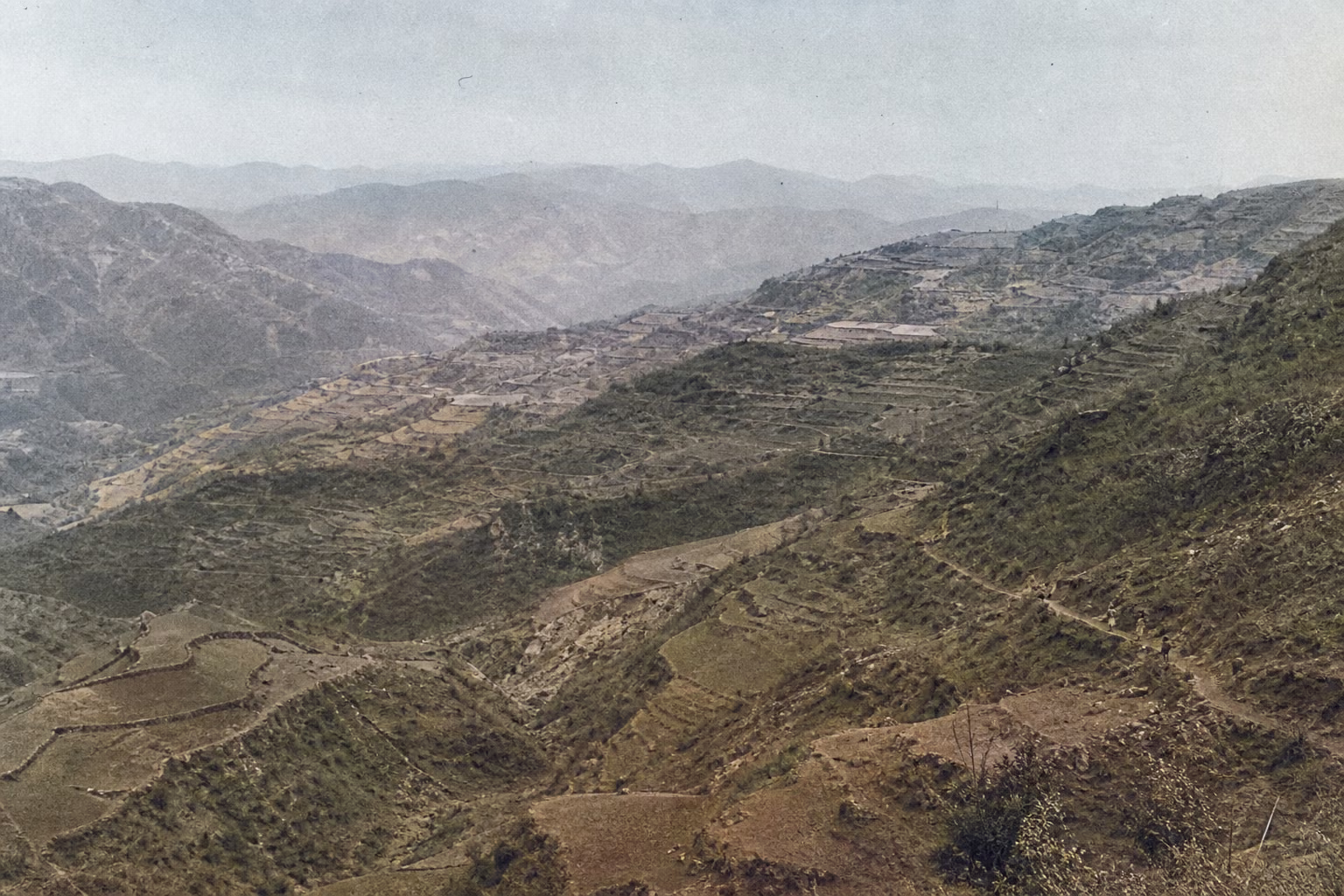
The Daba Mountains of northern Sichuan: poor soil and poor people, long burdened by opium, harsh levies, and extortion -- the social ground into which the Red Army entered Sichuan (with "Sichuan political corruption" and Paoge society counted together); after the Soviet Area established authority, attacking local tyrants, redistributing land, and recruiting for the Red Army proceeded in parallel ※ (mobilization and coercion coexisted; record both). Sichuan Army factions: Liu Xiang, Tian Songyao, Yang Sen, and Liu Cunhou each held his own defense zone, and the calculations of "suppressing Communists" and preserving one's zone were never the same -- every Red Army counteroffensive struck at that fissure.
Why It Was Fought
At Sujiabu, a defense combined with attacks on relief forces settled the account at 30,000, and the Hubei–Henan–Anhui Soviet Area immediately reached its height (see Battle of Sujiabu). Precisely because of that height, in the summer of 1932 Chiang Kai-shek personally supervised 300,000 troops pressing toward the Dabie Mountains. This time there was no second Sujiabu: the Fourth "Encirclement" Campaign against the Hubei–Henan–Anhui Soviet Area failed, and in October the main force of the Red Fourth Front Army withdrew from the base area, crossed the Pinghan Railway westward, passed over the Qinling and Daba Mountains, marched 3,000 li, and entered northern Sichuan in December. From peak to evacuation, only 1 season had passed.
To take footing in northern Sichuan was to land in the seams between warlord defense zones. Sichuan at this point was not under direct Nanjing administration: Liu Xiang, Tian Songyao, Yang Sen, and Liu Cunhou each held his own zone, and the calculations of "suppressing Communists" and preserving one's zone were never the same; the Daba Mountains were defensible; amid corrupt Sichuan politics, opium, and harsh levies, the people had been driven to extreme poverty. For an outside army of more than 20,000 coming from afar (the number entering Sichuan ranges by account from more than 10,000 to about 15,000, unverified), this place offered mountains to rely on, gaps to exploit, and poor people to mobilize. The Red Army established local government in Tongjiang, Nanjiang, and Bazhong, while attacking local tyrants, redistributing land, and recruiting for the Red Army at the same time.
The decision to enter Sichuan was made at a cadre meeting in southern Shaanxi during the westward move: cross the Daba Mountains, enter northern Sichuan, and rebuild a base area on the spot (meeting name and date unverified). When the decision was made, the intelligence in hand said that the Sichuan Army was fighting an internal war and that northern Sichuan's defense zones were thinly held; what was missing was the livelihood account on the far side of the mountains -- how many troops Tongjiang, Nanjiang, and Bazhong could support would only be known after crossing. That account soon hit bottom: at its height, the Soviet Area had a population of several million (figures vary by account), yet had to support an army and organs of 80,000 full-time personnel; ammunition had no outside aid and depended entirely on capture, so Tian Songyao and then Liu Xiang became the Red Army's "transport corps." Contracting the position was therefore not only a military method but also an arithmetic of grain: draw the enemy deep into barren ground, where his supply line is long and mine is short, while the counteroffensive must come before stored grain runs out. On Liu Xiang's side, the paper strength was 200,000; the troops belonged to different houses and the pay came from separate purses. He took command in the name of "suppressing Communists," but what he sought was to draw the forces of the various lords out of their zones and seize provincial government into his own hands. The dissent remains in memory: before and after Wanyuan, there were front-line disputes over whether to keep withdrawing and in which direction the general counteroffensive should strike, but no original record survives (seen only in memoir accounts, unverified) -- the result of 80,000 made the conclusion on behalf of the victors.
Tian Songyao could not sit by: Tongjiang, Nanjiang, and Bazhong pressed directly into his defense zone, and the rules of the defense-zone system were harder than the grand principle of "suppressing Communists"; for every extra day the outside army stood its ground, he lost another piece of territory. Chengdu organized 2 encirclement campaigns -- in February 1933, Tian Songyao came first with about 60,000 troops in 3 routes; at year's end, Liu Xiang took command and coordinated 6 routes, again with 200,000 on paper (troop figures vary by account). Nanjing was glad to see the Sichuan Army wear itself down, supplied some weapons and ammunition, and controlled matters from a distance (Chiang's relation with the Sichuan situation unverified).
The flaws on both sides lay in plain view. The Sichuan Army advanced by separate routes and, on home ground, had sources of soldiers and pay; but 6 routes meant 6 houses, and in a long fight each preserved its own strength while factions distrusted one another -- every Red Army counteroffensive struck at that fissure. The Red Fourth Front Army held rugged ground, but farmland was scarce and grain thin; the ceiling for supporting troops was low, and it could not sustain a long war of attrition. Xu Xiangqian's method took shape from this: contract the position -- withdraw line by line, lengthen the enemy's front, launch a general counteroffensive after exhausting him, and trade the depth of the Daba Mountains for stored momentum. Neither side had the capital for a quick victory, so once this war began, it lasted 2 years.
Course of the Engagement
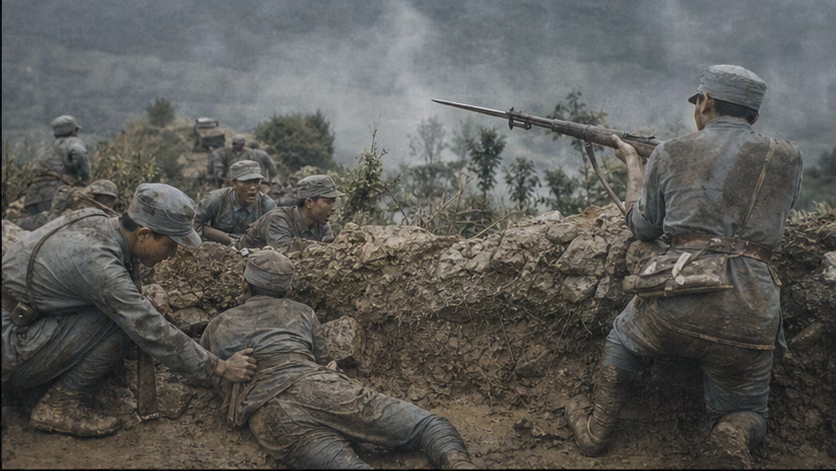
Countering the three-route encirclement (1933.2–6)
| Node | Key points |
|---|---|
| Contracting the position | Withdrew line by line from the outer perimeter of Tongjiang, Nanjiang, and Bazhong, drawing Tian Songyao's forces deep into the mountains |
| Kongshanba counteroffensive, May | Concentrated the main force for a counterattack in the direction of Kongshanba, cut the retreat of the enemy's left column, and annihilated most of it |
| Results | More than 24,000 killed, wounded, and captured (figures vary by account); the Soviet Area doubled in size; the Red Army expanded into 4 armies |
Countering the six-route encirclement (1933.11–1934.9, 10 months)
| Node | Key points |
|---|---|
| Liu Xiang takes command | 200,000 troops advanced in 6 routes; Chiang supplied weapons and ammunition (supply details unrecorded) |
| Line-by-line contraction | Over 10 months of seesaw fighting on the eastern and western lines, the Red Army withdrew step by step to the Wanyuan line -- most of the base area was yielded, and pressure reached its limit |
| Defense of Wanyuan, 1934.6–8 | Positions including Damianshan and Xuanzudian were held to the death: 3 months of decisive defensive fighting under the pledge to "live or die with the position" (details of fighting at each position unrecorded) -- both were positional defenses, but Wanyuan's victory and Guangchang's defeat form a contrast: Wanyuan was a selective last stand after contraction to the limit, with the line of departure for the general counteroffensive directly behind it |
| Huangmaoya general counteroffensive, 1934.8–9 | At the end of August, the Red Army shifted to the counteroffensive; the breach at Qinglongguan and the encirclement at Huangmaoya followed: killed, wounded, and captured totaled more than 80,000 ("80,000 enemy losses" is the common figure, composition unverified) -- one of the highest records for enemy losses inflicted in a single engagement in Red Army military history; the six-route encirclement collapsed completely |
Jialing River Campaign and abandonment of the Soviet Area (1935.3–4)
| Node | Key points |
|---|---|
| Forced crossing of the Jialing River beginning 3.28 | More than 100 boats were built for night crossings, and successive towns along the river were taken (results unverified) |
| Abandoning Sichuan–Shaanxi | The whole army of 80,000 moved west together with the Soviet Area organs -- 2 characterizations stand side by side: to support the Central Red Army's entry into Sichuan (the strategic-coordination view), and Zhang Guotao's westward retreat to avoid battle (the passive view). This is a well-known unresolved case in Party history |
Casualties and Losses
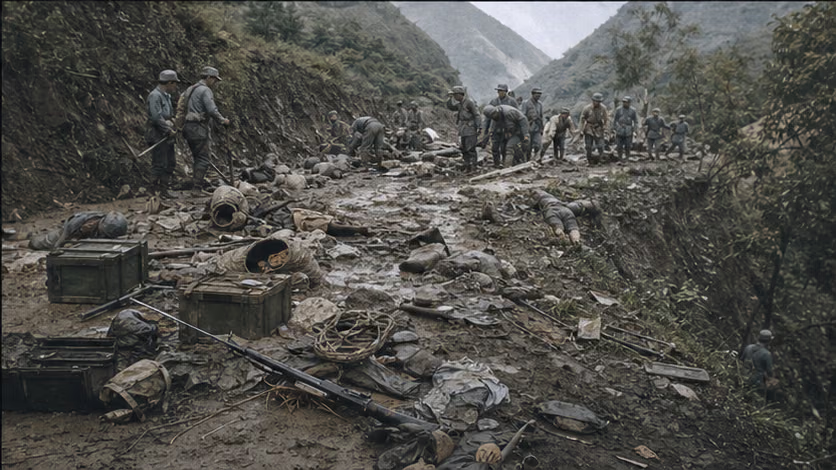
- Sichuan Army: roughly 100,000 annihilated across the 2 rounds (figures unverified).
- Red Army: tens of thousands killed and wounded over 2 years of hard fighting (figure disputed); during Wanyuan, military manpower and civilian labor reached their limits.
- ※ People of the Soviet Area: during the 10-month encirclement, manpower and material resources were totally mobilized, a kind of overdraft captured in accounts such as "the last handful of rice became army grain" (mobilization records unverified); after the Red Army withdrew, Sichuan Army home-return corps retaliated and settled accounts ※ (record unverified) -- once again, "those left behind bore the heaviest weight".
- ※ Soviet Area suppression of counterrevolutionaries: internal purges ran in parallel with military victory (wrongful cases such as Zeng Zhongsheng's belong to this period; see also the overview) -- the structure of outward victory and inward injury reappears.
Aftermath
- Joined forces with the Central Red Army (1935.6, Maogong) -- the subsequent struggle between the First and Fourth Front Armies and Zhang Guotao's separate Central Committee (the split on the grasslands) were the heaviest internal wounds in the history of the Long March (summarized in the overview and cross-referenced with the Long March entries).
- The Sichuan–Shaanxi Soviet Area disappeared, and the Sichuan Army was greatly consumed by this fighting -- 2 years later, when the War of Resistance broke out, 3 million Sichuan conscripts leaving the province went toward another war (see the Fourteen-Year War of Resistance entries: the remote causes of "without Sichuan, no army could be formed" include the mobilization base of these 2 years; mark this as interpretive layer).
- Xu Xiangqian's "contracting the position" method entered military-history textbooks, standing alongside the Central Soviet Area's "luring the enemy in deep" as 1 of the Red Army's 2 major defensive-counteroffensive models.
Accounts of Those Present
- Xu Xiangqian's 10 months: the campaign against the six-route encirclement bore down from beginning to end -- the young commander-in-chief of Sujiabu endured Wanyuan and emerged as a commander on a larger scale; the space and weight given to these 2 years in his later memoirs (relevant chapters of Historical Retrospect).
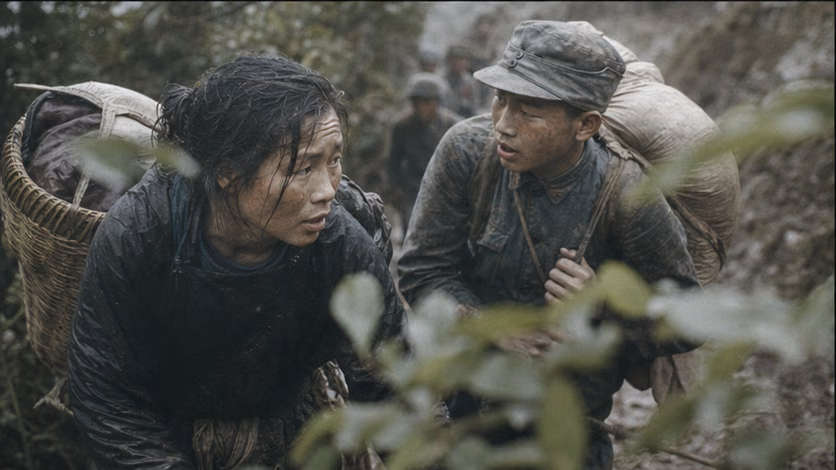
- Wanyuan's women's transport teams: the concrete form of total mobilization across the whole area -- lines of women and children carrying grain up the mountains (record unverified), the human shape of the 3 words "base area."
- The night at Huangmaoya: the night march in which the general counteroffensive inserted through and cut the enemy's retreat -- 10 months of withdrawal were reversed within a few nights, the rhythmic art of "contracting" and "releasing."
- The abandoned towns: Tongjiang, Nanjiang, and Bazhong, preserved through 2 years of fighting, were taken away by a single decision for the whole army to leave -- the glance of soldiers looking back at the base area (literary layer, not part of the factual main text; only this image-thread is retained here).
The Ground

- Depth of the Daba Mountains: the spatial account of line-by-line withdrawal -- with every line yielded, the enemy supply line lengthened by 1 measure and the point of my counteroffensive drew nearer by 1 measure; "contracting the position" is a textbook case of trading space for momentum.
- Wanyuan's Damianshan: a mountain complex of decisive defensive positions -- reverse slopes, echeloned works, and night counterattacks (with Hengyang and Guangchang, it forms 3 samples of a "last stand," whose conditions for success and failure can be compared).
- Jialing River: the riverine battle space of 100 boats crossing by night, and also the door of "leaving."
How Each Side Records It
- Communist canon: a main chapter in the military history of the Red Fourth Front Army; because of the Zhang Guotao problem, its narrative long remained understated, and only after Xu Xiangqian's memoirs were published did it gradually gain its place -- the problem of a memory discount for the "history of the Second Front Army" returns here (as with Battle of Sujiabu).
- Sichuan Army and local accounts: Sichuan people record this major battle in the late defense-zone system: conscription of labor, grain taxes, and "suppressing Communists" levies ※; Liu Xiang used the campaign to integrate Sichuan politics (the beginning of unified provincial government), while local history keeps another ledger.
- Scholarship: research proceeds simultaneously on the figures for enemy losses inflicted, the decision to abandon the Soviet Area, and the limits of social mobilization in the Soviet Area.
Disputes and Sensitivities
- The composition of "80,000 enemy losses" (proportions killed, wounded, and captured) remains unverified.
- The characterization of abandoning Sichuan–Shaanxi -- strategic coordination and passive battle avoidance stand side by side; it touches the evaluation of Zhang Guotao, so mark the layer.
- Wrongful suppression cases and military victory occurred in the same period -- do not narrate them separately.
- The coercive side of recruitment and mobilization ※ -- write it together with the voluntary side.
Sources and Open Questions
Sources: A Military History of the Fourth Front Army of the Chinese Workers' and Peasants' Red Army; Xu Xiangqian, Historical Retrospect; materials on the history of Sichuan warlords (compiled in Materials on the History of Sichuan Warlords); local Party-history materials from the Sichuan–Shaanxi Soviet Area.
Open questions: respective troop strengths and results for both sides across the 2 rounds of encirclement, by differing measures; details of fighting at each Wanyuan position; results of the Jialing River Campaign; documents on the evacuation decision; records of home-return corps retaliation; timeline of wrongful suppression cases; name and date of the meeting deciding entry into Sichuan; figures for the Sichuan–Shaanxi Soviet Area's population and support ceiling; memoir source for the front-line disputes before and after Wanyuan; documents on Liu Xiang's appointment as Sichuan "bandit-suppression" commander-in-chief and the deployment of the six-route encirclement.
All images on this site are AI-generated depictions. They are not historical photographs, not primary sources, and do not depict any real individual.