Engagement Archive · Crossing of the Chishui River
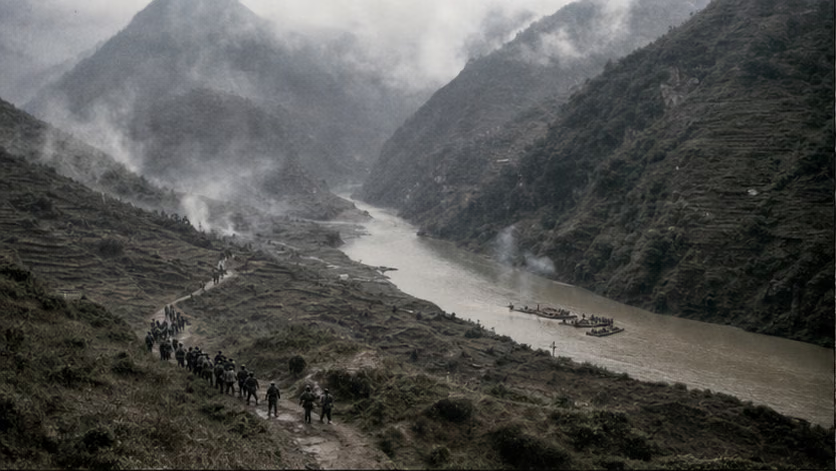
Thirty thousand Red Army troops were blocked by hundreds of thousands of Nationalist forces in the mountains along the borders of Sichuan, Guizhou, and Yunnan; in four months they crossed the same Chishui River four times, traced a wide arc, and walked out of the encirclement -- exhausted, badly reduced, but out.
Engagement Data
| Item | Content |
|---|---|
| Time | Around 1935.1.19 – 3.22; the four crossings themselves lasted about two months. Including the prelude (the forced crossing of the Wu River in 1934.12 and the occupation of Zunyi in 1935.1), it begins from 1934.12 |
| Place | The borderlands of Guizhou, Sichuan, and Yunnan; the upper and lower reaches of the Chishui River, Loushan Pass, Zunyi, and the Maotai line |
| Affiliation | Agrarian Revolutionary War · Long March (Central Red Army / First Front Army segment) |
| Maneuvering side | Central Red Army (First Front Army), under the command of the Central Revolutionary Military Commission; after the Zunyi Conference, military command was handled by a command group composed of Mao Zedong and others (organizational details unrecorded) |
| Pursuing and blocking side | KMT central armies (forces under Xue Yue, Wu Qiwei, Zhou Hunyuan, and others) and regional military systems including the Sichuan, Guizhou, and Yunnan armies |
| Result | The Red Army broke out of the encirclement, crossed the Wu River southward, advanced west into Yunnan, and shook off the main pursuing forces; but its strength had fallen sharply from more than eighty thousand at departure to around thirty thousand (including cumulative losses since Tongdao and the Xiang River; see the basis used in "Casualties and Losses") |
Belligerents
| Item | Maneuvering Side | Pursuing and Blocking Side |
|---|---|---|
| Strength | Around 30,000 before and after the Zunyi Conference (after the Battle of the Xiang River, the force had fallen sharply from 86,000 to this level; this is the common basis, details unrecorded) | Around 400,000 on all routes combined (KMT deployment basis, including Sichuan, Guizhou, and Yunnan regional forces, unverified) |
| Firepower | Rifles, a small number of machine guns and mortars; ammunition replenished through captures | The central armies were relatively well equipped; regional military systems varied. Aerial reconnaissance was available |
| Supply | No rear area; grain requisitioned locally (for taking from villages along the route, see "Casualties and Losses" ※) | Rear areas and traffic lines existed, but mountain supply was also difficult |
| Mobility | Entirely on foot, often several dozen li a day over a long period, with extreme exhaustion | Able to use roads and railways, but heavy equipment could not deploy in the mountains |
Terrain and Conditions
(For the larger situation -- the failure of the Fifth Counter-"Encirclement" Campaign, the strategic background of the Long March, and the Zunyi Conference -- see *Agrarian Revolutionary War · Overview*; this article covers only the Sichuan-Guizhou-Yunnan borderlands.)
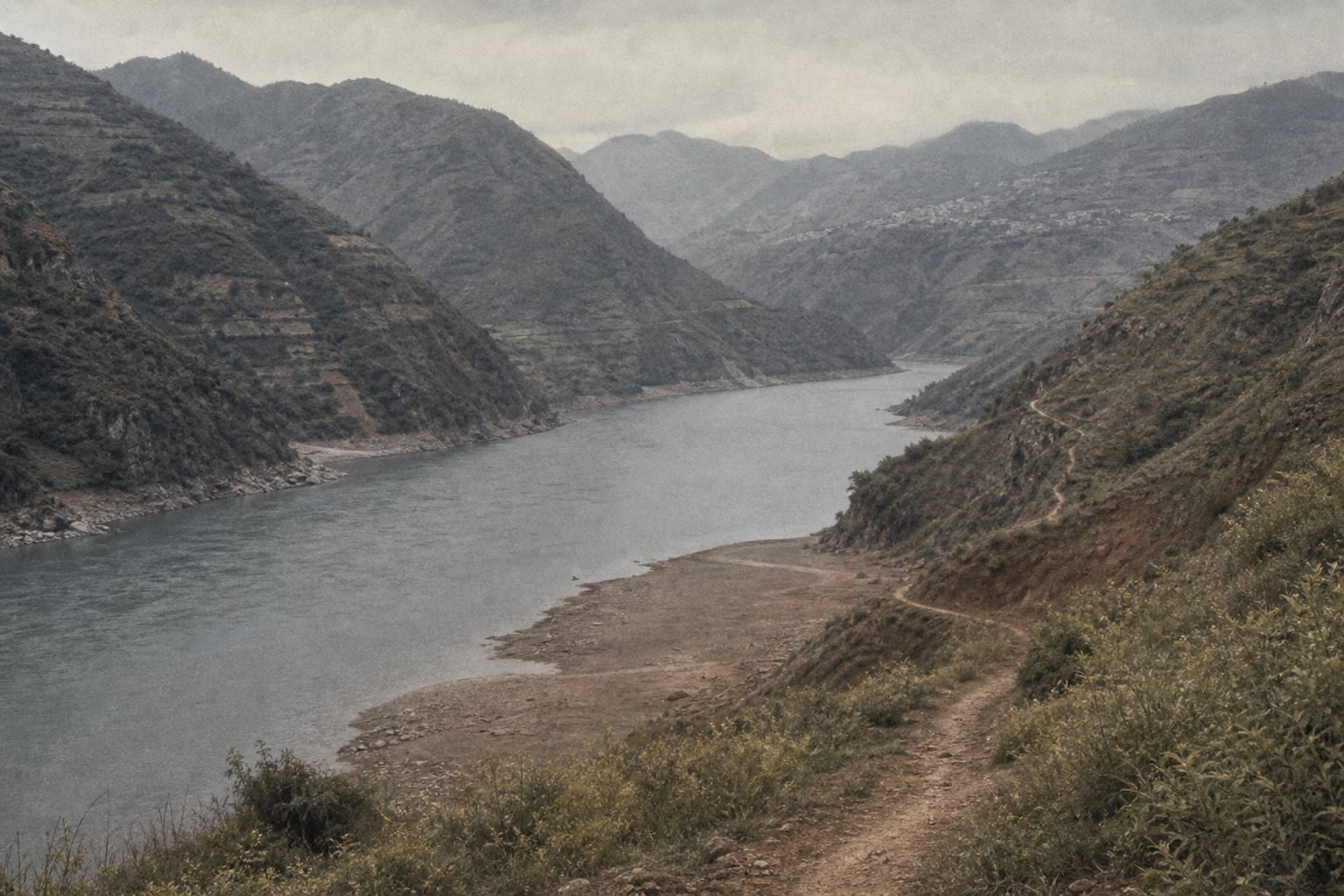
Sichuan-Guizhou-Yunnan borderlands: The Chishui River runs through folded mountains on the northern edge of the Yunnan-Guizhou Plateau. The mountains on both banks are high, the valleys deep, roads few, and ferry crossings the lifelines. Zunyi and Maotai were both market towns in northern Guizhou; Maotai was famous for its liquor. In this region, warlord power overlapped: Wang Jialie's Guizhou army was weak, Liu Xiang's main Sichuan army blocked entry into Sichuan, and Long Yun's Yunnan army guarded the gateway to Yunnan. Several regional armies each guarded their own defense zones and each had their own calculations; coordination was unstable from the start.
Social conditions: Northern Guizhou was long known as poor. A popular saying held that there was "no three li of level ground, no three days without rain, no person with three fen of silver" (period of circulation of the saying unverified). When the Red Army entered, its discipline was stricter than that of the government armies, and its propaganda about striking local tyrants and distributing floating wealth won support among some poor people; at the same time, a large army passing through and requisitioning grain remained a heavy burden on local villages (see "Casualties and Losses" ※).
Why It Was Fought
Seven days on the Xiang River left more than thirty thousand of the original 86,000 (see *Battle of the Xiang River*). The tuition paid in blood bought two things: jars and pots were buried locally, and the column was lightened from then on; the original direction, north toward western Hunan to join the Second and Sixth Red Army Corps, was acknowledged as a dead end -- Chiang Kai-shek was already waiting there with a net. In 1934.12, the two meetings at Tongdao and Liping redirected the march to Guizhou (for the meetings, see *Agrarian Revolutionary War · Overview*). At the end of the year the Red Army forced the Wu River, and on January 7, 1935, it took Zunyi by surprise. In mid-January, the Zunyi Conference reorganized military command.
The commanders had changed; the predicament had not. About thirty thousand men, no rear area, ammunition dependent on capture, grain and fodder gathered along the road, and on every side pursuing and blocking armies totaling around 400,000 (deployment figures vary by account). To stop was to be encircled; the only way to live was to find gaps while moving. The gaps did exist, lodged in the seams between the opponents' own calculations: the Sichuan-Guizhou-Yunnan borderlands were the junction of warlord defense zones. Liu Xiang's Sichuan main force was guarding against the Red Army entering Sichuan; Long Yun's Yunnan army guarded the gate to Yunnan; Wang Jialie's Guizhou army was the weakest. Several forces each held their own defense zone and each had their own calculations; coordination was unstable from the start, and the roads the Red Army could take lay where those calculations contradicted one another.
After the Zunyi Conference the intended direction was originally clear: cross the Yangtze River northward and join the Fourth Front Army. Chiang's objective was also clear: encircle and annihilate these thirty thousand men on the Sichuan-Guizhou-Yunnan border. Neither plan was realized -- this was where the Crossing of the Chishui River came from. It was not a predesigned "masterstroke," but a series of maneuvers forced by the defeat at Tucheng and the frustration of the plan to enter Sichuan: crossing once, then again, changing direction while on the move. In hindsight it looks like drawing the enemy about; at the time it was taking one step and then seeing the next. This section does not evade that.
Neither side had complete intelligence. The Red Army could see the calculations of the regional military systems: the Sichuan army guarded Sichuan, the Yunnan army guarded Yunnan, and the Guizhou army looked to itself, with defense zones taking priority over encirclement. It could not see the true strength of the Sichuan army: at Tucheng, Guo Xunqi's force was assessed as four regiments, but what it ran into was a hard opponent of more than six regiments (misassessment bases vary by account), and the plan to cross the Yangtze northward was canceled on the spot. Chiang could see the map: thirty thousand men, no rear area, and roughly 400,000 pursuing and blocking troops around them. He could not see where those thirty thousand men would go next -- between the four crossings the Red Army repeatedly changed direction, and every change forced the pursuing and blocking armies to reorder their deployment; in the mountains, one such reordering meant several days. The material account was equally harsh for both sides: the Red Army had no rear, grain came by requisition, ammunition by capture, river crossings by commandeered door planks and wooden boats, and in four months of marching several dozen li a day, more men fell out than were killed in battle; the pursuing and blocking armies had railways and roads, but the battlefield was in the mountains, heavy equipment could not deploy, and regional forces were unwilling to lend their defense zones to others.
Dissent also left a record. After the second crossing of the Chishui and the recapture of Zunyi, at the mid-March Gouba meeting, the majority favored attacking Daguxinchang, while Mao Zedong alone opposed it and his view was rejected; that night he went to persuade Zhou Enlai, and the next day's meeting rescinded the order (meeting date and voting details unverified). After this, military command was handled by a three-man group of Zhou Enlai, Mao Zedong, and Wang Jiaxiang (time and occasion of its establishment vary by account). The troops' complaints were equally real: "too much marching, too little fighting" -- several months later, before the Huili meeting, Lin Biao wrote a letter demanding a change in military command (see *Agrarian Revolutionary War · Overview*), speaking to the same account.
On January 19, the Red Army left Zunyi and moved north, toward the Yangtze River.
Course of the Engagement
| Phase | Time | Main Points |
|---|---|---|
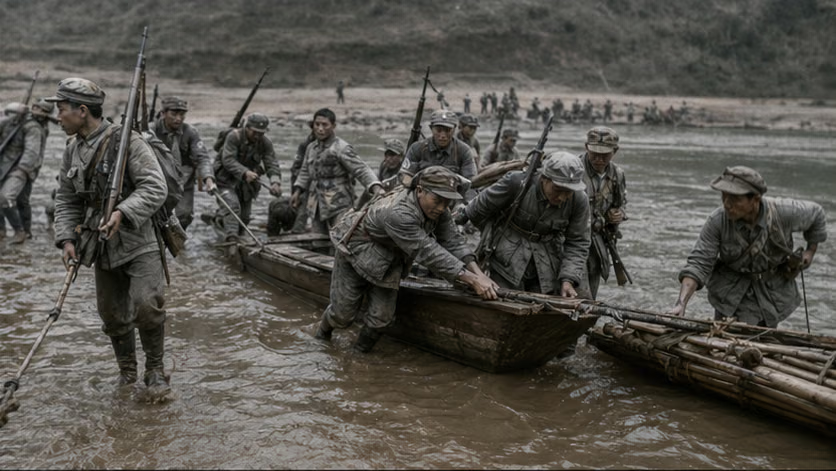
| Prelude: forced crossing of the Wu River | Late 1934.12–early 1935.1 | The Guizhou army deployed along the river; the Red Army used bamboo rafts and wooden rafts to force crossings and break through at ferry points such as Huilongchang and Jiangjiehe (specific dates for each crossing vary by account), opening the route toward Zunyi |
| Occupation of Zunyi | 1935.1.7 | Took Zunyi by surprise; the Guizhou army withdrew north. 1.15–17 Zunyi Conference (for the conference itself, see *Agrarian Revolutionary War · Overview*; here it is noted only briefly) |
| Battle of Tucheng | 1935.1.28 | At Qinggangpo, encountered Guo Xunqi's Sichuan army force. Intelligence judged it to be "four regiments"; it was in fact more than six regiments, with reinforcements continuing to arrive (troop misassessment bases vary by account). The assault failed, and Zhu De personally went to the front to supervise the fighting (figure disputed). The Red Army voluntarily withdrew from the battle -- it lost the fight, and only then came the first crossing |
| First crossing of the Chishui | 1935.1.29 | Crossed the Chishui westward from ferry points including Tucheng and Yuanhouchang, entering southern Sichuan. The original plan to cross the Yangtze northward and join the Fourth Front Army was abandoned because the Sichuan army tightly blocked the river line |
| Zhaxi reorganization | Early 1935.2 | At Zhaxi in Yunnan (today's Weixin), the force was reduced and reorganized, combat companies were strengthened, and offices were streamlined |
| Second crossing of the Chishui | 1935.2.18–21 | Unexpectedly turned back east, crossed the Chishui again from ferry points including Taipingdu and Erlangtan, and reentered Guizhou |
| Loushan Pass and recapture of Zunyi | 1935.2.25–28 | Took Loushan Pass on 2.25–26; recaptured Zunyi on 2.28; routed most of two divisions of Wu Qiwei's pursuing central-army force (combat result figures vary by account) -- the first major victory since the Long March began. Mao Zedong's "Yi Qin'e · Loushan Pass," with the lines "green mountains like the sea, the setting sun like blood," was composed at this time (dating of the poem unverified) |
| Third crossing of the Chishui | 1935.3.16–17 | Crossed westward from the Maotai ferry point, entered southern Sichuan, and feinted as if to cross the Yangtze northward, drawing Sichuan and Yunnan forces westward to block it |
| Fourth crossing of the Chishui | 1935.3.21–22 | Suddenly turned back, crossed eastward in secrecy from ferry points including Erlangtan and Taipingdu, and then crossed the Wu River southward (late March–early April, dates vary by account), threatening Guiyang directly |
| Drawing out the Yunnan army | Early 1935.4 | Chiang Kai-shek was in Guiyang supervising the campaign and urgently called the Yunnan army eastward to reinforce it; the Red Army took advantage of the opening and advanced west into Yunnan. The statement "so long as we can draw the Yunnan army out, that is victory" is attributed to Mao Zedong (source unverified) |
Casualties and Losses
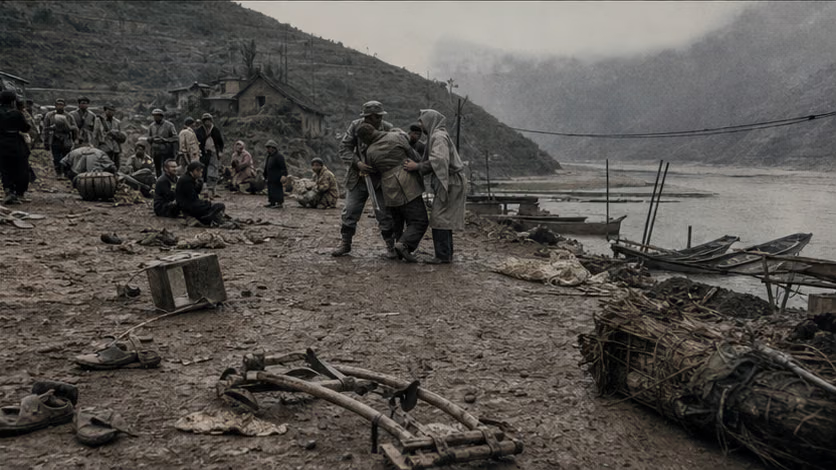
- Red Army combat casualties in this stage were relatively limited, but non-combat attrition was extremely heavy: four consecutive months of high-intensity mountain marching, with straggling, sickness, and desertion causing continuous losses. Around the Zunyi Conference the force numbered about 30,000; before the Dadu River it was already below 20,000 (figures vary by account; see *Jinsha River and Dadu River*).
- Participants and later studies alike point out that the troops were extremely exhausted in this stage, and that the complaint "too much marching, too little fighting" genuinely existed inside the Party and the army (Lin Biao's letter before the Huili meeting demanding a change in military command is discussed in *Agrarian Revolutionary War · Overview*; details unrecorded) -- the inspired stroke of maneuver and the physical price paid by the troops existed at the same time.
- ※ Civilian cost (Red Army side): a force of thirty thousand had no rear area, and grain and fodder depended on requisition along the route -- striking local tyrants, requisitioning or borrowing, and purchasing all existed side by side. Records of comparatively good discipline coexist with records of forced grain collection and press-ganging laborers and guides (local gazetteers of the counties along the route each contain accounts; systematic comparison unverified).
- ※ Civilian cost (pursuing and blocking side and regional military systems): the Sichuan, Guizhou, and Yunnan armies also burned, killed, imposed levies, and pressed laborers within their defense zones (specific areas and scale unrecorded). The people of northern Guizhou bore a double burden between the passage of the two armies. Both sides took from them; this article records both.
Aftermath
- After entering Yunnan, the Red Army moved directly to Jiaopingdu on the Jinsha River (1935.5), broke out of the encirclement by hundreds of thousands of pursuing and blocking troops, and passed the most dangerous blocking stage of the Long March (see *Jinsha River and Dadu River*).
- KMT side: Chiang Kai-shek's plan to encircle and annihilate the Red Army in Sichuan-Guizhou-Yunnan failed, and Xue Yue and other forces gained nothing after months of pursuit. The centrifugal tendency among regional military systems -- "pursue but do not block; defense zones first" -- was fully exposed in this blocking campaign.
- The Crossing of the Chishui River later became a classic paradigm of "mobile warfare" in CPC military history. In his later years Mao Zedong called it the "proudest stroke" of his life (seen in records of conversations with Montgomery; original wording unverified).
Accounts of Those Present
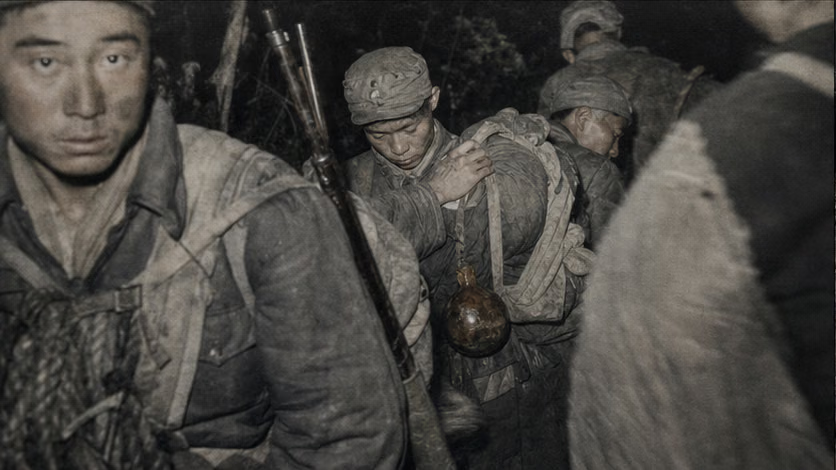
- The misassessment at Tucheng: the Qinggangpo positions faced each other until afternoon before the Red Army realized that the enemy opposite them kept growing in number -- intelligence had judged one Sichuan army brigade as a regiment-level force (misassessment details unrecorded). This battle was the starting point of the "Crossing of the Chishui River": not the opening of a clever plan, but the close of a defeat.
- The liquor at Maotai: the third crossing's ferry point was at Maotai, and the claim that troops used liquor to rub their feet and treat injuries while passing through the town is widely circulated; participants' recollections and later embellishments differ in degree (level of detail unverified).
- Command on a stretcher: Mao Zedong had only recently recovered from malaria at the time (physical condition unverified), and many key decisions were made on the march; Zhou Enlai was the person who made the final decisions in actual military command (wording of the Zunyi Conference resolution unverified).
- The people who walked: during continuous night marches, soldiers slept while walking by pulling on the pack straps of the person in front of them (participant recollection, source unverified); no statistic exists for the exact number who fell behind.
- Local support: examples of ganren (poor people) in northern Guizhou guiding the Red Army, carrying messages, and sheltering the wounded and sick are scattered through local gazetteers and oral histories; specific cases unverified.
The Ground
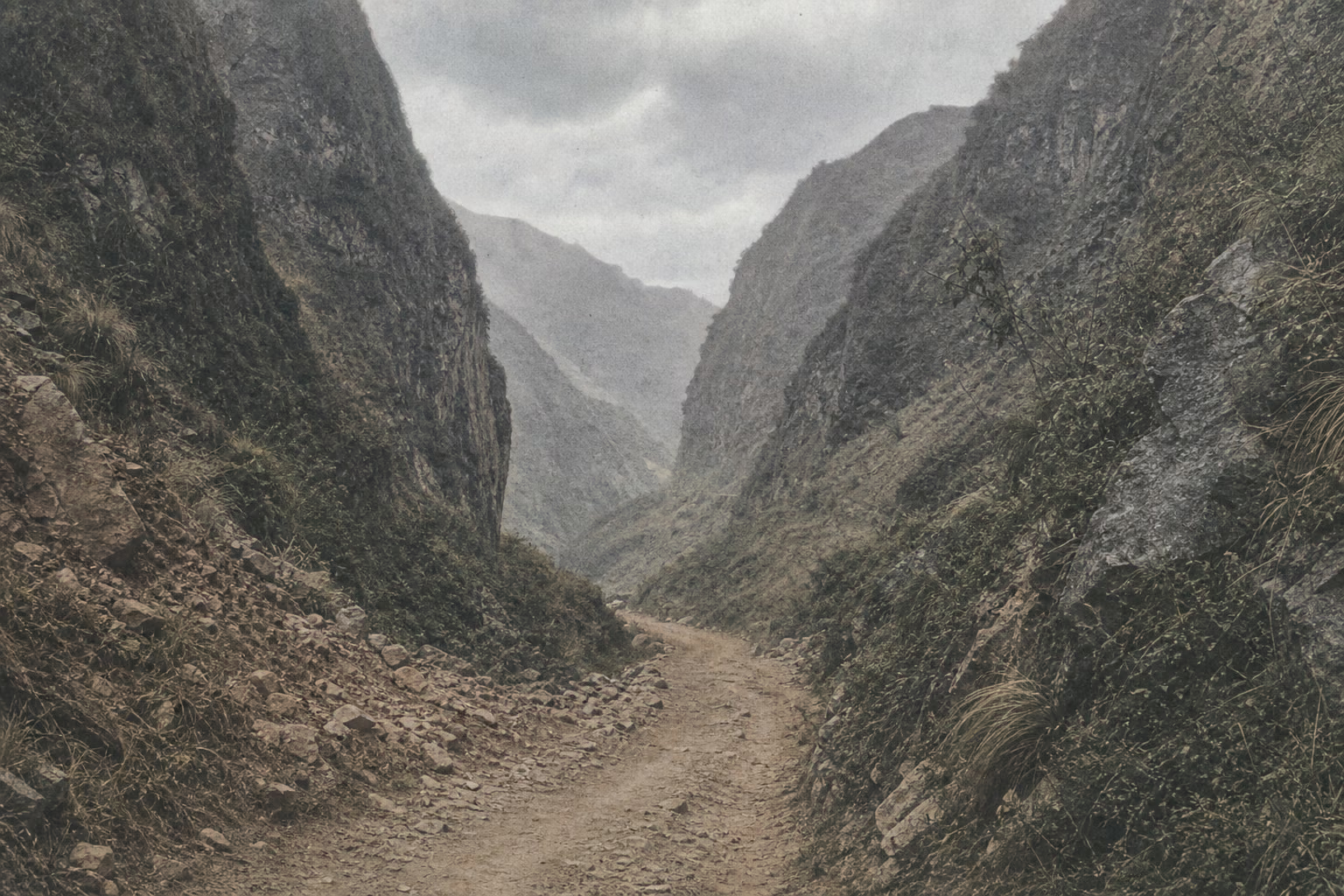
- The Chishui River itself: a deeply cut river valley, with several dozen li of mountain roads often lying between ferry points. To control a ferry point was to control the direction of maneuver; Taipingdu, Erlangtan, Maotai, and Tucheng each had distinct terrain.
- Loushan Pass: the first dangerous pass of northern Guizhou. Two mountains enclose one valley; it is the northern gate of Zunyi -- one pass determined possession of a city.
- Qinggangpo: a gourd-shaped valley east of Tucheng. The Sichuan army held the high ground, while the Red Army attacked uphill -- terrain disadvantage was one of the technical reasons for the failure at Tucheng.
- Space of mountain night marches: no roads, many small paths. At night, a large force stretched into a line several dozen li long on mountain tracks, with head and tail unable to look after one another.
- Maotai ferry point: the river surface was relatively wide and the current gentle, making it the most unhurried of the four river crossings -- the ferry conditions matched the intent to feint.
How Each Side Records It
- Communist canonical narrative (Long March narrative): the Crossing of the Chishui River is the representative work of Mao Zedong's military command, a classic case of "winning by surprise" and "using troops like a god"; the Zunyi Conference established Mao Zedong's military leadership position, and this engagement is direct proof that it "saved the Red Army."
- KMT "pursuit and suppression" narrative: official military histories describe this engagement as the Sichuan-Guizhou-Yunnan blocking of the "Zhu-Mao bandit remnants," acknowledge that the interception failed, and attribute it to poor coordination among regional armies and obstruction by terrain (specific military-history wording unverified); Chiang's diaries and telegrams contain repeated reviews of the failed blocking effort (original texts unverified).
- Later and scholarly reconsiderations:
- Demystifying and restoring the phrase "Mao Zedong used troops truly like a god": studies point out that the four crossings were not a predesigned maneuver, and that passive elements such as the defeat at Tucheng and the blocked entry into Sichuan really existed. The command's exceptional quality lay in "when wrong, change; change quickly," not in foreknowledge (evidentiary level: scholarly characterization; specific literature unverified).
- The intelligence misassessment in the Battle of Tucheng and the basis for reporting results in the Zunyi victory have both been rechecked (level: academic debate with historical basis, each item awaiting verification).
- The reconsiderations above belong to differences at the level of interpretation.
Disputes and Sensitivities
- "Proudest stroke" and "forced maneuver": both interpretations have grounds, and the gap between canon and textual verification is recorded as part of the matter.
- Nature of the losses: Red Army losses in this stage came mainly from exhaustion and falling behind rather than death in battle. The gap between the radiance of the "four crossings" in canonical narrative and the actual consumption borne by the troops is a sensitive point in balancing the narrative.
- Role of the Sichuan army: Guo Xunqi's Sichuan army force fought stubbornly at Tucheng, and also had a record in the War of Resistance Against Japan (he later held a New Fourth Army theater post, and his relations with the CPC were complex; full course unverified) -- figures in regional military systems were not one-dimensional.
- The defeat at Tucheng must be distinguished: the key to the "four crossings" lay in fighting by walking and winning by correcting mistakes, not in "uncanny calculation."
Sources and Open Questions
Known main sources:
- *Record of the Red Army's Long March* (collection of participant writings)
- Memoirs of Nie Rongzhen, Yang Chengwu, and other First Front Army generals (individual volumes unverified)
- KMT side: detailed combat reports on Xue Yue's pursuit-and-suppression forces, Chiang Kai-shek diaries and telegrams (held by Academia Historica in Taiwan, unverified)
- Relevant volumes of Sichuan, Guizhou, and Yunnan local gazetteers (figure disputed)
Open questions: the date and voting details of the Gouba meeting; the time and occasion when the three-man military group was established; the specific dates of each ferry crossing in the forced crossing of the Wu River; the actual strength of the Sichuan army at Tucheng and the details of the misassessment; whether Zhu De personally went to the Tucheng front; the basis for reporting enemy losses in the Zunyi victory; the dating of "Yi Qin'e · Loushan Pass"; the source of the statement "so long as we can draw the Yunnan army out, that is victory"; the original wording of Mao Zedong's conversation with Montgomery about his "proudest stroke"; the basis for Red Army strength figures at each stage; local-gazetteer records of grain requisition and pressed laborers along the route; the original text of Lin Biao's Huili letter; the full course of Guo Xunqi's life.
All images on this site are AI-generated depictions. They are not historical photographs, not primary sources, and do not depict any real individual.