Engagement Archive · Siege of Port Arthur (1904–05)
Fifty thousand Russian soldiers defended a fortress built on Chinese land; the Japanese Third Army spent three general assaults and a mountain of bodies on 203 Meter Hill, pouring more than fifty thousand men beneath its walls — and ten years earlier, this same city had already been massacred once by the army of the same country.
Engagement Data
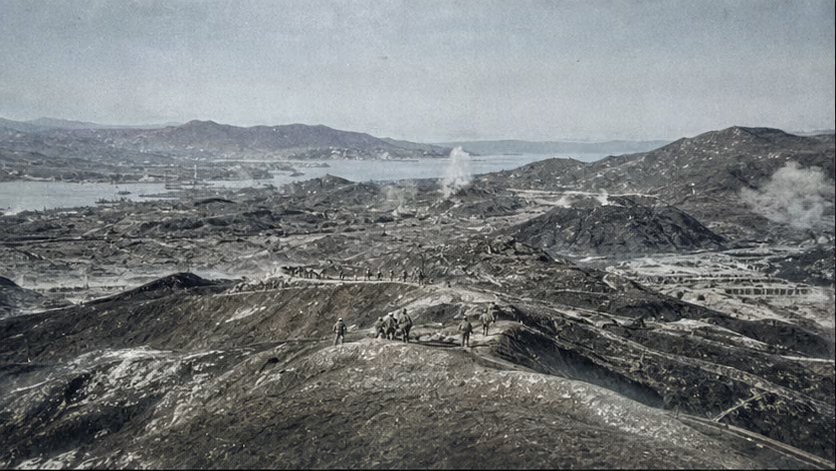
| Item | Details |
|---|---|
| Time | 1904.8 – 1905.1.2 (the siege is counted from the landward isolation in early August; the First Army had already cut off outside relief from 1904.5) |
| Place | Lushun Fortress at the southern end of China's Liaodong Peninsula (Russian name: Port Arthur) |
| Affiliation | Russo-Japanese War (foreign war on Chinese soil) · southern wing of the main land theater |
| Defenders | Russian Kwantung command: commander of the Kwantung Region Stessel, fortress commander Smirnov; the actual pillar of the defense was Major General Kondratenko (killed in December; details unverified) |
| Attackers | Japanese Third Army (commander Nogi Maresuke) |
| Result | 1905.1.2 Stessel opened the city and surrendered; the Port Arthur Pacific Squadron was completely destroyed, and Japan removed a danger to its rear |
Belligerents
| Item | Defenders | Attackers |
|---|---|---|
| Strength | About 44,000–50,000 defenders (including fortress artillery and sailors landed from ships; figures vary by statistical basis and account) | The Third Army had about 80,000, later increased to around 100,000 (figures vary by statistical basis and account) |
| Fortifications | Rebuilt by Russian forces after the First Sino-Japanese War: fortress groups, batteries, trench works, barbed wire, searchlights, and large numbers of machine guns | After encirclement, they dug parallel trenches and approach trenches, advancing by close siege work |
| Firepower | Fortress artillery groups and naval guns landed from the fleet for support | Field guns and siege guns; from November, 280 mm siege howitzers were brought in, later guided by observation from 203 Meter Hill |
| At sea | The Pacific Squadron was trapped inside the harbor and failed in two breakout attempts (including the 8.10 Battle of the Yellow Sea; details unrecorded) | The Combined Fleet blockaded the harbor entrance and harassed it at night with torpedo attacks |
| Supply | Reserves were limited, and scurvy spread (details unverified) | Sea transport supply was close at hand, but ammunition consumption repeatedly exceeded expectations |
Terrain and Conditions
(For the larger setting of the Russo-Japanese War — the breakdown of the Manchuria-Korea exchange, Russia's occupation of Manchuria without withdrawal, and the Qing court's non-belligerent neutrality — see "Russo-Japanese War · Overview.")
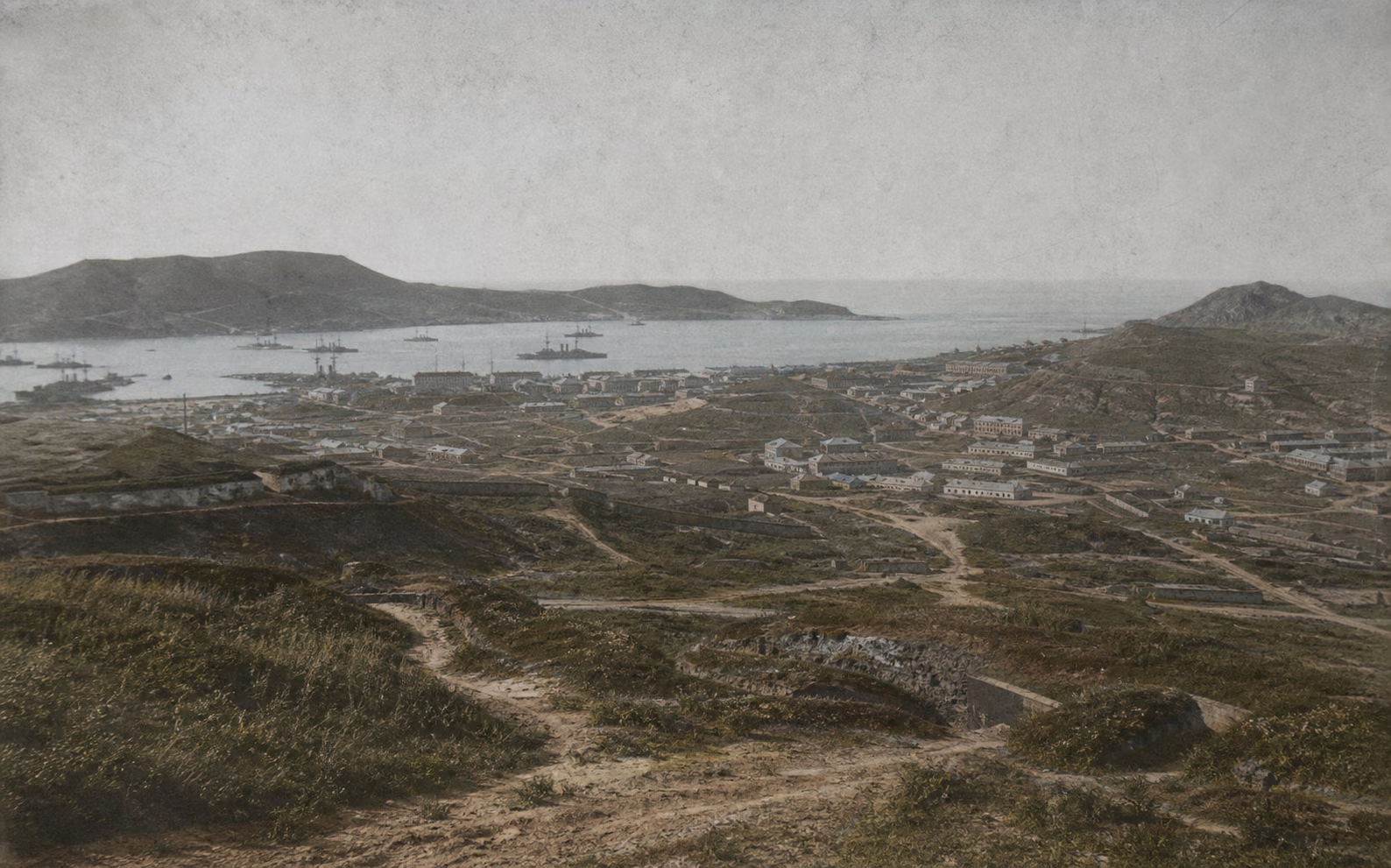
Port Arthur was the base Li Hongzhang had built up for the Beiyang Fleet. In 1894, during the First Sino-Japanese War, it fell to Japanese forces and was then massacred; the remains were buried in the Wanzhong Tomb beneath Baiyu Mountain (erected by the Qing government in 1896). In 1898, Russia leased Port Arthur and Dalian and rebuilt the fortress from the ground up. By 1904, this city had become a battlefield for the third time in ten years: the defenders had changed to Russians, the attackers were still Japanese, and the city and the people beneath it were still a Chinese city and Chinese people. Chinese residents in and around the city were requisitioned, driven away, and caught in artillery fire during the siege; systematic records of their situation remain unverified.※
Why It Was Fought
The cause of this battle was not in Port Arthur, but in 1900. During the Boxer Rebellion, Russia sent more than 100,000 troops under the name of "protecting the railway" and occupied all of Manchuria. In 1902, it signed the Treaty for the Return of the Three Eastern Provinces with the Qing government, promising a phased withdrawal; when the deadlines came, it repeatedly broke its promises and instead reinforced and held its positions (number of breaches and treaty details remain unverified). Japan's ledger went back still further: after the First Sino-Japanese War, the Triple Intervention forced it to disgorge Liaodong; two years later Russia itself leased Port Arthur and Dalian and drove a railway into the Liaodong Peninsula — Japan remembered this for ten years. In 1902, the Anglo-Japanese Alliance was formed, giving Tokyo backing. Japan's bottom line in negotiations with Russia was the "Manchuria-Korea exchange": recognizing Russian control of Manchuria in return for Russia recognizing Japan's exclusive control of Korea. The negotiations dragged on until they broke down in early 1904, and the decision for war was set at an imperial conference in early February. On the night of February 8, Japanese torpedo boats launched a surprise attack on the Russian Pacific Squadron outside Port Arthur; war was declared on February 10 (the sequence of the night attack and declaration of war has long been debated). As for the real owner of the battlefield — the Great Qing issued its edict of "neutrality as a non-belligerent" on the fourth day after the war began, designated the area east of the Liao River as the combat zone, and drew a battlefield for two belligerents on its own territory.
Port Arthur was the first nail that had to be pulled. The fortress sat at the southern end of the Liaodong Peninsula, fixed against the flank and rear of the Japanese line, and the Pacific Squadron trapped in the harbor was a suspended blade. Unless it was removed, the main force of the Manchurian Army could not go north with full commitment. Japan's overall requirement was a rapid decision: Russia was fed by the single-track Trans-Siberian Railway, and the longer the war dragged on, the more Russian forces would gather in the Liaoyang-Mukden direction. The Third Army was therefore assigned exclusively to the siege, and General Headquarters repeatedly imposed deadlines (deadline telegrams remain unverified). Siege artillery was insufficient, and from November 280 mm howitzers were dismantled from coastal batteries in Japan and shipped over (details of dismantling and transport remain unverified). The Russian calculation was the exact opposite: use the fortress to tie down the enemy for a long period, holding out until the Baltic Fleet arrived and land forces had completed their concentration (details of command disagreements remain unverified). But the Baltic Fleet did not sail until October, and the premise of "holding until" relief lay half a year away. One side traded lives for time; the other traded time for reinforcements — the same fortress, two opposing timetables.
This city also carried an account that neither side counted. In the First Sino-Japanese War of 1894, Japanese forces took Port Arthur and massacred the city, and the remains were buried in the Wanzhong Tomb beneath Baiyu Mountain. In 1898, Russia leased Port Arthur and Dalian and rebuilt the fortress. By 1904, within ten years, this city had become a battlefield for the third time: the defenders had changed to Russians, the attackers were still Japanese, and the city was still a Chinese city.
The fuse fell in August 1904: after the battles of Nanshan and Delisi cut Port Arthur off from the Russian forces at Liaoyang, the fortress stood isolated; on August 19, the Third Army launched the first general assault.
Could it have been avoided? The fleet inside the harbor could have broken out early, and the main Russian army could have thrown everything into relieving the fortress before the encirclement tightened. After two failed breakout attempts and one defeated relief attempt, the fortress's fate was only a matter of time. Even inside the Japanese army, frontal assault did have critics: proposals to besiege without attacking and let the fortress die on its own persisted (record unverified). On the eve of the third general assault, Deputy Chief of Staff Kodama Gentaro went personally to the army to supervise operations (sequence of intervention unverified). At the Qing court there had been another proposal: ally with Japan against Russia and seize the chance to recover Manchuria (proponents of this proposal and source memorials remain unverified). The court's final choice was to watch others fight a decisive battle on its own territory.
Course of the Engagement
| Phase | Time | Key Points |
|---|---|---|
| Landward isolation | 1904.5–7 | After the battles of Nanshan and Delisi, the Second Army cut Port Arthur off from the outside; the Third Army was formed in June and took over the siege mission; in July it compressed the outer perimeter step by step |
| First general assault | 8.19–24 | A frontal assault on the eastern fortress group caused heavy casualties and failed (Japanese casualty figures for this action vary by statistical basis and account) |
| Second general assault | late October | After switching to close siege work, the army attacked again and was still repulsed |
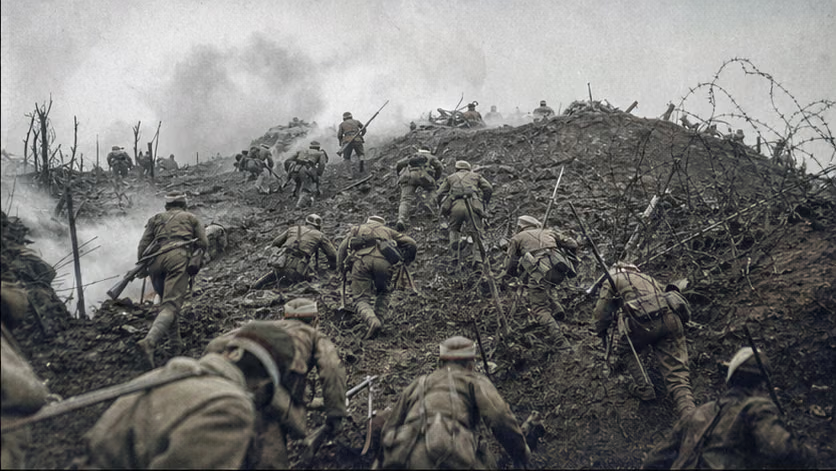
| Third general assault | from 11.26 | A general assault under deadline pressure from the General Headquarters of the Manchurian Army; on 11.27–12.5 the attack shifted to 203 Meter Hill, where repeated charges piled bodies into a mountain before the hill was taken |
| Bombardment of the harbor fleet | December | An observation post was set up on 203 Meter Hill, guiding 280 mm howitzers in high-angle fire over the mountains; the main ships of the Pacific Squadron inside the harbor successively settled on the bottom |
| Opening of the city | 1905.1.1–2 | On 1.1 Stessel sent a letter requesting surrender; on 1.2 the capitulation document was signed, and the defenders became prisoners of war |
Casualties and Losses
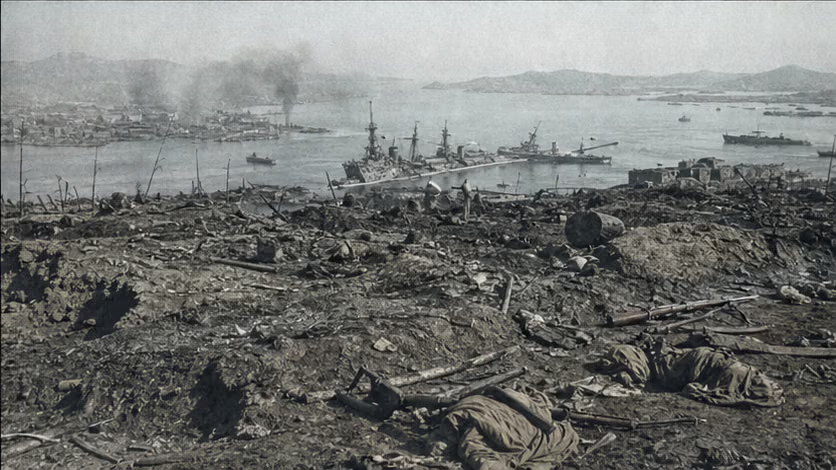
- Attackers: about 59,000 casualties in the siege (Japanese figures; the boundary of whether deaths from wounds and disease are included remains unverified) — the equivalent of grinding away most of an army and then filling it back in.
- Defenders: more than 30,000 casualties and more than 30,000 captured (including wounded and sick personnel; Russian and later research figures vary by statistical basis and account).
- The Pacific Squadron (Port Arthur detachment) was completely destroyed: its vessels either sank inside the harbor or were handed over after surrender.
- Chinese civilians: residents of the city and suburbs killed by artillery fire, requisition, and displacement were not counted.※
Aftermath
- The suspended blade on the southern wing of the Manchurian battlefield was removed; the Third Army went north and caught up with the Battle of Mukden.
- After the war, Stessel was sentenced to death by a Russian military court and later had the sentence commuted (trial and commutation details remain unverified); Smirnov and other generals spent years accusing one another over responsibility for the surrender (full sequence remains unverified).
- Nogi Maresuke returned home carrying the grief of two sons killed in battle (his elder son Nogi Katsunori died at Nanshan, and his younger son Nogi Yasunori died on 203 Meter Hill; details unverified). He wrote the poem "Nireisan" (a homophone for 203 Meter Hill) and described himself in terms close to "one general's success is built on ten thousand withered bones" (original poem text remains unverified). In 1912, on the day of Emperor Meiji's funeral, Nogi and his wife killed themselves.
- Port Arthur Fortress was transferred to Japan as a war trophy and later became the capital of the "Kwantung Leased Territory."
Accounts of Those Present
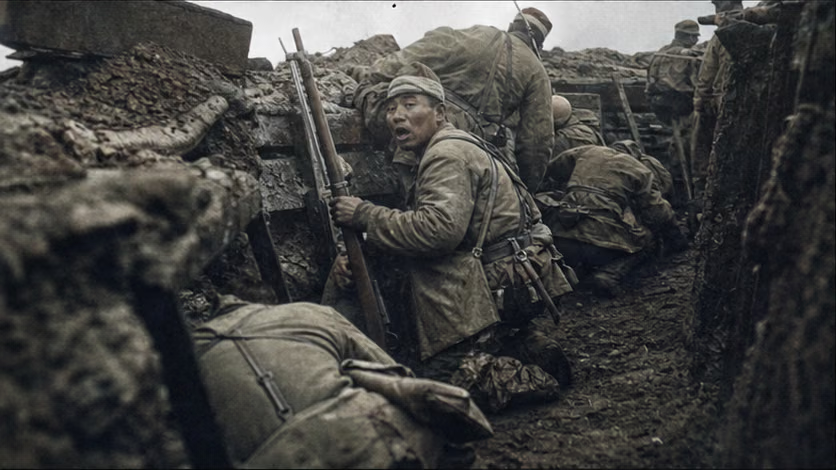
- The name of 203 Meter Hill: its elevation was 203 meters. Russian forces called it "High Mountain"; Japanese forces called it "Nireisan" (from a homophone of 203, using the characters in Nogi's poem; account unverified). Before the attack on the hill, officers received an order to occupy it "in order to observe the harbor" — one sentence, and around ten thousand casualties were poured into it (figure disputed).
- Nogi's two sons: the father was army commander, and both sons died one after the other on the line he commanded: the elder at Nanshan, the younger on 203 Meter Hill. After the war, Nogi asked to accept blame and die; Emperor Meiji did not permit it. Later militarist narratives turned this passage into a specimen of "loyalty to the sovereign," but the lines he himself left behind are closer to the self-description of "ten thousand withered bones" (poem text unverified).
- Kondratenko: the actual pillar of the Russian defensive system, moving among the fortress groups to supervise the defense, was killed by a shell in December (exact date and place remain unverified). After his death, the fortress's will to defend clearly slackened, and a little more than half a month later the city was opened.
- Inside the besieged city: Chinese residents and Russian logistics laborers living in proximity, the order of food distribution, hiding under bombardment — the records are scattered and remain unverified.※
- Between the two times: some people in the city remembered 1894 — the massacre ten years earlier and the siege today; oral materials from two generations of witnesses in the same city remain to be checked.
The Ground
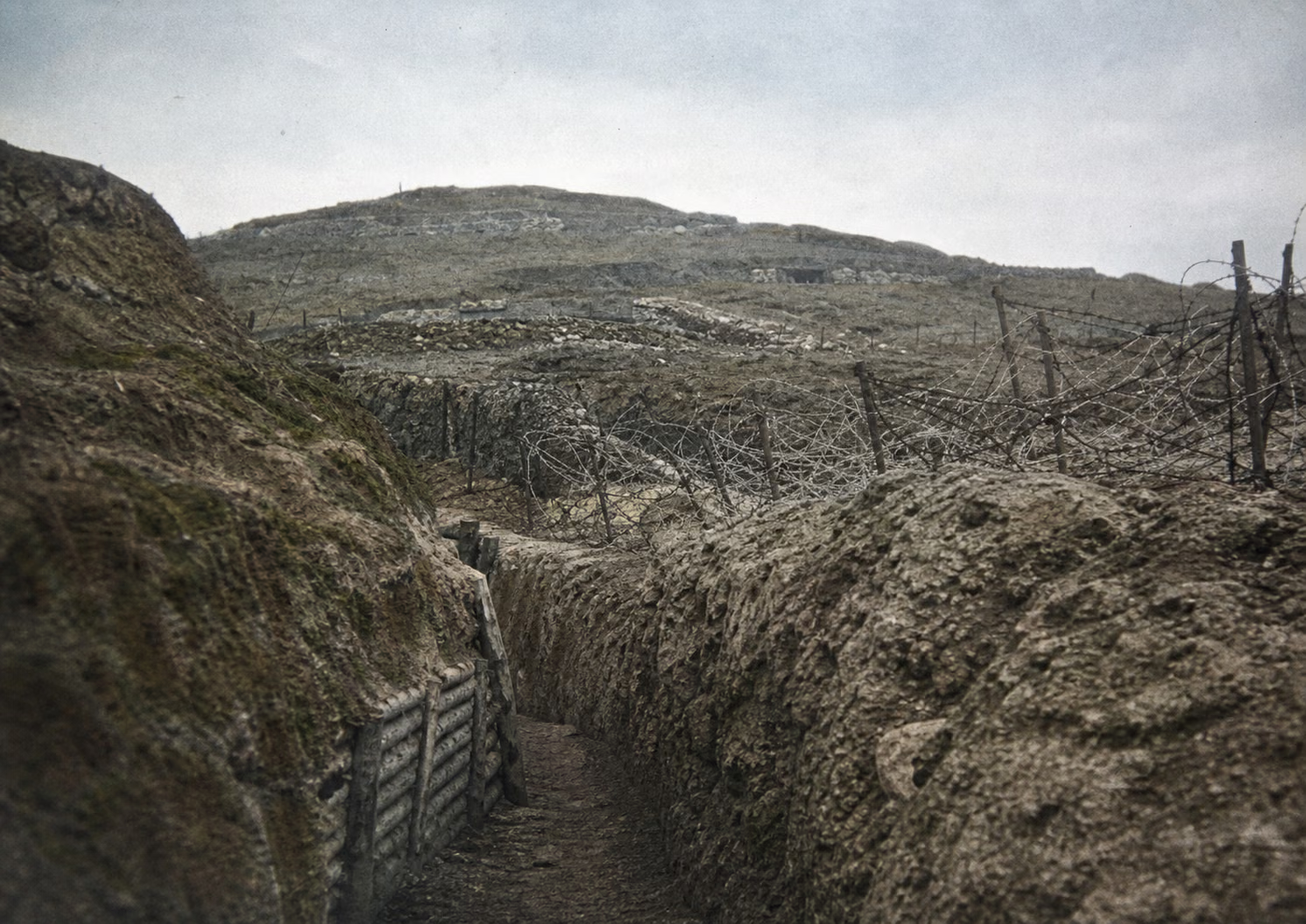
- The fortress was not a single city, but a ring of mountains: the eastern fortress group, Erlongshan, Songshushan, Wangtai, 203 Meter Hill... each high point was an independent killing ground.
- The spatial grammar of attack and defense was vertical: close siege work, approach trenches, parapets, barbed wire, searchlights, and night attacks — Europe's trench warfare ten years later rehearsed itself here in advance.
- The value of 203 Meter Hill was not the hill itself, but "seeing": once one stood on it, the fleet inside the harbor became a target under the gun sight. Observation, direction, high-angle fire — one spotting-and-adjustment loop decided the fate of a fleet.
- The two monuments stacked above and below Baiyu Mountain: below the mountain was the Wanzhong Tomb, erected by the Qing government in 1896 to bury the victims of the First Sino-Japanese War massacre at Port Arthur — Chinese people mourning their own dead on their own land. On the mountain was the "Hyouchu Tower" built by Japan in 1909, honoring Japanese dead from the Russo-Japanese War — later occupiers mourning their war dead on the same mountain. Two wars, two ways of dying, two systems of memory, stacked on the same mountain. This is one of the heaviest places in the whole line of Whence We Came: the mountain remained the same mountain; the people setting up the stele had changed.
How Each Side Records It
- Japanese side: "Port Arthur" and "203 Meter Hill" are core sacred terms in Meiji militarist narrative; textbook material on "human bullets" and "loyal courage" came from here. After the war, Japan built the Hyouchu Tower and Nogi Shrine, and the war dead were enshrined at Yasukuni. The brutality of the siege was also read as proof of the "Japanese spirit."
- Russian side: Stessel was made the scapegoat (death sentence later commuted), while Kondratenko was treated as the true hero. The loss of the fortress and the death of the fleet were viewed as evidence of imperial decay and fed directly into the Revolution of 1905 (wording in different periods remains unverified).
- Chinese side: in general histories of China, this battle is often passed over with one sentence, "Japan and Russia went to war on our territory." Within the city of Port Arthur, the memories of the First Sino-Japanese War massacre and the Russo-Japanese struggle are layered on top of one another; local memory is far thicker than official narrative (oral and local sources remain to be checked).
- Its place in world history: the largest sample of modern fortress attack and defense — barbed wire, machine guns, prototype mortars, and approach-trench work appeared here in concentrated form. European military observers recorded it item by item: whether fortresses could still be defended, whether infantry charges could still be used. The general staffs of many countries began arguing from here until 1914 (locations of observer reports remain unverified).
Disputes and Sensitivities
- Responsibility for opening the city: when Stessel surrendered, a considerable number of capable fighters still remained among the captured officers and men. Whether it was an "early surrender" or a surrender after exhaustion was argued in Russia for years (military court judgment and memoirs from all sides remain unverified).
- Casualty figures: the boundary between the Japanese figure of 59,000 and various research figures — whether sick personnel are included, and whether outlying operations are included — needs to be checked work by work.
- Nogi Maresuke's image: the Japanese narrative's "god of war," his own self-description of "ten thousand withered bones," and the Chinese perspective on the besieger cannot be collapsed into one.
- The spatial image of stacked steles above and below Baiyu Mountain presents, in concentrated form, the juxtaposition of battlefield remains and occupation commemoration.
Sources and Open Questions
Known main sources:
- The Japanese Defense Agency War History Office's Senshi Sosho volume on the Siege of Port Arthur (Japanese official history)
- Memoirs by Russian participants: writings by Smirnov and other defending generals (versions unverified); Russian military court trial records (to be checked)
- Nogi Maresuke's poetry collections and biographical materials (original poem text remains unverified)
- Lushun local gazetteers and establishment files for the Wanzhong Tomb and Hyouchu Tower (to be checked)
Open questions: statistical bases for the strength of defenders and attackers; Japanese casualties in each general assault; date and place of Kondratenko's death; the full sequence of Stessel's trial and commutation; original texts of poems related to "Nireisan" and "one general's success is built on ten thousand withered bones"; details of the deaths of Nogi's two sons; itemized details of the Pacific Squadron vessels sunk in the harbor; systematic records of Chinese residents' situation in Port Arthur during the siege; establishment files for the Wanzhong Tomb on Baiyu Mountain (1896) and the Hyouchu Tower (1909); locations of European military observers' reports on the attack and defense of Port Arthur; records of the imperial conference decision for war in February 1904; deadline telegrams between General Headquarters and the siege army; details of dismantling and transporting 280 mm howitzers from coastal batteries in Japan; the sailing date of the Baltic Fleet and Russian internal debate over "holding until relief arrived"; records of the Japanese army's proposal to "besiege without attacking"; the timing and division of responsibilities in Kodama Gentaro's trip to Port Arthur to supervise operations; proponents of the Qing court proposal to ally with Japan against Russia and sources for their memorials.
All images on this site are AI-generated depictions. They are not historical photographs, not primary sources, and do not depict any real individual.