Engagement Archive · Taiping Northern Expedition
Twenty thousand southern soldiers with no support behind them set out from Yangzhou, drove in one breath to the walls of Tianjin, were surrounded for two years in the bitter cold of northern China, and were annihilated, without a single formation surviving.
Engagement Data
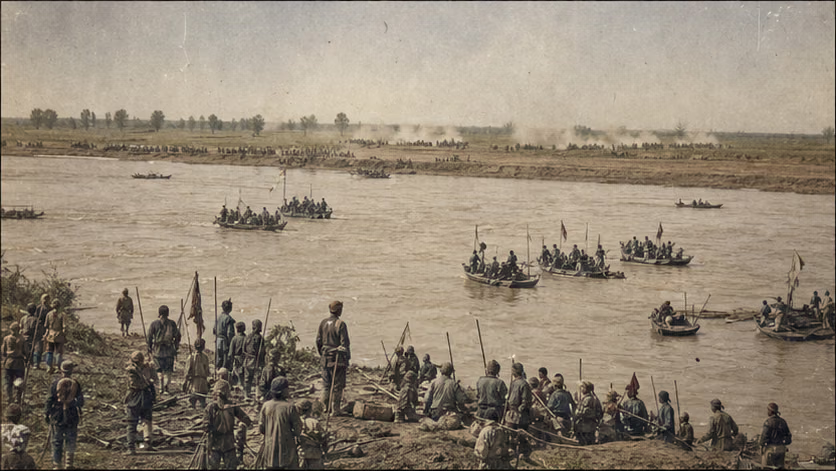
| Item | Details |
|---|---|
| Time | 1853.5 departure – 1855.5 fall of Fengguantun, about two years |
| Place | Set out from Yangzhou, passed through northern Anhui, Henan, and Shanxi into Zhili; endpoint around Jinghai and Duliu southwest of Tianjin, and Lianzhen and Fengguantun in Hebei |
| Belongs to | Taiping and Nian Rebellions · northern strategic thrust carried out at the same time as the Western Expedition (for the overall war, see Taiping Heavenly Kingdom: Overview) |
| Maneuvering side | Taiping Heavenly Kingdom Northern Expeditionary Army (chief commanders Lin Fengxiang, Li Kaifang, Ji Wenyuan) |
| Pursuing and blocking side | Qing forces: imperial commissioner Senggelinqin (with Mongol cavalry as the main force), Shengbao, and Eight Banner, Green Standard, and militia forces along the route |
| Result | 1855.3 Lianzhen fell and Lin Fengxiang was captured; 1855.5 Fengguantun fell and Li Kaifang was captured -- the whole army was annihilated |
Belligerents
| Item | Maneuvering side | Pursuing and blocking side |
|---|---|---|
| Strength | About 20,000 at departure (one account says around 30,000; bases of counting differ, figure disputed), expanded by coerced recruitment along the route, but the old core was worn down as fighting continued | Senggelinqin's and Shengbao's two forces together numbered several tens of thousands; they could draw locally on Eight Banner, Green Standard, Mongol cavalry, and militia forces, with continuous reinforcement |
| Firearms | Mainly cold weapons, with limited heavy matchlocks and locally made cannon, and weak in siege assault | Firearms were superior to the Taiping Army's, but not separated by a generational gap; the advantage lay in the numbers of cavalry and artillery |
| Cavalry | Almost no cavalry; at a comprehensive disadvantage in mobility and reconnaissance on the northern plains | Senggelinqin's Mongol cavalry was the Qing side's field-warfare trump card and the absolute main force in pursuit and blockade across the plains |
| Supply | No rear area and no grain depots; requisitioned grain locally, and after entering Zhili lost both grain and reinforcement | Raised pay locally and received direct supply from the capital; during the encirclement, the side whose logistics failed was the side under siege |
| Climate adaptation | Most soldiers came from Guangdong and Guangxi, Hunan and Hubei, and Anhui; they were unused to the severe cold of the north, and frostbite caused serious attrition (degree unverified) | Fighting on home ground, with no such problem |
Terrain and Conditions
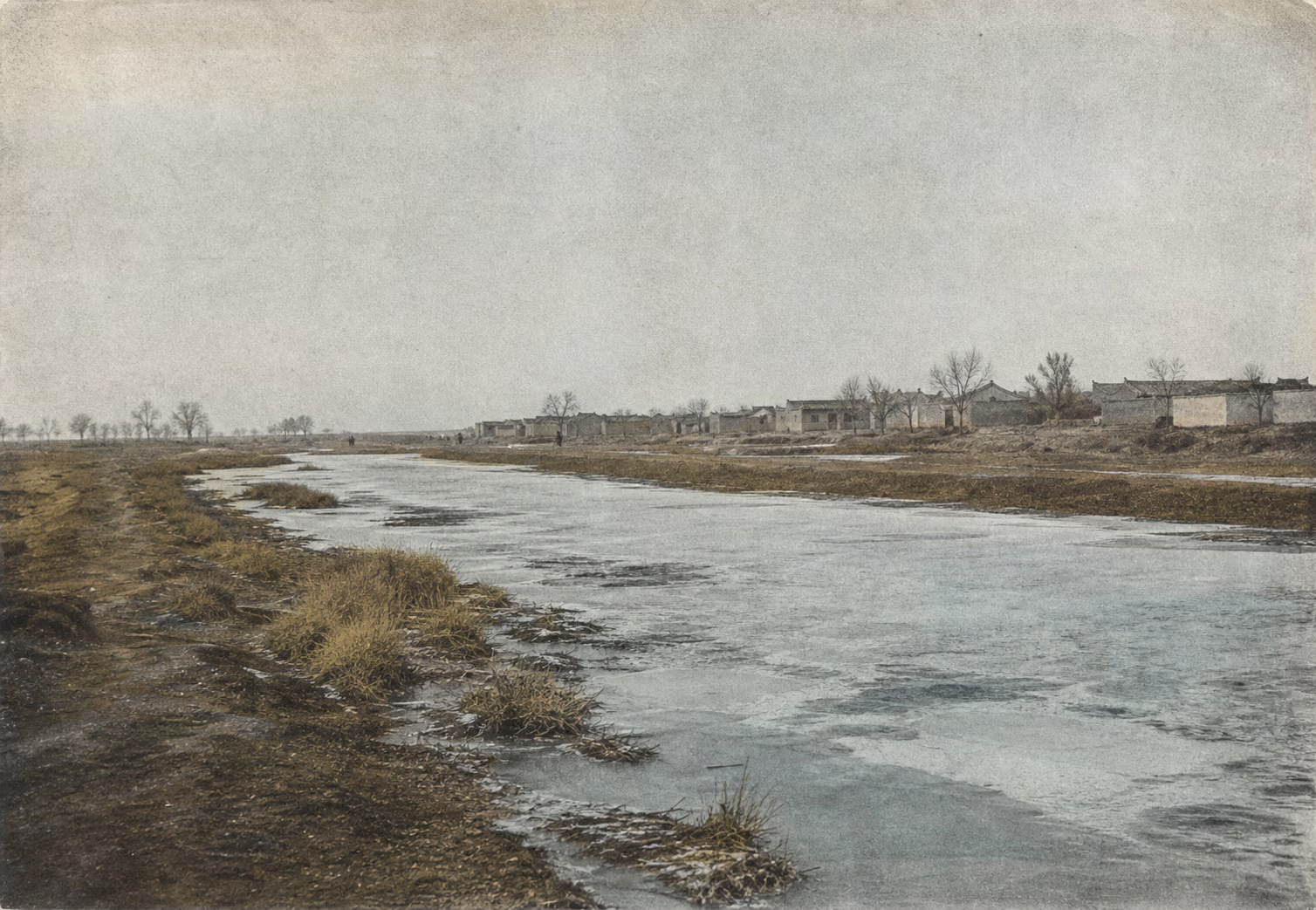
(For the larger situation of the 1850s -- the Qing court's exhausted finances, the rise of local militia, and the simultaneous fixing of the capital at Tianjing and launching of the Western Expedition -- see Taiping Heavenly Kingdom: Overview.)
The Anhui-Henan-Shanxi route: a prelude of war and disorder. Northern Anhui and southern Henan were already Nian activity zones, local militia were just rising, and official control was weak -- the Northern Expeditionary Army could drive forward quickly because the Qing forces along the route had no time to assemble. But this region had suffered repeated disasters for years. Villages and market towns had limited stored grain available for plunder and requisition, and the problem of feeding 20,000 people pressed on this army from the first day. ※ Along the route, the Northern Expeditionary Army coerced civilians into service; "seizing people to fill the army" appears repeatedly in Qing memorials and local gazetteers (specific scale and method unverified), and many of those coerced later died in the encirclements.
Zhili: the strategic ground around the capital, with high walls and difficult approaches. Once they crossed the Yellow River, entered Shanxi, and then turned east into Zhili, the terrain changed from hills to the great North China Plain, and the Mongol cavalry's home ground had arrived. Prefectural and county cities along the route had thick, strong walls. Lacking heavy artillery, the Northern Expeditionary Army could not take large cities and had to bypass them, and its speed advantage was worn down bit by bit. Deep autumn turned into winter. The temperatures were something southern soldiers had never experienced -- the lowlands and frozen rivers near Tianjin became natural works for a war of encirclement.
Why It Was Fought
The Jiangnan and Jiangbei Encampments had only just fixed themselves outside Tianjing. The Taiping Heavenly Kingdom's response was not to remove them first, but to divide its troops and send them far out -- launching the Northern Expedition and Western Expedition at the same time, betting on exterior lines.
This move north had been planted on the day the capital was fixed: when troops reached Jiangning, the two proposals of "going north to strike straight at Yanjing" and "fixing the capital at Jinling" both existed. Yang Xiuqing favored fixing the capital, and the decision was made with one stroke (the process of debate and participants in the capital decision are unverified). The northward plan was not thrown away; it was only reduced in scale -- from the whole army going north to one detached force, whose task was to shake the Qing court's foundation and take Beijing directly. Later usage commonly summarized the order in eight characters: "march by indirect roads, hasten toward Yandu" -- bypass fortified cities, do not covet territory, and drive straight for the capital (these eight characters are a later common summary of the Northern Expedition order; the original documentary source is unverified).
There really was a window of timing: Qing forces capable of field warfare were being held outside Tianjing, official control in northern Anhui and southern Henan was weak, and local militia were just rising. If the army moved fast enough, the Qing forces along the route would have no time to assemble -- speed was the Northern Expedition's entire capital. But several things were missing from this calculation, and each later showed itself: this army had almost no cavalry, so once it turned east into Zhili it entered the North China Plain home ground of the Mongol horsemen; it had no rear and no grain depots, so feeding itself depended entirely on local requisition, while Anhui and Henan had suffered repeated disasters and village stores were thin; most of its soldiers came from Guangdong and Guangxi and from Hunan and Hubei, and were unused to severe northern cold.
When the decision was made, Tianjing itself was also besieged inside the city. The Jiangnan and Jiangbei Encampments were fixed below the walls, the defense of the city needed troops, and the upstream grain route needed troops to seize it -- the Western Expedition and Northern Expedition were launched in the same month, but there was only one portion of capital, divided in three directions. As for the north, Tianjing knew little: how many famine victims and secret-society groups in Anhui and Henan could respond, what weight the Mongol horsemen carried on the plains, and what early-winter cold would mean for soldiers from Guangdong and Guangxi were all questions without reliable intelligence before departure (records of the Taiping Army's pre-departure intelligence work on the north have not been found; unverified). Only one thing could be calculated clearly: the main Qing field forces were being held outside Tianjing, and the farther north one went, the emptier it became. The first half of that judgment was right. Within half a year, the Northern Expeditionary Army crossed four provinces and drove straight into the capital region; what it failed to calculate was the second half -- at the end of that emptiness stood the capital, and to defend the capital the Qing court could spend without stint.
The Xianfeng court's actions confirmed this. When the alarm reached Beijing, the capital was placed under martial watch, and the court established the Capital Patrol and Defense Office to coordinate city defense (specific month and day of establishment unverified). It appointed Prince Hui Mianyu as General-in-Chief by Imperial Command and the Khorchin prince Senggelinqin as assistant minister to supervise the forces in the capital region; Eight Banner, Green Standard, and Mongol banner forces from each league concentrated continuously in Zhili. The treasury was already nearly empty, so the court used donations and lijin to piece together military pay -- in 1853, Lei Yixian first set up lijin at Lixiahe in Yangzhou precisely because of this Jiangbei military expense (the direct relation between the origin of lijin and military expenses is unverified). A force of 20,000 with no rear was betting on the opponent's heart; the opponent put up the manpower of the entire capital region, grain transport, and winter itself.
As for whether the Tianjing side had objections to the Northern Expedition proposal itself, extant records have not shown them (very few Taiping Heavenly Kingdom documents survive; whether objections existed and how they were worded are unverified). On the Qing side, from the alarm to the response, there was no second voice beside fighting -- what they were defending was the capital, and no one dared speak of another course. Later, Tianjing twice sent troops north to reinforce them: Zeng Lichang's force collapsed at Linqing, and Qin Rigang's force turned back midway (course of events unverified) -- the accounts of divided forces could not be recovered in the end.
In May 1853, Lin Fengxiang, Li Kaifang, and Ji Wenyuan led the army out from Yangzhou. This was a classic strategic all-in: using a detached force to gamble on the Qing dynasty's heart -- success would overturn the whole situation, failure would leave 20,000 veterans with no road home.
Course of the Engagement
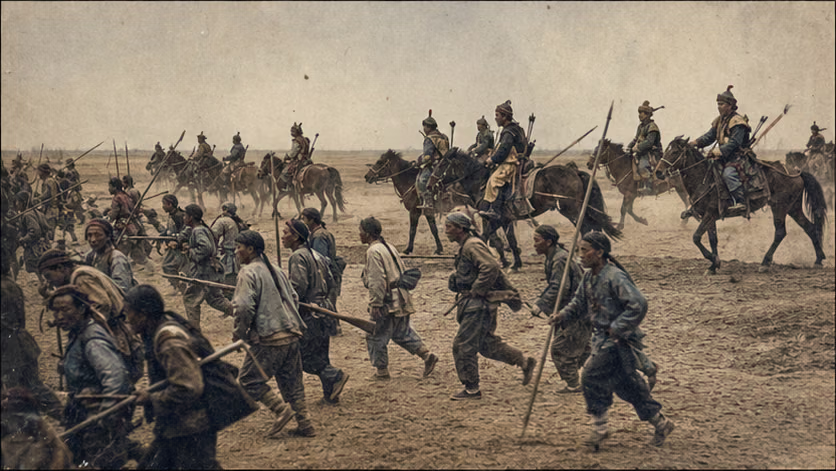
| Stage | Time | Key points |
|---|---|---|
| Departure and rapid advance | 1853.5–6 | Set out from Yangzhou, passed through northern Anhui into Henan; bypassed fortified cities and took indirect roads, moving extremely fast |
| Crossing the Yellow River | 1853.6–7 | Crossed around Sishui (Gongxian); with too few boats, the crossing took time and pursuing troops gradually assembled (crossing point and losses unverified); follow-on troops that failed to cross turned back (details unverified) |
| Entering Shanxi and making the detour | 1853.7–9 | Entered Shanxi, took Pingyang (Linfen) and other places, then turned east into Zhili -- this detour shook off some pursuing troops, but it lost the season and used up the time before winter |
| At the gates of Tianjin | 1853.10 | The vanguard reached Jinghai and Duliu Town, within a short distance of Tianjin; Zhili was shaken and the capital was placed under martial watch. Qing forces cut dikes to release water (record unverified), and severe cold slowed the offensive; the vanguard stopped below the city |
| Jinghai-Duliu standoff | 1853.11–1854.2 | Senggelinqin and Shengbao completed the encirclement; northern cold was unfamiliar to the troops, grain and reinforcement were both cut off, and attrition from freezing and hunger grew day by day. ※ Qing handling of occupied areas and prisoners was harsh, and Qing memorials often use terms such as "execute according to law" and "display the severed head" (Qing original-document language); during the encirclement, civilians were caught between the two sides, and famine spread through villages and market towns in the war zone (specific conditions unverified) |
| Southward withdrawal and breakout | 1854.2–3 | Abandoned Jinghai and Duliu and withdrew south through Fucheng; Ji Wenyuan had already died in battle earlier (time and place unverified); the force withdrew to Lianzhen, while Li Kaifang divided troops and moved south toward Gaotangzhou to meet reinforcements |
| Reinforcements collapse | 1854 spring | Tianjing sent Zeng Lichang north with reinforcements, but the force collapsed at Linqing in Shandong (course of events unverified) -- the last hope of the isolated force at Lianzhen was cut off |
| Lianzhen falls | 1855.3 | With grain exhausted, Lianzhen fell; Lin Fengxiang was captured and taken to Beijing for death by lingchi |
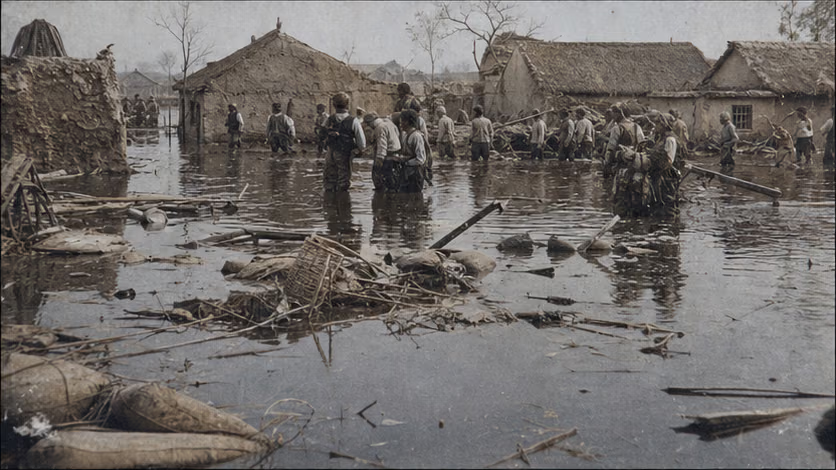
| Fengguantun flooded | 1855.5 | Senggelinqin diverted canal water to flood Fengguantun; Li Kaifang led the remnants out to surrender and was captured, then taken to Beijing for death by lingchi. The whole army was annihilated |
Casualties and Losses
- Maneuvering side: the roughly 20,000 men of the Northern Expeditionary Army were annihilated; there is no reliable itemized count of those killed in battle, frozen or starved, captured, or executed (total figures vary by basis); not a single formation survived. Civilians coerced along the route and surrendered soldiers mostly perished with them.
- Pursuing and blocking side: Qing casualties have no aggregate figure, and there are no statistics for the military expenses of the two-year blockade or the destruction in the Zhili and Shandong war zones (details unverified).
- Civilians: along the route through Anhui, Henan, Shanxi, and Zhili, grain requisition, coerced recruitment, military disaster, and battlefield flooding had a wide reach, while the records are scattered (specific conditions unverified).
- Political cost: the capital was shaken, and the Xianfeng court was at one point said to have discussed moving the capital (this account is widely circulated; original source unverified).
Aftermath
- The Taiping Heavenly Kingdom never restored the Northern Expedition direction. From then on, its military center of gravity lay entirely in the Western Expedition and along the Yangtze -- the loss of 20,000 veteran soldiers was one of the heaviest early cuts to the Taiping Army's vitality.
- Senggelinqin became the Qing court's most relied-upon commander through this engagement; eight years later he died on the battlefield while suppressing the Nian.
- Qing defense and militia reorganization in Zhili and Shandong accelerated from this point (specific measures unverified).
- Shengbao spent years supervising the fighting as "imperial commissioner" without success; after this he repeatedly rose and fell, and was finally ordered to commit suicide -- the official account after the war was longer than the battlefield account (details unverified).
Accounts of Those Present
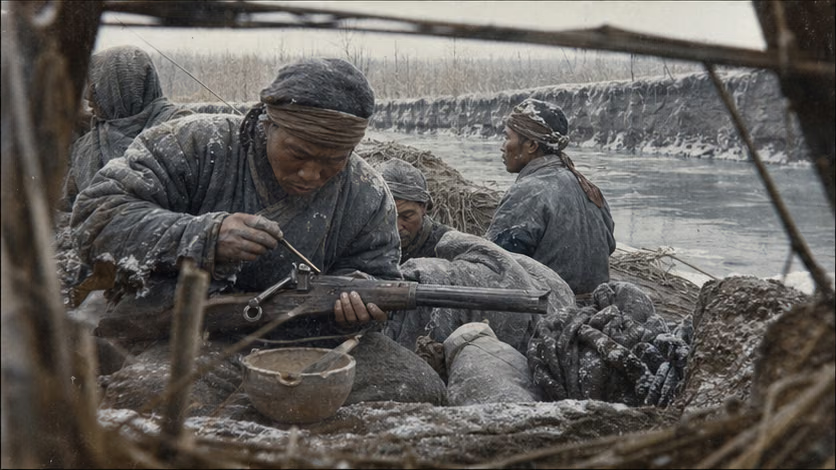
- Southerners meet the northern winter: soldiers from Guangdong and Guangxi and from Hunan and Hubei saw frozen rivers and heavy snow for the first time; many lost fingers and toes to frostbite, and sentries froze to death at their posts at night (specific records unverified) -- the enemy was not only the Qing army, but also the climate.
- Death by lingchi: Lin Fengxiang and Li Kaifang were taken to Beijing one after the other and executed by lingchi. Qing records say that Li Kaifang remained composed at the moment of execution (this is the Qing record's framing; original source unverified).
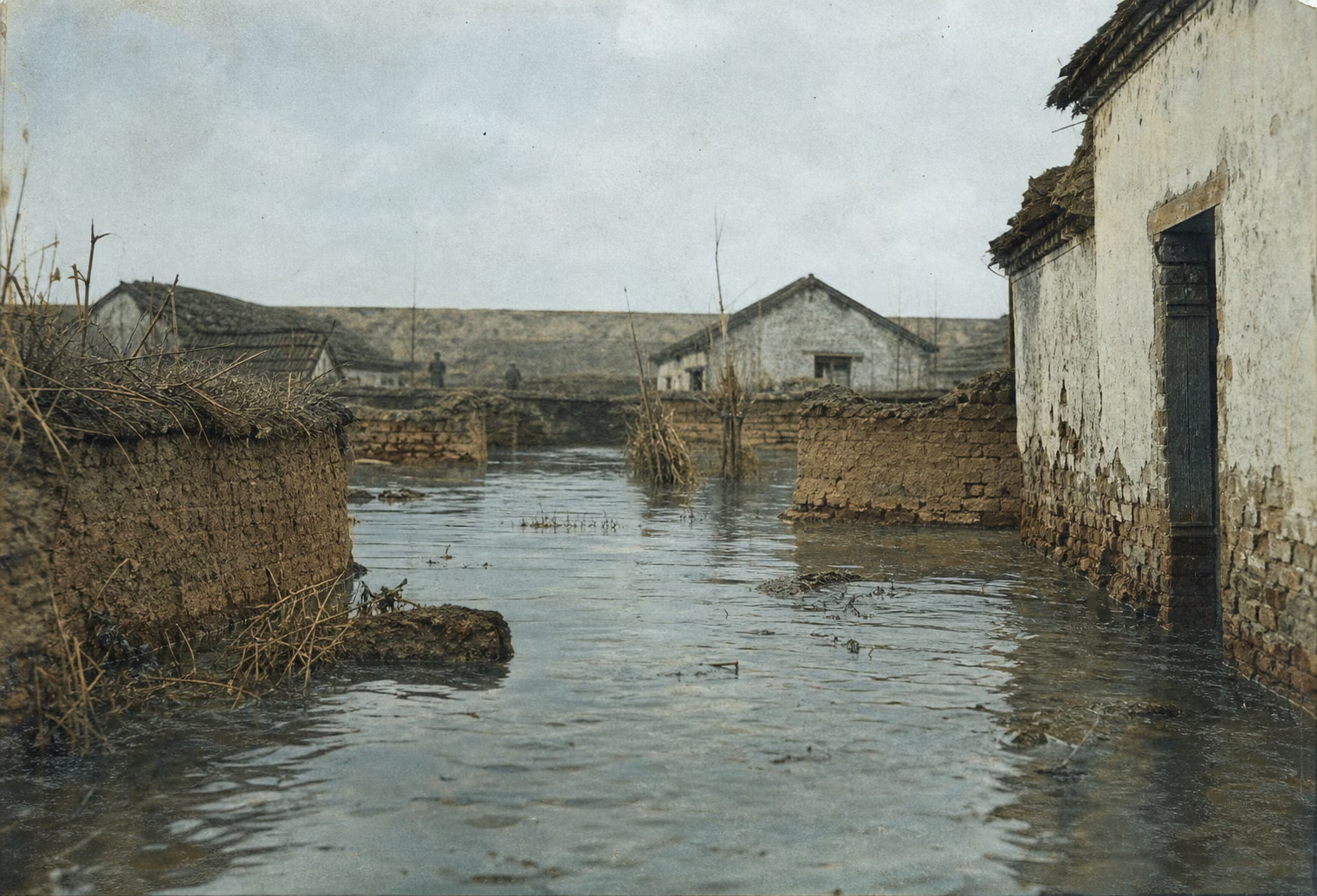
- Cutting water to flood the camp: in the final stage at Fengguantun, Senggelinqin did not storm the strongpoint but diverted water to flood the camp. Water inside the camp stood several chi deep, the gunpowder was soaked through, and men spent several days standing in water -- the end of the Taiping Army was not before the line, but in the water.
- The fate of the coerced: civilians seized along the route and forced into service had no road of retreat and no registry to which they could return; most died at Lianzhen and Fengguantun (scale disputed) -- outside the list of 20,000 people lay another layer of people without names.
- The reinforcements at Linqing: Zeng Lichang's reinforcements marched north and were not very far from Lianzhen, yet in one battle at Linqing they collapsed and fled south, and the chief commander soon died (details unverified) -- between an isolated army and its reinforcements, there was always one last stretch of road.
The Ground
- A 2,000-li axis of advance: Yangzhou -> northern Anhui -> Sishui crossing -> southern Shanxi -> the Zhili-Shandong-Henan border zone -> below Tianjin's walls. Its spatial form was a "line," not a "surface."
- The Yellow River crossing was the first throat of the whole route: too few boats, too many people, and pursuing troops behind them; the time spent crossing directly determined the later tempo.
- Jinghai-Duliu southwest of Tianjin: lowlands, canal, ice surface; in winter the watery terrain turned into encirclement works, and the southern army's water-country experience failed completely in the northern winter.
- Lianzhen and Fengguantun: two village strongpoints that were besieged until flooded and starved out, on an extremely small scale -- the annihilation of 20,000 people was finally compressed into the space of two villages.
- The North China Plain: open road for cavalry and killing ground for infantry -- space itself stood on the side of the pursuers and blockers.
How Each Side Records It
- Qing side at the time: official books and memorials called the Taiping Army "Yue bandits" and "rebels with loose hair" (Qing original-document terms). The Northern Expedition was recorded as a suppression campaign in which "rebel bandits fled north and the royal army annihilated them"; Senggelinqin's battle reports are the main body of source material, and their framing naturally stands with the pursuing and blocking side.
- The Taiping Heavenly Kingdom itself: very few edicts or military documents from the Northern Expedition survive, and Tianjing left almost no direct self-account of this annihilation -- the defeat was so complete that it lost the right of narration along with the army (the specific catalog of surviving documents is unverified).
- Changes in later narratives: Qing official dynastic history fixed the line of "rebels with loose hair"; after the Republic, the Northern Expeditionary Army was renarrated as a precursor of anti-Qing revolution and a tragic expedition; from the 1950s onward, mainland historiography incorporated it into the canon of peasant war, and "the tragedy of a lone army driving deep" became the standard evaluation; contemporary historiography, reexamining it again, more often asks about the strategic rationality of the decision itself -- whether sending 20,000 elite troops away from their base to strike directly at the capital was a feat or a losing move remains undecided.
Disputes and Sensitivities
- The Northern Expedition decision itself: was it Yang Xiuqing's strategic overreach, or an unavoidable division of forces? The debate inside the Taiping Heavenly Kingdom over investment in the Northern Expedition and the scale of rescue efforts leads directly into evaluations of Yang Xiuqing and Hong Xiuquan.
- The narratives of "not one surrendered" and "lingchi": each side's loyalist narrative -- the Taiping Army fighting to the death and refusing surrender, the Qing army capturing "rebels" and executing them according to law -- needs to be read with discount, because most original records come from the winning side.
- Coerced recruitment and atrocities: Qing sources wrote the Taiping Army as pure roving bandits, while revolutionary narratives avoided coerced recruitment and the civilian costs of the battlefield -- coerced recruitment and battlefield civilian costs both stand within the records.
- There is no reliable statistical set for casualties or for the number of people coerced into service.
Sources and Open Questions
Known main sources:
- Strategy for Suppressing and Pacifying the Yue Bandits (Qing official compilation; main framing of the pursuing and blocking side)
- Memorials by Senggelinqin and Shengbao (held at the First Historical Archives; specific file numbers unverified)
- Luo Ergang, History of the Taiping Heavenly Kingdom (representative mainland canonized narrative)
- Mao Jiaqi et al., General History of the Taiping Heavenly Kingdom (contemporary general study)
- Relevant prefectural and county gazetteer records from Zhili and Shandong (specific titles unverified)
Open questions: original source for "march by indirect roads, hasten toward Yandu"; the various bases of counting for departure strength; the crossing point, sequence, and losses at Sishui; the time and place of Ji Wenyuan's death in battle; details of Qing dike-cutting and water release; the course of Zeng Lichang's reinforcements collapsing at Linqing; original source for the proposal to move the capital; Qing archival originals on Lin Fengxiang's and Li Kaifang's capture and execution; local-gazetteer records on the scale of coerced recruitment along the route; catalog of surviving Taiping Heavenly Kingdom documents; specific month and day of the Capital Patrol and Defense Office's establishment and its operation; records of whether the Taiping Heavenly Kingdom side objected to the Northern Expedition decision; the Taiping Army's pre-departure intelligence gathering on the north; the course of Qin Rigang's northern reinforcement turning back midway; the direct relation between the origin of lijin and Jiangbei military expenses.
All images on this site are AI-generated depictions. They are not historical photographs, not primary sources, and do not depict any real individual.