Engagement Archive · Battle of Sanhe
The sharpest blade of the Xiang Army--Li Xubin's six thousand picked troops took four cities in succession and drove five hundred li deep alone, only to be encircled and destroyed outside Sanhe Town in a morning fog by Chen Yucheng and Li Xiucheng: the Taiping Army's most complete battle of annihilation in its later period.
Engagement Data
| Item | Details |
|---|---|
| Time | 1858.11 (tenth month of the eighth year of Qing Xianfeng): on 11.7 Taiping reinforcements cut the Xiang Army's rear route; on 11.14-15 came the encirclement and decisive battle |
| Place | Sanhe Town southwest of Luzhou Prefecture, Anhui (today Sanhe Town, Feixi County, Hefei), and the outer line of Baishi Mountain, Jinniu Town, and Fanjiadu |
| Belongs to | Taiping and Nian Rebellions · Central Anhui theater |
| Attacking / besieged side | Li Xubin's Xiang Army detachment (commanded by Li Xubin, Provincial Administration Commissioner of Zhejiang; Zeng Guohua, Zeng Guofan's younger brother, was with the army), besieging Sanhe Town |
| Defending / relieving side | Taiping Army: Wu Dinggui, commander defending Sanhe Town; Chen Yucheng, chief commander of the relieving main force's vanguard, with Li Xiucheng following in, and Wu Ruxiao, the Luzhou commander, joining Nian forces to cut off relief |
| Result | Li Xubin's Xiang Army detachment was completely destroyed; Li Xubin, Zeng Guohua, and several hundred civil and military officials and officers died; the Taiping Army exploited the victory to retake Shucheng and Tongcheng |
Belligerents
| Item | Li Xubin's Xiang Army detachment | Taiping Army (Chen Yucheng, Li Xiucheng, and others) |
|---|---|---|
| Strength | About six thousand when it entered Anhui (common statistical basis); *Draft History of the Qing* says that after taking Tongcheng and Shucheng, troops were detached to garrison them, leaving only five thousand in the face of the enemy; the attack on Sanhe's nine outer forts then cost more than a thousand casualties, so that about four or five thousand were surrounded--several statistical bases are placed side by side | Qing memorials and *Draft History of the Qing* say "a mass of one hundred thousand"; later researchers estimate the actual engaged force at several tens of thousands (number unverified). Included Chen Yucheng's own force, Li Xiucheng's force, Wu Ruxiao, and Nian units cooperating in cutting off relief |
| Composition | The veteran core of the old Xiang battalions left from Zeng Guofan's early army-building, a mobile field corps of soldiers tested in a hundred battles | Chen Yucheng's force was a main force of the Taiping Heavenly Kingdom's later period, skilled at rapid raids and envelopments; after continuous fighting it was also tired (Chen Yucheng returned by forced marches from the Jiangbei battlefield) |
| Firearms | Matchlocks, heavy matchlocks, Pishan cannon, and other mixed firearms and cold weapons | Broadly similar; firearms were slightly inferior, made up for by numbers and mobility |
| Supply and posture | Four or five hundred li deep inside Taiping-controlled territory; the rear route depended only on thin garrisons left at Tongcheng and Shucheng, and relief was cut off | Fighting on interior lines; grain routes from Luzhou and Chaoxian could be relied on, and reinforcements could arrive continuously |
| Weather | -- | Thick fog on the morning of the decisive battle; the Xiang Army had difficulty finding its bearings, favoring the encirclement |
Terrain and Conditions
(For the larger situation in 1858--the Taiping Heavenly Kingdom's turn from decline to renewed force after the Tianjing Incident, the Qing Jiangnan and Jiangbei Encampments again besieging Tianjing, and the Xiang Army moving east down the middle Yangtze--see *Taiping Heavenly Kingdom · Overview*.)
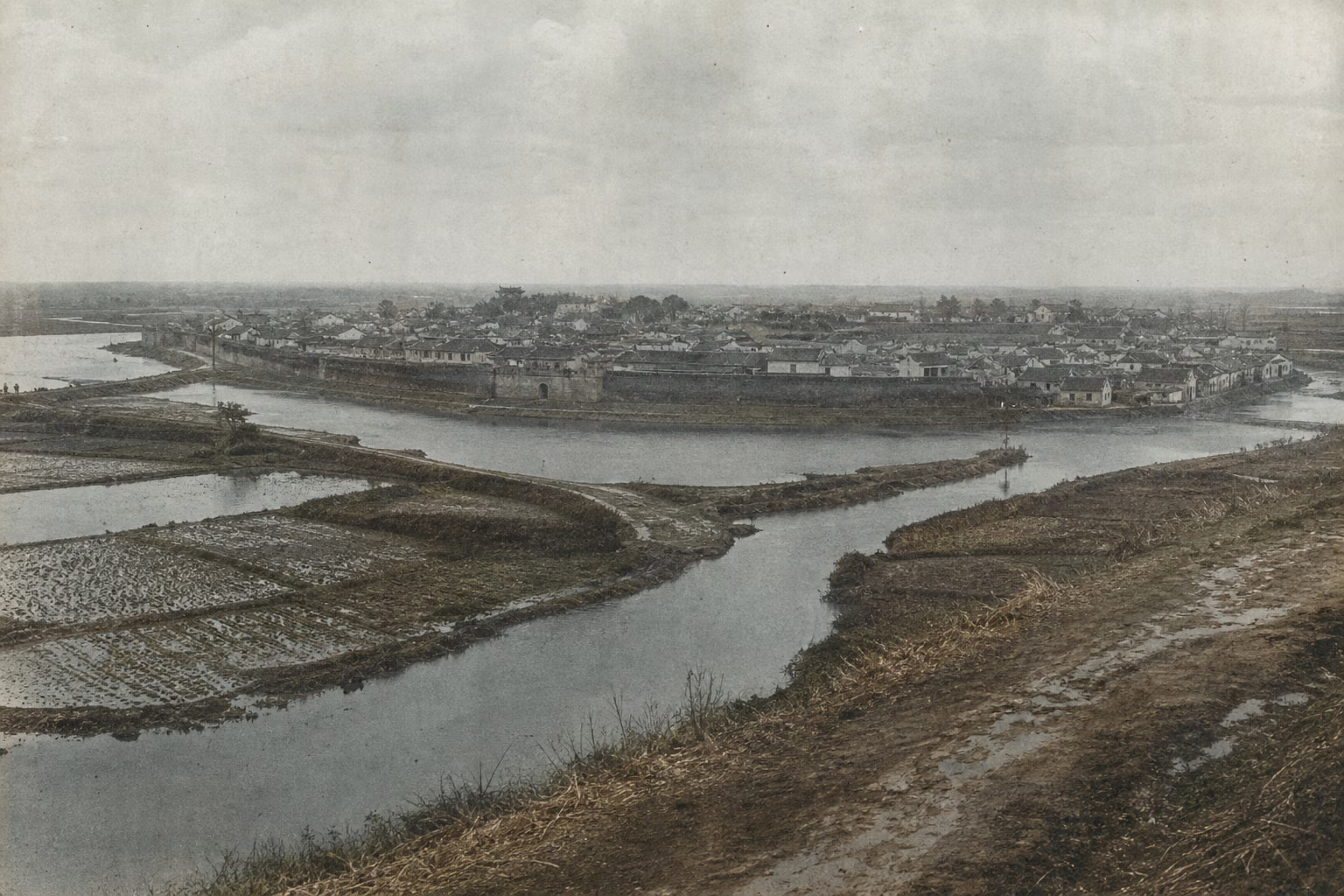
Central Anhui: the Xiang Army entered through a gap. In the autumn of 1858, the Taiping Army's main forces shifted east and would break the Jiangbei Encampment (Pukou was taken in September), leaving northern Anhui thinly held. After taking Jiujiang in May, Li Xubin's Xiang Army detachment pressed into Anhui; from September onward, in a little over a month, it took Taihu, Qianshan, Tongcheng, and Shucheng in succession, and its spearhead pointed straight at Luzhou Prefecture's seat (today Hefei).
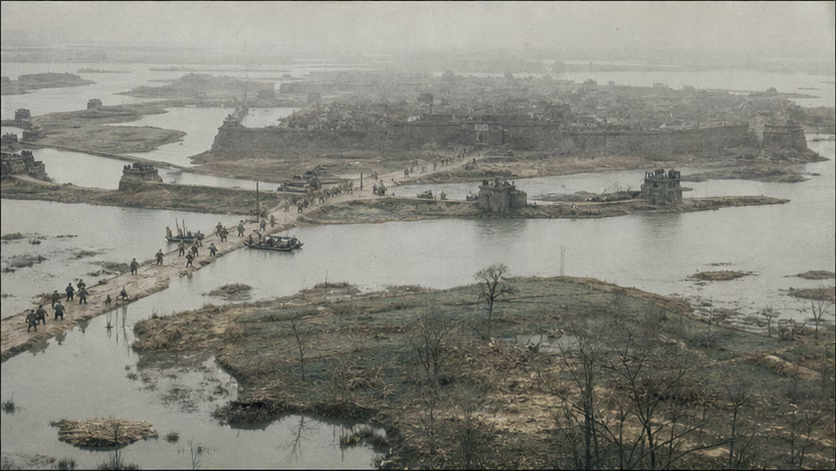
This town: Sanhe Town took its name from the meeting of the Fengle River, Hangbu River, and Xiaonan River (river names unverified). It was a water-and-land wharf, the southwest gate of Luzhou, and still more a key point for the grain route and material transfer between Tianjing and Luzhou. The Taiping Army built one walled town here and, outside it, held nine forts lined along the rivers. The town area was crossed by waterways and muddy polder fields, making it hard to deploy large bodies of men--the defenders knew the terrain, the guest army did not.
Why It Was Fought
The Western Expedition's offensive came to a close in 1856: Shi Dakai was ordered back to relieve Tianjing, while the Xiang Army navy, badly defeated at Hukou, had recovered its breath, retook Wuchang at year's end, and regained the upper reaches. In the autumn of the same year came the Tianjing Incident, and the Taiping Heavenly Kingdom turned from strength to decline (the incident belongs in the overview article). Over the next two years, the balance in the middle Yangtze moved back inch by inch--in May 1858, Li Xubin's detachment stormed Jiujiang, which had been held for five years; roughly seventeen thousand defenders under commander Lin Qirong all died, and after the city fell the killing was very severe (headcounts vary by basis and account).
The Xiang Army's strategy was still to proceed along the river, "controlling the lower reaches from above": once Jiujiang had fallen, the next step was Anqing and Luzhou. Riding a string of victories, Li Xubin drove deep with an isolated force. With about six thousand men (common statistical basis), from September onward in a little over a month he took Taihu, Qianshan, Tongcheng, and Shucheng in succession, detaching troops to garrison each city, so that his strength grew thinner the more he fought. His subordinate commanders and Zeng Guohua, who was with the army, both advised caution, but he would not leave troops behind in a show of timidity (details of the remonstrance come from Qing records; original source unverified). By the time his spearhead pointed directly at Luzhou Prefecture's seat, this isolated force had gone four or five hundred li deep into Taiping-controlled territory.
That Li Xubin dared fight in this way had one contingent personnel factor: his troops belonged to the Hubei Army system, and for several years of eastward campaigning Hu Linyi had directed them from the rear; but that autumn Hu Linyi had returned home on mourning leave for his mother, and no one in the army remained who could hold down this blade (the sequence between Hu Linyi's departure from camp and the Sanhe defeat remains unverified). His intelligence was not bad--it was true that the Taiping main forces had shifted east and northern Anhui was empty; what he lacked was a judgment of time--how many days Chen Yucheng would need to return from the Jiangbei battlefield, something no intelligence could give him (unverified). Existing records are insufficient to judge whether the Hubei encampment issued any restraining order against this isolated deep advance (unverified).
Sanhe Town sat across the grain route southwest of Luzhou: a water-and-land wharf where three rivers met, a key point for material transfer between Tianjing and Luzhou, with the Taiping Army holding one walled town and nine forts along the rivers. Without taking Sanhe, Luzhou could not be entered--so Li Xubin attacked the town in three columns. The timing also looked right: that autumn the Taiping main forces had shifted east, the Jiangbei Encampment had just been broken in September, and northern Anhui was empty. But emptiness cut both ways--a main force that could shift east could also return west.
The material account had long been there. Six thousand men were the entire mobile strength of this Hubei force; each captured city required a detached garrison, and by Sanhe only four or five thousand remained in the face of the enemy. The grain stations stretched for several hundred li along the route through Tongcheng and Shucheng, with only a few weakly garrisoned cities between them; once the rear route was cut, the front became a death ground. On the Taiping side, these were interior lines: the grain routes from Luzhou and Chaoxian were in hand, and reinforcements could be layered in one after another--only after continuous forced marches, Chen Yucheng's soldiers were already very tired too.
Wu Dinggui, the Sanhe defender, sent an urgent alarm. Tianjing hastily ordered Chen Yucheng, then on the Jiangbei battlefield, to move west by forced marches; Li Xiucheng followed in; Wu Ruxiao, the Luzhou commander, joined Nian forces and came south to cut off relief. One side had to preserve central Anhui's gate and grain route; the other had to seize the position before reinforcements arrived. The battle collided there. By the time Li Xubin had broken the nine outer forts and pushed close to the town wall, Chen Yucheng had already reached his rear. No record has been found of whether those inside Tianjing ever debated abandoning Sanhe and contracting the Luzhou line.
Course of the Engagement
| Stage | Time | Key points |
|---|---|---|
| Xiang Army drives deep | 1858.9-early 11 | Took Taihu, Qianshan, Tongcheng, and Shucheng in succession, leaving garrisons in each; after reaching Sanhe, attacked in three columns, broke the nine outer forts, and pressed close to the town wall |
| Reinforcements cut the rear | 11.7 | Chen Yucheng returned day and night from the Liuhe area, reached the line of Jinniu Town south of Sanhe and Baishi Mountain to the west, and cut the Xiang Army's retreat; Wu Ruxiao, the Luzhou commander, joined Nian forces and came south, cutting off relief from the Shucheng direction; Li Xiucheng's force camped at Baishi Mountain as a rear support |
| Encirclement | 11.8-13 | Taiping camps stretched for more than ten li (Qing memorial basis); Li Xubin's detachment drew back to its main camp, and the commanders discussed retreating to defend Tongcheng, but Li Xubin refused |
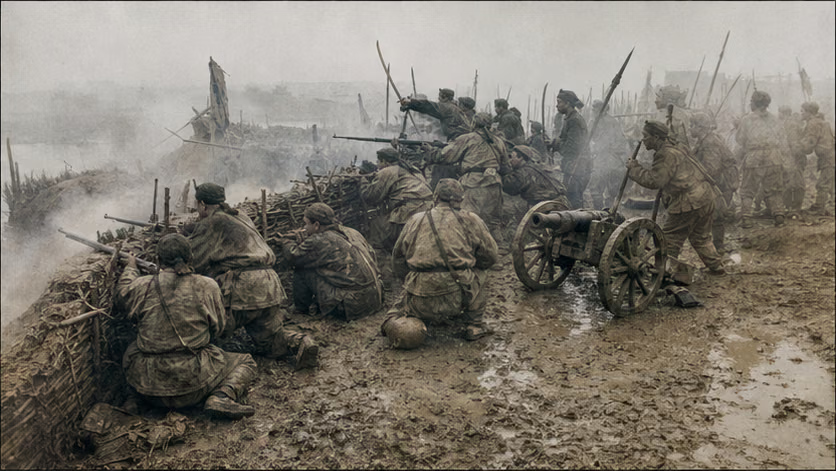
| Decisive battle | 11.14-15 | On 11.14 the Taiping Army attacked the Xiang Army camps from both sides; on 11.15 (early tenth lunar month; sexagenary-date conversion unverified) the Xiang Army assembled at midnight, advanced at dawn, and reached Fanjiadu in thick fog, where Taiping detachments enveloped it and the Xiang Army broke in panic; Chen Yucheng held the front, Li Xiucheng heard the gunfire and pressed in from Baishi Mountain, and Wu Dinggui's defenders sallied from inside the town, completing a three-sided encirclement |
| Complete destruction | 11.15 and the following days | All Xiang Army camps were broken; Li Xubin died charging the enemy line (two accounts of his death, see below), and Zeng Guohua died with him; the survivors withdrew into an isolated fort and held out until the thirteenth day of the tenth lunar month (Gregorian roughly 11.18, conversion unverified), when gunpowder, water, and rice were all exhausted; Circuit Intendant Sun Shouxin, Assistant Transport Commissioner Ding Ruiyi, and others died, and the whole army perished |
| Aftershocks | Late November | The Taiping Army exploited the victory and advanced west; on the nineteenth day of the tenth lunar month (conversion unverified) it retook Tongcheng, where Deputy General Li Cunhan of the remaining Xiang Army garrison and others died in battle; Qing forces under Duxing'a, Duolonga, and Bao Chao, then besieging Anqing, withdrew the siege and retreated to Susong on hearing the news |
Casualties and Losses
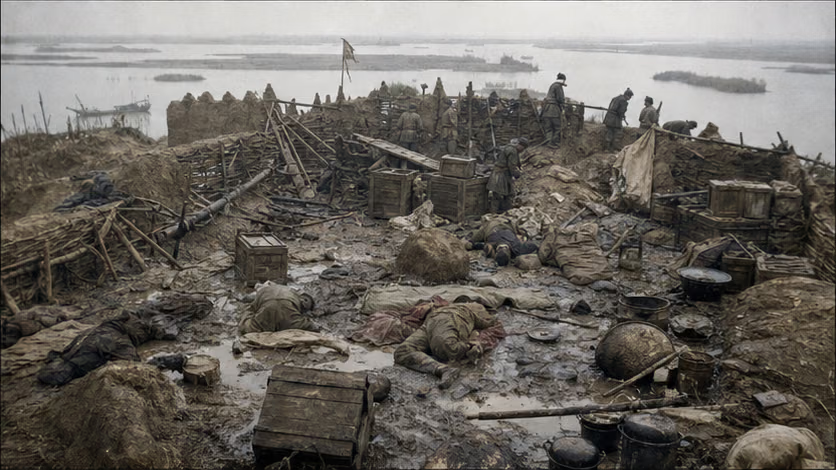
- Xiang Army: all surrounded units of Li Xubin's detachment were wiped out. The common account is that "six thousand picked troops were destroyed"; *Draft History of the Qing* uses a basis of five thousand facing the enemy, more than a thousand casualties in the siege attack, and roughly four or five thousand destroyed on the field at Sanhe; including the subsequent defeats at Tongcheng and elsewhere, Qing losses before and after exceeded eight thousand (one account, unverified). More than four hundred civil and military officials and officers died (source unverified). The chief commander Li Xubin, Zeng Guofan's younger brother Zeng Guohua, and several dozen deputy generals, brigade commanders, and assistant brigade commanders below the rank or title of regional commander died--the heaviest single loss of commanders and staff since the Xiang Army's formation.
- Taiping Army: no reliable casualty figure has been found (figure disputed). During the siege phase, the Qing side claimed to have "killed more than seven thousand rebels" (*Draft History of the Qing*, including defenders of the nine forts; statistical basis disputed, and Qing battle reports habitually exaggerated); during the decisive encirclement phase, the Taiping Army attacked a smaller force with superior numbers and used the fog to set an ambush, so its cost should have been much smaller than the enemy's, but no specific record exists.
- ※ The account in this region before this: in 1858.5 the Xiang Army took Jiujiang, and roughly seventeen thousand defenders under commander Lin Qirong all died; after the city fell, the Xiang Army's killing was very severe (headcounts vary by basis and account)--when the Xiang Army was annihilated at Sanhe, the Taiping Army took no surrenders and pursued the routed to the end, and contemporaries often mentioned the two accounts together (the causal explanation comes from Qing private records, unverified).
- Whichever statistical basis is used: what was lost was not a headcount, but the earliest-formed, most battle-willing old soldiers and commanders of the Xiang Army. Hu Linyi said that "men with the talent to dare battle, men of clarity and sufficient wisdom, have also withered away almost entirely"; this is what he meant.
Aftermath
- The central Anhui situation reversed: the Taiping Army retook Shucheng and Tongcheng, the siege of Anqing lifted itself, and for several years the Xiang Army did not dare advance lightly into central Anhui. Zeng Guofan and Hu Linyi gathered themselves again and changed to a steady, step-by-step plan for Anqing, not entering central Anhui's interior again until 1860 (see *Defense of Anqing*).
- Chen Yucheng's and Li Xiucheng's reputations rose together; linked with the earlier breaking of the Jiangbei Encampment and the later second breaking of the Jiangnan Encampment, this formed the Taiping Heavenly Kingdom's late military "restoration" situation.
- The Qing court gave Li Xubin special posthumous favor and the posthumous name "Zhongwu" (posthumous official title unverified); Xiang Army camps all wore mourning white; in one Xiangxiang county, there were "soul-summonings everywhere" (from later recollection; original wording unverified).
- Hu Linyi wrote in grief: "After the defeat and collapse at Sanhe, our vital force was entirely wounded; the picked troops gathered over four years were overturned in a single day, and men with the talent to dare battle, men of clarity and sufficient wisdom, have also withered away almost entirely... Military affairs take momentum as their root. After troops left from a hundred battles are overturned in a single day, the whole army is chilled; these tens of thousands will look at one another in alarm and warn each other, and cannot fight again." (included in *Collected Writings of Duke Hu Wenzhong*; wording unverified)
- Zeng Guofan later wrote of himself: "After the defeat and collapse at Sanhe, the vital force was badly wounded; not only was the overall situation suddenly ruined, but the morale of the men of my district also failed to rise." (source unverified)
Accounts of Those Present
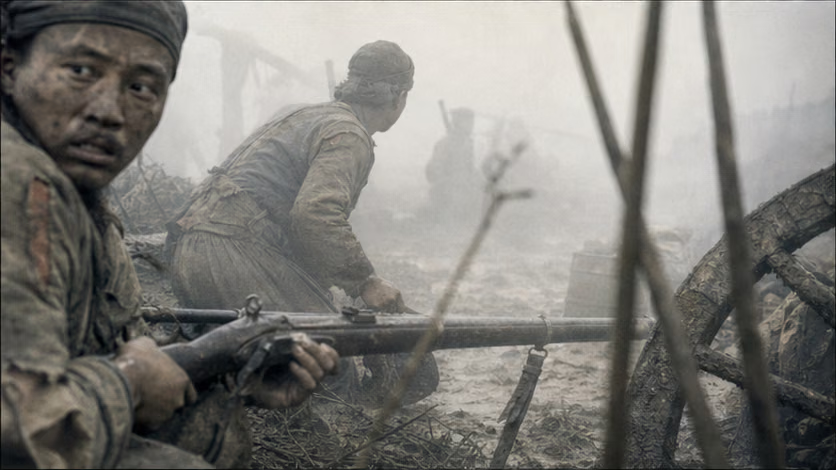
- Li Xubin's death: The Qing official account (Hu Linyi's memorial) says that when surrounded, after repeated urgings to break out, Li Xubin said, "In ten years since the army was raised, withdrawals have always damaged the state's prestige. In several hundred battles before and after, whenever I led troops out I did not expect to return alive," and then told the troops, "Those unwilling to follow me in death, please make your own plans." The camps knelt and wept, willing to die with him; he then put on formal clothing, kowtowed toward the imperial palace, and at the second watch charged straight into the enemy line on an angry horse, dying after his strength was spent. Another account says that after his camp was broken he hanged himself (this account appears in some private records; original source unverified). Both accounts exist.
- Zeng Guohua: Zeng Guofan's sixth younger brother (birth order unverified), he served as adviser with Li Xubin's army and died with him at Sanhe. His body was later recovered, but his head was not obtained; Zeng Guofan held a soul-summoning burial for him (details unverified).
- The isolated fort on the thirteenth day: After the camps were broken, Circuit Intendant Sun Shouxin, Assistant Transport Commissioner Ding Ruiyi, and others still held an isolated fort, waiting for reinforcements from Tongcheng. They held it until gunpowder, water, and rice were exhausted, and died together when the fort fell--the reinforcements from Tongcheng would never arrive, because Li Cunhan himself soon died on Tongcheng's wall.
- Chen Yucheng: In command of this battle while in his early twenties (born in 1836/1837, unverified), he rushed several hundred li in several days from the Jiangbei battlefield; on arriving, he did not attack first, but first cut the opponent's retreat--this battle fixed his position as the Taiping Army's leading general after he became the "Ying King."
- Fog: On the morning of 11.15 there was thick fog; the Xiang Army moved out at dawn and ran straight into the encirclement. The Qing memorial wrote, "Heaven was heavily fogged; the rebels divided into detachments and enveloped us; our army broke in panic" (*Draft History of the Qing* quotes the memorial; "rebels" is Qing terminology)--one fog entered both sides' military histories.
The Ground
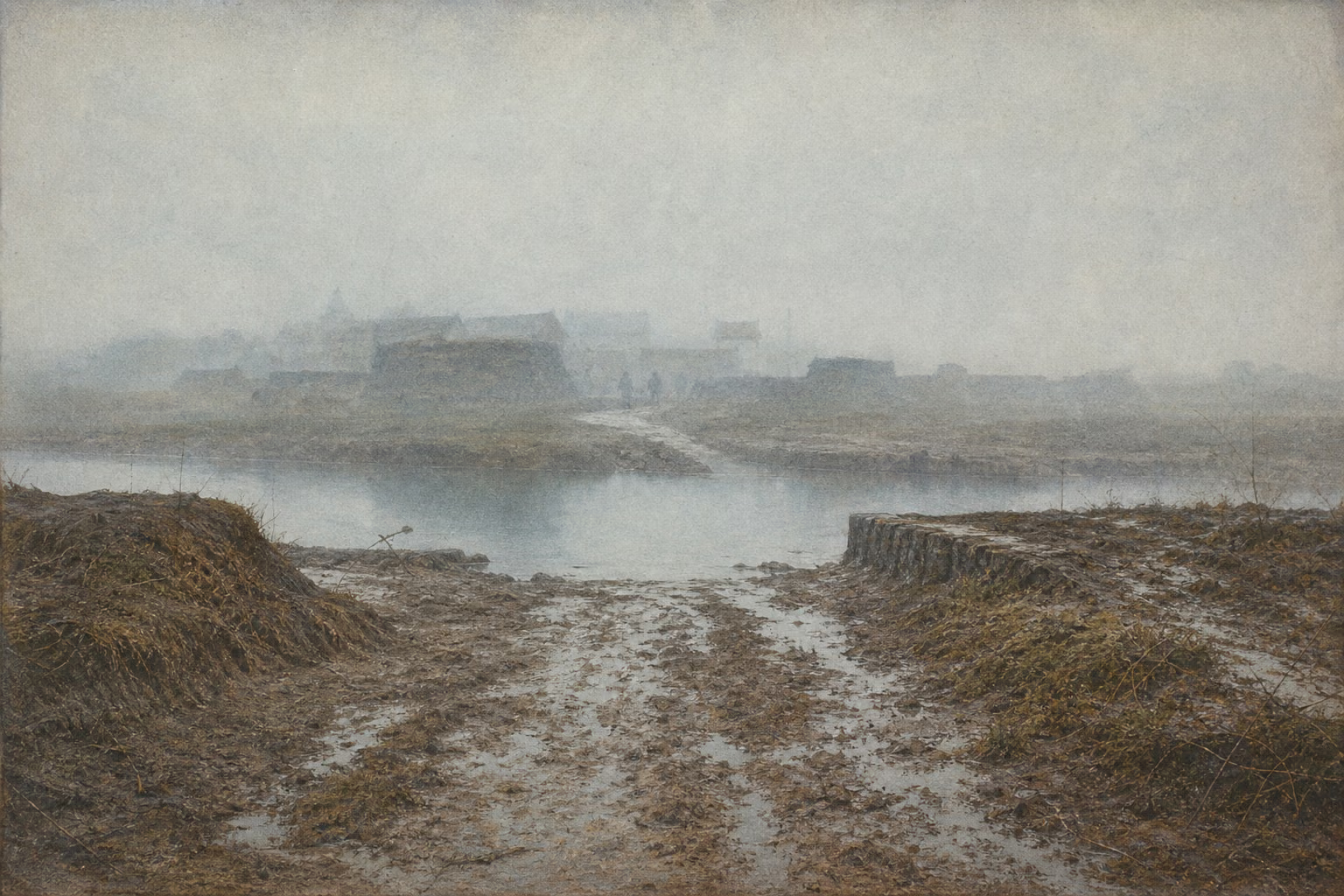
- At Sanhe Town three rivers met; streets and markets were set between waterways, and polder fields, embankments, and ferry crossings made a broken terrain. Large bodies of cavalry and close-order formations could not easily deploy, which favored ambush and division.
- Defensive face: the town wall plus nine outer forts set along the rivers, with the forts using the water as an obstacle; the Xiang Army first took the nine forts and pressed the town, while the Taiping defenders contracted inside--the attackers and defenders were finally enveloped in the same river network by a third force.
- Two outer-line points: Jinniu Town (south) and Baishi Mountain (southwest) were the jaws with which Chen Yucheng cut the retreat. Seen from Sanhe, these two places were both high ground and the positions for "closing the gate."
- Fanjiadu: the necessary route of the Xiang Army's morning attack on 11.15, and the encounter point in the thick fog--"ferry crossing + fog" is this battle's spatial signature.
- Vertical elements were weak, weather elements strong: the spatial grammar of this battle was river network + fog + pincer encirclement, not attack and defense over heights.
How Each Side Records It
- Qing records at the time: In memorials and private letters, it was pain and self-examination. Hu Linyi's memorial saying that "the vital force was entirely wounded" (a memorial requesting posthumous favor for Li Xubin, drafted over eight days, found in *Collected Writings of Hu Linyi*; details of the completed memorial unverified); Zeng Guofan's "the morale of the men of my district also failed to rise"; and *Draft History of the Qing: Biography of Li Xubin*, which made a biography from the memorials, called the Taiping Army "rebels," recorded Li Xubin's death in loyalty and the course of the whole army's destruction, and became the Qing side's most complete fixed version.
- Surviving Taiping records: Very few. No reliable self-account by Chen Yucheng survives (his confession after capture survives only in excerpts; authenticity and cuts unverified). A passage on the Battle of Sanhe appears in *Li Xiucheng's Autobiographical Account* (saying that Chen Yucheng's force was originally no match and that Li Xubin lost the moment to open battle--quotation and paragraph location unverified), the only surviving first-hand text by a senior Taiping commander about this battle. No Taiping battle-report archive has survived.
- Changes in later narratives: Xiang Army narratives from the Republic through Taiwan called it "the defeat at Sanhe" and "Li Zhongwu's martyrdom," centering loyalty and sacrifice; after 1949, mainland general histories fixed the name "Battle of Sanhe," listed it as a landmark battle in the Taiping Heavenly Kingdom's late military restoration, and made Chen Yucheng's art of command the center of the narrative. Today Sanhe Town is an old-town scenic area, with remains and memorials related to the Battle of Sanhe (site names unverified)--for today's tourists, it is an "old town"; for Xiangxiang, it was once white funeral banners in every household.
Disputes and Sensitivities
- Two accounts of Li Xubin's death: died charging the enemy line (Qing official account) / hanged himself (some private records); both accounts exist.
- Large divergence in troop-strength bases: The Qing side said the Taiping Army numbered "one hundred thousand," while later estimates put it at several tens of thousands; for the Xiang Army, six thousand / five thousand / eight thousand before and after all coexist as three bases. Every citation must mark its source.
- Divergent records of participants: *Draft History of the Qing* has "Chen Yucheng and Li Shixian joined with Nian bandits to come to the relief"; Li Shixian was in fact Li Xiucheng's younger brother, and mainstream records of this engagement all give Li Xiucheng--that Qing official historiography wrote the commander's name wrong is itself worth stating (cause of divergence unverified).
- The boundary of "complete destruction": Did Li Xubin's detachment truly have no survivor? The fate of scattered escapees and captives (fate unverified).
- The characterization as "the most complete battle of annihilation": This follows the common account here; strictly speaking, the battle combined encirclement-annihilation and pursuit, and whether it was "the greatest of the later period" is evaluative language; the text has already stated its nature.
- The sensitive face is limited: it does not involve modern ethnic or religious issues; local memory in Xiangxiang, Hunan, is deep, and passages involving the Xiang Army's "loyal martyr" narrative do not mock it.
Sources and Open Questions
Known main sources:
- *Draft History of the Qing: Biography of Li Xubin* (the Qing side's fixed version, quoting memorial language and using Qing terminology)
- Hu Linyi, *Collected Writings of Duke Hu Wenzhong* (memorials and letters after the Sanhe defeat; source for the phrase "the vital force was entirely wounded")
- Zeng Guofan's collected writings and family letters (the phrase "the morale of the men of my district also failed to rise," among others)
- *Li Xiucheng's Autobiographical Account* (the only surviving first-hand Taiping-side account)
- Luo Ergang, *History of the Taiping Heavenly Kingdom*, relevant volumes (one of the later research standard works)
Open questions:
1. The original source for Hu Linyi's phrase "the vital force was entirely wounded" (memorial or letter) and its exact wording; variant readings of "overturned / restored in a single day." 2. The source for Zeng Guofan's phrase "After the defeat and collapse at Sanhe... the morale of the men of my district also failed to rise." 3. The earliest sources for the two accounts of Li Xubin's death. 4. The original source and list of the more than four hundred dead civil and military officials and officers (titles and names of Zeng Guohua, He Zhongjun, Sun Shouxin, Ding Ruiyi, Li Cunhan, and others). 5. The statistical boundaries of the Xiang Army's three troop-strength bases (six thousand / five thousand / eight thousand before and after); scholarly basis for estimating actual engaged Taiping strength. 6. Conversion of the decisive date 11.15 with the lunar date; Gregorian equivalents for the isolated fort falling on the thirteenth day of the tenth lunar month and Tongcheng's recapture on the nineteenth. 7. The cause of the divergence between *Draft History of the Qing*'s "Li Shixian" and the mainstream "Li Xiucheng." 8. Zeng Guohua's birth order, the details of his body and head, and the fixed version of Li Xubin's posthumous official title and posthumous name. 9. Headcount bases and original records for the killing after Jiujiang fell in 1858.5; records of the Taiping Army's treatment of captives and wounded after Sanhe (whether there were survivors). 10. Chen Yucheng's birth year (1836/1837); authenticity of the excerpts from his confession after capture. 11. The original text and paragraph location of the Sanhe passage in *Li Xiucheng's Autobiographical Account*. 12. The river names behind Sanhe Town's name; names of today's Sanhe Town battle remains and memorial facilities. 13. The sequence between Hu Linyi returning home on mourning leave for his mother and the Sanhe defeat. 14. Whether the Hubei encampment (Guanwen, Zeng Guofan) issued any restraining order against Li Xubin's isolated deep advance. 15. Whether Chen Yucheng's return to relieve Sanhe came from a Tianjing order or from his own decision to turn back (to be checked against the relevant passage in *Li Xiucheng's Autobiographical Account*). 16. Records of Li Xubin's grain-station setup and grain-transport line after his detachment entered Anhui.
All images on this site are AI-generated depictions. They are not historical photographs, not primary sources, and do not depict any real individual.