Engagement Archive · Eastern Expedition to Suzhou–Changzhou and the Battles for Shanghai
In the summer of 1860, Li Xiucheng rode the momentum of the second destruction of the Jiangnan Encampment to sweep across southern Jiangsu and press on Shanghai; across two years, two assaults on Shanghai failed--the battlefield gave victories to both sides, but the lost thing was the pay source: Shanghai was held, Jiangsu and Zhejiang's fiscal wealth followed it, and the Huai Army and "borrowing foreign troops to aid suppression" began from here.
Engagement Data
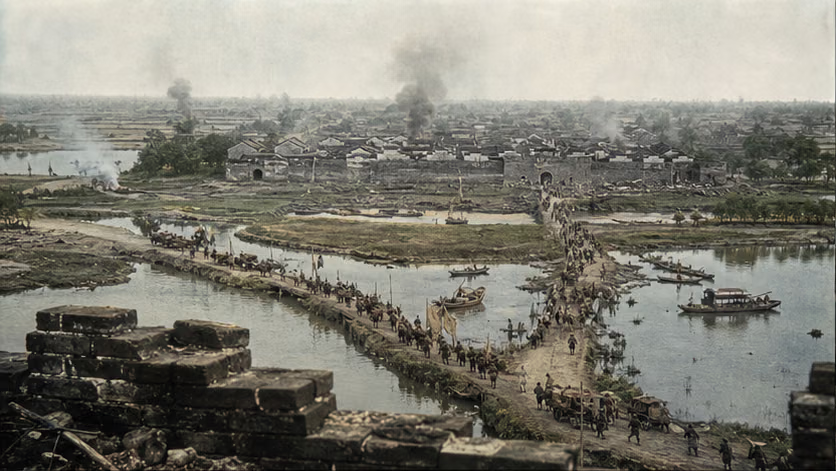
| Item | Details |
|---|---|
| Time | 1860.5 – 1862.9 (the eastern expedition to take Suzhou and Changzhou occurred in 1860.5–6; the first attack on Shanghai in 1860.8; the taking of Hangzhou in 1861.12; the second attack on Shanghai and Ward's death in 1862) |
| Place | Southern Jiangsu (Danyang--Changzhou--Wuxi--Suzhou--Songjiang--Qingpu--Jiading--Taicang), Shanghai county seat and the outskirts of the foreign concessions, Hangzhou in Zhejiang and eastern Zhejiang (Cixi) |
| War | Late Taiping and Nian Rebellions · Jiangnan theater |
| Eastern expedition side | Taiping Army forces under Li Xiucheng, Loyal King (the Hangzhou operation also had forces under Li Shixian in coordination; details unverified) |
| Intercepting side | Qing forces (remnants of the Jiangnan Encampment, local defense troops, and from 1862 Li Hongzhang's Huai Army); the Foreign-Arms Corps financed by Shanghai officials and gentry (commanded by the American Ward, expanded and renamed the "Ever-Victorious Army" in 1862); British and French land and naval forces stationed in China |
| Result | Southern Jiangsu and Zhejiang fiscal districts came under the Taiping Heavenly Kingdom, and Sufu Province was established; both attacks on Shanghai failed; from 1862 Shanghai became the counteroffensive base of the Huai Army and the Chinese-foreign allied forces |
Belligerents
| Item | Eastern expedition side (Taiping Army) | Intercepting side (Qing forces, Foreign-Arms Corps, British and French forces) |
|---|---|---|
| Strength | The eastern expedition to Suzhou and Changzhou was said to number several hundred thousand, but actual figures differ sharply across works (accounts vary); each attack on Shanghai committed roughly several tens of thousands (accounts vary) | Shanghai's defenders at first consisted of only several thousand Qing troops plus more than one thousand British and French garrison troops (British and French strength figures vary by statistical basis; accounts vary); the Foreign-Arms Corps initially had only a little over one hundred men, expanding to four or five thousand in 1862; the first Huai Army contingent to reach Shanghai in 1862.4 numbered roughly seven thousand (one account says 6,500; unverified) |
| Firearms | Cold weapons and firearms mixed; some captured foreign rifles and cannon, but in quantity and training they were inferior to the opponent | The Foreign-Arms Corps and British and French forces were fully firearm-equipped, with naval guns and field artillery; after reaching Shanghai, the Huai Army quickly reequipped with foreign rifles |
| Supply | Sufu Province's grain and taxes were in hand, but there was no stable source of arms | Shanghai port customs revenue and commercial taxes, steamship sea transport, and purchases of foreign arms--this was the heaviest item in the whole situation |
| Characteristics | Numerous, mobile, and capable of continuous operations | Few in number, sharp in weapons, holding a point (Shanghai) rather than holding a surface |
Terrain and Conditions
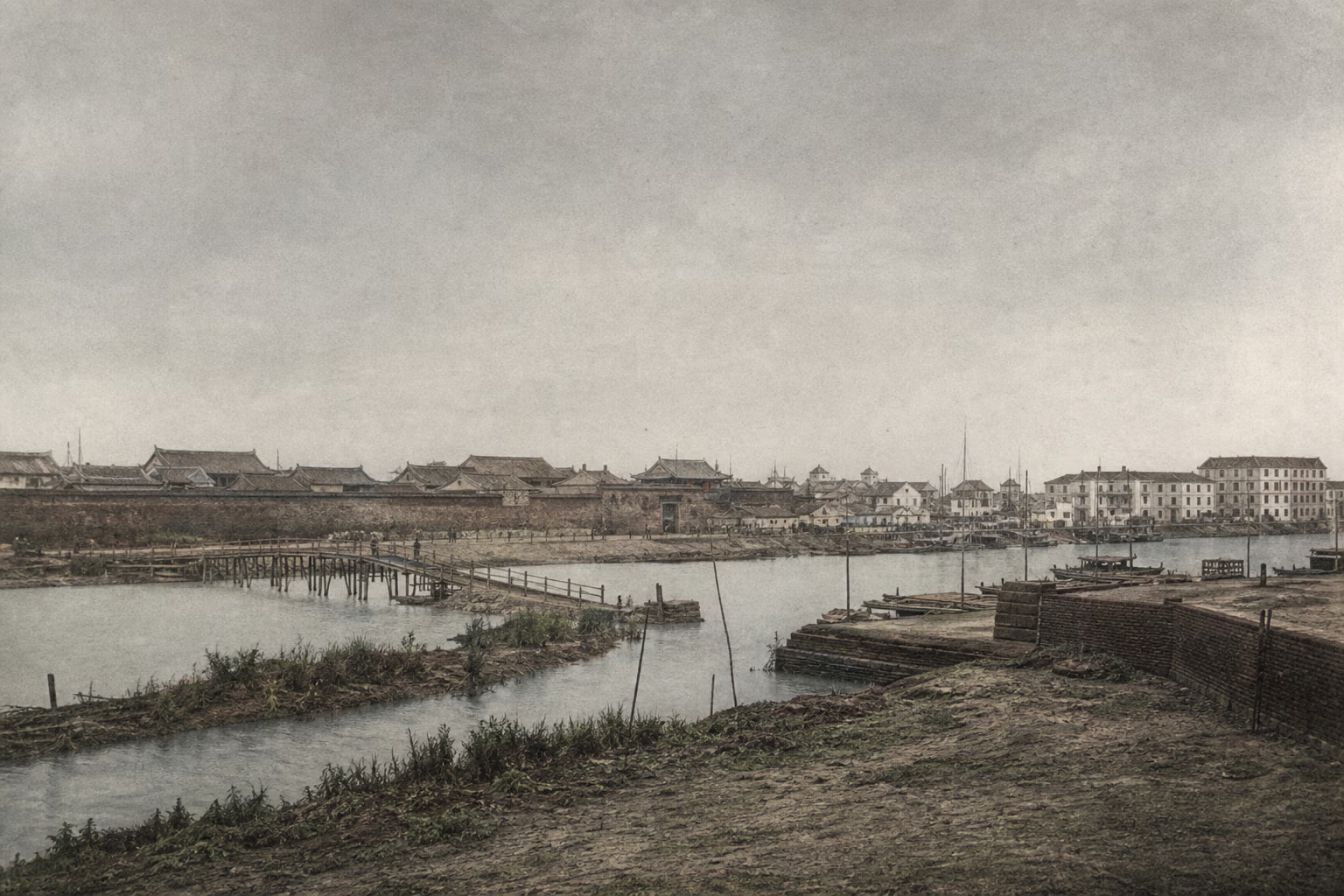
(For the Taiping Heavenly Kingdom's overall situation--revival and crisis after the Tianjing infighting--see *Taiping Heavenly Kingdom · Overview*.)
Southern Jiangsu: the richest piece of land in the country. The area around Suzhou, Changzhou, Wuxi, and Songjiang was then the Qing empire's heaviest region for tax revenue and tribute grain, and silk and tea exports were concentrated there. In May 1860, the Jiangnan Encampment was broken again; the Qing dynasty's regular military forces in this area collapsed with it, leaving only local militia and routed troops.
Shanghai: an isolated treaty-port point where Chinese and foreigners lived side by side. Outside the county seat were the British, French, and American concessions, and after its opening as a port in 1843 it had become a foreign-trade hub. Once southern Jiangsu was lost, Jiangnan's officials, gentry, and wealthy merchants almost all poured into the Shanghai concessions for refuge; people and money were crowded into this small patch of ground--behind Shanghai's defense stood the wealth of the whole Jiangnan paying the bill.
An absurd moment in time: When the Taiping Army first attacked Shanghai in 1860, Britain and France were, in name, at war with the Qing court--the Anglo-French allied forces were at that moment attacking Dagu in the north and pressing toward Beijing (the *Convention of Peking* was not signed until 1860.10). Fighting in the north and aiding the defense in the south, the same British and French forces played enemy and ally on two fronts (the full chronological details of "aiding in the south, fighting in the north" remain unverified).
Why It Was Fought
The long trenches outside Anqing could close in the summer of 1860 precisely because the Taiping Army's main forces were pressed downstream--turn the clock back to May of that year: Li Xiucheng "besieged Wei to save Zhao," struck in five directions, and broke the Jiangnan Encampment for the second time. The two encampments that had besieged Tianjing for seven years ended there, and the siege of Tianjing was temporarily lifted. The next question was where the freed army should go.
The Tianjing military conference adopted the plan of moving eastward to Suzhou and Hangzhou: seize Jiangnan's fiscal districts and use Jiangnan's pay to sustain the whole situation (the decision-making process and the background to Hong Rengan's proposal remain unverified). The area around Suzhou, Changzhou, Wuxi, and Songjiang was then the Qing empire's heaviest place for tax revenue and tribute grain, and a gathering point for silk and tea exports; once the Jiangnan Encampment was broken, the regular military forces in this area collapsed with it, leaving only local militia and routed troops. In mid-May, Li Xiucheng led his army eastward; the remnants of the encampment, already in defeat, fled east, and the cities of Suzhou and Changzhou were almost undefended--the richest land was, by chance, also the emptiest.
Farther east, Shanghai was the next inevitable target: take it, and the Taiping Army would gain a port, arms, customs revenue, and direct trade with foreigners; fail to take it, and it would remain a nail driven by the Qing side into Jiangnan's heartland. The Qing side understood this just as well--once southern Jiangsu was lost, Jiangnan officials, gentry, and wealthy merchants poured with their people and money into the concessions, and in June 1860 Shanghai's officials and gentry recruited a Foreign-Arms Corps on their own to help defend the city, without waiting for court orders. At this moment Britain and France were, in name, at war with the Qing court, and their allied forces were pressing on Beijing in the north: fighting in the north and aiding defense in the south, the same army divided the roles of enemy and friend across two fronts (the full chronology of "aiding in the south, fighting in the north" remains unverified).
That Tianjing conference is one of the few decision-making scenes that can be identified in Li Xiucheng's autobiographical account: Hong Rengan took the lead in discussion, settling on first moving east to take Suzhou and Hangzhou, then returning forces upstream, with an expected term of about one month (the claim about the deadline comes from Li Xiucheng's autobiographical account; the original wording and basis for the time limit remain unverified). Suzhou and Hangzhou fell after proclamations were sent ahead, but the deadline was not kept--southern Jiangsu's wealth held the eastern expeditionary army in place, and also delayed reinforcement upstream.
The court's determination on its side was a change of command forced out by reports of defeat. Once the Jiangnan Encampment collapsed, imperial edicts urged Zeng Guofan to lift the siege of Anqing and hurry east to reinforce Suzhou and Changzhou (original wording and chronology of the edicts unverified); Zeng Guofan replied and refused--to pacify Jiangnan one must hold the upstream position, and if Anqing were abandoned all previous work would be lost (general meaning of the memorial; wording unverified). Memorial and reply went back and forth, and the court yielded: Zeng Guofan was given the title of Minister of War and made acting Governor-General of Liangjiang, while the upstream siege did not move. The edict for eastern reinforcement was pushed back by the decision to continue the siege.
Material accounts determined how far each side could go: the Taiping Army had many men but no port; Sufu Province's grain and tax revenue could feed soldiers, but could not produce guns and cannon. After the Qing encampment collapsed, the Qing side had no troops to transfer; what Shanghai still held was customs revenue, commercial contributions, and steamships--hold this mouth, and the pay source and arms would still remain.
Dissent is thinly preserved on both sides. Li Xiucheng's autobiographical account shows his own weighing of the attack on Shanghai, and before advancing he had written to the foreign countries declaring that he would not violate the concessions (survival of the letter and original text unverified); no surviving record has been found of internal Taiping objections to first moving east and then west, or to attacking Shanghai twice. Surviving documents on Qing debates between holding Shanghai and abandoning Shanghai to save Suzhou are also few (no systematic record of dissent found; unverified).
By 1862, holding Shanghai and using it as a base to recover southern Jiangsu had formally become part of the Qing policy of "borrowing foreign troops to aid suppression" (the moment when "borrowing foreign troops to aid suppression" became a publicly promulgated imperial edict remains unverified). Standing before the Taiping Army, from Qing defense troops to the Foreign-Arms Corps, British and French land and naval forces, and then the newly arrived Huai Army, more and more forces accumulated. Behind Shanghai's defense, meanwhile, the wealth of the whole Jiangnan, sheltering inside the concessions, was paying the bill.
Course of the Engagement
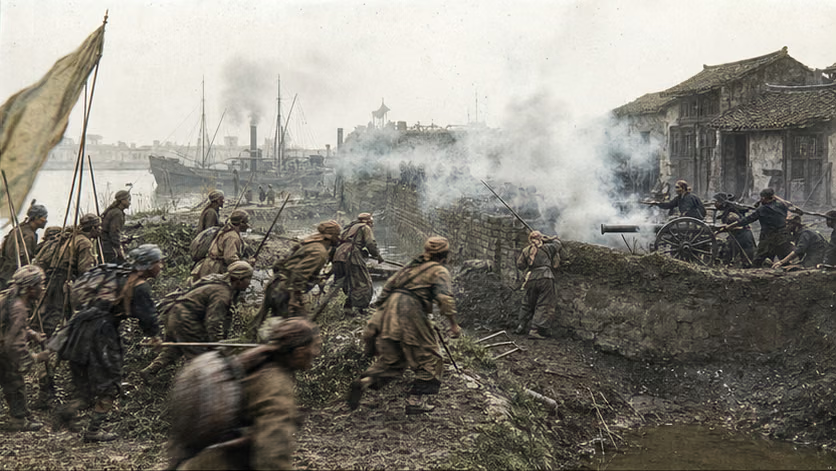
| Phase | Time | Key points |
|---|---|---|
| Eastern expedition to take Suzhou and Changzhou | 1860.5–6 | In mid-May the army advanced east from Tianjing: on 5.19 it took Danyang (Zhang Guoliang, assistant commander of the Jiangnan Encampment, drowned after retreating in defeat), then took Changzhou (5.26) and Wuxi (5.30), and on 6.2 took Suzhou--Jiangsu Governor Xu Youren died (killed or suicide, both accounts coexist); ※ before the city fell, routed Qing troops set fire to the commercial quarter outside Changmen, and Suzhou's most prosperous streets were destroyed by the Qing side's own hand (Suzhou local-gazetteer account; scope of burning unverified). The army then took Songjiang, Qingpu, Jiading, and Taicang in succession, established Sufu Province, and made Suzhou its provincial capital |
| First attack on Shanghai | 1860.8 | Li Xiucheng led his army to Shanghai's western outskirts (the Xujiahui--Jing'an Temple line; route of advance unverified); British and French garrison troops went directly onto the walls to help defend the county seat, while the Foreign-Arms Corps fought on the perimeter; after coming under artillery fire below the walls, the Taiping Army withdrew, Qingpu and Songjiang were lost again after being taken, and the army retreated to Suzhou |
| Turning to take Zhejiang | 1861.12 | Li Shixian's forces first took eastern Zhejiang, and Li Xiucheng's forces again took Hangzhou in December (the 12.29 account remains unverified): during the siege the city ran out of grain, and ※ many starved to death (numbers and source of the record unverified); Zhejiang Governor Wang Youling hanged himself after the city fell. Records of killing after resistance by the Hangzhou Manchu City banner garrison also remain unverified |
| Second attack on Shanghai | 1862.1–9 | In early 1862, the Taiping Army again pressed toward Shanghai along several routes, and the Wusong, Gaoqiao, Fengxian, Nanqiao, Jiading, Taicang, and Qingpu line changed hands repeatedly. British and French forces, the Ever-Victorious Army, and the newly arrived Huai Army launched joint attacks: French fleet commander Auguste Protet was killed by a bullet at the Battle of Nanqiao in 1862.5 (dates vary); the battles at Taicang, Jiading, and elsewhere brought victories and defeats for both sides, and Li Xiucheng at one point inflicted a major defeat on Qing forces at Taicang (basis for battle results varies). In late summer, because of an urgent edict from Tianjing, Li Xiucheng withdrew westward (main reason for withdrawal; one account links it to arrangements to relieve Tianjing, unverified) |
| Ward's death | 1862.9 | The Ever-Victorious Army followed British and French forces into Zhejiang to fight; on 9.20 Ward was shot while supervising the assault below the walls of Cixi, and died of his wounds (death on the next day or several days later, both accounts coexist) |
Casualties and Losses
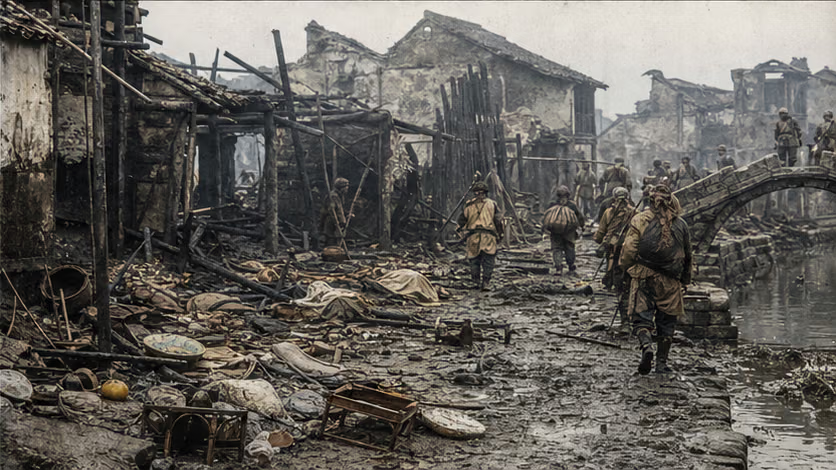
- Total casualties on both sides: no reliable statistics. In the eastern expedition to Suzhou and Changzhou, many cities fell after proclamations or through collapse, with few hard battles; casualties concentrated in the 1862 seesaw fighting around Shanghai. The scattered figures cited in various works (the claim that the Foreign-Arms Corps lost more than half its men at Qingpu, Qing losses at Taicang, and so on) have confused statistical bases and all remain unverified.
- The civilian cost was far greater than the military one: ※ starvation deaths during the siege of Hangzhou, ※ the Changmen fire in Suzhou, and killing, plunder, and flight as cities in southern Jiangsu and northern Zhejiang changed hands repeatedly. Jiangnan's population loss is the truly large number in this war (order-of-magnitude estimates come from later research; see "Disputes and Sensitivities").
- On the Qing side, major cities and senior officials were lost in succession: Jiangsu Governor Xu Youren and Zhejiang Governor Wang Youling died one after the other; the French commander Protet and the Foreign-Arms Corps commander Ward were killed in action. On the Taiping side, the eastern expedition itself did not cost heavily; the real price lay elsewhere--the main forces were held in the direction of Shanghai, while upstream Anqing was in danger at the same time.
Aftermath
- The decisive point was not the battlefield but the pay source. Shanghai's preservation meant the Qing side kept Jiangnan's largest tax source and entry point for arms. In 1862.4, Li Hongzhang led roughly seven thousand Huai Army troops to Shanghai aboard British merchant steamships (number of ships and first-contingent strength vary by statistical basis; this figure is doubtful), then used Shanghai as a base to expand the army and rearm it; a year and a half later, Suzhou was recovered from east to west--the capital that reversed attack and defense was Shanghai's customs revenue, lijin, and foreign rifles and cannon.
- "Borrowing foreign troops to aid suppression" became state policy. From 1862 the Qing court formally recognized and relied on British and French military assistance (the exact moment of the publicly promulgated imperial edict remains unverified), and the Ever-Victorious Army was incorporated into the Qing military establishment. After Ward's death, the American H. A. Burgevine succeeded him; after demanding pay and beating officials, Burgevine was dismissed, seized a steamer in 1863 and defected to the Taiping Army, then soon left again. The British officer Gordon took command of the Ever-Victorious Army in 1863.3 and became one of the main forces with which the Huai Army recovered southern Jiangsu.
- The Taiping Heavenly Kingdom's strategic deadlock. Although Sufu Province was gained, if Shanghai did not fall, Jiangnan's wealth remained incomplete, no source of arms existed, and the flank and rear would always be under threat. Two years later Suzhou and Tianjing fell in succession, and one of the upstream causes lay here (historians disagree on causal weight; see "Disputes and Sensitivities").
- Jiangnan society was left devastated: the population greatly decreased, fields were abandoned, and the silk and tea trades shifted route; southern Jiangsu's economic center thereafter moved permanently toward Shanghai.
Accounts of Those Present
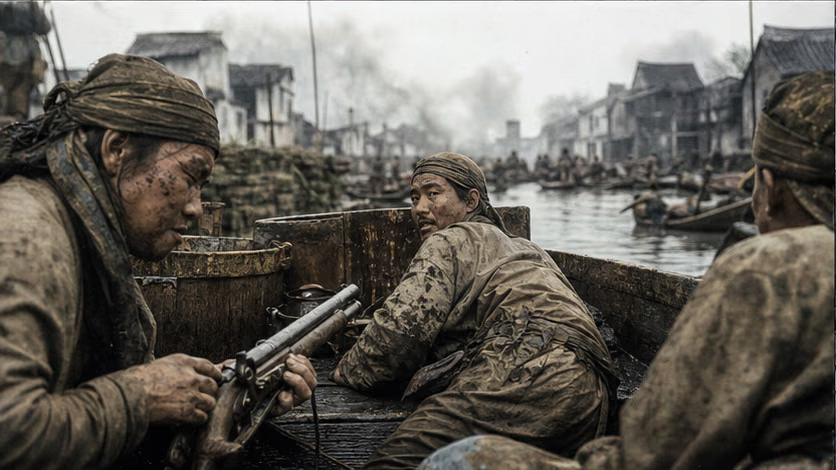
- Ward (Frederick Townsend Ward, 1831–1862): An American sailor by origin, in 1860 he was entrusted by Shanghai daotai Wu Xu and wealthy merchant Yang Fang to recruit a little over one hundred foreign adventurers into a force. After defeat, he recruited Chinese braves, placed foreigners as officers, and formed the "Foreign-Arms Corps." In 1862 he took Chinese nationality and was granted the rank of brigadier general; his force was bestowed the name "Ever-Victorious Army," and he married Yang Fang's daughter. In September of the same year, he was shot below the walls of Cixi and died at age thirty-one. The Qing court gave him a lavish burial at Songjiang and built a shrine (history of the shrine and tomb unverified).
- H. A. Burgevine (1836–1865): Ward's deputy and successor as commander of the Ever-Victorious Army. Because he demanded pay, let troops beat Yang Fang, and plundered the silver treasury, Li Hongzhang dismissed him. In 1863 he seized the steamer "Gaoqiao" and went to Suzhou to defect to the Taiping Army, helped Prince Mu Tan Shaoguang train a small Western-style unit, then left in frustration several months later and made his way to Japan. In 1865 he secretly returned to Fujian, intending again to join Taiping remnants; he was seized by Qing troops in Xiamen, and on the escort journey the boat capsized and he drowned at Lanxi, Zhejiang--the Qing side recorded it as an accident, while the claim that Li Hongzhang ordered him drowned circulated widely (this claim remains unverified).
- Wang Youling (1810–1861): Governor of Zhejiang. When Hangzhou was besieged, Zeng Guofan sat by without relief and Zuo Zongtang's troops were stalled on the Jiangxi-Zhejiang border (the reasons and responsibility for Zeng and Zuo not relieving the city were already debated at the time; details unverified); after the city fell, Wang hanged himself, and the Qing court gave him the posthumous title "Zhuangmin." It is said that Li Xiucheng respected his refusal to yield and prepared a coffin and escorted his bier out (this claim appears in Taiping-side accounts and later citations; original source unverified).
- Auguste Léopold Protet: French naval rear admiral and commander of the French fleet in the invasion of China. In 1862.5 he was shot dead while fighting the Taiping Army at Nanqiao in Fengxian--one of the highest-ranking foreign officers to die fighting for the Qing court (details of rank and place and time of death unverified).
- Zhang Guoliang: A fierce general of the Jiangnan Encampment, born in the Green Standard. After defeat at Danyang he retreated, fell from his horse while crossing a bridge, and drowned (or drowned himself, both accounts coexist)--the Jiangnan Encampment that had sustained the siege of Tianjing for seven years lost its commander Hechun by hanging at Xushuguan and its deputy Zhang Guoliang here; commander and deputy of one army died on the same day, and the Jiangnan Encampment could no longer be rebuilt.
The Ground
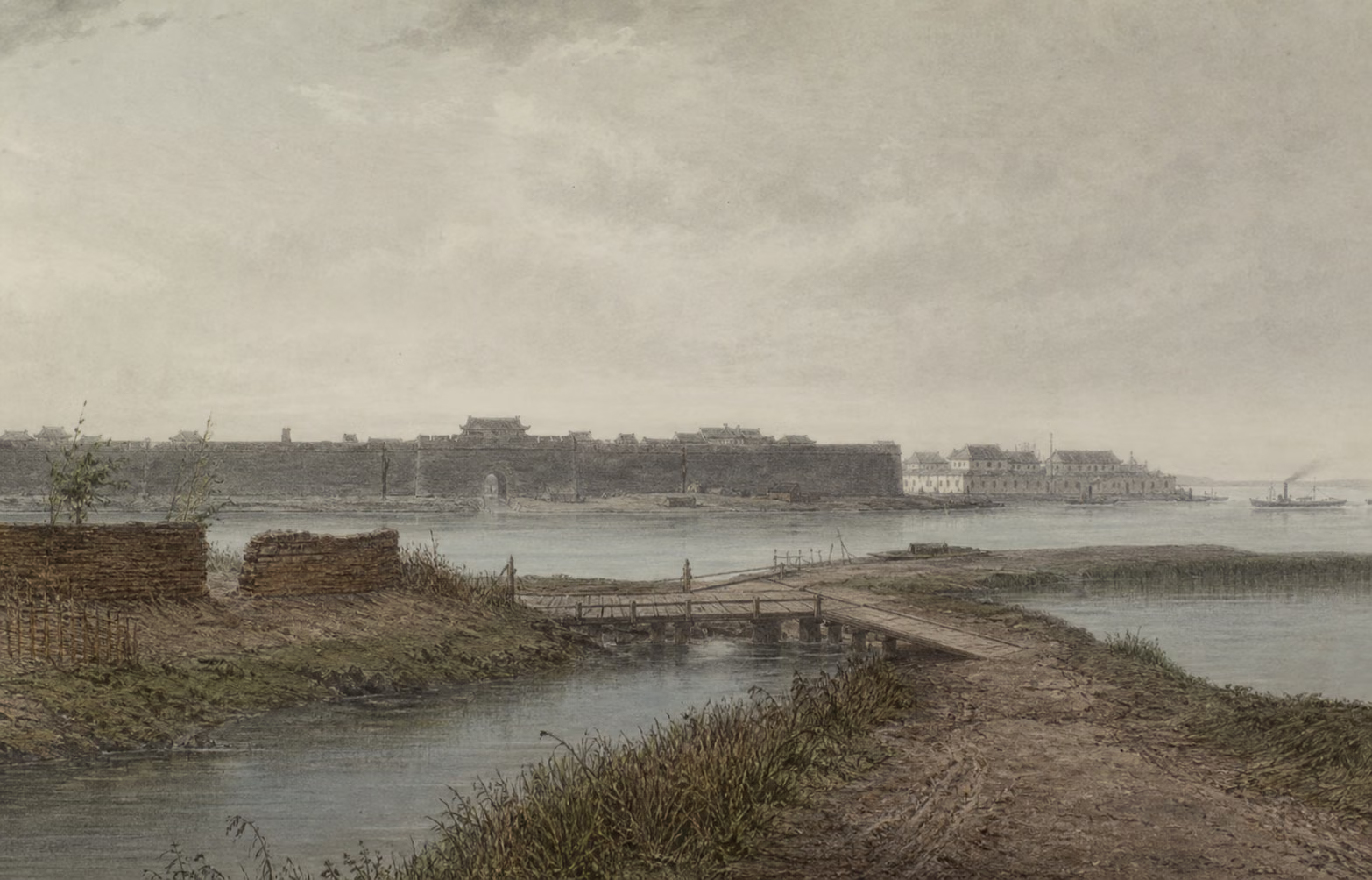
- The Jiangnan water network: Between Suzhou, Songjiang, and Taicang there were no great roads to speak of; canals, lakes, and polders cut the battlefield into fragments. Large-army movement depended on boats, while bridges, ferries, and river mouths were the keys--the Taiping Army was skilled at using the water network to weave through it, while the British and French forces countered with small steam launches and gunboats.
- Shanghai's two-layered space: The county seat (the Chinese-administered city) and the concessions were divided by Yangjingbang, one waterway apart and two armed orders side by side. When the Taiping Army first attacked Shanghai, it stopped below the county-seat walls--to attack the county seat meant also attacking into the guns of the British and French forces, and this "invisible wall" was the real reason Shanghai held.
- The seesaw corridor: The more-than-one-hundred-li corridor from Shanghai's western outskirts through Jiading, Taicang, Qingpu, and Songjiang changed hands repeatedly in 1862, with fortifications in every town. Names of small towns such as Nanqiao, Sijing, and Qibao were blood points in that year.
- A contrast of scale: The taking of Suzhou and Changzhou was a deep raid in which famous cities fell within ten-odd days; the Battle of Shanghai was a grinding struggle with one city as its bullseye and several tens of li as its depth. The same Taiping Army fought two kinds of war.
How Each Side Records It
- Qing records at the time: Official books and memorials called the loss of Suzhou and Changzhou "falling to the enemy" and their recovery "suppression and pacification," and used terms such as "rebels" and "traitors" for the Taiping Army (Qing original-document terminology). Many surviving refuge notes and diaries by Jiangnan officials and gentry record burning and plunder, flight, and precarious survival in the concessions in great detail, making them the main source for civilian perspectives on this campaign (representative titles unverified). The Qing court built shrines and granted posthumous honors to frontier officials who died, such as Wang Youling, and deliberated relief and shrines for Ward and Protet--there had been no precedent for state sacrifice to foreign officers before this.
- Surviving Taiping-side accounts: Very few. The most important are the passages in Li Xiucheng's autobiographical account on the eastern expedition and the two attacks on Shanghai; Li Xiucheng attributed the failure to take Shanghai to foreign assistance to the Qing and to command arrangements from above (original wording unverified). Other Taiping-side battlefield documents and proclamations survive only in scattered form, and their collection status remains unverified.
- Changes in later narratives: Twentieth-century textbook narratives treated "the Taiping Army's major defeat of the Foreign-Arms Corps and killing of Ward" as an anti-imperialist highlight, and the Battle of Qingpu was labeled the "Great Victory at Qingpu." After the 1980s, research attention shifted toward "borrowing foreign troops to aid suppression," Chinese-foreign relations, the rise of the Huai Army, and Shanghai's modernization; evaluations of Sufu Province under Taiping rule diverged (the positive judgment of the traditional peasant-war narrative coexists with reassessment of destructive records in Jiangnan local documents). In recent Shanghai local narratives, this campaign often appears as the prelude to the "rise of a treaty-port city"--battlefield memory has yielded to urban history.
Disputes and Sensitivities
- The nature of British and French participation: Nominal "neutrality" and actual assistance in defending the county seat, then by 1862 active fighting thirty li beyond the concessions (origin and enforcement of the "thirty-li" restriction unverified). Whether this was defense of expatriates and treaty ports or armed intervention in China's civil war remains disputed in Chinese and foreign historiography.
- Whether the Taiping Army should have, or could have, taken Shanghai: One view holds that Li Xiucheng hesitated for fear of consequences and, unwilling to go to war with the foreign powers, missed the opportunity; another holds that even a determined assault might not have succeeded and would have pushed Britain and France fully toward the Qing court earlier. This is a dispute over strategic counterfactuals, impossible to falsify and marked by hindsight.
- Responsibility for and scale of southern Jiangsu's population loss: Jiangnan's population fell sharply in 1860–1864. Qing documents mostly blamed the Taiping Army, while Taiping-side governance records (Li Xiucheng's pacification of civilians and tax-reduction measures in Sufu Province) form another side of the evidence. Later studies differ enormously in their estimates of deaths, and war, massacre, epidemic, famine, and flight are hard to separate; what can be determined is that the scale was enormous and attribution disputed.
- Emblematic narratives such as the "Great Victory at Qingpu": The original basis for the concrete results often used in textbooks (Foreign-Arms Corps casualty figures and so on) is thin.
- Sensitivity of terminology: this article does not use "bandit," "traitor," or "rebel scum" in its own narration; when Qing documents are cited, terms are placed in quotation marks and their source is marked.
Sources and Open Questions
Known main sources:
- Li Xiucheng's autobiographical account (core Taiping-side first-person account, passages on the attack on Shanghai)
- Qing memorials and veritable records (memorials by Zeng Guofan, Li Hongzhang, and Xue Huan; related entries in the *Veritable Records of the Qing* for the Xianfeng and Tongzhi reigns)
- Jiangnan officials' and gentry's refuge notes and diaries (titles unverified)
- Western records: English-language works related to the Ever-Victorious Army and Gordon (such as Andrew Wilson, *The "Ever-Victorious Army"*), and contemporary newspapers such as the *North-China Herald* (specific volumes and issues unverified)
- Suzhou Municipal Local Gazetteer Office, *The Taiping Heavenly Kingdom in Suzhou* (local-gazetteer account)
- Luo Ergang, *History of the Taiping Heavenly Kingdom* (general-history account)
Open questions:
1. The exact sequence of dates on which cities were recovered in the eastern expedition (Danyang 5.19, Changzhou 5.26, Wuxi 5.30, and Suzhou 6.2 form one circulated account, but original archives must be checked). 2. The two accounts of Xu Youren's cause of death; whether Zhang Guoliang drowned accidentally or drowned himself; the place and manner of Hechun's death. 3. The responsibility details for the Changmen fire in Suzhou (the claim that Xu Youren ordered it and Ma Dezhao carried it out) and the scope of the burning. 4. The exact date of the first attack on Shanghai in 1860 (mid- to late August), the route of advance (Xujiahui and Jing'an Temple account), British and French troop strength, and the chronology of "aiding in the south, fighting in the north." 5. The date Hangzhou fell (the 1861.12.29 account) and details of Wang Youling's suicide; records of starvation deaths during the siege of Hangzhou; records of killing in the Manchu City. 6. The original source for the claim that Li Xiucheng gave Wang Youling an honorable burial. 7. The date of Protet's death in action (the 1862.5.17 account), his rank, and the course of the Battle of Nanqiao. 8. The interval between Ward being shot (1862.9.20) and his death (next day / several days later, both accounts); the history of Ward's shrine and tomb at Songjiang. 9. The exact date when Li Hongzhang's first Huai Army contingent reached Shanghai (early 1862.4, with 4.4 / 4.8 and other accounts), its strength (6,500 / 7,000), and the number of steamships. 10. The moment and wording by which "borrowing foreign troops to aid suppression" became a publicly promulgated imperial edict; the exact time when the Chinese-Foreign Joint Defense Office was established (late 1861–early 1862). 11. The organizational evolution of the Ever-Victorious Army (the 1862.2 bestowed-name account / March formation account) and its strength in each period (4,500 / 5,000 / 6,500, among coexisting figures). 12. Burgevine's drowning: the original official notification and the source for the claim that Li Hongzhang ordered it. 13. The original source for Foreign-Arms Corps casualty figures in the Battle of Qingpu (1860.8). 14. Rechecking the original text of Li Xiucheng's autobiographical account on the attack on Shanghai. 15. The origin and enforcement of the British and French "thirty-li" operational restriction. 16. The original wording in Li Xiucheng's autobiographical account for the Tianjing military conference's "return within one month" claim and the basis for the deadline. 17. Original texts of the memorial exchanges in the Xianfeng reign in which Zeng Guofan was urged to lift the siege and go east, while Zeng insisted on continuing the siege of Anqing. 18. The moment and wording of the British and French declaration in 1860 that they would defend Shanghai county seat. 19. Survival and original text of Li Xiucheng's letter to the foreign countries before attacking Shanghai.
All images on this site are AI-generated depictions. They are not historical photographs, not primary sources, and do not depict any real individual.