Engagement Archive · Defense of Anqing
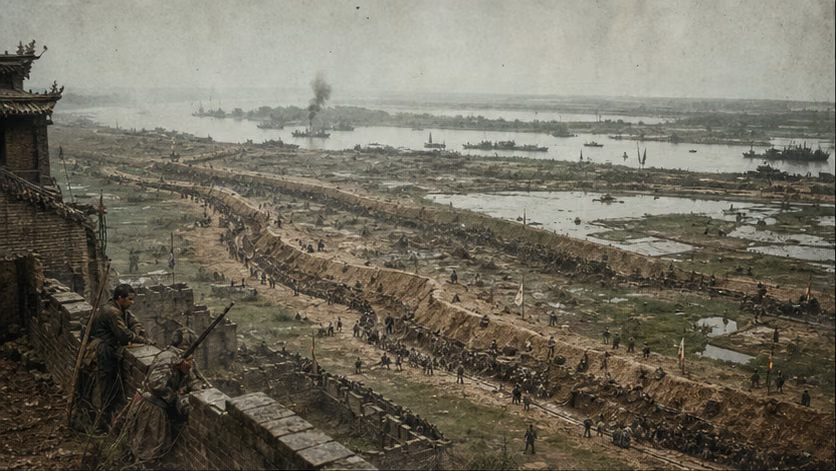
The Xiang Army dug two long trenches outside Anqing and held the city under siege for fifteen months; the Taiping Army's three major relief efforts were all stopped outside the trenches, and on September 5, 1861 a tunnel mine brought down the wall, with more than ten thousand defenders perishing to the last -- from then on Tianjing's upstream gate lay open, and the war could scarcely be turned back.
Engagement Data
| Item | Details |
|---|---|
| Time | Xiang Army encirclement began in 1860 – city fell on 1861.9.5, after a siege of about fifteen months |
| Place | Anqing, Anhui (north bank of the Yangtze, then the provincial capital of Anhui), and the outer line of Jixian Pass, Chigang Ridge, Ling Lake, and Tongcheng |
| Belongs to | Late phase of the Taiping and Nian Rebellions · contest for the upper Yangtze |
| Defending side | Taiping Army garrison at Anqing (commanders Ye Yunlai and Wu Dingcai) |
| Relief side | Ying King Chen Yucheng's forces; relief forces sent from Tianjing under Gan King Hong Rengan, Zhang King Lin Shaozhang, and others |
| Besieging side | Xiang Army land forces under Zeng Guoquan; navy under Yang Zaifu (Yang Yuebin) |
| Relief-blocking side | Xiang Army forces under Duolonga, Li Xuyi, Bao Chao, and others |
| Result | On 1861.9.5 the Xiang Army used a tunnel mine to collapse the city wall; the city fell, the defenders perished to the last, and Anqing returned to the Qing side |
Belligerents
| Item | Defending side (Taiping Army) | Besieging side (Xiang Army) |
|---|---|---|
| Strength | More than ten thousand defenders in the city (modern research basis; Qing memorial figures appear in the "Casualties and Losses" section) | Zeng Guoquan's land force initially about more than ten thousand men; Yang Zaifu's navy, about 4,000, controlled the river; by 1861 the besieging force had increased to about 40,000 (figure disputed) |
| Firepower | Mainly old-style heavy matchlocks, bird guns, and cold weapons; ammunition dwindled by the day | Trenches and forts plus naval gunboats controlling the river surface; some foreign rifles and cannon (bought from Shanghai, scale disputed) |
| Supply | After Zongyang fell in summer 1860, the encirclement gradually took shape, the grain routes were progressively cut, and by 1861 the city had run out of grain | The navy protected the Yangtze grain route, and supplies were never interrupted |
| Outer layer | Relief side: forces under Chen Yucheng, Hong Rengan, Lin Shaozhang, Huang Wenjin, and others, amounting successively to several tens of thousands (actual statistical basis varies, figure disputed) | Relief-blocking side: Duolonga and Li Xuyi held the Tongcheng line with about 20,000 cavalry and infantry, while Bao Chao's Tingzi Battalion served as the mobile force |
Terrain and Conditions
(For the broader situation around 1860 -- the second destruction of the Jiangnan Encampment, the eastern expedition to Suzhou and Changzhou, and the Second Opium War -- see Taiping Heavenly Kingdom: Overview.)
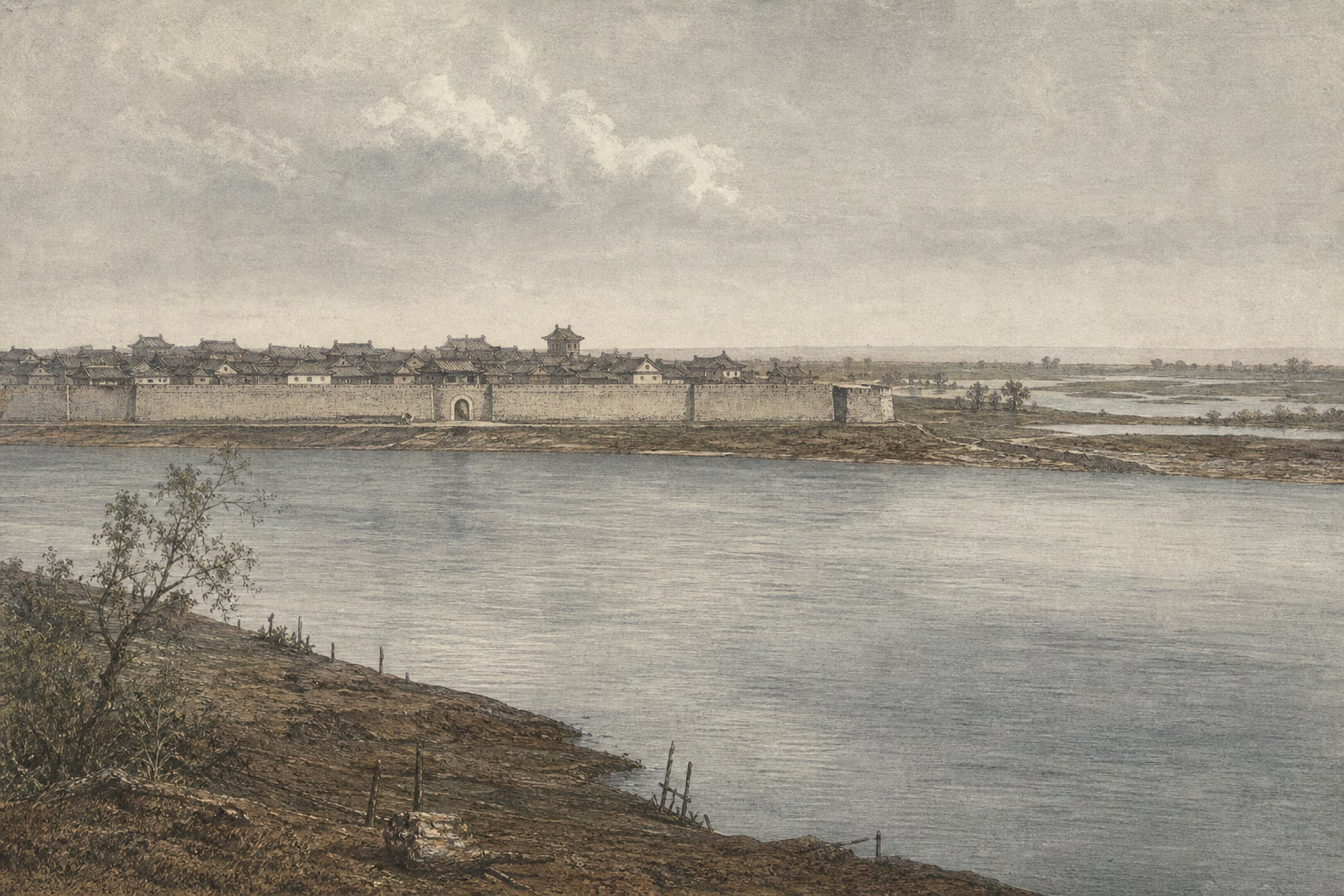
This city: Anqing stood on the north bank of the Yangtze. It was then the provincial capital of Anhui. Ling Lake lay northeast of the city, and Jixian Pass was the landward throat north of the city; hence the saying that "Anqing's danger lies at Jixian Pass." Occupied by the Taiping Army from 1853, it was Tianjing's most important upstream shield and the transfer point for Anhui grain and pay. The Taiping Heavenly Kingdom's later formulation was that "for every day Anqing is unharmed, Tianjing has no danger for a day" (Hong Rengan's words, quoted from modern historical works; original text unverified).
This land: Central Anhui had been pulled back and forth for years. Luzhou, Tongcheng, and Shucheng changed hands several times. The 1858 Battle of Sanhe (see Battle of Sanhe) was fought south of Luzhou, and Xiang Army elites had been wiped out there -- two years later they came back in a posture of revenge.
Why It Was Fought
The battle at Sanhe cut off the Xiang Army's edge south of Luzhou, and the Qing forces besieging Anqing accordingly lifted the siege and withdrew to Susong; central Anhui therefore had two years of relative quiet. But Zeng Guofan's strategy had not changed. It had merely become slower: still "control the lower reaches from above," first seize the upper Yangtze, then press downstream toward Tianjing; there would be no more Sanhe-style isolated thrusts, only steady advance, firm camps, and forts built step by step.
In 1860 the opening appeared. The Taiping Army destroyed the Jiangnan Encampment a second time, and its main force followed Li Xiucheng eastward toward Suzhou and Changzhou. The center of gravity of the whole situation pressed toward the richest ground downstream -- for the moment, no large army could return upstream. Zeng Guofan and Hu Linyi commanded more than 50,000 Xiang Army land and naval troops (Qing memorial basis) eastward from Hubei, took Taihu and Qianshan in succession, and drove straight at Anqing, striking at a place the Taiping Army had no choice but to rescue. On this land where 6,000 Xiang Army elites had been broken two years before, the Xiang Army came back in a posture of revenge.
Anqing was worth that lunge: Anhui's provincial capital on the north bank of the Yangtze, in Taiping hands since 1853, Tianjing's most important upstream shield, and the transfer point for Anhui grain and pay. The Taiping Heavenly Kingdom's later words stated the weight of it to the end -- "for every day Anqing is unharmed, Tianjing has no danger for a day" (Hong Rengan's words, quoted from modern historical works; original text unverified). Both sides saw this layer clearly: once Anqing was lost, Tianjing's west would have no cover.
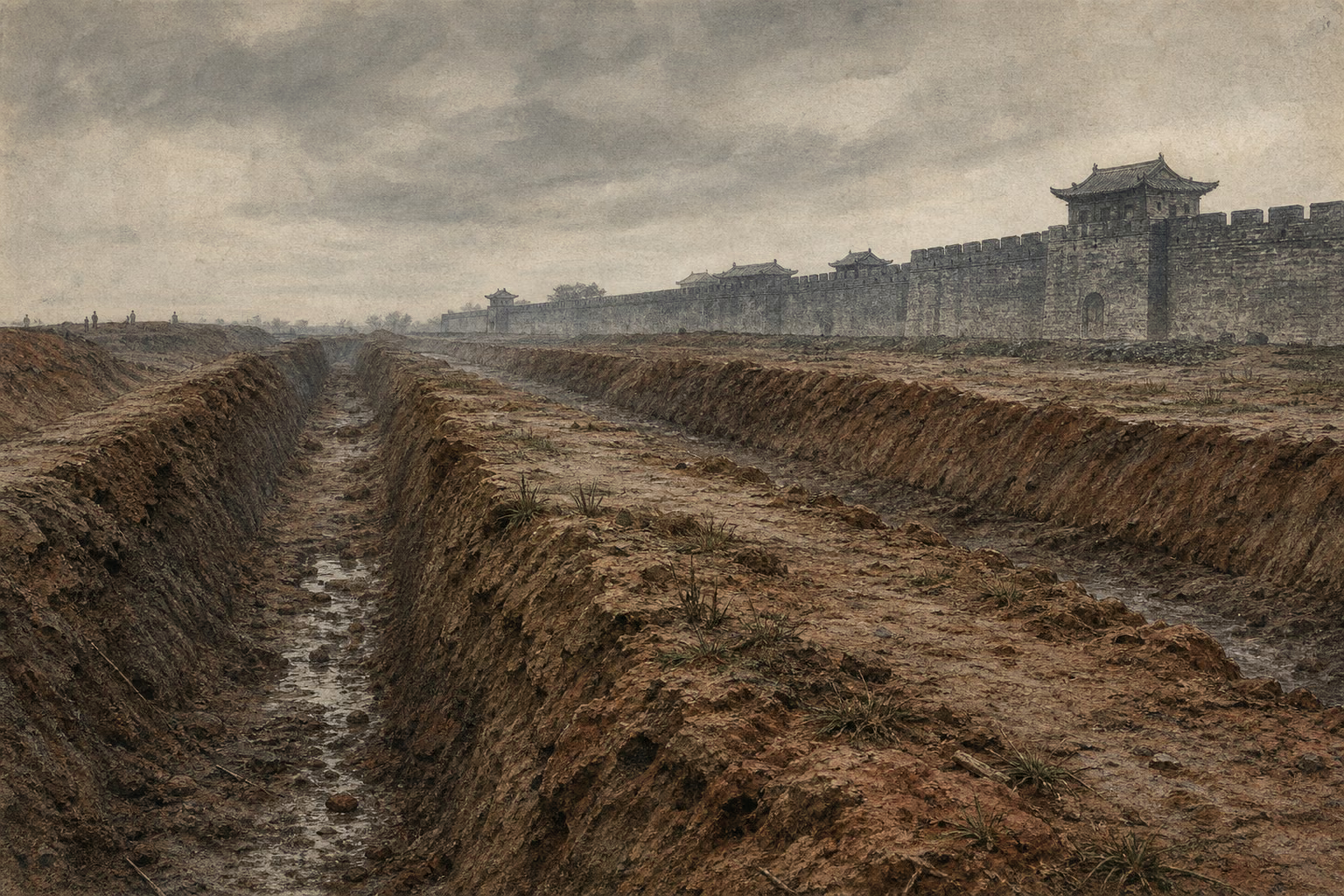
That summer, Zeng Guoquan's force reached the outskirts of the city and dug two long trenches, the inner trench to besiege the city and the outer trench to refuse relief (two-trench and three-trench accounts coexist, unverified); Yang Zaifu's navy controlled the river surface, Zongyang fell (summer 1860, exact month and day unverified), and the encirclement gradually took shape. The Taiping Army had no choice but to rescue it. The city thus became a noose for both sides: the Xiang Army used the city as bait, besieging the point and striking the relief; Taiping relief forces were fed batch by batch outside the trenches.
This decision was made in defiance of imperial edicts. In spring and summer 1860, after the Jiangnan Encampment was broken again and Suzhou and Changzhou were in danger, the court repeatedly issued edicts urging Zeng Guofan to lift the siege and send aid east, first rescuing the tax-rich lands of Jiangsu and Zhejiang. Zeng's replies came one after another, with only one meaning: once the siege of Anqing was lifted, all previous work would be thrown away (document numbers and dates of the exchanged edicts and memorials unverified; the matter appears repeatedly in Qing memorial documents). That same year he moved his headquarters to Qimen in southern Anhui, intending to attend to both the upper river and western Zhejiang. The result was that Qimen was hemmed in by mountains on four sides and had only a single grain route; Taiping spearheads swept nearby several times, and everyone in the staff was in fear. Staff member Li Hongzhang strongly urged moving the camp, failed to win the argument, and left the staff on a pretext (details unverified); at Taihu, Hu Linyi also disapproved of basing the headquarters at Qimen and exchanged letters of persuasion (original Hu-Zeng correspondence unverified). Neither objection shook Qimen, much less the long trenches outside Anqing.
On the Tianjing side, the determination to rescue Anqing was equally real, but the method was twisted. In autumn 1860 the plan was set to attack Wuhan jointly, striking a place the Xiang Army had to rescue in order to relieve the siege of the city: Chen Yucheng would move north of the Yangtze, and Li Xiucheng south of it. Li Xiucheng's mind was on newly gained Suzhou and Hangzhou downstream, and he advanced westward slowly all along the route -- later, in his own account, he did not conceal his lack of enthusiasm for the upstream campaign (relevant passages in Li Xiucheng's Autobiographical Account, original text unverified). Objections do not always have to be placed openly on the table; the speed of a march can itself be the objection.
Material boundaries tightened hard around both sides. The Xiang Army's long-trench method staked everything on logistics: only if the navy held the Yangtze could grain and ammunition connect, while pay came from coordinated support from Hunan and Hubei and the newly established lijin transit tax; arrears of several months were routine (specific conditions of pay arrears in the Anqing siege army unverified). The besieging army was wedged between the inner and outer trenches; once grain was cut, it would be dead ground. Inside the city it was simpler still -- once Zongyang was lost, only the Ling Lake water route remained for grain; once Ling Lake was cut too, the defenders had nothing left but waiting. Relief troops were fed batch by batch outside the trenches, until at last there was not even rice left for those inside the city to wait on.
Course of the Engagement
| Stage | Time | Key points |
|---|---|---|
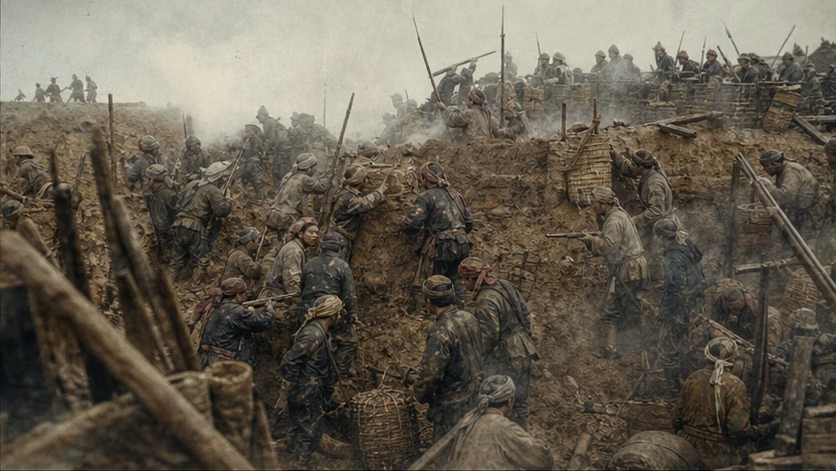
| Encirclement begins | Summer 1860 | Zeng Guoquan's force encamped outside Anqing and dug two long trenches: the inner trench besieged the city, the outer trench refused relief (two-trench and three-trench accounts coexist, unverified); Yang Zaifu's navy controlled the river; Zongyang fell (summer 1860, exact month and day unverified), and the encirclement was completed |
| Disposition for striking relief | Autumn-winter 1860 | Duolonga and Li Xuyi led cavalry and infantry to the Tongcheng-Guache River line, specializing in striking relief forces; Chen Yucheng attacked Guache River but failed (sequence unverified) |
| "Besieging Wei to rescue Zhao" aborts | Autumn 1860 – 1861.4 | Tianjing set the plan: Chen Yucheng would move north of the Yangtze and Li Xiucheng south of it, jointly attack Wuhan, and force the Xiang Army to return to relieve it, thereby lifting the siege of Anqing. Chen Yucheng took Huangzhou in 1861.3 and was only about one hundred li from Wuchang; traditional accounts say the British counselor Harry Parkes went from Hankou to Huangzhou to dissuade Chen's force from attacking Hankou (the reliability of this account is disputed, unverified). Together with Li Xiucheng's slow progress and failure to arrive, Chen led his main force back to Anhui in April. Li Xiucheng did not reach the Wuchang county area until June 1861, knew the matter was already beyond help, and returned east |
| First return to rescue | 1861.4–6 | Chen Yucheng returned with his army, camped at Jixian Pass, and fought repeated bloody battles with Zeng Guoquan's besieging force; the relief forces of Hong Rengan and Lin Shaozhang were blocked by Duolonga. Bao Chao and Cheng Daji's forces attacked the four forts outside Jixian Pass at Chigang Ridge: in early June three forts fell; Liu Canglin held the first fort alone, then the fort fell and his 4,000 elite troops were wiped out; ※ surrendered soldiers in the fort were killed (number disputed) |
| Ling Lake and the final counterattack | 1861.7–8 | The Taiping Army built forts on the north bank of Ling Lake (two accounts, thirteen or eighteen forts, unverified) and used small boats to carry grain into the city; Zeng Guoquan built forts to cut the route, and the city's grain road was then severed. In August, Chen Yucheng joined Yang Fuqing and others in a final counterattack, assaulting the outer trench fiercely in turn for more than ten days, without success |
| City falls | 1861.9.4–5 | The Xiang Army dug under the city at the foot of Ma Hill; on the morning of September 5 the charge exploded, collapsing the city wall, and troops poured in through the breach; Ye Yunlai and Wu Dingcai led the defenders in street fighting, and the city fell |
Casualties and Losses
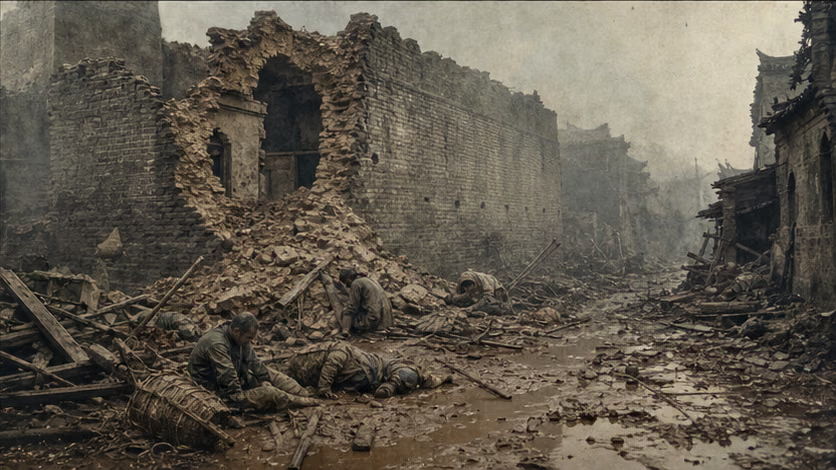
- Defending side: when the city fell, the defenders perished to the last. Two sets of figures are placed side by side -- Zeng Guofan's memorial claimed 16,000 enemy killed (there is also an account of more than 20,000, both from Qing memorials); modern research holds that the Taiping Army inside the city numbered at most about 10,000 (basis quoted through modern research, original source unverified). Defending commander Zhang Chaojue broke out and escaped (record unverified); Ye Yunlai and Wu Dingcai died.
- Relief side: Liu Canglin's 4,000 elite troops at Chigang Ridge were wiped out; there is no aggregate account of casualties in the relief battles of 1860–1861 (figure disputed).
- Besieging and relief-blocking side: Xiang Army casualties appear scattered through memorials by unit, with no reliable total (figure disputed).
- ※ After grain ran out in the city, records of "people eating one another" appear in multiple modern historical works (original source unverified); records of Xiang Army killing after the city fell likewise have sources still unverified.
- Very few surviving records describe what happened to civilians inside the city during the fifteen-month siege (specific circumstances unverified).
Aftermath
- Tianjing lost all its upstream gateways. The Xiang Army proceeded downstream, and in May 1862 Zeng Guoquan's force had already encamped at Yuhuatai (see Defense of Tianjing) -- between Anqing and Tianjing there was no strong city left.
- Chen Yucheng retreated to defend Luzhou and was stripped of his title as Ying King (details unverified); in May 1862 Luzhou could not be held, and he fled north to Shouzhou, where Miao Peilin lured and seized him; he soon died (see "Accounts of Those Present" for details).
- Hu Linyi vomited blood and died at Wuchang at the end of August 1861 (month and day unverified), without seeing the Anqing victory report that came a few days later.
- The method of "long-trench siege plus heavy forces to strike relief" was fully verified in this battle; Zeng Guoquan used the same method afterward in the siege of Tianjing.
- This battle is widely regarded by later generations as the turning point at which the Taiping Heavenly Kingdom moved from strength to decline and the course of the war became irreversible.
Accounts of Those Present
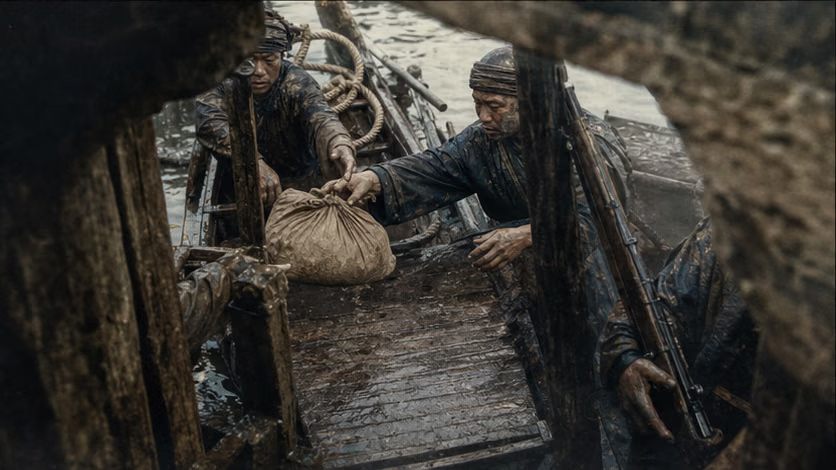
The death of the "Ying King": Once Anqing was lost, Chen Yucheng retreated to Luzhou and his followers scattered. In May 1862, he led the remnants of his force to Shouzhou to seek refuge with his former subordinate Miao Peilin -- at this point Miao had already secretly submitted to the Qing court and, under orders from imperial commissioner Shengbao, lured Chen Yucheng into captivity. As soon as Chen entered the city he was seized and sent under escort to Shengbao's headquarters. He refused to surrender; in accounts, when urged to submit he answered, "A true man dies if he dies; why this chatter?" (quotation source unverified). ※ He was put to death by lingchi at Yanjin, Henan, at age twenty-six (two accounts, May/June 1862, unverified). Another circulating story has him sigh before death, "With one man gone from the Taiping Heavenly Kingdom, half the realm is gone too" (source unverified, suspected later embellishment).
- Liu Canglin: Chen Yucheng's foremost fierce commander, he held the first fort at Chigang Ridge. After the other three forts had all fallen, his lone fort held out for several more days; when the fort fell he was killed (there is an account of "dismemberment," unverified). After Zeng Guofan received the report, he wrote to Zeng Guoquan that "killing these thousand-plus true rebels is better than taking a great city" (Zeng Guofan family letter, original text unverified; "true rebels" is a Qing-side term).
- "Zeng the Iron Barrel": Zeng Guoquan received this nickname because of the long-trench siege. The plan itself was also a dangerous move -- the Xiang Army was caught between the two trenches, and if attacks from inside and outside had both succeeded it would have been dead ground. Zeng Guofan stated this danger himself in an April 1861 memorial ("the rebel chief Four-Eyed Dog Chen Yucheng..."; "rebel chief" and "Four-Eyed Dog" are Qing memorial terms).
- The victory report reaches home: when Zeng Guofan heard that Anqing had been recovered, he wrote to Zeng Guoquan, taking that year's celestial signs, "sun and moon conjoined, five planets aligned," as an omen of restoration, and wished to gather 10,000 taels of gold to reward the army (quoted from modern historical works; original family-letter text unverified).
- A grain of rice in the city: after the city fell, the Xiang Army found five shi of privately hidden rice on defending commander Zhang Chaojue's rooftop (Qing-side record, unverified) -- by then grain inside the city had already run out.
- The Englishman below Huangzhou: the episode in which Harry Parkes went to Huangzhou to meet Chen Yucheng and "dissuade" him from attacking Hankou long appeared in textbooks; recent research has questioned its evidentiary chain (this account unverified).
The Ground
- Anqing's southern wall faced directly onto the Yangtze, and Yang Zaifu's navy controlled the river, effectively sealing the southern route; before the city fell, supply and breakout routes remained only to the north and east.
- Jixian Pass was the landward throat north of the city. The Taiping Army "guarded the pass rather than the parapet" and concentrated heavy forces there; after the Xiang Army broke the pass, it shifted to locking the city with long trenches.
- The siege space formed by the two long trenches: the inner trench locked the city, the outer trench refused relief, and the besieging army occupied the middle -- both an iron barrel and a narrow dead ground attacked from front and rear, where attack and defense could reverse at any moment.
- Ling Lake was the waterborne grain route northeast of the city: the Taiping Army used boats to move grain and built forts along the lake, while the Xiang Army built forts to cut the lake -- the struggle over the grain road took place on this water surface.
- The final breach came underground: tunnels were dug from the foot of Ma Hill to the city wall foundation, and charges were set to blast the wall.
How Each Side Records It
- Qing side at the time: memorials by Zeng Guofan, Zeng Guoquan, Duolonga, and others came one after another, calling the Taiping Army "rebels" and "bandits" (terms such as "false Ying King" and "Four-Eyed Dog" all come from Qing documents); the memorial basis claimed more than ten thousand enemy killed. Xiang Army-system writings such as Record of the Xiang Army also describe this battle in detail and count it as one starting point of "restoration."
- Taiping Army side: very few direct surviving records exist. Li Xiucheng discussed the loss of Anqing and Chen Yucheng's death in his autobiographical account (exact wording unverified); Hong Rengan's autobiographical account also touches on the failed relief effort (original text unverified). Chen Yucheng himself left no surviving autobiographical account; the confession after his capture survives only in fragments paraphrased through Shengbao's memorials, with authenticity and original wording unverified.
- Later narratives: modern-history textbooks long attributed the defeat at Anqing to "Parkes's intervention plus Li Xiucheng's delay," and defined it as the turning point at which the Taiping Heavenly Kingdom moved from strength to decline; research in recent decades has revised many specific issues, including the actual number of defenders, the evidence for the Parkes account, and the division of responsibility between Chen Yucheng and Li Xiucheng.
Disputes and Sensitivities
- The account of Parkes dissuading Chen at Huangzhou: Chen Yucheng's abandonment of the attack on Hankou has traditionally been attributed to Harry Parkes obstructing him in person; recent research questions the weakness of the evidence for this account (internal factors such as insufficient military strength in Chen Yucheng's force and Li Xiucheng's failure to arrive may have been more critical). This account involves the narrative of foreign intervention, and the evidence remains disputed.
- Two statistical bases for the number of defenders: Qing memorials (16,000 / more than 20,000) and modern research (about 10,000) differ by a factor of roughly two and come from different sources.
- Responsibility for ineffective relief: Li Xiucheng advanced late, Chen Yucheng twice returned to rescue without success, and Hong Rengan's relief force was blocked -- how responsibility should be divided remains debated among historians and is also a typical example of the Taiping Heavenly Kingdom's "factional hilltop" problem.
- ※ The killing of surrendered troops at Chigang Ridge, killings after the city fell, and the lingchi execution of Chen Yucheng are all matters recorded in scattered places, with sources often not yet firmly established.
Sources and Open Questions
Known main sources:
- Zeng Guofan's memorial drafts and family letters (Zeng Guofan Quanji)
- Qing-side memorials by Zeng Guoquan, Duolonga, Shengbao, and others
- Wang Kaiyun, Record of the Xiang Army (Xiang Army-system writing)
- Li Xiucheng's Autobiographical Account and Hong Rengan's Autobiographical Account (six-part autobiographical historical materials of the Taiping Heavenly Kingdom)
- Mou Anshi, Taiping Heavenly Kingdom; Mao Jiaqi, General History of the Taiping Heavenly Kingdom; Xia Chuntao and other modern researchers (quoted bases; specific editions and page numbers unverified)
Open questions:
1. Original sources for defender numbers: original wording of Zeng Guofan's memorial figure "16,000"; source of the research paper behind the "about 10,000" estimate. 2. Source basis for Zeng Guoquan's besieging force increasing to "about 40,000"; the distinction between two long trenches and three. 3. Specific number of surrendered troops killed at Chigang Ridge and the earliest source; source for Liu Canglin's manner of death (the "dismemberment" account). 4. Original sources for records of "people eating one another" inside the city and killings after the city fell (gazetteers / notes / memorials). 5. Evidentiary chain for the account of Parkes dissuading Chen at Huangzhou, and recent scholarship questioning it. 6. Date of Chen Yucheng's death (May/June), and original sources for "A true man dies if he dies" and the "half the realm is gone" saying. 7. Exact date of Hu Linyi's death; original text of Zeng Guofan's family letter on "sun and moon conjoined, five planets aligned." 8. Sources for Zhang Chaojue's breakout and five shi of privately hidden rice; number of forts at Ling Lake (thirteen/eighteen). 9. Exact wording of the Anqing-related passages in the autobiographical accounts of Li Xiucheng and Hong Rengan. 10. Exact month and day when Zongyang fell; sequence of Chen Yucheng's attack on Guache River. 11. Exchanged edicts and memorials in which the court urged Zeng Guofan to lift the siege and send aid east, and Zeng replied insisting on not lifting it (document numbers, dates). 12. Timing and decision process of Zeng Guofan's move to Qimen; beginning and end of Li Hongzhang's remonstrance against moving the camp and departure from the staff; original text of Hu Linyi's letters urging against basing the headquarters at Qimen. 13. Specific circumstances of pay arrears and logistics in the Anqing siege army; original text of the passage in Li Xiucheng's Autobiographical Account concerning his attitude toward relief operations upstream.
All images on this site are AI-generated depictions. They are not historical photographs, not primary sources, and do not depict any real individual.