Engagement Archive · Nian Rebellion
On the plains of Huaibei, a mobile armed force that had "turned infantry into cavalry" maneuvered for fifteen years against Qing blocking and pursuit forces from Senggelinqin to the Xiang and Huai armies; it first destroyed, beside the wheat fields of Shandong, the Qing court's last elite Manchu-Mongol regular force, and then forced into being the "river-defense" encirclement system that used rivers as walls -- its destruction marked the true end of the wars of the Taiping era.
Engagement Data
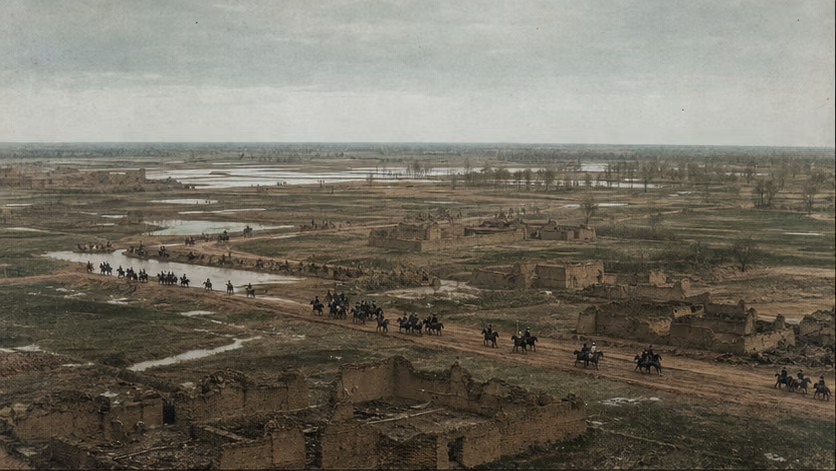
| Item | Details |
|---|---|
| Time | 1853 – 1868.8 (from the third year of Xianfeng to the seventh year of Tongzhi), roughly fifteen years in all |
| Place | Centered on northern Anhui, eastern Henan, and southwestern Shandong; its mobile range extended into Jiangsu, Hubei, Shaanxi, Shanxi, and Zhili |
| Affiliation | The northern branch and aftershock of the Taiping and Nian Rebellions (for the wider situation, see *Taiping Heavenly Kingdom · Overview*) |
| Mobile side | Nian Army: in the early phase, Zhang Lexing (Zhang Luoxing) and the Five-Banner Nian forces; in the later phase, the New Nian Army formed by Zhang Zongyu, Ren Huabang (Ren Zhu), and the Taiping Zun King Lai Wenguang; in 1866 it split into the Eastern Nian (Lai Wenguang, Ren Zhu) and Western Nian (Zhang Zongyu) |
| Blocking and pursuit side | Qing forces: in the early phase, mainly the Manchu-Mongol cavalry of the Khorchin prince Senggelinqin; after 1865, wholly dependent on the Xiang Army (Zeng Guofan, Bao Chao's Tingzi Battalion, and others) and the Huai Army (Li Hongzhang, Liu Mingchuan, and others) |
| Result | In 1868.1 the Eastern Nian was destroyed around Yangzhou, and Lai Wenguang was captured and executed; in 1868.8 the Western Nian was destroyed on the Tuhai River in northwestern Shandong, and Zhang Zongyu's fate became unknown. The Nian Rebellion ended |
Belligerents
| Item | Mobile side (Nian Army) | Blocking and pursuit side (Qing forces) |
|---|---|---|
| Strength | At its height said to number several hundred thousand (including family members accompanying the camps; figures vary sharply by counting basis, and accounts differ); later combat-capable cavalry numbered roughly several tens of thousands | Several thousand of Senggelinqin's personal cavalry formed the core, supported by provincial Green Standard troops and militia; after 1865, the Xiang and Huai armies committed more than one hundred thousand in total (cumulative figure, unverified) |
| Mobility | In the later phase it "turned infantry into cavalry"; one man had multiple horses and could travel several hundred li by day and night (distance disputed) | Senggelinqin's cavalry could pursue, but long pursuit exhausted both men and horses; the Xiang and Huai armies were mainly infantry and relied on walls and river-defense lines to restrict the enemy's mobility |
| Firepower | Mainly swords, spears, and captured mules and horses; later, captured foreign rifles increased, but firearms remained inferior overall | The Xiang and Huai armies had foreign rifles and artillery (pishan guns, explosive shells), while naval forces controlled the Grand Canal and the Huai River |
| Supply | Requisitioned grain locally, had no fixed rear area, and used mobile "circling" itself as a method of supply | Relied on prefectural and county seats, grain offices, and river transport; after 1866, used the Grand Canal, Yellow River, Jialu River, and Sha River to build long walls forming a blockade network |
| Command | In the early phase, each of the Five Banners had its own leaders and coordinated through alliances; later, Lai Wenguang reorganized the force according to the Taiping military system, and command gradually unified | In the early phase, Senggelinqin held sole command of the campaign; later, Zeng Guofan and Li Hongzhang successively supervised the war effort, while the Xiang and Huai systems stood side by side and repeatedly had problems coordinating |
Terrain and Conditions
(For the world and China-wide situation across these fifteen years, see *Taiping Heavenly Kingdom · Overview*.)
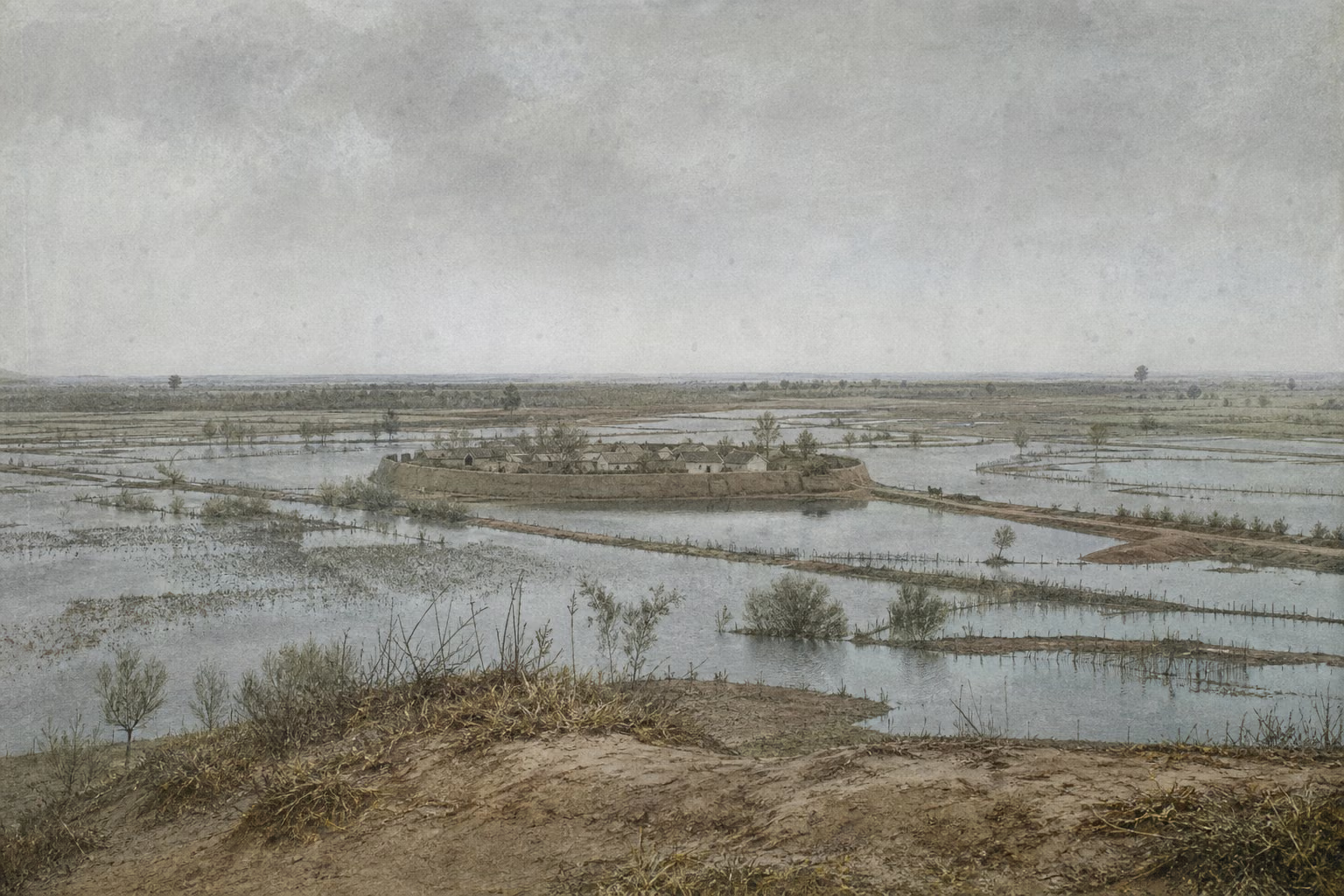
Huaibei: the soil of the Nian Army. The border region of northern Anhui, eastern Henan, and southwestern Shandong was a famine zone left by repeated breaches and course changes of the Yellow River. The land was poor; private salt trafficking and mutual-protection Nian associations had been ways of survival for generations. "Nian" was a Huaibei local expression: one band or one shop was one nian, originally a semi-armed group that gathered and dispersed in the slack seasons. In 1855 the Yellow River breached and changed course at Tongwaxiang, turning broad stretches of villages into flooded land. Disaster victims joined the Nian in groups -- the Nian Army grew from "bandit gangs" into a "great army," and famine was the first driving force (the causal chain between the breach and the expansion of the Nian Army, and the precise wording of it, remain unverified).
This battlefield itself: A thousand-li plain, with no mountain strongpoints to defend, where villages protected themselves with earthen walled enclosures. For the newly cavalry-like Nian Army, the plain was an open thoroughfare; for the blocking and pursuit side, it was an exposed field of attrition. When Li Hongzhang later managed to trap the Nian Army, he relied not on terrain, but on turning existing waterways -- the Yellow River, the Grand Canal, the Liutang River, and the Jiaolai River -- into walls.
Why It Was Fought
The advance into Jiangnan ended in the establishment of a capital: in March 1853, the Taiping Army captured Jiangning and soon divided its forces for the Northern Expedition and the Western Expedition. In May, the Northern Expeditionary force set out northward from Yangzhou and entered Henan through northern Anhui. The great army passed through in no more than a few ten-day periods; after the men had gone, the order of the official administration did not return with them -- the Nian groups along the Huai River rose in a rush.
The Nian were not a force raised by anyone's orders. They were the general eruption of a Huaibei society that had long been semi-armed -- in a place like this, only one signal separated society from war.
The passage of the Northern Expedition was that signal. From 1853, the various Nian grew from prison breaks, salt trafficking, and resistance to grain levies into armed gatherings of tens of thousands; in 1855 the Yellow River breached and changed course at Tongwaxiang, turning broad stretches of villages into flooded land, and disaster victims joined the Nian in groups, so that "bandit gangs" grew into a "great army" (the causal chain between the breach and the expansion of the Nian Army, and the precise wording of it, remain unverified). That same year, Nian leaders from many routes formed an alliance at Zhiheji (today's Guoyang, Anhui), elevated Zhang Lexing as "Alliance Lord of the Great Han" (also recorded as "Great Han King of Bright Mandate"; titles vary among sources, unverified), and established the Yellow, White, Red, Black, and Blue banners. They now had banners, and they also had the *Regulations for Marching*. In 1857 Zhang Lexing led his forces across the Huai River to join the Taiping Army and received Taiping titles (Zhang Lexing was enfeoffed as King Wo; other titles unverified), yet they "accepted enfeoffment but not operational command" -- the banner had been hung under the Taiping Heavenly Kingdom's northern branch, but the household still governed itself.
At the outset, the Qing court could not produce a proper opponent. Its main forces were pinned down on the Yangtze battlefield, and Anhui and Henan could only rely on Green Standard troops and militia for local seesaw fighting. After 1860, once both the Jiangnan and Jiangbei encampments had collapsed and the Eight Banners and Green Standard were no longer serviceable, the only direct-line force capable of mobile field operations was Senggelinqin's Manchu-Mongol cavalry -- suppressing the Nian became this force's last main battlefield, until the force itself was beaten out of existence.
The depth of the two sides' resolve left very different marks. The Nian Army's largest decision was the 1855 alliance at Zhiheji -- but the alliance did not become a command structure: each banner still led itself, and even after receiving Taiping princely titles it only "accepted enfeoffment but not operational command." Only in 1864, when Lai Wenguang reorganized the force according to the Taiping military system and turned infantry into cavalry, did the army gain a center. Two years later, at Xuzhou, the army split, and the eastern and western forces failed to aid each other -- who proposed the division, and whether there was debate, are not recorded by the Nian themselves; only a few lines survive in Lai Wenguang's prison self-account (original wording unverified).
The Qing court escalated its resolve step by step: around 1862 it ordered Senggelinqin to conduct the campaign alone, and wording such as "must be annihilated and eliminated" appears frequently in edicts (original text unverified). In his memorials, Senggelinqin repeatedly stated that men and horses were exhausted and infantry could not keep up (original memorial text unverified) -- but the only force in his hands that could fight in the field was this cavalry. If it stopped, the Nian Army would grow larger across the plain. In May 1865, after the army was destroyed at Gaolouzhai, the court's direct-line force had been wiped out; within days, Zeng Guofan was reassigned to supervise military affairs in Zhili, Shandong, and Henan (edict of appointment and date unverified).
Zeng Guofan reversed the method: he memorialized for heavy forces to be stationed in the four towns of Linhuai, Jining, Zhoujiakou, and Xuzhou, with walls built along rivers, using stillness to control movement (background and wording of the memorial unverified). This policy was not cheap -- most of the Xiang Army had already been demobilized, the northern expedition relied mainly on the Huai Army, and the Huai Army recognized only Li Hongzhang; the building of walls and establishment of grain offices depended on supporting funds from Liangjiang and Zhili. The Nian Army's boundary lay at the other end: it had no rear area and no source of arms; grain came from local requisition and horses from the battlefield. Once it was pressed into a river network, only daily attrition remained.
There was no absence of dissent on the surface. From the beginning, the river-defense wall-building policy was criticized at court as abandoning land and guarding stumps; in August 1866, when the Sha River and Jialu River line was torn open in a single night, impeachments followed. Zeng Guofan requested disciplinary review of himself, and at the end of the year Li Hongzhang took over (date of the edict changing commanders unverified). Li continued along the same river-defense path, building the walls more densely. On the Nian side, no documents of dissent have been found over joining the Taiping Army or dividing east and west -- this does not mean everyone was of one mind; it means this force's voice was never really on paper (only *Lai Wenguang's Self-Account* is extant as a single source, unverified).
Course of the Engagement
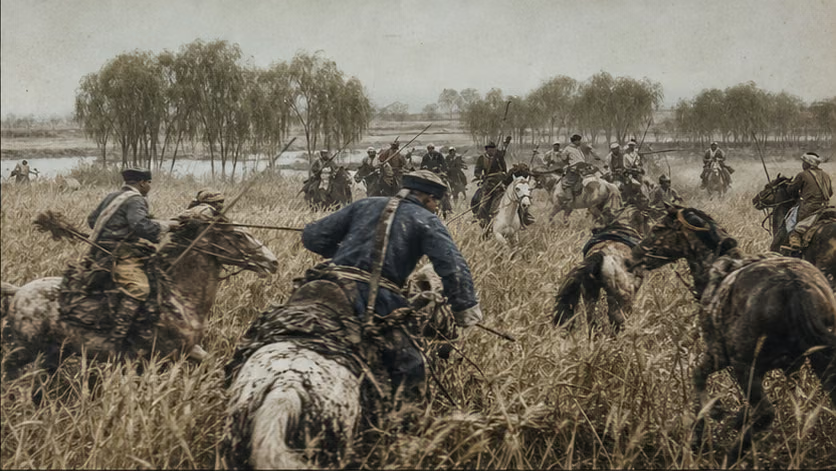
Fifteen years cannot be listed battle by battle. By form, they divide into four phases; the battles of Gaolouzhai and Yinlong River are listed separately.
| Phase | Time | Key Points |
|---|---|---|
| Uprising and Five-Banner period | 1853–1862 | The various Nian used walled villages as bases while gathering, dispersing, and moving, fighting a seesaw struggle against Qing forces and militia in Anhui and Henan; in 1855 the Zhiheji alliance created the Five Banners; in 1857 they joined the Taiping Army, supported operations in Huainan, and repeatedly entered Henan and Shandong |
| Senggelinqin's sole campaign and the death of Zhang Lexing | 1862–1864 | Senggelinqin supervised the campaign in northern Anhui and successively broke Nian walled villages; in 1863 he took Zhiheji, and Zhang Lexing, betrayed by a turncoat, was captured and executed by lingchi ※ (accounts describe the execution as extremely brutal; details unverified); the remnants moved west under Zhang Zongyu and Ren Zhu, joining Taiping forces under King Fu Chen Decai, King Zun Lai Wenguang, and others |
| The New Nian Army and the Battle of Gaolouzhai | 1864–1865.5 | After Tianjing fell, Lai Wenguang's Taiping troops and the Nian Army were combined, "turned infantry into cavalry," and transformed the whole force into cavalry. In 1865.5, the Battle of Gaolouzhai annihilated Senggelinqin's army (see table below) |
| River-defense, division of forces, and destruction | 1865.6–1868.8 | Zeng Guofan took over the suppression of the Nian and set the river-defense policy (defending the Grand Canal and Yellow River, building walls along the Jialu River and Sha River), but left before completing it; Li Hongzhang succeeded him. In 1866.10 the Nian Army divided into eastern and western routes around Xuzhou, Henan (place and month of division vary by account): the Eastern Nian under Lai Wenguang and Ren Zhu entered Hubei; in 1867.2 came the Battle of Yinlong River (see table below); in summer they entered Shandong and were encircled east of the Grand Canal; in 1867.11 Ren Zhu was shot and killed in battle at Ganyu by men who had defected to the Qing; on 1868.1.5 Lai Wenguang was captured at Wayaopu in Yangzhou ※, and on 1.10 was executed by lingchi in Yangzhou. Zhang Zongyu's Western Nian entered Shaanxi; in early 1868, hearing the Eastern Nian was in crisis, it crossed east over the Yellow River and drove straight toward Zhili, shaking the capital, but was soon encircled by Qing forces between the Yellow River, Grand Canal, and Tuhai River in northwestern Shandong; in 1868.8 the whole force was destroyed beside the Tuhai River at Chiping, and Zhang Zongyu's fate became a mystery (the drowning account and the hiding-away account stand side by side; both unverified) |
Battle of Gaolouzhai (1865.5, around Gaolouzhai, Heze County, Caozhou Prefecture, Shandong) -- ambush:
| Item | Ambushing side (Nian Army) | Ambushed side (Senggelinqin's Qing force) |
|---|---|---|
| Strength | Lai Wenguang, Zhang Zongyu, and Ren Zhu combined forces of several tens of thousands (including followers; figures for combat-capable troops vary by account) | Senggelinqin personally led several thousand cavalry as the core; infantry following behind had not arrived (some accounts give 7000, others more than ten thousand; listed side by side, unverified) |
| Course | The Nian Army lured them into desperate pursuit for several tens of days and several thousand li of movement (start and end distances unverified); after men and horses were exhausted, it set a prepared ambush ring at Gaolouzhai and closed around them | In May 1865 (specific dates such as the 18th and 21st are listed side by side, unverified), Senggelinqin's army entered the ambush. The cavalry was nearly annihilated; Senggelinqin broke out, fell from his horse, and hid in a wheat field near Wujiadian |
| Result | Senggelinqin died in the wheat field, killed by the Nian soldier Zhang Pigeng (the person and event have a basis in transmission, but details remain unverified); almost all remnants were destroyed | The Qing court's last elite Manchu-Mongol regular force was destroyed |
Battle of Yinlong River (1867.2.19, Yinlong River / Yonglong River, Jingshan, Hubei) -- set-piece battle:
| Item | Eastern Nian Army | Liu Mingchuan's Huai Army force | Bao Chao's Xiang Army Tingzi Battalion |
|---|---|---|---|
| Strength | Several tens of thousands under Lai Wenguang and Ren Zhu (accounts differ) | Roughly more than ten thousand (accounts differ) | More than ten thousand in the Ting Army (accounts give 1.2 wan and 1.8 wan, that is, 12,000 and 18,000, unverified) |
| Preceding causes | In the previous month they had repeatedly struck Qing forces: at Luojiaji they wounded Provincial Commander Guo Songlin and destroyed several thousand of his troops; at Yangjiahe they killed Brigade-General Zhang Shushan in battle | Had arranged with Bao Chao to advance in separate columns and converge for an attack | Same as preceding |
| Course | Liu Mingchuan's force did not wait for the Ting Army and advanced ahead of schedule (the claim that he was racing for credit is the mainstream narrative, unverified); it was surrounded and attacked by the Eastern Nian, losing Brigade-General Tang Diankui and several hundred others killed in action, and nearly being annihilated; Bao Chao's army then arrived from behind and struck hard. The Eastern Nian won first and then lost, suffering heavy casualties and retreating | Defeated first, then survived | Turned defeat into victory |
| Consequences | After entering Hubei, the Eastern Nian's momentum was badly damaged; it abandoned the plan to enter Sichuan and moved east into Shandong | Liu and Bao fought over credit and attacked each other in reports | Bao Chao soon reported illness, and the Tingzi Battalion was disbanded |
Casualties and Losses
- Qing forces: In the Battle of Gaolouzhai, several thousand of Senggelinqin's personal cavalry were destroyed (more than 7000 / more than ten thousand and other accounts stand side by side; all are Qing-side and later retrospective figures, unverified); in the Battle of Yinlong River, several hundred from Liu Mingchuan's force were killed in action (including Tang Diankui and several other officers), and Bao Chao's force also suffered considerable losses; there is no reliable aggregate number for the losses of Green Standard troops, militia, and local militia over the fifteen years. Senggelinqin's death itself was the largest single loss -- from that point, the court had no direct-line elite force left to use.
- Nian Army: No systematic statistics. After Zhiheji was lost in 1863, Zhang Lexing's line was almost wiped out; in 1867 the Eastern Nian was consumed unit by unit in the Shandong encirclement, and losses in the battles at Ganyu, the Mi River in Shouguang, and elsewhere numbered in the tens of thousands (figures vary by account); in 1868 the eastern and western Nian forces were successively destroyed in their entirety, and many prisoners are recorded as having been killed ※ (specific scale unverified).
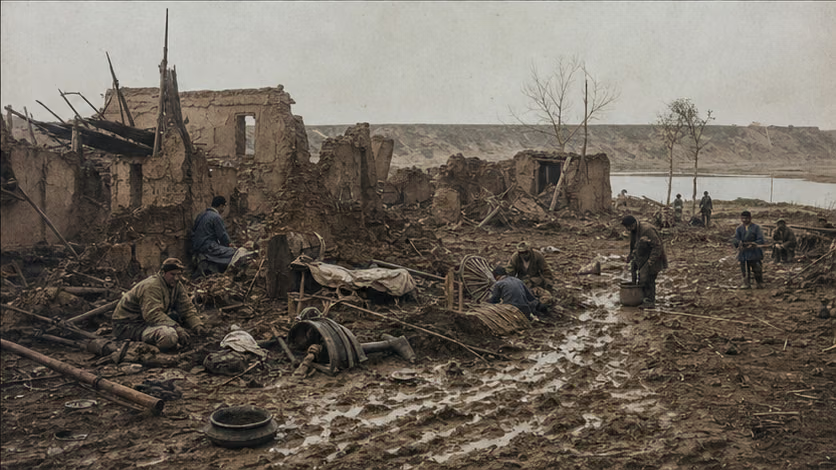
- Civilians: The Huaibei plain had already been broken by the Yellow River breach, and through fifteen years of seesaw war both sides made local grain requisition routine; villages were repeatedly slaughtered and burned in attacks and defenses of walled enclosures ※. Local gazetteers record both the killings by Senggelinqin's army during "clearing and suppression" of Nian-attached villages in northern Anhui and the abductions and plundering during Nian movement, but lack credible numbers (all unverified). This was the side that paid for the longest time and left the fewest numbers.
Aftermath
- The structure of military power settled into place: after Gaolouzhai, suppressing the Nian could rely only on the Xiang and Huai armies. The era of Manchu-Mongol nobles commanding armies ended, and the late-Qing pattern of Han Chinese governors-general and governors holding military power was fixed from this point. This line is the deepest trace the Nian Rebellion left in political history.
- Li Hongzhang and the Huai Army rose through first credit in the suppression of the Nian; the Huai Army became the Qing court's main armed force for the next thirty years, and commanders such as Liu Mingchuan emerged from it.
- Qing postwar measures in the war zone centered on household registration checks, organizing militia, and placing surrendered people; the social soil of Nian formation in Huaibei -- famine, salt prohibition, and armed walled villages -- was not eradicated. For decades afterward, the region remained a high-incidence area for secret societies and armed unrest (this judgment is unverified and can be checked against Guangxu-period mission cases and banditry records in Anhui and Henan).
- The officially compiled Qing *Strategy for Pacifying the Nian Bandits* concluded the war in a tribute-style official mode of writing, and the term "Nian bandits" became fixed in official histories from that point (title and compilation history unverified).
Accounts of Those Present
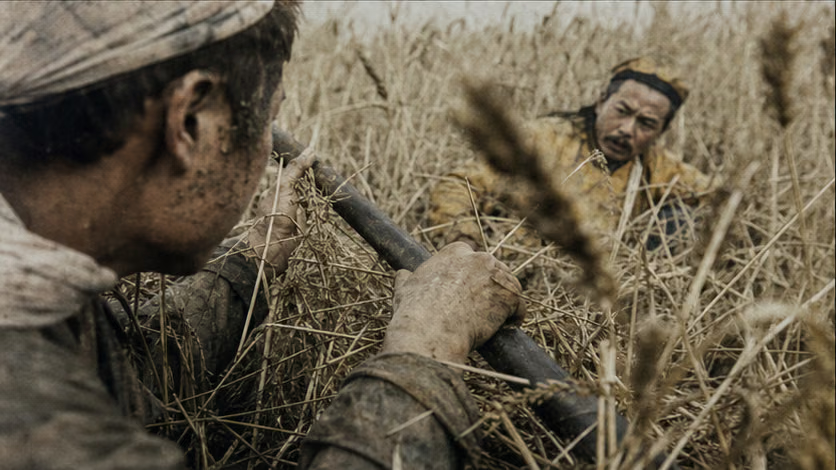
- Zhang Pigeng: A young Nian soldier searching out and killing remnant enemies after Gaolouzhai. In a wheat field he recognized a wounded high official wearing a yellow riding jacket and killed him with a blade -- the man killed was the Khorchin prince Senggelinqin. This person's story circulated very widely, but details (age, the claim that he was later captured by the Qing court and executed by lingchi, and so on) mostly come from accounts transmitted through several hands; the whole remains unverified.
- The death of Zhang Lexing ※: After his capture in 1863 he was executed by lingchi. Multiple accounts say that at the execution ground his son and wife were first killed, that he was forced to watch, and even that pieces of cut flesh were stuffed into his mouth; the brutality is rare even among Qing criminal cases -- all accounts require checking against original sources, and here are listed side by side as unverified.
- Lai Wenguang's self-account: In January 1868, in prison at Yangzhou, he wrote *Lai Wenguang's Self-Account*, ending with "only death can repay the state (meaning the Taiping Heavenly Kingdom) and preserve a minister's integrity" -- this is almost the only surviving first-person document from the New Nian Army's side, an old Taiping officer's accounting for two wars at once.
- Ren Zhu: The Eastern Nian's foremost cavalry commander, whose reputation for skill in battle was recognized even by enemies -- Li Hongzhang is said to have called him a "first-rank cavalry commander and good man" (original text unverified). In 1867.11 he was shot and killed in battle at Ganyu by men who defected to the Qing before the lines, and the Eastern Nian thereby lost its spearhead.
- The two faces of Senggelinqin: The same man wounded the Anglo-French fleet at the Taku Forts in 1859, was defeated at the Battle of Palikao in 1860, and died in a Heze wheat field in 1865. The Qing court gave him the posthumous name "Zhong" and had him share offerings in the Imperial Ancestral Temple; in Huaibei folk memory, he was the commander who "slaughtered walled villages." Both memories have evidence, and both are incomplete.
- Liu Mingchuan and Bao Chao: Yinlong River was defeat first and victory later. After the battle, Liu Mingchuan argued for credit through Li Hongzhang, Bao Chao angrily reported illness, and the Tingzi Battalion was immediately disbanded -- a battle that was then the largest-scale annihilation battle produced the disbanding of a crack army (details of the Liu-Bao struggle for credit in memorial exchanges unverified).
The Ground
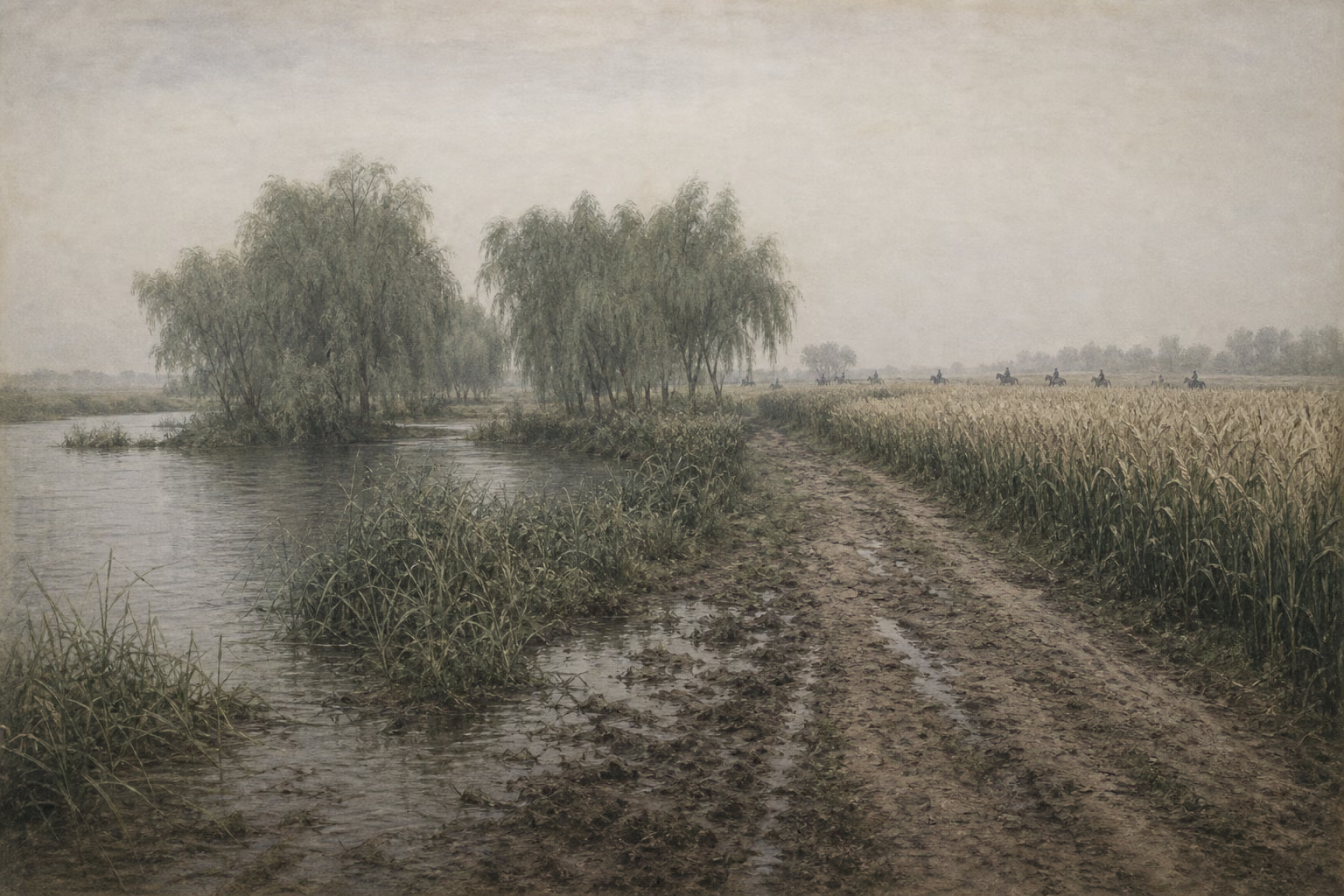
- The main battlefield was the great Huang-Huai plain: with no strongpoints to rely on, the value of cavalry was maximized, and "circling" (large-scale mobile maneuver) itself was a tactic.
- Walled villages: Huaibei villages commonly built earthen walls for self-protection. The Nian Army used walled villages as points and movement as lines; Qing "clearing of walled villages" meant removing the points and cutting the lines. Each point was a small fortress formed by dozens of households encircled by an earthen wall.
- The spatial grammar of Gaolouzhai: lure -- exhaust -- encircle. The pursuit corridor of several tens of days was the true fieldwork of this ambush; the final closing point (northwest of Heze, among river-bend willow groves and wheat fields) was only the mouth of the trap.
- The spatial grammar of river-defense: Li Hongzhang linked the Grand Canal, Yellow River, Liutang River, and Jiaolai River into blockade lines, and the Nian Army was pressed again and again into "cages" formed by waterways -- the Eastern Nian was finally destroyed in an encirclement ground east of the Grand Canal, south of the Yellow River, and north of the Liutang River, while the Western Nian was destroyed in the pocket-shaped land between the Yellow River, Grand Canal, and Tuhai River. Rivers here were not obstacles; they were walls.
- Yinlong River: a river-bend positional battle on the plain, where the Ting Army used arrays of pishan guns to withstand cavalry charges -- firearms as the frontal answer to cavalry.
How Each Side Records It
- The Qing side at the time: Memorials and edicts uniformly called them "Nian bandits" (the wording inside quotation marks is the Qing side's original term), and derogatory animal radicals were routinely added beside the names of Zhang Lexing, Lai Wenguang, and Zhang Zongyu. The officially compiled strategy wrote the fifteen years as a ledger of gradual "sweeping clean"; Gaolouzhai was recorded as an event of loyal martyrdom in which Prince Seng "died in service after exhausting his strength."
- Surviving Nian-side accounts: Extremely few. This means that large-scale first-person documentation is basically limited to *Lai Wenguang's Self-Account* (a prison confession in nature); only fragments survive of proclamations from Zhang Lexing's period and the *Regulations for Marching* (survival status unverified). Almost everything else depends on Qing archives and the opponent's perspective in local gazetteers. Most of this force's own voice scattered away with fifteen years of movement.
- Later narrative shifts: During the Republican period, the old term "Nian bandits" continued to be used; after 1949, mainland Chinese historiography framed it as the "Nian Army Uprising" and incorporated it into the history of peasant wars, while the history of the Nian Army became a specialized field (represented by the research of scholars such as Jiang Di; titles of works unverified). Research in recent decades has more often placed the Nian back into Huaibei regional society -- famine, salt smugglers, walled villages, lineages -- and, beyond the two classifications of "uprising" and "banditry," has added an explanatory path of "a local society made armed." Zhang Zongyu's fate, Zhang Pigeng's deeds, and similar matters still move between official history and folk legend.
Disputes and Sensitivities
- How to classify the Nian Army: Peasant uprising, roving bandits, and local self-defense armed force -- all three classifications have documentary support and still coexist.
- The Yinlong River case: Whether Liu Mingchuan "broke the agreement and raced for credit," causing the initial defeat, and why Bao Chao's Ting Army was disbanded after a victory -- accounts involving Xiang-Huai tensions and Li Hongzhang's protection of the Huai faction are widely circulated, but details mostly come from one side's narratives, and the original memorials over the credit dispute and the decision process for disbanding the battalion remain unverified. A victory that produced infighting is a miniature of factional politics in the latter half of the war to suppress the Nian.
- Assessment of Senggelinqin: The narrative of a national hero who resisted Britain and France coexists with the narrative of a repressor who slaughtered northern Anhui. This touches Manchu-Han relations and national historiography, and polarization in contemporary public opinion is obvious.
- Zhang Zongyu's fate: The accounts that he drowned himself and that he hid among the people (including legends that he appeared years later) coexist, with no confirmation for either.
- Casualty and atrocity figures: The Nian side had no statistics, while Qing memorial exaggeration and retrospective local-gazetteer records coexist, producing a wide gap between figures from the two sides. Both sides record atrocities against civilians and surrendered prisoners (see the ※ in Casualties and Losses), but the scale is mostly unknowable.
- The Nian Rebellion lasted fifteen years, and the form of "mobile war" ran through it from beginning to end; Gaolouzhai and Yinlong River are two key battlefield nodes.
Sources and Open Questions
Known main sources:
- *Nian Army*, edited by the Chinese Historical Society as part of the *Collected Materials on Modern Chinese History* series (six volumes, including Qing archives, local gazetteers, and compilations of contemporary accounts)
- *Lai Wenguang's Self-Account* (almost the only surviving Nian-side self-account)
- Accounts of the Yinlong River battle in local gazetteers such as the *Hubei Gazetteer* (source of Lai Wenguang's phrase "today we will behead Liu and capture Bao")
- The officially compiled *Strategy for Pacifying the Nian Bandits* (title unverified)
- Memorial drafts and collected writings related to Senggelinqin, Zeng Guofan, and Li Hongzhang
- Contemporary scholarship on the history of the Nian Army by Jiang Di and others (specific works unverified)
Open questions:
1. Zhang Lexing's title ("Alliance Lord of the Great Han" / "Great Han King of Bright Mandate" / "Great Han King" and other accounts) and the original recorded sources for the Five-Banner alliance 2. The Taiping Heavenly Kingdom's princely titles for Nian leaders (beyond Zhang Lexing as King Wo) and the original source for "accepted enfeoffment but not operational command" 3. Original documentary sources for the brutal details of Zhang Lexing's lingchi execution (killing family members first, stuffing flesh into his mouth, and other accounts) 4. The exact date of the Battle of Gaolouzhai (May 18 / 21 and other accounts), the troop figures for Senggelinqin's army, and the source level for Zhang Pigeng as a person and event (age, later fate) 5. The strengths of both sides at the Battle of Yinlong River, the original source for the claim that Liu Mingchuan advanced early in "breach of agreement and race for credit," and the decision process for disbanding Bao Chao's Ting Army 6. Verification of the original wording of Lai Wenguang's phrase "only death can repay the state"; Li Hongzhang's original wording in calling Ren Zhu a "first-rank cavalry commander and good man" 7. The specific time and place of the 1866 division of the Nian Army into east and west (the Xuzhou account remains unverified) 8. The source level for the accounts that Zhang Zongyu drowned himself / hid away; the fates of his subordinate commanders 9. The scholarly formulation of the causal relationship between the Yellow River breach at Tongwaxiang (1855) and the expansion of the Nian Army 10. Original records for the marching speed after the Nian side "turned infantry into cavalry" 11. The title and compilation history of *Strategy for Pacifying the Nian Bandits*; verifiable records of civilian losses in the Huaibei walled-village war 12. The original wording in Lai Wenguang's self-account about the proposal to divide the army at Xuzhou 13. The original wording in Senggelinqin's memorials stating that men and horses were exhausted and infantry could not keep up 14. The date and wording of the 1865 edict, after Gaolouzhai, appointing Zeng Guofan to supervise military affairs in Zhili, Shandong, and Henan 15. The original text of Zeng Guofan's memorial on defenses at the four towns (Linhuai, Jining, Zhoujiakou, and Xuzhou), building walls along rivers, and the source of the phrase "using stillness to control movement" 16. The memorials impeaching river-defense after the Sha River-Jialu River line was breached in 1866, Zeng Guofan's request for disciplinary review of himself, and the date of the edict changing commanders to Li Hongzhang
All images on this site are AI-generated depictions. They are not historical photographs, not primary sources, and do not depict any real individual.