Engagement Archive · Battles of the Taku Forts and Langfang
The war began with two hands moving at once: Seymour led more than two thousand troops of the Eight-Nation Alliance by train toward Beijing to "protect the legations," only to be trapped near Langfang by severed rail lines, Boxers, and the Gansu Army, unable to advance or withdraw, and half a month later retreated along the canal to Tianjin; without waiting for a declaration of war, the allied fleet moved before dawn on June 17 and seized the Taku Forts -- the alliance fired first, and the declaration-of-war edict came four days later.
Engagement Data
| Item | Details |
|---|---|
| Time | 1900.6.10–6.26 (Seymour Expedition); 1900.6.16–6.17 (Taku) |
| Place | Along the Tianjin-Beijing railway (Langfang-Luofa), and the North Canal line; Taku Forts |
| Belongs to | Boxer Rebellion · opening phase (see Boxer Rebellion: Overview) |
| Roles | Railway line: force moving to Beijing (Seymour's allied force) / blocking side (Boxers, Dong Fuxiang's Gansu Army); Taku: defenders (forces under Luo Rongguang, provincial commander-in-chief of Tianjin) / attackers (allied fleet and landing parties, mainly Russian, German, British, and Japanese) |
| Result | The Seymour Expedition failed and withdrew; the Taku Forts fell, the sea entrance stood open, and the war opened in full |
Belligerents
| Item | Blocking and defending side | Alliance forces |
|---|---|---|
| Strength | Langfang line: number of Boxers unverified; on 6.18 several thousand of Dong Fuxiang's Gansu Army joined in (figure disputed); Taku defenders about two to three thousand (figure disputed) | Seymour Expedition: mixed force of Eight-Nation sailors and marines, a little over 2,000; Taku: shipboard gun crews plus landing parties, more than nine hundred (figure disputed) |
| Firepower | Boxers chiefly used swords and spears; the Gansu Army was equipped with modern rifles; the Taku Forts had modern Krupp coastal guns, but ammunition and gunnery standards were limited | Standard rifles, machine guns, small accompanying guns; medium- and large-caliber naval guns of the fleet |
| Logistics | Took grain locally; Boxers relied on village altars | The Seymour Expedition's entire hope was the railway -- once the railway was cut, both advance and retreat were trapped |
Terrain and Conditions
(For the larger situation -- the partition crisis, anti-foreign feeling at court, and the posture of the powers -- see Boxer Rebellion: Overview.)
Zhili: In spring 1900, Boxers poured into Zhili from Shandong, clashing with government troops around Laishui and Zhuozhou (the killing of officials at Laishui, including the death of deputy commander Yang Futong, details unverified), and railway and telegraph lines between Beijing and Tianjin began to be torn up. The court swung uncertainly between suppression and conciliation of the Boxers; edicts reversed several times, and the front line did not know what to follow.
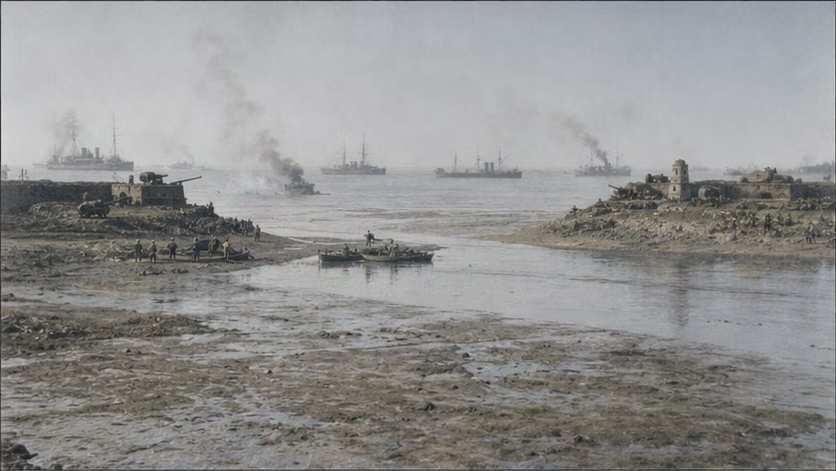
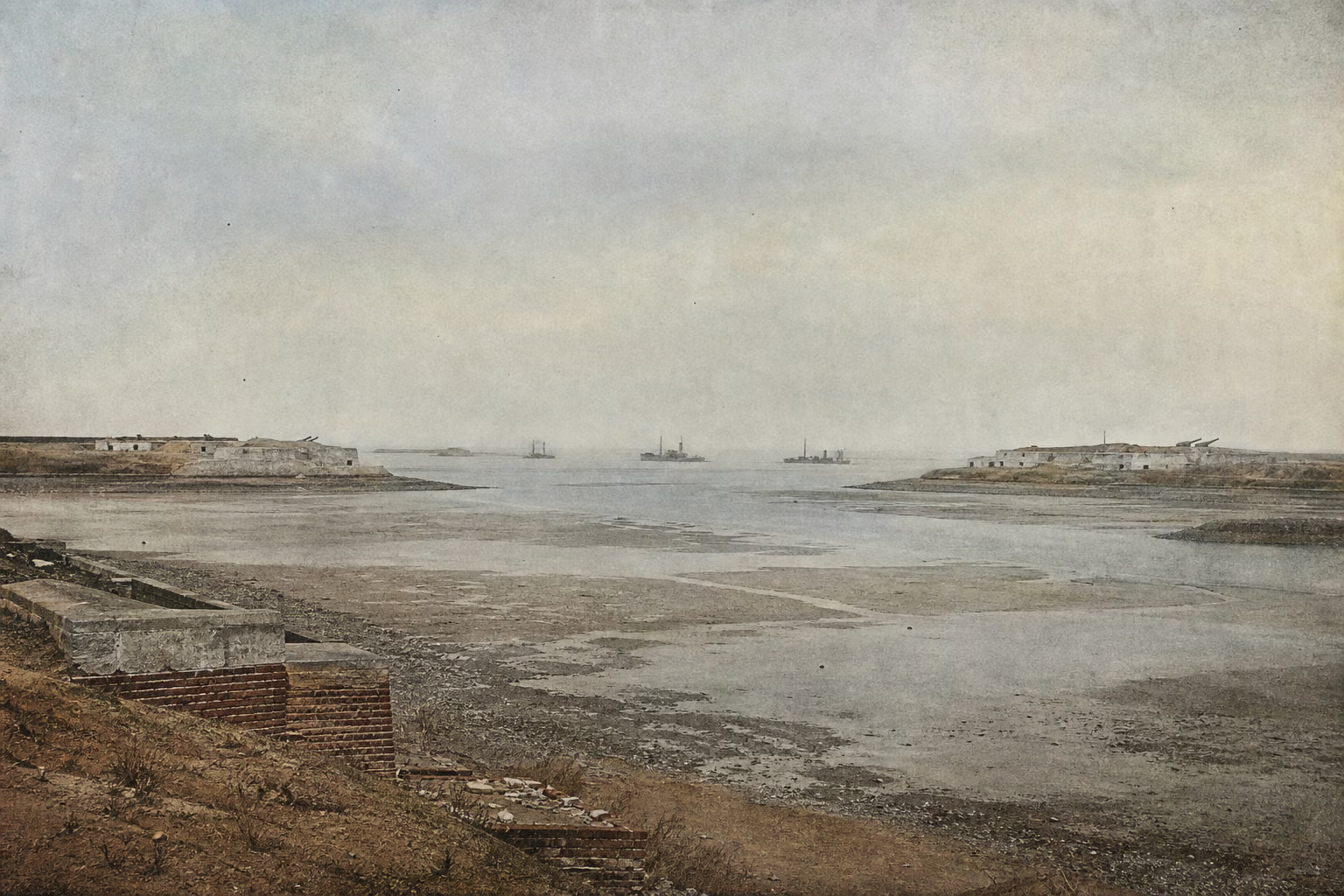
Taku mouth: The place where the Haihe River entered the sea, Tianjin's maritime gate, with forts facing each other on the north and south banks (number of forts and gun positions disputed); inside the mouth the water was muddy and shallow, large warships could not enter, and the alliance lay offshore, with only shallow-draft gunboats able to go in. The defending commander was Luo Rongguang, provincial commander-in-chief of Tianjin, aged sixty-seven (actual age disputed).
Why It Was Fought
The accumulated resentments of the missionary cases in Shandong had dragged on for decades, and by 1899 they had burned into the Boxers' village altars; in spring 1900, Boxers poured from Shandong into Zhili, clashed with government troops around Laishui and Zhuozhou, and the railway and telegraph lines between Beijing and Tianjin began to be torn up. By the end of May, the legation quarter in Beijing's Dongjiaomin Lane and the city outside it had become two different worlds. The countries first sent guards into Beijing, the first group numbering a little over three hundred (figure disputed). The standoff fixed in the overview had reached the point where it only waited for someone to raise the stake.
On June 10, the allied force at Tianjin put forward the British vice admiral Seymour, who led a mixed force of Eight-Nation sailors and marines, more than two thousand men, by train toward Beijing to "protect the legations." The alliance calculated that the train between Tianjin and Beijing could arrive in half a day, and that with firepower it could escort foreign residents in a single demonstrative march; what it did not calculate was that the roadbed was being dismantled section by section by villages along the line -- once the railway was cut, dozens of railcars became scrap iron. To the Qing court, this was an unauthorized army driving straight toward the capital; but the court had not settled on suppression or conciliation, its edicts had reversed several times, and along the line there was no organized interception order. The first to block the force at Langfang were Boxers carrying swords and spears; on June 18, several thousand of Dong Fuxiang's Gansu Army joined the combined attack (troop strength disputed).
Taku was another account. The mouth of the Haihe River was Tianjin's maritime gate; if the allied fleet offshore wanted to land or send reinforcements, everything passed through this entrance. In mid-June the fleet gathered outside the mouth, and on the 16th delivered an ultimatum to the defenders, demanding that they hand over the forts -- the alliance's stated reason was to secure the Taku-Tianjin line of communication and prevent the sea entrance from being blocked. The defender was the sixty-seven-year-old Luo Rongguang, provincial commander-in-chief of Tianjin. He refused. Before dawn on the 17th, shallow-draft gunboats and landing parties attacked from both sides, and the forts fell.
The material boundaries drawn for both sides were hard. The alliance's large warships offshore drew too much water and could not enter the mouth; the only mobile force was shallow-draft gunboats and more than nine hundred landing troops. The ultimatum decision came from days of consultation among naval commanders of the various countries (details of the resolution unverified), and the seizure of the forts depended on the pre-dawn deadline and surprise, not on the fleet's full firepower. On the defenders' side, apart from modern coastal guns, ammunition, gunnery, and reinforcement were all uncertain; communications between Taku and Beijing were broken and intermittent all along the way, and Luo Rongguang waited to the end without receiving an edict (communication sequence unverified).
Beijing's resolve turned over in these few days. Beginning on June 16, the empress dowager convened imperial conferences over successive days (the dates and agendas vary among records): Zaiyi and Gangyi advocated conciliating the Boxers and fighting, while Xu Jingcheng, Yuan Chang, and others argued forcefully that one country could not oppose the powers, and that troops, pay, and arms could not be relied upon. They argued and were not heeded -- a little more than a month later, both men were executed in the marketplace. On the day news of Taku's fall reached Beijing (dates vary by account), word also spread of a note from the powers demanding that the empress dowager return power to the emperor (the note's authenticity has always been disputed, source unverified). By this point the war argument was fixed.
The declaration-of-war edict came only four days later. First the forts were attacked; only afterward came the declaration. There is no dispute over that sequence. It is the foundation under every later narrative.
Luo Rongguang in fact had no other road. The ultimatum expired before dawn, and Beijing still did not know what was happening at Taku; he could not wait for any edict. To surrender the forts would be to open the gate and invite the thief in; to refuse was to face the fleets of the powers with one isolated command. He chose the latter, and when the forts fell he died at Taku -- the accounts of death in battle and suicide by poison coexist (accounts differ).
Course of the Engagement
| Phase | Time | Key Points |
|---|---|---|
| Seymour sets out | 6.10–11 | More than two thousand men departed Tianjin by train in batches, repairing track as they moved; Boxers destroyed the line along the route, and the farther they went, the slower they became |
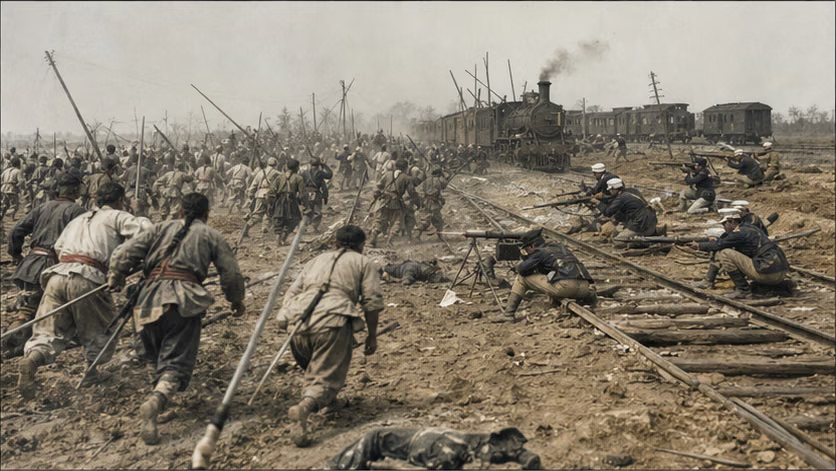
| Langfang-Luofa blocking action | 6.14–18 | The railway was cut both ahead and behind them, leaving them unable to advance or withdraw; ※ Boxers carrying swords and spears rushed rifle and artillery fire, suffering heavy casualties in close assaults, with the dead and wounded lying everywhere (no statistics); on 6.18 Dong Fuxiang's Gansu Army and the Boxers jointly attacked Langfang, inflicting several dozen allied casualties |
| Withdrawal | 6.19–26 | Abandoned the trains and retreated toward Tianjin along the North Canal, under attack along the route; on 6.22 seized and held the Xigu arsenal while waiting for relief; on 6.26 relief troops brought them back to the Tianjin concessions -- for the first time in the modern era, a Western allied force advancing in China had been stopped halfway and turned back (the main causes of failure were the severed railway and failed supply, without embellishment) |
| Taku ultimatum | 6.16 | The allied fleet ordered the defenders to hand over the forts; Luo Rongguang refused |
| Battle of Taku | before dawn, 6.17 | Allied shallow-draft gunboats and landing parties attacked from both sides; the defenders opened fire in return and damaged several enemy ships (accounts differ on caliber; the damage to the Russian gunboat *Gilyak* is recorded in multiple accounts); after several hours of hard fighting the forts fell, and Luo Rongguang died (accounts of death in battle and suicide by poison coexist) |
Casualties and Losses
- Seymour Expedition: alliance battle reports recorded more than sixty killed and more than two hundred wounded, totaling about three hundred (accounts differ); Boxers' dead and wounded along the Langfang line were not counted, and losses from close assaults were far heavier than those of the alliance.
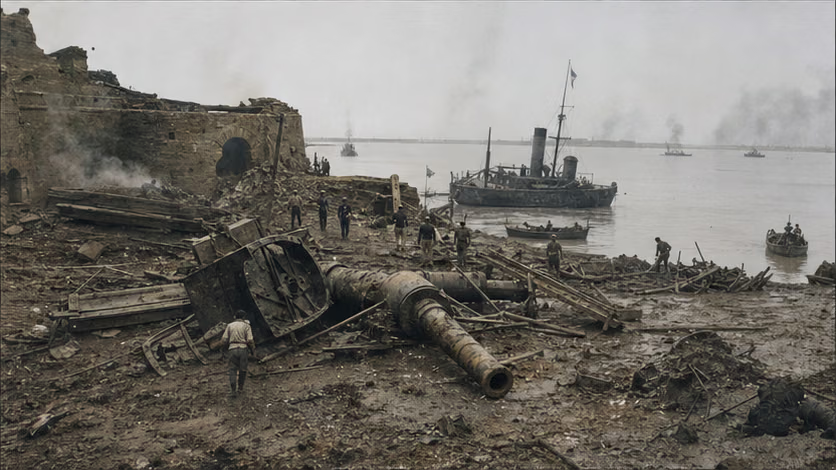
- Taku: defender casualties were heavy (figure disputed), all the forts were lost, and four torpedo boats from the remnants of the Beiyang Fleet moored inside the mouth were captured by the alliance (figure disputed).
- Once Taku was lost, allied troops landed continuously through the sea entrance -- every larger battle that followed entered through this breach.
Aftermath
- The alliance seized Taku first (6.17), and the Qing court's "declaration of war" edict came afterward (6.21) -- the forts were attacked first, the declaration came afterward; this sequence is the foundation under all narratives.
- The sea entrance stood open, and the Tianjin concessions changed from a besieged island into the alliance's forward base (see Battle of Tientsin (1900)).
- From this point the legation quarter was completely cut off from Beijing, and the countdown began toward the fifty-five-day siege of the legations (see Battle of Peking (1900)).
Accounts of Those Present
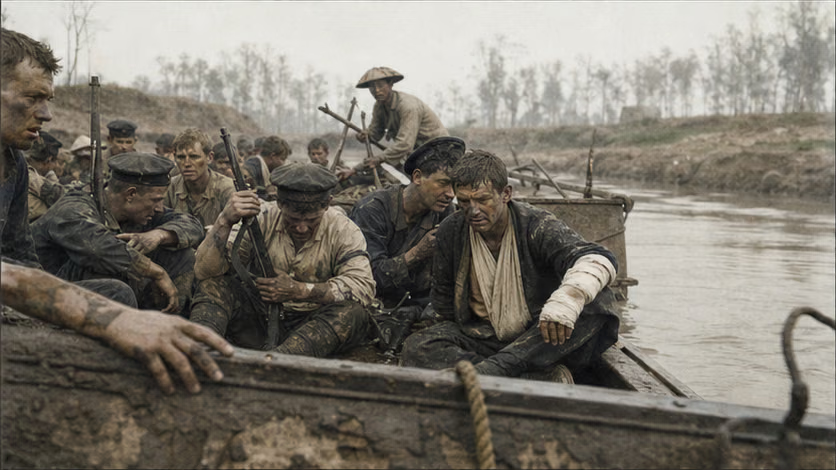
- Luo Rongguang: the sixty-seven-year-old defending commander refused the ultimatum, and when the forts fell he died at Taku -- the accounts of death in battle and suicide by poison coexist (accounts differ). In this engagement he had not received any edict from the court: the ultimatum expired before dawn, and Beijing still did not know.
- The train becomes scrap iron: the Seymour Expedition's entire mobility rested on the railway. Once the track was cut, dozens of railcars became a burden; during the retreat, the sick and wounded could only be loaded onto civilian boats on the canal, and boats proved more reliable than rails.
- Close assault with blades ※: along the Langfang line, Boxers carrying swords and spears charged into machine-gun and rifle fire; the front ranks fell in sheets, and those behind stepped over the bodies and went on -- this scene is strikingly consistent in the records of the various foreign contingents, and all of them also wrote of being unable to bear it.
- An alliance without a common language: eight nations were mixed together; command depended on Seymour's personal coordination and signals, and during the retreat each country's detachment found its own road -- from the first battle onward, the word "alliance" was a loose one.
The Ground
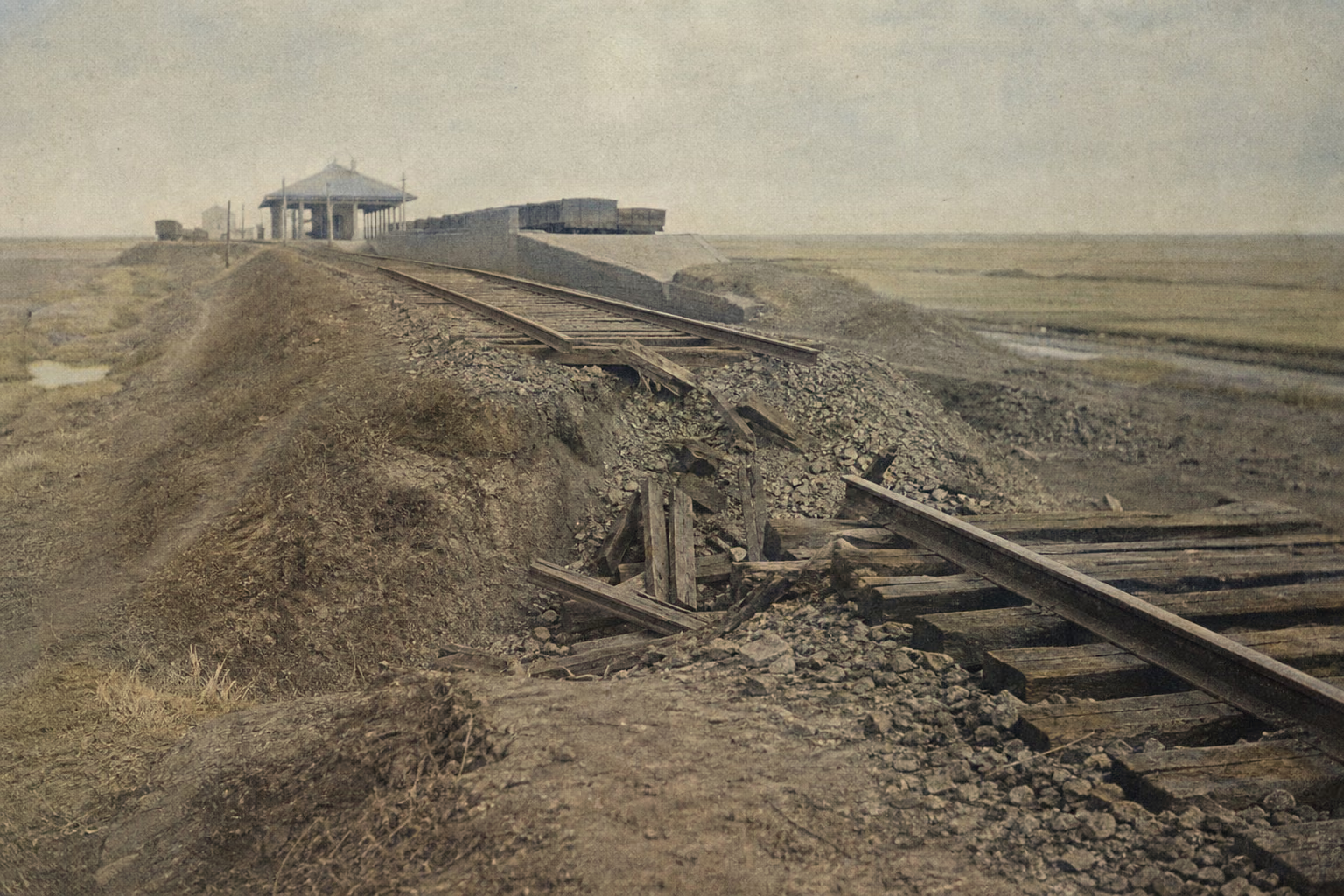
- The Beijing-Tianjin railway was a straight line, with Langfang just at the midpoint; on the plain, the only hard points were the roadbed, stations, and bridges -- the blocking action occurred at breaks in this linear space.
- Taku mouth: the mud was shallow and the flats broad, large warships could not enter, the forts sat low on both banks, and landing parties had to wade across the flats to attack -- the defenders held the ground advantage, and lost through isolation and the gap in firepower.
- The North Canal became the lifeline of the allied retreat: from railway men to boat people, an expeditionary force's mode of movement was twice changed by terrain.
How Each Side Records It
- Chinese side: the Battle of Langfang on 6.18 entered history most often as the "Langfang Victory," a rare "victory" in Boxer narratives; but contemporary allied battle reports recorded it as an orderly retreat after supplies were cut off, with limited casualties -- the two accounts coexist.
- Alliance side: the Battle of Taku was recorded as a "preventive action" to secure the line of communication; the Chinese side recorded it as an act that opened hostilities without declaration. As to who moved first, the calendars on the two sides wrote the same date, but read two different books.
- Seymour's defeat caused no small shock in European and American newspapers at the time -- the news value of "a Western army had been stopped and turned back" was itself a cognitive event at the turn of the century.
Disputes and Sensitivities
- The name and substance of the "Langfang Victory": alliance battle reports and Chinese narrative accounts stand side by side and remain to be checked; whether the main blocking force was Boxers or the Gansu Army, and how large the results were, vary among records.
- Who fired first in the Battle of Taku: the alliance ultimatum came first, and the bombardment came first; there is no error on that point. The alliance side also has the claim that "the defenders opened fire first" (accounts differ).
- Two accounts of Luo Rongguang's death, and his age remains to be checked.
Sources and Open Questions
Known main sources:
- Seymour's own battle reports and memoirs (*My Naval Career and Travels*, edition unverified)
- Records by embedded journalists and military doctors of the various allied countries (editions unverified)
- Luo Dunrong's *Gengzi Guobian Ji* and Li Xisheng's *Gengzi Guobian Ji*
- Zhili local gazetteers and relevant telegrams and memorials in *Qingji Waijiao Shiliao*
Open questions: the original allied battle-report text on the Seymour Expedition's batch strengths and casualties; the troop strength of the Gansu Army participating in the Battle of Langfang on 6.18; the damage to *Gilyak* and the varying accounts of damage to each vessel; the number of Taku forts, gun positions, and defending troops; Luo Rongguang's age and manner of death; details on the capture of four torpedo boats; the number of the first legation guards; dates and agenda records for the imperial conferences; authenticity and source of the return-of-power note; the Taku-Beijing communication sequence; the resolution process by which allied naval commanders consulted and issued the ultimatum; the original memorials of Xu Jingcheng and Yuan Chang opposing war; Luo Rongguang's communications refusing the ultimatum and requesting aid.
All images on this site are AI-generated depictions. They are not historical photographs, not primary sources, and do not depict any real individual.