Engagement Archive · Resistance Against Russia in Manchuria (1900)
Inside the passes, the fight was against 20,000 troops of the Eight-Nation Alliance; beyond the passes, what came was 170,000 Russian troops -- advancing in 6 columns, taking all of Manchuria in 3 months, and before the main operation began, driving several thousand Chinese border residents at Blagoveshchensk and the Sixty-Four Villages East of the River down into the Heilongjiang -- this was the largest military operation of the Boxer year, and the most indistinct page in later memory.
Engagement Data
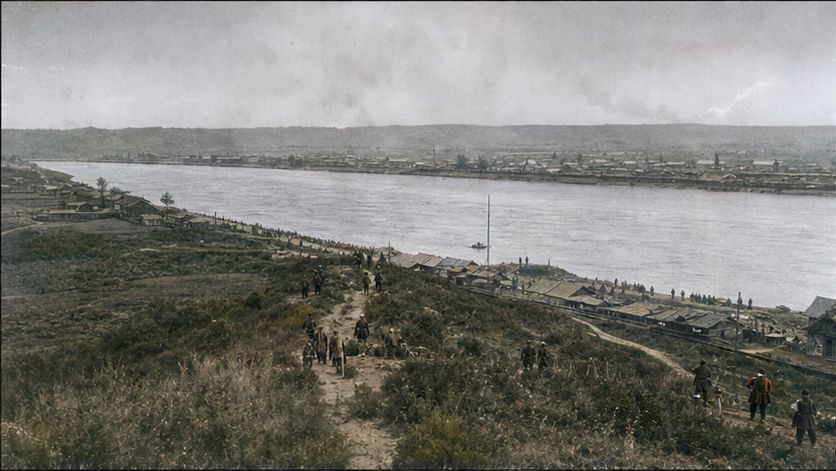
| Item | Details |
|---|---|
| Time | 1900.7–10 (military occupation); Russian occupation continued, and withdrawal negotiations dragged on for years |
| Place | All of Manchuria: Heilongjiang City (Aigun), Qiqihar, Jilin, Fengtian, and the line of the Chinese Eastern Railway |
| Belongs to | Boxer Rebellion · Manchurian front (see Boxer Rebellion: Overview), not under the same command as the alliance inside the passes |
| Invading side | Russia (in the name of protecting the railway -- the Chinese Eastern Railway), about 170,000 men in 6 columns |
| Resisting side | Qing forces of the 3 northeastern provinces (the jurisdictions of the generals of Heilongjiang, Jilin, and Shengjing) and local militia |
| Result | The whole region fell: Qiqihar fell on 8.28, Jilin was lost in September, and Russian troops entered Fengtian on 10.1; Russian forces occupied the region for more than 1 year, repeatedly delaying withdrawal |
Belligerents
| Item | Invading side | Resisting side |
|---|---|---|
| Strength | About 170,000 in 6 columns, with Siberian and Far Eastern garrisons committed as formed units | The trained troops and defense battalions of the 3 provinces totaled several tens of thousands, stationed separately in the cities and unable to support one another (baseline figure disputed) |
| Equipment | Standard rifles, artillery, Cossack cavalry, with rail and river-steamer supply | Modern firearms and older weapons mixed together, without unified command |
| Posture | Advanced from multiple bases at Khabarovsk, Port Arthur-Dalian, and Vladivostok, along railways and rivers | Each fought on its own, while orders for fighting, defense, and negotiation contradicted one another |
Terrain and Conditions
(For the larger situation, see Boxer Rebellion: Overview.)
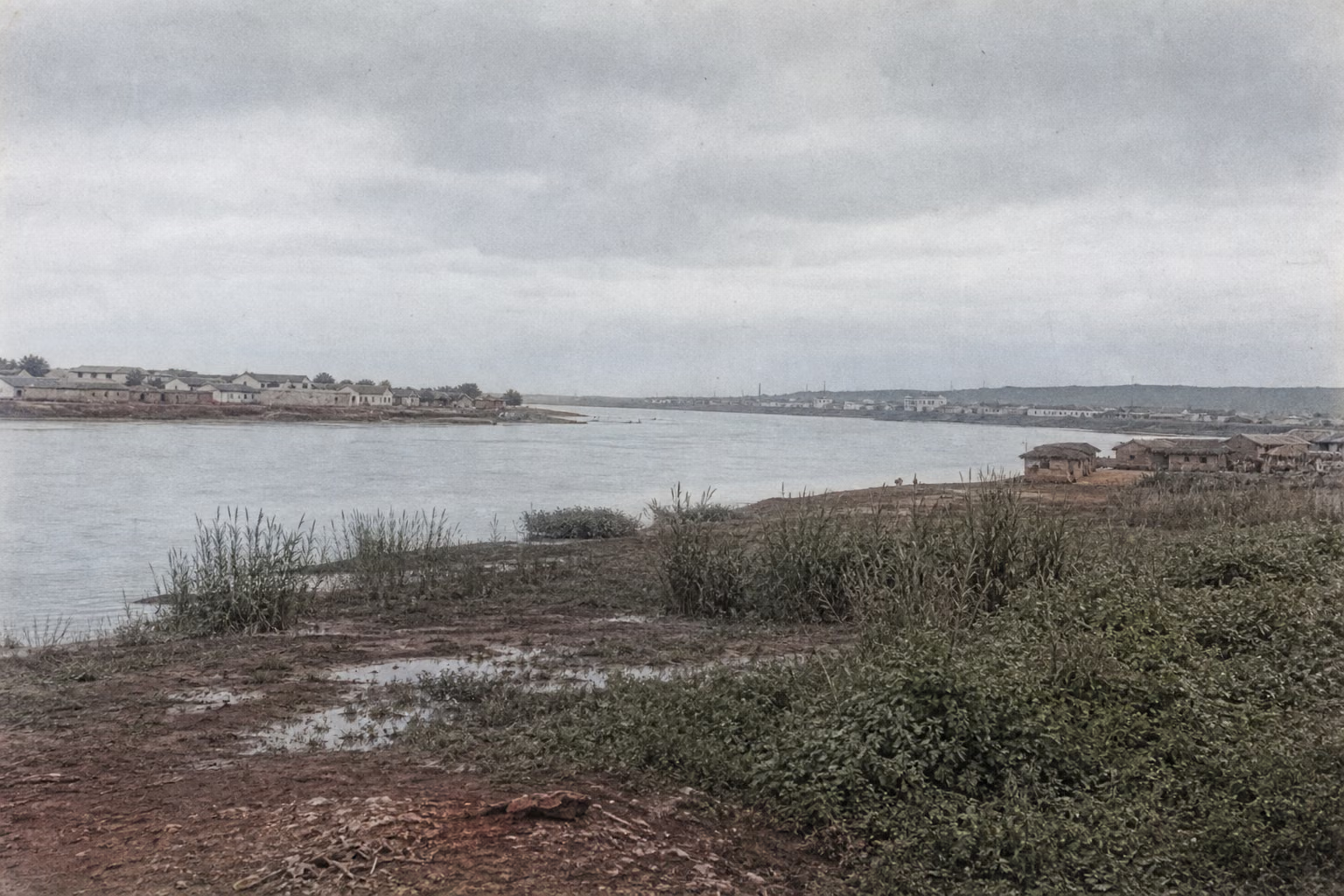
In Manchuria in 1900, the Chinese Eastern Railway was under construction, and Russian people, rubles, and railway guards were scattered along the line. The Heilongjiang was the border river: on the north bank, Blagoveshchensk held several thousand Chinese merchants and laborers; on the south bank, Aigun was the forward post of the Heilongjiang general's jurisdiction; the Sixty-Four Villages East of the River, on the left bank, were long-settled villages whose residents' "permanent right of residence" was explicitly recorded in the Treaty of Aigun. The 3 provincial generals -- Shoushan in Heilongjiang, Changshun in Jilin, and Zengqi in Shengjing -- held different positions on whether to fight or defend. Once the declaration-of-war edict was issued inside the passes, the fire of tearing up the railway and attacking Russian strongpoints reached this railway line.
Why It Was Fought
When Tianjin fell on July 14, the fighting inside the passes still had more than 1 month to go before it reached Beijing; beyond Shanhaiguan, another invasion, larger in scale, had already begun. This chapter takes another line and writes Manchuria.
Once the declaration-of-war edict of June 21 was issued, the fire of tearing up the railway and attacking Russian strongpoints reached the Chinese Eastern Railway. In Manchuria in 1900, this railway was still under construction, and Russian people, rubles, and railway guards were scattered along the line -- it was both the skeleton by which Russia extended itself into Manchuria and the first target to be torn up after the Boxer disorder spread there. Russia then used "protecting the railway" as the reason to send troops, but the scale of 170,000 men in 6 columns and the method of driving straight for the provincial capitals far exceeded what railway protection required: this was a long-planned occupation operation, borrowing the name of the Boxer disorder (the decision-making level inside Russia remains unverified).
This step had backers in Petersburg and opponents as well. The expedition was pressed by War Minister Kuropatkin, and the name of "protecting the railway" came from the War Ministry; Finance Minister Witte had for years advocated another road: railway, ruble, and migration, a gradual swallowing that would not push Manchuria toward Britain and Japan through military occupation. Once the Boxer disorder arose and the declaration-of-war edict came down, the gradualist party had no place before the throne (this account comes from Witte's memoirs and is attested in one source only). Beijing's resolve had sources of its own: in successive imperial conferences before the declaration edict, Prince Duan, Zaiyi, and Gangyi advocated war, while the Guangxu Emperor and ministers of the Zongli Yamen remonstrated without effect; Xu Jingcheng and Yuan Chang, whose remonstrance was most urgent, were executed in the marketplace more than 1 month later (the original edict of charges remains unverified). The viceroys and governors-general of the southeast jointly declared mutual protection and did not obey the edict; Manchuria hung alone, beyond the reach of that protection.
Why now: Siberian and Far Eastern garrisons were already positioned in formed units on the frontier, while the Eight-Nation troops inside the passes were being held down by Beijing and Tianjin; the court's attention, reinforcements, and telegraph lines all faced south -- the Manchurian window stood open. Petersburg's calculation was to use the disorder to turn a sphere of influence into actual occupation; what it did not calculate was that this occupation would later cling to the withdrawal-negotiation table for years, all the way to the Russo-Japanese War. On the Manchurian side, there was no calculation to make: the 3 provincial generals -- Shoushan in Heilongjiang, Changshun in Jilin, and Zengqi in Shengjing -- differed on whether to fight or defend; the trained troops and defense battalions together numbered several tens of thousands (baseline figure disputed), were stationed separately in the cities, and could hardly support one another, forced to take battle one by one between contradictory telegrams of "fight by imperial order" and "do not lightly open hostilities."
The material boundaries drawn for the 2 sides were unequal. The 170,000 Russian troops did not come from Europe: the Circum-Baikal section of the Siberian Railway was not yet open, and eastward transport depended on ferries across the lake; what was actually used was the Amur Military District and Far Eastern garrisons, deployed along the river routes and railway -- enough to occupy Manchuria, not enough to push another step deeper. On the Manchurian side, the pay of the trained troops and defense battalions had depended on support from inside the passes; in the Boxer year that support was severed, arms and ammunition mixed new and old, and once they were fired they were gone. How long each city could hold depended on local stocks, not on the court's resolve.
The fuse can be dated specifically to July 16: the Russian authorities at Blagoveshchensk searched for and arrested Chinese merchants and laborers, drove several thousand people to the bank of the Heilongjiang and forced them to swim across, shooting and cutting them down; about 5,000 were killed (figures vary among accounts). The ※ killings at Blagoveshchensk came before the full invasion -- they were not a byproduct of battle running out of control, but the first step in the occupation operation.
Some tried the option of not engaging: Changshun negotiated peace in Jilin, and Jilin was still lost in September; Shoushan resisted at Qiqihar until the city fell on 8.28, then took his own life in apology. The 2 roads led to the same result.
Course of the Engagement
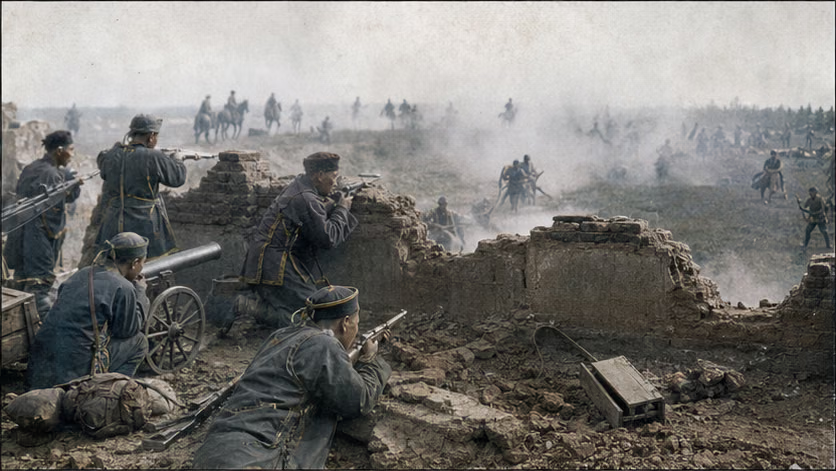
| Phase | Time | Key Points |
|---|---|---|
| ※ Blagoveshchensk Massacre | 7.16–21 | The Russian authorities at Blagoveshchensk searched for and arrested several thousand Chinese merchants and laborers, drove them to the bank of the Heilongjiang and forced them to swim across, shooting and cutting them down; about 5,000 were drowned or killed (Russian archives and survivor accounts differ) -- the killing of civilians, not called a battle, is entered here only under this ※ |
| ※ Sixty-Four Villages East of the River | from 7.17 | Long-settled villages whose "permanent right of residence" was explicitly recorded in treaty text were burned, their residents killed, and cleared out; several thousand died (figures vary by account); the land on the left bank was effectively lost from this point |
| Defense of Aigun | late July–early August | Deputy lieutenant-general Fengxiang's force fought hard; after Aigun fell, the city was burned; Fengxiang later died in battle at Beidaling (details unverified) |
| Harbin | July–early August | A reversal of roles: the Russian railway-construction strongpoint was besieged by Qing forces and local militia, and Russian relief troops moved up the Songhua River in early August to relieve it -- one of the few actions on the Manchurian front in which the attacking side was Chinese forces (level of battle detail unverified) |
| Qiqihar | 8.28 | The city fell; after leaving the instruction that "soldiers and civilians are not to resist," Heilongjiang general Shoushan took poison, then ordered a guard to shoot him when the poison failed (accounts differ; the "lying in a coffin" account is widely circulated and belongs to the legendary layer) |
| Jilin | September | Jilin general Changshun negotiated peace with Russia, and Jilin was lost (course of the negotiations unverified) |
| Fengtian | 10.1 | Russian troops entered Fengtian; Shengjing general Zengqi first fled, then was forced to sign with the Russian authorities the Provisional Regulations for Handing Over Fengtian Territory; the Qing court refused to approve it and dismissed him from office (course of events unverified) |
Casualties and Losses
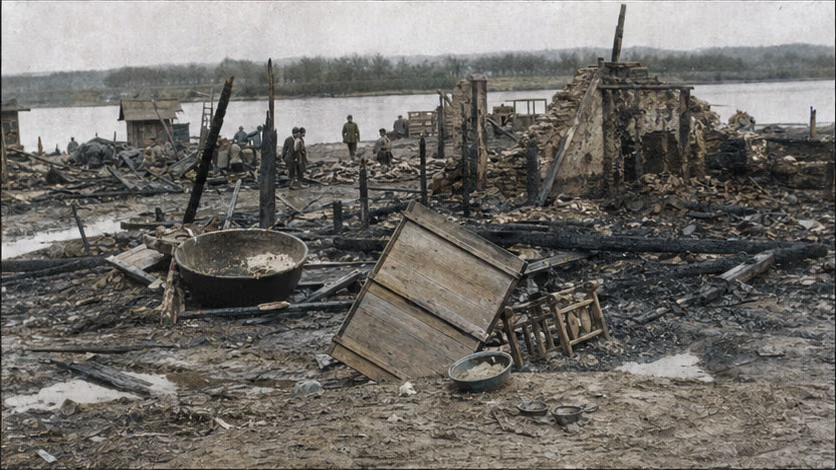
- ※ Civilians: about 5,000 at Blagoveshchensk and several thousand in the Sixty-Four Villages East of the River (figures vary among accounts) -- the largest single civilian death toll of the Boxer year was in Manchuria, not Beijing or Tianjin.
- Resisting side: Fengxiang and other units died in battle (figure disputed); the garrisons of the various cities either collapsed or surrendered, and Aigun and other cities were burned.
- Invading side: Russian casualties were relatively limited (figure disputed) -- 170,000 against dispersed enemies, and most cities were "received" rather than stormed.
Aftermath
- Russian forces stayed in Manchuria and would not leave: the 1902 Convention for the Evacuation of Manchuria provided for phased withdrawal, but was not carried out when due (implementation details unverified).
- In 1903, the movement to resist Russia began among students abroad and in domestic public opinion, the first great wave of modern student movements.
- In 1904.2, the Russo-Japanese War began on Chinese soil -- 10 years after the First Sino-Japanese War, Manchuria had 2 new belligerent states (see the articles on the Russo-Japanese War under [Foreign War on Chinese Soil]).
- The residents of the Sixty-Four Villages East of the River never returned to the left bank.
Accounts of Those Present
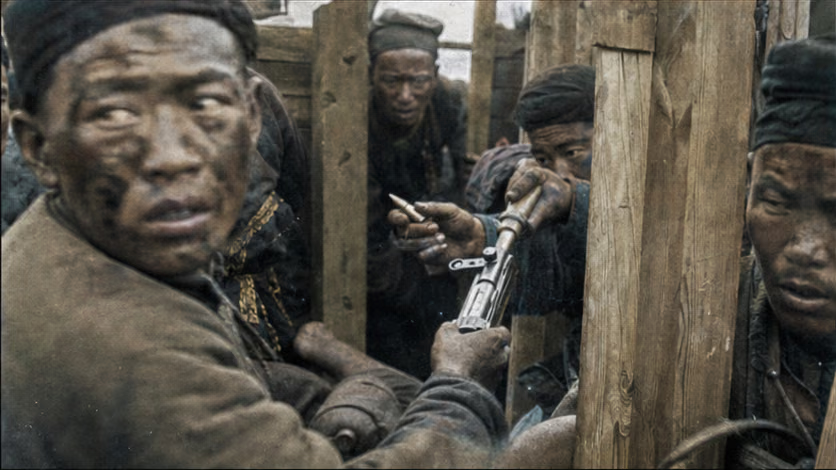
- Forced crossing ※: survivors of Blagoveshchensk recalled more than 10,000 people being driven to the riverbank; those who could swim were shot in midstream, while those who could not swim went into the water holding door planks and children -- soldiers and civilians in Aigun on the south bank witnessed it across the river (survivor records remain to be collected and checked).
- Fengxiang: deputy lieutenant-general of Aigun, who withdrew to Beidaling after the city fell and died in battle there (details unverified) -- a commander on the Manchurian front who fought to the end.
- Shoushan: before the city fell, he left the instruction that "soldiers and civilians are not to resist" and took his own life in apology -- the poison did not kill him, so he ordered a guard to shoot him; the "lying in a coffin" episode is the most widely circulated and the lowest in evidentiary level (legendary layer).
- Zengqi: first fled, then was escorted back under compulsion to sign, and was then dismissed by the court -- the Provisional Regulations for Handing Over Fengtian Territory was not something he could sign away alone; the course of events remains disputed and unverified.
The Ground
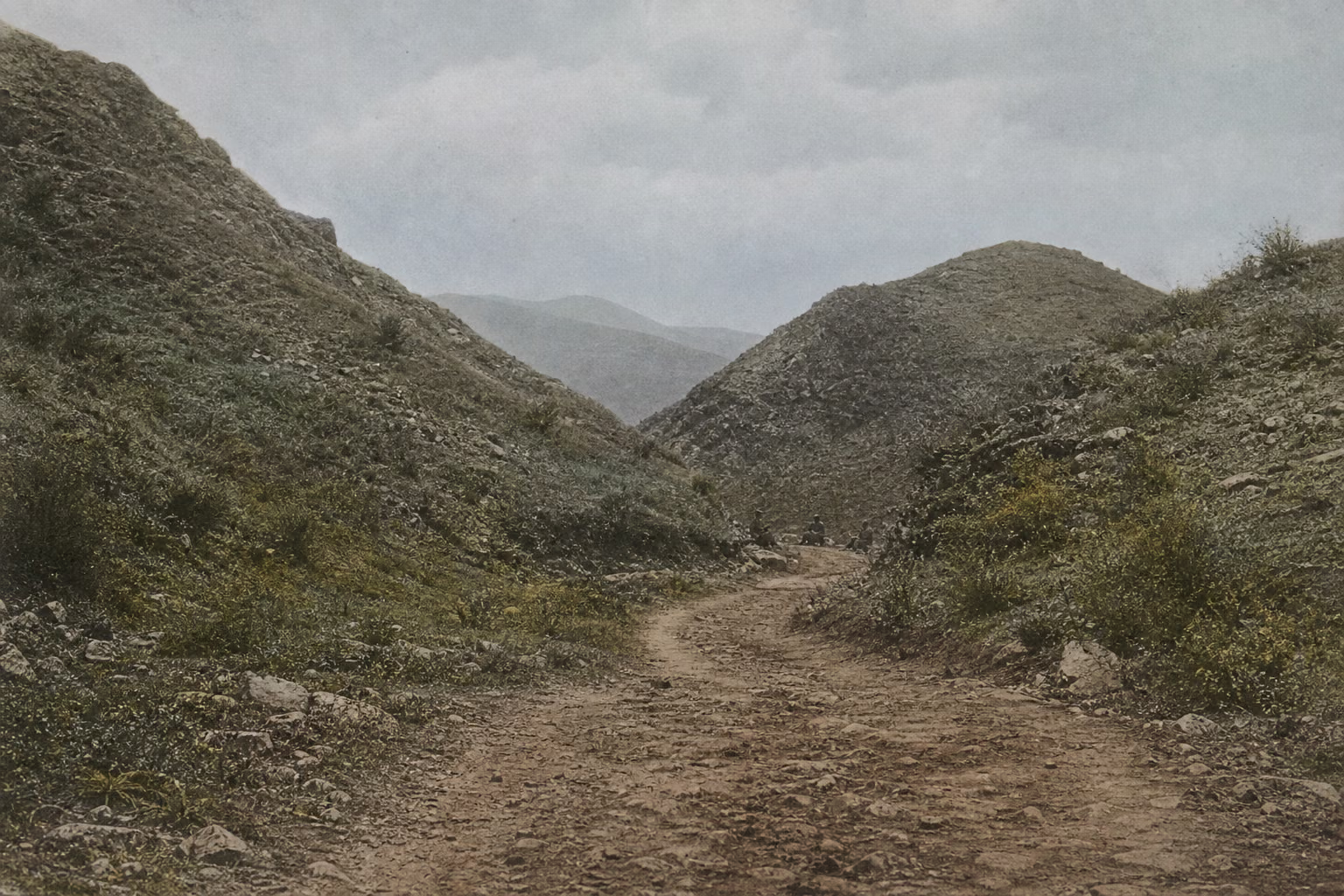
- The Heilongjiang was the first battle line and the first killing ground: on the 2 banks of the border river, Blagoveshchensk and Aigun faced each other across the water, and the massacre occurred on the waterline.
- The T-shaped line of the Chinese Eastern Railway was the skeleton of the Russian 6-column advance: Manzhouli-Harbin-Suifenhe formed the horizontal line, Harbin-Port Arthur the vertical, and Russian troops moved down along the line into the countryside, with all 3 provincial capitals on it.
- The Songliao Plain had no defensible barriers; mountain passes such as Beidaling were the only blocking points -- all the defender's terrain advantage lay in rivers and winter cold, and the war was fought in summer.
- Harbin: a new city born from the railway, first a besieged strongpoint and then the hub of occupation.
How Each Side Records It
- Russian side: recorded at the time as "protecting the railway and pacifying disorder"; Russian archives on the massacres did not come to light until years later (publication process unverified).
- Chinese side: in local Manchurian memory there is an oral layer of "the Boxer Russian calamity" and "fleeing the Russians"; Blagoveshchensk and the Sixty-Four Villages were never forgotten in the borderlands. In the national narrative, however, Boxer Rebellion = Boxers = Beijing and Tianjin, and this Manchurian page is far more indistinct -- largest in scale, most indistinct in memory. That contrast is the reason this chapter exists.
- Treaty history: the Sixty-Four Villages East of the River are a page on which the written right of residence in the Treaty of Aigun was voided by force -- the gap between treaty text and real land is a layer textbooks rarely reach.
Disputes and Sensitivities
- Death figures for Blagoveshchensk and the Sixty-Four Villages: Chinese records, Russian archives, and survivor accounts stand in several parallel sets (accounts differ).
- The decision-making level and degree of premeditation in Russia's dispatch of troops: scholarship is still working through the argument between the stated reason of "protecting the railway" and the actual results of occupation.
- The claim of a "Yellow Russia Plan" is widely circulated; its source and text remain unverified, and the level of the historical materials remains to be distinguished.
- Details of Shoushan's suicide and the course of Zengqi's signing coexist in different accounts.
Sources and Open Questions
Known main sources:
- Chinese side: survivor oral accounts and local gazetteers of Aigun (*Aigun County Gazetteer*, etc., volume references unverified); telegrams and memorials from the Manchurian sections of *Qingji Waijiao Shiliao*
- Russian side: massacre investigations and War Ministry archives (state of opening and organization unverified)
- Modern scholarship: studies by Xue Xiantian and others on the Boxer Russian calamity and the Sixty-Four Villages East of the River (bibliography unverified)
Open questions: the casualty figures for the massacres across different statistical bases and the original Russian archival text; the organization and commanders of the Russian 6-column force; the dates of Aigun's fall and Fengxiang's death in battle; the level of battle detail for the siege of Harbin; the source lines for the different accounts of Shoushan's suicide; the text of the Provisional Regulations for Handing Over Fengtian Territory and the course of his dismissal; implementation details of the 1902 evacuation convention; the Russian War Ministry decision files for the dispatch of troops and the level at which the "protecting the railway" rationale was proposed (the account of Kuropatkin's advocacy); the original text of Witte's memoirs opposing military occupation of Manchuria; memorial drafts by ministers who argued for peace in the Boxer imperial conferences, and the original edict text giving the charges against Xu Jingcheng and Yuan Chang when they were executed in the marketplace; the Circum-Baikal connection of the Siberian Railway and Russian eastward transport capacity; records of the severing of support pay to the 3 northeastern provinces.
All images on this site are AI-generated depictions. They are not historical photographs, not primary sources, and do not depict any real individual.