Engagement Archive · Counterattack in Self-Defense Against Vietnam
At dawn on February 17, 1979, the People's Liberation Army crossed the border simultaneously on the Guangxi and Yunnan fronts with 9 armies; in 28 days it took Cao Bang, Lang Son, and Lao Cai, announced its withdrawal on March 5, and had fully returned across the border by March 16 -- a border war of rapid advance and rapid withdrawal, in which both sides declared victory, and whose exposed problems were written into every page of China's military reforms over the following 10 years.
Engagement Data
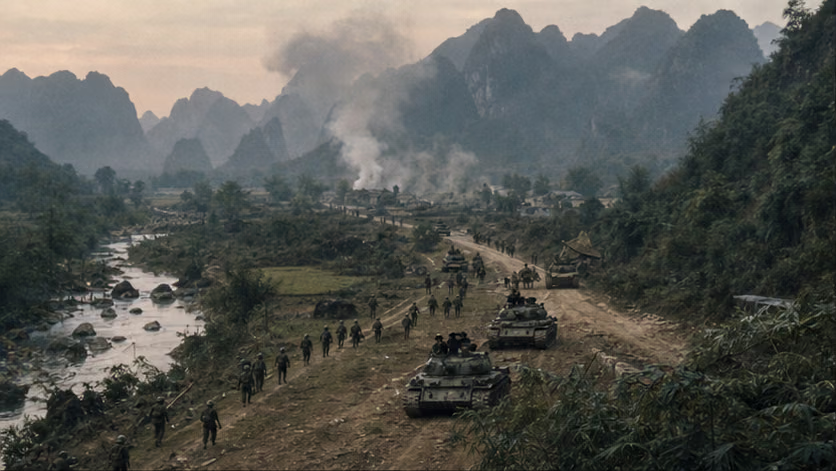
| Item | Content |
|---|---|
| Time | 1979.2.17–3.16, 28 days in all |
| Place | The full length of the China-Vietnam border: the eastern front opposite Guangxi (Dong Dang–Lang Son and Cao Bang directions), and the western front opposite Yunnan (Lao Cai, Cam Duong, and Sa Pa directions) |
| Belongs to | Sino-Vietnamese War · counterattack phase (for the larger situation and the chain of estrangement, see *Sino-Vietnamese War · Overview*) |
| Attacker | Chinese People's Liberation Army: on the eastern front, Guangzhou Military Region (commander Xu Shiyou), the 41st Army, 42nd Army, 43rd Army, 54th Army, and 55th Army, plus the main force of the 50th Army; on the western front, Kunming Military Region (commander Yang Dezhi), the Eleventh Army, 13th Army, and 14th Army, plus the 149th Division of the 50th Army (order-of-battle details unrecorded) |
| Defender | Vietnam People's Army units facing the northern front: Third Division (Lang Son), 346th Division (Cao Bang), 345th Division (Lao Cai), and others, together with independent regiments and battalions, armed public-security posts, and militia; the 316A Division hurried to reinforce the western front from the Lai Chau direction |
| Result | The Chinese side took Cao Bang, Lang Son, Lao Cai, and other major towns in northern Vietnam, then withdrew on its own initiative; both sides declared victory |
Belligerents
| Item | Attacker | Defender |
|---|---|---|
| Troops | 9 armies, 200,000–300,000 troops (figures vary by account), with hundreds of thousands of support-front militia and civilian laborers | About 6 regular divisions on the front line, plus local forces, public security, and militia, totaling about 100,000 (figures vary by account); most main forces were in Cambodia |
| Armor | Several hundred Type 59 and Type 62 tanks and Type 63 armored vehicles (figure disputed) -- the first large-scale use of armored troops in mountain-jungle terrain | A small number of tanks; abundant antitank weapons, including Soviet-aid models and models previously supplied by China |
| Firepower | Army- and division-level artillery groups: 122 mm howitzers, 130 mm guns, and rocket artillery | Division- and regiment-level artillery, plus a firepower system based on prepared positions |
| Air | The air force flew patrols and stood alert but did not cross the border to fight (explanations vary by account) | The air force essentially did not take off to meet the attack |
| Grounding | The vast majority of officers and soldiers had never been in battle, and wartime expansion brought in large numbers of new recruits; training had been neglected for more than 10 years | After 30 years of war, light infantry and guerrilla tactics were well practiced; whole-population defense -- villages fortified, mines and bamboo stakes laid, militia everywhere |
Terrain and Conditions
(For the larger situation and the chain of estrangement, see *Sino-Vietnamese War · Overview*; this section deals only with the border.)
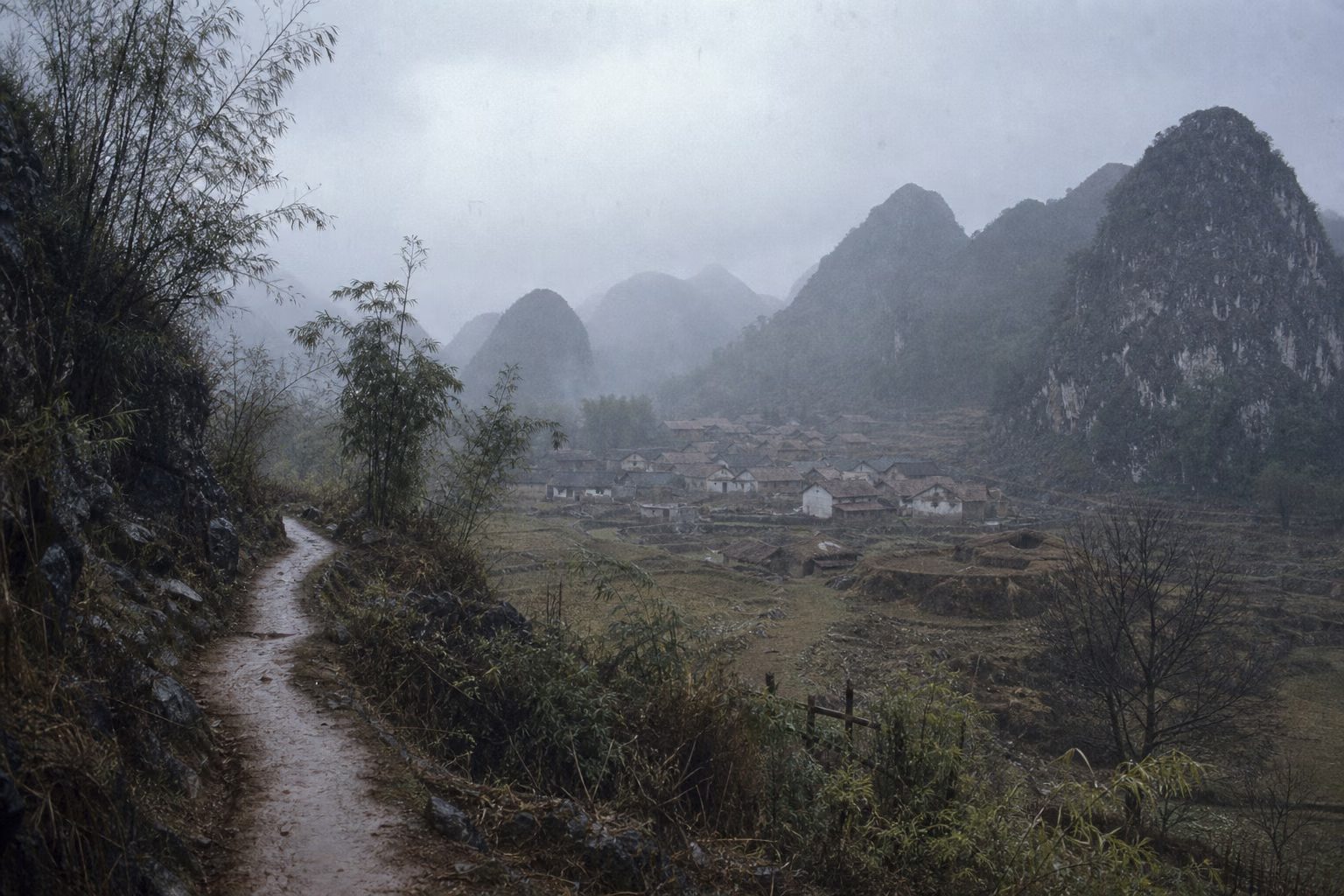
Borderline: Guangxi and Yunnan border the northern Vietnamese provinces for about 1,300 kilometers, with karst stone mountains alternating with subtropical jungle, and frequent rain and fog in February and March. Roads were scarce, and only 2 railways faced the front directly, Pingxiang–Dong Dang and Hekou–Lao Cai; mountain paths were the only choice for penetration, and also natural pockets for ambush.
People on both sides: On both sides of the border, Zhuang–Tay-Nung, Miao–Hmong, and other peoples had lived across the line, intermarried, and traded for centuries; from 1978, ports of entry were closed and border residents were pulled back, while the Guangxi and Yunnan side saw an inflow of returned overseas Chinese awaiting resettlement (※ see the overview for background). On the northern Vietnamese side, after decades of wartime mobilization, "one hand on the hoe and one hand on the gun," every village had militia and every settlement had works -- what the PLA faced was not a line of defense, but a defended country.
The guarded north: Before and after the opening of the war, the Shenyang, Beijing, Lanzhou, and Urumqi Military Regions all entered combat readiness at the same time, guarding against Soviet coordination from the north (details of deployment unrecorded) -- this southern-front war was fought under the shadow of the northern front.
Why It Was Fought
Vietnamese tanks entered Phnom Penh on January 7; PLA artillery crossed the China-Vietnam border 41 days later. The 4 years that took the two sides from "comrades plus brothers" to this point -- the turn toward the Soviet Union, anti-Chinese expulsions, bloodshed on the border, and finally entry into Cambodia -- have been recorded in the overview. What turned the last page was 3 things before and after those 41 days.
The first was in Beijing. In early December, the Central Military Commission made the decision to fight, and troops of the Guangzhou and Kunming Military Regions immediately moved toward the border (sequence of meetings and orders unverified). The guideline was drawn narrowly: limited time, limited depth, striking the northern Vietnamese front line, a quick fight and quick withdrawal, and no attack on Hanoi. The time window was also narrow -- once the rainy season arrived in April, armor and artillery would have to fight in the mud. The second was in Washington. From January 28 to February 5, Deng Xiaoping visited the United States and told Carter that Vietnam had to be given a "necessary lesson" (wording unverified); the U.S. side neither supported nor stopped him (accounts vary by basis). The third lay between Moscow and China's northern frontier. The precondition for opening the war was a judgment: constrained by treaty wording and the Far Eastern winter, the Soviet Union was unlikely to move south in force (assessment bases vary by account) -- even so, the northern military regions shifted into alert across the line.
Xu Shiyou's eastern front was to strike Cao Bang, the hard core of the northern Vietnamese front line and the station of the 346th Division, with a plan for east-west converging penetrations to encircle and annihilate it quickly (the account that Cao Bang was to fall "in several days" circulates, but the original basis is unverified). Yang Dezhi had been transferred from the Wuhan Military Region to Kunming only at the end of January, and the war opened less than a month after he took up the post. The Vietnamese calculation was different: 200,000 main-force troops were in Cambodia, while on the northern line local forces and militia would be arranged layer by layer to wear the enemy down, and regular units would not be committed lightly -- Hanoi's judgment was that China would not dare truly fight, or would not fight for long (Vietnamese decision-making bases vary by account); on February 17 itself, many forward positions in northern Vietnam had not yet entered the highest state of alert (record unverified).
Both sides miscalculated by half. The Chinese side underestimated how hard northern Vietnam would be to fight even without its main force -- whole-population defense dragged a war of annihilation into the reduction of one mountain and one cave after another. The Vietnamese side underestimated that China really would press across the border at the scale of 9 armies.
At dawn on February 17, artillery preparation began along the full length of the border, and infantry and tanks crossed the boundary markers. Xinhua's statement that day called it a "counterattack"; Hanoi Radio that day called it an "invasion" -- the 2 words have stood side by side ever since.
Course of the Engagement
| Phase | Time | Key Points |
|---|---|---|
| Breakthrough along the whole front | 2.17 | After artillery preparation at dawn, the eastern and western fronts crossed the border simultaneously at dozens of points; the eastern front advanced toward Dong Dang and the outskirts of Cao Bang, while the western front forced a crossing of the Red River |
| Cao Bang penetration | 2.17–2.25 | The 41st Army advanced from Nianjing toward Banzhuang, while the 42nd Army moved from Buju through Dong Khe toward Cao Bang, converging to encircle it; tank detachments inserted along mountain roads to Dong Khe within several hours (duration unverified); the 121st Division of the 41st Army went deep behind enemy lines, went without food for several days, and kept moving toward its assigned area even after its organization had been broken up; Cao Bang was taken on 2.25 (dates vary by account), the Vietnamese 346th Division broke into small units, and clearing operations continued into early March |
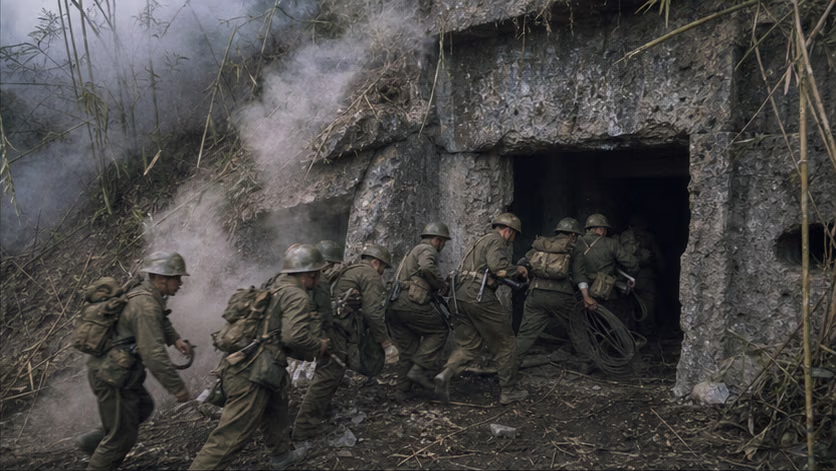
| Dong Dang–Lang Son | 2.17–3.4 | The 55th Army annihilated the defenders in the Dong Dang area on 2.23; Gui Tun Fort (a French-colonial fortress) was demolished with charges in its tunnels -- Chinese military history records that the defenders refused to surrender and that the fort collapsed in depth, while Vietnamese records say civilians sheltering inside died (※ the 2 accounts are listed side by side; numbers unrecorded). The attack on Lang Son began on 2.27; on 3.1, more than 300 artillery pieces launched a 30-minute rapid bombardment; on 3.2, the northern urban area was controlled (unverified); on 3.4, part of the force crossed the Ky Cung River into the southern urban area -- south of Lang Son the hills end and the plain begins, and Hanoi was shaken |
| Western-front depth | 2.17–3.5 | Lao Cai was taken on 2.19 and Cam Duong on 2.25 (both dates unverified), and the 345th Division retreated in disorder; the 316A Division's reinforcement was blocked at Dai Nai (unit designations unrecorded); the 149th Division of the 50th Army entered the western front and in early March routed the main force of the 316A Division in the Bridge No. 4–Sa Pa direction (dates vary by account) |
| Withdrawal announced | 3.5 | Xinhua was ordered to issue a statement announcing withdrawal; on the same day Hanoi issued a nationwide mobilization order -- one side announced it was leaving, the other that the whole country would prepare for war, and the next 10 years of the war were already buried in that day |
| Withdrawal | 3.5–3.16 | The forces withdrew under alternating cover, demolishing facilities and recovering materials along the way; the dispute over the scope of destruction is treated in the disputes section ※. In mid-March, the 448th Regiment of the 150th Division, 50th Army, was ambushed and encircled during withdrawal, losing more than 500 men, with more than 200 captured (date and figures disputed) -- the largest single Chinese loss and prisoner incident of the entire war; on 3.16 the last troops returned across the border |
Casualties and Losses
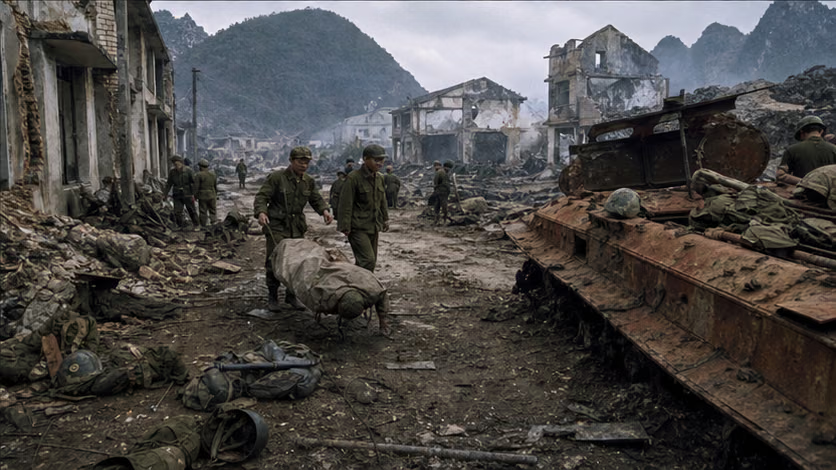
- Attacker: one circulated set of statistics (source unverified) gives 6,954 killed and about 15,000 wounded; another account gives more than 8,500 killed; the official full-basis figures have not been released. Armored-vehicle battle losses ran to several hundred vehicle-incidents, with several dozen total losses (figure disputed).
- Defender: Chinese battle reports claimed more than 57,000 Vietnamese troops eliminated (boundaries among killed, wounded, and captured unverified); Vietnam said its own military losses were far lower than this and did not publish systematic figures, while also saying it eliminated 62,000 Chinese troops.
- ※ Civilians: Vietnamese bases say civilian deaths in northern Vietnam ran into the tens of thousands (classification figures unrecorded); Chinese battle reports do not include a civilian category. Chinese border villages and towns were affected by shelling, and support-front militia and civilian laborers suffered casualties (figure disputed).
- Prisoners of war: exchanges at Friendship Pass in May–June 1979 -- Vietnam handed over 238 Chinese captives (one account says 240, figure disputed), and China handed over 1,636 Vietnamese captives (unverified).
Aftermath
- Withdrawal was completed on March 16, and fighting over points straddling the border and artillery duels began that same year -- the war did not end, it only changed form (continued in *Battles of Fakashan and Koulinshan*).
- The military review list included unfamiliarity with infantry-tank coordination, poor communications, an excessive share of newly recruited soldiers in wartime expansion, penetrating detachments running out of food, mismatch between maps and the ground, and pack-animal logistics half paralyzed in the jungle. This list drove the 1980s demobilization, combined group armies, and restoration of military academies -- the tuition paid in 1979 was entered in the accounts of the next 10 years of military reform.
- Vietnam issued a general mobilization order, and from then on several hundred thousand troops were stationed on the northern line year-round; the economic burden of two-front war became one of the more distant causes of Doi Moi in 1986.
- Apart from condemnation, military aid, and naval and air reconnaissance, the Soviet Union did not intervene militarily -- the treaty umbrella did not open (details of the Soviet response unrecorded).
- Chinese postwar hero-model propaganda ran hot for a time, then domestic narratives gradually became low-key; placement of disabled veterans and martyrs' families, and border martyrs' cemeteries (Longzhou and Jingxi in Guangxi; Pingbian, Jinping, Malipo, and others in Yunnan), became long-term matters.
Accounts of Those Present
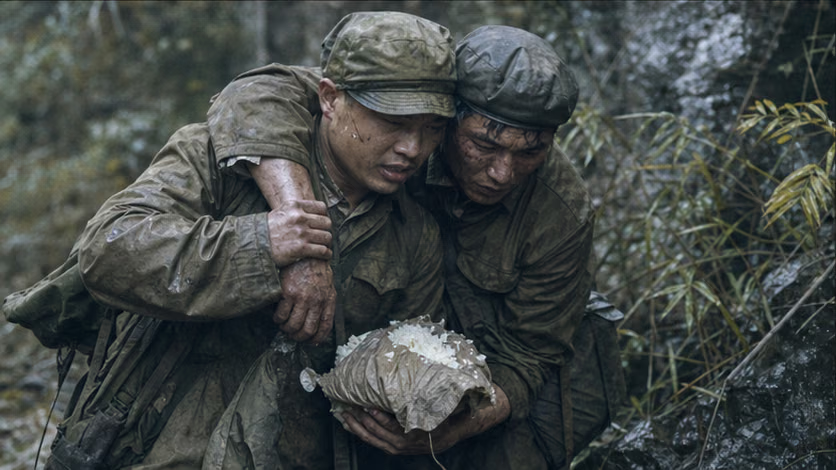
- Two old generals: Xu Shiyou was 73, commanding a large-force operation for the last time; Yang Dezhi had been in Kunming for less than a month when the war opened, and after becoming gravely ill during the campaign he was sent to Beijing, with command continued by other senior leaders of the military region (details unverified) -- both men were Red Army cadres who had come through the Long March, and their last battle was fought on the border of what had once been "comrades plus brothers."
- Backpack straps: Infantry riding on tanks had no handholds and tied themselves to turret railings with backpack straps; when they were ambushed, they could not untie themselves, and casualties came in swathes (recorded in multiple memoirs, source unverified).
- The 7 days of the 121st Division: The 121st Division penetrating toward Banzhuang went without food for several days, surviving on wild banana pith and raw rice, carrying wounded men through the stone mountains to complete the whole route -- its organization was broken up, but the mission was not lost (recorded in division histories and memoirs).
- The militia opposite: In the front-line villages, those who fired included people in uniform and people not in uniform, men and women, old and young; among captured personnel were women militia -- the other face of whole-population defense is whole-population involvement (records from both sides are listed side by side ※).
- The French fort: Dong Dang's Gui Tun Fort was a reinforced-concrete fortress from the French colonial period -- works left by occupiers of an earlier age were used in this war; more than 10 tons of charges were placed in its tunnels (figure disputed).
- 238 and 1,636: Footage survives of the prisoner exchange at kilometer zero of Friendship Pass -- the later scrutiny and circumstances of the returned captives remain unopened in the archives (unverified, sensitive).
The Ground
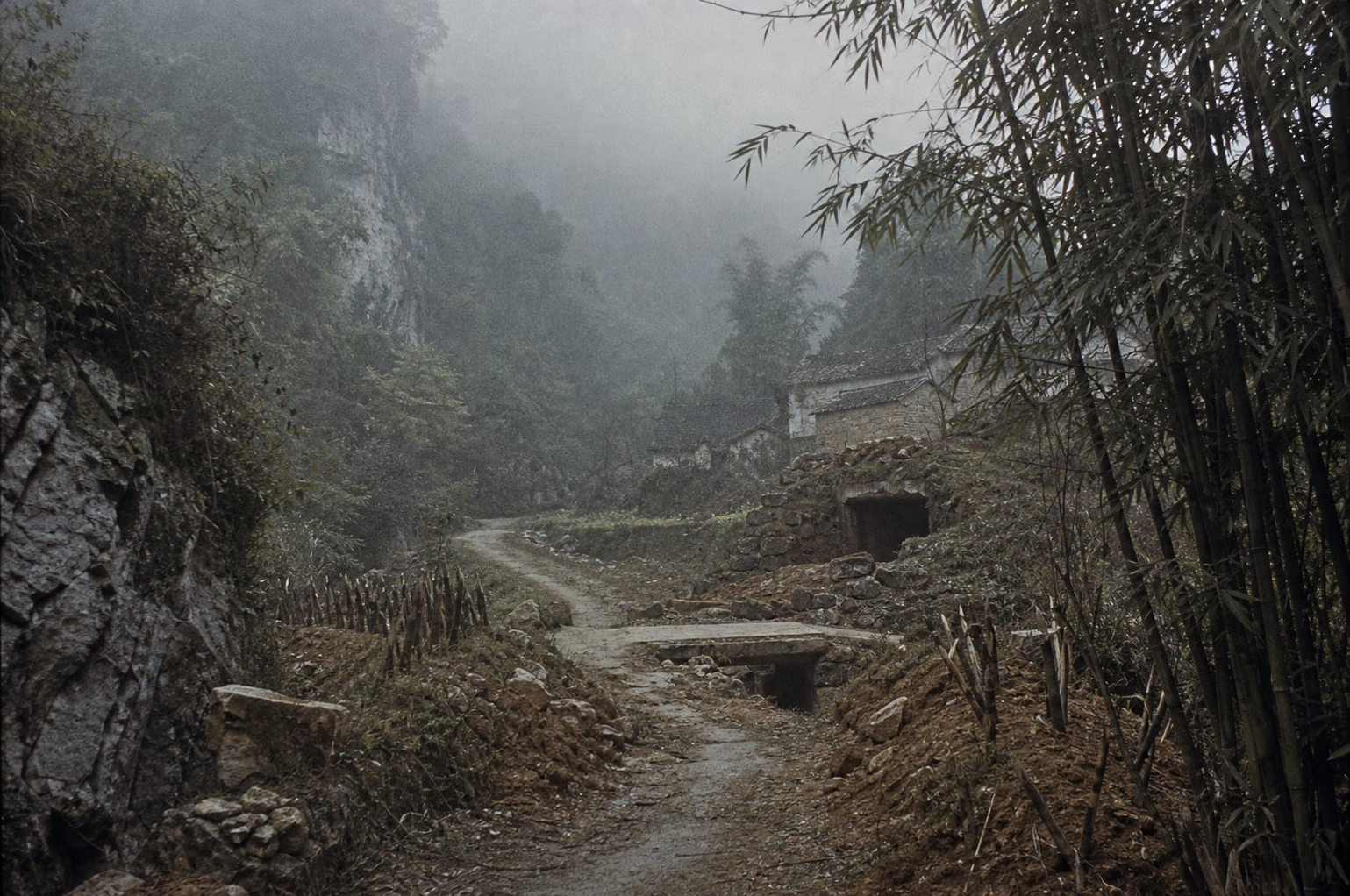
- Karst stone mountains + caves + bamboo forest + fog: sightlines were often under 100 meters, and high ground and cave mouths decided everything -- the spatial grammar of reducing points in jungle.
- Penetration lines: mountain paths, passes, bridges, and culverts -- marching columns sealed at head and tail by fire points on both sides of a valley were a repeated spatial predicament of this war (Dong Khe, Banzhuang, Dai Nai, and the 448th Regiment among the cases).
- Fortified villages: tunnels under houses, hidden bunkers at village entrances, bamboo-stake minefields along field ridges -- every village was a miniature fortress.
- Cities: the two-bank structure of Lang Son's northern urban area, the Ky Cung River, and the southern urban area; the fortress group at Dong Dang, including Gui Tun Fort and Tan Mo Height.
- Historical layers: French fortresses, roads built by Chinese engineering troops during the aid-to-Vietnam period, and Soviet-aid radar stations -- remains of 3 eras stacked on the same battlefield.
How Each Side Records It
- Chinese side: The full official name is "Counterattack in Self-Defense Against Vietnam and Defense of the Frontier Operation." Propaganda ran hot in 1979; 1980s literature and film left *Wreaths at the Foot of the High Mountains* (1982 novel, 1984 film, years unverified) -- rare works that wrote directly about sacrifice and internal military problems. After normalization in 1991, the narrative remained low-key for a long period, and no official full history has appeared. Veterans' memories resurfaced in the internet age: privately printed memoirs, revisits to the border, and cemetery memorial visits.
- Vietnamese side: It is named the "1979 War to Defend the Northern Border," with 2.17 as a commemorative day; the narrative core is "repelling 600,000 invading troops" (Vietnamese basis figure) and the deaths of northern border civilians ※. After normalization, official commemoration remained low-key for a long time, then warmed after 2014, with concentrated fortieth-anniversary reporting in 2019; Lang Son, Cao Bang, and other places retain war remains and memorial facilities (details unrecorded).
- Both sides declared victory: The Chinese side closed with "achieved the expected objectives," and the Vietnamese side with "defended the border" -- the coexistence of 2 victory narratives is itself the first commemorative fact of this war.
- International: Western and Japanese journalists that year entered Lang Son and Cao Bang from the Hanoi side, leaving reports of destroyed cities (see also the disputes section); scholarship mostly places the war within the frame of the "Third Indochina War."
Disputes and Sensitivities
- 4 mutually incompatible sets of casualty and result figures (Chinese self-reported losses, Vietnamese losses in Chinese battle reports, Chinese losses as self-reported by Vietnam, and Vietnamese civilian-related bases ※) -- none of the statistical boundaries has been made public.
- Destruction during withdrawal ※: The Chinese basis says military facilities were destroyed and materials previously supplied to Vietnam were recovered; the Vietnamese basis says towns such as Lang Son and Cao Bang were systematically destroyed and includes this among accusations against China; on-site reporting by third-party journalists falls between the 2 accounts. Scope, targets, and command level all remain unverified.
- Gui Tun Fort ※: Chinese military history records it as the demolition of a strongpoint whose defenders refused to surrender; Vietnamese records say hundreds of civilians sheltering inside died (figure disputed) -- listed side by side.
- 448th Regiment incident: Disputes over responsibility for the withdrawal sequence and command handling (internal military conclusions unverified); the later circumstances of returned captives remain unverified.
- The phrase "the world's third military power": Often seen in Chinese narratives as a quotation, but the original Vietnamese source remains unverified -- it should be cited cautiously.
- Evaluation of military performance: swift-victory narratives and reviews of a "costly victory" coexist.
Sources and Open Questions
Known main sources:
- Postwar summaries by the participating military regions and unit histories of participating forces (internally issued, not declassified; holdings unverified)
- Memoirs and oral-history compilations by participating officers and soldiers (many privately printed; sifting unverified)
- Xiaoming Zhang, *Deng Xiaoping's Long War: The Military Conflict between China and Vietnam, 1979–1991* (2015)
- Edward C. O'Dowd, *Chinese Military Strategy in the Third Indochina War* (2007)
- King C. Chen, *China's War with Vietnam, 1979* (1987)
- Vietnamese side: publications of military-history institutions under Vietnam's Ministry of National Defense, and commemorative materials from *People's Army Newspaper* (bibliography unverified)
- Li Cunbao, *Wreaths at the Foot of the High Mountains* (literary witness)
Open questions: the time chain of decision-making meetings and operational orders; committed troop strengths and order-of-battle details; each side's casualty bases and statistical boundaries; the source for the account that Cao Bang was to fall "in several days"; Yang Dezhi's illness and withdrawal from command and the continuation of command; the amount of charges at Gui Tun Fort and the composition of the dead; duration of the Dong Khe penetration; dates when Lao Cai, Cam Duong, Cao Bang, and the northern urban area of Lang Son were taken; the date, losses, and handling conclusions for the 448th Regiment; prisoner-exchange figures; bases for the air force's nonparticipation; source for the backpack-strap detail; Vietnamese source for the phrase "the world's third"; years for *Wreaths at the Foot of the High Mountains*.
All images on this site are AI-generated depictions. They are not historical photographs, not primary sources, and do not depict any real individual.