Engagement Archive · Counter-"Mopping-Up" Operations (1941–42, incl. ※ the "Three Alls")
After the Hundred Regiments Offensive, Japanese forces changed the object of war in North China from armies to society itself -- "Three Alls" mopping-up, no man's zones, and the tightening of the "cage" cut the base areas' population and territory by nearly half in two years; counter-"mopping-up" was not one battle, but the way the entire military and civilian population of the base areas survived under strangulation.
Engagement Data
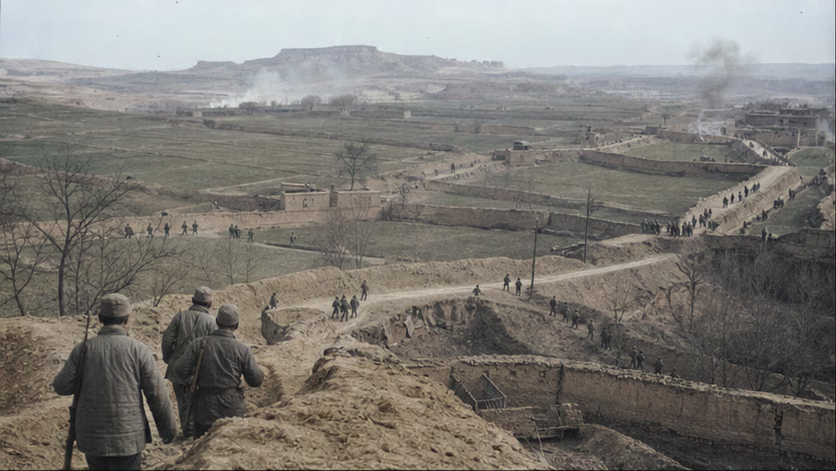
| Item | Content |
|---|---|
| Part of | Fourteen-Year War of Resistance · Battlefields Behind Enemy Lines (for the overall picture, see *Battlefields Behind Enemy Lines · Overview*) |
| Time | 1941 – 1942 (the two most intense years; "mopping-up" began in 1938 and continued to 1944, with this article taking these two years as its axis) |
| Place | Base areas across North China: Jinchaji (Beiyue, Central Hebei), Jin-Ji-Lu-Yu, Jinsui, Shandong |
| Belligerents | Main forces of the Eighth Route Army, local forces, militia, and the people of the base areas / Japanese North China Area Army (commanders Tada Hayao -> Okamura Yasuji in 1941.7) and puppet troops |
| Form | Japanese side: five "Public Security Strengthening Campaigns" plus large "mopping-up" operations by iron-wall encirclement; Chinese side: transfer, scorched-earth denial, and counter-"mopping-up" through coordination between inner and outer lines |
| Result | The base areas entered their most difficult period but did not collapse; they began to recover from 1943 onward |
Belligerents
| Item | Military and civilians of the base areas | Japanese and puppet forces |
|---|---|---|
| Strength | Dispersed persistence; main forces broke into smaller units | A single large "mopping-up" operation often involved tens of thousands (70,000 in Beiyue in autumn 1941, 50,000 in the 1942 "May First" operation in Central Hebei, and so on; counting standards vary by account) |
| Methods | Tunnels, land mines, sparrow warfare, intelligence networks, scorched-earth denial | Iron-wall encirclement, combing clearance operations, selective mopping-up, plus blockhouse-blockade ditches and walls |
| Object | -- | The object of war expanded to the people and the resources of survival themselves: burn all, kill all, loot all (the "Three Alls"; Japanese documents called this "annihilation operations" -- the perpetrator's own operational term) |
Terrain and Conditions
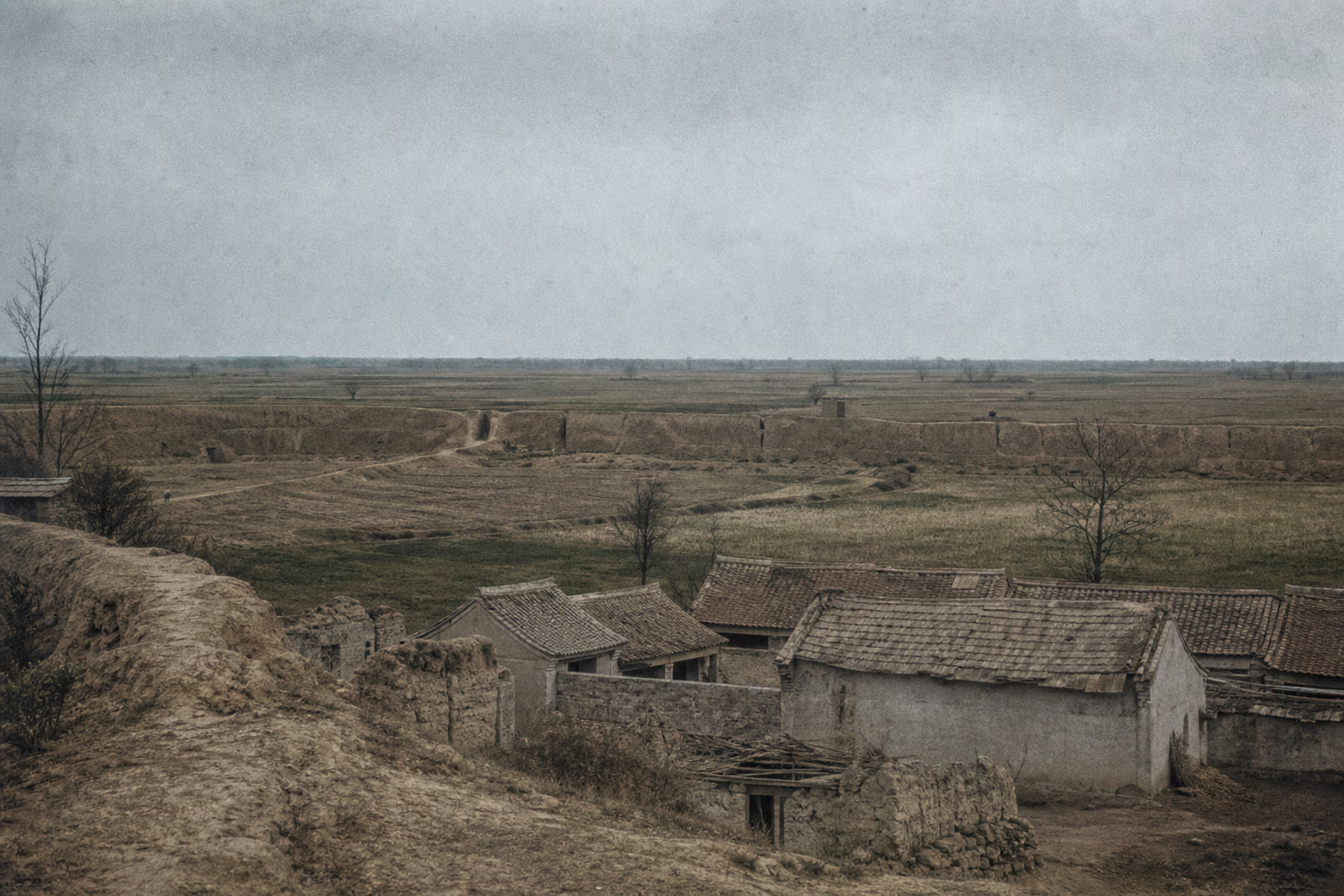
The Hundred Regiments Offensive exposed the strength of the base areas. After Okamura Yasuji took office, he pushed "public security warfare" toward totalization: military clearance, political puppetization, economic blockade, and fortification works of blockhouses, ditches, and walls (the blockade ditches and walls in North China totaled more than 10,000 kilometers; counting standards vary by account). In 1941–42 North China also suffered a severe drought -- natural disaster and "mopping-up" overlapped, and the food problem and survival problem of the base areas became one and the same.
Why It Was Fought
The bill for the Hundred Regiments Offensive began to arrive in early 1941. The demolition campaign by 105 regiments tore open the cage for one season, but it also let the North China Area Army see its opponent's strength for the first time -- Japanese war histories acknowledged that they had "suffered a major blow beyond what had been anticipated." The consequence of that reassessment was retaliation: in the third phase of the Hundred Regiments Offensive, major Japanese "mopping-up" operations had already pressed into the base areas; from this year onward, "mopping-up" was no longer a routine matter of annual rhythm, and the war changed its object.
For Japanese forces, North China was the logistics base of the "Greater East Asia War," and the manpower and material resources for feeding war with war had to come from here; after the Pacific War began, this base had to be made still more "absolutely stable." But guerrilla warfare was immersed among the people, and clearance troops could not catch the main forces -- pushed to its end point, the logic of public security warfare was to destroy the entire social foundation that might support the guerrillas: burn all, kill all, loot all, called "annihilation operations" in Japanese documents. In July 1941, Okamura Yasuji took command of the North China Area Army, and five "Public Security Strengthening Campaigns" rolled across the region in succession from then on. Where this road ended, Japanese war histories later left a line of their own: "the more they were suppressed, the more fiercely they burned" (passage unverified).
Natural disaster also overlapped: the severe drought in North China in 1941–42 pressed together with "mopping-up," and the base areas' food problem and survival problem became a single problem.
For the base areas, this fight offered no option of whether to fight or not. If the front-line battlefield was defeated, it could withdraw westward; the base areas behind enemy lines, however, grew inside the enemy's occupied zones -- there was nowhere to retreat. So-called counter-"mopping-up" was not the name of one battle, but the way the entire military and civilian population of the base areas survived under strangulation.
The policy was not decided only after the mopping-up operations arrived at the door. Once the counterattack in the third phase of the Hundred Regiments Offensive began, Eighth Route Army headquarters had repeatedly telegraphed the various areas to center their work on counter-"mopping-up," persist in dispersion, and accumulate strength (dates and wording of the telegrams unverified). The base areas had things the enemy did not: relay sentries and internal lines in enemy-work networks, so the assembly for a mopping-up operation often reached them before the operation set out (specific battle examples unverified). What could not be estimated was the intensity -- no one could know in advance how far annihilation operations and no man's zones would push the bottom line (unverified). Material conditions fixed the method of fighting: ammunition depended on captures and reloading; arsenals could make land mines and grenades but not shells, so the fighting could only become mobile warfare and sparrow warfare. Under blockade and famine, by the end of 1941 "better troops and simpler administration" pressed from Yan'an into every subdistrict, requiring full-time personnel to be reduced to numbers the base areas could support. The boundary on the other side was also tightening: after the Pacific War began, veteran troops in North China were transferred south, while newly formed brigades and puppet troops filled the lines; blockhouses grew more numerous, and troops were spread thinner and thinner -- the cruelty of the "Three Alls" and this "thinness" were two sides of the same thing: when manpower was insufficient, terror was used instead (structural inference, unverified).
Records of dissent are thin on both sides. On the Japanese side, Okamura Yasuji claimed after the war that he had restrained his subordinates with "do not burn, do not kill, do not rape" (seen only in his own memoir account; authenticity and effect unverified). On the base-area side, no record of dissent over "persisting behind enemy lines" has been seen; the dispute was over how many forces should stay and how they should stay -- before the Central Hebei "May First" mopping-up operation, there had been discussion over whether the main force should leave the plain in advance (record unverified).
On January 25, 1941, at Panjiayu in eastern Hebei, Japanese forces massacred and burned roughly 1,230 villagers collectively (figures vary by account). The two most difficult years began on a day like this.
Course of the Engagement
| Node | Time | Key points |
|---|---|---|
| Retaliation after Huangtuling | Late 1939–1940 | Large "mopping-up" operations gradually became an annual rhythm (a stroke of prehistory; see also *Battle of Huangtuling*) |
| Beiyue large "mopping-up" operation in autumn 1941 | 1941.8–10 | 70,000 Japanese troops encircled the heartland of Jinchaji; the Five Heroes of Langya Mountain (9.25, covering the transfer until ammunition ran out and then jumping from a cliff, two dead and three surviving -- Ge Zhenlin and Song Xueyi survived, details and level of textual verification); massacres at Pingshan, Fuping, and elsewhere ※ |
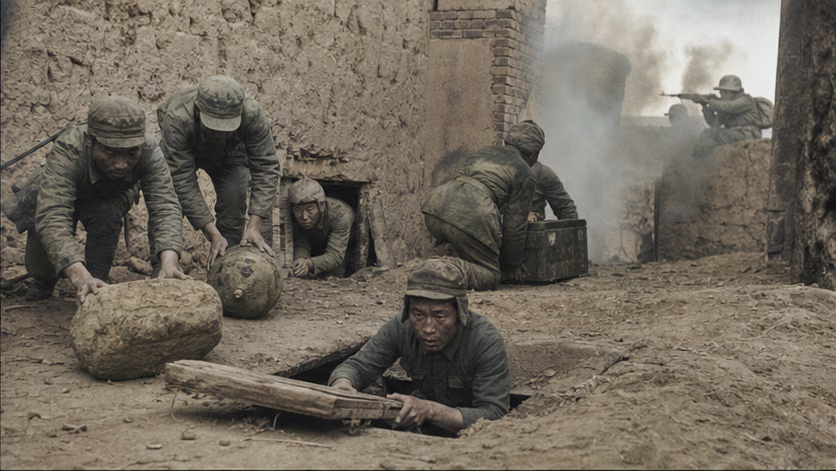
| "May First" large "mopping-up" operation | 1942.5–6 | Okamura Yasuji used 50,000 troops to encircle the Central Hebei plain -- the cruelest single engagement in the history of the base areas: Central Hebei changed from a base area into a guerrilla zone, and Eighth Subdistrict commander Chang Deshan was killed (May); tunnel warfare was upgraded from hiding caves into a combat-tunnel system precisely under this strangulation (Ranzhuang and others) |
| Breakout at Shiziling | 1942.5.25 | Japanese forces encircled Eighth Route Army headquarters; deputy chief of staff Zuo Quan covered the breakout and was killed by artillery fire -- the highest-ranking commander killed on the battlefields behind enemy lines (Liao County was renamed Zuoquan County) |
| "Mopping-up" operations in central Shandong, Yimeng, and elsewhere | 1941–42 | The Shandong base areas were pulled back and forth repeatedly; massacres at Duiyatou and elsewhere ※ (individual cases unverified) |
| Recovery | 1943– | The enemy's strength was exhausted and ours recovered; "advance when the enemy advances" (penetrating into the enemy's rear behind the enemy rear) became a new method |
※ Atrocity Records
- "Three Alls" / annihilation operations: the Japanese document term "annihilation" (jinmetsu) appears in operational orders (document source unverified) -- burning villages, killing villagers, and looting grain and livestock. Across the repeated "mopping-up" operations in North China, civilians killed cumulatively numbered in the hundreds of thousands (statistical bases from various base areas are listed side by side; accounts vary).
- Representative massacres: Panjiayu (1941.1.25, eastern Hebei, roughly 1,230 villagers were collectively massacred and burned -- figures vary by account); Beituan tunnel poison-gas massacre (1942.5.27, during the "May First" mopping-up operation, Japanese forces released poison gas into tunnels, killing more than 800 villagers -- figures vary by account); Pingyang, Duiya, and other cases (case-by-case verification pending).
- No man's zones: "gathering households and merging villages" along the Great Wall line created a "thousand-li no man's zone" (Jireliao, 1941–44): scattered households were burned out, "human pens" (settlements) were enclosed, and those outside the enclosures were killed on sight -- the affected population numbered in the hundreds of thousands (research counts vary by account).
- Spread from germ warfare: records of plague and cholera releases in North China (linked to the germ warfare in Zhejiang-Jiangxi and Changde; see also, unverified).
- Recorders: base-area investigations at the time (wartime reports such as the *Jinchaji Daily* -- originals can be checked on literature platforms); postwar local gazetteers and networks of massacre memorials; testimony by Japanese veterans (Higashi Shiro and others) and indirect corroboration from Japanese war histories; joint investigations by Chinese and Japanese scholars (Bu Ping and others; bibliography unverified).
Casualties and Losses
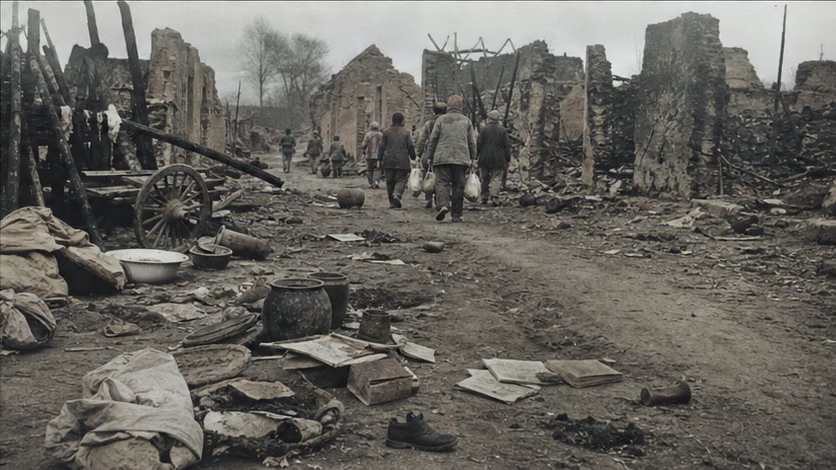
- Base areas: in 1941–42, territory and population were reduced by nearly half (the population of Jinchaji, for example, fell from 25 million to 19 million; counting standards vary by area and account); troop numbers fell by roughly 30 percent (figures vary by account).
- Civilians ※: see the preceding section -- the main body of the "cost" in this article is civilian.
- Japanese and puppet forces: cumulative combat losses across the repeated "mopping-up" operations vary by statistical basis -- public security warfare was also a bottomless pit for Japanese forces (the passage in *Public Security War in North China* acknowledging that "the more they were suppressed, the more fiercely they burned" remains unverified).
Aftermath
- The organizational resilience of the base areas did not break under high pressure -- better troops and simpler administration, large-scale production, and advancing when the enemy advanced became the textbook three-piece set.
- Tunnel warfare and mine warfare took shape and entered national memory (with a note on the gap between their filmic versions and their real forms).
- Okamura Yasuji's "achievements" and his postwar fate (in 1949 the National Government's military tribunal found him not guilty, after which he served as a military adviser to Taiwan -- the chief designer of public security warfare in North China was never tried, connecting to the postwar-trials issue; see also the overview).
Accounts of Those Present
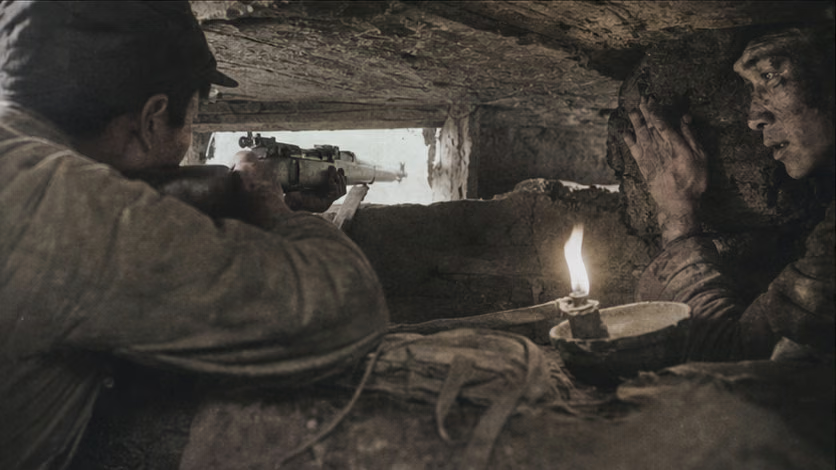
- The fifth man on Langya Mountain: the cliff-jump survivors Ge Zhenlin and Song Xueyi -- the two who lived through the "Five Heroes" narrative, and then lived the rest of their lives as "surviving martyrs" (oral-history layer); the defamation lawsuit (2016 judgment) as one element in contemporary memory.
- A night in the tunnel: survivor recollections from the Beituan massacre (oral materials; evidentiary level unverified) -- tunnels were shelters but could also become graves: this two-sidedness.
- Zuo Quan's final moment: on Shiziling, he let staff officers go first and stayed behind to observe artillery positions (details unverified) -- the breakout of the headquarters organs and the death of a chief of staff.
- Childhood inside a "human pen": oral accounts by survivors of the no man's zones (to be compiled) -- walls, shacks, work passes: the everyday form of occupation violence.
- **The eight mules of the *Jinchaji Daily***: Deng Tuo led the newspaper staff in publishing while transferring (the anecdote of "running a newspaper with eight mules" remains unverified) -- a note of cultural resistance within counter-"mopping-up."
The Ground
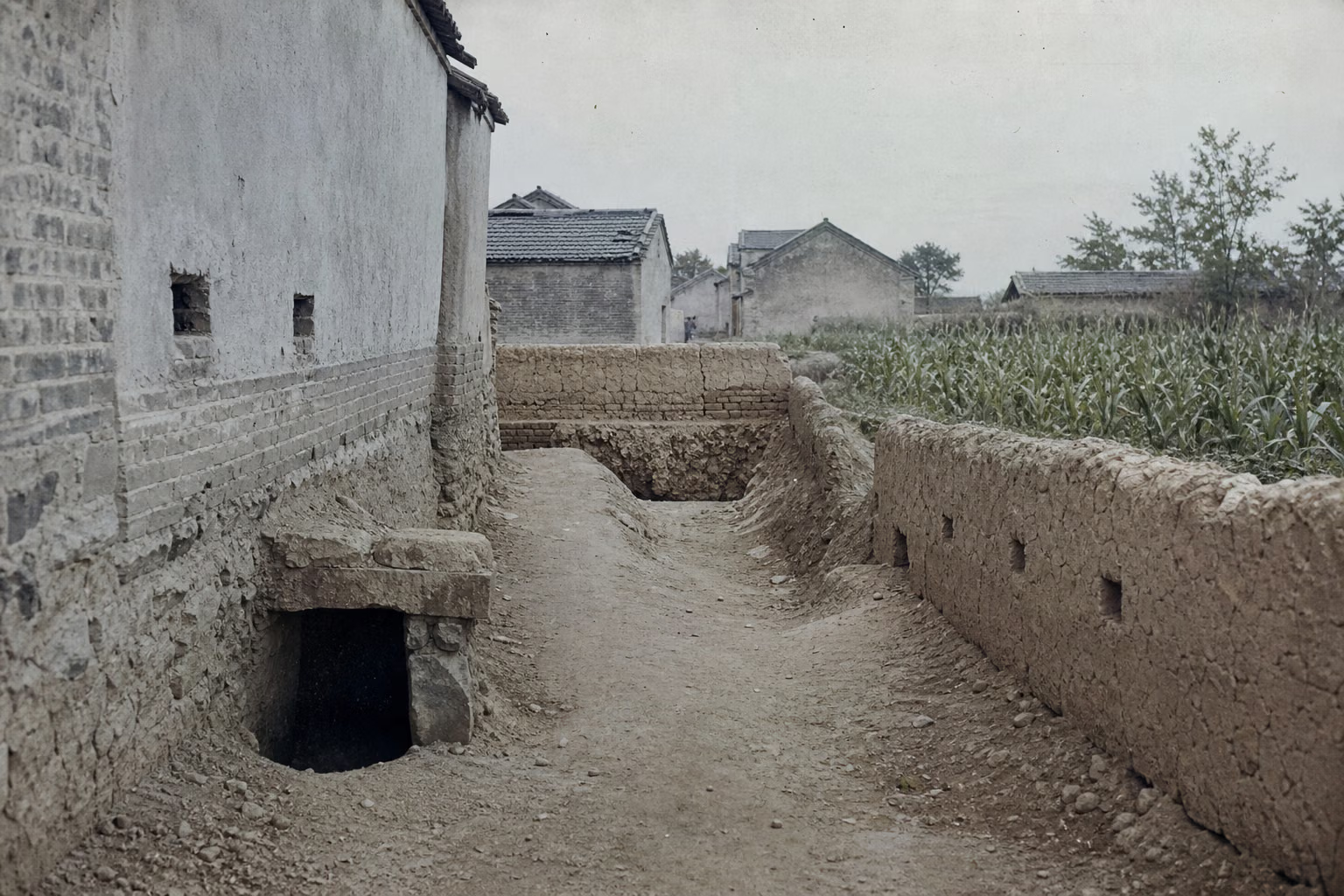
- Encirclement and counter-encirclement: the contracting ring of iron-wall encirclement vs. inner-line troops finding gaps and outer-line troops smashing the rim -- the spatial contest over the "ring."
- Tunnel networks: four levels linking home-street-village-field, with firing ports, alternate openings, choke points, and water-vapor traps -- the war architecture beneath civilian homes (Ranzhuang survives and can be verified).
- Blockade ditches and walls: the Japanese side's "boundary works" sliced the plain into blocks -- the four-part blockade space of ditch, wall, blockhouse, and road.
- Green sorghum fields and the snow season: a seasonal battlefield of summer concealment and winter exposure -- rhythm meant life or death.
How Each Side Records It
- Chinese side: the Five Heroes of Langya Mountain and tunnel warfare entered the canon and textbooks; massacre memory formed a network of county-level monuments (the density of local memory far exceeds the space available in general histories -- this gap).
- Japanese side: *Public Security War in North China* records in detail the deployments of repeated "mopping-up" operations and preserves the term "annihilation" in archives -- officially compiled war history attests to the framework of atrocities itself; veterans' testimony movements and denialism coexist.
- Scholarship: joint Chinese-Japanese research (Bu Ping, Kasahara, and others) has advanced empirical work on massacres; "public security warfare" is studied as a form of anti-humanitarian war.
Disputes and Sensitivities
- Figures for each massacre -- annotate case by case, and state "no statistics" where none exist.
- Textual verification of the Langya Mountain details and the defamation case -- keep the factual layer and the legal layer separate.
- Okamura Yasuji's postwar acquittal -- facts and consequences, without emotional elaboration.
- Atrocity records and *Defense of Nanjing* are both model entries.
Sources and Open Questions
Sources: *Public Security War in North China* (Japanese official compilation, first parallel reading); *Historical Materials on the Jinchaji Anti-Japanese Base Area*; massacre memorial halls and local gazetteers; joint Chinese-Japanese historical research reports by Bu Ping and others; *Materials on the Central Hebei "May First" Counter-Mopping-Up Operation*.
Open questions: troop strengths in repeated "mopping-up" operations and statistical bases for base-area losses; figures for Panjiayu, Beituan, and other cases; documentary source for "annihilation"; population counts for no man's zones; details of Zuo Quan's death; documents on the Okamura judgment; the Jinchaji population curve; dates and wording of Eighth Route Army headquarters telegrams on counter-"mopping-up" policy; specific battle examples in which base-area intelligence networks gave warning of mopping-up operations; textual verification of Okamura Yasuji's memoir claim of "do not burn, do not kill, do not rape"; records of the discussion over whether the main force should transfer out before the Central Hebei "May First" mopping-up operation; Japanese archival verification for the structural inference that "when manpower was insufficient, terror was used instead."
All images on this site are AI-generated depictions. They are not historical photographs, not primary sources, and do not depict any real individual.